
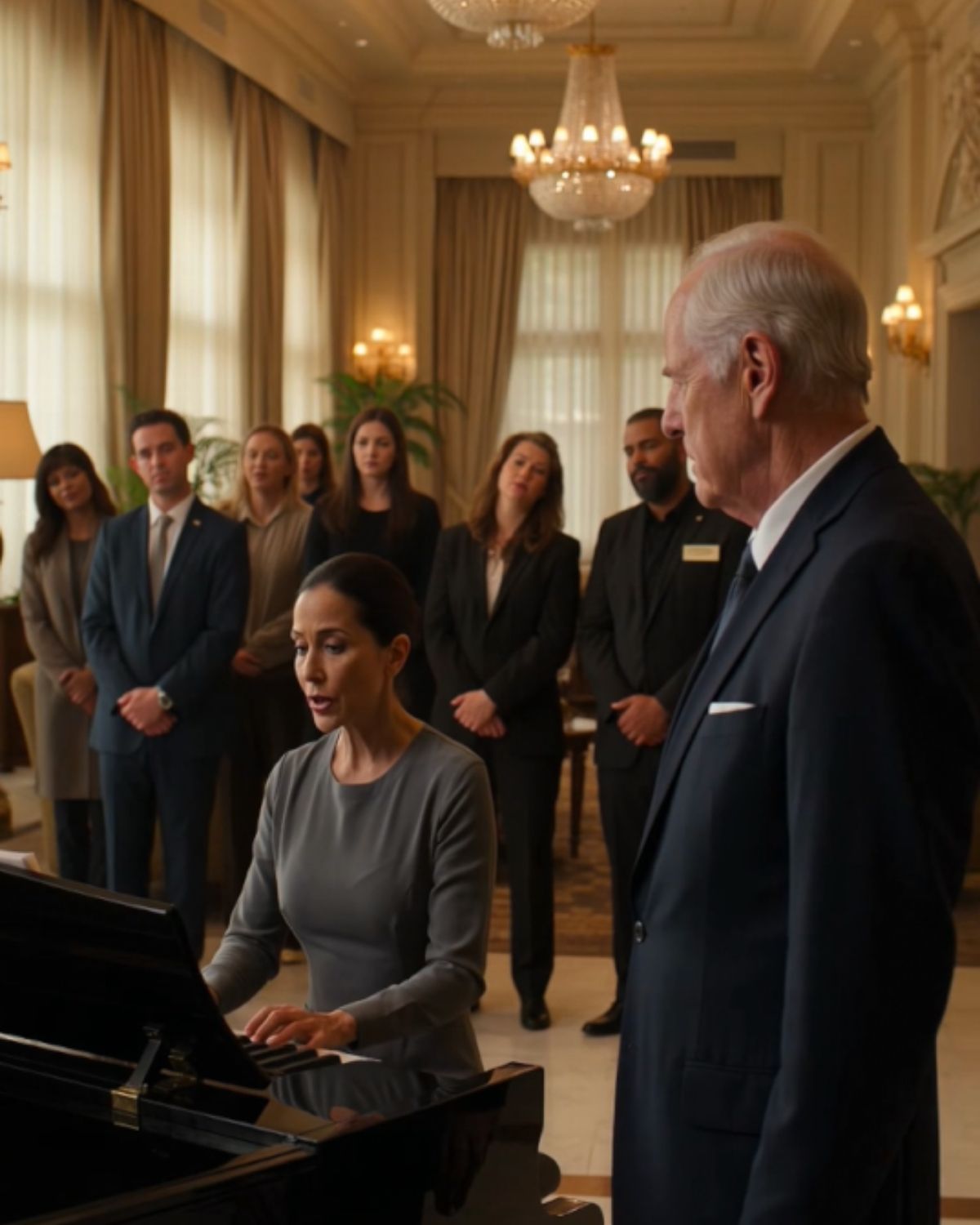
The first note came out wrong.
A sharp, lifeless click echoed across the marble lobby of the Bellmont Grand Hotel.
The pianist stopped.
He pressed the key again.
Nothing.
Around him, conversations continued beneath crystal chandeliers. Guests crossed the lobby carrying leather bags and champagne glasses. A wedding party posed beside the staircase. Two executives laughed near the bar.
The black grand piano sat in the center of it all, polished until it reflected the gold ceiling above.
But one key was broken.
The pianist tried once more, then closed the lid with frustration.
“I told maintenance about this yesterday,” he said.
A hotel supervisor glanced at his watch.
“The evening reception starts in forty minutes.”
“I can’t perform with a dead E-flat.”
“Play around it.”
The pianist stared at him.
“You don’t play around a missing note.”
He stood, gathered his sheet music and walked away.
Across the lobby, a cleaning cart stopped.
The woman pushing it had been watching.
Her name was Rosa Alvarez.
She was forty-six years old, small, quiet and almost invisible to the people who passed through the Bellmont Grand each day.
Her gray uniform was always clean, though the cuffs had faded from years of washing. Her shoes were practical and worn. Her dark hair was pulled into a low bun beneath a plain black net.
Most guests knew her only as the woman who emptied ashtrays, polished brass rails and removed coffee stains before anyone important noticed them.
Few employees knew much more.
Rosa arrived before sunrise.
She worked until late afternoon.
Then she took two buses home to a small apartment she shared with her daughter and elderly mother.
She never complained.
She never joined the arguments in the staff cafeteria.
And she never went near the piano.
Until that evening.
Rosa pushed her cart closer.
The broken key was slightly lower than the others.
She looked at it for a long moment.
Then she glanced around the lobby.
The supervisor was arguing into his phone.
The receptionist was checking in a large group.
No one was watching her.
Rosa reached beneath the piano lid and pressed the key gently.
Click.
She pressed the neighboring key.
A clear note rang.
Then the broken one again.
Silence.
She crouched beside the instrument.
A young banquet server named Chloe noticed her.
“What are you doing?”
Rosa looked up.
“The hammer isn’t returning.”
Chloe frowned.
“The what?”
Rosa opened the front panel carefully.
Inside, rows of felt-covered hammers and strings stretched across the wooden frame.
Chloe took a step back.
“You should leave that alone.”
Rosa examined the mechanism.
A narrow wooden part had slipped out of position. A small metal spring hung loose beside it.
“It can be fixed,” Rosa said.
The hotel supervisor, Martin Blake, heard her.
He marched across the lobby.
“Rosa.”
She straightened.
“What are you doing to that piano?”
“The key is stuck.”
“I know the key is stuck.”
“The spring came loose.”
Martin looked at the open panel, then at her hands.
“Close it.”
Rosa did not move.
“It will only take a minute.”
“Maintenance has been called.”
“When will they arrive?”
“That is not your concern.”
“The reception starts soon.”
Martin stepped closer and lowered his voice.
“Leave it. It’s not your job.”
Rosa looked at the piano.
Then at the guests crossing the lobby.
She knew that tone.
It was the tone managers used when they wanted to remind someone of her place without saying the words directly.
Rosa had heard it when she offered a better way to remove water stains from the ballroom floor.
She had heard it when she warned that a loose stair rail could hurt someone.
She had heard it whenever experience came from a person without a title.
She closed the panel slowly.
“Yes, Mr. Blake.”
Martin walked away.
Chloe gave Rosa a sympathetic look.
“He’s nervous about the reception.”
Rosa nodded.
She returned to her cart.
But her eyes remained on the piano.
At six o’clock, the lobby began to fill.
The hotel was hosting a private anniversary event for the Bellmont Foundation, the charitable organization established by the hotel’s original owner.
Photographers gathered near the entrance.
Waiters carried trays of sparkling water and wine.
Local business leaders arrived in dark suits.
A string quartet had been hired to perform near the staircase, but the piano was supposed to open the evening.
At six fifteen, maintenance called.
Their technician was delayed across town.
At six twenty, the hotel pianist returned, tested the key and shook his head.
“I told you. I cannot perform on this.”
Martin’s face tightened.
“You are under contract.”
“My contract requires a working instrument.”
“We have two hundred guests arriving.”
“Then find a working piano.”
The pianist closed his music folder.
Martin followed him toward the staff corridor.
“You cannot leave.”
“I am not damaging my reputation because your hotel ignored basic maintenance.”
Their voices faded behind the service door.
Rosa stood near a marble column, polishing a brass table.
She had heard every word.
At the reception desk, the general manager asked Martin what was happening.
Martin forced a smile.
“A minor technical problem.”
The general manager looked toward the silent piano.
“Fix it.”
“I’m trying.”
“No. Fix it.”
Martin turned and saw Rosa watching.
For one second, their eyes met.
Then he looked away.
Rosa returned to the cleaning area near the elevators.
She placed a folded cloth on her cart.
Beneath it was a small sewing kit she carried for torn uniform seams.
Inside the kit were thread, needles, a safety pin, a tiny pair of pliers and a narrow strip of wire.
She looked at the wire.
Then at the piano.
Chloe appeared beside her.
“You really know how to fix it, don’t you?”
Rosa did not answer.
“How?”
“My father repaired pianos.”
Chloe blinked.
“Was he a technician?”
Rosa’s hand tightened around the cloth.
“Sometimes.”
“What does that mean?”
“It means people paid him to repair them more often than they paid him to play them.”
Chloe glanced toward Martin.
“He told you not to touch it.”
“I know.”
“The general manager is furious.”
“I know that too.”
Rosa closed the sewing kit.
For twenty years, she had followed instructions.
She had cleaned rooms after guests left without learning her name.
She had worked double shifts when colleagues became sick.
She had watched people speak around her as though she were part of the furniture.
She had accepted it because dignity did not always require recognition.
But a broken piano was not a dirty glass or a missing towel.
A piano could be damaged by careless hands.
It could also be saved by careful ones.
Rosa pushed the cart back toward the lobby.
Martin was standing near reception with the general manager.
He saw her approaching.
“Rosa, where are you going?”
She stopped beside the piano.
“To fix the key.”
Martin stared at her.
“I already told you—”
The general manager interrupted.
“You can fix it?”
Rosa looked at him.
“Yes.”
Martin shook his head.
“She is part of housekeeping.”
The general manager looked at the clock.
“The event begins in ten minutes.”
Martin lowered his voice.
“We cannot allow an unqualified employee to tamper with a Steinway.”
Rosa did not react.
The general manager studied her.
“Have you repaired one before?”
“Yes.”
“How many?”
Rosa paused.
“Enough.”
Martin gave a humorless laugh.
“That is not an answer.”
Rosa looked directly at him.
“It is the only answer I have time to give.”
Chloe covered a smile.
The general manager stepped aside.
“You have five minutes.”
Martin’s expression changed.
“Sir—”
“Five minutes.”
Rosa placed the cloth on the piano bench.
She washed her hands at a nearby service sink, dried them and returned.
Guests began entering the lobby.
Several slowed when they saw a cleaner kneeling beside the grand piano.
Rosa opened the front panel again.
Her movements were precise.
She did not touch the strings.
She did not force the key.
She removed the loose spring, straightened the tiny hook with the pliers and guided it back into place.
The mechanism shifted.
She pressed the key.
A muted note sounded.
Not perfect.
She adjusted the wooden lever by less than a millimeter.
Pressed again.
The E-flat rang clearly through the lobby.
Several people turned.
Rosa tested it four more times.
Each note responded.
Then she checked the neighboring keys to ensure nothing else had moved.
The entire repair took three minutes and twenty seconds.
She closed the panel.
The general manager exhaled.
Martin said nothing.
The hotel pianist had already left.
The string quartet was not scheduled to begin for another half hour.
The piano sat ready.
But no one was there to play it.
The first guests gathered around the reception area.
An elderly man entered through the main doors accompanied by a younger assistant.
His name was Arthur Bellmont.
He was eighty-three years old and the last surviving son of the hotel’s founder.
Though he no longer managed the company, his presence still changed the room.
Employees straightened when they saw him.
Managers hurried forward.
Photographers raised their cameras.
Arthur walked with a polished wooden cane. His silver hair was combed neatly back, and a dark blue handkerchief rested in his breast pocket.
Martin approached him with a broad smile.
“Mr. Bellmont, welcome.”
Arthur looked toward the piano.
“I thought there would be music.”
Martin’s smile weakened.
“Our pianist experienced an unexpected issue.”
“The instrument?”
“The key has been repaired.”
“Then where is the pianist?”
Martin searched for an answer.
Rosa stood beside her cart, preparing to leave.
Arthur’s eyes moved toward her.
Then toward the open sewing kit on the piano bench.
“Who repaired it?”
The general manager gestured to Rosa.
“She did.”
Arthur looked surprised.
“You?”
Rosa nodded.
“Yes, sir.”
“You are a piano technician?”
“No, sir.”
Martin stepped in.
“Ms. Alvarez has some personal experience, apparently.”
Arthur noticed the edge in his voice.
“What kind of experience?”
Rosa closed the sewing kit.
“My father taught me.”
Arthur studied her for a moment.
Then he looked at the empty piano bench.
“Can you play?”
The question struck Rosa harder than anyone realized.
Her fingers stopped moving.
Martin answered for her.
“Mr. Bellmont, I’m certain our entertainment team can arrange—”
Arthur raised one hand.
He kept his eyes on Rosa.
“Can you?”
Rosa looked at the black piano.
Its surface reflected the chandelier above, just as another piano had reflected another ceiling decades earlier.
She had not played in public for twenty-seven years.
Not since a small recital hall.
Not since her father stood backstage in a borrowed suit, smiling as though the world had finally opened.
Not since everything changed.
“A little,” she said.
Arthur smiled.
“Then give us a little.”
Rosa shook her head.
“I should return to work.”
The general manager glanced around the lobby.
The guests were waiting.
“Just until the quartet begins.”
Martin leaned closer to Rosa.
“Do not make this worse.”
She looked at him.
That sentence decided it.
Not because she wanted to challenge him.
Because for too many years, she had treated music as something dangerous.
Something connected to loss.
Something that belonged to a version of her life she could no longer afford to remember.
She removed her cleaning gloves.
Then she sat at the piano.
The lobby quieted slightly.
Not completely.
Some guests continued speaking.
A waiter passed carrying glasses.
Someone laughed near the staircase.
Rosa placed her hands above the keys.
They trembled.
She lowered them.
The first chord was soft.
So soft that only the people nearest the piano heard it.
Then came a simple sequence of notes.
Slow.
Measured.
Almost like someone walking home in the dark.
Arthur Bellmont stopped moving.
His assistant noticed.
“Sir?”
Arthur raised one finger.
Rosa continued.
The melody had no printed score.
No official title.
It began with four descending notes, then lifted into a warmer phrase before returning to the same quiet pattern.
The conversations nearest the piano faded.
A woman at reception turned.
The string players by the staircase looked toward Rosa.
The melody grew.
Not louder.
Deeper.
It carried something old inside it.
A tenderness that did not ask for attention but slowly took control of the room.
Arthur gripped his cane.
His face changed.
The color left his cheeks.
“That song…”
His assistant leaned toward him.
“Are you all right?”
Arthur did not answer.
Rosa’s hands moved with increasing confidence.
The years between her and the instrument began to disappear.
She no longer saw hotel guests.
She saw her father’s narrow workshop.
Wooden hammers hanging from nails.
Sheets of music stacked beside unpaid bills.
A cup of coffee growing cold on top of an upright piano.
She heard his voice counting time.
Not faster, Rosita.
Let the note arrive before you leave it.
She played the middle section.
Arthur took one step toward the piano.
Then another.
Around him, guests fell silent.
An elderly woman near the bar covered her mouth.
A man from the foundation board stared at Rosa.
The melody had once been played every evening in the Bellmont Grand.
Forty years earlier, guests had requested it by name.
Then one day, it disappeared.
No sheet music remained.
No official recording had ever been released.
Only older staff and members of the Bellmont family remembered it.
Rosa reached the final section.
The melody softened.
Four descending notes.
A pause.
Then one last chord.
Her hands remained on the keys.
For several seconds, no one moved.
The silence was complete.
Then Arthur spoke.
“Who taught you that melody?”
Rosa turned on the bench.
The elderly man stood less than two meters away.
His eyes were wet.
“My father,” she said.
Arthur’s fingers tightened around the handle of his cane.
“What was his name?”
The room waited.
“Mateo Alvarez.”
Arthur’s cane slipped from his hand.
His assistant caught it before it struck the floor.
Martin’s face changed.
The general manager looked from Arthur to Rosa.
Arthur stepped closer.
“Mateo Alvarez?”
Rosa stood.
“Yes.”
“He was your father?”
“Yes.”
Arthur stared at her as though he had seen a person return from the dead.
“He was the pianist who created this song.”
Rosa looked down.
“My father never called himself a composer.”
“But he was.”
Arthur’s voice shook.
“He wrote that melody in this hotel.”
Whispers spread through the lobby.
Rosa glanced around, uncomfortable beneath so many eyes.
Arthur pointed toward the piano.
“He played here every evening from 1978 to 1986.”
Rosa nodded slowly.
“I know he worked at a hotel.”
“Not simply at a hotel.”
Arthur turned toward the guests.
“This hotel.”
The lobby became still again.
Arthur looked at the chandeliers above them.
“My father hired Mateo when no one else would.”
Rosa’s eyes narrowed.
Arthur continued.
“He had arrived in the city with no formal credentials, no permanent address and very little English. But he could hear a damaged string from across a room.”
A faint smile crossed Arthur’s face.
“He repaired this piano before he was ever allowed to play it.”
Rosa looked at the instrument.
Her father had never told her that.
Arthur touched the edge of the piano carefully.
“The hotel pianist became ill one night. Mateo sat down and played.”
His voice softened.
“By the end of the evening, no one remembered that he was the repairman.”
Guests listened without speaking.
Arthur turned back to Rosa.
“The melody you just played was called ‘The Light in the Hall.’”
Rosa’s eyes filled.
“My father called it ‘La Luz del Pasillo.’”
Arthur smiled through his tears.
“Yes.”
“He said he wrote it for my mother.”
Arthur’s expression changed again.
“He told us he wrote it for someone waiting at home.”
Rosa swallowed.
“My mother waited for him every night.”
The black piano stood between them like a witness.
Arthur took a breath.
“Your father was one of the finest musicians this hotel ever employed.”
Martin shifted uncomfortably.
Rosa looked toward him, then back to Arthur.
“If that is true, why does no one know his name?”
The question cut through the room.
Arthur’s face lost its smile.
The foundation board members glanced at one another.
Arthur looked down at the piano lid.
“Because we failed him.”
No one expected the answer.
Rosa stood completely still.
Arthur continued.
“In 1986, the hotel changed management. The new director wanted a more prestigious image.”
He spoke the words with visible shame.
“Mateo had never attended a conservatory. He was an immigrant. He repaired instruments during the day and played at night.”
Rosa already knew where the story was going.
Arthur’s voice became quieter.
“They replaced him with a classically trained European pianist.”
A woman in the crowd lowered her eyes.
“They told him his music was too simple,” Arthur said. “Too sentimental. Not refined enough for the direction of the hotel.”
Rosa’s jaw tightened.
“My father stopped playing after that.”
Arthur closed his eyes.
“I know.”
“You knew?”
“Yes.”
“And you did nothing?”
The lobby froze.
Martin looked horrified that a cleaner had spoken to Arthur Bellmont that way.
Arthur did not appear offended.
He appeared wounded.
“I was young,” he said. “I had recently joined the board. I disagreed with the decision, but I did not stop it.”
Rosa’s hands curled at her sides.
“He came home that night and locked his piano.”
Her voice remained calm, but the calm was sharp.
“He said the hotel no longer needed him.”
Arthur’s eyes filled again.
“I visited his apartment two weeks later.”
Rosa looked at him.
“He would not see me.”
“He sold the piano the next month.”
Arthur lowered his head.
“I heard.”
Rosa thought of the years that followed.
Her father tuning pianos in restaurants he was never invited to play.
Repairing instruments in wealthy homes while owners spoke past him.
Teaching Rosa in the evenings on borrowed keyboards.
Refusing to perform even when people asked.
He had carried the wound quietly.
And because he never spoke bitterly, Rosa had never understood where it began.
Arthur reached into the inner pocket of his jacket.
He removed an old leather wallet.
From it, he pulled a small folded photograph.
The image was faded at the edges.
A young Mateo Alvarez sat at the Bellmont piano, smiling toward the camera.
Behind him stood Arthur, perhaps thirty years old, one hand resting on the piano.
Rosa took the photograph.
Her breath caught.
Her father looked younger than she remembered.
Hope still lived openly on his face.
“I have carried this for decades,” Arthur said.
Rosa looked at him.
“Why?”
“Because it reminds me of the moment I should have been braver.”
Across the lobby, Martin stood near the cleaning cart.
His earlier confidence had disappeared.
He looked at Rosa’s uniform.
Then at the photograph.
Then at the piano she had repaired in less than four minutes.
For the first time, he seemed to understand that the person he had dismissed as unqualified had grown up beside the man whose music helped define the hotel’s history.
Arthur looked toward the general manager.
“Where is Mateo’s name displayed?”
The general manager hesitated.
“I don’t believe it is.”
“Where are the records from those years?”
“In the hotel archive.”
“And the sheet music?”
“We have no original composition attributed to him.”
Rosa handed the photograph back.
“My father never wrote that melody down.”
Arthur stared at her.
“He played it from memory?”
“He said some music should be remembered by the heart before the hands.”
Arthur looked toward the piano.
“Do you know all of it?”
Rosa nodded.
“He taught it to me when I was twelve.”
“Has anyone else heard you play it?”
“My daughter.”
“Anyone here?”
“No.”
Arthur’s eyes moved across the silent lobby.
“Then tonight is the first time this hotel has heard Mateo’s melody in nearly forty years.”
The guests began applauding.
It started softly.
Then grew.
Rosa stood beside the piano, uncertain where to look.
She was still wearing her gray cleaning uniform.
Her cart remained beside the marble column.
A yellow cloth hung from the handle.
Nothing about her appearance had changed.
But the way people looked at her had.
Martin approached.
“Rosa…”
She turned.
He stopped.
The words seemed difficult for him.
“I should not have spoken to you the way I did.”
Rosa waited.
“I assumed you did not understand the instrument.”
“You assumed more than that.”
Martin’s face tightened.
He looked around the lobby.
Everyone was watching.
That was the moment recognition reached him.
Not recognition of the melody.
Recognition of his own behavior.
It showed in the way his shoulders dropped.
In the way he stopped standing above her.
In the silence before he answered.
“Yes,” he said. “I did.”
Rosa did not rescue him from the discomfort.
She had spent too many years rescuing other people from the consequences of underestimating her.
Arthur turned to the foundation board.
“This hotel has spent years celebrating its history while forgetting one of the people who created it.”
He pointed toward the piano.
“That ends tonight.”
One board member stepped forward.
“What do you propose?”
Arthur did not hesitate.
“The melody will be professionally recorded and archived under Mateo Alvarez’s name.”
Rosa’s eyes widened.
“We will place his photograph beside this instrument with the true history of his work.”
Arthur looked at Rosa.
“And no use of the composition will occur without the permission of his family.”
The general manager nodded immediately.
“Of course.”
Arthur continued.
“The hotel will establish a music scholarship in his name for self-taught musicians and children of hotel employees.”
Rosa looked down.
Her daughter, Elena, had been accepted into a university music program three months earlier.
She had not enrolled.
Tuition was too expensive.
Rosa had not told anyone at work.
Arthur saw something shift in her face.
“Do you have children?”
“One daughter.”
“Does she play?”
“Violin.”
“Is she studying?”
Rosa paused.
“She was accepted.”
“Was?”
“She delayed enrollment.”
Arthur understood.
The lobby remained silent.
“This scholarship will begin with her,” he said.
Rosa shook her head immediately.
“I did not play for money.”
“I know.”
“I repaired the piano because it was broken.”
“I know that too.”
“Then please don’t make this a reward.”
Arthur stepped closer.
“It is not a reward.”
He looked at the photograph in his hand.
“It is a correction.”
Rosa’s eyes filled.
For years, she had watched doors close quietly.
No dramatic refusal.
No single villain.
Just forms, fees, assumptions and people who believed talent should arrive dressed a certain way.
Arthur held out the photograph.
“This belonged to your father.”
Rosa took it with both hands.
“He should have been honored while he was alive,” Arthur said.
“Yes.”
The truth landed without decoration.
Arthur nodded.
“You are right.”
He did not ask for forgiveness.
He did not claim good intentions.
He simply stood inside the consequence of what had been lost.
Then he looked at the piano bench.
“Will you play it again?”
Rosa stared at the keys.
The lobby waited.
Near the entrance, guests had gathered in a semicircle.
The wedding party had stopped taking photographs.
Waiters stood still with trays balanced in their hands.
The string quartet lowered their bows.
Even Martin remained silent beside the cleaning cart.
Rosa sat down.
She placed the photograph of her father on the music stand.
This time, her hands did not tremble.
She began with the same four notes.
The melody moved through the lobby again.
But now everyone knew what they were hearing.
Not background music.
Not a forgotten hotel tune.
They were hearing a man reclaim his place in the room that had erased him.
Arthur sat in the front row.
Tears moved freely down his face.
He did not wipe them away.
Rosa played the section her father had written for her mother.
Soft chords.
A rising phrase.
Then a pause that always felt like someone opening a door.
She remembered being twelve years old, sitting beside Mateo on a wooden bench.
He would guide her hand toward the keys.
Never strike a note because you are afraid of silence, he told her.
Silence is part of the music.
Now the entire Bellmont Grand understood.
The pauses carried as much truth as the notes.
When Rosa reached the ending, she slowed.
The last chord remained in the air beneath the chandelier.
No one applauded immediately.
For several seconds, the lobby held the silence exactly as Mateo had taught her.
Then Arthur stood.
He was the first.
The guests followed.
The applause rose so loudly that employees from the restaurant and conference rooms came to see what had happened.
Rosa looked toward the photograph.
Her father was smiling from another time.
For once, the room was applauding the right person.
In the weeks that followed, the hotel moved the piano to a place of honor beneath the main chandelier.
A bronze plaque was installed beside it.
It read:
MATEO ALVAREZ
Resident Pianist and Composer, 1978–1986
Creator of “The Light in the Hall”
Below the inscription was a line from one of Mateo’s old notebooks:
“Music does not ask where your hands have worked. It only asks whether they know the truth.”
The hotel also changed Rosa’s position.
She refused a ceremonial title.
She did not want to become a symbol placed in a brochure and forgotten.
Instead, she accepted a paid role overseeing the care of the hotel’s instruments while continuing part-time with housekeeping until a new technician could be trained.
Three evenings a week, she played in the lobby.
Her daughter began music school that autumn as the first recipient of the Mateo Alvarez Scholarship.
Martin remained at the hotel, but he never again told an employee that something meaningful was “not their job” without first asking what they knew.
And Arthur attended every anniversary performance of “The Light in the Hall.”
He always sat near the piano.
He always held the same old photograph.
And he always cried before the final note.
Because sometimes history is not lost.
Sometimes it is standing nearby in a faded uniform, holding a cleaning cloth, waiting for someone to stop judging the hands long enough to hear what they can do.
Never assume the person cleaning the room has nothing to teach the people who own it.


