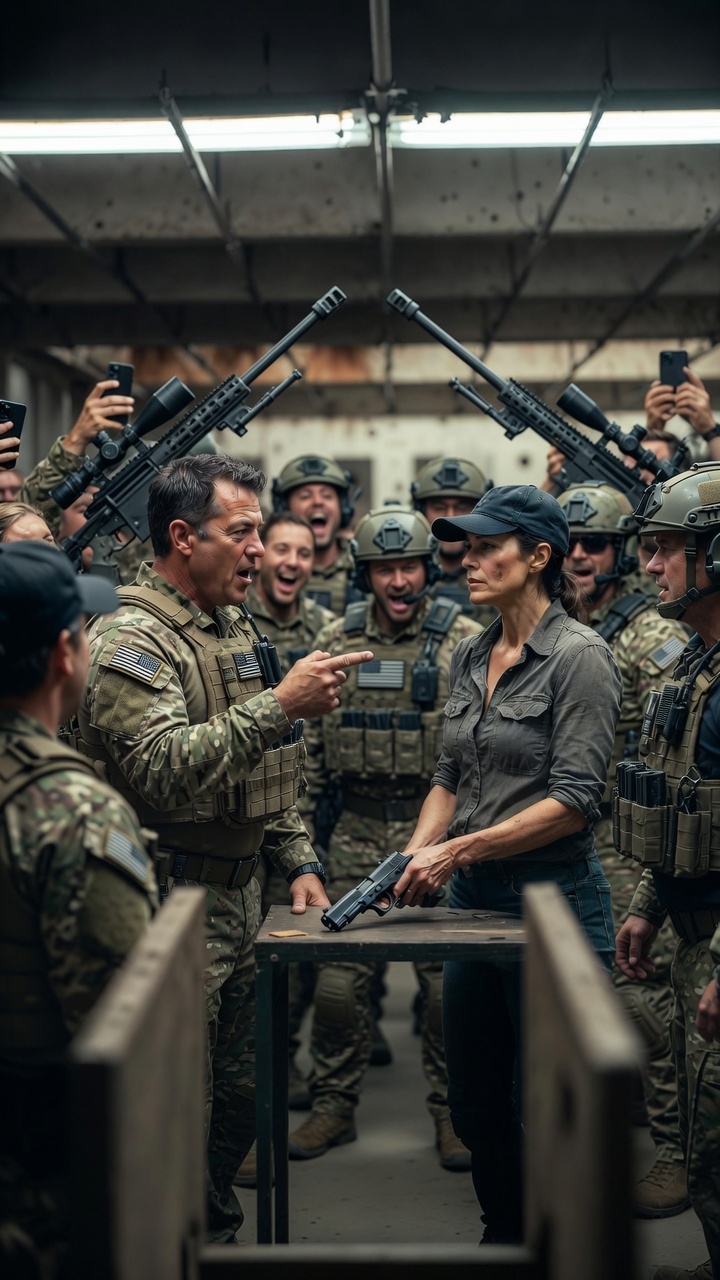
The Entire Range Laughed at the Quiet Woman—Until She Took Apart the Instructor’s Pistol Without Looking
The first mistake Sergeant Mark Dawson made was assuming Evelyn Cain did not know how to handle a firearm.
The second was making sure thirty people—and at least six recording phones—heard him say it.
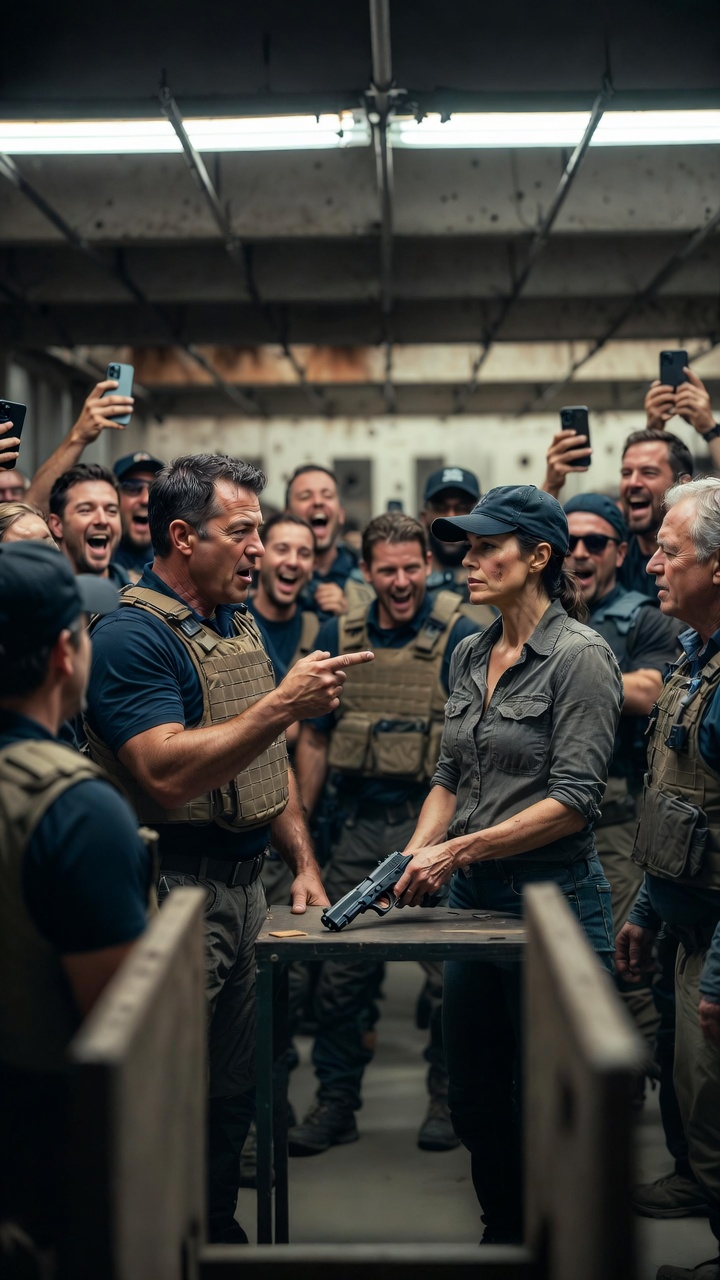
It happened on a crowded Saturday morning at Thunder Creek Range, a civilian shooting facility built to feel more military than recreational. Concrete barriers divided the lanes. Steel targets hung beyond the berm. Former service members wore unit shirts, younger shooters carried expensive equipment, and everyone seemed determined to prove they belonged there.
Mark stood in the middle of it all like a man who believed the building had been constructed around him.
He was nearly fifty, broad through the shoulders, with a weathered face and a voice trained to carry across firing lines. He had served in the Army, reminded people of that often, and now taught advanced handgun courses on weekends.
Most students respected him.
Some feared embarrassing themselves in front of him.
Mark appeared to enjoy both.
Evelyn arrived alone.
She wore faded jeans, a plain gray shirt, and an old baseball cap with no visible insignia. Her range bag was worn at the corners. She did not have a customized holster, a tactical belt, or a shirt advertising her qualifications.
She signed the waiver, listened to the safety briefing, and took a position near the end of the line.
She spoke to no one unless spoken to first.
The only person who watched her closely was Tom, an older veteran with silver hair and a slight limp. He had spent enough years around military people to know that confidence did not always announce itself.
Sometimes it stood quietly in the corner and checked the exits.
During the equipment inspection, Evelyn picked up her pistol and paused with her thumb near the safety.
It lasted less than two seconds.
Mark noticed.
“Well,” he said loudly, “that’s not a promising start.”
Several people turned.
Evelyn looked at him. “Is there a problem?”
Mark stepped closer and pointed at her hands.
“You tell me. You’ve been staring at that safety like it owes you money.”
A few students laughed.
One of the phones shifted toward Evelyn.
She glanced down at the weapon, then back at Mark. “I was checking the mechanism.”
“You check it by using it.”
“Yes, Sergeant.”
Her answer was calm and respectful.
Mark heard weakness.
“First time handling one of these?”
“No.”
“Doesn’t look that way.”
The laughter grew louder.
Tom leaned against the divider and studied Evelyn’s posture. She was not shrinking. She was not embarrassed. Her breathing had not changed.
She was simply watching Mark.
“Her grip looks fine,” Tom said.
Mark waved him off. “Her grip is too low, her support hand is lazy, and she doesn’t even look comfortable with the controls.”
Evelyn lowered the pistol onto the table, muzzle downrange.
Mark turned toward the group.
“This is why fundamentals matter,” he announced. “People watch a few videos, buy a pistol, and think they’re ready. But confidence without competence is dangerous.”
Another phone appeared.
Mark continued speaking, now fully performing for the audience.
“You can tell who has experience before they ever fire a shot. The weapon either belongs in their hands, or it doesn’t.”
Evelyn’s eyes moved briefly to the pistol on Mark’s demonstration table.
It was a military-issue sidearm he had been using throughout the morning.
“You maintain that yourself?” she asked.
Mark looked amused. “Of course.”
“May I?”
He laughed. “You want to inspect my weapon?”
“I’d like to understand the platform.”
That drew another round of quiet laughter.
Mark picked up the pistol, cleared it dramatically, and placed it in front of her.
“Go ahead,” he said. “Maybe you’ll learn something.”
Evelyn checked the chamber again.
Then she began.
There was no hesitation.
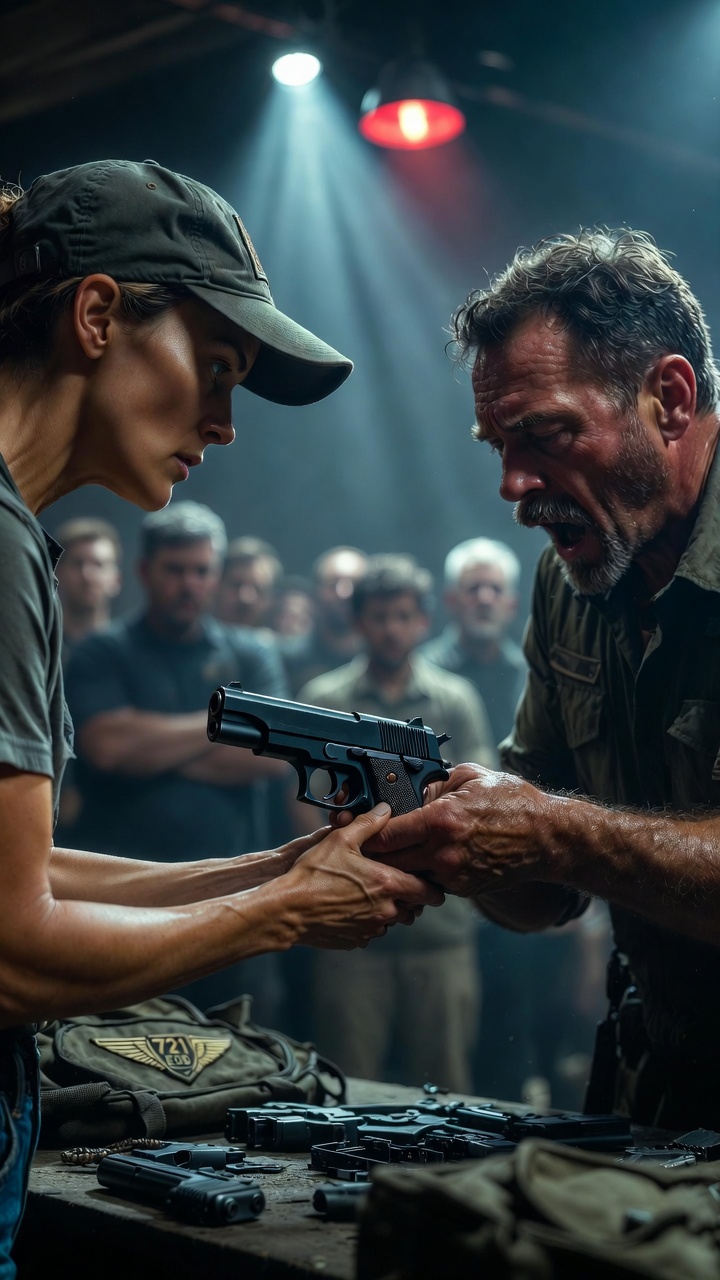
Her hands moved quickly but without urgency. She removed the magazine, locked the slide, checked the chamber, released the assembly, separated the slide from the frame, removed the recoil spring, extracted the barrel, and placed each component on the table in a straight, deliberate row.
Metal touched wood in a steady rhythm.
Click.
Tap.
Click.
Tap.
By the time Mark turned back from addressing the class, his pistol no longer existed as a complete weapon.
It had become a neat arrangement of parts.
Evelyn had disassembled it in seconds.
Bare-handed.
Without looking down more than twice.
The laughter stopped.
The phones kept recording, but the people holding them no longer smiled.
Mark stared at the table.
For the first time that morning, he had nothing to say.
Evelyn picked up the slide and tilted it toward the overhead light.
“There’s a fracture beginning here,” she said.
Mark blinked. “What?”
She pointed to a hairline mark near the locking area.
“Small crack in the slide. Easy to miss. It has not separated yet, but continued use will widen it.”
Mark leaned forward. “That’s a machining line.”
“No, Sergeant. The direction is wrong for machining.”
Tom moved closer.
Evelyn ran one finger along the interior surface.
“There’s also too much lubricant on the contact points. It is collecting residue and preventing you from seeing the early wear pattern.”
Mark’s face hardened.
“My weapon runs perfectly.”
“It may,” Evelyn said. “Until it doesn’t.”
One of the younger students stepped forward to see the crack.
Mark blocked him with an arm.
“It’s cosmetic.”
Evelyn turned the frame over and read the serial number.
“This is still government property.”
The room seemed to become smaller.
Mark’s expression changed.
Only slightly.
But Tom saw it.
Evelyn continued in the same neutral tone.
“The serial series identifies it as a military inventory weapon. A structural defect should be documented and the sidearm removed from service until inspection. If it was transferred through an authorized program, the maintenance requirement should still be in the paperwork.”
Mark looked around at the cameras.
“This is a marksmanship class,” he said. “Not a maintenance lecture.”
“No, Sergeant.”
“You think taking apart a pistol makes you a shooter?”
“No.”
“You work in an armory?”
“Not exactly.”
Tom folded his arms. “What did you do?”
Evelyn placed the slide back on the table.
“Logistics and maintenance support.”
Mark gave a short laugh, relieved to have found a label he could dismiss.
“So you handled supplies.”
“Sometimes.”
“Where?”
“Fort Bragg.”
Tom’s eyes narrowed.
“Which unit?”
Evelyn paused.
“EOD.”
The silence that followed was different from the first one.
The first had been surprise.
This was recognition.
A young man near the back lowered his phone.
Tom straightened. “Explosive Ordnance Disposal?”
“Yes.”
Mark looked from Tom to Evelyn.
“You were a bomb technician?”
“I worked with ordnance.”
“What kind?”
“Unexploded munitions. Improvised devices. Legacy systems. Chemical delivery components when required.”
She said it as though she were listing items from a grocery receipt.
Mark stared at the woman he had just accused of being uncomfortable around a pistol.
Tom looked at him.
“You mocked an EOD technician for checking a safety mechanism.”
A few people looked away, embarrassed on Mark’s behalf.
But pride does not surrender easily when an audience is present.
Mark reached for the pieces of his pistol.
“Being good with explosives doesn’t make someone a marksman.”
Evelyn nodded once. “That is true.”
Mark began reassembling the weapon.
His hands were faster than they needed to be.
Twice, his fingers slipped.
Evelyn did not comment.
When he finished, he inserted a magazine, stepped into the firing lane, and faced the target.
“Watch,” he said. “This is what the class is about.”
He raised the pistol.
His shoulders were tense.
The room had gone quiet enough to hear the ventilation system pulling air toward the backstop.
Mark fired.
The shot cracked through the range.
The round struck high and left, cutting the outer scoring ring.
No one spoke.
Mark stared at the target as if it had betrayed him.
Evelyn’s head tilted slightly.
“Your sight alignment is off.”
Mark lowered the pistol. “I pulled it.”
“The rear alignment is displaced approximately three millimeters.”
He turned. “You can’t tell that from one shot.”
“The barrel is also sitting at a slight angle.”
Mark’s jaw tightened.
“You installed the retaining pin incorrectly after cleaning. It is applying uneven pressure. The point of impact will continue high and left.”
Mark looked at the gun.
Then at Evelyn.
Then back at the gun.
“Open it,” Tom said.
Mark did not move.
“Open it,” Tom repeated.
With every phone still aimed at him, Mark cleared the weapon and took it apart.
The pin was misaligned.
Exactly as Evelyn had said.
Tom looked at the students, then at Mark.
“Now would be a good time to stop talking and start listening.”
Mark’s face flushed dark red.
For several seconds, the only movement came from the red safety lights above the lanes.
Evelyn returned to her own table.
She did not smile.
She did not glance at the cameras.
She assembled her pistol with the smooth, continuous movement of someone whose hands had repeated the same task under conditions far worse than an indoor shooting range.
She loaded one round.
Stepped forward.
Raised the weapon.
Her posture looked almost casual, but every part of her body was balanced.
She fired once.
The bullet struck the center of the target.
Not near the center.
Not inside the center ring.
It cut directly through the bull’s-eye.
Evelyn lowered the pistol, cleared it, placed it in a safe condition, and collected the casing from the floor.
That was when one of the younger students noticed the slight stiffness in her left leg.
“Are you still active duty?” he asked.
“No,” Evelyn said. “Medical retirement.”
She bent to close her range bag.
As she did, the fabric shifted and revealed a faded patch stitched near the side pocket.
Tom froze.
The patch showed a winged bomb above a unit number.
His face lost its color.
He stepped closer, not to challenge her, but because he needed to be certain.
“Where did you get that patch?”
Evelyn looked at it.
“It was mine.”
Tom’s eyes moved to her face.
“Evelyn Cain?”
She gave a small nod.
But Tom shook his head slowly.
“No. The report spelled it differently.”
Evelyn’s expression did not change.
“Some records used Kane. It was corrected later.”
Tom stared at her as the final pieces came together.
The unit.
Fort Bragg.
The medical retirement.
The stiffness in her leg.
Kandahar.
He turned toward the room.
“Do any of you know what happened at Kandahar Airfield in 2011?”
No one answered.
Mark stood with his disassembled pistol still on the table.
Tom’s voice dropped.
“A device was discovered near a service corridor used by flight crews and medical personnel. The first search found a secondary charge. Then they realized the secondary was meant to drive everyone toward the primary.”
Evelyn closed her bag.
“Tom.”
But he continued.
“The evacuation route itself had been trapped. People were already moving toward it.”
Every eye in the room was now on Evelyn.
“She found the main device,” Tom said. “The mechanism was unstable, and the remote platform couldn’t reach it. She sent the rest of the team back.”
Mark’s face went still.
Tom looked directly at him.
“She stayed.”
Evelyn’s fingers tightened around the handle of her bag.
“There were other people involved.”
“But you stayed,” Tom said. “You disabled the primary charge while the airfield was being cleared.”
He looked at her leg.
“The blast wall failed after the final component was removed. That’s how you were injured.”
No one held a phone casually anymore.
Several had lowered them completely.
The young student who had laughed first stared at the floor.
Mark remained motionless.
The confidence had drained from his face, leaving behind something much more human.
His eyes moved from Evelyn’s hands to the old cap on her head, then to the worn bag by her side.
He finally understood what he had been looking at.
Not nervousness.
Not ignorance.
Habit.
A woman who had spent years treating every mechanical detail as the difference between life and death had paused to check a safety.
And he had laughed at her for it.
Mark swallowed.
His shoulders dropped.
The red color in his face faded, replaced by a gray, stunned silence.
Around him, thirty witnesses watched the exact moment his certainty collapsed.
Evelyn stepped back toward his table.
“May I?” she asked.
Mark moved aside immediately.
She adjusted the barrel retaining pin, inspected the contact surfaces, and wiped away the excess lubricant.
“You need about forty percent less,” she said. “More oil does not mean more protection. It can hide wear and trap contamination.”
She reassembled the weapon and handed it to him, grip first.
Mark accepted it with both hands.
“Sergeant Cain,” he said quietly.
“Evelyn is fine.”
“I owe you an apology.”
She waited.
“I was disrespectful. I made assumptions. And I tried to embarrass you in front of everyone.”
“Yes,” she said.
Mark looked surprised by the directness.
Then Evelyn added, “You did not know.”
“That doesn’t excuse it.”
“No. But now you know.”
She picked up her bag.
“That is usually what learning looks like.”
As she walked toward the exit, the students nearest the aisle stepped aside.
No one told them to.
They simply moved.
The path opened in front of her until the room resembled something far more formal than a civilian range.
Just before Evelyn reached the door, the facility supervisor rushed in from the lobby.
He was a heavyset man named Paul Mercer, usually cheerful and rarely speechless.
He stopped when he saw her.
“Cain?”
Evelyn turned.
Paul removed his range cap.
“I was at Kandahar,” he said.
Her expression softened.
“Which section?”
“Medical transport.”
His voice shook slightly.
“We were moving patients when your team redirected us. We complained because we thought the delay was unnecessary.”
He glanced at the people around him.
“Ten minutes later, they found the device along our original route.”
Evelyn said nothing.
Paul stepped closer.
“You saved everyone in that convoy.”
“We had good intelligence.”
“You made the call.”
“It was my job.”
Paul looked toward the classroom.
“We could use someone like you here. Instructor position. Any schedule you want.”
Evelyn considered it for a moment.
Then she shook her head.
“People remember what they discover for themselves.”
She glanced at Mark.
“They will remember today longer than they would remember a lecture.”
Then she left.
The door closed behind her.
Inside, no one spoke for several seconds.
Mark looked down at the pistol she had repaired.
Then he faced his students.
“New rule,” he said.
His voice no longer carried the performance it had earlier.
“No one in this class mocks another person’s equipment, grip, questions, experience, or lack of experience.”
A student near the back raised his hand.
“Sergeant?”
“Yes?”
“How do you become that good?”
Mark looked toward the closed door.
For once, he did not answer immediately.
“You listen more than you speak,” he said. “You stop believing that volume is the same as authority. And you never assume the quietest person in the room has the least to teach you.”
That morning, Mark Dawson entered Thunder Creek Range believing respect belonged to the loudest and most experienced man in the room.
By noon, he understood the truth.
Real expertise rarely needs to announce itself—and the people most worth listening to are often the ones everyone else is too busy talking over.