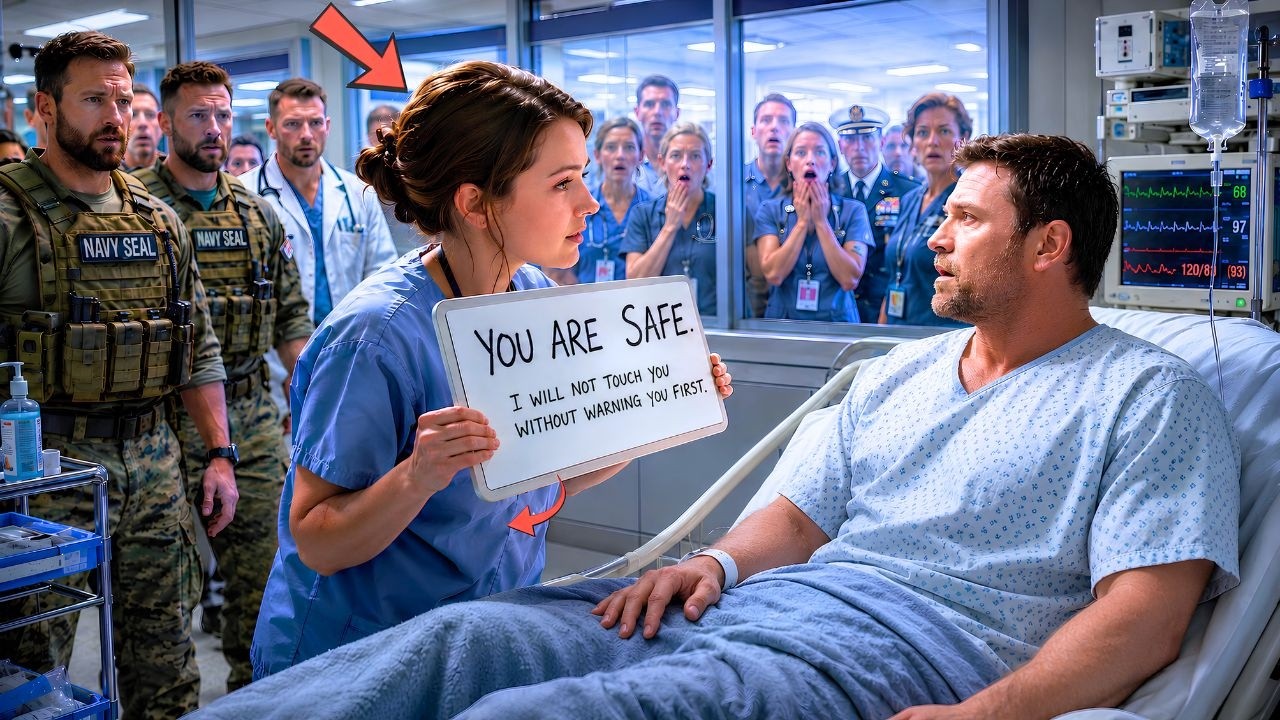
The patient was bleeding through two layers of trauma dressing when the charge nurse decided to teach the new nurse a lesson.
“Rear Admiral Keane is yours,” Paige Corrian said, dropping a thin intake folder onto the counter. “Let’s see whether all that talking of yours works when the patient actually matters.”
Several nurses heard her.
No one laughed, but two of them looked away.
Aaron Daly had been at Naval Medical Center for six weeks. That was long enough to understand that silence could be a form of agreement.
She picked up the folder without reacting.
“What’s the ETA?”
“Fifteen minutes.”
“Anything I need to know?”
Paige was already turning away.
“He’s combative.”
That was all she said.
The emergency and trauma department did not reward hesitation. Doors opened before stretchers stopped moving. Orders were given in fragments. Mistakes were remembered longer than successes, and speed was treated not merely as a skill but as proof of character.
Aaron had come from a community hospital in Ohio where the overnight staff knew many patients by name. At Naval Medical Center, she had learned to move faster, document tighter, and ask fewer questions.
But she had not stopped explaining procedures before she performed them.
Even when the patient was frightened.
Even when the room was busy.
Especially then.
Her habit had become a running joke.
During her second week, Paige watched Aaron tell a young corpsman exactly how an arterial blood draw would feel before inserting the needle.
“You’re not hosting a podcast,” Paige had said loudly enough for the nurses’ station to hear. “Draw the blood.”
Another time, Aaron paused before cutting away a civilian contractor’s shirt.
“I need to expose your chest so we can check for injuries,” she told him.
Paige glanced at the clock.
“His chest is not classified information, Daly.”
The jokes spread.
Some called Aaron “the tour guide.”
Others said she was too soft for trauma.
Aaron never argued. She simply continued telling patients what she was about to do.
To her, explanations were not kindness added after clinical care. They were clinical care.
A patient who understood was less likely to panic.
A patient who trusted the team was more likely to cooperate.
A patient who felt powerless could become dangerous—not because they were difficult, but because fear had taken control of their body.
Paige saw the pauses.
Aaron saw what those pauses prevented.
Now, with fifteen minutes before Rear Admiral Russell Keane arrived, Aaron opened the folder Paige had handed her.
The first page listed his age, rank, blood type, allergies, and suspected injuries after a vehicle collision near the naval facility.
The second page contained a brief note from the transport team.
Severe trauma to left shoulder and upper chest. Significant blood loss. Periods of agitation during extraction.
Aaron kept reading.
Near the bottom, in smaller print, was a line that should have been part of the briefing.
Profound bilateral hearing loss related to prior combat exposure. Does not use sign language.
Aaron stopped.
She turned the page.
A behavioral health note had been attached from an earlier admission.
History of severe hypervigilance. Unexpected physical restraint may trigger defensive response. Establish visual contact before touch.
Aaron looked toward Paige.
Paige was standing across the department, discussing bed assignments with an administrator. She did not look back.
The omission had been deliberate.
Aaron could feel the shape of the trap now. A severely injured senior officer. Deaf. Bleeding. Traumatized by restraint. Delivered into a crowded room where everyone would shout instructions he could not hear.
If he panicked, Aaron would be blamed.
If she slowed the team down, Paige would call her indecisive.
If she lost control, Paige would finally have proof that compassion did not belong in trauma care.
Aaron closed the folder.
She did not confront Paige.
Instead, she took a small whiteboard from the family consultation room, checked that the marker worked, and found a set of basic communication cards used for patients who could not speak after surgery.
Then she returned to the chart and memorized the details that mattered.
Do not approach from behind.
Do not restrain without warning.
Maintain visual contact.
Explain before touch.
The ambulance doors opened twelve minutes later.
The department changed instantly.
“Trauma incoming!”
The stretcher moved through the bay doors surrounded by paramedics. Russell Keane was pale beneath the blood on his uniform undershirt. His left shoulder was immobilized, his chest dressing was saturated, and one IV line was barely holding.
A paramedic spoke rapidly while the team transferred him.
“Rear Admiral Russell Keane, sixty-one, collision with partial vehicle rollover, blunt trauma to left chest, probable clavicle fracture, possible vascular injury, pressure dropping during transport—”
Keane could not hear any of it.
From his position on the stretcher, he saw masked faces moving around him. Hands reached toward his body. Someone cut fabric from his shoulder. Another nurse grabbed his wrist. A physician leaned over him while calling for blood.
To everyone else, it was a coordinated trauma response.
To Keane, it looked like an ambush.
His eyes widened.
His right hand tore the IV tubing free.
Blood sprayed across the sheet.
“Hold him still,” someone shouted.
Two staff members moved in.
Keane reacted before they reached him.
He drove his forearm into one nurse’s chest and twisted away from the physician. His injured shoulder struck the rail, and his face contorted in pain. He kicked against the stretcher frame, trying to sit up as monitors slid toward the floor.
“Get restraints!”
“Push sedation!”
“Admiral, stop fighting us!”
He heard none of it.
More people crowded around him.
His breathing became rapid and shallow. His eyes darted from face to face, searching for an exit that did not exist.
A physician reached across his chest.
Keane swung again.
Aaron stepped between them.
“Everybody back.”
No one moved.
Paige’s voice cut across the room.
“Daly, get out of the way.”
Aaron did not raise her voice.
“He can’t hear us. Back up and let him see one person.”
“We don’t have time for this.”
“He thinks we’re attacking him.”
The monitor alarm accelerated.
Aaron looked at the two staff members nearest the stretcher.
“Three steps back. Please.”
Something in her tone made them obey.
The space around Keane opened.
Aaron moved into his direct line of sight. She kept both hands visible and did not touch the stretcher.
Keane’s fist was still raised.
Aaron lifted the whiteboard.
She had written in large block letters:
YOU ARE IN A HOSPITAL.
YOU ARE SAFE.
I WILL NOT TOUCH YOU WITHOUT WARNING YOU FIRST.
Keane’s eyes moved across the words.
Then they returned to Aaron’s face.
For several seconds, the room was reduced to the sound of alarms he could not hear and the sight of a nurse who was not moving toward him.
His fist lowered by a few inches.
Aaron erased the board and wrote again.
MY NAME IS AARON.
YOU ARE BLEEDING.
WE NEED TO HELP YOUR SHOULDER AND CHEST.
MAY I COME CLOSER?
Keane stared at the question.
Then he nodded once.
Aaron stepped forward slowly.
Before touching his wrist, she pointed to it. She waited until he looked down, then wrote:
I NEED TO CHECK YOUR PULSE.
He nodded again.
The physician beside her watched in silence.
Aaron checked the pulse and wrote the next step.
A DOCTOR NEEDS TO PRESS ON YOUR CHEST.
IT MAY HURT.
IS THAT OKAY?
Keane closed his eyes briefly, then nodded.
The physician examined him.
No restraint was needed.
No sedative was given.
When the team needed to replace the IV, Aaron explained it on the board. When they needed to cut away the rest of his shirt, she told him first. When the portable imaging unit was brought in, she showed him where it would move and where he needed to remain still.
Each explanation took seconds.
Each one prevented another struggle.
The room became efficient again, but the efficiency was different now. It was built around Keane’s understanding rather than his submission.
His blood pressure remained dangerously low.
Imaging confirmed extensive injury around the shoulder and upper chest, with internal bleeding requiring immediate surgery.
The surgeon explained the risks aloud by habit, then looked at Aaron.
Aaron wrote the essential information in clear lines.
YOU HAVE INTERNAL BLEEDING.
SURGERY IS NEEDED NOW.
WITHOUT IT, YOU MAY DIE.
THE SURGEON WILL REPAIR THE BLEEDING.
DO YOU UNDERSTAND?
Keane read the board twice.
He pointed to the marker.
Aaron gave it to him.
His hand trembled as he wrote:
CHANCE OF LOSING ARM?
The surgeon answered, and Aaron translated the answer onto the board.
LOW, BUT POSSIBLE. SAVING YOUR LIFE COMES FIRST.
Keane nodded.
Aaron placed the consent form where he could see it and wrote:
DO YOU AGREE TO SURGERY?
He signed.
When the surgical team wheeled him out, his gaze stayed on Aaron until the doors closed.
For the first time since the ambulance arrived, no one in the trauma bay spoke.
The physician who had ordered restraints looked at the unused straps on the floor.
A nurse slowly picked them up.
Paige broke the silence.
“Clean the room. We have another admission coming.”
Aaron turned to dispose of the bloodied supplies.
Paige stepped closer.
“You got lucky.”
Aaron met her eyes.
“No. I read the chart.”
Paige’s expression did not change, but the muscles along her jaw tightened.
By the time Keane came out of surgery, the story had already spread through the department.
Some said Aaron had calmed a violent admiral with a whiteboard.
Others said the patient had not been violent at all until the team surrounded him.
Paige called it “a complicated case managed by the entire unit.”
Aaron said nothing.
Before Keane was transferred to recovery, she prepared three orientation cards and placed them where he would see them when he opened his eyes.
The first read:
YOU SURVIVED THE SURGERY.
The second:
YOU ARE AT NAVAL MEDICAL CENTER.
The third:
THERE IS NO CREW HERE. YOU ARE SAFE. AARON IS NEARBY.
The last line came from a note buried in his history. Years earlier, Keane had survived an explosion at sea. During episodes of disorientation, he sometimes believed he had awakened inside the damaged compartment where members of his crew had died.
When he emerged from anesthesia, the reaction was immediate.
His eyes opened without recognition.
His right arm swung upward. His body twisted, pulling against the surgical dressing. A recovery nurse reached for him, and Keane recoiled so violently that the monitor leads snapped from his chest.
Aaron stepped into view and held up the first card.
YOU SURVIVED THE SURGERY.
His movement slowed.
She showed him the second.
YOU ARE AT NAVAL MEDICAL CENTER.
Then the third.
THERE IS NO CREW HERE. YOU ARE SAFE. AARON IS NEARBY.
Keane’s gaze fixed on the words.
His hand, still raised defensively, began to fall.
His breathing remained fast, but his body stopped fighting.
Aaron placed her palm against her own chest, then pointed to him, silently matching her breath to a slower rhythm.
After several moments, he followed.
The recovery nurse looked at Aaron.
“How did you know?”
Aaron nodded toward the chart.
“He told us. Someone just had to read it.”
Over the next two days, Keane searched for Aaron each time he woke.
When she was present, he settled quickly.
When she was not, he asked for the board and wrote her name.
AARON?
She began checking on him at the start and end of each shift. The visits were brief. She did not linger or treat him as helpless. She updated him, answered questions in writing, and made sure incoming staff knew how to approach him.
The pattern stabilized him.
Then the senior officers arrived.
Vice Admiral Victor Halden came with two aides, a medical liaison, and the kind of stillness that caused people to straighten before he spoke.
Paige met them near the nurses’ station.
“I supervised the team that received Rear Admiral Keane,” she said. “It was a difficult admission, but our unit responded appropriately.”
Halden looked through the glass panel into Keane’s room.
“I was told there was an acute trauma reaction.”
“Yes, sir. We managed it.”
“How?”
Paige gestured toward the department.
“Coordinated de-escalation. Medication support. Standard procedure.”
Halden turned his attention back to her.
“What medication?”
Paige hesitated.
“I would need to verify the exact dose.”
“And the whiteboard?”
Paige’s smile tightened.
“One of the communication tools available to the team.”
“Who used it?”
“A number of staff contributed.”
Inside the room, Keane was watching.
He could not hear Paige, but he could see her speaking to Halden. He saw her gestures toward the unit. He saw Aaron’s name appear nowhere on her lips.
He reached for the whiteboard beside his bed.
By the next morning, Aaron was removed from Keane’s care.
Paige handed her a temporary reassignment sheet.
“Internal review.”
“For what?”
“Possible deviation from protocol.”
“What deviation?”
“You exceeded your role, delayed emergency interventions, and developed an inappropriate attachment to a patient.”
Aaron read the document twice.
“It says sedation stabilized him.”
“That is what the report reflects.”
“He wasn’t sedated during the trauma response.”
Paige folded her arms.
“That is your interpretation.”
“It’s in the medication record.”
“The review team will determine what matters.”
Aaron looked toward Keane’s room.
“Has he been told why I’m not assigned to him?”
“That is no longer your concern.”
The review moved quickly.
Too quickly.
Paige’s incident report described Aaron as a probationary nurse who had obstructed the trauma team while attempting an “unapproved communication intervention.” It said Keane had stabilized after medication and team restraint.
The whiteboard was not mentioned.
Neither was the warning in the chart.
Neither was Paige’s failure to brief Aaron about his deafness or trauma history.
Nurses who had witnessed the event avoided eye contact when Aaron asked whether they had been interviewed.
One finally whispered, “Paige decides our shifts.”
Another said, “I have two kids. I can’t be pulled into this.”
Aaron understood.
Understanding did not make it hurt less.
In Keane’s room, the effect of her absence was immediate.
He asked the first nurse for the board.
AARON?
The nurse wrote:
NOT ON THIS FLOOR TODAY.
That was not true.
The next shift gave him no clear answer.
When Paige entered, he wrote the question again.
WHERE IS AARON?
Paige took the marker.
She wrote:
TRANSFERRED TO ANOTHER UNIT.
Keane stared at the words, then at Paige.
His face became still.
Not confused.
Not angry.
Still.
He had commanded ships, overseen thousands of personnel, and spent decades reading people in rooms where no one said exactly what they meant.
He knew when information was being withheld.
That afternoon, a young nurse named Marisol Vega found one of Keane’s boards leaning behind a linen cart.
A question had been written across it in his uneven post-surgical handwriting.
WHERE IS THE PERSON WHO SAVED ME?
Marisol carried it to Aaron.
Aaron was sitting alone in a staff room with a copy of the incident report.
For several seconds, she did not speak.
Marisol closed the door.
“I was in the trauma bay,” she said. “I saw what happened.”
Aaron looked up.
“Did you tell the review team?”
Marisol’s eyes dropped.
“No.”
Aaron nodded once and handed the board back.
“Keep it safe.”
The termination recommendation arrived the following day.
The letter stated that Aaron had failed to adapt to the operational demands of the department. Because she was still in her probationary period, the hospital could end her employment without a formal disciplinary hearing.
Human Resources offered her another option.
“If you sign a voluntary resignation,” the representative said, “there will be no termination notation in your record.”
Aaron sat across from Paige, an administrator, and the HR representative.
A pen rested beside the document.
Paige’s face carried the calm confidence of someone who believed the process had already ended.
Aaron read the resignation form.
Then she pushed it back.
“I’m not signing that.”
The HR representative leaned forward.
“This is the more protective option for your career.”
“It says I’m leaving voluntarily because I failed to meet the department’s standards.”
“That is administrative language.”
“It’s false language.”
Paige exhaled.
“Aaron, this is exactly the problem. You turn every procedure into a moral debate.”
Aaron looked at her.
“I explained treatment to a deaf patient. I obtained consent. I used information in his chart to prevent a trauma reaction from becoming a physical confrontation.”
“You delayed the team.”
“I prevented restraints.”
“You exceeded your authority.”
“I communicated with my patient.”
The administrator glanced at the clock.
Beyond the conference room, staff members were preparing the hospital auditorium for a departmental recognition ceremony. Senior leaders had remained on site because Rear Admiral Keane’s injury had drawn attention across the command.
Aaron had already emptied half her locker.
Her spare shoes were in a tote bag.
Her badge would be deactivated by the end of the afternoon.
The HR representative placed the pen closer to her.
“This is your final opportunity to resign.”
Aaron left the pen where it was.
“Then terminate me accurately.”
The room went silent.
Paige’s eyes narrowed.
Aaron’s voice remained steady.
“Write that I was terminated because I warned a deaf patient before touching him. Write that I read the trauma note no one briefed me on. Write that I refused to restrain a frightened man when communication worked.”
The administrator’s expression hardened.
“That is not how the findings are written.”
“Then the findings are wrong.”
Paige reached for the folder.
“This meeting is concluded.”
The door opened.
Everyone turned.
Rear Admiral Russell Keane stood in the doorway wearing a hospital gown beneath a dark robe. His left arm was secured in a sling. His face was pale, and an aide held a wheelchair behind him in case he could no longer stand.
Beside him was Vice Admiral Victor Halden.
Marisol Vega followed, carrying the original whiteboard.
No one spoke as Keane entered.
He walked slowly to the table and placed the board in front of Aaron.
The words she had written on the night of his admission were still visible beneath faint smears.
YOU ARE IN A HOSPITAL.
YOU ARE SAFE.
I WILL NOT TOUCH YOU WITHOUT WARNING YOU FIRST.
Paige stood.
“Admiral, you should not be out of recovery.”
Keane looked at her.
The color left her face.
It happened gradually, as if each second brought another piece of information she had not expected.
Her eyes moved from Keane to Halden.
Then to Marisol.
Then to the board.
Her hand, which had been resting on the incident report, slowly withdrew.
That was the moment she understood.
The patient had not accepted her explanation.
The officers had not accepted her summary.
And the evidence had not disappeared.
Halden placed a folder on the table.
“We reviewed the trauma bay camera footage,” he said. “We also reviewed the intake log, medication administration record, surgical notes, transport report, and the original behavioral health alert.”
The administrator shifted in his chair.
Halden continued.
“The video shows Nurse Daly instructing the team to create visual space around Rear Admiral Keane. It shows her using this board. It shows his defensive response decreasing before any sedative was administered.”
Paige opened her mouth.
Halden raised one hand.
“The medication record confirms that no chemical restraint was used during the period described in your report.”
The room became very quiet.
“The intake log also confirms that the warning regarding hearing loss and restraint-triggered trauma was available before the patient arrived.”
His eyes settled on Paige.
“Yet that information was not included in the briefing given to Nurse Daly.”
Paige’s voice was smaller now.
“The department was under extreme pressure.”
“So was the patient.”
Keane reached for the marker.
With his right hand, he wrote beneath Aaron’s original message.
SHE MADE ME STOP.
He turned the board toward the table.
Then, slowly, he spoke.
His voice was rough and uneven, shaped by years of limited hearing.
“I was not fighting because I was angry.”
Everyone watched him.
“I was fighting because I was afraid.”
He looked at Aaron.
“She knew the difference.”
Paige’s shoulders lowered.
Keane continued.
“I could not hear you. I could not understand why people were holding me. I thought I was somewhere else.”
His hand tightened around the marker.
“She stood where I could see her. She told me what was happening. She gave me a choice when I believed I had none.”
He turned toward the administrator.
“If your staff had restrained me, I would have fought harder. If they had delayed surgery while trying to sedate me, I might have died from blood loss.”
No one challenged him.
Halden opened the folder.
“Rear Admiral Keane requested that the complete record be preserved. That includes the video, the board, and all versions of the incident report.”
Marisol stepped forward.
“I was there,” she said. Her voice trembled, but she did not stop. “Nurse Daly is telling the truth. I should have said so earlier.”
Paige looked at her.
Marisol looked back.
A second nurse appeared at the open doorway.
“So was I,” he said. “I saw Paige give Aaron the file without briefing her.”
The power in the room shifted without anyone announcing it.
Five minutes earlier, Aaron had been the probationary nurse refusing to sign her resignation.
Now Paige was the person being asked to surrender her access badge.
The termination recommendation was withdrawn that afternoon.
Every adverse note related to the incident was removed from Aaron’s file.
Paige was suspended from charge duties pending investigation.
The review expanded beyond one report. Auditors compared camera footage with documentation. They examined discrepancies in the sedation record. They interviewed new employees who described a pattern of incomplete briefings followed by public criticism.
Once the first nurse spoke, others followed.
Not all at once.
But enough.
Aaron returned to work the next morning.
There was no celebration when she entered the department. No applause. Trauma units did not stop for symbolic moments.
But the nurse who had once called her “the tour guide” handed her a marker before rounds.
“Thought you might need this,” he said.
Aaron accepted it.
Within a month, she was asked to join a clinical working group developing communication protocols for deaf veterans and patients with acute trauma responses.
She insisted the protocol remain practical.
Whiteboards stocked in every trauma bay.
Communication cards within reach.
Hearing status displayed clearly during intake.
One designated staff member maintaining visual contact.
No unexpected touch unless the patient’s immediate survival required it.
And one question before restraint:
Does this patient understand what we are doing?
Russell Keane eventually returned to his training command.
He added a section to leadership instruction on fear-based resistance.
He taught officers and medical teams that defiance and terror could look identical from across a room.
He never called the lesson his own.
He said it came from a nurse who had understood that control was not the same as cooperation.
The original whiteboard remained at Naval Medical Center.
It was kept in the trauma supply area, where new nurses sometimes noticed the faded words beneath the fresh ink.
Months later, another veteran arrived in the emergency department.
He had lost most of his hearing after years around aircraft engines. He was disoriented, breathing hard, and pulling away whenever anyone approached.
Several younger nurses gathered outside the bay.
Aaron picked up the board.
She stepped into his line of sight and wrote:
MY NAME IS AARON.
I WILL NOT DO ANYTHING UNTIL YOU UNDERSTAND AND AGREE.
The man read the message.
His eyes moved from the board to her open hands.
Then he nodded.
Outside the room, no one called it softness.
They watched a frightened patient become part of his own care.
They watched seconds of patience prevent minutes of force.
And they learned what Paige had discovered too late:
In the most powerful rooms, the strongest person is often the one who refuses to stop seeing the human being in front of them.