When American soldiers reached the gates of Dachau on April 29, 1945, they expected a battle.
What they found instead was a train.

More than thirty freight cars stood on the tracks outside the concentration camp, their doors hanging open beneath a gray Bavarian sky.
Inside were bodies.
They were piled together so tightly that arms, legs, and hollow faces seemed to merge into a single mass. Some were naked. Others still wore the striped clothing of prisoners. Many had been dead for days, brought to Dachau after a journey in which hunger, exposure, disease, and neglect had turned the train into a moving grave.
The smell reached the American soldiers before they understood what they were seeing.
Some stopped walking.
Some turned away and vomited.
Others stared silently into the cars, gripping their rifles with both hands.
They had crossed North Africa, Sicily, France, and Germany. They had seen men torn apart by artillery and villages destroyed by war.
But this was different.
These people had not died in battle.
They had been transported, starved, beaten, discarded, and stacked like unwanted cargo.
And somewhere beyond that train, behind an electrified fence and a row of guard towers, thousands of prisoners were still alive.
Barely.
Twelve years earlier, Dachau had begun with an announcement that sounded almost administrative.
On March 22, 1933, less than two months after Adolf Hitler became chancellor of Germany, the first prisoners arrived at an abandoned munitions factory northwest of Munich.
The new government called Dachau a camp for political prisoners.
Its earliest inmates included communists, Social Democrats, trade unionists, and other Germans considered dangerous to the Nazi regime. They had not necessarily committed crimes. Many had simply belonged to the wrong party, attended the wrong meeting, published the wrong article, or refused to remain silent.
The camp’s purpose was clear from the beginning.
It was not merely to imprison opposition.
It was to terrify everyone outside the wire.
Under commandant Theodor Eicke, brutality became procedure. Punishments were formalized. Guards were taught that prisoners were enemies who deserved no sympathy. Beatings, prolonged standing, isolation, torture, and execution were absorbed into the daily operation of the camp.
When Eicke later rose within the concentration camp system, he carried Dachau’s methods with him.
The organization of the camp, its regulations, and its culture of controlled cruelty became a model for other Nazi concentration camps. Dachau also became a training center where SS guards learned how to dominate prisoners through humiliation, exhaustion, and fear.
The camp was divided into separate worlds.
There were the prisoners’ barracks, packed behind fences, ditches, walls, and watchtowers.
There were administrative buildings where files were stamped and deaths were recorded in bureaucratic language.
There was the bunker, where selected prisoners could be isolated and tortured beyond the view of the rest of the camp.
There were workshops, kitchens, laundries, storage areas, and SS facilities.
Everything had a function.
Even terror was organized.
As Nazi control expanded, so did the categories of people sent to Dachau.
Jehovah’s Witnesses were imprisoned for refusing military service or loyalty to Hitler. Roma and Sinti were persecuted under racial policies. Gay men were incarcerated and marked as social enemies. Clergy who opposed the regime were confined there. So were people labeled criminals or “asocial”—a deliberately vague category applied to those whom the Nazis considered unemployed, homeless, undisciplined, or otherwise unfit for their vision of society.
The labels were different.
The result was the same.
A human being entered the gates and was reduced to a number, a category, and a source of labor.
In November 1938, after the coordinated anti-Jewish violence known as Kristallnacht, nearly 11,000 Jewish men were sent to Dachau. Some were released after agreeing to leave Germany, but the message was unmistakable: the regime no longer intended merely to exclude Jewish citizens from public life.
It had begun imprisoning them by the thousands.
Then war came.
After Germany invaded Poland in September 1939, Dachau expanded from an instrument of domestic repression into part of a continental system of imprisonment, exploitation, and mass death.
Prisoners arrived from across occupied Europe.
They were forced to work in construction projects, workshops, gravel pits, road crews, drainage operations, and later in industries connected to the German war effort. As Allied bombing intensified and Germany’s labor shortage deepened, the SS increasingly leased prisoner labor to factories.
By 1944, Dachau controlled a vast network of subcamps, many located near armaments facilities in southern Germany. The system eventually included roughly 140 subcamps and labor detachments.
The arrangement was profitable because the prisoners were treated as replaceable.
They were underfed, overworked, and housed in conditions that encouraged disease. When one worker collapsed, another could be sent from the barracks.
Death was not a malfunction in the system.
It was built into the calculation.
Inside the main camp, some barracks held clergy. Others held the sick. Medical experiments were conducted on prisoners without meaningful consent. In the bunker, men could disappear into punishment cells.
Outside, the crematorium operated.
The camp had not been constructed as an extermination center like Auschwitz-Birkenau. But thousands died at Dachau from executions, beatings, disease, malnutrition, medical abuse, exposure, and labor performed until the body could no longer continue.
By the final months of the war, even the camp’s machinery of control was beginning to collapse.
The Red Army was advancing from the east. American and British forces were pushing through Germany from the west. As Nazi camps near the front were evacuated, prisoners were transported deeper into the shrinking territory still controlled by the Reich.
Many were sent to Dachau.
The barracks overflowed.
Sanitation broke down.
Food became scarcer.
Typhus spread through bodies already weakened by hunger.
Men arrived after days inside sealed or open freight cars, sometimes without adequate food or water. Others came on foot. Those who survived the journey often reached Dachau too sick to stand.
In April 1945, the SS knew the Americans were approaching.
Camp commandant Martin Weiss and other senior personnel fled.
But before leaving, the SS attempted to evacuate thousands of prisoners. Approximately 7,000 were forced southward in what became a death march.
They were driven toward the Tyrol under armed guard.
Anyone who fell behind risked being shot.
Others died from cold, hunger, and exhaustion beside the road.
Some prisoners were loaded onto trains.
One of those transports had left Buchenwald with thousands of inmates.
By the time it reached Dachau, most of the men aboard were dead.
That was the train the Americans found on April 29.
Units of the U.S. 42nd and 45th Infantry Divisions approached the camp from different directions. Near the complex, there were brief exchanges of fire. Some German personnel resisted. Others attempted to surrender.
Then the Americans passed the train.
Whatever military expectations they had carried toward Dachau disappeared beside those freight cars.
Soldiers moved from wagon to wagon.
The same scene repeated itself.
Bodies twisted together.
Skin stretched across bone.
Eyes left open.
Hands frozen in positions that suggested the men had spent their final hours reaching for air, water, or one another.
Beyond the train, the camp contained approximately 30,000 starving prisoners. Many were so weak that celebration itself became dangerous. Some tried to run toward the Americans and collapsed. Others reached through the wire, crying, laughing, or calling out in languages the soldiers could not understand.
For the prisoners, the men in American uniforms did not look like ordinary soldiers.
They looked like proof that the world outside the camp still existed.
But the liberators were not prepared for what liberation required.
They saw barracks crowded with the sick and dying.
They saw bodies left unburied because the crematorium could no longer keep up.
They saw men who looked less like survivors than skeletons wrapped in skin.
They heard fragments of testimony—beatings, shootings, starvation, medical experiments, hangings, torture, friends disappearing into the bunker, relatives dying on marches.
The soldiers had been trained to capture enemy positions and accept surrender.
No one had trained them for Dachau.
And then they encountered the SS.
What happened next remains one of the most disturbing and disputed episodes of the camp’s liberation.
Some German guards were killed during combat.
Some were killed while attempting to flee.
Others were shot after surrendering.
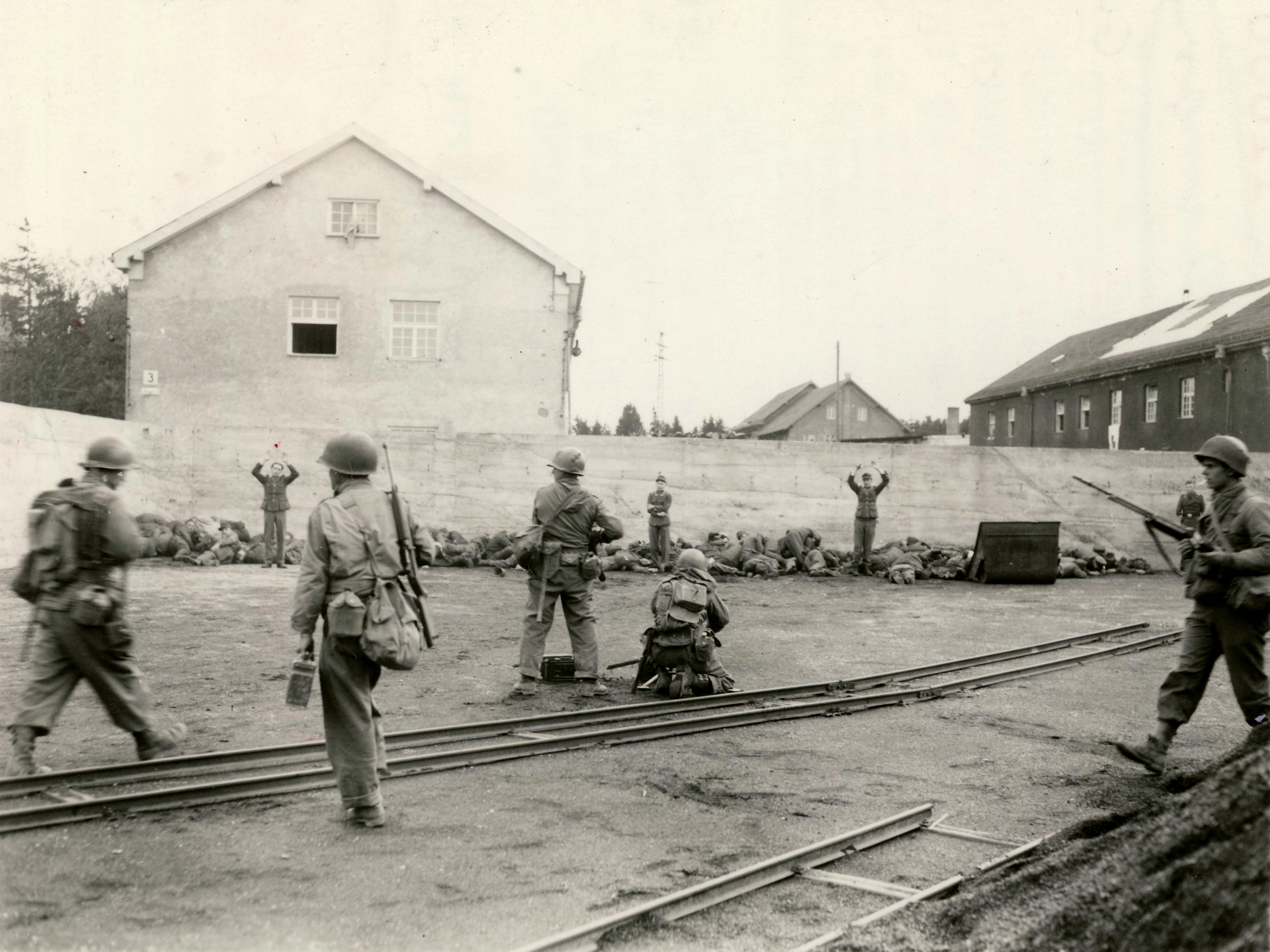
Near the coal yard, a group of captured SS personnel was lined against a wall under American guard. A machine gun was positioned facing them.
The prisoners stood with their hands raised.
One account described an American officer, overwhelmed by what he had seen, giving an order that was understood as permission to shoot.
The gun opened fire.
Several SS men fell immediately.
Others dropped to the ground, some wounded, some perhaps pretending to be dead. Rifle and pistol shots followed.
The shooting stopped only when another American officer intervened.
Elsewhere, four German personnel who had approached under a white flag were taken toward the death train. According to later testimony, an American officer shot them after forcing them to look inside the cars. Another soldier fired at the wounded men.
The precise number killed in these incidents has never been established with certainty.
A U.S. Army investigation conducted shortly afterward concluded that at least seventeen German prisoners were shot near the coal yard and that other surrendered personnel had been killed elsewhere. Later estimates have varied, often placing the overall number of SS personnel killed by American soldiers and liberated prisoners somewhere between roughly thirty and fifty.
The killings were not an official American policy.
They were not ordered by senior Allied command.
They were acts committed in the chaos of liberation by men whose discipline had fractured under the weight of what they had just witnessed.
That context explains the rage.
It does not turn the executions into lawful acts.
Inside the camp, another reckoning had already begun.
Some prisoners recognized SS guards who had removed their uniforms and attempted to hide among the inmates. Others found kapos—prisoners who had received privileges for supervising or abusing fellow prisoners.
The balance of power reversed in minutes.
Men who had spent years lowering their eyes now pointed into the crowd.
“That one.”
A guard would be dragged forward.
Prisoners surrounded him with fists, sticks, tools, or shovels.
In one witnessed incident, a former prisoner stomped on the face of an SS man until it was barely recognizable. In another, prisoners beat a guard to death while American soldiers stood nearby and did not intervene.
The soldiers saw the blows.
They also saw the barracks.
They saw the train.
For a brief and terrible period, law disappeared inside Dachau.
There was only memory, rage, and access to men who had once appeared untouchable.
One guard tried to push his way through a group of prisoners.
For years, an SS uniform had made people step aside.
Now no one moved.
The prisoners closed around him.
His expression changed before the first blow landed.
The arrogance vanished from his face. His eyes moved from one prisoner to another, searching for the obedience he had once commanded.
There was none.
For the first time, he understood that the gate no longer protected him.
The moment lasted only seconds.
Then the crowd pulled him down.
The Americans eventually restored control, disarmed prisoners, separated captured Germans, and began the enormous task of keeping the survivors alive.
Liberation did not immediately end the dying.
Typhus remained a threat. Thousands were severely malnourished. Giving too much food too quickly could be fatal. Medical units had to establish quarantine procedures, distribute suitable rations, and care for people whose bodies had been pushed past ordinary limits of survival.
The dead still had to be buried.
American authorities ordered residents of the nearby town of Dachau to enter the camp and see what had existed beside their community.
Some said they had known nothing.
Others claimed they had heard rumors but not understood the scale.
They were made to walk past the bodies.
Some covered their faces.
Some cried.
Some stared at the ground.
The Americans also required local civilians to assist with burial work. The purpose was practical, but it carried a moral message.
No one would be permitted to say the camp had been an invention.
No one would be allowed to hide behind distance while the evidence lay in front of them.
The name Dachau would no longer belong only to a town.
It would belong to history.
The killings of surrendered guards were investigated by the U.S. Army. Statements were collected. Officers and soldiers were questioned. The inquiry determined that unlawful shootings had occurred.
Yet no major court-martial followed.
The war in Europe ended days later, on May 8, 1945. The scale of Nazi crimes was still being uncovered. Across the continent, millions were displaced, cities lay in ruins, and other camps were revealing horrors of their own.
The case faded without full legal resolution.
That absence has complicated the memory of Dachau’s liberation ever since.
The SS guards were part of a system responsible for extraordinary cruelty.
The prisoners had endured conditions almost impossible for outsiders to comprehend.
The American soldiers had walked without warning into a landscape of deliberate human destruction.
And yet the question remains uncomfortable precisely because it has no simple answer:
What happens when those who arrive to end lawlessness allow rage to replace the law?
Dachau does not offer the comfort of a clean ending.
There was justice in opening the gates.
There was mercy in feeding the starving.
There was truth in forcing the world to look at the bodies.
But there was also vengeance.
And vengeance, even when born from justified horror, is not the same as justice.
During the twelve years of Dachau’s existence, more than 200,000 prisoners passed through the main camp and its network of subcamps. The Dachau Memorial Site records at least 41,500 deaths, while the true number cannot be established with complete precision because many deaths were never properly documented.
They died from hunger.
From disease.
From forced labor.
From shootings and executions.
From medical abuse.
From the slow destruction of the body by a system designed to make suffering ordinary.
Dachau had begun as a place to silence political opponents.
It became a blueprint.
Its fences, regulations, classifications, punishments, forced labor, and trained guards helped shape a camp system that spread across Nazi-controlled Europe.
That was the most frightening truth exposed when the gates opened.
Dachau was not created by a sudden explosion of madness.
It was constructed step by step.
A political enemy was imprisoned.
A minority was labeled dangerous.
A category of people was declared inferior.
A guard was taught not to see a prisoner as human.
A punishment became routine.
A death became paperwork.
And eventually, freight cars full of bodies could arrive at a station while an entire bureaucracy continued functioning around them.
The liberation of Dachau stopped the killing inside the camp.
It did not undo what had happened there.
It revealed it.
And perhaps that is why the image of those American soldiers standing beside the death train still matters.
They had reached the end of a war and discovered the end result of twelve years of unchecked hatred.
The lesson of Dachau is not only that evil must be defeated after it becomes powerful.
It is that it must be recognized while it is still asking permission to become normal.