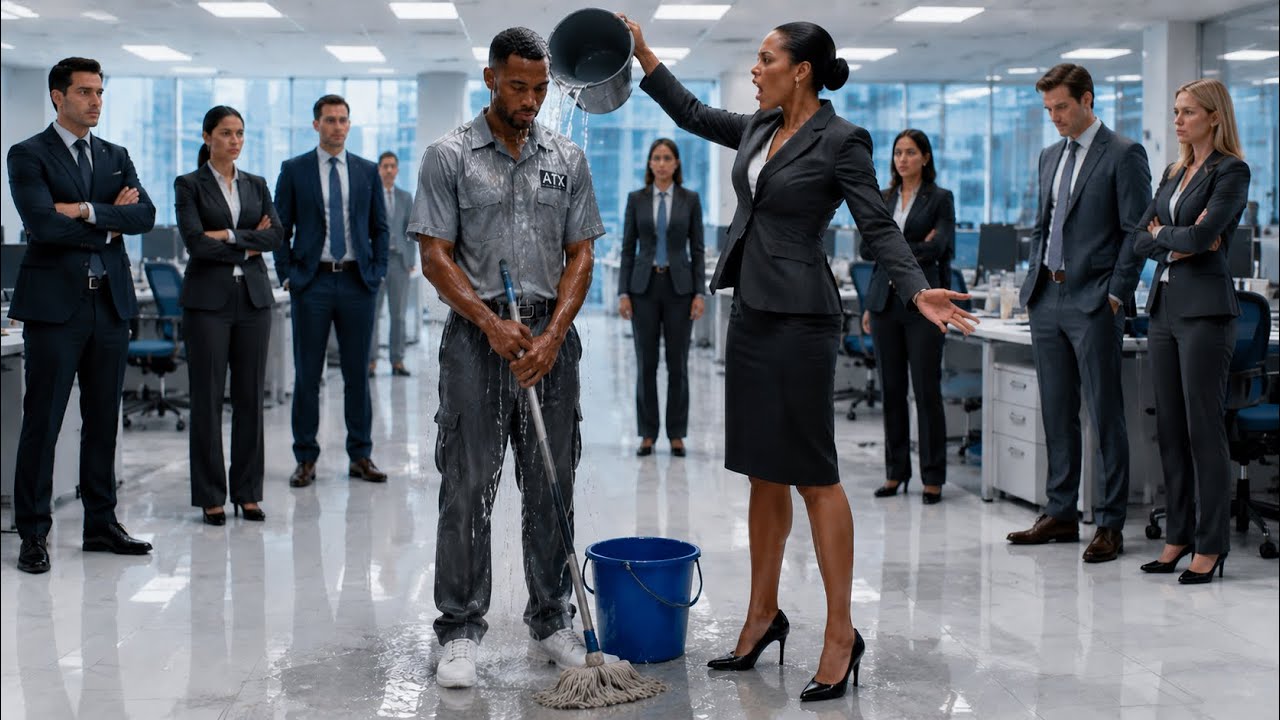
The lobby floor was so polished it reflected the ceiling lights like glass.
Outside, downtown Austin was already moving at full speed. Black SUVs eased into the drop-off lane. Men in tailored suits checked their watches while stepping out of luxury cars. Women in fitted blazers crossed the marble entrance with laptops tucked under one arm and coffee in the other.
Everyone looked important.
Everyone looked like they belonged.
And then Nolan Reed walked in wearing faded work pants, a gray sweatshirt, scuffed shoes, and an old canvas backpack with one broken zipper.
Three people glanced at him.
Two looked away immediately.
The third, a junior account manager waiting near the elevators, shifted his briefcase closer to his leg as if Nolan might take it.
Nolan noticed.
He noticed everything.
Near the reception desk, a printed notice had been taped to a clipboard.
KEEP LOBBY FLOORS DRY AT ALL TIMES.
Any slip-and-fall complaint will be charged against the facilities operating budget.
The wording was formal, but the meaning was simple.
If someone in an expensive suit slipped on a wet floor, the people earning the least would pay for it through reduced hours, delayed equipment replacements, or another round of “temporary budget adjustments.”
Nolan read the notice twice.
Then he picked up a yellow mop bucket and began working.
No one in the building knew that he had returned to the United States six days earlier after spending three years abroad.
No one knew he had completed an MBA in London.
No one knew that before graduation, he had survived a brutal internship in Singapore at one of the largest logistics firms in Asia, where twelve-hour days were considered light and supply-chain failures were analyzed like military operations.
He spoke four languages well enough to negotiate contracts in them.
He understood risk management, corporate governance, labor efficiency, cross-border logistics, and operational finance.
He had rejected two Fortune 500 offers before boarding the flight home.
Most importantly, no one knew that in three months, Nolan Reed was scheduled to take control of the company whose floor he was mopping.
Reedwell Industries had been founded by his grandfather forty-one years earlier.
What began as a regional freight brokerage had grown into a national logistics and infrastructure company with more than four thousand employees, dozens of major clients, and a glass headquarters in downtown Austin.
The official succession plan had already been approved.
In ninety days, Nolan would become chief executive officer.
But before the announcement, he had made his grandfather an unusual request.
“I don’t want to enter through the boardroom,” Nolan had said.
His grandfather had stared at him from behind a wide walnut desk.
“Then where do you want to enter?”
“The service entrance.”
The old man had said nothing.
Nolan continued.
“If people know who I am, they’ll perform. They’ll show me polished reports, selected employees, prepared answers, and clean conference rooms. I’ll see the company they want me to see.”
“And what do you think you’ll see carrying a mop?”
“The company they actually built.”
His grandfather leaned back.
Nolan knew the request sounded theatrical, so he made the terms practical.
Sixty days.
No public identity.
No executive access unless there was a legal or safety emergency.
Nolan would work through a facilities contractor as an entry-level cleaning employee.
He would report what he saw when the assignment ended.
His grandfather eventually agreed.
“You may not like what you find,” the old man warned.
“That’s the point.”
By 8:15 that morning, the lobby was filling faster.
A major client delegation was due at nine, and every department seemed to be performing urgency for everyone else.
That was when Kayla Mercer appeared.
Kayla was the Assistant Director of Operations, a title she wore like a badge large enough to enter a room before she did.
She was in her late thirties, sharply dressed, confident, and always moving as if someone important was watching.
She stopped three feet from Nolan and looked at the mop bucket.
“You’re blocking the entrance.”
Nolan moved the bucket aside.
Kayla did not leave.
“The floor needs to remain completely dry today,” she said.
Her voice was louder than necessary.
Two receptionists looked up.
A group near the elevators paused long enough to listen.
“We have a client meeting this morning. If someone slips and files a complaint, the cost comes out of facilities. That means your budget, your equipment, and possibly your hours. Do you understand?”
Nolan looked at the floor.
There was no standing water.
The warning sign was visible.
The mop head was nearly dry.
“Yes,” he said.
Kayla glanced at his shoes.
“Good. Because we can’t afford careless people today.”
She turned and walked away.
One of the receptionists lowered her eyes.
The other smiled faintly.
Not at Nolan.
At Kayla.
It was the kind of smile people gave when they wanted power to know they were on its side.
Nolan moved the bucket another foot toward the wall and continued working.
He did not defend himself.
He did not mention that the facilities liability structure described in the notice was badly designed.
He did not explain that charging safety incidents directly against lower-level operating budgets often encouraged concealment rather than prevention.
He did not tell Kayla that he had written a graduate paper on that exact issue.
He simply watched her walk away.
By the end of the first week, Nolan understood something that would never appear in an annual report.
The floors were clean.
The culture was not.
The break room taught him more than any executive briefing could have.
People spoke freely around him because they did not consider him part of the room.
They complained about managers, clients, bonuses, spouses, and coworkers.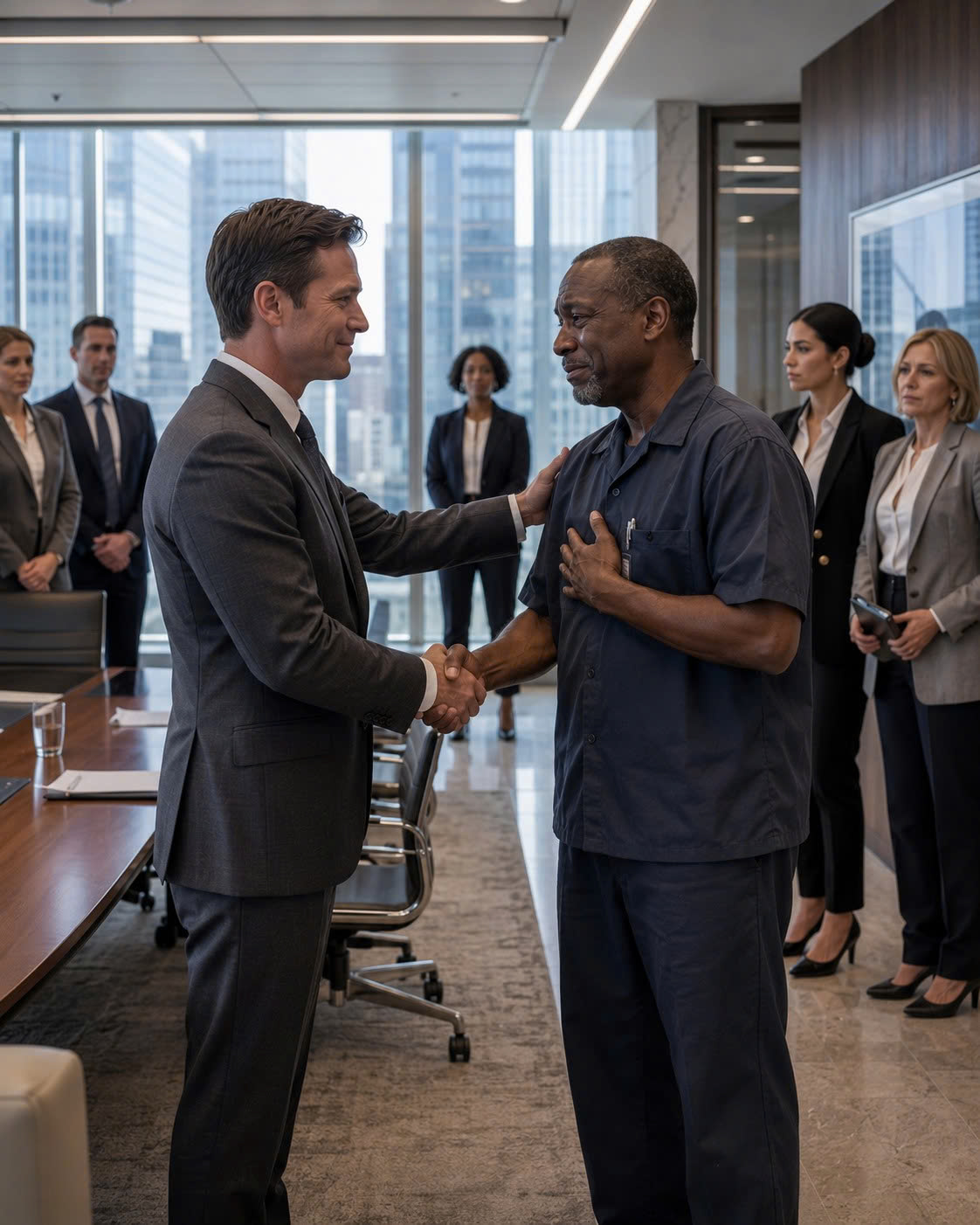
They left half-finished conversations suspended in the air when a director entered, then resumed them the second the person left.
They also talked about Nolan.
“New maintenance guy looks lost.”
“He’s not maintenance. He’s cleaning.”
“What’s the difference?”
Laughter followed.
Another afternoon, someone left a paper cup on a table less than two feet from a trash bin.
When Nolan walked past, the employee tapped the cup with one finger.
“You missed one.”
Nolan picked it up.
The employee never looked away from his phone.
What disturbed Nolan was not the cruelty itself.
It was how effortless it seemed.
No one paused before speaking.
No one seemed angry.
They were not losing control.
They were simply revealing what they believed the natural order of the building should be.
Some people were visible.
Others existed to remove the evidence left behind by visible people.
Nolan remembered every incident.
Not emotionally.
Precisely.
Date.
Time.
Location.
Names.
Witnesses.
Pattern.
He treated humiliation like operational data.
That was also how he came to know Darius Cole.
Darius was fifty-two years old and had worked in facilities at Reedwell for eleven years.
He arrived before sunrise and usually left after most executives had gone home.
He was not talkative, but he was never cold.
On Nolan’s third day, Darius opened the supply cabinet and handed him a blue bottle.
“Use this on the conference tables,” he said. “Not the clear one. Clear one leaves streaks under those lights.”
No lecture.
No performance.
Just useful information.
The supply room under Darius’s care was more organized than the procurement office upstairs. Every bottle had a label. Every replacement filter had a date. Tools were returned to the same hooks, even though no supervisor checked.
Darius greeted the overnight guard by name.
He knew which elevator made a grinding sound when temperatures dropped.
He knew the receptionist’s daughter had started college.
He knew one of the janitors sent half her paycheck to family in Guatemala.
Most people in the building did not know his name.
They called him “facilities,” “maintenance,” or simply, “Hey.”
One afternoon, Nolan sat alone near the loading dock during lunch.
Darius lowered himself onto the bench beside him and opened a paper bag.
Inside was a turkey sandwich cut in half.
Without saying much, he handed one half to Nolan.
“I’m fine,” Nolan said.
Darius shrugged.
“It’ll go to waste.”
Nolan accepted it.
The sandwich was ordinary.
Bread, turkey, mustard, lettuce.
But it was the first thing anyone in the building had offered him without wanting credit.
They ate in silence while delivery trucks reversed toward the dock.
Nolan looked at the man beside him and thought about the executive bonuses he had reviewed before returning home.
Then he looked at Darius’s worn work gloves.
Somewhere in the company, there was a spreadsheet that measured productivity, retention, compensation, and labor costs.
But no spreadsheet recorded the fact that Darius gave away half his lunch to someone he believed had less.
By the twelfth day, Nolan had seen enough small humiliations to understand the pattern.
Kayla corrected facilities workers in public and praised executives in private.
She referred to support staff as “headcount” when budgets were discussed.
She once made a security guard stand outside her office for twenty minutes, then walked past him without acknowledging that she had requested him.
No single event was dramatic enough to trigger a formal investigation.
That was what made the culture durable.
It survived through small acts that were easy to deny and exhausting to challenge.
Then two hundred dollars disappeared.
Every month, employees on the third floor contributed to a common fund. The money paid for birthday cakes, farewell cards, flowers, and small office events.
The fund usually held around four hundred dollars in cash inside a locked cabinet in the operations supply room.
On a Thursday morning, Kayla announced that half of it was missing.
By lunch, everyone had heard.
By two o’clock, Darius had been accused.
Nolan learned about it when he saw three employees standing outside a glass meeting room.
Inside, Darius sat across from Kayla and an HR representative.
His hands rested on his knees.
Kayla was speaking.
“The cabinet was accessed yesterday afternoon,” she said. “You were seen entering the room.”
“I put the water dispenser bottle on the shelf,” Darius replied.
“Were you alone?”
“For less than a minute.”
“And you expect us to believe you didn’t see the envelope?”
“I didn’t open the cabinet.”
Kayla leaned back.
“We have to consider the most likely explanation.”
There it was.
Not evidence.
Likelihood.
And likelihood, in Kayla’s mind, had already been shaped by job title, uniform, and salary.
Darius explained himself again.
He did not raise his voice.
He did not accuse anyone else.
He did not demand an attorney or threaten legal action.
He answered every question with the calm restraint of a man who had spent years learning that visible anger would be used as additional evidence against him.
HR issued a formal written warning pending review.
No one reviewed the camera footage.
No one checked access records.
No one asked who else knew where the cash was kept.
Darius’s supervisor signed the warning.
Then avoided eye contact in the hallway.
That evening, Darius returned to work.
He replaced a broken trash liner.
He adjusted a crooked entrance mat.
He wiped fingerprints from the glass doors of the same meeting room where his integrity had been questioned.
Nolan watched him work.
The injustice was not only in the accusation.
It was in how quickly everyone accepted it.
It was in how relieved they seemed to have found a person convenient enough to blame.
At 9:40 that night, Nolan went to the security office.
Pete Alvarez, the overnight guard, was watching six camera feeds and eating pretzels from a paper cup.
“You need something?” Pete asked.
“I think an innocent employee was blamed for theft.”
Pete stopped chewing.
Nolan pointed toward the hallway camera feed.
“I need to see yesterday’s footage outside the operations supply room.”
Pete studied him.
“You know I can’t show security footage to contractors.”
“I know.”
“Then why are you asking?”
“Because Darius Cole received a formal warning today, and no one checked whether he touched the cabinet.”
Pete’s eyes shifted toward the screen.
He knew Darius.
Everyone who arrived before sunrise knew Darius.
Pete sighed, turned toward the keyboard, and pulled up the archived footage.
At 3:17 p.m., Darius entered the supply room carrying a water bottle.
Forty-three seconds later, he left empty-handed.
He never approached the cabinet.
At 4:02 p.m., another employee entered.
At 4:05 p.m., Kayla entered.
At 4:11 p.m., two operations coordinators walked in together.
The camera did not show the cabinet itself, but it destroyed the claim that Darius had been the only likely person with access.
Pete replayed the footage.
Then he exported the clip without being asked twice.
“You didn’t get this from me,” he said.
Nolan took the drive.
“I won’t forget that you helped.”
Pete gave him a strange look.
Nolan slipped the drive into his backpack.
For the first time since beginning the assignment, he considered ending it early.
His agreement with his grandfather had been sixty days.
He had completed twelve.
If he revealed himself now, he would lose nearly seven weeks of observation.
There were probably deeper problems he had not yet seen.
More managers.
More departments.
More evidence.
But Darius would have to return the next morning carrying a theft warning in his personnel file.
Every hour Nolan waited protected the integrity of his experiment and extended the punishment of an innocent man.
He sat alone in his temporary apartment until after midnight.
The flash drive rested on the table.
At 12:36 a.m., he sent one message to his grandfather.
Tomorrow, the observation period ends.
The reply came four minutes later.
Understood.
At 8:10 the next morning, a black Cadillac pulled to the front entrance of Reedwell Industries.
Pete was still at the security desk when the car stopped.
The rear door opened.
Nolan stepped out wearing a charcoal-gray suit, polished black shoes, and a white shirt with no tie.
His hair was neatly combed.
His posture had changed, not because the clothes gave him authority, but because he was no longer concealing it.
Pete stood.
Nolan walked through the same lobby he had mopped the day before.
The junior account manager who once moved his briefcase away now held the elevator door.
“Which floor, sir?”
“Three.”
By 8:30, the main conference room was full.
Operations leaders, HR representatives, department managers, legal counsel, and two members of the executive team had been called in with little explanation.
Kayla entered carrying a tablet.
When she saw Nolan standing near the screen, she hesitated.
Then professionalism took over.
She smiled, walked toward him, and extended her hand.
“I don’t believe we’ve met. Kayla Mercer, Assistant Director of Operations.”
Nolan looked at her hand.
Then at her face.
“We’ve met.”
The smile remained for one second too long.
Her hand lowered slowly.
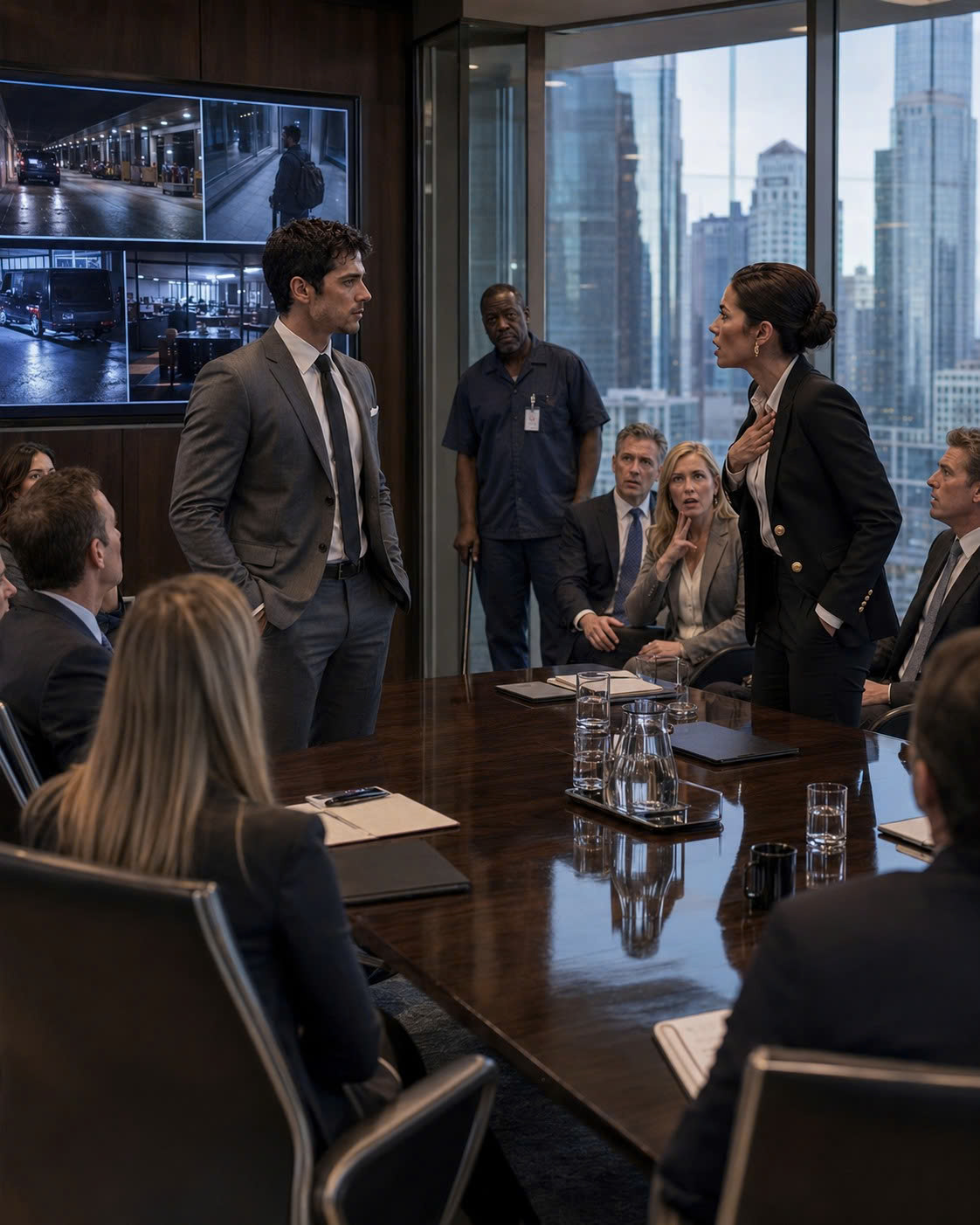
Nolan connected the flash drive to the conference room display.
The security footage began to play.
No introduction.
No speech.
The room watched Darius enter the supply room with a water bottle and leave forty-three seconds later.
Nolan replayed it.
Then he turned toward Kayla.
“You issued a formal warning for theft based on this?”
Kayla’s expression tightened.
“There was other contextual information.”
“What information?”
“He was seen near the location.”
“So were four other people.”
“We were conducting a review.”
“You punished him before conducting one.”
The room went quiet.
Kayla glanced toward the executives at the far end of the table.
She was searching for the highest-ranking person in the room.
She had not yet understood that she was looking at him.
Nolan stepped away from the screen.
“My name is Nolan Reed.”
The general counsel lowered his pen.
One executive leaned back.
Several people stopped moving.
Kayla’s face changed.
Not dramatically.
First, her eyes narrowed.
Then they widened.
Her mouth opened slightly, but no words came out.
Her shoulders, rigid seconds earlier, dropped by less than an inch.
It was enough.
Recognition moved through the room before anyone spoke.
Nolan continued.
“For the last twelve days, I have worked in this building as a contracted cleaning employee.”
No one looked at him now.
They looked at themselves through him.
“I was not here as a consultant. I was not here as an auditor. I was not here to test cleaning procedures.”
He glanced around the table.
“I was here to see how this company behaves when it believes no one important is watching.”
A manager near the window lowered his eyes.
One of the reception supervisors folded her hands tightly.
Nolan looked toward Kayla.
“I was told I blocked hallways. I was warned publicly about budgets I understood better than the person explaining them. I listened while employees joked about people who clean their offices. I watched support staff spoken to like equipment.”
No one interrupted.
“Most of those moments were small,” Nolan said. “That is why they survived.”
He placed one hand on the table.
“This company has developed two sets of rules. One for people with titles, and one for everyone else.”
Kayla’s face had lost its color.
“You mistook authority for superiority,” Nolan said. “And yesterday, that mistake damaged an innocent man’s name.”
He turned toward HR.
“Bring Darius Cole in.”
Darius entered ten minutes later wearing his navy work uniform.
He stopped inside the doorway when he saw the room.
His eyes found Nolan.
For the first time, he seemed unsure what to say.
Nolan walked toward him and extended his hand.
Darius shook it.
“You’ve worked here for eleven years,” Nolan said. “You’ve arrived on time, maintained an excellent record, trained new employees without formal recognition, and kept this building operating while people who did not know your name benefited from your work.”
Darius glanced around the room.
“You also received a disciplinary warning for an act you did not commit.”
Nolan looked at the HR director.
“That warning will be removed immediately.”
The director nodded.
“Effective Monday, Darius Cole will become Facilities Operations Coordinator.”
Darius stared at him.
The room remained silent.
“The position includes a salary increase, benefits adjustment, and supervisory authority over vendor scheduling and facilities inventory.”
Darius swallowed.
His lower eyelids tightened.
He looked down for a moment, then back at Nolan.
He did not cry.
He did not give a speech.
He only nodded once.
But the hand Nolan was still holding began to tremble.
That was the moment the room understood the scale of what had happened.
This was not charity.
It was correction.
Darius had not been elevated because Nolan felt sorry for him.
He had been placed where his record said he already belonged.
Kayla was escorted to HR after the meeting.
Her employment was terminated before noon.
Before she left, Nolan asked to speak with her privately.
She sat across from him in a smaller conference room, a cardboard box resting near her feet.
For the first time since he had met her, she did not appear busy.
“You planned this,” she said quietly.
“No.”
“You came here looking for people to fail.”
“I came here looking for the truth.”
Kayla stared at the table.
Nolan placed a card in front of her.
It contained information for a leadership and ethics development program run by an independent nonprofit in Austin.
She looked at it but did not touch it.
“What I did was wrong,” she said.
It was not quite a question.
“Yes.”
“You think a class fixes that?”
“No.”
Nolan leaned back.
“But losing your job doesn’t have to be the only thing that defines today.”
Kayla looked at him.
“You knew what you were doing,” he said. “You were not confused. You made choices because you believed the people beneath you could not affect you.”
Her eyes dropped.
“If you ever lead people again, learn how to build them instead of control them.”
Kayla picked up the card.
She did not thank him.
She placed it inside her purse and left with the box.
The company did not transform overnight.
Real cultures rarely do.
But over the next several weeks, small things changed.
Employees started saying good morning to facilities staff.
They learned names.
People carried their own cups to the trash.
Managers became more careful about correcting employees in public.
The break room grew quieter, but not because Nolan had installed cameras or issued threats.
People had simply learned that invisibility was often an illusion.
Nolan did not launch a glossy culture campaign.
He did not order posters about respect.
He continued walking the building.
He knew which elevator still vibrated on cold mornings.
He knew which light flickered near the loading dock.
He knew Pete’s son was applying to community college.
He knew Darius preferred inventory reports printed in the morning because vendors returned calls more reliably before lunch.
Three months later, Nolan sat in his grandfather’s office.
The succession date was one week away.
His grandfather closed the report Nolan had prepared.
“Infrastructure?” the old man asked.
“Strong.”
“Contracts?”
“Stable.”
“Financials?”
“Mostly where we expected.”
“And the people?”
Nolan paused.
“Most are good. Some learned to survive the culture. A few learned to exploit it.”
His grandfather studied him.
“You ended the sixty-day plan after twelve.”
“Yes.”
“Would you make the same decision again?”
“Yes.”
The old man nodded slowly.
“So would I.”
He stood and walked toward the window overlooking Austin.
“Are you ready?”
Nolan looked at the city below.
Then he thought about the lobby, the mop bucket, the sandwich near the loading dock, and Darius standing in a room full of people who had finally been forced to see him.
“Yes,” Nolan said. “Now I am.”
There was one detail Nolan had never shared publicly.
On his second day in the building, he had reviewed old internal personnel files using the temporary executive access his grandfather had authorized for emergencies.
Darius had applied for the Facilities Operations Coordinator position twice.
Both times, Kayla had rejected him.
Her written assessment said the same thing in both files.
Not sufficiently qualified for leadership responsibility.
Yet Darius had already been performing half the coordinator’s duties without the title or pay.
Nolan knew that before the money disappeared.
He had not promoted Darius to create a dramatic moment.
He had corrected a decision that should never have survived for years.
The man everyone saw cleaning the floor had been capable of running the floor all along.
And the person holding the mop may one day decide the future of the entire building.
So treat people with respect not because someone powerful might be watching, but because who you are when you think no one is watching is the only version of you that truly counts.