CHAPTER ONE — “GET HIM OFF THIS PLANE NOW”
The flight attendant looked at my daughter’s worn sneakers, then at my hoodie, then at the first-class seat number printed on my boarding pass.
2A.
Her smile did not disappear.
That was the part that stayed with me.
She kept smiling while she decided we did not belong.
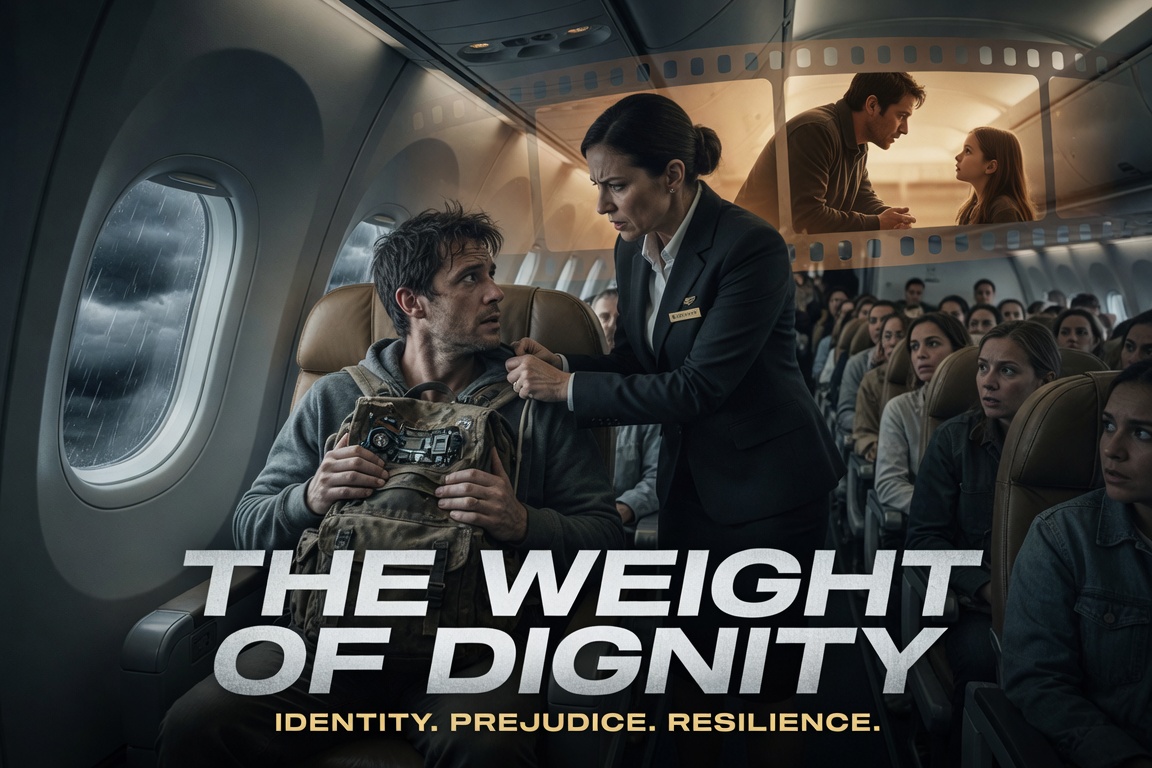
“Sir,” she said, lowering her voice as if kindness could make humiliation quieter, “I’m going to need you and your daughter to gather your things.”
My daughter’s small hand tightened around mine.
“Dad?”
The cabin had gone still.
Not silent.
Airplanes are never silent.
There was the soft hum of ventilation, the metallic click of a seat belt, the distant thud of luggage being pushed into overhead bins, the muffled cough of a man in 3C pretending not to listen. Outside the oval window, rain streaked across the glass, turning the runway lights at Chicago O’Hare into blurred red and blue stars.
But the people were quiet.
That was always the sound I remembered from moments like this.
Not cruelty.
Not laughter.
Silence.
The kind of silence that gathers when everyone understands something unfair is happening but waits to see whether it will cost them anything to care.
My daughter, Lily, was nine years old. She had spent three weeks drawing airplanes in the margins of her homework because this was going to be her first time in first class. Not because we were rich. Not because I wanted luxury. Because she had survived a year of hospital rooms, physical therapy, and nights when she pretended not to cry because she thought my grief already had too much work to do.
I had used miles.
Upgrades.
A favor from a colleague who said, “Ethan, please let your kid have one beautiful thing this year.”
So I did.
Seat 2A for me.
Seat 2B for Lily.
She had worn her yellow sweater because she said it looked like sunshine. Her right sneaker had a silver star drawn on it in permanent marker. Her backpack was shaped like a blue whale and held three things she considered essential: noise-canceling headphones, a notebook, and the small wooden airplane I had carved for her after her mother died.
The flight attendant’s name tag read: TESSA MARLOW.
Her uniform was perfect.
Navy jacket.
Red scarf.
Hair pulled back so tightly it seemed disciplined into obedience.
Behind her stood a gate supervisor in a black blazer, his tablet tucked under one arm. His name tag read: KEN BARLOW.
He looked at me the way people look at a problem they have already decided to solve quickly.
I glanced down at my boarding pass again.
Then back at them.
“There seems to be a mistake,” I said.
Ken’s jaw shifted.
“Yes, sir. That’s what we’re trying to address.”
I kept my voice calm.
“Good. Then let’s address it. These are our seats.”
Tessa’s smile tightened.
“Sir, we need you to come with us.”
“Why?”
The question made the man in 1D turn slightly.
A woman across the aisle lowered her phone but did not put it away.
Lily pressed closer to my side.
Ken stepped forward.
“Sir, we’ve had a concern raised about your boarding status.”
“My boarding status?”
“Yes.”
I held out both boarding passes.
He did not take them.
That told me enough.
“You haven’t looked at them.”
“We can resolve this at the gate.”
I looked down at Lily.
Her face had become pale, the way it did when too much attention gathered around her. She hated loud places. She hated strangers staring. She hated not knowing the rules of a room.
“Lily,” I said softly, “put your headphones on.”
She obeyed quickly, though her fingers fumbled with the case.
Tessa glanced at the passengers.
“Sir, please don’t make this more difficult.”
I looked at her.
“I’m sitting in a seat I paid for.”
A man in 2C, across the aisle, gave a small laugh.
Not loud.
Enough.
He wore a cream cashmere sweater, a gold watch, and the comfortable irritation of someone whose life had trained him to expect immediate correction when reality inconvenienced him.
“I told you,” he said to Ken. “This is getting absurd.”
I turned toward him.
He did not look away.
The supervisor shifted.
“Mr. Blakely, we’re handling it.”
Blakely.
The name meant something.
Warren Blakely, venture investor, aviation lobbyist, frequent television guest, a man who liked to discuss efficiency while other people absorbed the human cost of it. I had seen his photograph in briefings. He was scheduled to speak at the Transportation Futures Summit in Seattle the next morning.
The same summit I was flying to attend.
He looked at me, then at Lily’s whale backpack.
“I don’t know how this happened,” he said, not to me but about me, “but I specifically confirmed 2A.”
Ken’s face tightened.
Tessa turned back to me.
“Sir, this aircraft is full. We need to verify your reservation.”
“You mean you need my seat.”
Tessa’s eyes sharpened.
“Sir, please lower your voice.”
My voice had not changed.
That was another thing people did.
They called calm resistance aggression because obedience had failed to arrive.
Lily’s headphones covered her ears now, but I could see her watching my mouth, trying to understand what was happening. Her left hand clutched the wooden airplane so hard her knuckles had gone white.
I crouched slightly so I could speak to her.
“Sweetheart, we’re going to step out for a minute.”
Her eyes filled.
“Did we do something wrong?”
The question moved through me like a blade turned slowly.
I looked at the adults around us.
At Tessa’s fixed smile.
At Ken’s impatient tablet.
At Warren Blakely’s expensive disgust.
At the passengers who suddenly found their screens fascinating.
Then I looked back at my daughter.
“No,” I said. “We did nothing wrong.”
Ken exhaled.
“Sir, this is your final request.”
I stood slowly.
“Are you removing us from the flight?”
“We are asking you to deplane while we verify—”
“Are you removing us?”
His face hardened.
Tessa looked toward the front galley.
Another crew member stood there, frozen.
Ken lowered his voice.
“Sir, if you refuse, security will be called.”
Lily heard that word even through the headphones.
Security.
Her eyes widened.
Something inside me became very still.
I had built my life around systems.
Flight networks.
Airport logistics.
Public-private transportation contracts.
Risk models that predicted where human decisions became institutional failures.
I knew the exact second when an inconvenience became a documented incident.
I reached into my pocket and took out my phone.
Ken’s eyes narrowed.
“Sir, recording is not permitted if it disrupts—”
“I’m not recording.”
I opened my contacts.
Tessa stepped closer.
“Sir.”
I looked at Ken.
“I want the reason for removal stated clearly.”
He said nothing.
Warren Blakely muttered, “Unbelievable.”
Then, from somewhere near the cockpit door, a voice cut through the cabin.
A male voice.
Sharp.
Impatient.
Loud enough for everyone.
“Get him off this plane now!”
Lily flinched.
That was the moment.
Not when they questioned the ticket.
Not when they ignored the boarding pass.
Not when they chose a powerful man’s comfort over a child’s dignity.
The moment my daughter flinched because an adult in uniform made her feel like danger.
I picked up her backpack.
Then mine.
I took Lily’s hand.
And I walked off Flight 417 without raising my voice.
But before I stepped through the aircraft door, I turned back once.
Ken Barlow stood in the aisle.
Tessa Marlow looked relieved.
Warren Blakely had already opened his laptop.
I looked at them the way I had been trained to look at failing systems.
Not with rage.
With documentation.
Then I made the call.
CHAPTER TWO — THE CALL FROM THE JET BRIDGE
The jet bridge smelled of wet coats, metal, and jet fuel.
Lily walked beside me without speaking.
Her headphones were still on. Her eyes stayed fixed on the gray carpet beneath our feet, following the black rubber seams as if they were tracks leading somewhere safer.
Behind us, the aircraft door closed.
Softly.
That sound should not have felt like a verdict.
At the end of the jet bridge, two airport security officers waited with Ken Barlow. One was young and nervous. The other was older, female, with tired eyes that missed very little.
“Sir,” Ken said, “we appreciate your cooperation.”
I looked at him.
“No, you don’t.”
His mouth tightened.
“Excuse me?”
“You appreciate that I did not create a scene.”
The older security officer glanced at me.
Ken looked down at his tablet.
“We simply need to verify a seating irregularity.”
I handed him the boarding passes again.
This time, he took them.
His eyes moved across the screen.
Then stopped.
The color changed around his mouth.
“Mr. Carter,” he said, quieter now.
“Yes.”
He looked at Lily’s boarding pass.
Then mine.
I watched the numbers arrange themselves in his mind.
Valid ticket.
Confirmed seat.
Priority boarding.
No flag.
No irregularity.
Only a passenger who did not look the way first class was supposed to look in his head.
The older officer stepped closer.
“Is there a problem with the tickets?”
Ken swallowed.
“We’re verifying.”
“That wasn’t my question.”
The officer’s name badge read S. RAMIREZ.
I liked her immediately.
Ken lowered his tablet.
“There may have been a duplicate seating issue.”
“There wasn’t,” I said.
He looked at me.
“How would you know?”
I smiled faintly.
“Because I checked before boarding. Twice.”
Lily tugged my sleeve.
“Dad, can we go home?”
That nearly broke me.
We were not going home.
We were flying to Seattle because I had a meeting at nine in the morning that could decide the future of one of the largest aviation modernization projects in American history.
But my daughter did not know that.
To Lily, this trip was not about aerospace infrastructure, fleet integration, airport redevelopment, labor guarantees, autonomous maintenance systems, or a fifty-two-billion-dollar corridor partnership spanning five states and three airlines.
To Lily, this trip was supposed to be pancakes at the hotel, the Space Needle, and watching airplanes from a first-class window.
I knelt in front of her.
“We’re going to find another way.”
Her lower lip trembled.
“Are they mad because I wore sneakers?”
I closed my eyes for half a second.
When I opened them, Officer Ramirez was looking away.
Not because she was indifferent.
Because she had heard.
Ken had too.
He did not look away fast enough.
“No,” I told Lily. “They made a mistake because they forgot people matter more than appearances.”
She nodded, but children know when adults are trying to turn pain into a lesson before the wound has stopped bleeding.
My phone buzzed.
Mara Ellison.
Chief legal officer of Carter Atlas Mobility.
The woman who had once told a governor that “urgent” was not a legal argument.
I answered.
“Ethan.”
Her voice was alert immediately.
“What happened?”
I looked at the closed aircraft door.
“Freeze all discretionary movement on the Meridian aviation partnership.”
Ken looked up.
He recognized the word Meridian.
Good.
Mara was silent for one second.
Only one.
“Full freeze?”
“Preliminary. I want no signature packets released, no public statement, no summit-stage confirmation, and no private assurances to Meridian Air Group until I review a passenger treatment incident.”
Ken’s eyes widened.
Officer Ramirez glanced between us.
Mara’s voice became colder.
“Passenger treatment involving whom?”
“Me.”
Another silence.
This one sharper.
“Are you safe?”
I looked at Lily.
“No.”
Mara understood.
“Is Lily with you?”
“Yes.”
“What airline?”
“Meridian Air.”
Ken took one step back.
“What flight?”
“417. O’Hare to Seattle.”
Mara exhaled once.
Not panic.
Anger under glass.
“I’m notifying the board hold channel and compliance review. Do you need law enforcement?”
I looked at Officer Ramirez.
“Airport security is present. I want the body camera preserved, gate footage preserved, boarding records preserved, and all communications regarding seat 2A and 2B held.”
Ken whispered, “Sir…”
I looked at him.
Mara heard.
“Who is that?”
“Gate supervisor.”
“Name?”
“Ken Barlow.”
Ken’s face drained.
Mara’s keyboard began clicking through the phone.
I continued, “There was a passenger in 2C. Warren Blakely. He appears to have asserted a claim to my seat.”
Mara stopped typing.
“Blakely is on the Meridian advisory subcommittee.”
“I know.”
Ken’s hand moved to his radio.
Officer Ramirez saw it.
“Sir,” she said to him, “please don’t transmit anything about this incident until I know what’s being documented.”
Ken froze.
Mara asked, “Do you want me to call Simon Vale?”
Simon Vale was CEO of Meridian Air Group.
A man scheduled to stand beside me onstage tomorrow morning in front of cameras and announce what Meridian believed was a historic strategic partnership.
I looked at Lily.
She had removed one side of her headphones. She was listening now. Not to the call. To me.
“No,” I said. “Not yet.”
Ken opened his mouth.
I held up one finger.
Not rudely.
Precisely.
“Mara,” I said, “this may be nothing more than one bad decision by a gate team.”
Ken almost exhaled.
“But if their culture allowed a child to be removed from a valid first-class seat because someone decided we didn’t look valuable, then we have a partnership problem.”
Mara’s voice softened slightly.
“For the record, Ethan, what do you want done first?”
I looked at the aircraft door.
Then at the little girl standing beside me in a yellow sweater, holding a wooden airplane like it was the last safe object in the world.
“Find us another flight,” I said. “Then find out how often this has happened to people who couldn’t make this call.”
CHAPTER THREE — THE MAN THEY DIDN’T SEE
My name is Ethan Carter.
Most people who passed me in airports saw a tired father with a worn backpack, a hoodie with one frayed cuff, and shoes that had survived too many terminals.
They were not wrong.
They were simply incomplete.
I was forty-two years old. Widower. Father. Systems architect. Founder of Carter Atlas Mobility, though the founder title always sounded more glamorous than the work felt. I spent most of my days in rooms without windows, arguing about airport throughput, maintenance labor, passenger equity metrics, fleet emissions, rural access, emergency routing, and whether a transportation system designed for profit could still be forced to remember it served human beings.
My daughter told her classmates I “fixed airports.”
That was close enough.
The $52 billion deal had started as a map on my kitchen wall.
Not in a boardroom.
Not in Washington.
In my kitchen, three years after my wife died.
Anna Carter died because a medical transfer flight could not reach her in time.
That was the simple version.
The official version was more complicated: storm rerouting, maintenance backlog, regional airport closure, crew availability, delayed approval chain, fragmented air ambulance coordination, and a private contractor whose system did not speak cleanly to the hospital network.
Complicated is what institutions call tragedy when every single person involved can point to someone else’s piece of the failure.
Lily was six then.
She had sat on the kitchen floor with her wooden airplane, asking why Mommy could not just take a faster plane.
I had no answer fit for a child.
So I built one.
Not a faster plane.
A better system.
Carter Atlas began with emergency routing software. Then airport logistics. Then fleet maintenance intelligence. Then regional aviation access modeling. Then public infrastructure integration. The kind of work nobody understood at dinner parties until something failed and suddenly everyone wanted to know why the system had not been smarter.
Now Carter Atlas led the SkyBridge Mobility Corridor, a $52 billion public-private aviation modernization project tying together airport redevelopment, regional air access, fleet replacement, maintenance training, cargo resilience, medevac priority routing, and passenger equity standards.
Meridian Air Group wanted the lead commercial carrier role.
They wanted it badly.
They had spent eighteen months courting governors, union leadership, airport authorities, manufacturers, and my board. They had promised rural routes. Workforce investments. Training centers. On-time reliability. Sustainability. Customer dignity.
Customer dignity.
That phrase appeared on page 417 of their proposal.
I knew because I wrote the scoring metric.
At 9:00 tomorrow morning in Seattle, Meridian expected to announce preliminary selection as lead aviation partner.
By 7:14 tonight, that announcement was frozen.
Because one of their teams had looked at my daughter and decided dignity belonged to passengers who matched their imagination of money.
That was not revenge.
It was data.
A system that fails quietly in front of the wrong person has probably failed loudly in front of people nobody heard.
CHAPTER FOUR — THE ROOM NEAR GATE C19
Airport security placed us in a small interview room near Gate C19.
Not because we had done anything wrong.
Because nobody knew what else to do with us.
The room had beige walls, a metal table, four chairs, a camera in the corner, and a vending machine humming outside the door. Lily sat beside me with her knees pulled close, the whale backpack on her lap. Someone had brought her apple juice and pretzels. She had not touched either.
Officer Ramirez stood near the door, speaking quietly into her radio.
Ken Barlow stood across from me, no longer carrying himself like a man managing inconvenience. His face had gone gray under the fluorescent lights.
Tessa Marlow arrived ten minutes later.
Without the smile.
She stepped into the room and looked at Lily first.
That mattered.
Then she looked at me.
“Mr. Carter,” she said, “I’m sorry for the confusion.”
Confusion.
I watched that word enter the room and fail.
Lily looked at me.
Even at nine, she knew confusion was too small for what had happened.
“What exactly confused you?” I asked.
Tessa’s hands clasped in front of her.
“There was a seating issue.”
“No.”
Ken cleared his throat.
“Mr. Carter—”
I looked at him.
“There was no seating issue. There was a passenger in 2C who wanted my seat. You looked at me, looked at my daughter, and decided we were easier to remove.”
Tessa’s face tightened.
Ken said, “That is not accurate.”
Officer Ramirez turned slightly.
I nodded.
“All right. Then let’s write your version.”
Ken blinked.
“My version?”
“Yes.”
I removed a notebook from my backpack.
Lily watched.
She had seen this notebook before.
Black cover.
Elastic band.
It was where I wrote systems failures, meeting notes, and occasional grocery lists when my phone died.
“Time of removal. Staff names. Passenger complaint. Stated reason. Ticket status. Whether ID was checked. Whether duplicate seat was confirmed. Whether passenger in 2C was asked to move. Whether any passenger in economy was removed under similar conditions. Whether you contacted central operations before forcing a deplane.”
Ken stared at the notebook like it was a weapon.
It was not.
Weapons hurt people.
Records stop people from pretending hurt did not happen.
Tessa’s lips parted.
“I didn’t know who you were.”
The room went quiet.
There it was.
The most honest thing anyone from Meridian had said.
I looked at her.
“That is the problem.”
Her eyes filled, but she held herself together.
“I didn’t mean it like that.”
“How did you mean it?”
She looked at Lily.
Then back at me.
“I mean…”
She stopped.
Because there was no clean way to finish.
I didn’t know you mattered.
I didn’t know you had power.
I didn’t know this could hurt me too.
Ken stepped in.
“We were under boarding pressure. Mr. Blakely said there had been a prearranged seat change.”
“Did he show proof?”
“No.”
“Did I?”
Ken looked down.
“Yes.”
“Then why did his claim outweigh my document?”
Silence.
Officer Ramirez’s body camera blinked red.
Tessa whispered, “Because he sounded certain.”
I turned to her.
“And I didn’t?”
She shook her head quickly.
“No, you were calm.”
“Then what was the difference?”
She did not answer.
Ken said, “Mr. Carter, I understand this looks bad.”
“No,” I said. “It is bad.”
Lily’s hand found mine under the table.
I softened my voice.
“Not because I lost a seat. Seats can be replaced. Flights can be rebooked. What happened here is bad because my daughter asked if her shoes made you angry.”
Tessa’s face collapsed.
Ken closed his eyes.
Officer Ramirez looked down at her notes.
Lily whispered, “Dad.”
I turned.
She leaned closer.
“Can we leave?”
“Yes.”
I stood.
Ken stepped forward.
“We can still get you on the flight. Mr. Blakely has agreed to—”
I almost laughed.
Agreed.
As if dignity could be restored by the man who stole it granting permission too late.
“No.”
Ken looked startled.
“No?”
“My daughter is not walking back onto that aircraft so everyone can watch her return to a seat they helped take from her.”
Tessa flinched.
Good.
Some sentences should bruise.
Mara texted me then.
Northstar Regional can route you through Denver. Private conference room arranged. Wheels up 9:40. Lily’s meal preference noted.
I looked at Lily.
“Pancakes in Seattle might be delayed.”
Her mouth trembled.
Then she whispered, “Can we still see planes?”
I squeezed her hand.
“Yes.”
Ken looked at my phone.
“Mr. Carter, Meridian would like to offer—”
I raised my eyes.
“Mr. Barlow, tonight Meridian offered my daughter a lesson. She learned that rules bend for confident men in expensive sweaters. Tomorrow I’m going to ask your CEO whether that was local failure, corporate habit, or leadership design.”
No one spoke.
I picked up our bags.
At the door, Tessa said, “I really am sorry.”
I turned back.
She looked smaller without authority.
Not innocent.
Human.
That mattered too.
“Then write down exactly what happened before someone teaches you how to remember it differently.”
CHAPTER FIVE — THE EXECUTIVE WHO STOPPED SMILING
Simon Vale was smiling when the freeze notice reached him.
That was what Mara told me later.
He stood in a private dining room at the Fairmont Olympic Hotel in Seattle, rehearsing tomorrow’s remarks with a communications team, two governors’ aides, three Meridian executives, and Warren Blakely, who had somehow arrived before us because Flight 417 departed only eighteen minutes late after removing the problem from seat 2A.
Me.
Simon Vale was fifty-six years old, CEO of Meridian Air Group, and widely admired for turning a struggling legacy airline into a polished modern brand. He was handsome in the way CEOs often are after good tailoring and controlled lighting: silver hair, measured smile, posture trained by cameras. He had built his reputation on operational discipline.
That discipline cracked when his general counsel showed him the hold notice.
MERIDIAN AIR GROUP — SKYBRIDGE PARTNERSHIP SELECTION STATUS PAUSED PENDING PASSENGER INCIDENT REVIEW, CULTURE COMPLIANCE AUDIT, AND EXECUTIVE DISCLOSURE.
Simon read it once.
Then again.
Warren Blakely apparently said, “This is a tactic. Carter’s people are always theatrical about ethics metrics.”
That sentence did not age well.
Simon looked at him.
“Carter?”
Warren frowned.
“Yes. Ethan Carter. The committee chair. Systems guy. Widower with the daughter. You know.”
Simon’s hand tightened around the paper.
According to Mara, the room went so quiet someone’s fork touched a plate and sounded like glass breaking.
Simon asked one question.
“Where is Ethan Carter right now?”
No one knew.
That was Meridian’s second failure of the night.
They had removed a passenger from their aircraft and did not know where he went.
CHAPTER SIX — NORTHSTAR FLIGHT 88
Northstar Regional Flight 88 did not have first class.
Lily liked it better.
The plane was smaller, the seats narrower, and the overhead bins stubborn. But the captain came out before boarding to meet her after Mara’s assistant quietly mentioned she loved airplanes. He crouched in front of her, showed her the wing lights through the terminal window, and gave her a spare trading card with the aircraft model on it.
“Do you know what that part is?” he asked, pointing toward the tail.
Lily nodded.
“Vertical stabilizer.”
The captain’s eyebrows rose.
“Well,” he said, “I stand corrected. You should be giving the tour.”
For the first time since Meridian removed us, Lily smiled.
Not completely.
Enough.
A flight attendant named Rosa helped her place the whale backpack under the seat.
“Important passenger?” Rosa asked.
Lily looked uncertain.
I watched carefully.
The question could hurt if said wrong.
Rosa pointed to the wooden airplane in Lily’s hand.
“I mean your copilot.”
Lily looked down.
Then nodded.
“He’s nervous.”
Rosa leaned closer.
“Tell him I’ve flown this route for twelve years and the snacks are excellent.”
Lily laughed.
That laugh was worth more than the first-class cabin.
As the plane lifted through the rain, Lily pressed her forehead to the window. Chicago became light and shadow beneath the clouds. Her hand relaxed around the wooden airplane.
After the seat belt sign turned off, she looked at me.
“Dad?”
“Yes?”
“Are you going to get those people fired?”
The question was careful.
Children know more about adult power than adults like to admit.
I looked at the aisle where Rosa moved slowly, helping an elderly man open a water bottle.
“I don’t know yet.”
“They were mean.”
“Yes.”
“But maybe they were scared?”
I turned toward her.
“What makes you say that?”
Lily shrugged.
“Sometimes people are mean when they think they’ll get in trouble.”
That was Anna in her.
My wife had been a pediatric nurse before illness made her a patient. She believed children often described adult systems better than professionals because children had not yet learned to make cruelty sound sophisticated.
I touched Lily’s wooden airplane.
“What do you think should happen?”
She looked back out the window.
“They should know they made me feel bad.”
“They will.”
“And they should not do it again.”
“No.”
“And the man in the sweater should sit by the bathroom next time.”
I laughed.
I couldn’t help it.
Lily smiled.
Then, after a moment, she added, “But maybe don’t ruin everybody’s Christmas.”
“It’s July.”
“You know what I mean.”
I did.
My daughter was asking me not to let pain turn me into someone who enjoyed punishment more than repair.
Nine years old.
Yellow sweater.
Wiser than three executive committees.
“I promise,” I said, “I won’t make this about revenge.”
She nodded.
Then leaned her head against my arm.
“Can it be about rules?”
“Yes.”
“And pancakes?”
“Yes.”
She closed her eyes.
“Good.”
By the time we landed in Denver for the connection, Meridian had called twenty-three times.
I did not answer.
Not because I wanted them to panic.
Because panic tells the truth faster than prepared statements.
CHAPTER SEVEN — THE PATTERN
Mara did not sleep that night.
Neither did her team.
By the time Lily and I reached Seattle, they had preserved gate footage, passenger manifests, crew communications, internal messages, and customer complaint data from Meridian’s premium cabin incidents over the past three years.
The pattern appeared by sunrise.
Not identical.
Patterns rarely are.
They hide in variations.
A military veteran in Dallas downgraded after a loyalty-status conflict with a corporate traveler.
A grandmother in Atlanta questioned twice because staff assumed she was “confused” about her first-class ticket.
A Black physician in Boston asked to show proof of upgrade after another passenger complained about “boarding irregularities.”
A young man with visible work clothes moved from premium economy because a high-tier member requested “space to work.”
A mother with a child using a mobility device told her equipment “created boarding complexity” while a celebrity passenger was accommodated without delay.
Each incident had a different explanation.
Seat duplication.
Operational needs.
Customer confusion.
Cabin balance.
Staff discretion.
Service recovery.
Individually, each could be minimized.
Together, they said something uglier.
Meridian’s culture did not officially instruct employees to judge passengers by status, race, clothing, disability, age, or perceived wealth.
It did something more subtle.
It rewarded the quiet removal of discomfort from premium spaces.
And discomfort, too often, meant people who reminded wealthy passengers the world was larger than them.
At 8:12 a.m., Mara came to my hotel suite.
Lily was asleep in the second room, surrounded by airplane cards, one pancake uneaten on a plate beside her bed.
Mara placed a folder on the table.
She was forty-eight, tall, Black, precise, with silver-threaded braids and a navy suit that made every room feel under oath. She had been a civil rights attorney before becoming my chief legal officer. She did not waste adjectives.
“It’s not one bad gate team,” she said.
I opened the folder.
“I know.”
She sat across from me.
“Meridian will argue these are isolated.”
“They aren’t.”
“No.”
“What about Blakely?”
Mara’s face hardened.
“His assistant emailed Meridian customer relations two hours before boarding requesting ‘assurance of appropriate premium cabin environment’ and asking whether a seat could be ‘reclaimed’ if ‘misassigned.’”
I stared at her.
“Reclaimed.”
“Yes.”
“Was my name attached?”
“No. Seat 2A was.”
“And Meridian responded?”
She slid a printed email across the table.
We will have station leadership monitor and resolve discreetly.
I read it twice.
Discreetly.
That word carried the weight of everything.
Not fairly.
Not lawfully.
Not according to ticket validity.
Discreetly.
I placed the paper down.
“Mara.”
“Yes?”
“What happens if we walk away from Meridian?”
She did not answer quickly.
That was why I trusted her.
“Operationally? It delays the corridor. Politically? It complicates two state agreements. Financially? Meridian loses the lead carrier share, projected long-term revenue exposure in the tens of billions, not immediate cash but strategic position. Publicly? It becomes a major story.”
“And if we stay?”
“We condition selection on enforceable reforms, oversight, passenger dignity standards, staff retraining with teeth, executive accountability, and external audit. But that requires trusting Simon Vale to change the company under pressure.”
I looked out the window.
Seattle lay under a pale morning sky, glass towers reflecting water and cloud. Planes moved in the distance, climbing from the airport one by one, each carrying people with stories no boarding system could read.
“What do you think?” I asked.
Mara leaned back.
“I think your daughter asked the right question.”
I looked at her.
“Which one?”
“Can this be about rules?”
The corner of my mouth moved.
“She’s terrifying.”
“She gets it from Anna.”
I looked down at the folder.
Anna’s name still had the power to quiet a room inside me.
Mara continued, “Ethan, you built SkyBridge because systems failed your family. If Meridian’s system failed Lily and others, the answer cannot be private revenge. It has to be public correction.”
I nodded.
“What about Tessa and Ken?”
“We review fairly.”
“Fairly doesn’t mean softly.”
“No.”
“But not performatively.”
Mara’s eyes held mine.
“No.”
I closed the folder.
“Set the meeting.”
CHAPTER EIGHT — THE CEO AT THE GLASS TABLE
The meeting took place at 10:30 a.m. in a conference room overlooking Seattle-Tacoma International Airport.
Glass walls.
Long table.
Coffee nobody drank.
Outside, jets rolled slowly beneath a sky the color of steel wool. The room smelled of carpet, espresso, raincoats, and the faint anxiety of executives trying not to look at their phones.
Simon Vale arrived with his chief operating officer, general counsel, head of customer experience, and two board members.
He looked like a man who had aged overnight.
Good.
Not because I wanted him to suffer.
Because leaders should look tired when harm done under their brand reaches the table.
He did not begin with a joke.
He did not begin with legal language.
He looked at me and said, “Mr. Carter, I’m sorry.”
I waited.
He turned toward the second chair.
Lily was not there.
She was upstairs with Mara’s assistant, eating waffles and drawing aircraft with too many engines.
Simon noticed the empty chair.
His face tightened.
“I’m sorry to your daughter too.”
That mattered more.
Not enough.
But more.
I nodded once.
“Tell me what happened.”
His general counsel shifted.
Simon raised a hand.
“No.”
Then he looked at his notes.
“Meridian staff removed you and your daughter from valid first-class seats after a high-value passenger raised a request regarding seat 2A. The staff failed to verify the claim before action. They ignored valid documentation. They escalated perceived cabin discomfort into a passenger removal. They caused harm.”
Mara’s pen paused.
She looked at me.
That was not a legal answer.
That was a dangerous answer.
Maybe Simon Vale was better than his company’s failure.
Or maybe he understood honesty was now his only option.
I leaned forward.
“Why?”
Simon’s eyes moved to the runway.
When he spoke, his voice was lower.
“Because we built a premium culture around deference.”
No one from his team moved.
He continued.
“We trained staff to protect high-value passenger experience. We measured complaints from top-tier travelers aggressively. We rewarded quick resolution. We told ourselves fairness was assumed.”
He looked back at me.
“It wasn’t.”
The head of customer experience, a woman named Andrea Shaw, looked down.
Simon said, “People filled the gap with bias, fear, status pressure, and appearance-based judgment.”
I studied him.
“Did you know?”
“No.”
“Should you have?”
“Yes.”
That answer landed.
No defense.
No fog.
Mara wrote something down.
I asked, “What about Warren Blakely?”
Simon’s jaw tightened.
“His advisory role is terminated effective immediately.”
“Convenient.”
“Yes,” Simon said. “Also necessary.”
“What about the gate team?”
Andrea Shaw finally spoke.
“Tessa Marlow submitted a written statement at 3:40 a.m. It contradicts portions of Ken Barlow’s initial report. She acknowledges she made assumptions about your appearance and failed to challenge the seat removal request. She also identified a phrase used by station leadership.”
“What phrase?”
Andrea looked ashamed.
“Protect the cabin.”
Silence.
Protect the cabin.
From whom?
From a single father in a hoodie.
From a nine-year-old girl in a yellow sweater.
From anyone who made wealth share space with reality.
Simon closed his eyes briefly.
Then opened them.
“Ken Barlow has been placed on leave. Tessa Marlow requested to remain available for investigation and passenger apology. The captain who ordered removal claims he relied on station guidance.”
Mara said, “The captain used the phrase ‘Get him off this plane now.’”
Simon flinched.
“Yes.”
I let the silence sit.
Some sentences deserve to echo back at the people who sent them into the world.
Finally, Simon asked, “What do you want?”
There it was.
The question everyone eventually asks after power shifts.
My answer surprised even me with how quickly it arrived.
“I want my daughter to receive a written apology that does not contain the words confusion, misunderstanding, or inconvenience.”
Simon nodded.
“I want every passenger removed from premium cabins under discretionary circumstances over the past three years reviewed by an independent team.”
Another nod.
“I want restitution where harm occurred.”
“Yes.”
“I want premium passenger complaint influence separated from safety and ticketing decisions.”
“Yes.”
“I want external civil rights and disability access auditing tied to executive compensation.”
Andrea looked up sharply.
Simon said, “Agreed.”
His COO shifted.
“Simon—”
Simon did not look at him.
“Agreed.”
I continued.
“I want staff trained to understand that valid documentation outweighs social pressure.”
“Yes.”
“I want Warren Blakely removed from every SkyBridge advisory conversation.”
“Done.”
“And I want Meridian’s lead partner selection suspended until the board verifies these conditions are binding.”
The room went still.
There it was.
The money.
The $52 billion corridor.
The prize.
Simon’s face did not change much, but his hands folded slowly on the table.
“How long?”
“As long as it takes.”
“Our competitors will move.”
“They should.”
The COO leaned forward.
“Mr. Carter, with respect, punishing Meridian could set back regional access for millions of passengers.”
I turned toward him.
“With respect, that is exactly why I’m not signing a system-changing aviation deal with a company that removed my daughter from a valid seat because a rich man wanted more comfort.”
His face reddened.
Simon quietly said, “Enough, Mark.”
The COO sat back.
I looked at Simon.
“You still have a path.”
He held my gaze.
“Not the original one.”
“No.”
“What changes?”
“Meridian loses exclusivity. The corridor becomes multi-carrier. Your company may still participate, but not as unchecked lead. The value of your position drops because trust dropped.”
Simon looked down.
Everyone knew what that meant.
Not immediate bankruptcy.
Not melodrama.
Something worse for a company built on future dominance.
Meridian had not lost $52 billion in cash.
They had lost control of the door to it.
Simon nodded slowly.
“Understood.”
Mara closed her folder.
The meeting was almost over when the conference room door opened.
My assistant stepped in, face apologetic.
“Ethan.”
“Yes?”
“Lily asked if Mr. Vale is the person whose plane made her cry.”
The room went silent.
Simon’s face changed.
That question reached him in a place spreadsheets could not.
I stood.
“She doesn’t need to come in.”
Simon surprised me.
“No,” he said quietly. “But I should answer her.”
CHAPTER NINE — LILY’S QUESTION
Lily sat in a small lounge upstairs with a plate of waffles, a cup of orange juice, and a drawing spread across the table.
She had drawn a plane with six engines, three tails, and a smiling whale sitting in the cockpit.
Simon Vale stood near the doorway, suddenly unsure of what to do with his hands.
Powerful men often know how to address crowds and forget how to speak to one child.
Lily looked at him.
“Are you the boss?”
Simon swallowed.
“Yes.”
“Of the mean plane?”
His general counsel, standing behind us, looked like she wanted the floor to open.
Simon nodded.
“Yes.”
Lily looked at me, checking whether honesty was allowed.
I gave a small nod.
She turned back to him.
“You should tell them not to yell.”
Simon’s face softened.
“You’re right.”
“And not make kids think their shoes are wrong.”
His eyes moved to her sneakers.
The silver star on the right toe had smudged during the night.
“Your shoes were not wrong,” Simon said.
Lily studied him.
“Then why did they look at them?”
Simon opened his mouth.
Closed it.
Good.
Adults should struggle when children ask clean questions about ugly things.
Finally, he said, “Because they forgot how to look at people properly.”
Lily frowned.
“That’s a weird thing to forget.”
“Yes,” Simon said. “It is.”
She picked up the wooden airplane.
“My dad says rules are supposed to help people.”
“He’s right.”
“Then your rules are broken.”
Simon’s eyes lowered.
“Yes.”
She nodded once, satisfied with the accuracy.
“Are you going to fix them?”
“I’m going to try.”
Lily tilted her head.
“Trying means you might not.”
For the first time all morning, Mara smiled.
Simon almost did too, but it hurt him.
“You’re right again,” he said. “I’m going to fix them.”
Lily looked at me.
“Can he do that?”
I looked at Simon.
“That depends on whether he means it after today.”
Simon accepted that without flinching.
“I will send you the changes,” he told Lily.
She considered this.
“In big words?”
“Probably.”
She made a face.
“Send Dad the big words. Send me the rules.”
Simon nodded.
“Deal.”
She returned to her drawing.
Then, without looking up, she said, “And the man in the sweater should say sorry too.”
Mara murmured, “Noted.”
Warren Blakely would hate that.
Good.
CHAPTER TEN — THE PUBLIC STATEMENT
Meridian’s stock fell six percent before noon.
By three, the story had leaked.
Not from us.
Stories involving wealthy passengers, public contracts, and a child removed from first class have a way of finding oxygen.
The first headline was ugly.
SINGLE DAD REMOVED FROM FIRST CLASS BEFORE $52B AVIATION DEAL FREEZE
Then came worse ones.
MERIDIAN UNDER REVIEW AFTER INCIDENT INVOLVING SKYBRIDGE CHAIR
AIRLINE CULTURE AUDIT ORDERED AFTER CHILD REMOVED FROM VALID PREMIUM SEAT
WARREN BLAKELY OUT AS ADVISOR AMID PASSENGER SEAT CONTROVERSY
I hated the headlines.
Not because Meridian looked bad.
Because Lily became “child removed from first class,” and I became “single dad,” and together we were flattened into symbols before we had finished being human.
That evening, I took Lily to a quiet spot near the airport observation windows.
Seattle rain moved across the glass.
Planes rolled through silver mist.
She sat beside me with her knees tucked under her chin, watching runway lights blink through the weather.
“Are we famous?” she asked.
“No.”
“Are people talking about us?”
“Yes.”
She thought about that.
“Can they stop?”
“I’ll try.”
She leaned against my arm.
“People keep saying first class.”
“I know.”
“But it wasn’t about the big seat.”
“No.”
“It was about them thinking we shouldn’t have it.”
I looked down at her.
“Yes.”
She nodded.
“Can we go home soon?”
“Tomorrow.”
“Good.”
A plane lifted into the clouds.
She watched until it disappeared.
Then said, “Mom would be mad.”
I smiled sadly.
“Very.”
“She’d use her nurse voice.”
“She would.”
Lily sat up straighter and imitated Anna with terrifying accuracy.
“Excuse me, we do not speak to families that way.”
I laughed so suddenly that people nearby turned.
Lily laughed too.
For a moment, the airport became less heavy.
That night, I released a statement.
Not long.
Not dramatic.
My daughter and I were removed from valid seats on Meridian Air Flight 417 after staff chose status pressure over documentation and dignity. This review is not about special treatment for my family. It is about every passenger who has been dismissed, doubted, displaced, or humiliated without having the power to force a second look. The SkyBridge partnership was built to modernize aviation infrastructure. That includes the human systems that determine who is treated as if they belong. We will proceed only with partners willing to prove, in policy and practice, that respect is not a premium benefit.
Mara read it twice.
Then nodded.
“Anna would approve.”
I looked at the final line.
Respect is not a premium benefit.
“Yes,” I said. “She would.”
CHAPTER ELEVEN — WHAT IT COST
Three months later, Meridian lost the lead role.
Not all participation.
The lead.
That distinction mattered.
They remained part of the SkyBridge corridor under strict conditions, but their exclusive commercial carrier position was divided among three airlines, including Northstar Regional. Their projected long-term position was reduced by billions. Analysts argued about the number. Some said eighteen. Some said thirty. Some said the full strategic value of the original $52 billion pathway had been permanently lost.
The internet preferred simpler math.
Single Dad’s Call Costs Airline $52B Deal
I hated that headline too.
It made the story sound like revenge.
It was not.
Revenge would have been easy.
One call.
One cancellation.
One public humiliation to answer another.
Repair was harder.
Repair meant reading hundreds of pages of policy.
Meeting passengers who had been quietly mistreated.
Listening to Meridian employees describe impossible pressure from elite complaint metrics.
Hearing Tessa Marlow cry during her testimony and still asking why she had not stopped.
Learning Ken Barlow had been trained by managers who told him premium cabin complaints could damage station performance scores.
Watching Simon Vale stand before his own employees and say, “I built a culture where you believed protecting status was part of protecting the brand. That failure is mine first.”
That did not absolve anyone.
It located responsibility where it belonged.
Tessa kept her job after suspension, retraining, and direct participation in policy redesign.
Ken did not.
Not because the company needed a public sacrifice, but because the review found he had falsified parts of the incident report and pressured two junior employees to support his version.
The captain retired early.
Warren Blakely sued no one because discovery would have been unkind to him.
Lily received three letters.
One from Tessa.
One from Simon.
One from a woman named Dr. Alana Price, the physician in Boston who had been asked to prove her upgrade two years earlier. She wrote:
Your dad made them look at what they did to you. That made them look at what they did to me. Thank you for asking the right question.
Lily kept that letter in her airplane notebook.
She underlined one sentence.
Your rules are broken.
Then she wrote beneath it:
Rules can be fixed if people tell the truth.
I put the notebook away carefully when she left it on the kitchen table.
Some things children write are too important to correct for grammar.
CHAPTER TWELVE — THE NEXT FLIGHT
The next time we flew, Lily chose economy.
Not because she was afraid.
Because, as she explained while packing gummy bears into her backpack, “I want to see if people are nice when the seats are smaller.”
We flew Northstar Regional from Seattle to Boise for the opening of a rural maintenance training center funded through SkyBridge. The aircraft was full of students, mechanics, nurses, two ranchers, a grandmother with knitting needles, and a baby who objected to altitude with admirable consistency.
Lily sat by the window.
I sat beside her.
No one knew who I was except the crew, and they treated everyone the same way, which was the highest compliment I could give them.
Before takeoff, Lily looked across the aisle at a man in work boots trying to fit a duffel bag under the seat. A flight attendant came over, helped him turn it sideways, and said, “There we go. Perfect.”
Lily leaned toward me.
“Good rule.”
“Yes.”
The plane took off into morning light.
Clouds opened beneath us like white fields. Lily pressed her palm to the window.
“Dad?”
“Yes?”
“Do you ever wish you yelled at them?”
I thought about Flight 417.
The aisle.
The silence.
Ken’s tablet.
Tessa’s smile.
Warren Blakely’s laugh.
The words that made my daughter flinch.
Get him off this plane now.
“Yes,” I said.
She turned, surprised by the honesty.
“Really?”
“Yes.”
“Why didn’t you?”
I looked at her.
“Because I wanted you to remember what happened clearly. Not just my anger.”
She thought about that.
“Were you scared?”
“Yes.”
That answer mattered too.
Fathers sometimes think love requires pretending fear never enters the room.
It does.
Love is what remains standing beside you when fear arrives.
Lily looked down at the wooden airplane in her lap.
“Mom would have held my other hand.”
My throat tightened.
“Yes.”
She put her hand in mine.
“You held both.”
I looked out the window until the clouds blurred.
For a moment, I could not speak.
Below us, the country stretched in rivers, fields, highways, towns, airports, and runways, all connected by systems people rarely noticed when they worked and never forgot when they failed.
That was what I had spent years building.
Not deals.
Not headlines.
Not billion-dollar announcements.
A world where a child needing to get somewhere would not depend on whether the person at the gate decided she looked valuable enough to move safely through it.
Weeks later, at the training center opening, Simon Vale stood on a smaller stage than the one he had expected in Seattle. No dramatic lighting. No triumphant announcement. Just a hangar filled with students, mechanics, local officials, and families eating sandwiches from folding tables.
He spoke plainly.
“Meridian lost trust because we confused status with value. We are here because trust can only be rebuilt where people can watch the work.”
I stood in the back with Lily.
Mara stood beside me.
“Decent speech,” she said.
“Decent start,” I answered.
Lily tugged my sleeve.
“Can we see the engines?”
That was my daughter.
Scandal outside.
Machines inside.
We walked through the hangar together.
A young mechanic opened a panel and explained the training engine to her. Lily listened with fierce attention, asking questions that made him grin and then sweat slightly.
At the far end of the hangar, Tessa Marlow stood near a Meridian information table.
She saw us and went still.
I could have turned away.
I didn’t.
Lily noticed her too.
For a long moment, neither moved.
Then Tessa walked over.
No uniform today.
Simple Meridian polo.
Hair loose around her shoulders.
She looked at Lily, not me.
“Hi, Lily.”
Lily held my hand but did not hide.
“Hi.”
Tessa swallowed.
“I wrote you a letter.”
“I got it.”
“I meant it.”
Lily studied her.
Then asked, “Do you still look at people’s shoes?”
Tessa’s eyes filled.
“No.”
Lily nodded.
“Good.”
Tessa let out a small breath.
“Thank you.”
Lily looked toward the training engine.
“I have to go learn about turbines now.”
She walked away.
Tessa watched her go.
Then looked at me.
“I don’t expect forgiveness.”
“Good,” I said.
She nodded.
I added, “But keep doing the work.”
Her face changed.
Relief, shame, responsibility.
All of it.
“I will.”
Mara, watching from a few feet away, murmured, “Your daughter conducts better hearings than most judges.”
“Yes,” I said. “And with fewer procedural delays.”
That night, after the event, Lily fell asleep in the hotel with her airplane notebook open on her chest. I moved it carefully.
On the page, she had drawn two planes.
One large.
One small.
Between them, she had written:
People are not seats.
I sat on the edge of the bed for a long time, listening to the quiet hum of the hotel air conditioner and the distant sound of aircraft lifting into the night.
The world had not become fair because one airline lost a deal.
It never works that cleanly.
But somewhere, in training rooms, gate briefings, board meetings, policy manuals, complaint dashboards, and the minds of people who had once thought premium meant permission, something had shifted.
Not enough.
Enough to begin.
I turned off the lamp.
Lily stirred.
“Dad?”
“I’m here.”
“Did we fix the rules?”
I looked at the window, where runway lights blinked in the distance like small promises waiting to be kept.
“Some of them.”
She was quiet for a moment.
Then, half-asleep, she said, “Good. Tomorrow we fix pancakes.”
I smiled in the dark.
Outside, another plane rose into the sky.
This time, no one had to prove they belonged before it carried them home.