
Part 1 — The Fortress Built to Destroy Human Beings
In the quiet hills of Upper Austria, about twenty kilometers east of the city of Linz and less than two hundred kilometers from Vienna, stands a massive stone fortress overlooking the surrounding countryside.
At first glance, it resembles an old military stronghold.
High granite walls.
Guard towers.
Heavy iron gates.
A commanding view over the valley below.
Today it is preserved as the Mauthausen Memorial.
But between 1938 and 1945, this place represented something far more terrifying.
For tens of thousands of people across Europe, passing through these gates meant entering a place from which they would never return.
Among all the concentration camps operated by Nazi Germany, Mauthausen developed one of the deadliest reputations.
Prisoners called it the camp of “no return.”
That nickname was not born from rumor.
It reflected reality.
Over the course of the Second World War, approximately 190,000 to 200,000 prisoners from more than forty nations were deported to Mauthausen and its network of subcamps.
More than half of them would die from starvation, disease, execution, medical neglect, brutal forced labor, or systematic murder.
Death was not simply a consequence of imprisonment.
It became one of the camp’s primary functions.
Unlike many prisons built to isolate people from society, Mauthausen was designed to consume them.
Every aspect of its operation—from its location and architecture to its labor system and daily routines—served that purpose.
To understand why this camp became one of the most feared in the Nazi concentration camp system, it is necessary to go back to the political ambitions that shaped it.
When Adolf Hitler annexed Austria into Nazi Germany in March 1938, an event known as the Anschluss, Austria immediately became integrated into the expanding machinery of the Third Reich.
Hitler viewed Austria not simply as occupied territory.
It was part of what he considered his homeland and an important stage upon which his vision of a thousand-year empire would be built.
He dreamed of transforming German-speaking Europe through monumental architecture.
Entire cities were to be redesigned.
Gigantic government buildings, triumphal avenues, vast public squares, and monumental structures would demonstrate what Nazi propaganda claimed was the permanence and superiority of the Reich.
Albert Speer, Hitler’s chief architect, translated these ambitions into enormous construction plans that required unimaginable quantities of stone.
Not ordinary building material.
Granite.
Hitler believed granite represented strength, permanence, and imperial power.
It would outlast generations.
The problem was not finding architects.
It was finding enough labor.
This was where Heinrich Himmler saw an opportunity.
As Reichsführer-SS, Himmler controlled the rapidly expanding concentration camp system.
He recognized that prisoners could become a virtually limitless source of unpaid labor.
Instead of merely imprisoning political enemies, Jews, Roma, Soviet prisoners of war, Jehovah’s Witnesses, homosexual men, and countless others labeled undesirable by the regime, the SS could exploit them economically while simultaneously destroying them physically.
Forced labor became inseparable from persecution.
The SS even established commercial enterprises to profit from concentration camp labor.
One of the most important was DEST—Deutsche Erd- und Steinwerke, or German Earth and Stone Works.
The company specialized in quarrying stone and producing construction materials for the regime’s ambitious building projects.
When SS officials surveyed Austria after the Anschluss, one location immediately stood out.
Near the small market town of Mauthausen lay rich granite deposits that had been quarried for centuries.
The stone was exceptionally durable.
Nearby rail connections made transportation practical.
The surrounding landscape offered isolation while remaining close enough to industrial centers.
For the SS, it was the perfect location.
Construction of the camp began in August 1938.
The first prisoners forced to build Mauthausen were themselves concentration camp inmates transferred from Dachau.
Even before the camp officially opened, prisoners were compelled to erect the walls that would later imprison—and often kill—them.
They cut stone from the nearby quarry.
They hauled blocks uphill by hand.
They assembled the very fortress that would become their own prison.
It was one of the earliest examples of the concentration camp system feeding directly into its own expansion.
From the beginning, Mauthausen looked different from many other camps.
Rather than rows of simple wooden barracks spread across flat ground, much of the camp resembled a medieval fortress.
Its thick granite walls rose above the surrounding countryside like a castle built for war.
Watchtowers stood at strategic corners.
Searchlights illuminated every approach after dark.
Multiple layers of barbed wire—many of them electrified—encircled the compound.
Nothing about the design suggested temporary detention.
Everything communicated permanence.
Power.
Fear.
Escape seemed almost unimaginable.
The earliest version of the camp remained relatively small.
There were only four principal barracks.
One housed members of the SS.
The remaining three held prisoners.
Within months, however, those buildings proved insufficient.
The Nazi state was arresting people on an ever-growing scale.
Political opponents disappeared first.
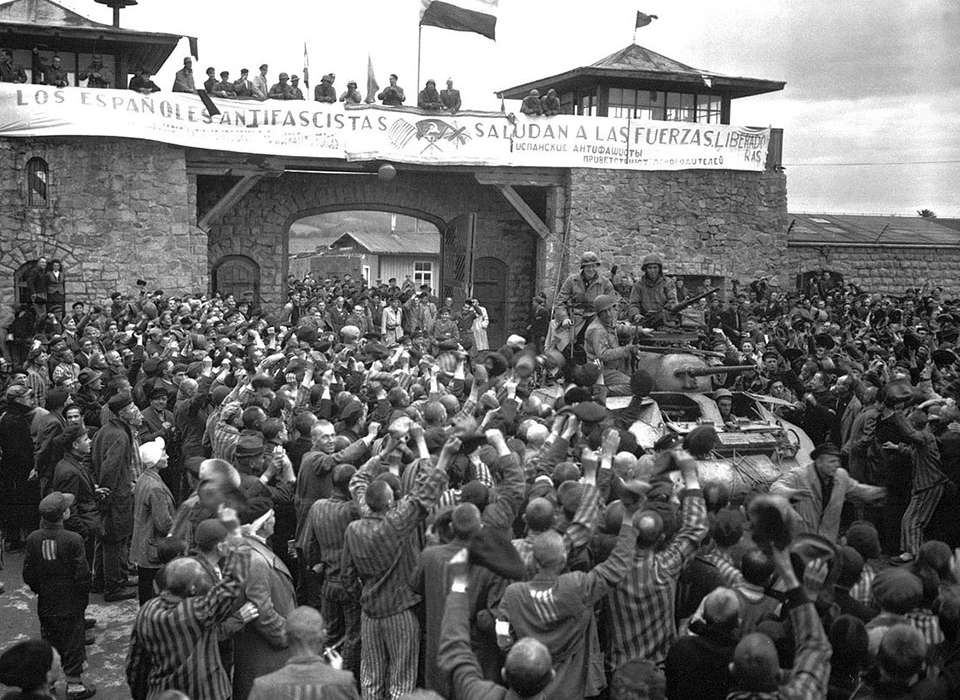
Soon afterward came Austrian resistance members, German dissidents, Spanish Republicans fleeing Franco’s victory, Polish civilians, Soviet prisoners of war, Jews deported from across occupied Europe, Roma families, Jehovah’s Witnesses, homosexual men, and many others whom the regime considered enemies or racial outsiders.
As the war expanded across Europe, so did Mauthausen.
Barracks multiplied.
Workshops appeared.
Administrative buildings increased.
Guard facilities expanded.
Eventually the main camp became the center of an enormous complex consisting of dozens of satellite camps stretching across Austria.
Thousands more prisoners poured into the system every month.
The camp evolved into one of the largest concentration camp networks under SS control.
Yet regardless of where they came from, nearly every prisoner experienced the same ritual upon arrival.
The process began long before they understood where they had been taken.
After exhausting journeys inside overcrowded freight trains, survivors stepped onto unfamiliar ground under shouted commands from SS guards.
Dogs barked.
Prisoners were ordered to line up immediately.
Any hesitation invited beatings.
The first objective was simple.
Strip away every trace of personal identity.
Names no longer mattered.
Families no longer mattered.
Occupations, education, military service, religious beliefs, achievements, and memories became irrelevant.
Prisoners surrendered whatever belongings they still possessed.
Suitcases disappeared.
Wedding rings vanished.
Photographs of loved ones were confiscated.
Letters from home were taken away.
Money had no value.
Everything that connected them to their previous lives disappeared within minutes.
Next came the shaving.
Hair was removed from the head and often from the entire body.
The procedure was not performed for comfort or hygiene alone.
It served psychological purposes.
People who had arrived looking like teachers, engineers, students, musicians, priests, laborers, or fathers suddenly looked nearly identical.
Individuality dissolved.
Clothing followed.
Prisoners were ordered to undress completely.
Many endured forced showers under humiliating conditions.
Only afterward did they receive camp uniforms, frequently worn by previous inmates who had already died.
The garments rarely fit.
Shoes often did not match.
Personal dignity disappeared alongside personal possessions.
Finally came the numbers.
Instead of introducing themselves by name, prisoners learned to answer with identification numbers assigned by the SS.
The bureaucracy of extermination depended upon reducing human beings into records.
Files replaced identities.
Statistics replaced lives.
Every prisoner also received colored symbols stitched onto clothing.
These triangles identified why the Nazis believed each person belonged inside the camp.
Political prisoners.
Criminal prisoners.
Jews.
Jehovah’s Witnesses.
Homosexual prisoners.
Roma.
Foreign forced laborers.
The classification system encouraged division while reinforcing Nazi racial ideology.
It also determined how prisoners were treated.
Some groups faced harsher conditions than others.
For many newcomers, this first day proved more psychologically devastating than any beating.
They realized they had not entered an ordinary prison.
They had entered a carefully organized system designed to erase the person they once were.
Outside the walls, people still had names.
Inside Mauthausen, they became numbers expected to work until they collapsed.
Above them stood armed guards.
Around them rose stone walls.
Ahead lay years of hunger, exhaustion, violence, and uncertainty.
Few understood that the camp’s true purpose extended far beyond imprisonment.
The granite quarry beneath the hill would soon reveal the logic behind everything they had experienced.
The fortress above existed for one reason.
To feed a machine that extracted stone by consuming human lives.
And once that machine began operating, survival itself became an extraordinary exception rather than the expectation.