Chapter One
Twelve Minutes After My Death
My daughter-in-law was calculating how long my body needed to remain undiscovered.
“Not overnight,” Vanessa whispered. “That invites questions.”
Her voice came through the narrow opening between two Italian wool jackets hanging inside my bedroom closet. Beyond them, lamplight cut across the carpet in a thin gold blade.
My son stood at the foot of my bed.
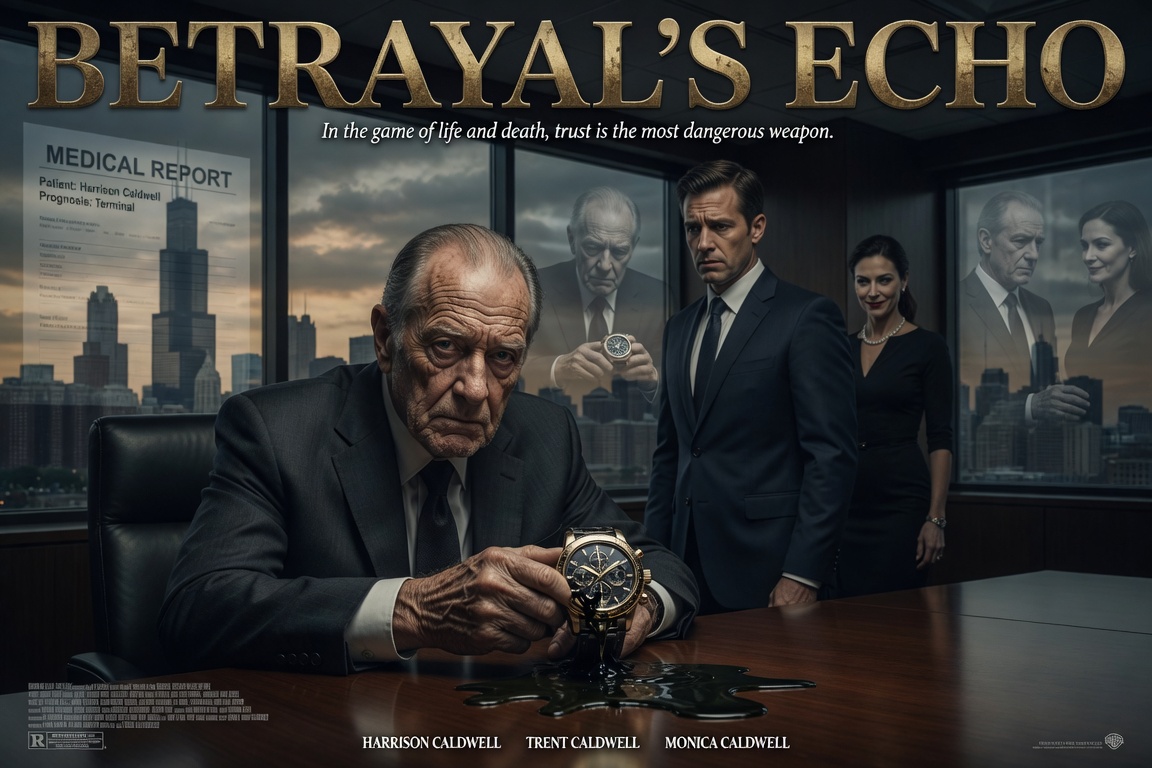
Trent had removed his suit coat but kept his tie knotted. He always did that when he was nervous. Even as a boy, he hated appearing unfinished.
“How long, then?” he asked.
“Two hours. Maybe three.”
“And the medical examiner?”
“He’s seventy, Trent. He has an arrhythmia, high blood pressure, and a documented history of chest pain. They won’t treat a cardiac event like a homicide unless someone gives them a reason.”
Rain ticked against the bedroom windows.
Chicago spread beyond the glass in a wet constellation of traffic lights, office towers, and red aircraft beacons. Forty years earlier, I had watched that same skyline from a rented apartment above a laundromat and promised myself I would someday own a view like this.
Now I stood barefoot in darkness while my only son discussed the safest hour to find me dead beneath it.
Trent rubbed both hands over his face.
“The policy pays immediately?”
“Once the death certificate is filed. Twenty-five million to the company. The succession agreement gives you operational control before the board can appoint an interim chief executive.”
“And the trust?”
Vanessa paused.
I could see her reflection in the tall mirror across the room. She was thirty-nine, elegantly thin, with black hair cut at her jaw and the stillness of someone who had learned young that visible fear attracted predators.
“The family trust becomes irrevocable after his death,” she said. “Your voting shares increase to fifty-one percent.”
Trent looked toward the closet.
I stopped breathing.
His eyes remained on the dark wooden doors for three seconds, perhaps four. Then he turned away.
“I don’t like talking about it in here.”
“Why?”
“Because this is his room.”
Vanessa’s expression softened, but only for a moment.
“Then remember what he did to you.”
My son walked to the rain-streaked window.
Below him, Lake Shore Drive glistened like a black ribbon laid across the city.
“He didn’t beat me,” Trent said.
“No. He did something more respectable.”
His shoulders tightened.
“He left,” she continued. “Every morning, every birthday, every time your mother needed him. He built terminals in Rotterdam while she sat through chemotherapy alone.”
“I was there.”
“You were seventeen.”
“I said I was there.”
The words cracked across the bedroom.
Vanessa lowered her voice.
“And when she died, what did he do?”
Trent’s reflection stared back at him from the glass.
“He bought another company.”
“No. He bought forgiveness without asking whether you were selling it.”
The silence that followed was more painful than anything they had said about the insurance money.
Because that part was true.
My wife, Eleanor, had died twenty-three years earlier in a room at Northwestern Memorial Hospital while I was somewhere over the Atlantic negotiating the acquisition of a freight carrier in Belgium.
I had told myself the deal protected twelve thousand jobs.
I had told myself Eleanor had been unconscious.
I had told myself Trent understood.
A man can build an empire from the excuses he refuses to examine.
Vanessa opened the leather portfolio resting on my bed.
“The dosage has to remain consistent,” she said. “Small enough to resemble deterioration. No sudden spike.”
My fingertips went cold.
Trent turned from the window. “You said there was no pain.”
“There shouldn’t be.”
“Shouldn’t?”
“The delivery system was designed for cardiac research. It releases microdoses through the skin. Dizziness, fatigue, irregular heartbeat. Eventually, an event.”
“What kind of event?”
“The kind his doctors have been expecting for years.”
Lightning whitened the windows.
For an instant, every detail in the bedroom appeared with merciless clarity: Eleanor’s silver hairbrush on the dresser, the reading chair no one had sat in since her death, my son’s expensive shoes planted on the rug she had chosen.
Then darkness returned.
Trent sat on the edge of my bed.
“When?”
Vanessa closed the portfolio.
“Once he signs the transition papers.”
“And if he doesn’t?”
“He will. Tomorrow morning, you give him the watch.”
My heart struck once, hard enough to shake my ribs.
Trent looked down at his hands.
“He’ll recognize it.”
“That’s the point.”
“He thought it was lost.”
“You found it in the old storage unit. Tell him you wanted him to have something that belonged to his father.”
“My grandfather.”
“Yes.”
Trent’s jaw tightened.
“He won’t wear it.”
Vanessa smiled without warmth.
“He will if you ask him to.”
They left twelve minutes later.
I remained in the closet long after their footsteps disappeared down the hall.
The air smelled of cedar, damp wool, and the faint citrus cologne Trent had worn since college. My knees trembled, though the room was warm.
On the floor beside my foot lay a small blue button.
It had fallen from one of Eleanor’s old winter coats years ago. I had never thrown it away.
I picked it up and closed my hand around it.
My first instinct was to call the police.
My second was to summon my security director, have Trent and Vanessa removed from the house, and freeze every account carrying the Caldwell name.
That was the man I had trained myself to become: decisive, protected, always three moves ahead.
But another question stopped me.
Why had my son hesitated?
He had discussed my death. He had allowed the plan to continue. Yet when Vanessa described the final result, something in him had recoiled.
Perhaps it was cowardice.
Perhaps there was still a fragment of the boy who once waited at the front window with a baseball glove while I flew to Singapore instead of attending his championship game.
I stepped out of the closet.
The leather portfolio was gone. The bedroom looked untouched.
Only the indentation where Trent had sat remained on the bedspread.
I crossed the room and placed Eleanor’s button inside the top drawer of my nightstand. Then I picked up the telephone.
I did not call the police.
I called my assistant.
“Margaret,” I said when she answered, her voice thick with sleep. “Cancel everything before noon.”
“Are you all right, Mr. Caldwell?”
I looked toward the door through which my son had just walked.
“No,” I said. “But tomorrow, I intend to find out how much time I have left.”
At eight the next morning, Trent entered the breakfast room carrying a narrow wooden box.
Chapter Two
The Gift
The box was older than my company.
Dark walnut. Brass hinges. A faded burn mark along one corner.
My father had made it with his own hands in 1951, back when he worked nights repairing rail engines near Cicero and spent his Sundays carving toys he was too ashamed to give me.
Trent placed it beside my coffee.
“I found this in the storage building on Fulton,” he said.
Morning light spilled through the windows, pale and cold. Steam rose from the coffee service. Somewhere downstairs, a vacuum cleaner hummed across the marble foyer.
Vanessa sat opposite me in a cream-colored dress, stirring tea she never drank.
I rested my palm on the box.
“You went through the Fulton building?”
“We’re consolidating old company property,” Trent said. “Most of it is junk.”
“Your grandfather’s belongings are not junk.”
“I didn’t mean his things.”
“You said most.”
A flicker of irritation crossed his face.
Vanessa touched his wrist beneath the table.
I noticed because I had spent four decades reading negotiations through gestures smaller than that.
“Open it,” she said gently.
The hinges released with a tired metallic sigh.
Inside lay my father’s watch.
Its round steel case was scratched nearly white along the edges. The crystal carried a hairline fracture between the four and five. The dial had yellowed to the color of old ivory, and the numerals looked hand-painted.
A brown leather strap curled beneath it, stiff with age.
For several seconds, the room around me vanished.
I was nine again, sitting on an overturned bucket in the rail yard while my father leaned into the open belly of a locomotive. Snowmelt dripped from the steel chassis. His sleeves were rolled above his elbows despite the cold.
The watch had flashed on his wrist whenever he reached for a wrench.
He had never let me touch it.
“Where did you find this?” I asked.
“In one of his tool chests.”
“That chest was empty when he died.”
Trent looked at Vanessa before answering.
“There was a false panel.”
My thumb moved across the cracked crystal.
My father and I had never understood one another.
He considered ambition a kind of fever. I considered contentment an excuse used by men afraid to test themselves. When I left Chicago to build my first trucking route, he told me a road was useful only if it brought a man home.
I laughed at him.
Three years later, he died alone at his kitchen table.
I had been in Dallas signing my first major contract.
“I thought you might want it,” Trent said.
His voice had changed.
The polished executive was gone. For a few seconds, he sounded like the boy who once asked whether airplanes flew high enough to see heaven.
I studied him.
He had my height and Eleanor’s eyes. Gray had begun to show at his temples, though he dyed it before board meetings. A pale scar crossed his chin from the afternoon he fell off his bicycle and I had instructed my driver to take him to the emergency room because I was closing an acquisition.
“Help me put it on,” I said.
His fingers stopped above the table.
Vanessa’s spoon clicked against her cup.
I held the watch toward him.
“You brought it for me, didn’t you?”
“Yes.”
“Then help me.”
Trent stood and walked around the table.
His hands were warm as he fastened the leather strap around my left wrist. He pulled it tighter than necessary. Beneath the watch case, something cold pressed into my skin.
He stared at it once the buckle was secured.
“Too tight?” he asked.
“No.”
For one breath, his fingers remained around my wrist.
He could have removed it.
He did not.
Instead, he stepped away.
“It looks right on you,” Vanessa said.
I raised the watch to my ear.
The ticking was faint and irregular.
My father had once told me that cheap watches counted seconds, while good watches protected them.
I had accused him of trying to make poverty sound poetic.
“When was it serviced?” I asked.
“I don’t know,” Trent replied. “Probably not for decades.”
“I’ll take it to someone.”
Vanessa’s eyes lifted.
“It seems to be running.”
“So was the Titanic when it left port.”
Trent forced a laugh.
The watch ticked against my pulse throughout breakfast.
By ten thirty, a pressure had begun behind my eyes.
At eleven fifteen, my right hand trembled while signing a customs document.
At eleven forty-two, I rose from my desk and the office tilted so violently that I caught myself against the window.
My assistant rushed in.
“Mr. Caldwell?”
“I stood too quickly.”
“You were already standing.”
Beyond the glass walls of my office, employees moved through Caldwell Meridian’s headquarters carrying tablets, coffee cups, and urgent expressions. A forty-foot world map covered the main operations floor, pulsing with thousands of small lights representing cargo ships, aircraft, rail lines, and trucks.
The system had been my idea.
Every light meant something was moving because I had ordered it moved.
I stared at the map until my vision steadied.
“Find Mara Ellison,” I told Margaret.
“The jeweler?”
“She still has a shop on Wabash.”
“I thought she retired.”
“Mara will retire when diamonds stop lying.”
Margaret reached for the phone.
“And cancel my car. I’ll take a taxi.”
“You haven’t taken a taxi in twenty years.”
“Then today should be educational.”
Mara Ellison’s shop occupied the second floor of a narrow building beneath the elevated train tracks.
No security guard stood at the entrance. No velvet ropes protected the display cases. A handwritten sign on the door read:
IF YOU NEED TO ASK WHETHER IT IS REAL, YOU ALREADY KNOW.
A bell rang when I entered.
The shop smelled of polishing compound, old paper, and the bitter espresso Mara brewed in a dented silver pot. Watches filled the walls. Their ticking overlapped in a soft mechanical rain.
Mara emerged from behind a curtain wearing a magnifying loupe over one eye.
She was sixty-three, with copper-colored hair pinned carelessly above her neck and a black apron dusted with metal filings.
“Harrison Caldwell,” she said. “Either something priceless has broken, or you have.”
“Possibly both.”
She removed the loupe.
Her gaze moved to the watch on my wrist.
Every trace of amusement left her face.
“Where did you get that?”
“It belonged to my father.”
“Take it off.”
“I only need it examined.”
“Take it off now.”
Her voice cut through the ticking room.
I reached for the buckle.
“No.” Mara came around the counter. “Don’t touch the case. Hold your arm still.”
She pulled on a pair of thin gloves, then used a narrow instrument to lift the leather strap without pressing the watch against my skin.
Something sharp released from beneath the case.
Blood welled in four tiny points along my wrist.
Mara swore.
“What is it?” I asked.
She placed the watch inside a glass dish and switched on a bright work lamp.
From beneath the scratched steel case protruded a wafer-thin black circle no larger than a coin. Four microscopic needles glistened along its surface.
Mara looked at my bleeding wrist.
“How long have you been wearing this?”
“Three hours.”
She grabbed the telephone.
“Who are you calling?”
“An ambulance.”
“No.”
“Harrison, something has been injected into you.”
“I know.”
She froze.
The elevated train roared past outside, rattling the windows.
“You know?”
“I know who gave it to me.”
Mara’s eyes hardened.
“Then you also know this is no longer a jewelry repair.”
She reached again for the phone.
I covered the receiver with my hand.
“If the police arrive now, the person responsible will claim ignorance, destroy the remaining evidence, and hide behind enough attorneys to turn truth into an administrative error.”
“You’re bleeding on my counter.”
“I have bled in more expensive places.”
“This isn’t a boardroom.”
“No,” I said. “In a boardroom, the knives are easier to see.”
Mara stared at me for a long moment.
Then she released the telephone.
“You’re going to a hospital.”
“I’ll go through a private entrance.”
“You’re giving me the name of your doctor.”
“Dr. Samuel Levin.”
“And after he stabilizes you, we call the police.”
“After you open the watch.”
Her lips parted.
“I’m not bargaining with a poisoned man.”
“You recognized it before you saw the needles.”
Mara looked toward the glass dish.
The old watch lay beneath the lamp, ticking softly.
Her expression changed from anger to something I could not identify.
Grief, perhaps.
Or recognition.
“My father drew that dial from memory for fifty years,” she whispered.
I glanced at the yellowed face.
“What are you talking about?”
Mara leaned closer to the watch but did not touch it.
“This is not your father’s watch.”
“It was on his wrist every day of my childhood.”
“I don’t mean he didn’t own it.”
She turned off the shop’s front lights and locked the door.
Then she carried the glass dish into the back room.
“This watch officially never existed,” she said. “And whoever put those needles inside it may have missed the most valuable secret of all.”
Chapter Three
The Watch That Never Existed
Dr. Levin arrived twenty minutes later carrying an emergency medical case and the expression of a man preparing to insult me professionally.
He had treated my family for thirty years. At sixty-eight, he was short, broad-shouldered, and permanently unimpressed by wealth.
He examined the punctures, drew three vials of blood, attached portable electrodes to my chest, and informed me that refusing an ambulance was the behavior of “a stubborn farm animal with excellent insurance.”
“What was in the device?” I asked.
“I won’t know until the laboratory runs the samples.”
“Your suspicion?”
“Digitalis, potassium compounds, beta-blockers, possibly a combination designed to aggravate your existing rhythm disorder.”
“Fatal?”
“Eventually.”
Mara looked away.
Dr. Levin pointed a finger at me.
“You are going to the hospital.”
“I have work to do.”
“You can do it from a cardiac unit.”
“I cannot allow anyone to know I discovered the device.”
“Harrison—”
“If Trent believes the plan is working, he will continue behaving as though he is safe.”
Mara turned sharply.
“Trent?”
Dr. Levin stopped packing his equipment.
Neither man nor woman spoke.
I had said my son’s name aloud without intending to.
The truth felt uglier once it occupied the room.
Dr. Levin sat down.
“Tell us everything.”
So I did.
I described the closet, the insurance policy, the dosage, the transition papers, and Trent’s hand fastening the strap around my wrist.
When I finished, the clocks on the walls seemed unbearably loud.
Mara removed her glasses and pressed her fingers against her eyes.
“I remember him at Eleanor’s funeral,” she said. “He was shaking so badly he couldn’t hold the flowers.”
“He was nineteen.”
“And now he’s trying to kill you.”
“Perhaps.”
“Harrison, four needles were in your skin.”
“Vanessa designed the plan.”
“Trent put the watch on you.”
“I am aware of that.”
“Are you?”
Her question found its mark.
I looked at the blood drying along my wrist.
Dr. Levin stood.
“I’ll admit you under another name. No public record, no staff gossip. We’ll monitor you for several hours, then decide whether you’re stable enough to leave.”
“Agreed.”
He blinked.
“That was easier than expected.”
“I’m old, Samuel. Not irrational.”
Mara made a sound that might have been a laugh.
Before leaving, Dr. Levin sealed the black delivery device inside a specimen container. Mara photographed it from every angle and documented the removal.
Then she turned her attention to the watch.
Under magnification, the scratched steel case revealed details invisible to the naked eye: a tiny crown-shaped mark near the lower lug, three numbers engraved beneath decades of grime, and a narrow seam around the back plate.
“Your father ever tell you where he got it?” she asked.
“He said it was payment for repairing a truck during the war.”
“Which war?”
“He never specified.”
Mara placed the watch inside a padded clamp.
“My father was born Elias Morgenstern in Łódź, Poland. In 1944, he was fourteen years old and hiding in Switzerland under forged papers. His father, Abram, had been one of Europe’s finest independent watchmakers before the occupation.”
She selected a tool no thicker than a sewing needle.
“Abram and five other craftsmen worked inside an abandoned chapel near the French border. They repaired watches for soldiers, diplomats, smugglers, anyone who could pay. But repairs were a disguise.”
“For what?”
“Moving people.”
The back plate released with a quiet click.
Mara lifted it.
Inside, instead of the standard arrangement of gears and springs, a crescent-shaped bridge curved around the movement. Its surface had been engraved with a pattern of intersecting roads.
“The craftsmen built twenty-four watches,” Mara said. “Each one contained part of a route network used to move Jewish children, political prisoners, and downed Allied pilots across Europe. No single watch held the complete map.”
She pointed to the bridge.
“The engravings looked decorative unless you knew how to align them.”
“And this one?”
“This was the master.”
I stared at the tiny roads.
“How do you know?”
“Because of that symbol.”
Near the balance wheel, barely visible beneath oxidation, was a six-pointed star enclosed within a compass.
“My father drew it every year on the anniversary of his escape.”
Mara’s voice grew quieter.
“He said the master watch disappeared in 1945 with an American truck driver called Henry.”
My father’s name.
A chill moved through me that had nothing to do with the drug in my bloodstream.
“Henry Caldwell was not a soldier,” I said. “His hearing was damaged in a rail accident. The Army rejected him.”
“Civilian drivers carried supplies. Some worked with relief organizations.”
“He never left the United States.”
Mara met my eyes.
“Then he lied to you.”
She removed two microscopic screws and lifted the engraved bridge.
Beneath it lay a tightly folded strip of translucent material.
Not paper.
Film.
Mara’s hands began to shake.
“Is that the route map?” I asked.
“No.”
She held the strip beneath a specialized scanner. Pale letters appeared on the monitor, handwritten in several languages.
Names.
Dates.
Locations.
Dozens of them.
At the bottom of the document was a message in English.
Mara enlarged it.
HENRY,
THE WATCH BELONGS TO THE ROAD, NOT TO THE MAN.
IF I DO NOT RETURN, KEEP THE NAMES SAFE.
ONE DAY, YOUR SON MAY BUILD SOMETHING LARGE ENOUGH TO FINISH WHAT WE BEGAN.
ABRAM
My throat tightened.
“My father could barely read,” I said.
“He could read that.”
“He never mentioned Abram.”
“Perhaps he was protecting him.”
“They were all dead by then.”
“Survivors do not always stop hiding when the danger ends.”
Mara scrolled farther down.
A second message appeared, written in my father’s blocky handwriting.
HARRISON,
IF YOU FOUND THIS, I FAILED TO TELL YOU WHILE I COULD.
YOU ALWAYS WANTED TO BUILD ROADS.
MAKE SURE THEY CARRY MORE THAN MONEY.
DAD
The letters blurred.
I removed my glasses and wiped them, though there was nothing on the lenses.
All my life, I had remembered my father as a tired, uneducated mechanic who distrusted ambition because he possessed none of his own.
Yet beneath the watch on his wrist, he had carried the names of people smuggled away from death.
He had watched me build Caldwell Meridian’s first routes across Europe.
He had waited for me to ask the right questions.
I never had.
Mara touched the edge of the workbench.
“There’s something else.”
She rotated the watch case beneath the scanner.
The modern black delivery device had been attached over a thin steel ring added to the back. Along its inner surface, nearly hidden beneath adhesive, ran a sequence of electronic contacts.
“What are those?”
“Data pins.”
“The watch is mechanical.”
“The original watch is. The poison delivery system isn’t.”
She connected the ring to a diagnostic reader.
A string of numbers appeared on the screen.
Dates. Times. Dosages.
The first entry was six weeks old.
My pulse slowed.
“I only wore the watch today.”
Mara read the next lines.
The delivery system had been tested repeatedly before being placed on my wrist. Each test included an identifier for the connected device controlling it.
The same identifier appeared thirty-seven times.
“Can you trace it?” I asked.
“Not to a name from this equipment. But the police can.”
I leaned closer.
At the bottom of the screen was a final scheduled command.
A larger dosage.
The date was three days away.
The time was 9:30 p.m.
The evening of Caldwell Meridian’s annual board dinner.
Mara looked at me.
“They were not waiting for your health to decline.”
“No.”
“They chose the exact minute.”
I stared at the scheduled command.
At 9:30 on Friday night, I was expected to stand before the board and sign control of my company over to Trent.
My death had not merely been predicted.
It had been placed on the corporate calendar.
Chapter Four
The Company I Built for a Stranger
I spent four hours beneath a false name in a private cardiac suite while Dr. Levin flushed the drug from my system and insulted my dietary habits.
By evening, the dizziness had faded.
The anger had not.
From the hospital bed, I watched Trent call my phone twice.
He left one message.
“Dad, just checking whether the watch is keeping time. Call me when you can.”
I replayed it three times.
Not because of what he said.
Because of the silence before he hung up.
A six-second pause.
Long enough to confess.
Long enough to warn me.
Long enough to do nothing.
At seven, Naomi Price entered the room carrying a laptop and two sealed folders.
Naomi had served as Caldwell Meridian’s general counsel for fourteen years. She was forty-seven, tall, severe, and wore her silver-streaked hair in a braid that reached the center of her back.
She had once represented dockworkers injured by one of my subcontractors.
After she defeated our legal team, I hired her.
“You look terrible,” she said.
“Samuel has been praising my appearance all afternoon.”
Dr. Levin removed the monitor from my finger.
“I told him his arteries have the emotional range of concrete.”
Naomi placed the folders on the bed.
“You asked me to review the insurance policy without alerting the finance department.”
“What did you find?”
“The policy was authorized eight months ago by Trent and Vanessa through a subsidiary risk committee. It names the corporation as beneficiary, but a private succession agreement redirects the resulting liquidity toward the purchase of your voting shares.”
“Legal?”
“Technically.”
“Ethical?”
“No.”
She opened the first folder.
“The policy contains an accelerated control provision if you die within ninety days of signing the transition document.”
“Friday.”
“Yes.”
“Who drafted it?”
“An outside firm in Delaware. The partner handling it attended law school with Vanessa.”
Naomi studied me.
“What aren’t you telling me?”
I looked toward Dr. Levin.
He closed the door.
Then I told her.
Unlike Mara, Naomi did not interrupt. She listened with her hands folded, her face revealing nothing until I described the needles.
Then she rose and walked to the window.
Traffic crawled along the avenue below.
“You need federal investigators,” she said.
“I need evidence Trent cannot explain away.”
“He placed a drug-delivery device against your skin.”
“A device hidden inside an object that passed through several hands.”
“Are you defending him?”
“I am removing every defense he might use before he uses it.”
Naomi turned.
“Why?”
“Because he is my son.”
“That is not an answer.”
“It is the only answer I have.”
She returned to the bed.
“There’s another problem. If we expose the policy before Friday, the board will suspend Trent but may still force you into retirement for health reasons. Several directors already believe you’ve stayed too long.”
“They may be right.”
Naomi’s eyebrows lifted.
I had never admitted that before.
For years, succession had been a subject I treated like surrender. Every candidate lacked judgment. Every timeline felt premature. Every proposal seemed to threaten the structure I had built.
In truth, I did not know who I was without the company.
I had confused being necessary with being loved.
“Draft a new transition agreement,” I said.
“To whom?”
“An interim chief executive chosen by the board.”
“Not Trent?”
“No.”
“And your shares?”
“Place them into a foundation.”
Naomi stared at me.
“What kind of foundation?”
I gave her the microfilm from the watch.
She read the names in silence.
When she reached my father’s message, she sat down.
“I built my first European distribution hub twelve miles from one of these routes,” I said. “My father tried to tell me something before he died. I was too busy explaining my success to listen.”
“You couldn’t have known.”
“I could have asked.”
Naomi closed the file.
“What do you want the foundation to do?”
“Emergency transportation. Refugee evacuation. Medical logistics. Disaster corridors. The work my company is best equipped to perform and has spent forty years treating as public relations.”
“And control of Caldwell Meridian?”
“The foundation receives forty percent. Employees receive twenty. The remainder stays with the family trust, but no individual may control a majority.”
“Trent will fight it.”
“I expect him to.”
“Vanessa will recognize what you’re doing before the board dinner.”
“Then we must give them something more urgent to fear.”
That night, I returned home wearing a replacement watch.
A cheap one from the hospital gift shop.
The original remained locked in Mara’s workshop.
Trent found me in the library.
A fire burned behind the iron grate, filling the room with the scent of oak smoke and old leather. He stood near the doorway, his face pale.
“You changed watches.”
“The strap broke.”
“When?”
“During a meeting.”
His eyes moved to my left wrist.
“Where is it?”
“With a repairman.”
His nostrils flared.
“Which repairman?”
“Why?”
“It belonged to Granddad.”
“And you called his belongings junk yesterday.”
“I told you that wasn’t what I meant.”
I poured two fingers of bourbon into a glass.
My hand remained steady.
“Sit down, Trent.”
“I have a call.”
“Sit.”
He obeyed.
Even at forty-two, part of him still reacted to the tone I had used when he was a child.
I hated myself for using it.
“The board dinner is Friday,” I said. “I’m signing the transition agreement.”
His expression changed so quickly that a stranger might have missed it.
Relief.
Then suspicion.
“You’re stepping down?”
“I’m transferring daily control.”
“To me?”
I let the silence lengthen.
He leaned forward.
“You said I’d earned it.”
“I said you had earned consideration.”
“I have run operations for six years.”
“You have managed operations. Running the company requires the confidence of the board.”
“I have their confidence.”
“You have their fear. I made the same mistake for thirty years.”
His fingers curled around the arm of the chair.
“Who, then?”
“The board will appoint an interim executive.”
The color drained from his face.
“You’re humiliating me.”
“No announcement has been made.”
“You promised.”
“I promised you an opportunity. Not a throne.”
He stood.
The boy vanished. The executive returned.
“If you bring in an outsider, the company will fracture. Half the senior team reports to me.”
“Then we will learn whether they serve Caldwell Meridian or Trent Caldwell.”
“You don’t trust me.”
The words hung between us.
Behind him, firelight moved across the portrait of Eleanor above the mantel.
“You stopped asking for my trust years ago,” I said.
His face tightened.
“You were never home long enough for me to ask.”
There it was.
Not a corporate argument.
A wound that had been waiting twenty-five years to speak.
“I know,” I said.
The answer surprised him.
It surprised me as well.
He looked away first.
“I need the watch back.”
“Why?”
“It’s mine.”
“You gave it to me.”
“I changed my mind.”
“Did you?”
He glanced toward the door.
Vanessa stood there.
She wore no shoes. Her expression was calm, but one hand pressed flat against the doorframe.
“What happened to the strap?” she asked.
“It separated from the case.”
“Was the case damaged?”
“I don’t believe so.”
She smiled.
“Good.”
Then she crossed the room, kissed my cheek, and said she was glad I had decided to sign the transition papers.
Neither of them knew I had removed those papers from the agreement.
Neither knew the watch had recorded every dosage command.
But as Vanessa followed Trent into the hall, she glanced back at my wrist.
For the first time since I had known her, I saw naked fear in her eyes.
Chapter Five
The Price of a Childhood
At nine the following morning, Vanessa entered Caldwell Meridian’s restricted pharmaceutical warehouse using Trent’s executive credentials.
Our security system captured her face from three angles.
She remained inside for eleven minutes.
When she left, she carried nothing visible.
Naomi showed me the footage in my office.
“What does the facility store?” I asked.
“Cardiac medication, injectable oncology drugs, temperature-sensitive compounds. We transport them for several manufacturers.”
“Could she replace the substance in the delivery device?”
“If she still had access to it.”
“She believes the watch is being repaired.”
Naomi closed the video.
“She may try to retrieve it.”
“Let her.”
Mara had already moved the watch.
She placed a replica in her shop safe: same scratched case, same cracked crystal, same leather strap. A retired theatrical prop maker created the exterior from high-resolution scans.
Inside the replica was a transmitter.
The real watch rested in a bank vault.
At noon, I called Vanessa.
“I’m worried the jeweler may have lost your grandfather’s watch,” I said.
Silence.
Then: “Why would you think that?”
“She claims someone entered the shop last night.”
“Was anything stolen?”
“Apparently not. I’m going there at six.”
“Alone?”
“I’ve been alone most of my life.”
“That isn’t true.”
“No,” I said. “It is merely how I behaved.”
Another silence.
Vanessa’s voice softened.
“Harrison, perhaps you should let Trent pick it up.”
“He has a board presentation.”
“I can go.”
“Why does the watch matter so much to you?”
Her answer came too quickly.
“It matters to Trent.”
At 5:53 p.m., rain began again.
Mara’s shop was dark except for a lamp above the back workbench. The elevated tracks cast moving shadows across the ceiling.
I waited in the storage room with Naomi and two plainclothes investigators from the Chicago Police Department.
I had finally agreed to involve them after the laboratory confirmed the substance in my blood: a controlled cardiac glycoside mixed with a medication that suppressed early warning symptoms.
The combination had no legitimate reason to exist.
At 6:17, the front door opened.
Vanessa entered.
She wore a gray coat and leather gloves.
“Harrison?”
No one answered.
She walked behind the counter.
Her movements were quick, practiced. She opened drawers, checked beneath the register, then approached the safe.
A voice spoke from the darkness.
“Looking for this?”
Trent stepped into the pool of light holding the replica watch.
Vanessa stopped.
I had not known he would come.
Neither had the police.
Trent’s hair was wet from the rain. His tie hung loose. He looked less like an executive than a man who had run several blocks without deciding where he was going.
“Give it to me,” Vanessa said.
“You told me it was at the jeweler’s.”
“It is.”
“It was in your desk.”
Her expression hardened.
“You searched my desk?”
“I searched our house after the monitoring application disappeared from my phone.”
The investigators glanced toward me.
So did Naomi.
Trent knew.
Perhaps he had known since breakfast.
Vanessa lowered her voice.
“We shouldn’t discuss this here.”
“What did you put in it?”
“You know what was in it.”
“You said it would make him sick.”
“It was supposed to.”
“You said he would have time.”
“For what?”
“To sign. To retire. To live somewhere else.”
Vanessa stared at him.
“You understood the policy.”
“I understood the money. I didn’t understand you had scheduled the final dose.”
“You watched me schedule it.”
“I thought it was a failsafe.”
Her laugh was quiet and exhausted.
“A failsafe for what, Trent? His recovery?”
He flinched.
Vanessa moved closer.
“Your father would never step aside. You said that yourself. He would die at his desk and leave you sixty years old, still asking permission to move a truck from one dock to another.”
“I didn’t say kill him.”
“You said you wanted your life back.”
“My life.”
“And what do you think money is? Money is time someone else cannot take from you.”
She removed one glove.
A red scar crossed the center of her palm.
I had seen it before but never asked how she received it.
“My mother worked two jobs,” Vanessa continued. “When she got sick, the insurance company delayed treatment for eleven weeks because a form was coded incorrectly. Eleven weeks. She died owing ninety-three thousand dollars to a hospital that sent collection letters to her funeral.”
Trent’s voice dropped.
“This isn’t about your mother.”
“It is always about my mother.”
“No. It’s about you being terrified that one day someone richer will decide you don’t matter.”
“Yes.”
The answer silenced him.
Vanessa’s face changed. The hard calculation vanished, revealing the frightened girl beneath it.
“I will never be powerless again,” she said. “Neither will you.”
Trent looked at the watch in his hand.
“My father is not an insurance company.”
“No. He’s worse.”
His head snapped up.
“He taught you to beg for love and call it ambition. He built an empire out of every dinner he missed, every promise he broke, every night your mother cried after pretending she wasn’t waiting for him.”
“I know what he did.”
“Then why are you protecting him?”
“I’m not.”
“You came here to remove the evidence.”
Trent’s fingers tightened around the watch.
“I came here because I needed to know whether he was still wearing it.”
My chest tightened.
Vanessa studied him.
“You were going to warn him.”
“I don’t know.”
“Yes, you do.”
Trent’s voice broke.
“I kept thinking he would take it off.”
“But he didn’t.”
“He trusted me.”
The words barely rose above the ticking clocks.
My son sank into Mara’s chair.
The watch rested between his palms.
“When he asked me to fasten it, I thought he knew,” he whispered. “He kept looking at me.”
Vanessa crouched in front of him.
“Listen to me. We can still fix this.”
“How?”
“We destroy the device. The drug will clear his system. He signs on Friday. We cancel the final dose.”
“And if he doesn’t sign?”
Her face became still again.
Trent looked into her eyes and found the answer.
He stood so suddenly the chair fell backward.
“You were going to do it anyway.”
“You don’t understand what happens if he gives control to someone else.”
“I understand perfectly.”
“No, you don’t. Your entire identity depends on that company. Without it, you’re just a neglected child with a famous last name.”
Trent recoiled as though she had struck him.
Then he placed the watch on the workbench.
“I’m done.”
Vanessa stared at him.
“You think he’ll forgive you?”
“No.”
“You think the police will believe you were confused?”
“No.”
“Then what exactly are you done with?”
Trent looked toward the dark storage room.
For one impossible second, I believed he could see me through the wall.
“Being the man he made me,” he said.
Vanessa picked up the watch.
The transmitter activated.
A small green light flashed beneath the crystal.
She saw it.
Her eyes widened.
“This isn’t the watch.”
The police stepped from the shadows.
Vanessa ran.
Chapter Six
The Road Beneath the City
She reached the staircase before Detective Ruiz caught her.
Vanessa did not scream or fight. She simply went limp, forcing the officers to carry part of her weight as they placed her in handcuffs.
Trent remained beside the workbench.
When I entered the room, he did not look surprised.
His face collapsed.
“You heard everything.”
“Yes.”
“How long?”
“Long enough.”
Rain hammered the windows. Blue police lights flickered across the ceiling.
Trent looked down at my bare wrist.
“Are you dying?”
“No.”
The breath left him so violently that he gripped the edge of the table.
I had imagined this confrontation dozens of times since the closet.
In some versions, I struck him.
In others, I listed every school, house, vacation, and opportunity my money had provided. I explained the sacrifices required to build something capable of surviving generations.
Standing before him, none of those arguments mattered.
A father cannot defend his absence by presenting receipts.
“Why didn’t you stop her?” I asked.
He stared at the floor.
“Because part of me wanted what she promised.”
“My death?”
“The end of waiting.”
“For the company?”
“For you to choose me.”
His eyes lifted.
“When I was twelve, you told me I could come to the airport. You were flying to Los Angeles. I packed a bag.”
I remembered the trip.
A union strike had threatened our western routes. I spent four days negotiating.
“You left without me,” Trent said.
“Your mother told me you had a fever.”
“I lied about the fever after I heard you tell your driver there wasn’t room.”
I closed my eyes.
“I don’t remember saying that.”
“I do.”
The clocks continued ticking around us.
Trent wiped his face with one hand.
“I hated you for so long that hating you became the only thing we did together.”
“You could have left the company.”
“And gone where? Every room I entered, someone knew your name. Every success belonged to you. Every failure proved I wasn’t you.”
“So you decided to inherit me by force.”
“No.”
His voice fell.
“I decided not to ask questions when Vanessa said there was another way.”
That was the truth.
Not innocence.
Not murder conceived in cold blood.
Cowardice sharpened by resentment, then disguised as inevitability.
Detective Ruiz approached.
“Mr. Caldwell, we need to take your son in.”
Trent held out his hands before the detective requested them.
The handcuffs clicked around his wrists.
At the door, he stopped.
“Was Granddad’s watch really worthless?”
I looked toward Mara.
She brought the genuine watch from a secured case and placed it beneath the lamp.
Trent stared at the engraved movement.
“It may be one of the most historically important watches in existence,” Mara said. “Its market value could exceed ten million dollars.”
A bitter laugh escaped him.
“Of course it could.”
“That is not its real value,” I said.
I showed him the names on the microfilm.
He read my father’s message.
His face changed when he reached the final line.
MAKE SURE THEY CARRY MORE THAN MONEY.
“What does it mean?” Trent asked.
“It means your grandfather knew what I might become.”
“And did you?”
“Become it?”
He nodded.
I looked around the darkened shop, at my son in handcuffs and my daughter-in-law standing between two officers.
“Yes,” I said. “I became exactly what he feared.”
Friday’s board dinner was held in Caldwell Meridian’s original warehouse on the South Branch of the Chicago River.
I had purchased the building in 1989, when the roof leaked and rats nested inside the loading bays. Now its brick walls enclosed a polished event space with steel beams, suspended lights, and windows overlooking the black water.
More than three hundred executives, investors, employees, and family members attended.
Rumors moved through the crowd faster than wine.
Trent’s arrest had not yet become public, but his absence was impossible to ignore. Vanessa’s name had vanished from the program. Security stood at every entrance.
At 9:25 p.m., I walked onto the stage.
The cheap hospital watch remained on my wrist.
The real watch rested in a glass case beside the podium.
Behind me, a screen displayed a photograph of my father at twenty-seven. He stood beside a relief truck in France, one boot on the running board, thinner than I had ever known him.
The picture had been found in an archive that morning.
He had left America in 1945 as a civilian driver for an international relief organization.
He had lied to me about nearly everything he did during those eighteen months.
Not from shame.
From a promise of secrecy.
“My father believed roads should carry more than money,” I told the room.
No one moved.
“For most of my life, I believed he lacked ambition. Yesterday, I learned he helped move sixty-three people across borders during the final months of the Second World War. Twenty-seven were children.”
The screen changed.
Names from the microfilm appeared behind me.
Some had photographs beside them. Others had only birth dates and locations.
“My father carried these names inside a watch. He waited for me to become a man capable of understanding why.”
I looked across the crowd.
Drivers in blue uniforms stood beside directors in tuxedos. Warehouse supervisors sat near investment bankers. Men and women who had built my company without ever entering my home watched me with uncertain faces.
“I was not that man when he died.”
The words scraped my throat.
“I built Caldwell Meridian by treating motion as the highest form of progress. Faster ships. Larger aircraft. Shorter delivery windows. I measured success by how much we moved and how little time we wasted.”
I paused.
“But time is not wasted only by delay.”
Eleanor’s face appeared in my mind.
Trent at twelve, standing beside a packed bag.
My father at his kitchen table, waiting for a son who did not arrive.
“Time is also wasted when a man is so busy building a future that he abandons everyone meant to live in it.”
At the rear of the room, someone lowered their head.
I opened the transition document.
“Tonight, I am resigning as chief executive officer of Caldwell Meridian.”
A murmur passed through the warehouse.
“I am also declining to name my son as my successor.”
The sound grew louder.
I waited until it faded.
“Effective immediately, Naomi Price will serve as interim CEO while the board conducts an independent search.”
Naomi stood near the stage, visibly startled despite having drafted the agreement.
I had not told her I intended to recommend her.
She had spent fourteen years challenging me.
The company needed someone who did not confuse obedience with loyalty.
“Forty percent of my voting shares will be transferred to the Road Home Foundation, an independent nonprofit that will use Caldwell Meridian’s transportation network during humanitarian emergencies. Twenty percent will be placed in an employee ownership trust.”
Several directors turned toward one another.
A few appeared furious.
Good.
The company had spent too many years mistaking my comfort for stability.
“The remaining shares will stay with the Caldwell family trust. But no member of my family, including me, will ever again control this company alone.”
I signed the document.
The sound of the pen across paper carried through the microphone.
On the wall behind me, a digital clock changed to 9:30.
The exact minute chosen for my death.
I looked at my father’s watch inside the glass case.
It continued ticking.
Chapter Seven
What Forgiveness Is Not
Vanessa accepted a plea agreement.
She provided investigators with purchase records, software logs, medical research files, and communications showing how the device had been constructed and tested.
She admitted designing the plan.
She also confirmed that Trent knew the watch would deliver medication but claimed she had concealed the lethal dosage schedule from him until three days before the board dinner.
The prosecutors believed her because the digital evidence supported it.
Trent pleaded guilty to conspiracy, reckless endangerment, insurance fraud, and evidence tampering.
He faced prison.
Not as long as Vanessa.
Long enough.
Six months after the arrests, I visited him at the Federal Metropolitan Correctional Center.
The visiting room smelled of disinfectant and vending-machine coffee. Fluorescent lights hummed above gray plastic tables bolted to the floor.
Trent entered wearing tan prison clothes.
He had stopped dyeing his hair.
The gray at his temples made him look more like me than I wanted.
We sat opposite one another.
For several minutes, neither of us spoke.
“How is the company?” he finally asked.
“Profitable.”
He gave a tired smile.
“I didn’t ask about the stock price.”
“That is progress.”
“How is Naomi doing?”
“She fired three vice presidents during her first month.”
“Only three?”
“She is becoming sentimental.”
His smile faded.
“And the foundation?”
“We completed our first operation in April. Medical supplies into a flooded region in Honduras. Two hundred and twelve people evacuated on returning aircraft.”
“Granddad would have liked that.”
“I hope so.”
Trent looked at my wrist.
I wore my father’s watch.
Mara had restored the movement but left every scratch untouched. The cracked crystal had been stabilized rather than replaced.
Some damage deserves to remain visible.
“You kept it,” Trent said.
“For now. It goes to a museum next year.”
“You could sell it.”
“I have enough money.”
“You always said there was no such thing.”
“I was wrong about many things.”
A guard walked past.
Trent folded his hands on the table.
“Did you come to forgive me?”
“No.”
The answer struck him, though he tried not to show it.
I leaned forward.
“Forgiveness is not a door a guilty person knocks on and an injured person is obligated to open. It is not a document I sign because prison has made you look older.”
His gaze dropped.
“I understand.”
“No. You are beginning to.”
I placed a photograph between us.
It showed a twelve-year-old boy standing beside an airport window with a small suitcase at his feet.
Trent touched the edge of the image.
“Mom took this.”
“I found it in one of her albums.”
On the back, Eleanor had written:
He waited until midnight because Harrison said he might return.
Trent’s mouth tightened.
“I don’t remember waiting that long.”
“I do not remember calling.”
“You didn’t.”
“I am sorry.”
He looked up.
I had apologized to business partners, employees, shareholders, and governments. Usually the words were strategic, calibrated, designed to limit damage.
This apology had nowhere to hide.
“I am sorry I taught you that love must be earned through usefulness,” I continued. “I am sorry I made you believe my attention was a promotion you might eventually receive. I am sorry you learned to measure yourself against a company because your father refused to stand still long enough to see you.”
His eyes filled.
I did not look away.
“But I am not responsible for what you did with that pain.”
“I know.”
“You placed the watch on my wrist.”
“I know.”
“You heard what Vanessa intended and remained silent.”
“I know.”
“You must live with that without turning me into the reason it happened.”
His tears fell onto the table.
“Yes.”
The guard looked toward us, then away.
Trent wiped his face with his sleeve.
“What happens now?”
“You serve your sentence.”
“And after?”
“I don’t know.”
“You always know.”
“That was another lie.”
He stared at the photograph again.
“Will you come back?”
I listened to the clocks beyond the security doors.
Somewhere in the building, a buzzer sounded.
“I will come next month,” I said.
It was not forgiveness.
It was not absolution.
It was a promise small enough to keep.
Chapter Eight
The Seconds We Carry
A year later, Mara and I stood beneath the high glass ceiling of the Chicago History Museum while workers lowered my father’s watch into its permanent display.
The exhibit was called The Roads Between Us.
Beside the watch lay enlarged copies of the microfilm, photographs of Abram Morgenstern’s hidden workshop, and testimonies from the descendants of people named inside the movement.
Mara had located twenty-one families.
One woman traveled from Oregon carrying a photograph of her grandmother at age seven. A handwritten note on the back named Henry Caldwell as the American driver who brought her across the border beneath sacks of flour.
I studied the child’s face.
My father had never told me.
He had returned to Chicago, repaired rail engines, raised a stubborn son, and died believing his greatest story might disappear inside a scratched steel watch.
“Do you wish you’d known him differently?” Mara asked.
“Every day.”
She adjusted the corner of an information card.
“My father used to say regret is love arriving after the train has left.”
“Watchmakers should avoid transportation metaphors.”
“He was also terrible with directions.”
Children entered the gallery with their teacher.
They crowded around the display, leaving fingerprints on the glass. One boy pointed at the cracked crystal.
“Why didn’t they fix that part?”
The teacher began answering, but I stepped closer.
“Because the crack is part of what happened to it.”
The boy looked at me.
“Does it still work?”
“Yes.”
“Then why put it in a museum?”
I considered the question.
“Because not everything valuable is meant to belong to one person.”
He nodded as though this were obvious, then ran to join his classmates.
Through the museum windows, snow drifted across Chicago.
Caldwell Meridian trucks moved along the avenue below. Their blue-and-silver logos had recently been changed. Beneath the company name, in smaller letters, appeared a new line:
EVERY ROAD SHOULD BRING SOMEONE HOME.
The board had approved it without knowing those were the last words my father ever spoke to me.
I had been twenty-nine, impatient, and late for a flight to Dallas.
He stood at his apartment door holding the wooden watch box.
“Take this,” he had said.
“I don’t have room.”
“It’s only a watch.”
“I’ll get it next time.”
He looked at me for a long moment.
Then he closed the box.
“Every road should bring someone home, Harry.”
I laughed, kissed his cheek, and left.
There was no next time.
The memory had lived inside me for forty-one years without revealing its meaning.
Now I understood.
My father had not been criticizing the roads I built.
He had been asking where they led.
That evening, I returned to the house overlooking Lake Michigan.
I no longer occupied the master bedroom. The room held too many ghosts and one terrible conversation. I had converted it into an archive for Eleanor’s photographs, letters, and journals.
Her winter coat still hung in the closet.
The blue button remained inside my nightstand.
I carried it downstairs and placed it in a small frame beside her photograph.
Then I sat near the window.
The skyline burned gold across the dark water.
At seven, the telephone rang.
A recorded voice informed me that I had a call from a federal correctional facility.
I accepted.
“Hi, Dad,” Trent said.
“Hello, son.”
Neither of us spoke for several seconds.
In the past, I would have filled the silence with instructions, schedules, or questions designed to avoid the one thing that frightened me most.
Closeness without control.
This time, I waited.
“I got the books you sent,” Trent said.
“Were they the correct ones?”
“Yes. Granddad’s biography isn’t very good.”
“He does not have a biography.”
“The museum catalog.”
“Ah.”
“He looks miserable in every photograph.”
“He considered smiling suspicious.”
Trent laughed.
The sound was quiet, uncertain, but real.
We spoke for twenty-three minutes.
About the museum.
About Eleanor.
About a logistics textbook he was helping another inmate understand.
Before the call ended, Trent asked whether I would visit in October.
I looked at the calendar.
Years earlier, I would have checked the board schedule, flight availability, and expected return on the interruption.
“October ninth,” I said. “Ten in the morning.”
“You wrote it down?”
“Yes.”
“Good.”
The line disconnected.
I remained beside the window as snow began to fall across the city.
For most of my life, I believed time was something powerful men controlled. We divided it into quarters, deadlines, shipping windows, and years of growth. We purchased speed and punished delay. We wore expensive watches to prove every second belonged to us.
But time belongs to no one.
It is entrusted.
A father can waste it.
A son can poison it.
A stranger can preserve it inside a hidden movement for generations.
And sometimes, if the truth arrives before the final second, a broken family may discover that time cannot be recovered—but what remains can still be used differently.
On my wrist, the hospital watch ticked beneath my cuff.
Cheap.
Accurate.
Ordinary.
My father’s watch belonged to history now.
The next hour belonged to me.
For the first time in seventy years, I knew exactly where I intended to spend it.