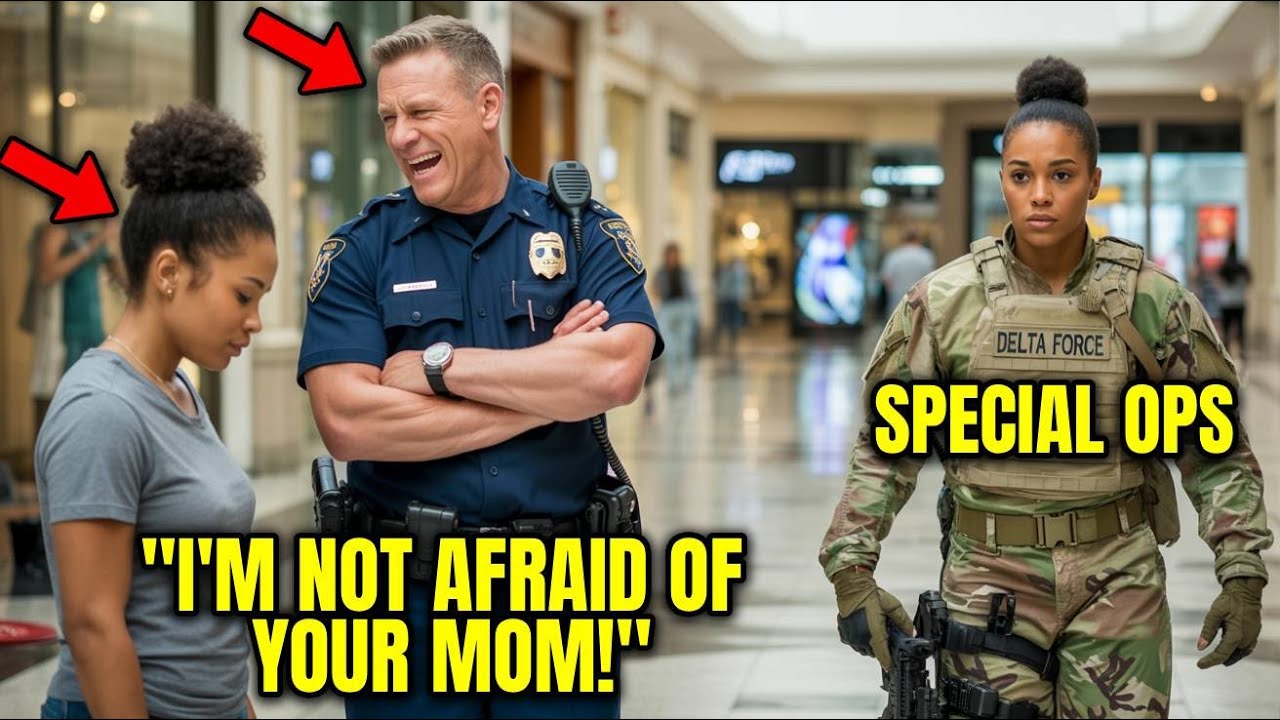
The first time Officer Colton Reeves laughed, twelve-year-old Amaya Richardson thought she had misunderstood him.
The second time, he made sure everyone in the shoe department heard.
“Special Forces?” he repeated, shaking his head. “Your mother?”
He looked Amaya up and down, then let out a louder laugh.
By the time he said, “Kids really will make up anything these days,” half the people inside Dick’s Sporting Goods had stopped shopping.
Amaya stood beside a display of white Nike sneakers, holding one shoe against her foot. Her best friend, Kayn, was still gripping the other half of the pair.
Only a minute earlier, they had been talking about school, basketball tryouts, and whether Amaya’s mother would let her buy shoes that cost more than a hundred dollars.
“My mom’s picking us up,” Amaya had told Kayn. “She just got back from overseas. She’s in Special Forces, so she’s been gone forever.”
She hadn’t announced it.
She hadn’t been speaking to anyone else.
She had simply said it with the easy pride of a daughter who had counted every day her mother was away.
But Reeves had been standing nearby, browsing running shoes while wearing jeans and a dark Charlotte-Mecklenburg Police Department quarter-zip. His badge was clipped to his belt, visible whenever his jacket shifted.
He had turned toward the girls with an amused expression.
“Did you say your mother is in Special Forces?”
Amaya nodded.
“Yes, sir.”
Reeves smiled as if she had just claimed her mother was an astronaut living on Mars.
“What does she do, exactly?”
Amaya hesitated. Her mother had taught her not to discuss details about deployments, missions, or units with strangers.
“She’s a sergeant major,” Amaya said carefully. “She works at Fort Bragg.”
That was when he laughed the first time.
At first, Amaya assumed he was impressed.
Then she saw his face.
It wasn’t surprise.
It was disbelief.
Reeves folded his arms.
“Listen, sweetheart. Special Forces isn’t like the movies. They don’t just let anyone walk in and call themselves Special Forces.”
“My mom doesn’t just call herself that,” Amaya replied. “That’s her job.”
A woman looking at hiking boots glanced over. A teenage employee arranging shoeboxes slowed his movements.
Reeves noticed the attention and seemed to enjoy it.
“I’ve worked around military guys,” he said. “I know what those people are like.”
Amaya’s fingers tightened around the shoe.
“My mom is one of those people.”
“Your mother might be in the Army,” Reeves said. “Maybe she works in an office. Maybe she does paperwork. But Special Forces?”
He glanced around as though inviting the strangers nearby to share the joke.
“Come on.”
Kayn leaned closer to Amaya.
“Let’s just go,” he whispered.
But Amaya didn’t move.
Her mother had spent months away from home. She had missed Amaya’s school play, her birthday dinner, and the championship game where Amaya had scored the winning basket.
Nicole Richardson had called whenever she could, sometimes from bright rooms, sometimes from dark ones, always refusing to say exactly where she was.
She had never complained.
She had never described the danger.
She had only asked about homework, reminded Amaya to help her grandmother, and promised she would come home.
Amaya had watched her mother return two days earlier, walking through the airport in uniform with a heavy bag over one shoulder and exhaustion hidden behind a smile.
There was nothing imaginary about her.
“You don’t know my mom,” Amaya said.
Reeves raised his eyebrows.
“And you don’t have to invent stories to be proud of her.”
The words landed harder than the laughter.
A few people exchanged uncomfortable looks. Someone farther down the aisle lifted a phone.
Amaya felt heat climbing into her face.
“I’m not inventing anything.”
“Okay,” Reeves said, drawing the word out. “Your mother is a Special Forces sergeant major.”
“She is.”
“And she’s coming here?”
“She said she’d meet me by the shoes.”
Reeves checked his watch.
“Well, now I’m curious.”
He leaned against a display table as though settling in for entertainment.
“Maybe we’ll get to meet the famous secret agent.”
Several people heard him.
Nobody laughed.
But nobody told him to stop, either.
That silence made Amaya feel smaller than the jokes did.
She looked at the adults surrounding them. Some stared at the floor. Others pretended to compare prices while listening to every word.
The employee holding the shoeboxes looked as though he wanted to intervene, but his eyes kept drifting toward the badge on Reeves’s belt.
Reeves saw that hesitation too.
His posture changed slightly.
He wasn’t just a man teasing a child anymore. He was a police officer who knew everyone could see that he was a police officer.
“You know,” he continued, “lying about military service is serious. People sacrifice a lot to earn those titles.”
“My mother earned hers.”
“Then what unit?”
“I’m not telling you.”
Reeves gave a satisfied nod.
“Of course you’re not.”
Amaya’s throat tightened.
Kayn touched her arm.
“Amaya, forget him.”
She wanted to.
She wanted to put the shoe back, walk outside, and wait for her mother somewhere nobody could see her.
But leaving felt like admitting she had lied.
“She has medals,” Amaya said. “She has pictures with her team. She has a green beret in a case at home.”
Reeves chuckled.
“You can buy those online.”
The woman near the hiking boots frowned.
“That’s enough,” she said quietly.
Reeves turned toward her.
“I’m just having a conversation.”
“She’s a child.”
“And I’m teaching her that people shouldn’t make claims they can’t prove.”
Amaya stared at him.
There was something in the way he kept saying “your mother.” Something in the way he had looked at Amaya’s dark skin, then pictured the woman who had raised her.
He never said a Black woman could not be Special Forces.
He didn’t have to.
“My mother doesn’t need you to believe in her,” Amaya said.
Reeves tilted his head.
“Is that what she tells you?”
“No. That’s what I’m telling you.”
For the first time, the smile slipped from his face.
Then he looked around at the phones, the spectators, and the nervous employee. His grin returned.
“You’re confident. I’ll give you that.”
Amaya’s eyes burned, but she refused to cry.
“You’ll see.”
Reeves laughed again.
“There it is. The big reveal.”
More people had gathered at the ends of the aisle. What had begun as a private conversation between two children had become a public spectacle.
Some were recording.
Others whispered.
A father pulled his young son closer but stayed to watch.
Amaya could feel every eye on her. With each passing second, her certainty became heavier to carry.
Not because she doubted her mother.
Because she had begun to understand that truth did not always protect you from humiliation.
Sometimes the truth stood alone while everyone waited to see whether it deserved help.
Reeves stepped closer.
“Here’s some advice,” he said. “When adults know more than you, it’s better to listen than argue.”
Amaya lifted her chin.
“You don’t know more about my mother than I do.”
“I know what Special Forces looks like.”
“No,” she said. “You know what you think it looks like.”
A soft murmur moved through the crowd.
Reeves’s jaw tightened.
“You’ve got quite an attitude.”
“She’s defending her mother,” Kayn said.
Reeves glanced at him.
“Nobody asked you.”
Kayn went silent.
Amaya saw the embarrassment on her friend’s face and suddenly felt guilty that he had been pulled into it.
She put the Nike back on the display.
“Come on,” she whispered.
They had taken only two steps when Reeves called after her.
“Tell your mother we’re sorry we missed her.”
Amaya stopped.
His tone made several people wince.
She turned around, but no words came.
For one terrible moment, the pressure cracked through her composure. Her lower lip trembled.
Reeves noticed.
So did everyone else.
Then a voice came from behind the crowd.
“You didn’t miss me.”
The aisle went completely still.
People shifted aside.
A woman in Army combat uniform walked toward them carrying a black portfolio beneath one arm. She was tall, but it was not her height that made the crowd move.
It was the way she carried herself.
Her steps were measured. Her shoulders were square. Her expression was calm enough to be unsettling.
Sergeant Major Nicole Richardson did not need to raise her voice to command a room.
Amaya recognized her mother immediately.
Relief rushed through her so quickly that her knees almost weakened.
“Mom.”
Nicole’s eyes found her daughter first.
She saw the flushed cheeks, the glassy eyes, and the way Amaya’s hands had curled into fists.
Then she looked at Reeves.
Her gaze dropped briefly to the badge on his belt.
“Which one of you is Officer Reeves?”
Nobody answered.
They didn’t need to.
Reeves straightened away from the display table.
“That would be me.”
Nicole walked to Amaya and placed one hand on her shoulder.
“Are you hurt?”
Amaya shook her head.
“No, ma’am.”
“What happened?”
Amaya looked at Reeves.
“He heard me tell Kayn you were in Special Forces. He said I was making it up. He kept laughing.”
Nicole remained still.
“He said you might work in an office,” Amaya continued. “He said I was telling fairy tales.”
Reeves gave a dismissive breath.
“It wasn’t that serious.”
Nicole looked at him.
“You publicly accused my daughter of lying?”
“I was joking with her.”
“She wasn’t laughing.”
Reeves glanced at the surrounding phones.
“This got blown out of proportion. I was just surprised.”
“By what?”
The question was simple.
Reeves opened his mouth, then paused.
Nicole waited.
“By the claim,” he said at last. “Special Forces is unusual.”
“Unusual for whom?”
“You know what I mean.”
“I’d like to hear you explain it.”
The confidence in Reeves’s face began to thin.
He looked at Nicole’s uniform more carefully. His eyes moved over her name tape, her rank, her unit insignia, and the tabs above her pocket.
His shoulders lowered by a fraction.
“I didn’t realize she was being literal.”
Nicole’s hand remained on Amaya’s shoulder.
“My daughter told you her mother was a sergeant major at Fort Bragg. Which part sounded like a metaphor?”
A few people in the crowd smiled.
Reeves did not.
“Ma’am, I respect your service.”
“You didn’t respect my daughter.”
“I didn’t know who she was.”
Nicole’s expression changed.
Not much.
But the entire aisle seemed to feel it.
“That is the problem, Officer Reeves.”
The title sounded different when she said it.
It was not admiration.
It was accountability.
“You’re suggesting that her treatment should have depended on knowing who her mother was,” Nicole continued. “She deserved basic respect before I entered this building.”
Reeves shifted his weight.
“I said I was surprised. Women in those positions are still uncommon.”
“Uncommon does not mean impossible.”
“I understand that now.”
“No. You understand it because I’m standing in front of you wearing proof.”
Nicole looked around at the people recording.
“My daughter gave you the truth before I arrived. You decided the truth could not possibly look like her family.”
Reeves’s mouth tightened.
For the first time, he had no reply ready.
The woman near the hiking boots folded her arms. The teenage employee had stopped pretending to organize boxes. Even the father with the young boy was watching Reeves now rather than Amaya.
The direction of the room had changed.
A few minutes earlier, every eye had made Amaya feel accused.
Now those same eyes had become witnesses.
Reeves rubbed the side of his jaw.
“Look, Sergeant Major, I already said I respect what you do. I made a bad joke. That’s all.”
Nicole studied him.
Then she glanced at the black portfolio beneath her arm.
“Officer Colton Reeves. Central Division?”
His face changed.
It was immediate.
A slight widening of the eyes. A sudden stillness in the jaw. His right hand dropped away from his belt.
“How do you know my division?”
Nicole opened the portfolio.
Inside was a printed roster marked with the seals of Fort Bragg and the Charlotte-Mecklenburg Police Department.
“I spent this morning reviewing candidates for next month’s joint crisis-leadership program,” she said. “Your department nominated twelve officers.”
She turned one page.
“Your name is number seven.”
The crowd went silent again.
This time, Reeves did not look amused.
Nicole closed the folder.
“I chair the assessment panel.”
The color drained from his face.
For several seconds, he simply stared at her.
That was the moment Amaya would remember.
Not the shouting, because there had been none.
Not the crowd, even though dozens of people were watching.
She would remember the exact second Officer Reeves realized the woman he had dismissed as imaginary was responsible for evaluating whether he had the judgment to lead others under pressure.
His lips parted.
Nothing came out.
The phones around them captured everything: the stiff posture, the lowered eyes, and the long silence of a man watching his certainty collapse in public.
Nicole did not smile.
She did not celebrate.
She simply said, “Interesting demonstration of judgment.”
Reeves swallowed.
“Sergeant Major, I think we got off on the wrong foot.”
“You didn’t get off on the wrong foot with me.”
Nicole turned slightly toward Amaya.
“You humiliated a twelve-year-old girl because her reality did not fit your assumptions.”
“I didn’t intend to humiliate her.”
“You continued after she asked you to stop.”
“She never—”
“She told you that you did not know her mother. She tried to walk away. Her friend asked you to leave her alone. A stranger told you she was a child.”
Nicole’s voice remained controlled.
“You had several opportunities to stop. You chose an audience instead.”
Nobody moved.
Reeves looked at the people surrounding him, perhaps realizing that every excuse he offered had already been contradicted by someone’s recording.
“I apologize,” he said.
Nicole waited.
Reeves looked at her.
“I said I apologize.”
“You’re apologizing to the wrong person.”
His eyes shifted toward Amaya.
She stood straighter beside her mother.
“I’m sorry,” he said.
Amaya held his gaze.
“For what?”
The question surprised him.
Nicole did not help.
Reeves looked down at the floor, then back at Amaya.
“I’m sorry for laughing at you.”
Amaya said nothing.
“And for saying you were lying,” he added. “You were telling the truth. I was wrong.”
Nicole’s hand gave Amaya’s shoulder a gentle squeeze.
Reeves continued, his voice quieter now.
“I shouldn’t have embarrassed you. I shouldn’t have assumed anything about your mother. You didn’t deserve that.”
Amaya took a breath.
“Okay.”
She did not tell him it was fine.
Because it wasn’t.
She did not rush to comfort the adult who had hurt her.
She simply accepted that he had finally said the truth aloud.
The store manager appeared from behind the crowd and informed Reeves that an incident report had been completed. Several witnesses had already provided their names, and the manager intended to contact the department’s professional standards office.
Reeves nodded without argument.
His badge, which had seemed so powerful minutes earlier, now looked strangely small against his belt.
Before leaving, Nicole turned toward the crowd.
“You all saw what happened,” she said. “Some of you recorded it. One person spoke up. Most of you stayed quiet.”
Several people lowered their phones.
“I’m glad there is evidence,” Nicole continued. “But a child should not have to wait for her mother to arrive before adults decide she deserves dignity.”
The woman near the boots nodded.
The employee looked down.
Nicole did not shame them. She did not need to.
The truth was already sitting heavily in the aisle.
“Authority is not permission to make someone smaller,” she said. “And disbelief is not harmless when you use it to humiliate someone who has less power than you.”
A man near the back began to clap.
The sound was hesitant at first. Then the woman near the boots joined him. Within seconds, applause spread through the department.
Nicole raised one hand.
The clapping stopped.
“This isn’t about applauding me,” she said. “It’s about remembering what you do the next time someone is being treated like entertainment.”
She looked at Amaya.
“Ready to go home?”
Amaya nodded.
Kayn picked up the Nike sneakers.
“Do we still get these?”
For the first time since the confrontation began, Nicole smiled.
“After all that, they’d better make you run faster.”
A few people laughed, but this time the sound felt warm.
At the register, the woman from the hiking section approached Amaya.
“I’m sorry I didn’t say something sooner,” she said. “You were very brave.”
The teenage employee came over next.
“My sister wants to join the Army,” he said. “I’m going to tell her about you and your mom.”
Another woman thanked Nicole. A father crouched beside his son and quietly explained why Reeves had been wrong.
The support arrived late.
But Amaya no longer felt invisible.
Outside, the afternoon heat wrapped around them as they crossed the South Park Mall parking lot.
For several steps, Amaya said nothing.
Then she asked, “Were you really going to evaluate him?”
Nicole nodded.
“He was on the roster.”
“Is he going to get kicked out of the program?”
“That decision won’t be made because he insulted my daughter,” Nicole said. “It will be made after his department reviews what happened and the panel evaluates whether he has the judgment required for leadership.”
Amaya looked disappointed.
“You could fail him.”
“I could.”
“Then why not?”
Nicole stopped beside their car.
“Because power should never be used the way he used his.”
Amaya thought about that.
Nicole placed both hands on her daughter’s shoulders.
“You told the truth. You defended it without becoming cruel. And even when the room made you feel alone, you did not let someone else rewrite your life.”
“I almost cried.”
“Courage isn’t the absence of tears.”
“I wanted to leave.”
“But you didn’t abandon yourself.”
Amaya looked back toward the store.
“Everyone thought I was lying.”
“Not everyone.”
“Nobody helped.”
“Some were afraid. Some were uncertain. Some were waiting for proof.”
Nicole opened the car door.
“Remember this: the truth does not become more true when powerful people finally approve of it.”
Amaya climbed inside.
Before Nicole closed the door, Amaya looked up at her.
“I’m proud of you, Mom.”
Nicole smiled.
“I’m proud of you, too.”
“For what?”
“For standing in front of a grown man with a badge and refusing to let him laugh you out of what you knew.”
The next morning, videos from the store had spread throughout Charlotte. The police department confirmed that Reeves had been removed from the leadership-program roster pending an internal review. The store’s incident report and witness statements were added to the investigation.
But the clip people shared most was not the moment Nicole revealed who she was.
It was the moment Amaya looked directly at Reeves and asked, “For what?”
Because an apology without accountability protects the person who caused the harm.
And because sometimes the bravest person in the room is not the one wearing the uniform—it is the child who refuses to surrender the truth while every adult waits for someone else to defend it.