The laughter started when the old man asked for a rifle.
It rolled across Range 7, loud enough to rise above the metallic clatter of magazines being loaded and the dry afternoon wind sweeping over the firing line.
“Sir,” Corporal Nathan Reed said, trying and failing to hide his grin, “this isn’t a carnival booth.”
Several Marines nearby laughed harder.
The old man did not.
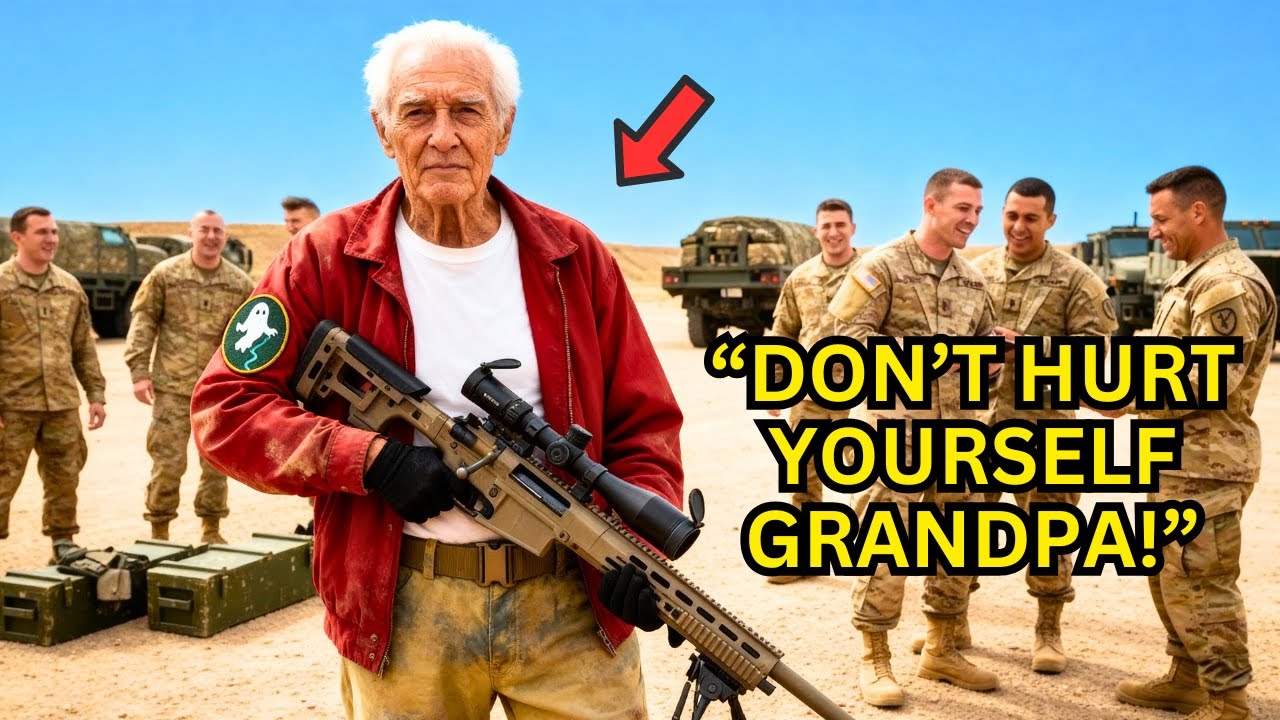
He sat alone on a wooden bench near the edge of the range, both hands resting on a polished walking cane. His name was Philip Lawson. He was eighty-three years old, with narrow shoulders, silver hair, and a faded field jacket that looked as though it had survived several lifetimes.
The jacket was worn at the elbows. One pocket had been repaired with thread that did not quite match. Above it was a small, weathered patch most of the Marines did not recognize.
Philip looked toward the rifles arranged on the rack.
“I asked whether one was available,” he said calmly. “I didn’t ask for a prize.”
The laughter faded into a few scattered chuckles.
Corporal Reed stepped closer.
“You know where you are?”
“Range 7.”
“You military?”
“Not anymore.”
That answer drew another smirk.
Around them, a dozen young Marines waited for their afternoon qualification period. They were confident, restless, and comfortable in a place governed by commands they understood. Philip’s presence seemed to offend that order.
He looked too old.
Too quiet.
Too ordinary.
Reed folded his arms.

“This is a live-fire range. Civilians don’t just walk in and ask to shoot.”
“I have a visitor’s pass.”
“Having a visitor’s pass doesn’t make you qualified to handle a weapon.”
Philip studied the corporal’s face for a moment. There was no anger in his expression. That somehow made Reed more irritated.
“I’m waiting for General Davies,” Philip said. “He’s running late. I thought I might fire a few rounds while I waited.”
This time, the laughter was immediate.
“General Davies?” one Marine repeated.
“Sure,” another said. “And I’m waiting for the commandant.”
Reed leaned down slightly, as if speaking to someone who could not hear well.
“Sir, generals don’t schedule range meetings with random civilians.”
Philip’s fingers tightened around the handle of his cane, but his voice remained even.
“Then I suppose one of us has incorrect information.”
A young lance corporal named Mateo Alvarez stood several feet away, watching the exchange. Unlike the others, he did not laugh.
There was something about the old man’s posture.
Philip’s back was slightly bent by age, but his eyes moved with precision. He noticed every weapon, every open bolt, every Marine crossing the firing line. When someone behind him accidentally swept an unloaded rifle a few degrees too far, Philip’s gaze snapped toward the muzzle before the range safety officer even noticed.
Alvarez had seen nervous civilians visit the range.
Philip was not nervous.
He looked familiar with danger in a way the younger men were not.
Corporal Reed reached toward the visitor badge clipped to Philip’s jacket.
“Let me see that.”
Philip handed it over.
The pass was legitimate. It had been issued that morning and authorized access to the training area. The name printed across it was clear:
PHILIP LAWSON.
Reed read it, then looked at the old man again.
“Could be a mistake.”
“It isn’t.”
“You expect us to believe a general invited you here?”
“I don’t expect you to believe anything,” Philip replied. “I expect you to verify it.”
The Marines stopped smiling.
Reed’s face tightened.
People usually reacted when he pressed them. Civilians apologized. Junior Marines became nervous. Older visitors tried to explain themselves.
Philip did none of those things.
He simply waited.
Reed turned toward the range office.
“Gunny!”
Gunnery Sergeant Robert Miller emerged moments later, already wearing the impatient expression of a man who believed every problem could be solved by raising his voice.
Miller was broad across the chest, with twenty years in uniform and the confidence of someone accustomed to being obeyed before he finished speaking.
“What’s the issue?”
Reed handed him the visitor’s pass.
“This gentleman says he’s meeting General Davies. He also wants us to issue him a rifle.”
Miller looked Philip up and down.
His eyes paused on the cane, the old boots, and the faded jacket.
Then he laughed once.
Not loudly.
Almost dismissively.
“Sir, I think you’ve wandered into the wrong area.”
“No,” Philip said. “I haven’t.”
Miller glanced at Reed as though the answer confirmed his suspicions.
“This is an active military firing range. You cannot handle a service weapon without authorization, training verification, and range clearance.”
“I understand range procedure.”
“I’m sure you believe you do.”
Philip looked past him toward the targets.
“I was familiar with it before you were born.”
A few Marines exchanged glances.
Miller’s jaw shifted.
“Let’s not make this difficult.”
“I’m not making it difficult.”
“You’re refusing to leave.”
“I’m waiting for the man who invited me.”
Miller stepped closer.
The old patch on Philip’s jacket caught his attention. It was dark green, nearly gray with age. A black animal-like shape was stitched across its center, surrounded by a thin red border. Most of the lettering had faded.
Miller pointed at it.
“What is that supposed to be?”
Philip looked down at the patch.
For the first time, something changed in his face.
Not fear.
Not embarrassment.
Something heavier.
“It belonged to my unit.”
Miller pinched the edge of the patch between two fingers, examining it as though it were a novelty purchased from an army-surplus store.
“Never seen it.”
Philip’s hand moved quickly.
He did not grab Miller’s wrist, but he placed two fingers against the gunnery sergeant’s hand and pushed it gently away.
“Don’t touch it.”
The words were quiet.
The effect was immediate.
Miller’s eyes narrowed.
Around them, the range fell silent.
For one brief second, Philip was no longer seeing the Marines, the rifle racks, or the dusty hills surrounding Range 7.
He smelled wet earth.
Burned powder.
Blood mixed with jungle rain.
He saw twelve men moving through darkness without lights, their uniforms soaked through, their faces blackened with mud. He remembered the weight of a wounded Marine across his shoulders. He remembered radio silence, artillery in the distance, and the certainty that no rescue force knew exactly where they were.
Most of all, he remembered Daniel Mercer lying on the floor of a medevac helicopter, one hand pressed against a wound no bandage could close.
Daniel had been twenty-four.
His voice had barely risen above the engine.
“Don’t let them forget us, Phil.”
Philip had carried those words for fifty-seven years.
Miller pointed toward the exit.
“That’s enough. Corporal, escort him off the range.”
“I suggest you call General Davies first,” Philip said.
“I don’t take suggestions from unauthorized civilians.”
A flicker of disappointment crossed Philip’s face.
Not because he was being removed.
Because of the uniform Miller was wearing while doing it.
Reed stepped toward him.
“Come on, sir.”
Philip slowly rose from the bench. His knees resisted, and he leaned on the cane until they steadied.
Several Marines watched without speaking.
Alvarez moved closer to Reed.
“Corporal, maybe we should check the pass.”
Reed frowned.
“We checked it.”
“No, I mean call headquarters. The name might—”
“Stay out of it.”
Near the back of the range stood Thomas Henderson, a civilian logistics manager who had arrived to inspect a shipment of training ammunition.
Henderson had watched the entire confrontation.
He was not a Marine, but he had spent thirty years working around the Corps. He also collected declassified military records and had written two articles about special reconnaissance units in Vietnam.
The patch on Philip’s jacket bothered him.
So did the name.
Lawson.
Henderson pulled out his phone and searched an archived document he had saved years earlier. Most of the page was blacked out. Only a few names remained visible.
One of them was Lawson, Philip R.
Above the list were two words:
PROJECT CHIMERA.
Henderson stopped breathing for a moment.
The file had been discussed for decades in military-history circles. A twelve-man reconnaissance team had operated deep inside enemy-controlled territory during the final years of the Vietnam War. Their missions had not officially existed. Their unit insignia had never been formally approved.
Most records remained classified long after the war ended.
According to the fragments that had become public, only two members of the team had returned.
Henderson looked at the old man being escorted away.
Then he called the general’s office.
At headquarters, Major General Charles Davies was reviewing a readiness report when his aide entered.
“Sir, there’s a Thomas Henderson calling from Range 7. He says it’s urgent.”
Davies did not look up.
“Tell him to contact range command.”
“He mentioned Philip Lawson.”
The general’s pen stopped.
He slowly lifted his eyes.
“What name?”
“Philip Lawson, sir.”
Davies stood so quickly that his chair struck the wall behind him.
“Where is he?”
“Range 7.”
“Why is Henderson calling?”
The aide hesitated.
“He says Gunnery Sergeant Miller is having Mr. Lawson removed. Possibly detained.”
For several seconds, Davies said nothing.
Then his expression hardened.
“Get the vehicle.”
“Sir?”
“Now.”
As the aide reached the door, Davies added, “Call archives. Have them cross-reference Lawson with Project Chimera.”
The aide turned back.
“Project what?”
“Just make the call.”
At Range 7, Miller’s patience had disappeared.
“Last warning,” he told Philip. “Walk willingly, or I call military police.”
Philip stood beside the bench, cane planted in the dirt.
“I have not threatened anyone. I have shown you valid authorization. You may call whomever you believe necessary.”
Miller stepped closer.
“You think being old means the rules don’t apply to you?”
“No,” Philip said. “I think the rules should apply to everyone.”
That answer struck harder than an insult.
Miller’s face reddened.
“Reed, take him.”
Before Reed could move, engines roared beyond the range gate.
Every head turned.
Two black military vehicles swept down the access road, followed by a security vehicle with its lights flashing. Dust rose behind them as they stopped near the firing line.
Doors opened.
A colonel stepped out first. Then two staff officers.
Finally, General Davies emerged in full service uniform.
The range snapped to attention.
“General on deck!”
Boots struck the ground.
Spines straightened.
Miller’s anger vanished, replaced by confusion.
Davies did not acknowledge the formation.
He walked directly past Miller.
Past Reed.
Past the rifle racks.
He stopped in front of Philip Lawson.
For a moment, neither man spoke.
Davies looked at Philip’s face, then down at the faded patch on his jacket.
His entire posture changed.
The general brought his heels together.
Then he raised his hand in a formal salute.
Every Marine on Range 7 froze.
An active-duty major general was saluting the old man they had just tried to remove.
Philip looked at him for a long moment.
Then, slowly, he returned the salute.
“Mr. Lawson,” Davies said, his voice carrying across the silent range. “It is an honor to finally meet you.”
Behind him, Corporal Reed’s mouth opened slightly.
Miller’s face lost all color.
Davies lowered his hand.
“I apologize for being late. There was a command briefing I couldn’t leave.”
“I assumed you had a reason,” Philip said.
The general turned toward Miller.
“What happened here?”
Miller swallowed.
“Sir, we had an unidentified civilian requesting access to a service weapon. We were following safety procedures.”
“Unidentified?”
“He had a pass, sir, but we couldn’t verify—”
Davies held out his hand.
Reed immediately gave him the visitor’s pass.
The general examined it.
“It was issued by my office.”
No one moved.
Davies looked at Miller’s hand, then at the edge of Philip’s patch, which had been slightly folded when Miller touched it.
“Did you put your hands on that insignia?”
Miller glanced toward Philip.
“I was examining it, sir.”
“Do you know what it is?”
“No, sir.”
Davies faced the Marines.
“This patch belonged to Project Chimera.”
No recognition appeared on most of the young faces.
The general let the silence sit.
“Project Chimera was a twelve-man Force Recon element formed for operations that could not be publicly acknowledged. They worked deep in hostile territory. No standard support. No reliable extraction. In some missions, no radio contact for days.”
Alvarez looked at Philip.
The old man’s eyes remained fixed somewhere beyond the targets.
Davies continued.
“Their names were removed from ordinary records. Their reports were sealed. Families were told almost nothing. When missions succeeded, someone else received credit. When men died, their loved ones were given carefully worded letters.”
He pointed toward the patch.
“Twelve Marines wore that symbol.”
The wind moved lightly across the range.
“Two came home.”
Miller stared at Philip.
The general’s voice dropped.
“Philip Lawson was one of them.”
The moment of recognition arrived without warning.
Miller’s shoulders sank.
His eyes moved from the patch to Philip’s cane, then to the weathered hands he had dismissed as weak. His mouth tightened, but no words came out.
Behind him, Reed looked at the ground.
The laughter from minutes earlier seemed to hang over every Marine who had joined it.
Davies turned back to Miller.
“Mr. Lawson’s confirmed decorations include the Navy Cross, three Silver Stars, and five Purple Hearts. A significant portion of his service record remained sealed for fifty years.”
The general paused.
“And you decided his value based on his jacket.”
Miller’s lips parted.
“Sir, I—”
“No.”
The single word stopped him.
“You saw an elderly man and assumed age had erased whatever he once was. You saw worn clothing and decided he did not belong. You saw calmness and mistook it for weakness.”
Miller stood rigidly.
Davies stepped closer.
“You did not merely disrespect a guest. You disrespected a Marine whose service helped build the institution represented by the uniform you are wearing.”
Miller’s eyes flicked toward Philip.
Philip did not look triumphant.
That made the shame worse.
Davies gave his orders in a level voice.
“You will report to my office at 0700 tomorrow. You will be removed from range authority pending review. For the next thirty days, you and every Marine who participated in this incident will attend the base military-history program.”
No one spoke.
“You will study reconnaissance operations in Vietnam. You will interview veterans whose service predates your own. You will write a full report on what military respect means when rank, youth, and appearance are removed from the equation.”
Davies looked directly at Miller.
“But first, you will apologize.”
Miller turned toward Philip.
The gunnery sergeant who had filled the range with authority now seemed unable to find his voice.
Finally, he removed his cover.
“Mr. Lawson, I was wrong.”
Philip watched him quietly.
“I judged you by your age and appearance. I ignored your authorization. I touched something I had no right to touch.”
Miller’s throat tightened.
“I’m sorry.”
Corporal Reed stepped forward next.
“So am I, sir.”
One by one, the others followed.
Some spoke clearly. Some barely managed the words. Alvarez, who had not laughed, still apologized for not speaking sooner.
Philip listened to each of them.
When they finished, he rested both hands on his cane.
“You’re young,” he said. “That explains a mistake. It does not excuse it.”
No one looked away.
“A uniform can make people listen to you. Rank can make people obey you. Neither one can make you honorable.”
His eyes moved across the formation.
“You have to do that yourself.”
The words were not loud, but every Marine heard them.
“I served with men who had no medals, no headlines, and no graves their families could visit. Some of them were younger than you. They did not die so later generations could become impressed with themselves.”
Philip touched the patch gently.
“One of my closest friends asked me not to let people forget them. That is why I still wear this.”
For the first time, his voice almost broke.
“He knew he wasn’t going home.”
The range remained completely still.
General Davies looked toward the weapons rack.
“Mr. Lawson, you came here to shoot.”
A faint smile appeared on Philip’s face.
“That was the idea.”
Davies turned to the range officer.
“Prepare a lane.”
A standard M4 carbine was brought forward.
Philip inspected it without ceremony. He checked the chamber, tested the sling, adjusted the stock, and examined the sights with movements that were slower than they might once have been, but just as deliberate.
The Marines watched every motion.
No one laughed when he lowered himself into position.
No one whispered when he declined a shooting rest.
The target stood far downrange.
Philip took a breath.
The first shot cracked across the dry air.
Then the second.
He did not rush. Each round came after the same calm pause, as though he were listening to a rhythm only he could hear.
Ten shots.
Ten controlled bursts of sound.
When the target was brought back, the Marines gathered around it.
The group was tight and centered.
Not miraculous.
Not theatrical.
Just the result of decades-old skill that age had slowed but not erased.
Philip cleared the rifle and handed it back.
“Sight pulls slightly right,” he said.
The range officer looked at the target, then at the old man.
“Yes, sir.”
That evening, General Davies ordered an official review of the incident. The base issued a formal apology to Philip, though he asked that no one be discharged over what had happened.
“Correct them,” he told Davies. “Don’t simply remove them.”
Miller spent the next month sitting in classrooms with Marines half his age, studying operations he had once considered irrelevant history. He listened to veterans describe friends whose names never appeared in textbooks.
He learned that some of the quietest men in the room had lived through things he could barely imagine.
Weeks later, Miller saw Philip at the base commissary.
The old man was comparing two cans of coffee when Miller approached him.
This time, Miller did not wear the confidence of rank like armor.
“Mr. Lawson?”
Philip turned.
Miller stood with his hands at his sides.
“I wanted to apologize again. Not because I was ordered to.”
Philip waited.
“I’ve been reading about Chimera,” Miller said. “There isn’t much.”
“There was never supposed to be.”
“I keep thinking about what you said. About the men people forgot.”
Philip placed one can of coffee in his cart.
Miller looked at the faded patch.
“Would you tell me about them?”
Philip studied him for several seconds.
Then he nodded toward a small seating area near the front windows.
“Do you have time?”
“Yes, sir.”
“Then sit down.”
For nearly two hours, Miller listened.
Philip told him about Daniel Mercer, who could repair a radio with wire stripped from an ammunition crate. He told him about Samuel Ortiz, who carried photographs of a daughter he had never met. He told him about twelve men who entered the jungle knowing their country might never publicly admit where they had gone.
Miller did not interrupt.
He did not defend himself.
He simply listened.
And for Philip, that was enough.
Because respect is not proven by how loudly we honor heroes after discovering their medals.
It is proven by how we treat the stranger whose story we have not yet taken the time to hear.