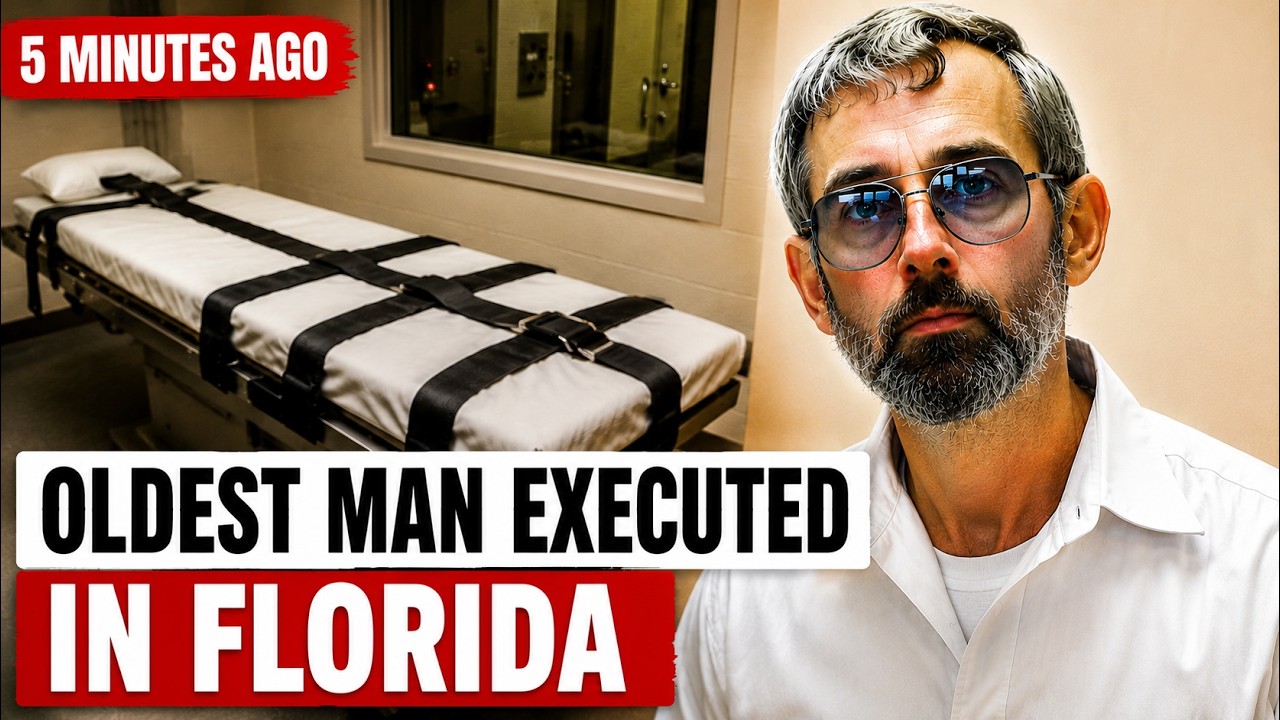
STARK, Florida — A 74-year-old man who spent more than three decades on death row for the brutal murder of his wife was executed Thursday evening, becoming the oldest person put to death in Florida in over a century
Dusty Ray Spencer was pronounced dead at 6:10 p. m. at Florida State Prison after a 10-minute lethal injection
 His final words were an apology to the family of Karen Spencer, the woman he beat with a brick and stabbed repeatedly in their Orange County backyard in January 1992.
“Sorry to the family. Into thy hands I commit my spirit and my soul. I’m on my way, Lord.
I’m on my way. Amen,” Spencer said from the gurney.
The execution came after a record-setting pace of state-ordered deaths. Florida has carried out more executions in the last two years than almost any other state in a single decade. For some, the process has become routine
But the case of Dusty Ray Spencer forced a rare reckoning with time, aging, and what justice means after 34 years.
Spencer was 40 when he killed his wife. He was 74 when the state killed him. In between, he sat on death row through the entire adulthood of his stepson Timothy, who at 18 had watched his mother die while trying to stop the attack with a rifle that misfired.
The crime itself was a textbook case of domestic violence escalation, documented, reported, and ignored by a system that at the time treated a threat to kill as a private matter. In December 1991, Spencer choked Karen and told her he would kill her. He was arrested.
 From jail, he called her and repeated the threat. She asked a judge to let him spend Christmas at home. He came back on New Year’s Day 1992 and beat her with a clothes iron, leaving her with 11 stitches.
Police did not issue a warrant.
On January 18, 1992, Spencer returned a final time. He beat Karen with a brick, slammed her head against a concrete wall, and stabbed her four or five times in the chest. Her son Timothy ran inside, grabbed a .
22 caliber rifle, and pulled the trigger. It misfired. Spencer turned a knife on him.
Timothy fled to a neighbor’s home and called 911.
When officers arrived, they found Karen dead with a small, sickly dog named Pebbles on her chest, refusing to leave.
 Spencer was arrested two days later in Kissimmee. In December 1992, a jury recommended death by a 7-5 vote, and a judge sentenced him to die. But that vote margin would become a central controversy decades later
Florida now requires at least eight of 12 jurors to recommend death. Under current law, Spencer’s divided jury would have resulted in life imprisonment.
His appeals stretched through the 1990s, 2000s, and 2010s. He became a different man in prison, according to anti-death penalty advocates who knew him: sober for the first time since his teens, devout, reflective. He suffered from cirrhosis of the liver, heart problems, and cognitive decline
His lawyers argued the state was planning a “nursing home execution.”
On Wednesday, his final meal consisted of pizza, french fries, and a milkshake. “Just food,” a prison spokesperson said.
Outside the prison walls, protesters and supporters of the death penalty faced each other across a road they have stood on many times before. For Karen Spencer’s family, there was no closure, only the fact that a man who committed an unforgivable act had been given three decades to reflect, age, and apologize.
 Karen Spencer was 40 when she died. She raised three sons largely alone after a previous divorce. She ran a successful painting business alongside Dusty.
She had a dog with four teeth. She is buried in Burlington, North Carolina, under her birth name, her killer’s surname removed from her headstone.
Her murder changed Florida law. Lawmakers tightened bail restrictions for domestic violence suspects, criminalized threats of violence, and required first court appearances before bail could be set. But those changes came too late for Karen.
As the drugs flowed into Dusty Ray Spencer’s veins Thursday evening, the question that haunted his case remained unanswered: What do you do 34 years later with a man who did something unforgivable and then spent three decades becoming someone slightly different than the man who did it?
The executioner’s answer was lethal injection. Spencer’s last words were a prayer. Karen’s last words were never recorded.
She spent them begging for her life in a backyard that had been part of the home she helped build.
The state of Florida proceeded. The oldest person executed since 1924 died at 6:10 p. m.
The dog that refused to leave her body has been gone for decades. The system that failed her still exists, now with new rules written in her memory. The question of whether those rules are enough will be answered only by the next woman who picks up the phone to report a threat, and by the officer who decides how quickly to respond.


