“Tell them she’s my wife.”
The sentence crossed the marble lobby of the Hotel Emperador and silenced everyone inside it.
The receptionist stopped typing. Two bellboys froze beside a luggage cart. A businessman lowered his phone. Even the pianist near the bar lifted his hands from the keys.
In the middle of the lobby stood Paola Aguinaga, a 31-year-old housekeeper holding a damp cloth against her gray uniform.
Across from her was Verónica Salgado, one of the wealthiest women in Mexico City, pointing at Paola as though she were something unpleasant that had been dragged in from the street.
And beside them stood Alberto Cervantes, the millionaire owner of the hotel.
Verónica stared at him.
“Your wife?”
Alberto did not blink.
“Yes,” he said. “Paola is my wife.”
It was a lie.
But no one in that lobby yet understood why the lie would destroy a multimillion-dollar deal—and expose the woman who had just humiliated a housekeeper in front of everyone.
It had begun twenty minutes earlier, on a suffocating Thursday afternoon in September.
The air outside was heavy with heat and exhaust. Inside the Hotel Emperador, the temperature was cool, the chandeliers glowed above polished marble, and guests moved through the lobby carrying leather briefcases and designer shopping bags.
Paola had worked there for three years.
She knew which elevator door shuddered before opening. She knew which suite had a faucet that leaked only at night. She knew how to remove red wine from cream-colored carpet and lipstick from white linen without leaving a trace.
She also knew which guests thanked the staff—and which ones looked through them as if uniforms made people invisible.
Verónica Salgado belonged to the second group.
She arrived shortly after five o’clock wearing a white silk dress, oversized sunglasses, and gold heels that struck the floor with sharp, impatient clicks.
Two assistants followed her. One carried her handbag. The other held three folders and a phone that never stopped ringing.
Verónica was in the hotel for a private meeting with Alberto and several members of the board.
Her family’s investment group was preparing to inject millions into the Emperador. The deal would allow the hotel to renovate two floors, pay overdue debts, and avoid layoffs.
Everyone had been instructed to treat her with exceptional care.
Paola was cleaning near the entrance when Verónica’s assistant stepped backward without looking and knocked over a waiter’s tray.
A glass of iced coffee shattered on the floor.
Brown liquid splashed across the marble and landed on the bottom of Verónica’s white dress.
The waiter immediately apologized.
Paola hurried over with towels and placed a yellow warning sign beside the spill.
“Please be careful, señora,” she said. “The floor is slippery.”
Verónica slowly removed her sunglasses.
She looked at the stain on her dress.
Then she looked at Paola.
“What did you do?”
“The tray fell, señora. I’m cleaning it now.”
Verónica’s voice rose.
“I asked what you did to my dress.”
Paola remained calm.
“I didn’t touch your dress.”
One of the assistants glanced toward the shattered glass but said nothing.
Verónica stepped closer.
“This dress costs more than you earn in a year.”
Several guests turned toward them.
Paola felt the heat move from her neck to her face, but she kept her eyes steady.
“I can ask someone from laundry services to help with the stain.”
“You can start by apologizing.”
“I’m sorry the coffee spilled, but I didn’t cause it.”
That answer changed Verónica’s expression.
She was not used to employees correcting her.
“Do you know who I am?”
“Yes, señora.”
“Then you should know better than to argue with me.”
Marina, the young receptionist behind the front desk, had been watching. She stepped forward carefully.
“Señora Salgado, I saw what happened. Paola was several meters away when the tray fell.”
Verónica turned toward her.
“Did I ask for your opinion?”
Marina stopped.
The hotel’s operations manager stood near the elevators. He could see the entire scene, but the investment contract was sitting upstairs, waiting to be signed.
He looked away.
Verónica pointed to the brown drops on her shoes.
“Clean them.”
Paola glanced down.
“Excuse me?”
“You’re part of the cleaning staff, aren’t you?”
“Yes.”
“Then clean my shoes.”
The lobby went quiet.
Verónica extended one foot slightly, expecting Paola to kneel.
Paola tightened her grip on the towel.
She needed the job. Her mother’s medication cost more each month than Paola could comfortably afford. Missing even one paycheck would mean choosing between rent and treatment.
But there are moments when obedience stops being professionalism and becomes humiliation.
Paola placed the towel inside her cleaning cart.
“I will clean the floor,” she said. “I will arrange treatment for your dress. But I will not kneel in front of you.”

Verónica’s mouth opened slightly.
“You won’t?”
“No, señora.”
“Then perhaps you won’t be working here tomorrow.”
Marina tried again.
“Please, Señora Salgado—”
“I want her supervisor.”
The operations manager finally approached, forcing a nervous smile.
“I’m sure we can resolve this privately.”
“There is nothing to resolve,” Verónica replied. “Fire her.”
Paola looked at the manager.
For three years, she had covered extra shifts, cleaned rooms after midnight, trained new employees, and returned wallets, jewelry, and cash that guests had left behind.
The manager knew all of that.
Still, he avoided her eyes.
Then the private elevator opened.
Alberto Cervantes stepped out.
He was 41, tall, restrained, and usually so formal that employees lowered their voices when he passed.
Paola had seen him hundreds of times but had spoken to him only twice.
Once when he asked whether an elevator was working.
Once when he thanked the housekeeping team after a conference.
He walked toward the crowd and looked first at the broken glass, then at Paola’s face, and finally at Verónica.
“What happened?”
Verónica spoke before anyone else could answer.
“One of your cleaners ruined my dress, refused to apologize, and then became aggressive.”
“That isn’t what happened,” Marina said.
Verónica ignored her.
“I’ve asked your manager to dismiss this woman immediately. Frankly, Alberto, if your staff behaves this way before our agreement is signed, I can only imagine what happens when no investors are watching.”
Alberto looked at Paola.
“Did you spill the coffee?”
“No, señor.”
“Did you insult Señora Salgado?”
“No.”
“Did she order you to kneel and clean her shoes?”
Paola hesitated.
“Yes.”
Alberto’s jaw tightened.
Verónica laughed softly.
“Don’t be dramatic. I asked an employee to do her job.”
Alberto looked around the lobby.
Dozens of people were watching.
Then he said the words no one expected.
“She is not just an employee.”
Verónica folded her arms.
“Then who is she?”
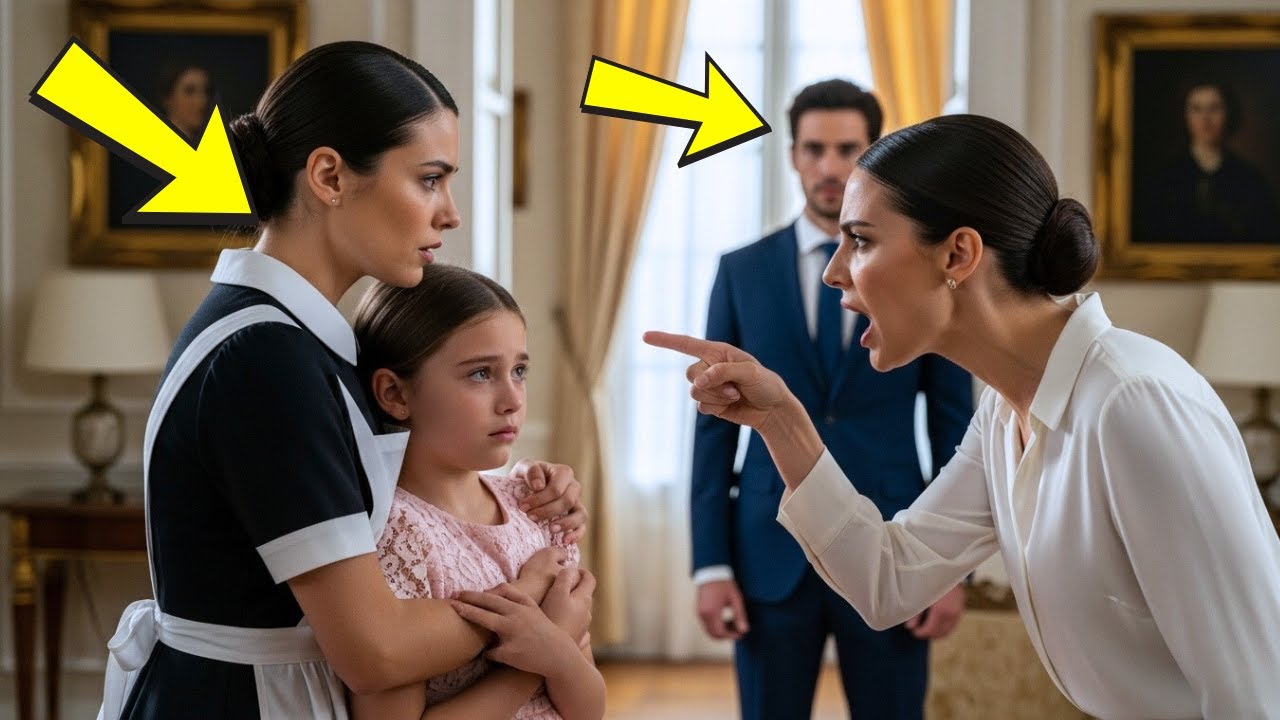
Alberto stepped beside Paola.
“Tell them she’s my wife.”
The silence was immediate.
Paola turned toward him so quickly that the name badge on her uniform swung sideways.
Alberto continued before she could speak.
“And you will apologize to her.”
The color in Verónica’s face changed.
Her anger did not disappear. It reorganized itself.
Her shoulders lowered. Her voice softened. Even her eyes changed.
“Alberto, I had no idea.”
“That should not matter.”
“Of course it matters. She’s your—”
“No,” he interrupted. “It should not matter whether she is my wife, a guest, or the woman cleaning this floor. You humiliated her because you believed she had no power.”
Verónica looked around and realized that everyone had witnessed the change in her behavior.
Her face hardened again.
“This is absurd.”
“Apologize.”
Verónica looked at Paola, but the words seemed physically painful for her.
“I regret the misunderstanding.”
“That was not an apology,” Alberto said.
Her fingers tightened around her handbag.
“I apologize.”
Paola did not answer.
Verónica turned and walked toward the elevators, her assistants rushing after her.
The moment the doors closed, the lobby erupted in whispers.
Paola stared at Alberto.
“Your office,” he said quietly.
“No.”
The whispers stopped again.
Paola’s voice remained controlled.
“You don’t get to invent a marriage and then order me upstairs.”
A few employees looked at the floor to hide their reactions.
Alberto nodded.
“You’re right. The service corridor, then. Somewhere we can talk.”
In the corridor behind the lobby, Paola faced him with her arms folded.
“Why did you say that?”
“Because she was going to have you fired.”
“So you made me your wife?”
“It was the first thing I could think of that would force her to reveal what she really believed.”
“You used me to make a point.”
“Yes,” Alberto admitted. “And I’m sorry.”
Paola had expected excuses. His direct answer left her momentarily silent.
He continued.
“I watched her change the second she believed you had status. I wanted everyone else to see it too.”
“You could have defended me without lying.”
“I should have.”
Paola removed her name badge and held it in her palm.
“People like her do not respect women like me because powerful men claim us. They respect us when powerful men stop allowing humiliation in their buildings.”
Alberto looked at the badge in her hand.
“You’re right again.”
She pinned it back onto her uniform.
“Then don’t call me your wife again.”
By the next morning, the story had spread through the entire hotel.
Some employees smiled at Paola as if she had suddenly become important. Others whispered that she had secretly been involved with the owner for years.
Managers who had barely acknowledged her now opened doors for her.
A supervisor offered her coffee.
Paola refused it.
The lie had protected her from Verónica, but it had also proved something painful: the same people who ignored her on Wednesday treated her differently on Friday because they believed she belonged to a millionaire.
At eleven that morning, Verónica’s lawyers sent the hotel a formal letter.
The investment group would withdraw from negotiations unless Alberto issued a public apology and terminated Paola’s employment.
The board called an emergency meeting.
Without Verónica’s investment, the Emperador could lose its credit line. Renovations would stop. More than eighty employees could be laid off before Christmas.
Several board members demanded that Alberto sacrifice one housekeeper to save the hotel.
He refused.
By lunchtime, Verónica had given the story to a business journalist.
The headline appeared online:
HOTEL MILLIONAIRE INVENTS SECRET WIFE TO DEFEND EMPLOYEE
The article described Paola as an “unstable cleaner” who had allegedly threatened an important investor.
Her photograph, taken from the hotel’s social media page, was shared thousands of times.
Strangers commented on her uniform, her face, and her supposed relationship with Alberto.
Her mother called crying.
Paola read only five comments before turning off her phone.
At three o’clock, Alberto found her changing sheets in Suite 804.
“You should go home,” he said.
“Am I suspended?”
“No.”
“Then I’m working.”
“There are reporters outside.”
“That is not my fault.”
“I know.”
Paola pulled the clean sheet tightly across the mattress.
“Will you apologize to Verónica?”
“No.”
“Will you fire me?”
“No.”
“Then let me finish the room.”
Alberto stood near the doorway.
“The board is holding a dinner tonight. Verónica will be there with her lawyers. She intends to announce that she is withdrawing the investment.”
Paola continued tucking the corners of the sheet.
“She had planned to withdraw before yesterday.”
Alberto frowned.
“What do you mean?”
Paola stopped.
For the first time, uncertainty crossed her face.
“Nothing.”
“Paola.”
She looked toward the hallway to make sure they were alone.
“Three months ago, I found invoices in a wastebasket inside the executive conference room. They were marked as copies, so I assumed they had already been processed.”
“What invoices?”
“Maintenance services. Air-conditioning repairs. Elevator inspections. Marble restoration.”
“That sounds normal.”
“The companies were different, but the bank account numbers were the same.”
Alberto stared at her.
Paola reached beneath the towels on her cart and removed a thin folder.
“I studied accounting at university. I left before graduating when my mother became ill, but I still know how to read an invoice.”
Alberto opened the folder.
Inside were photocopies, payment records, dates, signatures, and handwritten notes.
Paola had organized everything by vendor and month.
More than sixteen million pesos had been paid to seven companies over two years.
All seven companies led back to the same address.
And one authorization signature appeared on almost every transfer.
Verónica Salgado’s.
Alberto looked up slowly.
“How did you get these?”
“Documents are left in conference rooms. Draft contracts are thrown away. People discuss things in front of cleaning staff because they assume we cannot understand them.”
“Why didn’t you bring this to me?”
“I sent copies to the compliance email six weeks ago.”
Alberto’s face tightened.
“We never received them.”
“Someone replied.”
She showed him a printed email.
The message thanked her for the information and stated that an internal review had found no irregularities.
The name at the bottom belonged to the hotel’s chief financial officer—a man Verónica had personally recommended to the board.
Alberto read the email twice.
That evening, the Emperador’s ballroom was filled with board members, attorneys, investors, and journalists.
Verónica entered wearing a dark red suit.
She moved through the room with the confidence of someone who believed the outcome had already been purchased.
Paola stood near the back in her gray uniform.
Alberto had offered her different clothes.
She had refused.
“If they only listen when I look wealthy,” she told him, “then they have learned nothing.”
At eight fifteen, Verónica stepped onto the stage.
She described Alberto’s behavior as reckless. She accused him of creating a false marriage to intimidate a guest. She called the hotel’s management unstable and irresponsible.
Then she looked directly at Paola.
“This woman is not Alberto Cervantes’s wife,” she announced. “She is a housekeeping employee who has taken advantage of his poor judgment.”
Cameras turned toward Paola.
Verónica smiled.
“The Hotel Emperador expects millions from my family while allowing staff members to insult me publicly. Therefore, our investment group is withdrawing its offer effective immediately.”
Several board members began speaking at once.
One demanded Alberto’s resignation.
Another told security to escort Paola out.
Paola walked toward the stage instead.
Her shoes made almost no sound on the carpet, but the room gradually fell silent.
Verónica watched her approach.
“You’ve already caused enough embarrassment,” she said.
Paola stopped a few feet away.
“You’re right about one thing.”
Verónica raised an eyebrow.
“I am not Alberto’s wife.”
A few journalists leaned forward.
Paola continued.
“But I am the woman who found where your companies have been stealing from this hotel.”
No one moved.
Alberto’s attorney placed copies of the invoices on the tables.
A forensic auditor stepped forward and confirmed that the bank accounts, shell companies, and payments had been independently verified that afternoon.
Then Marina activated the ballroom screen.
Security footage appeared.
It showed Verónica’s assistant entering the hotel’s finance office after midnight three weeks earlier. He carried out two archive boxes and loaded them into a vehicle registered to Verónica’s investment group.
A second video showed the chief financial officer removing files after Paola’s email had been received.
Verónica’s smile disappeared.
Alberto addressed the room.
“The proposed investment was never intended to save the Emperador. It was designed to convert stolen funds into ownership. Once Señora Salgado gained control of the hotel, the missing payments would have been buried during restructuring.”
Verónica looked toward her attorney.
He did not look back.
Her fingers closed around the stem of her champagne glass.
For the first time that evening, she looked at Paola—not at the uniform, not at the shoes, not at the name badge.
At Paola.
Her eyes moved to the folder in Paola’s hands.
Then to the auditors.
Then to the two investigators who had entered through the side doors.
The blood drained from her face.
The room saw the exact moment she understood.
The housekeeper she had ordered to kneel had been quietly standing above the entire scheme.
Verónica’s glass began to tremble.
A drop of champagne spilled over the rim and landed on her hand.
No one rushed to clean it.
The chief financial officer attempted to leave through the kitchen entrance, but security stopped him.
Verónica’s lawyers requested a private meeting.
Alberto refused.
“You wanted this handled publicly,” he said. “It will be handled publicly.”
The investment agreement was canceled.
The evidence was submitted to prosecutors, and the hotel filed a civil claim to recover the missing money.
Within a week, Verónica resigned from three corporate boards. Her family’s company issued a statement distancing itself from the transactions. The chief financial officer was dismissed and later charged in connection with fraudulent payments and document destruction.
But Paola did not become a celebrity overnight.
She returned to work the following Monday.
She arrived at seven, changed into her uniform, and began checking the supply carts.
When Alberto found her, she was showing a new employee how to remove coffee from silk without spreading the stain.
“I’d like to offer you a position in compliance,” he said.
Paola did not immediately answer.
“I haven’t finished my degree.”
“We’ll pay for you to finish it.”
“And the housekeeping staff?”
“What about them?”
“They need an anonymous reporting system that does not go through management. Salaries should be reviewed. Overtime must be recorded. And no employee should lose a job because a wealthy guest demands it.”
Alberto nodded.
“Put it in writing.”
“I already did.”
She handed him three pages.
For the first time, Alberto smiled.
Six months later, Paola completed the university courses she had abandoned when her mother became ill. She became the hotel’s internal compliance coordinator, though she continued eating lunch with the housekeeping team.
Marina was promoted to guest services supervisor.
The operations manager who had looked away in the lobby was required to attend the same dignity-at-work training as every new employee. He later apologized to Paola in front of the staff.
Alberto never again referred to Paola as his wife.
Not until nearly two years later.
By then, the hotel had recovered most of the stolen funds. No employees had been laid off. The anonymous reporting system Paola designed had been adopted by three other properties.
She and Alberto had spent those two years disagreeing in meetings, reviewing policies, visiting her mother, and learning the difference between rescue and respect.
They married in a small civil ceremony with fewer than twenty guests.
Marina was one of the witnesses.
After the ceremony, she laughed and asked Alberto whether he remembered the first time he had called Paola his wife.
Alberto looked at Paola before answering.
“I remember.”
Paola adjusted the simple ring on her finger.
“The first time,” she said, “he gave me a title because he thought it would make people respect me.”
“And now?” Marina asked.
Paola smiled.
“Now he knows I never needed one.”
Because dignity does not come from the person standing beside you, the money in your account, or the name printed beneath your photograph.
And anyone who needs to know your status before treating you like a human being has already revealed how little status they truly deserve.