They Thought Her Silence Meant Weakness. Then the Whole World Saw the Truth.
Chapter One
The Toast
The first glass struck Nora Vale just below the collarbone.
Cold champagne splashed across her throat, slipped beneath the neckline of her navy dress, and ran in sparkling threads down her arms. A second later, the orange juice followed.
It soaked the front of her dress in a bright, sticky bloom.
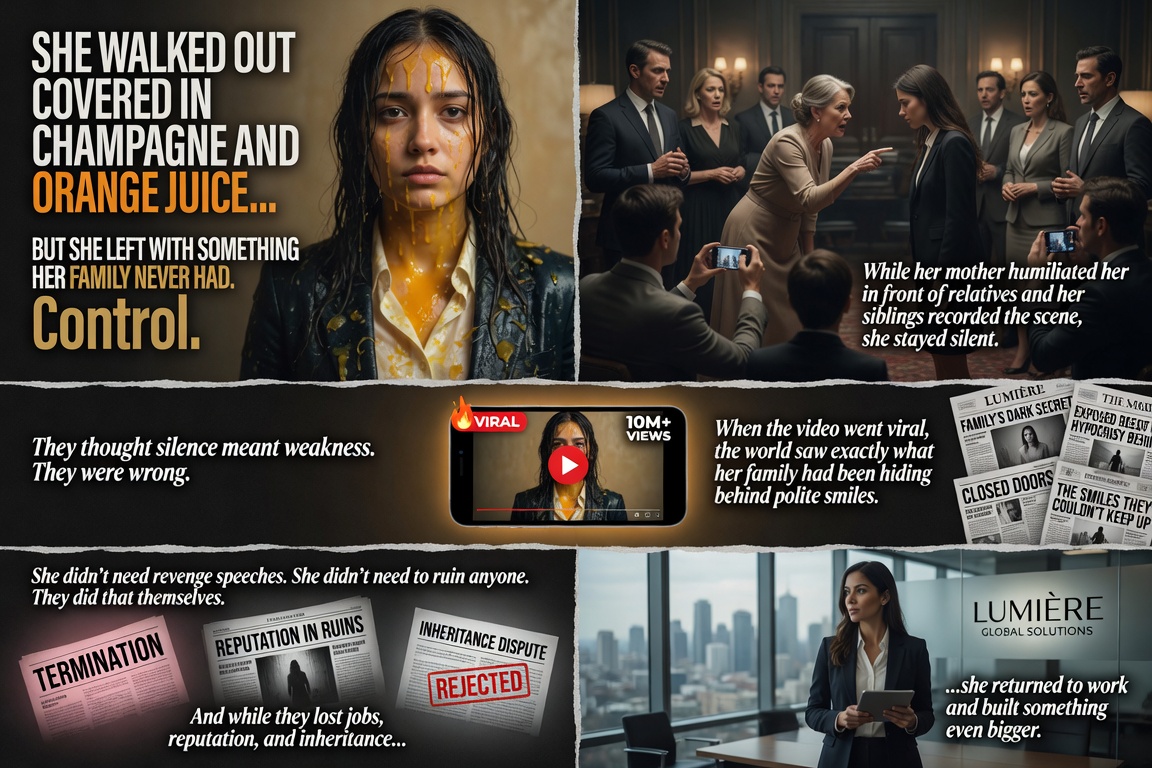
Someone gasped.
Someone else laughed.
And at the far end of the white-linen table, Nora’s younger sister kept filming.
The courtyard of Vale House had gone so still that Nora could hear the fountain behind her. Water trickled over limestone cherubs. Ice shifted inside crystal glasses. Beyond the brick walls, traffic murmured along Richmond’s Monument Avenue, indifferent to the fact that a family was tearing itself open beneath a canopy of imported wisteria.
Marianne Vale stood three feet away, still holding the empty silver pitcher.
At sixty-four, Nora’s mother had perfected the art of appearing composed while destroying someone. Her silver-blond hair remained smooth despite the September humidity. Her ivory suit showed no stain. Not one drop had touched her.
“You could have prevented this,” Marianne said.
Her voice was soft.
That was what made it worse.
Around the table sat thirty-two relatives, three members of the Vale & Company board, two longtime family attorneys, and Eleanor Vale, Nora’s eighty-seven-year-old grandmother, whose wheelchair had been positioned beneath the shade of a magnolia tree.
A string quartet had stopped playing near the garden doors.
Nora glanced down at herself.
Pulp clung to the fabric over her ribs. A thin stream of champagne traveled from her wrist to the tip of her middle finger and dropped onto the flagstones.
Her brother Caleb rose from his chair.
“Mom,” he said, but there was no outrage in his voice. Only caution. “Not here.”
Marianne turned toward him.
“Where, then?”
The silver pitcher trembled slightly in her hand.
“Where are we supposed to speak to her? She doesn’t answer calls. She leaves meetings. She hides behind assistants and legal language.”
“I don’t hide,” Nora said.
Her voice carried farther than she intended.
Several relatives lowered their eyes.
June adjusted her phone to keep Nora centered in the frame. At thirty-five, she had inherited Marianne’s beauty but not her discipline. Her blond hair hung loose around her shoulders, and her expression shifted constantly as she monitored the reactions on her screen.
The red light above the phone camera remained on.
Nora looked directly at it.
“How long have you been recording?”
June’s lips parted.
“This is for us.”
“There is no ‘for us’ once you press record.”
Marianne placed the empty pitcher on the table.
“You see?” she said to the relatives. “This is what she does. She redirects. She changes the subject until everyone else feels guilty for asking a simple question.”
“It wasn’t a simple question.”
“We asked you to sign one document.”
Nora looked at the cream-colored folder lying beside Caleb’s plate.
The family continuity agreement.
That was what they had called it during the private meeting an hour earlier. A temporary restructuring designed to protect Vale & Company while Caleb negotiated a national expansion.
Nora had read only eleven pages before finding the clause that would place her twenty-two-percent trust interest behind a forty-eight-million-dollar credit facility.
If the expansion failed, the bank could seize nearly every property held by the Vale family trust, including Vale House, two commercial kitchens, the company’s distribution center, and the pension reserve that had been created for longtime employees.
Nora had closed the folder.
“No.”
One word.
No raised voice. No accusation. No speech.
The anniversary luncheon had begun fifteen minutes later.
Marianne had stood to make a toast celebrating forty years of Vale & Company. She spoke of sacrifice, loyalty, and the burden of building something meant to outlive its founder.
Then she told everyone Nora was refusing to save the business.
The folder had traveled around the table.
By the time it reached Cousin Meredith, Nora had realized several pages were missing.
Now Caleb lifted the document.
“Everyone here signed.”
“Not everyone understands what they signed.”
A murmur moved through the courtyard.
Caleb’s jaw tightened.
He was forty-three, broad-shouldered and handsome in the effortless manner that made strangers trust him before he spoke. A faint white scar crossed his left eyebrow, the last visible mark from the bicycle accident that had split their childhood in two.
“You always do this,” he said. “You make everyone feel stupid.”
“I said they may not understand the document.”
“You’re implying the same thing.”
“No. You’re hearing the same thing.”
Marianne stepped between them.
“Enough.”
Nora’s skin began to cool beneath the wet dress. A breeze passed through the courtyard, carrying the scent of wet stone, orange peel, and the roses arranged along the table.
Her father remained seated.
Daniel Vale stared into his untouched glass.
He had once designed schools, museums, and a public library whose curved glass roof appeared in architecture magazines. At sixty-seven, he had the stooped shoulders of a man who had spent years making himself smaller inside his own home.
Nora watched him turn his wedding ring around his finger.
He would not look at her.
That hurt more than the drink.
Marianne opened the cream folder.
“Do you want to know what your sister is protecting?” she asked the table.
“Marianne,” Eleanor said.
The old woman’s voice was thin but sharp enough to stop the murmuring.
Marianne did not turn.
“Nora owns a private consulting company that profits when businesses fail. She walks into companies, cuts departments, closes facilities, and calls it restructuring. Yet when her own family asks for help, suddenly she has a conscience.”
Nora felt thirty-two pairs of eyes settle on her.
Her company, Bridgework Strategies, did not profit from failure. It redesigned supply systems for businesses facing collapse. During the pandemic, Nora and her team had kept independent restaurants, local pharmacies, nursing homes, and food distributors operating when their ordinary networks had broken.
Marianne knew that.
She also knew the lie would sound cleaner.
“Aunt Marianne,” someone whispered.
But Marianne had been waiting too long to stop.
“Your father postponed retirement. Caleb has not taken a full salary in eighteen months. June has spent every waking hour protecting this company’s name. And you arrive four times a year, sit at the edge of the table, and judge us.”
Nora looked toward June’s phone again.
The red light continued to glow.
June swallowed.
“Mom, maybe we should stop.”
“No,” Nora said.
June’s eyes flicked toward her.
“Keep recording.”
For the first time, Marianne’s composure fractured.
Her nostrils flared. The fingers around the folder whitened.
“You think you’re so controlled,” she said. “So untouchable.”
Nora said nothing.
“You use silence like a weapon.”
Still nothing.
Marianne pulled a single page from the folder and laid it on the table.
“Then explain this.”
The document bore Nora’s name.
Beneath it appeared a signature.
Her signature.
At first glance, it looked convincing. The narrow capital N. The compressed letters. The abrupt stroke beneath the last name.
But Nora had stopped underlining her signature seven years earlier, after a bank had warned her that the extra line made it easier to copy.
She stepped closer.
The relatives nearest the document leaned back to give her room.
“What is that?” Eleanor asked.
Caleb reached for the page.
Marianne placed her palm over it.
“Nora already approved the preliminary guarantee three months ago. She’s refusing now because she wants control.”
Nora bent over the table.
At the bottom of the page, beside her copied signature, appeared the name of a witness.
Daniel Vale.
Her father.
Nora lifted her eyes.
Daniel’s face had gone gray.
“Dad?”
His mouth opened.
No sound came out.
Caleb seized the page.
“This isn’t what it looks like.”
Nora straightened.
“What does it look like?”
“A draft.”
“With my signature.”
“A digital placeholder.”
“And a witness.”
“Nora,” Marianne said, “do not make this uglier than it already is.”
The wet dress clung to Nora’s skin. Orange juice had pooled inside one of her shoes. She could feel the pulse in her throat, quick but steady.
Her mother had thrown the drink because Nora would not surrender her trust interest.
Her brother had presented a forged guarantee.
Her father had witnessed it.
And her sister was recording everything.
Nora looked around the table.
The relatives who had urged her to sign were now studying their plates.
The attorneys had stopped pretending not to listen.
One of the board members quietly removed his napkin from his lap and placed it beside his glass.
Nora reached for the forged page.
Caleb held it tighter.
“Let go,” she said.
“It belongs to the company.”
“It has my name on it.”
“Nora.”
“Let go.”
Something in her voice made his fingers release.
She folded the page once and slipped it into the leather bag hanging from the back of her chair.
Marianne stared at her.
“You cannot take corporate documents.”
“I’m taking evidence bearing my forged signature.”
The word forged moved through the courtyard like wind through dry grass.
June finally lowered her phone.
“You’re really going to do this?” she asked.
Nora turned toward her sister.
“Do what?”
“Destroy us.”
For one strange second, Nora saw June at nine years old, standing outside Nora’s bedroom with a broken music box cupped in both hands. Their mother had been shouting downstairs. June had not asked Nora to fix the music box. She had only stood there until Nora opened the door.
Now June was thirty-five, holding a phone between herself and every feeling she did not know how to survive.
Nora took her bag.
“No,” she said. “I’m going home.”
She walked across the courtyard.
No one stopped her.
Behind her, Marianne spoke again.
“If you leave now, don’t come back expecting to be part of this family.”
Nora paused beneath the garden arch.
For most of her life, those words would have turned her around.
At sixteen, after Caleb’s bicycle accident, Marianne had blamed Nora for letting him ride down the hill alone. Nora had spent two decades confusing guilt with loyalty.
At twenty-eight, when she moved to Chicago for work, Marianne accused her of abandoning Daniel during his heart surgery. Nora had returned within twenty-four hours and stayed for six weeks.
At thirty-six, when she refused to leave Bridgework and join the family company, Marianne stopped speaking to her for eleven months.
Every return had taught her family the same lesson.
The threat worked.
Nora looked back at the table.
Her father was crying silently.
Caleb stared at the forged document as if he could still pull it from her bag.
June’s phone had risen again.
Marianne stood beneath the magnolia tree, dry and immaculate.
Nora stepped through the arch.
The iron gate closed behind her with a quiet metallic click.
Her car waited at the curb, baking beneath the white afternoon sun. As she reached for the door, her phone vibrated inside her bag.
She expected Caleb.
Instead, the screen displayed an unfamiliar Virginia number.
A text message appeared.
Ms. Vale, this is Special Investigations at Commonwealth Atlantic Bank. We need to discuss a personal guarantee executed in your name. Please do not alert the other signatories.
A second message arrived before Nora could breathe.
We believe this may not be the only one.
Chapter Two
The Version They Chose
By eight that evening, more than four million people had watched Marianne Vale pour a pitcher of mimosas over her daughter.
The first version lasted twenty-three seconds.
June had uploaded it to her private account with the caption:
When the family martyr finally gets called out.
Someone screen-recorded it before she deleted it.
The clip crossed from private accounts to gossip pages, then to national feeds. By sunset, strangers were slowing down the footage frame by frame.
They noticed the way Nora did not flinch when the liquid struck her.
They noticed the forged document.
They noticed June laughing during the first three seconds.
Most of all, they noticed the audio.
June had apparently forgotten that her phone had begun recording before Marianne’s toast.
A second video surfaced shortly after midnight, nearly twelve minutes long. It contained Marianne’s speech, Caleb’s accusations, Nora’s refusal to sign, and the moment Nora identified the false signature.
The internet did what it always did.
It simplified everyone.
Marianne became “Mimosa Mom.”
Caleb became “Fraud Brother.”
June became “Camera Sister.”
Nora became “The Silent Daughter.”
Memes appeared before breakfast.
A clothing company offered Nora a lifetime supply of stain-resistant dresses. A law firm posted a slow-motion analysis of her expression. A morning show invited her to speak about toxic families.
Nora declined everything.
She stood beneath the shower in her apartment until the water ran cold.
The champagne came out easily. The orange juice did not. Its sweetness clung to her skin even after she scrubbed her arms twice.
Her apartment occupied the fourth floor of a converted tobacco warehouse near the James River. The ceilings were high, the windows tall and imperfect. Rain from an approaching storm pressed a gray hand against the glass.
She had chosen the place because the brick walls were thick.
Silence stayed where she put it.
At nine the next morning, she entered Bridgework Strategies through the freight elevator.
The office filled half of an old printing factory. Whiteboards covered the walls. Maps, warehouse diagrams, transportation routes, and colored strings showed how food, medicine, people, and money moved through systems most consumers never saw.
Nora loved the office before anyone arrived.
The air smelled faintly of coffee grounds and dry-erase markers. The only sound came from the building’s old pipes knocking awake.
She placed her bag on the conference table.
The forged page remained inside a plastic sleeve provided by the bank investigator.
After leaving Vale House, Nora had driven directly to Commonwealth Atlantic. She spent three hours in a windowless room with a woman named Greta Shaw, who wore red glasses and asked questions without wasting words.
The guarantee had been used to secure an initial twelve-million-dollar bridge loan eight months earlier.
A second guarantee had appeared three months later.
A third was under review.
All bore Nora’s signature.
All had been witnessed by Daniel.
“Nora?”
She turned.
Ana Ruiz stood near the elevator with two coffees in one hand.
At fifty-two, Ana directed Bridgework’s field operations and could enter a failing commercial kitchen, distribution center, or hotel and identify the source of chaos before most executives had found the light switch.
She had short black hair streaked with silver and the patient eyes of someone who had raised three sons without expecting any of them to make life easier.
Ana set down the coffees.
“I watched it.”
“So did four million other people.”
“Seven point two now.”
Nora closed her eyes.
“Please don’t give me numbers.”
“You pay me to give you numbers.”
“Not those numbers.”
Ana studied her dress. Nora had chosen a charcoal suit that morning, plain and severe enough to discourage questions.
It did not work.
“Did she mean to throw it?”
“Yes.”
“Did you know about the signature?”
“No.”
“Did your father?”
“Yes.”
The word came out cleanly.
Ana’s face changed.
Not pity. Ana knew Nora hated pity.
Recognition.
“That’s the part,” Ana said.
Nora looked toward the rain beginning to streak the windows.
“What part?”
“The part that hurts.”
Employees began arriving at nine-thirty.
No one mentioned the video.
That made it worse.
They spoke gently around Nora. They closed doors softly. They avoided using the word “family” during a presentation about a family-owned grocery chain.
At eleven, Bridgework’s managing partner asked Nora into his office.
Martin Kessler was sixty, careful, and incapable of sitting without arranging whatever lay in front of him. He aligned two pens with the edge of his desk before speaking.
“The board is concerned about distraction.”
Nora watched his hands.
“Which board?”
“Ours.”
“Bridgework has six directors. Three of them texted me this morning.”
“There are concerns about our clients.”
“Have any clients complained?”
“No.”
“Have any canceled?”
“No.”
“Then the concern is theoretical.”
Martin sighed.
“That tone is exactly what I’m trying to avoid.”
“What tone?”
“The courtroom tone.”
“I asked two questions.”
“You made them sound like an indictment.”
Nora leaned back.
Years ago, Martin had recruited her from a global consultancy after watching her rebuild a frozen food distribution network during a historic ice storm. He admired her precision when it saved clients. He found it uncomfortable when directed at him.
“We have a pharmaceutical supply contract entering final review,” he said. “The client is conservative. They don’t want controversy.”
“I was assaulted at a private family event.”
“You understand how headlines work.”
“Yes. They make passive sentences useful.”
Martin’s mouth tightened.
“I am not blaming you.”
“Then don’t ask me to carry the consequence.”
The rain struck harder against the windows.
Martin looked down at the pens.
“We think it would be wise for you to take two weeks.”
“We?”
“The board.”
“Paid?”
“Yes.”
“And if I refuse?”
His silence answered.
Nora felt something inside her go still.
Bridgework had been her work for nine years. She had slept in warehouse offices, negotiated with union leaders, rebuilt supply routes after hurricanes, and spent holidays on conference calls so clients’ hourly workers could go home.
She owned twelve percent of the company.
Martin owned thirty-one.
The rest belonged to investors who praised courage in quarterly letters and feared it in real life.
“Two weeks,” Nora said.
“It’s not punitive.”
“Of course not.”
“Nora.”
She stood.
“Should I transfer active files to Ana?”
Martin hesitated.
“Yes.”
By noon, Nora was carrying a cardboard archive box toward the freight elevator.
Ana intercepted her.
“What happened?”
“Two-week leave.”
“Martin is an idiot.”
“He is a predictable collection of incentives.”
“That’s a longer way to say idiot.”
Nora almost smiled.
Ana took the box from her hands.
“Go home.”
“I don’t want to go home.”
“Then go somewhere no one knows you.”
“Where is that?”
Ana considered.
“At seven million views? Maybe Canada.”
The elevator doors opened.
Before Nora stepped inside, the receptionist called her name.
A padded envelope had arrived by courier.
No return address.
Inside was a flash drive, a stack of payroll reports, and a handwritten note.
Nora read it twice.
Ana leaned over her shoulder.
The note contained only three lines.
They used the employee retirement reserve as collateral.
Your brother authorized it.
Your father signed because Marianne told him you had agreed.
At the bottom, one final sentence had been written with enough pressure to tear the paper.
Ask what happened to the night-shift complaints from the Hanover kitchen.
Nora looked at the flash drive.
“What is the Hanover kitchen?” Ana asked.
Nora’s mouth had gone dry.
“Vale & Company’s largest food production site.”
“What complaints?”
“I don’t know.”
The receptionist approached with a worried expression.
“There’s someone downstairs asking for you.”
“Reporter?”
“No. A woman. She says she used to work for your family.”
“What’s her name?”
“Leah Price.”
Nora knew the name.
Leah had served as Vale & Company’s human resources director for eleven years.
Six months earlier, the company announced that she had resigned to spend more time with her family.
Nora had sent flowers.
The receptionist lowered her voice.
“She says your mother destroyed her career.”
The freight elevator chimed behind them.
Its doors slid closed.
Chapter Three
The Cost of Keeping Quiet
Leah Price refused to enter the building.
She waited beneath the loading canopy while rain hammered the alley and overflowed the gutters. She wore a yellow waterproof coat and held a thick black binder against her chest.
Up close, she looked older than the woman Nora remembered from company Christmas dinners. Her cheeks were hollow. The skin beneath her eyes held the bruised color of sleeplessness.
“You look like Daniel,” Leah said.
No greeting.
No sympathy.
Nora appreciated both.
“What happened at Hanover?”
Leah glanced toward the security camera above the loading dock.
“Is there somewhere else?”
They drove to a diner beside the railroad tracks.
The place was nearly empty. Storm clouds turned the windows black though it was not yet three. A waitress set down three cups of coffee and left the pot.
Ana sat beside Nora.
Leah sat across from them, still holding the binder.
“Your mother told me you wanted the complaints buried,” she said.
Nora felt the words before she understood them.
“My mother said what?”
“That you were advising the company privately. She said disclosure would jeopardize the expansion loan and trigger layoffs.”
“I have never advised Vale & Company.”
“I know that now.”
Leah opened the binder.
Inside were photographs, emails, accident reports, payroll records, and handwritten statements.
The Hanover kitchen operated twenty hours a day, producing prepared food for corporate events, hospitals, schools, and private aviation companies across three states.
Eighteen months earlier, workers on the overnight shift began reporting faulty refrigeration units and chemical leaks from an aging sanitation system.
Management delayed repairs.
The complaints increased.
Then a worker named Luis Mendoza collapsed after inhaling chlorine gas created by two chemicals that should never have been stored together.
He survived, but his lungs were permanently damaged.
“The official report called it employee error,” Leah said.
Ana turned a page.
“These storage labels were changed after the accident.”
“I know.”
“Who changed them?”
“The Hanover site manager. Caleb’s office approved the revised report.”
Nora looked at the email beneath the photograph.
The approval came from Caleb’s company account.
Leah continued.
“After Luis hired an attorney, three other workers came forward. They reported unpaid overtime, falsified temperature logs, and managers ordering employees to work during active gas alarms.”
“Why didn’t they go to regulators?”
“They tried.”
Leah slid another document across the table.
The complaint had been withdrawn.
At the bottom appeared the electronic authorization of the employee who filed it.
“He says he never withdrew it,” Leah said. “The company gave him ten thousand dollars and a nondisclosure agreement. Two weeks later, he was deported after an anonymous tip.”
Nora stared at the page.
Outside, a freight train moved through the rain. Its horn sounded low and mournful, vibrating through the diner windows.
“Did Caleb know?” Nora asked.
“Yes.”
“My mother?”
Leah’s fingers tightened around her coffee cup.
“She knows everything that can threaten the company.”
The waitress approached, sensed the silence, and turned away.
“Why were you fired?” Ana asked.
“I refused to alter Luis’s personnel file.”
Leah reached inside the binder and removed a letter on Vale & Company stationery.
The letter accused her of mishandling confidential employee data, creating a hostile workplace, and displaying instability during executive meetings.
It bore Marianne’s signature.
“They offered me eighteen months’ salary if I signed a confidentiality agreement,” Leah said. “I have two children in college and a husband with multiple sclerosis.”
“Did you sign?”
“Yes.”
Her voice broke on the word.
She looked out the window until she recovered.
“I told myself I had no choice. Then yesterday I watched your mother pour that drink on you while your family sat there.”
Leah turned back.
“I recognized the room.”
Nora did not ask what she meant.
She already knew.
The room was not a physical place.
It was the invisible structure Marianne built around people, where obedience looked voluntary and resistance looked cruel.
“Who sent the flash drive?” Nora asked.
“Not me.”
“Do you know who did?”
“No.”
“Does the bank know about the retirement reserve?”
“Maybe. Caleb moved the money through three subsidiaries.”
Ana closed the binder.
“How much?”
“Eighteen million.”
Nora stared at her.
Vale & Company employed nearly four hundred people. Many had worked for the family for decades.
Eighteen million dollars represented retirements, surgeries, mortgages, grandchildren’s tuition, and all the small futures people believed they had earned.
“Why would my brother risk that much?”
“To keep the company alive.”
Leah said it without hesitation.
The answer disturbed Nora more than greed would have.
During the pandemic, Vale & Company lost almost every event contract in six weeks. Marianne refused to terminate longtime employees. She kept kitchens running to prepare meals for shelters, hospitals, and school districts, often at cost.
The newspapers called her a civic hero.
Nora had believed them.
Perhaps Marianne had believed them too.
“Your mother saved hundreds of jobs,” Leah said. “At first.”
“And later?”
“Later she had to hide what saving them had cost.”
Nora poured coffee though her cup was still full.
The liquid climbed toward the rim.
“Why use my signature?”
“The family trust owns the properties. Caleb needed unanimous beneficiary approval to pledge them as collateral.”
“He had everyone except me.”
“He didn’t have your grandmother.”
Nora stopped pouring.
Leah nodded.
“Eleanor never signed.”
“Then the bank documents have two forged approvals.”
“At least.”
Thunder cracked above the railroad yard.
Ana reached over and moved Nora’s cup before the coffee spilled.
“What do you want from her?” Ana asked Leah.
Leah’s face hardened.
“I want my name back.”
Nora understood.
Not money.
Not an apology.
Her name.
Marianne had taken Leah’s refusal and rewritten it as instability. She had converted integrity into misconduct because the company could not survive the truth.
Nora had spent her own life being rewritten in similar ways.
Cold. Ungrateful. Difficult. Disloyal.
Every label concealed the same fact.
She had said no.
“May I copy this?” Nora asked.
Leah placed both hands over the binder.
“For the bank?”
“For an attorney representing the employees.”
“I can’t afford a lawsuit.”
“You won’t be paying.”
“Who will?”
Nora had no answer yet.
Her phone vibrated.
A message from Daniel appeared.
Please meet me. Alone.
A second message followed.
Your mother doesn’t know I’m contacting you.
Nora looked at the time.
“Where?” she typed.
His reply came immediately.
The old Broad Street station. Six o’clock.
The abandoned station had been Daniel’s first major restoration project. He used to take Nora there on Sunday mornings, before the shops opened, and teach her how buildings carried weight.
Never trust the pretty part, he would say, pointing toward ornate ceilings and polished stone.
Find the load-bearing wall.
Nora closed Leah’s binder.
At six, she found her father sitting beneath the station’s enormous clock.
The storm had moved east, leaving the sky the color of steel. Water dripped through cracks in the glass roof and struck the marble floor in slow, hollow taps.
Daniel wore no coat.
His white hair was wet. His shirt clung to his narrow shoulders.
Nora sat beside him.
For several minutes, neither spoke.
The station smelled of rain, dust, and old iron.
Daniel reached inside his pocket and removed a small brass key.
“I signed as witness,” he said.
Nora did not move.
“He told me you had agreed.”
“Caleb?”
Daniel nodded.
“Did you see me sign?”
“No.”
“Then you did not witness it.”
“I know.”
“Did you ask why I wasn’t present?”
“I did.”
“And?”
“He said the bank needed the page immediately. Marianne said you had signed electronically and the original would follow.”
Nora watched water drip from the roof into a darkening stain on the marble.
“You believed them.”
“I chose to.”
The honesty cut deeper than an excuse.
Daniel rubbed his thumb over the brass key.
“When your mother is afraid, she becomes very convincing.”
“You were afraid too.”
“Yes.”
“Of losing the company?”
“Of losing her.”
Nora looked at him.
Daniel’s eyes filled, but he did not look away.
“I have spent forty-three years confusing peace with the absence of an argument,” he said. “I told myself I was protecting the family. Mostly, I was protecting myself from the discomfort of opposing her.”
He handed Nora the key.
“What does it open?”
“A cabinet in my old studio.”
“The one at Vale House?”
“Yes.”
“What’s inside?”
“The original trust documents. Amendments. Letters from your grandfather. Records Eleanor does not know I kept.”
“Why did you keep them?”
“Because I knew one day someone would ask what we had actually agreed to.”
Nora closed her hand around the key.
The metal was warm from his body.
“Why didn’t you tell me about the guarantee?”
Daniel looked toward the vast station windows.
“Because Caleb said the expansion would solve everything. Because your mother said no one would be hurt. Because every wrong decision looked temporary when we made it.”
He bent forward, elbows on his knees.
“There is something else.”
Nora waited.
“Your mother did not tell the truth about Caleb’s accident.”
The station seemed to contract around them.
Nora heard the distant scrape of a maintenance cart. A pigeon fluttered in the rafters.
She had been sixteen.
Caleb had been twenty.
He came home from college and took his racing bicycle down River Road after drinking with friends. Nora saw him leave. She tried to take his keys, but he laughed and rode away.
Forty minutes later, a truck struck him at the bottom of the hill.
He spent three weeks in intensive care.
Marianne told everyone Nora had encouraged him to race.
She told Nora that if she had been less jealous, less difficult, less eager to see Caleb fail, she would have stopped him.
Nora believed her.
For twenty-six years, she believed her.
“What truth?” Nora asked.
Daniel’s voice dropped.
“Your mother knew he had been drinking.”
Nora’s fingers tightened around the key.
“She saw him leave?”
“She gave him the bicycle.”
The air left Nora’s lungs.
Daniel continued before she could speak.
“Caleb had argued with her. He wanted to drive. She took his car keys and told him to ride if he needed to prove how grown he was.”
Nora stood.
The marble floor tilted beneath her.
“She blamed me.”
“Yes.”
“Why?”
Daniel covered his face with both hands.
“Because Caleb might not forgive her.”
Nora looked down at her father.
“And I would.”
He lowered his hands.
The silence between them became an answer.
She stepped backward.
“Nora.”
“Don’t.”
“I should have told you.”
“You should have stopped her.”
“Yes.”
“All those years.”
“I know.”
“No, you don’t.”
Her voice echoed through the station.
A maintenance worker looked up from the far end of the hall.
Nora lowered her volume.
“You don’t know what it costs to build a life around guilt that belongs to someone else.”
Daniel’s mouth trembled.
“You’re right.”
He did not reach for her.
For once, he allowed her anger to remain hers.
Nora turned toward the exit.
Behind her, Daniel spoke.
“Your grandmother’s trust has a conduct provision.”
She stopped.
“What kind?”
“If a beneficiary uses fraud, coercion, or financial misconduct to gain control of trust assets, Eleanor can permanently remove that beneficiary.”
“Caleb?”
“And June, if she helped conceal it.”
“What about Marianne?”
“She is not a beneficiary.”
Nora turned.
Daniel’s face looked ancient beneath the station clock.
“The company is her inheritance,” he said. “And she may already have lost it.”
Chapter Four
The Load-Bearing Wall
Nora entered Vale House at four in the morning.
The storm had stripped leaves from the magnolia trees and scattered them across the courtyard where the luncheon tables had stood. Staff had removed the linens, flowers, and shattered glass. Only a pale orange stain remained on the flagstones.
Her key still worked.
Inside, the house breathed with the low mechanical hum of climate control. Portraits of dead Vales watched from paneled walls. The air smelled of beeswax, old books, and the lilies Marianne ordered replaced every Monday.
Nora removed her shoes.
She had learned as a child which floorboards creaked.
Daniel’s studio occupied the third floor, above the ballroom. He had abandoned it fifteen years earlier when Marianne converted half the space into a private archive for the company.
The brass key opened a narrow cabinet built behind a row of architectural models.
Inside sat four gray document boxes.
Nora carried them to the drafting table.
The first contained original company records.
The second held correspondence between Eleanor and Nora’s grandfather, Samuel Vale, who died before the company became nationally known.
The third contained trust amendments.
The fourth contained letters addressed to Daniel but never sent.
Nora worked until sunrise.
Samuel Vale had established the family trust after selling a chain of hardware stores. He distrusted inherited wealth and intended the trust to preserve property, not create idle heirs.
One clause appeared repeatedly in his letters.
No beneficiary should receive the power to control another beneficiary’s choices by threatening their housing, livelihood, or place within the family.
Nora read the sentence three times.
The irony was so precise it felt engineered.
At seven-fifteen, a floorboard creaked behind her.
Marianne stood in the doorway.
She wore a gray silk robe and held a mug of tea.
She did not seem surprised.
“Your father gave you the key.”
“Yes.”
“I wondered how long it would take.”
Nora placed a sheet of paper over the copied documents.
Marianne entered.
Without makeup, she looked smaller. Her skin showed shadows and fine lines normally softened beneath careful foundation. But her posture remained exact.
“The bank called Caleb,” she said.
“They told him not to contact me.”
“Do you imagine that would stop him?”
“No.”
Marianne set down her mug.
“Did you speak to Leah Price?”
Nora looked up.
“How do you know?”
“Because Leah has spent six months waiting to punish me.”
“She wants her name cleared.”
“She accepted a settlement.”
“She accepted money because her husband is sick and her children are in college.”
“She signed an agreement.”
“After you threatened to destroy her career.”
“I protected four hundred employees from a lawsuit that would have closed the Hanover kitchen.”
“You protected the company.”
“They are the same thing.”
“No, they’re not.”
Marianne’s expression tightened.
“This is why you never understood Vale & Company. You think a business is contracts and diagrams. It is people. Real people who need paychecks every Friday whether the world is fair or not.”
“Luis Mendoza needed lungs.”
A flicker passed through Marianne’s eyes.
“He was compensated.”
“He was blamed.”
“The alternative was shutting down the kitchen during our most fragile quarter.”
“You say that as if there were only two options.”
“There are always dozens of options when you are not the one responsible for choosing.”
Nora stood.
Morning light entered through the studio windows, exposing dust in the air.
“You forged my signature.”
“I did not.”
“You allowed it.”
“I learned about it afterward.”
“And then?”
Marianne looked toward the boxes.
“And then the loan had already prevented collapse.”
“You could have told the bank.”
“And triggered default?”
“You could have told me.”
“You would have reported it.”
“Yes.”
“There. You see?”
Marianne spoke with the exhaustion of someone proving a long-disputed point.
“You value being right more than you value what survives.”
Nora let the accusation settle.
Once, it would have sent her scrambling to prove she cared.
Now she heard the mechanism inside it.
“You are asking me to measure truth against the consequences you chose.”
“I am asking you to live in the real world.”
“In the real world, workers’ retirement money does not belong to you.”
“We were going to replace it.”
“With what?”
“The expansion proceeds.”
“What if the expansion failed?”
“It wasn’t going to fail.”
“You don’t know that.”
“I know this company.”
“You knew the Hanover kitchen too.”
Marianne flinched.
Barely.
But Nora saw it.
Outside, morning traffic began along the avenue. A garbage truck groaned at the corner. Somewhere downstairs, a housekeeper opened curtains.
Marianne walked toward the studio windows.
“When I was eleven,” she said, “my mother left me and my sisters in a motel room for three days.”
Nora said nothing.
She had heard a softer version of the story. Marianne’s mother had been unreliable. The family had struggled. There had been an eviction.
Not three days alone in a motel.
“We had six dollars,” Marianne continued. “The motel manager came every morning and told us he would call the police. My youngest sister cried whenever tires stopped outside because she thought they were coming to separate us.”
Her hands rested on the windowsill.
“I learned something in that room. People forgive almost anything if you appear to have control. The moment they smell chaos, they take what little you have left.”
Nora watched her mother’s reflection in the glass.
“I built Vale & Company so none of you would ever be in that room.”
“And then you built the room around us.”
Marianne closed her eyes.
For a second, Nora thought the words had reached her.
Then Marianne turned.
“I will not apologize for surviving.”
“I didn’t ask you to.”
“You always ask. You simply do it without words.”
There it was again.
Silence transformed into aggression.
Boundaries transformed into punishment.
Marianne reached for the stack of copied trust amendments.
Nora placed her hand over them.
“Don’t.”
The two women stood on opposite sides of the drafting table.
Marianne’s fingers hovered above Nora’s.
“Eleanor cannot see those.”
“Why?”
“She will remove Caleb from the trust.”
“If he committed fraud, that is her decision.”
“He made one desperate choice.”
“He made several.”
“For this family.”
“He used my name.”
“Because you never would have helped.”
Nora felt a sudden, sharp sadness.
Not because Marianne was right.
Because she still believed coercion became acceptable when love failed to produce obedience.
“You could have asked me,” Nora said.
“We did.”
“No. You told me what would happen if I refused. That is not asking.”
Marianne withdrew her hand.
From downstairs came the faint chime of the front door.
Then voices.
One male. One female.
Marianne’s face changed.
“Who is that?”
Nora checked her phone.
No messages.
Footsteps moved through the hall below.
A moment later, Greta Shaw from Commonwealth Atlantic appeared in the doorway with a forensic accountant and two uniformed officers.
Marianne looked at Nora.
“You called the police.”
“No.”
Greta held up a document.
“Mrs. Vale, we have a warrant to secure financial records connected to suspected bank fraud and misappropriation of restricted employee funds.”
The tea mug slipped from Marianne’s hand.
It struck the wooden floor and broke.
For the first time in Nora’s life, her mother looked as if she had no idea what expression came next.
Chapter Five
Everyone’s Favorite Villain
By Friday, Vale & Company had lost three hospital contracts, two school-district agreements, and its largest private aviation client.
The board placed Caleb on administrative leave.
June’s access to the company’s social accounts was suspended after investigators discovered she had deleted comments from employees describing safety problems at the Hanover kitchen.
Marianne remained chief executive in name, but the bank froze the company’s revolving credit line.
Payroll was due in six days.
The internet celebrated.
Nora found no satisfaction in it.
Strangers posted photographs of Marianne’s house, Caleb’s children, June’s former boyfriend, and even Daniel’s cardiac rehabilitation center. Reporters waited outside Vale House. Someone threw a gallon of orange juice against the front gate.
The viral clip had created a moral stage.
Everyone wanted a villain clear enough to hate without examining themselves.
Nora refused three interviews and stopped answering unknown numbers.
On Monday morning, she arrived at Bridgework despite her mandatory leave.
Martin met her in the lobby.
“You shouldn’t be here.”
“I need my Hanover supply maps.”
“You transferred the files to Ana.”
“I created a separate model for regional food-service capacity.”
“Why?”
“Vale & Company may miss payroll. If that happens, four hundred employees lose income and dozens of clients lose food-service contracts.”
Martin glanced toward the conference rooms.
“This is not Bridgework’s problem.”
“It will become everyone’s problem when hospitals and schools lose vendors with forty-eight hours’ notice.”
“We have not been retained.”
“They can’t retain us. Their credit is frozen.”
Martin lowered his voice.
“You cannot use company resources to rescue your family.”
“I’m not rescuing my family.”
“It certainly looks that way.”
Nora looked through the glass wall toward the analysts working inside.
“Two hundred and thirty Vale employees are hourly workers. Many have health insurance tied to their jobs. Forty-one are within five years of retirement.”
“You have memorized the numbers.”
“Yes.”
“That does not make you objective.”
“No one is objective. Some people are simply honest about what they’re protecting.”
Martin’s expression chilled.
“What are you protecting?”
“The workers.”
“And what does Bridgework gain?”
“Nothing immediately.”
“Then the answer is no.”
Nora stood very still.
Across the lobby, the receptionist pretended not to listen.
Martin folded his arms.
“This company does not perform charity work.”
“We perform emergency stabilization.”
“For paying clients.”
“When did that become the moral distinction?”
“When we became responsible for ninety-two employees of our own.”
Nora knew he was not entirely wrong.
Bridgework had salaries, leases, insurance, and investors. Martin’s caution protected people too.
But caution had become his only argument.
“I can build the model independently,” she said.
“Not with Bridgework data.”
“The data is mine.”
“It was created during company time.”
“I created it six years before joining Bridgework.”
Martin’s eyes narrowed.
“You are not thinking clearly.”
The sentence was familiar.
Marianne used it whenever Nora’s conclusions became inconvenient.
Nora picked up the archive box she had brought from home.
“I resign.”
The receptionist looked up.
Martin blinked.
“Don’t be dramatic.”
“I’m not.”
“You own equity.”
“I’ll retain it under the operating agreement.”
“You cannot walk out because I refused one unauthorized project.”
“I’m walking out because when a crisis affected your reputation, you removed the person harmed by it. Now that the crisis affects people without power, you call helping them charity.”
Martin’s face reddened.
“You’re making a mistake.”
“Possibly.”
“What will you do?”
Nora looked through the glass wall again.
Ana was standing inside the operations room.
She had heard everything.
Nora turned back to Martin.
“Work.”
She left Bridgework carrying one box.
Ana caught up with her outside.
Rain had given way to a hard blue sky. Delivery trucks rattled along the street. The river smelled of mud and sun-warmed concrete.
“You quit,” Ana said.
“Yes.”
“That was stupid.”
“Probably.”
“What’s the plan?”
“I don’t have one.”
Ana stared at her.
Nora stopped walking.
“What?”
“I have known you for nine years,” Ana said. “I have watched you create evacuation plans for floods that had not happened and secondary vendors for ingredients no one had ordered. You do not buy coffee without a contingency plan.”
“I left before I could make one.”
Ana began smiling.
It was not a kind smile.
It was the smile of someone who had been waiting for a locked door to open.
“Good,” she said.
“Why is that good?”
“Because your plans are excellent, but you use them to avoid wanting anything.”
Nora resumed walking.
Ana followed.
“I want the Vale employees paid.”
“That is a task. What do you want?”
“I want the retirement funds restored.”
“Another task.”
“I want the truth documented.”
“Task.”
Nora stopped at the curb.
A city bus passed, blowing hot exhaust toward them.
“What do you want, Nora?”
The question landed harder than Marianne’s pitcher.
Nora had built her life around solving what other people broke. Wanting was dangerous. Wanting created leverage.
“I want work to stop belonging to the people with the most money,” she said.
Ana waited.
Nora looked toward the old warehouses stretching along the river.
“I want the cooks, drivers, servers, cleaners, warehouse crews, and coordinators to own part of what they keep alive.”
“That sounds expensive.”
“It is.”
“And complicated.”
“Yes.”
“And possibly impossible.”
“Yes.”
Ana nodded.
“Now we have a plan.”
They spent the next four days in a borrowed conference room above a community bank.
Nora mapped every Vale contract, kitchen, vehicle, vendor, payroll obligation, and client dependency she could legally access. Leah brought employee records. Ana contacted former site managers.
A labor attorney agreed to advise the workers without charge.
A credit union offered emergency individual loans if someone could verify employment.
By Thursday evening, they had designed a temporary cooperative operating structure that could take over selected Vale contracts if the company entered receivership.
It was not a rescue.
It was an evacuation route.
They called it Common Table.
On Friday morning, Eleanor summoned Nora to Vale House.
The reporters had thinned, but satellite vans still occupied the opposite curb. Nora entered through the service gate.
Her grandmother waited in the library.
Eleanor Vale had ruled the family through money, silence, and the possibility of approval. She wore dark green and sat upright in her wheelchair beneath Samuel’s portrait.
A television beside the fireplace showed a business channel with the sound muted.
Nora remained standing.
Eleanor gestured toward a chair.
“I watched the whole video,” she said.
“So did everyone.”
“Not everyone understood it.”
“Did you?”
“No.”
The admission surprised Nora.
Eleanor folded her hands.
“I thought your mother was strong.”
“She is.”
“I thought strength meant she could be trusted with power.”
“That is different.”
“Yes.”
The old woman looked toward Samuel’s portrait.
“I created a trust designed to prevent idleness. Instead, I made all of you compete for security.”
Nora sat.
“Grandfather created the trust.”
“I expanded it. I added performance conditions. I gave Marianne control of the company but not the land. I believed dependence would force cooperation.”
“It forced fear.”
Eleanor’s eyes returned to Nora.
“You sound like him.”
“Who?”
“Samuel.”
“That is not necessarily a compliment.”
A faint smile touched Eleanor’s mouth.
“No.”
She opened a folder on her lap.
“I have frozen all beneficiary distributions.”
Nora thought of Caleb’s mortgage, June’s apartment, and several cousins whose lives depended on quarterly trust payments.
“For how long?”
“Until the investigation concludes.”
“What about relatives who were not involved?”
“They benefited from ignorance.”
“Some of them had no access to the facts.”
“Then ignorance was convenient.”
Nora recognized the shape of the judgment.
Punish everyone to preserve control.
“You are doing what Marianne does,” she said.
Eleanor’s eyes sharpened.
“Be careful.”
“You asked for honesty.”
“I did not ask for disrespect.”
“Those are often confused in this house.”
Silence filled the library.
The clock on the mantel ticked loudly.
Finally Eleanor slid the folder across the table.
“I am considering removing Caleb and June as beneficiaries. I intend to place control of the trust in your hands.”
Nora did not touch the folder.
“No.”
“You have not read the proposal.”
“I don’t need to.”
“You are the only one who refused to exploit the trust.”
“That does not make me qualified to control everyone else.”
“It makes you less dangerous.”
“Power does not become healthy because you give it to the least eager person.”
Eleanor’s expression shifted.
For the first time, Nora saw not the family matriarch but an old woman facing the possibility that her life’s architecture had failed.
“What do you suggest?” Eleanor asked.
“Dissolve the family control structure.”
“And give away what Samuel built?”
“Convert the commercial assets into an independent trust. Restore the employee retirement reserve first. Place the remaining voting shares under professional management with worker representation.”
“What happens to the inheritance?”
“The family receives what remains after restitution and taxes, without control over the company.”
“Caleb and June would lose millions.”
“If the conduct clause applies, they lose it anyway.”
“And you?”
Nora looked toward Samuel’s portrait.
“I lose it too.”
Eleanor stared at her.
“You would surrender your inheritance?”
“I would surrender control.”
“Why?”
“Because it has already cost too much.”
The library door opened.
Caleb entered without knocking.
He looked as if he had not slept. His beard had grown unevenly, and the confident ease that once filled rooms had disappeared.
He closed the door behind him.
“You don’t get to give away my children’s future,” he said.
Nora stood.
Eleanor’s hand moved toward the bell on her chair.
Caleb ignored her.
“You were always waiting for this,” he told Nora.
“For what?”
“For me to fail.”
“No.”
“You think I don’t remember the hill?”
Nora went cold.
Caleb laughed once, without humor.
“Dad told you.”
“He told me the truth.”
“His version.”
“You were drinking.”
“I was twenty.”
“Mom gave you the bicycle.”
“She was angry.”
“And she blamed me.”
Caleb looked toward the floor.
“I know.”
The room seemed to lose sound.
Nora took one step toward him.
“You knew?”
“Not then.”
“When?”
He said nothing.
“When did you know, Caleb?”
His face folded inward.
“Two years later.”
Nora could hear the clock again.
Each tick separated one life from another.
“You let me believe it for twenty-four more years.”
“I tried to tell you.”
“When?”
“You wouldn’t speak to me.”
“You never came.”
“I didn’t know how.”
Nora felt a laugh rise in her throat, sharp and dangerous.
“You forged my signature because you didn’t know how to ask. You let me carry your guilt because you didn’t know how to speak. Is there anything in your life that has not become someone else’s responsibility?”
Caleb’s eyes filled.
“You think I wanted any of this?”
“I think you wanted the outcome.”
“I wanted the company to survive.”
“So did Mom.”
“She begged me to find the money.”
“And you did.”
“I thought the expansion would cover everything.”
“You gambled with employee pensions.”
“I gambled with all of us.”
“No. You knew you had a house to lose. They did not know their retirement was on the table.”
Caleb’s breathing quickened.
“You walked away,” he said. “You got to build your clean little life while the rest of us stayed here carrying the company.”
“I was not allowed to work there unless I obeyed Mom.”
“You could have changed things.”
“You mean I could have absorbed them.”
Eleanor struck the bell.
Its metallic sound cut through the room.
Both siblings turned.
The old woman held the trust proposal in one hand.
“You will leave,” she told Caleb.
He looked at her.
“Grandmother.”
“Now.”
Caleb wiped his face.
At the door, he paused beside Nora.
“There is another guarantee,” he said quietly.
“I know.”
“No. You don’t.”
He looked toward Eleanor, then back at Nora.
“The last one wasn’t for the bank.”
“Who was it for?”
Caleb’s eyes held a kind of terror Nora had never seen in him.
“Bridgework.”
Chapter Six
The Company Behind the Company
Martin Kessler denied everything.
He denied knowing Caleb personally.
He denied negotiating with Vale & Company.
He denied that Bridgework had considered purchasing any family assets.
Then Nora placed a copy of the fourth guarantee on his desk.
Martin stopped denying.
The document pledged Nora’s trust interest as security for a private acquisition agreement. If Vale & Company defaulted on its credit line, Bridgework and its investment partner would acquire the Hanover kitchen, distribution center, and six major contracts at a predetermined price.
Twenty-seven cents on the dollar.
Nora’s signature appeared at the bottom.
Martin removed his glasses.
“Where did you get this?”
“That is not the important question.”
“It is to me.”
“Caleb.”
Martin leaned back.
The office looked exactly as Nora had left it. Pens aligned. Files stacked. A framed statement about integrity mounted behind the desk.
“You cannot use improperly obtained documents,” he said.
“You cannot purchase assets using forged consent.”
“I was told the trust approval was valid.”
“By Caleb?”
“By counsel.”
“Whose counsel?”
“I’m not discussing privileged negotiations.”
“You wanted Vale & Company to fail.”
“No.”
“You designed a transaction that became profitable only if it failed.”
“We designed a continuity acquisition.”
“For twenty-seven cents on the dollar.”
“Bridgework would assume enormous liabilities.”
“After the retirement reserve was stripped out.”
Martin’s face hardened.
“That was not disclosed to us.”
Nora watched him carefully.
He was telling the truth.
Not all of it, but that part.
Martin opened a drawer and removed a folder.
“Six months ago, Marianne approached our investment partner. She knew the expansion carried risk. She wanted a buyer prepared to preserve operations if the company defaulted.”
“Did she ask that employees retain their jobs?”
“Yes.”
“Their pensions?”
“The retirement reserve was represented as fully funded.”
Nora sat back.
Marianne had created a private escape route for the company.
But she had not told Caleb.
Or Caleb had not understood its true purpose.
“Why require my trust interest?”
“Your grandmother would not negotiate. Your stake provided a path to challenge a trust deadlock.”
“Using a forged signature.”
“I believed you signed.”
“You placed me on leave after the video because you were afraid I would discover the transaction.”
Martin looked down.
The movement was almost imperceptible.
Nora felt anger settle into clarity.
The leave had not been about client discomfort.
It had been containment.
“You were going to buy my family’s company,” she said. “And you intended to keep me away from the negotiation.”
“You were emotionally compromised.”
“I was legally compromised by a false signature, and you never verified it with me.”
“The negotiations were confidential.”
“So was my consent.”
Martin stood.
“Nora, listen to me. Vale & Company is collapsing. Whether we caused it does not change that. Bridgework can preserve hundreds of jobs.”
“And gain millions in assets.”
“Those facts can coexist.”
“Yes.”
Her answer stopped him.
Nora rose.
“You are right. Profit and preservation can coexist. But secrecy and consent cannot.”
“What are you planning?”
“A better offer.”
“With whose money?”
“Not yours.”
Martin’s expression changed.
“You don’t have financing.”
“Not yet.”
“No serious lender will fund an employee cooperative built in six days.”
“Then it’s fortunate serious lenders are not the only kind.”
She left him standing beneath the framed statement about integrity.
Common Table’s first meeting took place that night in a union hall near the interstate.
One hundred and seventy-three Vale employees attended in person. More joined by video from kitchens in Norfolk, Charlottesville, and Raleigh.
Cooks sat beside drivers. Account managers sat beside dishwashers. Some had spent their entire careers at Vale & Company. Others had been hired weeks earlier.
Nora stood beneath fluorescent lights with no stage and no microphone.
She showed them the numbers.
Vale & Company had enough cash to operate for approximately eleven days.
The bank could force liquidation.
Bridgework could purchase selected assets, preserving some jobs but eliminating others.
Or employees could form a cooperative corporation, bid on contracts, lease equipment from the trust, and negotiate debtor-in-possession financing.
She did not call it hope.
She called it risk.
“You could lose,” she said. “You could invest time in a structure that never receives financing. Some contracts may leave. Some facilities may close. Ownership will not protect you from bad quarters, expensive repairs, or one another.”
A man in a warehouse uniform raised his hand.
“What do we get if it works?”
“A vote.”
“On what?”
“Executive compensation. Major asset sales. Safety leadership. Retirement contributions. Board representation.”
Someone near the back laughed.
“Marianne will never agree.”
“She may not have a choice.”
The room stirred.
Leah stepped forward.
She had not planned to speak.
For several seconds, she looked at the faces of former coworkers who had once believed she abandoned them.
“I did not resign,” she said.
The room quieted.
She told them about Luis.
She told them about the false complaints in her personnel file.
She told them she had signed a confidentiality agreement because fear had narrowed her world until money looked like the only door.
When she finished, no one applauded.
Applause would have made the moment easier than it was.
Instead, an older woman in a bakery jacket stood and walked toward Leah.
Her name was Patrice. She had worked for Vale & Company for twenty-nine years.
She wrapped her arms around Leah.
Then others rose.
By the end of the meeting, one hundred and forty-eight employees had signed preliminary cooperative membership forms.
The following morning, three credit unions agreed to review the proposal.
A regional foundation offered a loan guarantee if the trust transferred two properties to an independent worker-benefit structure.
A hospital system promised to retain its contract if food safety oversight became independent.
The plan did not become safe.
It became possible.
That afternoon, Nora received a voice message from Marianne.
Her mother had not contacted her since the search warrant.
Nora listened alone.
Marianne’s voice sounded controlled at first.
“Your father told me about Common Table. The board is considering it.”
A pause.
“I assume you expect me to object.”
Another pause, longer.
“I don’t.”
Nora sat at the borrowed conference table, surrounded by empty coffee cups and financial projections.
Marianne continued.
“But you need to understand something about the Hanover accident. Caleb approved the report. June deleted the comments. I authorized Leah’s settlement.”
Her breath caught.
“But none of them made the original decision to keep the kitchen open.”
Nora closed her eyes.
“I did.”
The message ended.
Ten minutes later, Leah called.
Investigators had found a second set of Hanover safety reports.
The original copies contained Marianne’s handwritten instructions.
Delay closure until after aviation contract renewal.
At the bottom appeared another note.
Nora agrees risk can be managed.
Her mother had not merely used her name with the bank.
She had used it to justify keeping a dangerous kitchen open.
Chapter Seven
The Ballroom
Vale House closed to the public on October 12.
The company canceled weddings, charity galas, and holiday events. Delivery trucks removed rented furniture. Florists carried out arrangements meant for celebrations that would never happen there.
Nora found Marianne in the ballroom after dark.
Rain tapped against the tall windows. Half the chandeliers had been switched off, leaving islands of amber light across the polished floor.
Marianne stood near the stage, placing silver candlesticks into a wooden crate.
She wore black trousers and an old company polo shirt.
Nora had never seen her mother dressed like an employee.
“You came,” Marianne said.
“You asked me to.”
“I wasn’t sure that still mattered.”
“It matters once.”
Marianne nodded.
On the stage behind her, the Vale & Company logo had been removed from the wall. Four pale rectangles marked the places where the letters had been.
Nora placed the Hanover report on a table.
“You wrote my name.”
“Yes.”
“Why?”
“Because Caleb was wavering.”
“So you told him I supported the decision.”
“Yes.”
“You knew I would not.”
“Yes.”
Each answer landed without defense.
Nora had imagined this confrontation for days. In every version, Marianne argued. Nora dismantled her logic. The truth finally cornered her.
Instead, her mother confessed so plainly that anger lost its expected shape.
“Luis could have died,” Nora said.
“I know.”
“You blamed him.”
“Yes.”
“You destroyed Leah’s career.”
“Yes.”
“You used employee pensions.”
“I authorized twelve million. Caleb moved the rest.”
“You forged my consent.”
“I allowed Caleb to.”
“You blamed me for his accident.”
Marianne looked toward the dark windows.
“Yes.”
The ballroom’s ventilation system exhaled through ceiling grates.
Nora’s hands had begun to shake.
She pressed them flat against the table.
“Why are you admitting this now?”
“Because the investigators already know most of it.”
“That is not an answer.”
“No.”
Marianne removed her reading glasses and folded them.
“I am tired.”
Nora almost laughed.
“So is everyone you hurt.”
“I know.”
“Stop saying that.”
Marianne flinched.
It was small, but real.
Nora moved away from the table.
For years, she had believed that if Marianne ever acknowledged the truth, something inside Nora would unlock. The guilt would leave. The old wound would close.
Instead, she felt grief.
Truth could return stolen weight.
It could not return stolen years.
“You said silence was my weapon,” Nora said.
Marianne looked at her.
“It was the only place you couldn’t follow me.”
The words hung between them.
Marianne sat on the edge of the stage.
“I could always tell what you were thinking.”
“No. You could tell when I disagreed.”
“That felt like judgment.”
“Because you knew what you were doing.”
Marianne’s face tightened.
“I knew what I was preventing.”
“What?”
“Collapse.”
The old certainty entered her voice.
Nora heard the motel room. Six dollars. Three girls waiting for the police.
“You were saving us from a disaster that had already ended,” Nora said.
“Disasters do not end. They change clothes.”
“That does not give you the right to control everyone around you.”
“I fed this family.”
“You frightened it.”
“I gave you opportunities I never had.”
“And charged obedience as interest.”
Marianne rose.
“You think I wanted children who feared me?”
“I think you wanted children who could not leave.”
The accusation struck.
Marianne’s mouth opened, then closed.
Rain intensified against the windows.
“I loved you,” she said.
“I know.”
The answer seemed to hurt her more than denial would have.
Nora continued.
“I know you loved me. That is why this was so difficult to understand.”
Marianne looked down at the floor.
“I watched you become independent, and I told myself I was proud. But every boundary felt like evidence that you no longer needed me.”
“I needed you.”
“You never acted like it.”
“I learned not to.”
Marianne sat again.
The distance between them was less than ten feet.
It felt like an ocean mapped over forty years.
“What happens now?” she asked.
“The board accepts the Common Table proposal or the bank begins liquidation.”
“I meant us.”
Nora looked toward the empty wall where the company name had hung.
“I don’t know.”
“You always know.”
“No. I always prepare.”
“What is the difference?”
“Preparation allows for uncertainty. Control punishes it.”
Marianne let out a breath that almost became a laugh.
“You’ve been waiting to say that.”
“No.”
Nora picked up the Hanover report.
“I have been waiting to stop explaining.”
She walked toward the ballroom doors.
“Nora.”
She turned.
Marianne stood beneath the half-lit chandeliers, smaller than the room she had ruled for decades.
“I am going to plead guilty,” she said.
Nora said nothing.
“The attorneys believe I can avoid prison if I cooperate, repay the settlement funds, and accept responsibility for the safety violations.”
“That is your decision.”
“Caleb may be charged with bank fraud.”
“Yes.”
“June will lose her position.”
“Yes.”
“Eleanor has removed them from the trust.”
Nora waited.
“She removed you too.”
Nora felt no surprise.
“Why?”
“Because you demanded dissolution.”
“That is not misconduct.”
“No. It is her final attempt to make you afraid.”
Marianne’s expression changed.
For once, there was no pride in it.
Only recognition.
“You were right,” she said. “The trust was never an inheritance. It was a leash.”
Nora placed her hand on the ballroom door.
“Then let it go.”
“Can you?”
The question followed Nora into the hallway.
She did not answer.
At dawn, Eleanor suffered a stroke.
She survived, but the woman who had governed the Vale family for thirty-six years could no longer speak.
Her unsigned trust amendment remained on the library desk.
One page removed Caleb, June, and Nora as beneficiaries.
Another transferred voting control to a worker-benefit foundation.
Only Eleanor’s initials appeared at the bottom.
The attorneys disagreed over whether the amendment was valid.
The family prepared for war.
Chapter Eight
What They Inherited
The legal battle lasted four months.
Cousins hired attorneys.
Attorneys hired forensic accountants.
Forensic accountants discovered expenses no one had questioned in years.
Company money had paid for family vacations described as client retreats, private renovations labeled as venue improvements, and school tuition classified as executive development.
Most of the relatives had not considered themselves dishonest.
They considered the benefits normal.
That was the problem.
Caleb was charged with bank fraud, falsifying financial statements, and misusing protected retirement assets. He pleaded guilty to two counts in exchange for cooperation and restitution.
The judge sentenced him to eighteen months in federal prison.
June was not criminally charged. Investigators concluded she had deleted employee comments and altered public statements, but had not participated in the forged guarantees.
The board terminated her.
Her professional accounts lost sponsors. Her communications agency dropped her. Former friends repeated private stories to reporters.
For the first time since adolescence, June had no audience she could control.
Marianne pleaded guilty to workplace safety violations, obstruction, and making false statements during the Hanover investigation. She avoided prison but received three years of supervised probation, substantial fines, and eight hundred hours of community service.
She sold her jewelry, her second home, and her remaining company shares to fund restitution.
Daniel filed for legal separation.
He rented a one-bedroom apartment near the river and began volunteering with an organization that restored public libraries.
He sent Nora a letter every Sunday.
For the first three months, she did not open them.
Eleanor remained in a rehabilitation facility.
Unable to speak clearly, she communicated through letters traced slowly on a tablet.
Her first complete sentence to Nora took eleven minutes to type.
I mistook control for stewardship.
Nora read it twice.
Then she placed the tablet back in her grandmother’s lap.
“What do you want to do now?”
Eleanor’s hand shook as she typed.
Finish amendment.
“Which version?”
Eleanor looked at her.
Nora understood.
The version transferring control away from the family.
The final agreement took six more weeks.
The trust restored every dollar removed from the employee retirement reserve, including lost interest. Commercial kitchens and distribution assets moved into the Vale Workforce Foundation, governed by a board composed of financial professionals, community representatives, and elected employees.
No Vale family member held permanent control.
Eleanor created fixed educational funds for her grandchildren and great-grandchildren. No one received quarterly lifestyle payments. No one could threaten another person’s home or income by removing them from favor.
The family called it betrayal.
Eleanor called it correction.
Nora received no special inheritance.
She asked for none.
Common Table purchased Vale & Company’s operating contracts and leased three facilities from the new foundation.
The first year nearly broke them.
A hospital canceled its agreement after a pricing dispute. Two senior managers quit when employees rejected their compensation packages. A refrigeration failure destroyed forty thousand dollars in inventory.
Ownership did not eliminate fear, ego, exhaustion, or bad judgment.
It forced those things into the open.
At meetings, dishwashers questioned executives.
Drivers demanded safer schedules.
Account managers learned that promising impossible deadlines created human costs in kitchens they rarely visited.
Nora served as interim chief operating officer but refused the permanent title.
“Why?” Ana asked.
They were standing inside the former Hanover kitchen on the day it reopened.
The walls had been stripped to the concrete. New ventilation systems gleamed overhead. Safety instructions appeared in English, Spanish, Vietnamese, and Arabic.
“Because organizations should not be built around the person who designed the first version,” Nora said.
“That sounds responsible.”
“It is also selfish.”
Ana raised an eyebrow.
“I want to build the next thing.”
“What next thing?”
Nora looked through the glass wall toward the training floor.
Former Vale employees were teaching independent restaurant owners how to form purchasing cooperatives. A group of home healthcare workers had arrived to learn about shared transportation systems. Two rural grocery owners studied maps of regional food routes.
Common Table had begun as an emergency plan for one company.
It was becoming infrastructure for people who had never been invited into ownership.
“Bigger,” Nora said.
Ana smiled.
“There you are.”
Nora incorporated Control Shift six months later.
The name made Ana laugh for a full minute.
The company helped workers and retiring business owners convert small and midsize companies into sustainable employee-owned operations.
They did not promise harmony.
They designed governance for disagreement.
They created rules requiring informed consent, independent oversight, transparent compensation, and methods for removing leaders without destroying the organization.
Nora raised less money than Martin predicted she would need.
She hired fewer executives than investors recommended.
She gave voting shares to employees earlier than her attorney advised.
Within two years, Control Shift had converted nineteen businesses across seven states.
A machine shop in Ohio.
A home-care company in Arizona.
A commercial laundry in Georgia.
A regional bakery in Pennsylvania.
None made headlines.
That pleased Nora.
The viral video remained online, but the world slowly found new people to simplify.
Mimosa Mom became an occasional joke.
The Silent Daughter became an old reference.
At forty-four, Nora stopped being publicly recognizable.
She returned to grocery stores without strangers whispering.
She attended meetings where no one knew what her mother had poured over her.
For the first time, she could decide when the story entered a room.
June contacted her through Ana.
She had moved to Baltimore and found work coordinating communications for a tenant-rights organization. The salary was a fraction of what she once earned.
She no longer used personal social media.
Her message contained six words.
I’m ready to listen without recording.
Nora waited three weeks before responding.
They met in a public park.
June arrived without makeup and placed her phone facedown on the bench between them.
“I thought recording protected me,” she said.
“From what?”
“Being forgotten.”
Nora looked at the children playing near the fountain.
“Did it work?”
“No.”
June twisted the strap of her bag.
“I was jealous of you.”
“Why?”
“You could leave.”
“You could have left.”
“I didn’t know who I was when Mom wasn’t looking at me.”
Nora understood more than she wanted to.
They did not reconcile that afternoon.
Reconciliation was not a switch.
They spoke for forty minutes.
Then Nora left.
Three months later, they spoke again.
Caleb wrote from prison.
His first letters were explanations.
Nora returned them unopened.
His seventh letter contained no explanation.
I knew the truth about the hill and let you carry it because your guilt made my life easier. I did the same thing with the company. I kept calling pressure love because I was afraid of what my choices said about me. I do not expect forgiveness. I wanted one sentence in your life to contain the truth.
Nora kept that letter.
She did not answer until after his release.
Marianne was the last.
For two years, communication passed through attorneys, therapists, and Daniel.
Then an envelope arrived at Control Shift.
Inside was a dry-cleaning receipt dated the day after the luncheon.
Marianne had preserved Nora’s stained navy dress.
Beneath the receipt was a handwritten note.
I kept it because I believed the stain proved what you had done to me.
Now I understand it proves what I did to you.
I will not ask you to make me feel better about knowing that.
Nora sat alone in her office.
Outside, employees gathered for the annual ownership meeting. Voices traveled through the glass walls. Someone laughed near the coffee station. Chairs scraped across the floor.
At the bottom of the note, Marianne had written one final line.
May I return the dress?
Nora folded the paper.
She typed an address.
Not her home.
A textile recycling center.
Then she added:
You may attend the Common Table anniversary next month. You may not speak for me, explain me, or approach me without asking.
Marianne replied the following day.
Understood.
Chapter Nine
A Seat at the Back
The fifth anniversary of Common Table took place at Vale House.
The worker foundation had renovated the property and converted the former family residence into a training center, public event venue, and small-business institute.
No family portraits remained in the hall.
The ballroom still had chandeliers, but the stage now displayed the names of every employee-owner.
Luis Mendoza attended with an oxygen concentrator beside his chair.
Leah introduced him.
The applause lasted nearly two minutes.
Nora stood near the back wall, away from the stage.
She had declined the keynote address.
The story did not belong to her alone.
Ana spoke instead.
She described the first union hall meeting, the borrowed conference room, the failed loan applications, the refrigeration disaster, and the night everyone voted to reduce their own distributions rather than lay off twenty-three workers.
“That,” Ana said, “was the first moment we knew ownership had become more than paperwork.”
Nora saw Daniel seated in the third row.
His hair was entirely white now. Beside him sat June.
Caleb stood near a side door, uncertain whether he was welcome. He had found work managing inventory for a building supplier after more than fifty companies rejected him.
No one in the family had regained what they lost.
Their old jobs were gone.
Their reputation had changed permanently.
Their inheritance no longer existed in the form they had expected.
But they were alive.
They worked.
They waited for trust instead of demanding it.
Near the rear entrance, Marianne appeared.
She wore a dark blue dress without jewelry.
No one announced her.
Some employees recognized her. Their conversations quieted as she passed.
Marianne stopped beside Nora.
She did not speak immediately.
“May I stand here?” she asked.
Nora looked at the empty space beside her.
“Yes.”
They listened to the rest of Ana’s speech.
Marianne kept her hands clasped in front of her.
When Luis crossed the stage, she lowered her head.
She did not approach him.
She did not cry where people could see.
At the end of the ceremony, employee-owners gathered beneath the chandeliers for a photograph.
Someone brought bottles of champagne.
Another person carried trays of orange juice.
Ana caught Nora’s eye from across the ballroom.
The corner of her mouth lifted.
Nora shook her head, but she was smiling.
Glasses were filled.
Champagne first.
Orange juice second.
Marianne remained beside the back wall.
“You can join them,” she said.
“So can you.”
“I don’t think they want me.”
“Some don’t.”
Marianne absorbed the answer.
“Do you?”
Nora looked at her mother.
Age had softened parts of Marianne’s face but not erased its familiar architecture. Nora could still see the woman who built a company from nothing, the frightened girl in the motel room, the mother who had fed hundreds of employees during a crisis, and the executive who destroyed lives to hide the cost.
Love did not require Nora to choose only one version.
Neither did truth.
“I want you to learn how to be here without owning the room,” Nora said.
Marianne nodded.
“I’m trying.”
Across the ballroom, Ana lifted a glass.
“To the people who kept the doors open,” she called.
The room answered with raised glasses.
Nora did not move toward the center.
She had spent years imagining control as a locked door, a firm voice, the ability to walk away before anyone else could leave her.
Now she understood it differently.
Control was not forcing the world to become safe.
It was knowing what belonged to her.
Her work.
Her voice.
Her silence.
Her yes.
Her no.
And the distance between them.
Marianne stood beside her, waiting instead of demanding.
Nora lifted her glass.
The champagne caught the chandelier light.
For a moment, it looked like something burning.
Then she drank.
This time, nothing was taken from her.