When British troops entered Bergen-Belsen on April 15, 1945, they found a world that seemed beyond human comprehension.
Bodies lay unburied across the camp. Thousands of prisoners were still alive, but barely. Hunger, disease, and exhaustion had reduced them to shadows. The smell of death hung over everything.
Among the SS personnel arrested there was a young woman only twenty-one years old.
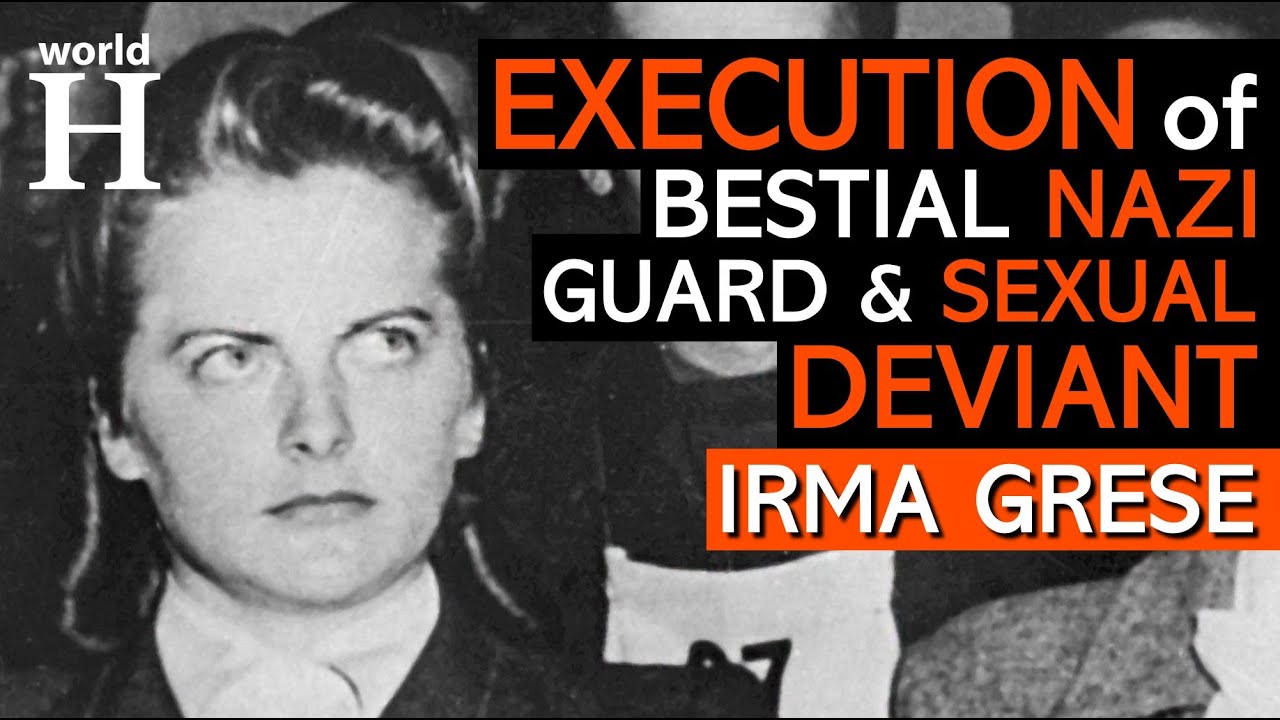
Her name was Irma Grese.
To survivors, she was not just another guard.
She was remembered as one of the most feared women in the Nazi camp system.
Irma Grese was born on October 7, 1923, in Wrechen, Germany. She grew up in a poor rural family during the unstable years of the Weimar Republic. Her father worked in the dairy trade, and the family lived under strict discipline.
Her childhood was marked by hardship and tragedy. In 1936, her mother died by suicide after discovering her husband’s affair. Irma was still young, and the home she returned to afterward was cold, religious, and harsh.
At the same time, Germany itself was changing.
After Hitler came to power in 1933, Nazi propaganda entered schools, youth groups, newspapers, films, and public life. Children were taught obedience, racial hatred, and loyalty to the state. Even families that resisted Nazi influence could not fully protect their children from the system around them.
Irma did not excel at school. She left early and moved through low-level jobs: farm work, shop work, and later hospital assistance. At Hohenlychen Sanatorium, she worked under doctors connected to the Nazi medical establishment. She wanted to become a nurse, but lacked the education required.
By 1942, Grese entered Ravensbrück.
It was the largest concentration camp built specifically for women.
Ravensbrück was not simply a prison. It was a training ground for female SS guards. Women learned how to command prisoners, enforce punishment, and treat human beings as tools of labor and death.
There, Grese entered a world where cruelty was not an accident.
It was taught.
It was rewarded.
It was normalized.
Ravensbrück exposed her to a system of forced labor, starvation, and medical abuse. The camp held women from across Europe: Poles, Russians, Jews, Roma, political prisoners, and others targeted by the Nazi regime.
For Grese, this was the beginning of a transformation.
When she later told her father she was supervising prisoners, he reportedly reacted with rage and drove her away. Whatever moral barrier remained between her old life and the camp system was breaking.
In March 1943, Grese was transferred to Auschwitz-Birkenau.
There, her name became infamous.
Birkenau was one of the central sites of Nazi mass murder. Trains arrived packed with deportees. Some prisoners were selected for forced labor. Others were sent almost immediately to death.
Inside that machinery, Grese gained power.
Survivors later described her as beautiful in appearance but terrifying in behavior. The contrast made her even more haunting in memory. Some called her the “Hyena of Auschwitz.” Others remembered her as the “Beautiful Beast.”
At Auschwitz, she was no longer a powerless young woman from a broken household.
She could command.
She could punish.
She could decide who suffered.
And according to survivor testimony, she seemed to enjoy that power.
By 1944, Grese had become a senior overseer in Lager C at Birkenau, where tens of thousands of women were crowded into unbearable conditions. The barracks were packed. Sanitation collapsed. Prisoners lacked food, water, rest, and basic dignity.
Grese supervised other guards and controlled the daily lives of prisoners already fighting to survive.
She carried a whip.
She beat prisoners for arriving late, for taking food, for moving too slowly, or for no clear reason at all. Survivors described punishments that forced women to stand for hours in the cold or hold stones until their bodies gave way.
Her violence was not merely discipline.
It became part of the terror of the camp.
Even in a place filled with brutality, Grese stood out.
She participated in selections, the moments when prisoners were judged as either useful for labor or marked for death. Women were inspected, separated, and sent away under the cold language of Nazi bureaucracy.
For the prisoners, a gesture from someone like Grese could mean life or death.
There were also accusations of sexual abuse, exploitation, and sadistic control over vulnerable prisoners. Some women were temporarily favored, then discarded when they were no longer useful or interesting to her.
Grese’s power rested on the total helplessness of others.
That was what made her terrifying.
She did not create the Nazi system.
But she served it willingly.
And inside it, she became one of its cruelest faces.
As the Red Army approached Auschwitz in January 1945, the SS began evacuating prisoners. These forced evacuations became death marches. Starving prisoners were driven through winter conditions; those who collapsed could be shot or left behind.
Grese moved with the collapsing camp system, first through Ravensbrück and then to Bergen-Belsen.
By the time she arrived there, Belsen was no longer functioning as a normal camp. It had become a place of disease, starvation, and mass death. There was little food, almost no clean water, and typhus spread rapidly through the overcrowded barracks.
But even as the Third Reich was collapsing, the violence continued.
Survivors accused Grese of beating prisoners, forcing exhausting punishments, and continuing to behave with the same arrogance she had shown at Auschwitz.
When British forces liberated Bergen-Belsen, Grese was arrested with Josef Kramer and other SS personnel.
During interrogation, she showed little remorse. She presented herself as someone who had simply done her duty.
But the survivors who testified against her told a different story.
At the Belsen Trial, which began in September 1945, witnesses described her cruelty in detail. Grese denied many accusations and claimed the testimony was exaggerated. She admitted some beatings but denied murder.
The court did not believe her.
On November 17, 1945, Irma Grese was sentenced to death.
On December 13, 1945, she was hanged by British executioner Albert Pierrepoint.
Her final word was reportedly simple and cold:
“Quickly.”
She was twenty-two years old.
Irma Grese’s life remains disturbing not because she was born a monster, but because she shows how ordinary people can be shaped, empowered, and corrupted by a system built on hatred.
She entered the Nazi camp world young.
She learned its rules.
Then she embraced its violence.
By the end, she was not remembered as a victim of circumstance, but as a willing servant of one of history’s most brutal systems.
Her story is a warning.
Evil does not always begin with power.
Sometimes it begins with obedience, ambition, resentment, and the moment a person discovers they can hurt others without consequence.
And once that door opens, the damage can become unforgettable.


