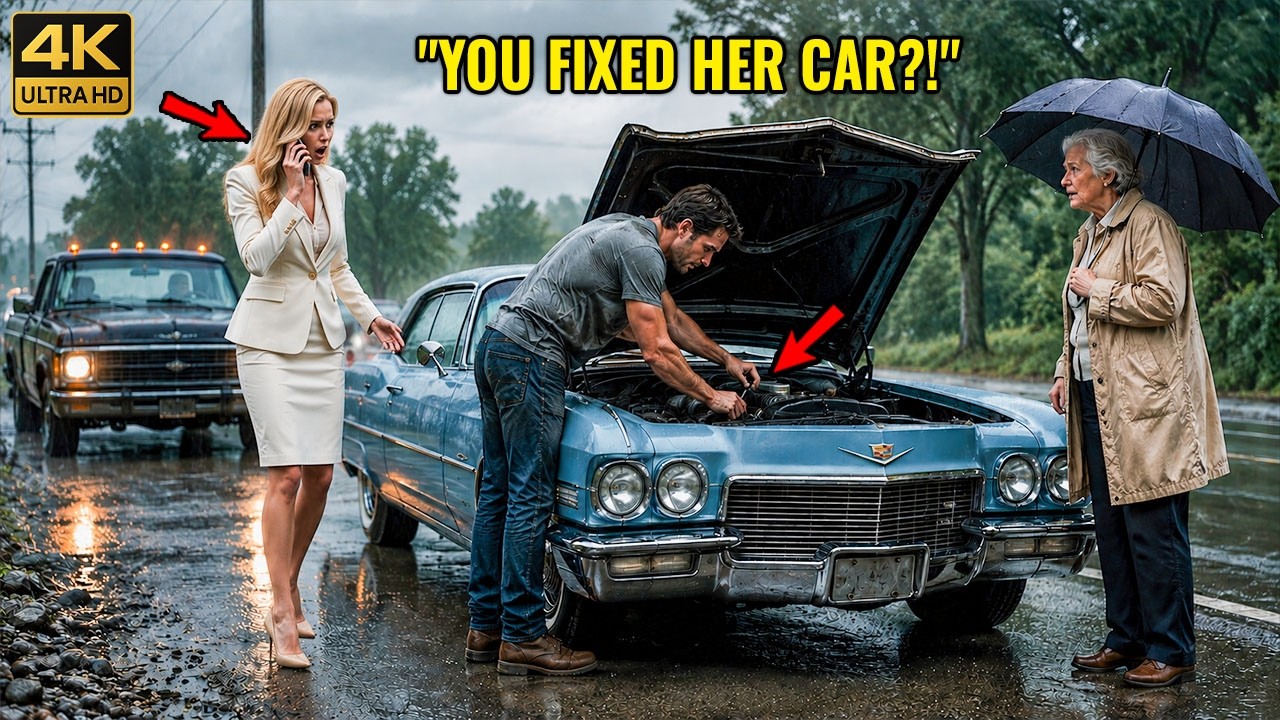
The rain had turned the shoulder of Jefferson Avenue into a strip of black glass when Nolan Rourke saw the elderly woman standing beside the Cadillac.
Cars passed her without slowing.
One driver splashed muddy water across her coat. Another leaned on the horn as though an eighty-year-old woman with a dead engine had personally chosen to block his evening commute.
Nolan drove another hundred feet before pulling his rusted pickup onto the shoulder.
He could not afford to be late.
The electricity bill for his garage was sitting unopened on the passenger seat. His landlord had already left two messages. He had promised his nine-year-old daughter that he would call before bedtime, and lately, too many promises had been reduced to apologies.
Still, he backed up.
The woman stood with one hand gripping the open driver’s door. Her silver hair was damp, and her fingers trembled from the cold.
“Ma’am,” Nolan said as he stepped into the rain. “Stay inside the car. You’ll freeze out here.”
“I called roadside assistance.”
“How long ago?”
“Forty minutes.”
Nolan looked at the dark stretch of road behind them.
“Get in. I’ll take a look.”
He wore a faded work jacket with ROURKE AUTO stitched across the chest, though most of the lettering had peeled away. His hands were scarred from engines, sheet metal, and years of work no one applauded.
The woman studied him for a moment.
Then she nodded.
Her name was Evelyn Whitmore.
Nolan did not recognize it.
He only knew that her Cadillac was old, heavy, and built during a time when manufacturers still left enough room under the hood for a mechanic’s hands.
He raised the hood, clipped a flashlight to the frame, and began checking the obvious failures.
Battery connection.
Fuel relay.
Ground wire.
Sensor harness.
Then he stopped.
A wire near the crankshaft position sensor had been cut.
Not worn through.
Not damaged by heat.
Cut cleanly.
He moved the flashlight closer. A fuse had been replaced with one rated high enough to delay a failure but low enough to create an intermittent shutdown under load. One connector had been pulled apart and pushed back together so quickly that the locking clip had cracked.
Nolan stared at the three details.
Any one of them could have been sloppy maintenance.
All three together were a message.
Someone had wanted the Cadillac to run for a while.
Then stop.
“Is it bad?” Evelyn called from inside the car.
Nolan closed his hand around the severed wire.
“It’s fixable.”
That was not the answer to her question, but it was the only one he was ready to give.
He made a temporary splice, replaced the fuse with one from his truck, secured the loose connector, and let the engine idle while rain hammered the hood.
The Cadillac steadied.
Evelyn offered him cash.
Nolan shook his head.
“You stopped in weather no one else would stop in.”
“I had tools.”
“That isn’t the same thing.”
He closed the hood. “Drive straight home. No detours. And have someone you trust inspect the car tomorrow.”
“You’re not someone I can trust?”
Nolan looked at her, then at the empty road.
“I’m someone you met twenty minutes ago.”
Evelyn smiled faintly.
“Sometimes that is enough.”
She drove away.
Nolan stood in the rain long after her taillights disappeared.
The clean cut bothered him.
So did the fuse.
So did the timing.
By the time he reached Rourke Auto, the garage looked even smaller than usual. Water dripped through a seam in the roof into a five-gallon bucket. The office heater rattled without producing heat. Three customer cars sat in the bays, but only one owner was likely to pay on time.
For the past four years, Nolan had kept the garage alive one repair at a time.
Before that, he had worked as a diagnostic systems engineer for a major automotive technology supplier. He had designed fault-detection routines, analyzed failure patterns, and trained software to distinguish normal wear from deliberate interference.
Then he discovered a backdoor in a diagnostic platform.
The backdoor allowed someone with the right credentials to alter safety logs after a vehicle test. Nolan reported it. Two days later, the incriminating files disappeared.
A week after that, investigators found his digital signature attached to an unauthorized transfer.
His company fired him.
The industry stopped returning his calls.
Friends distanced themselves. His marriage collapsed under the pressure. Even his custody schedule became a negotiation shaped by money he no longer had.
Nolan learned what powerful institutions did when the truth threatened them.
They did not always destroy the evidence.
Sometimes they destroyed the person carrying it.
He had promised himself never to return to that world.
But that night, he pulled a battered engineering notebook from the bottom drawer of his desk.
For three hours, he compared the Cadillac’s damage with failure models he had documented years earlier. The pattern was elegant in the worst possible way.
The vehicle would drive normally until heat, vibration, and electrical resistance aligned. Then the altered circuit would produce a believable mechanical failure.
To a tow-truck driver, it would look like age.
To an insurance company, it would look like neglect.
To anyone reviewing the diagnostic report, it would look natural.
Nolan was still staring at his notes when his phone rang.
“Is this Nolan Rourke?” a woman asked.
“Yes.”
“My name is Cassandra Whitmore.”
Her voice was controlled, sharp, and accustomed to immediate answers.
“My mother says you worked on her vehicle this afternoon.”
“I made a temporary repair.”
“She was alone with you on Jefferson Avenue.”
Nolan leaned back in his chair.
“If you’re asking whether I harmed her car, the answer is no.”
“I haven’t asked anything yet.”
“You didn’t call to thank me.”
There was a pause.
Then Cassandra said, “What exactly did you find?”
Nolan described the cut sensor wire, the incorrect fuse, and the damaged connector.
“Old cars have wiring problems,” she replied.
“Old wires fray. They melt. They corrode. They don’t make straight cuts.”
Silence.
“And the fuse?”
“Chosen to delay the shutdown.”
Another pause, longer this time.
“Our internal service team inspected that car last month.”
“Then either they missed it, or the damage happened afterward.”
“What are you suggesting?”
Nolan looked at the notebook on his desk.
“I’m suggesting someone wanted that car to fail at a specific time.”
Cassandra’s voice lost some of its certainty.
“My mother could have been killed.”
“Yes.”
“Do you understand who you’re talking about?”
“No.”
“My mother is Evelyn Whitmore. My father founded Whitmore Motors.”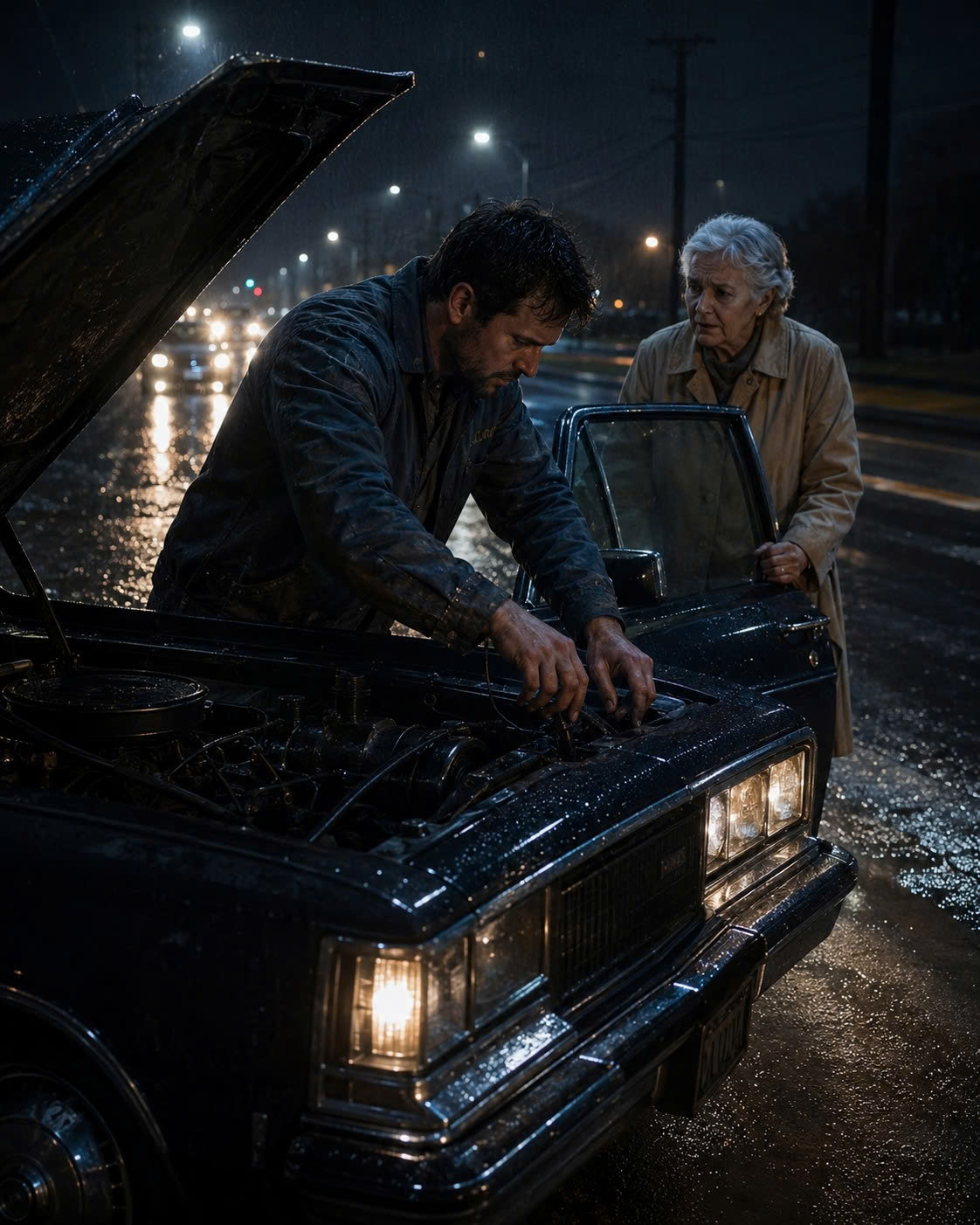
Nolan looked toward the rain-streaked garage window.
Whitmore Motors was one of Detroit’s oldest surviving automotive companies. Its newest division was preparing to launch the Aurora X-Line, an advanced vehicle platform built around assisted driving and predictive diagnostics.
Now Nolan understood the Cadillac.
It was not valuable because of the car.
It was valuable because of the woman driving it.
“Ms. Whitmore,” he said, “someone inside your company may have tried to kill your mother.”
The following morning, three black vehicles stopped outside Rourke Auto.
Cassandra entered with a security officer, a corporate attorney, and a man carrying a leather folder.
She wore a charcoal coat that probably cost more than Nolan’s monthly rent. Her expression was composed, but there were dark circles beneath her eyes.
The attorney placed a confidentiality agreement on Nolan’s workbench.
“This ensures that all information concerning Mrs. Whitmore’s vehicle remains private.”
A second document followed.
It included a payment large enough to clear Nolan’s debts.
Nolan did not touch either paper.
Cassandra watched him. “You helped my mother. We are grateful.”
“This isn’t gratitude.”
“It is protection.”
“For whom?”
The attorney stiffened.
Cassandra lowered her voice. “Mr. Rourke, our company is preparing for the most important product launch in its history. An unsupported accusation could damage thousands of employees.”
“So could a vehicle designed to hide evidence after someone tampers with it.”
“You don’t know that this involves our products.”
Nolan opened a metal drawer and removed the cut section of wire, the fuse, and photographs he had taken beside the road.
“I know this failure was built to look accidental.”
He pushed the evidence across the bench.
“If someone’s life is at risk, you don’t buy silence. You find out who benefits from it.”
For the first time, Cassandra looked at him without seeing a mechanic in an old jacket.
Two hours later, Nolan was inside Whitmore Motors’ technical center.
Engineers with security badges stared at his dented toolbox. A junior manager asked three times who had authorized his access. One technician smirked when Nolan opened a paper notebook instead of a company tablet.
Cassandra led him to a secure test lab where diagnostic data from the Aurora X prototypes filled several monitors.
Nolan scanned the error trees.
Thermal instability.
Signal desynchronization.
Temporary sensor dropout.
Automated log correction.
Then he saw it.
A seven-second delay between fault detection and system response.
The same delay the altered fuse in Evelyn’s Cadillac had created.
“Run prototype seventeen,” Nolan said.
A senior engineer frowned. “We’ve already reviewed that vehicle.”
“Run the raw log.”
“We don’t provide raw data to outside mechanics.”
Nolan turned toward Cassandra. “Then I’m done here.”
Before she could respond, the lab doors opened.
Bennett Ashcroft entered with two board members and Graham Hollis, Whitmore Motors’ chief legal adviser.
Ashcroft was the chairman of the board, a polished man in his sixties whose reputation had been built on acquisitions, restructuring, and removing people who resisted either.
He looked Nolan up and down.
“This is the roadside mechanic?”
Nolan said nothing.
Ashcroft glanced at Cassandra. “You allowed an unvetted outsider into a restricted testing environment during the final launch cycle?”
“He identified a possible connection to the prototype failures.”
Ashcroft laughed once.
“Cassandra, desperation is not a management strategy.”
Graham stepped closer to the monitor and closed the raw-data window.
“Mr. Rourke’s presence creates substantial liability.”
Nolan saw the framework name just before the screen disappeared.
AURORA-X RECOVERY LAYER.
The structure beneath it looked almost identical to the system that had destroyed his career.
His face remained still, but his hands tightened around the handle of his toolbox.
Ashcroft noticed.
“Something wrong?”
“No,” Nolan said. “Something familiar.”
That evening, Cassandra reopened Nolan’s old employment file.
She expected to find a disgraced engineer trying to attach himself to a powerful family.
Instead, she found inconsistencies.
The security report accusing Nolan had been prepared before the alleged data transfer occurred. His access credentials had been authenticated from two locations at the same time. Several internal emails had been removed from the archive under legal privilege.
The outside counsel advising Nolan’s former employer had been Graham Hollis.
When Cassandra confronted Nolan, he did not seem surprised.
“I found a software backdoor,” he told her. “It could rewrite diagnostic history after a safety event. I reported it. The original files vanished. Then my signature appeared in the access logs.”
“You believe Graham framed you?”
“I believe someone needed a guilty employee more than they needed the truth.”
“Why didn’t you fight?”
“I did.”
Nolan looked around the garage.
“This is what fighting looked like after I ran out of money.”
Cassandra’s eyes moved toward the leaking roof and the unpaid invoices stacked beside the register.
“I judged you when I walked in here.”
“Most people do.”
“I was wrong.”
Nolan did not accept the apology or reject it.
He only said, “Your mother is still in danger.”
Cassandra arranged an emergency technical briefing before the board.
Ashcroft approved the meeting almost immediately.
That was when Nolan knew it was a trap.
The boardroom was forty floors above downtown Detroit, surrounded by glass and winter sky. Nolan entered carrying the same scratched metal toolbox he used every day.
One director glanced at it and whispered something to the man beside her.
Ashcroft smiled.
“Mr. Rourke, I understand you’ve brought your complete laboratory.”
A few people laughed.
Nolan placed the toolbox on the table.
“I brought the Cadillac parts.”
Ashcroft leaned back. “Then enlighten us.”
Nolan asked the technical team to display the raw logs from three Aurora X prototypes beside the electrical readings from Evelyn’s Cadillac.
He marked the signal delays.
Seven seconds.
Seven seconds.
Seven seconds.
Then he showed how the system erased the initiating fault and replaced it with a secondary mechanical error.
“The Cadillac used physical components,” Nolan said. “The prototypes use software. But the failure architecture is the same. Trigger, delay, shutdown, rewrite.”
Graham interrupted.
“That is speculation from a man previously terminated for data misconduct.”
Nolan changed the display.
A line of recovery code appeared.
“This subroutine was built from the Aurora X internal framework. It isn’t third-party code. It was written by someone with access to your test environment.”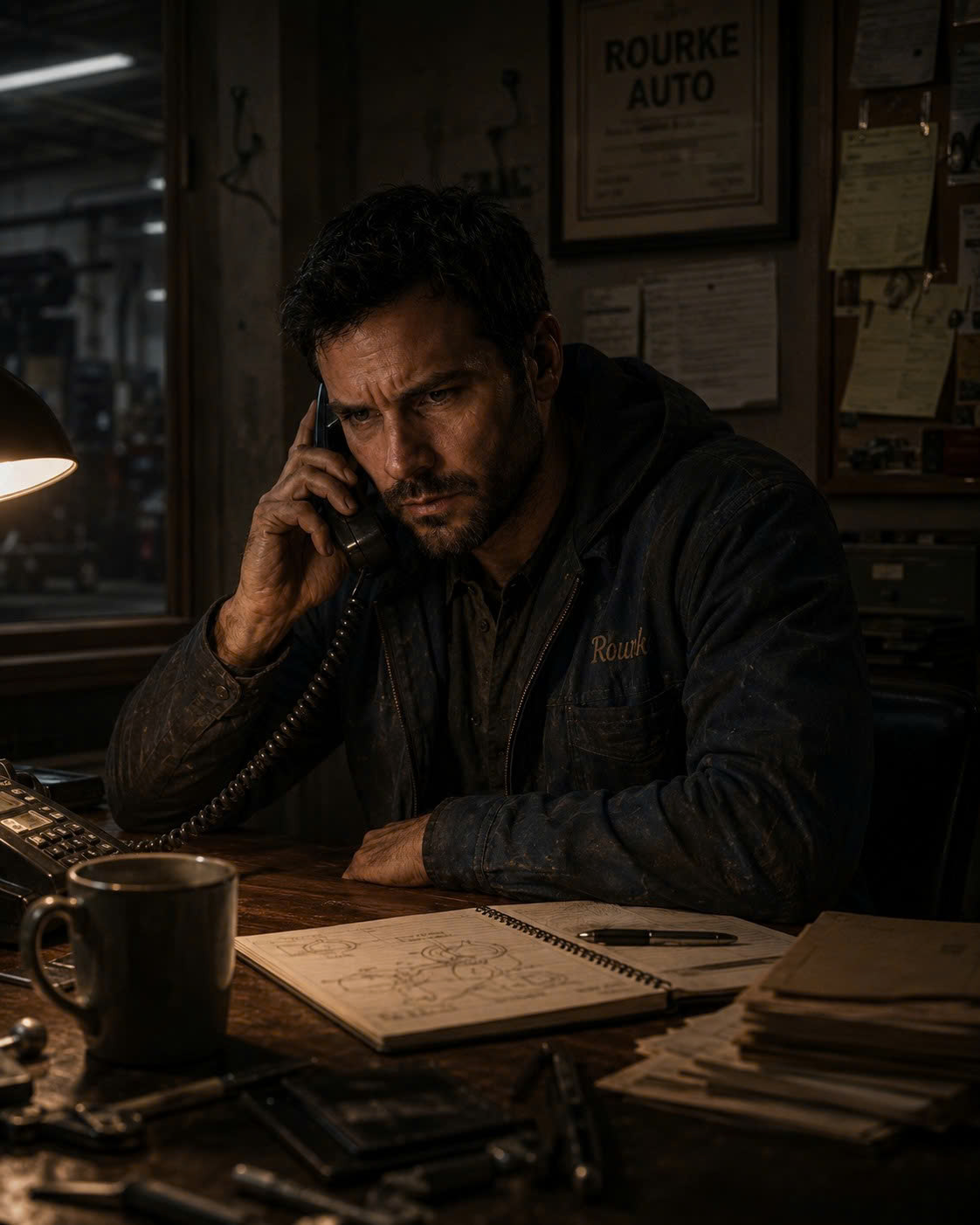
The laughter stopped.
Several board members leaned forward.
Graham reached for his tablet.
Cassandra spoke before he could send a message.
“All access to the test network has been suspended.”
Graham’s face changed for half a second.
It was small, but Nolan saw it.
So did Cassandra.
That afternoon, Evelyn remembered something she had dismissed as unimportant.
Before leaving Whitmore headquarters, a member of the security team had advised her to avoid her usual route because of construction. He directed her toward the isolated section of Jefferson Avenue where her car later failed.
The Cadillac’s dashcam was recovered.
The footage showed a man in contractor clothing entering the parking garage, opening Evelyn’s hood, and working near the engine bay for less than four minutes.
His face was partially hidden.
His access badge was not.
It belonged to a contractor approved through Graham Hollis’s office.
Evelyn also revealed a clause in Whitmore Motors’ founding charter. Her late husband had written it after an early safety scandal nearly destroyed the company.
If credible evidence showed that a board chairman had endangered a member of the founding family or knowingly compromised product safety, the CEO could order an independent audit and suspend the chairman’s voting authority.
Ashcroft and Graham responded before Cassandra could act.
A story appeared online accusing Nolan of fabricating a safety crisis to extort Whitmore Motors. Reporters surrounded his garage. Former colleagues were quoted describing him as unstable and resentful.
His landlord delivered an eviction notice two months ahead of schedule.
The pattern was exactly the same as before.
Discredit the witness.
Control the story.
Wait for the public to forget the evidence.
Cassandra offered Nolan a legal team.
“I don’t want to become your charity case,” he said.
“This isn’t charity.”
“Then give me one day and the original server data.”
That night, Nolan contacted Rowan Pierce, an independent systems auditor known for preserving evidence before corporations could bury it.
The three of them worked inside Rourke Auto.
There were no polished conference rooms. No climate-controlled laboratory. Nolan used an aging laptop, diagnostic modules salvaged from wrecked vehicles, and a simulation rig assembled on a steel bench.
The heater failed shortly after midnight.
Cassandra kept her coat on and drank coffee so burned that she stopped making faces after the second cup.
Nolan barely spoke.
His hands moved steadily between hardware and code, building a simulation from the Cadillac’s physical damage and the Aurora X recovery structure.
“What are you trying to make it do?” Cassandra asked.
“Tell the truth.”
“Code doesn’t tell the truth.”
“No. But it leaves habits.”
He explained that whoever designed the sabotage had taught the system to erase the primary fault. But erasing a fault required the code to confirm the fault existed first.
That confirmation had to be stored somewhere, even briefly.
They were searching for the shadow left by the deletion.
At two in the morning, Ashcroft called Cassandra.
“End this,” he told her. “Return to headquarters and issue a statement blaming the prototype irregularities on vendor integration.”
“You know that isn’t true.”
“What I know is that the board will remove you tomorrow for disclosing confidential data to a disgraced outsider.”
“My mother’s car was sabotaged.”
“Your mother is alive.”
The words hung in the cold garage.
Cassandra looked at Nolan.
He had heard them.
Ashcroft continued, “Protect the company your father built.”
After the call ended, Cassandra stood motionless beside the workbench.
“My father spent his life building Whitmore Motors.”
Nolan did not look away from the screen.
“Then don’t use his name to excuse what could kill people.”
“You think this is easy?”
“No.”
He finally turned toward her.
“But saving your chair while defective cars reach the road doesn’t protect the company. It makes you part of the failure.”
Cassandra stared at him.
Then she removed her corporate access card and placed it beside the diagnostic unit.
“Use everything.”
Just before dawn, the hidden recovery logs appeared.
The first credential came from Graham Hollis’s legal administration server.
The second was an approval token.
Rowan verified its digital chain twice.
It belonged to Bennett Ashcroft.
The sabotage trigger was scheduled for launch day.
During the public Aurora X demonstration, multiple vehicles would experience synchronized diagnostic failures. The launch would collapse on live television. Whitmore’s share price would crash. Cassandra would be removed for mismanagement.
A group of investors aligned with Ashcroft had already prepared financing to acquire a controlling stake and seize the company’s autonomous-driving patents.
Evelyn’s Cadillac had been the test.
A low-risk vehicle with older systems, used to prove the failure logic could be disguised as ordinary wear.
It had also been a warning to the one founding shareholder who still had the authority to stop Ashcroft.
The emergency board session began at nine.
Ashcroft opened with a motion to remove Cassandra as CEO for unauthorized disclosure of protected technical assets.
Nolan sat at the far end of the room beside Rowan.
Ashcroft spoke for fifteen minutes about governance, stability, and fiduciary duty. Then he displayed Nolan’s old disciplinary record.
“This man is not a whistleblower,” Ashcroft said. “He is a dismissed employee with a documented history of data theft. Cassandra Whitmore placed our company in his hands.”
Several directors nodded.
Ashcroft turned toward Nolan.
“Mr. Rourke, do you deny that you were terminated for misconduct?”
“No.”
The room shifted.
Ashcroft smiled.
“Do you deny that your reputation was damaged long before you entered this company?”
“No.”
“Then on what basis should anyone here trust you?”
Nolan folded his hands on the table.
“Don’t trust me. Trust the evidence you paid your own systems to preserve.”
Cassandra stood.
“Before this vote proceeds, I am invoking Article Fourteen of the founding charter.”
Graham’s head snapped toward her.
“That article is obsolete.”
Evelyn’s voice came from the doorway.
“No, it is not.”
Everyone turned.
The woman Nolan had found shivering beside an old Cadillac entered with a cane in one hand and a certified copy of the company charter in the other.
She was no longer a stranded motorist.
She was Evelyn Whitmore, founding shareholder, widow of the company’s creator, and legal witness to the clause Ashcroft had assumed everyone had forgotten.
“I affirm the CEO’s right to initiate an emergency safety audit,” she said.
Ashcroft’s smile disappeared.
Nolan connected his simulation to the boardroom display.
The screen showed two vehicles: Evelyn’s Cadillac and an Aurora X prototype.
He activated the sequence.
The Cadillac’s altered circuit produced a delayed sensor failure.
Seven seconds later, the Aurora X code mirrored it.
Both systems generated a false secondary error. Both attempted to erase the initiating event.
Then Nolan froze the simulation before deletion.
A hidden identifier remained on the screen.
The fingerprint matched the internal Aurora X recovery framework.
Rowan stood.
“I independently captured and verified these records before the meeting. They existed on Whitmore Motors’ servers prior to Mr. Rourke receiving access. The evidence has not been created or altered by him.”
Cassandra displayed the dashcam footage.
Then the contractor’s access authorization.
Then Graham’s credentials.
Finally, Ashcroft’s approval token.
Each piece appeared alone.
Together, they formed a chain no one in the room could explain away.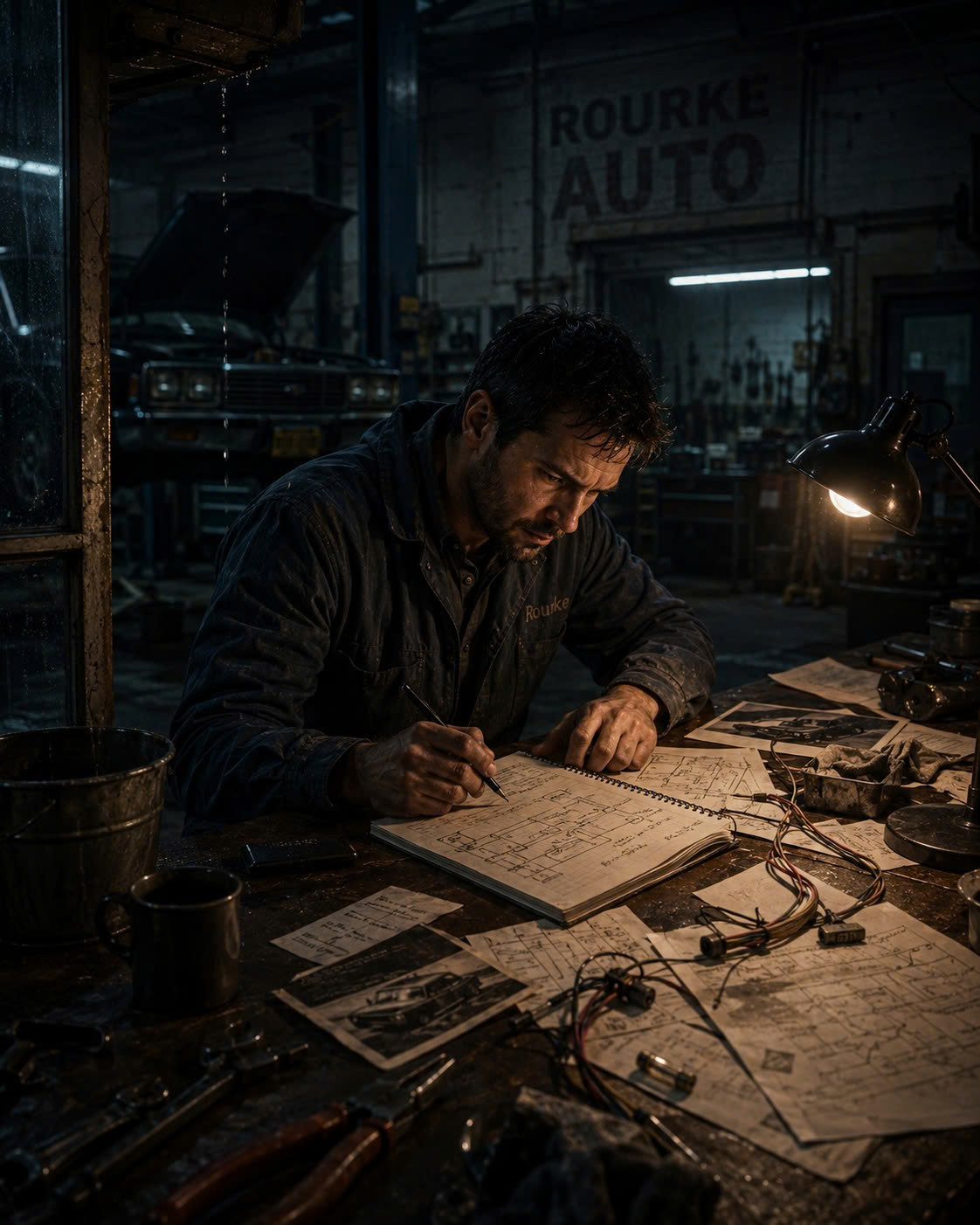
Graham began gathering his papers.
Security moved toward him.
Ashcroft remained seated.
For the first time that morning, he looked at Nolan directly.
Not at the jacket.
Not at the toolbox.
At Nolan.
The color had drained from Ashcroft’s face. His mouth opened, but no words came. Around him, directors who had laughed at Nolan’s toolbox now avoided the chairman’s eyes.
Evelyn watched in silence.
Cassandra did not move.
Ashcroft looked toward the door, then at the approval code glowing on the screen.
That was the moment he understood.
The mechanic he had tried to humiliate had not entered the room seeking revenge.
He had entered carrying the one thing Ashcroft’s power could not survive.
Proof.
The board suspended Ashcroft’s voting authority immediately. Graham Hollis was removed from all company systems and escorted from the building.
The evidence was turned over to federal investigators and state authorities. Civil claims followed, along with a criminal investigation into attempted sabotage, market manipulation, and reckless endangerment.
Nolan did not celebrate.
His first request was to quarantine every Aurora X prototype carrying the compromised recovery layer.
The launch was postponed.
No vehicles reached customers.
Three weeks later, Cassandra visited Rourke Auto without security or lawyers.
She offered Nolan a senior position leading independent diagnostic safety, with authority to block any vehicle program that failed his review.
Nolan read the proposal twice.
Then he set it down.
“I spent years trying to survive after a corporation decided my name was disposable.”
“I know.”
“I don’t want another badge that can be taken away when the truth becomes inconvenient.”
Cassandra nodded.
She did not argue.
A week later, she returned with a different agreement.
Rourke Auto would remain independently owned. Whitmore Motors would fund upgraded equipment and contract the garage as an external safety verification center. Nolan would report findings directly to an independent committee, not the legal department or board chairman.
He would have authority without surrendering ownership.
Evelyn brought the new sign herself.
ROURKE INDEPENDENT MOTORS.
Nolan ran his hand across the lettering before it was mounted above the garage door.
“You spelled it right,” he said.
Evelyn smiled. “I had people check.”
Business changed quickly.
Prototype vehicles arrived under covered transport. Engineers came to learn from the man they had once dismissed. Customers who could afford dealership prices waited weeks for Nolan’s opinion.
But some things did not change.
When a single mother arrived with a failing alternator and twenty dollars in her purse, Nolan repaired the car before discussing payment.
When an elderly man needed tires before winter, Nolan found a safe used set and charged him only for installation.
The garage light stayed on.
The roof stopped leaking.
The old heater was replaced, but Nolan kept it in the back room as a reminder of the night a broken machine, terrible coffee, and three people refusing to look away changed an entire company.
Whitmore Motors released the Aurora X-Line six months late.
The launch opened with Cassandra explaining why the delay had been necessary. She publicly credited Nolan Rourke, not as a roadside mechanic who had gotten lucky, but as the diagnostic engineer whose judgment had prevented a deliberate failure from becoming a public tragedy.
His former employer issued a formal apology after investigators proved his access records had been falsified.
Nolan framed the letter and hung it near the garage office.
Not because it erased the years he had lost.
It did not.
But one Saturday morning, his daughter stood beneath it while Nolan showed her how to test a battery.
She looked from the letter to the new sign outside.
“Does this mean everyone knows you were telling the truth?”
Nolan tightened the terminal clamp.
“The people who matter do.”
She smiled.
For the first time in years, he did too.
A stranger had once been abandoned beside a road because helping her looked inconvenient. Nolan stopped because he believed safety came before money, titles, and appearances.
That small decision exposed a conspiracy, saved a company, protected thousands of drivers, and returned a stolen name to the man who had earned it.
Because sometimes the smallest act of decency is the loose thread that pulls an entire corrupt system apart.