Marisol Vega had cleaned hundreds of hotel rooms without ever touching anything that frightened her.
She had found wedding rings wrapped in tissues, wallets beneath mattresses, medication inside bathroom drawers, and once, an envelope containing more cash than she earned in six months.
She always reported everything.
But the folded note beneath the lamp in Room 1412 felt different.
The room had belonged to a couple who checked out two hours earlier. They had left almost nothing behind—no receipts, no toiletries, not even a used glass beside the bed.
That alone was unusual.
Guests who paid for luxury suites normally left traces of themselves everywhere.
Marisol was changing the sheets when she noticed the bedside lamp sitting slightly crooked. Its heavy brass base had been pushed several inches away from the wall.
She lifted it to wipe the table.
A small piece of hotel stationery had been folded twice and pressed beneath the base.
It had not fallen there.
Someone had hidden it.
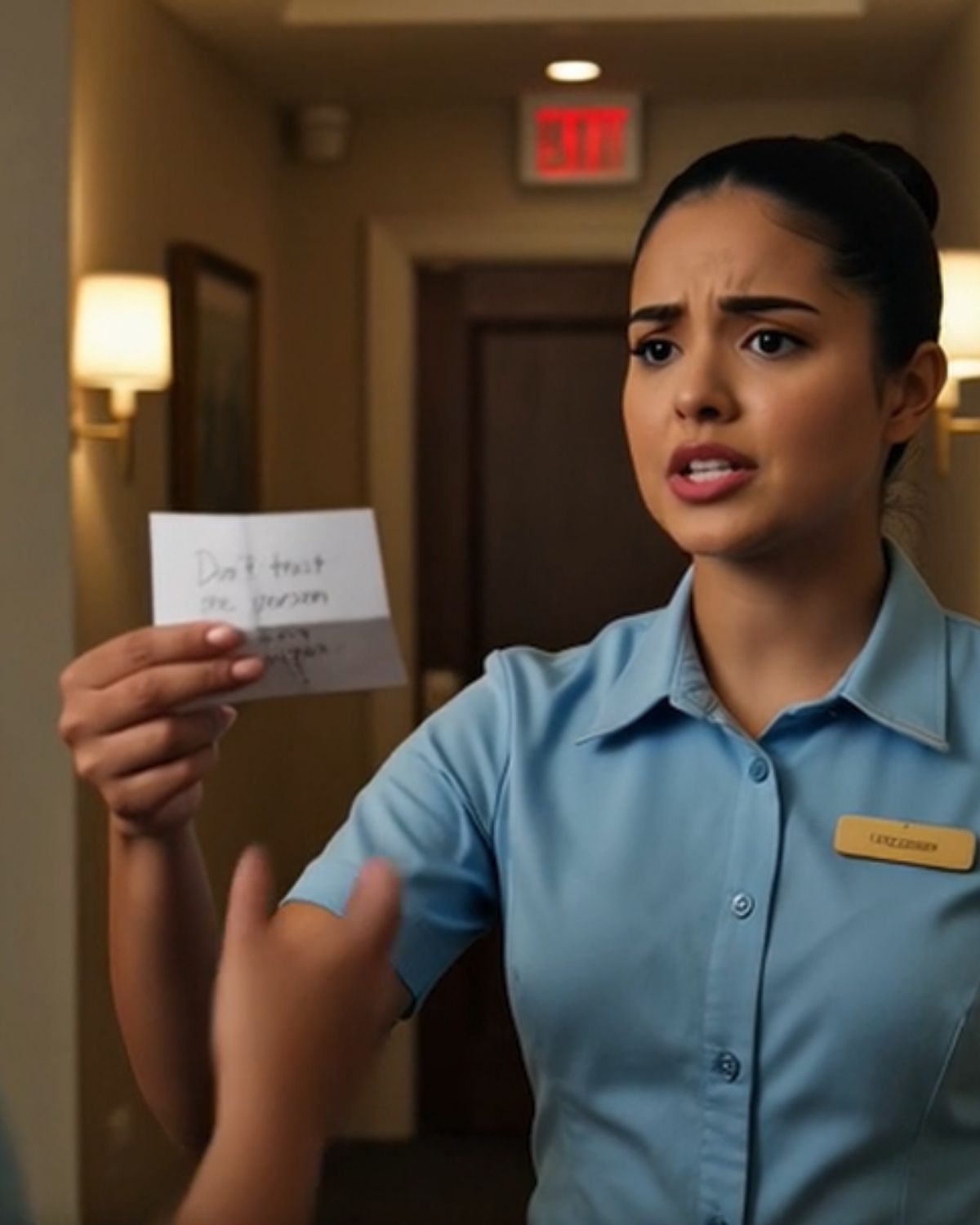
Marisol unfolded the paper.
Only one sentence had been written across it.
“Don’t trust the person coming tonight.”
For a few seconds, the room seemed completely silent.
Then the air-conditioning clicked on, making Marisol jump.
She read the sentence again.
The handwriting was uneven. Some letters had been pressed so hard that the pen had nearly torn through the paper.
This was not a reminder.
It was not part of a game.
Whoever wrote it had been afraid.
Marisol looked around the room.
A half-empty bottle of water stood near the television. One bathroom towel was missing. There was a dark mark on the carpet near the door, as though someone had dragged a suitcase—or something heavier—across it.
She walked into the hallway carrying the note.
Her coworker, Denise, was loading towels onto a housekeeping cart.
“Look at this,” Marisol said.
Denise read it and laughed.
“It’s probably nothing.”
“Someone put it under the lamp.”
“Maybe the guests were fighting. Maybe one of them was being dramatic.”
Marisol turned the paper over.
The back appeared blank, but faint lines had been pressed into it from whatever had been written on the sheet above.
She tilted it toward the hallway light.
There were numbers.
Possibly a room number.
And beneath them, what looked like a name beginning with the letter M.
“No,” Marisol said quietly. “Someone wanted this hidden.”
Denise’s smile faded slightly.
“Then take it to the desk.”
They walked quickly past the housekeeping carts and service elevators.
The luxury hotel continued operating around them as though nothing had happened.
A wedding party posed near the grand staircase. A pianist played beneath a crystal chandelier. At the bar, guests laughed over glasses that cost more than Marisol’s weekly grocery budget.
Nobody noticed the housekeeper carrying a warning through the lobby.
At the reception desk, Assistant Manager Daniel Crowe was studying a list of VIP arrivals.
Marisol placed the note in front of him.
“I found this hidden in Room 1412.”
Daniel glanced at it.
“Was anything else left behind?”
“No.”
“Did the guest report a problem?”
“Not that I know of.”
“Then send it to lost property.”
Marisol stared at him.
“It’s a warning.”
“It could be anything.”
“It says not to trust someone coming tonight.”
Daniel lowered his voice.
“We have nearly four hundred guests in this building. We cannot alarm people over an anonymous sentence.”
“The writing on the back may have a room number.”
Daniel held it toward the light for less than a second.
“I don’t see one.”
“You have to look carefully.”
He pushed the note back toward her.
“We don’t create problems without proof.”
Behind Marisol, another receptionist looked away.
Daniel had already returned to the arrivals list.
The conversation was over.
But Marisol did not move.
She had worked at the Calder House Hotel for eleven years. She knew how people looked at housekeeping employees.
They saw the uniform.
They saw the cart.
They saw someone who entered after they left and disappeared before they returned.
They did not see how much housekeepers noticed.
Marisol knew when a couple had argued before checking out.
She knew when a guest was pretending not to be sick.
She knew when a child had been crying all night, even after the family carefully removed every used tissue from the room.
Small details told stories.
And the details in Room 1412 were telling her that someone had left in a hurry.
“Can you at least check who stayed there?” she asked.
Daniel sighed.
“Guest information is confidential.”
“I cleaned the room.”
“That does not authorize you to investigate the guest.”
A security supervisor named Owen Blake had been standing near the office door. He stepped forward and took the note.
“I’ll log it,” he said.
Daniel gave him a warning look.
Owen shrugged.
“Logging it takes thirty seconds.”
He carried the paper into the security room.
Marisol followed.
The room contained six monitors showing hallways, entrances, elevators, and parking areas. Owen entered the room number into the hotel system.
Room 1412 had been booked under the name Leah Sloane.
One adult.
Three nights.
Cash deposit.
No loyalty account.
“She checked out at 7:06 this morning,” Owen said. “Nothing unusual in the report.”
“Can we look at the hallway camera?”
Owen hesitated.
Daniel appeared in the doorway.
“We are not reviewing hours of footage because of a note.”
Marisol pointed at the paper.
“Someone might be in danger.”
“Or someone wrote something meaningless and forgot it.”
Daniel checked his watch.
“We have a medical charity reception starting in twenty minutes. Security needs to focus on the event.”
The words made Marisol look up.
“Medical charity?”
“The Bellmont Children’s Foundation. They are meeting with a family staying in the hotel.”
Marisol suddenly remembered the faint marks on the back of the note.
She grabbed a pencil from Owen’s desk.
“What are you doing?” Daniel asked.
Marisol laid the note facedown and gently moved the side of the pencil across the paper.
Gray graphite settled into the indentations.
Letters slowly appeared.
Owen leaned closer.
There was a name.
MORENO
Underneath it was a four-digit number.
1708
And beside that, a time.
8:30
Daniel stopped looking at his watch.
Marisol knew Room 1708.
She had delivered extra blankets there the previous evening.
The Moreno family had arrived from a small farming town nearly four hours away. Their nine-year-old son, Mateo, was scheduled for heart surgery at St. Anne’s Children’s Hospital.
His parents, Luis and Gabriela, had spent months raising money for travel, treatment, and temporary housing.
A local charity had arranged their hotel stay.
When Marisol brought the blankets, Mateo had been sitting near the window building a spaceship from paper cups. His younger sister, Sofia, had fallen asleep across two chairs.
Gabriela had apologized for the mess.
Marisol had told her that children were allowed to make messes.
“The Morenos are in 1708,” Marisol said.
Daniel’s face tightened.
“That information should not be discussed.”
“It’s written on the note.”
Owen took the paper from her and examined the graphite markings.
“Who is coming to see them at 8:30?”
Daniel did not answer immediately.
“The foundation arranged for a patient-services coordinator to meet them before tomorrow’s hospital admission.”
“What is the coordinator’s name?” Marisol asked.
“I don’t remember.”
“Is it someone from the hospital?”
“I assume so.”
“You assume?”
Daniel turned toward her.
“This is exactly why employees should follow procedure instead of creating theories.”
Marisol looked at the clock.
It was 8:12.
In Suite 1708, Gabriela Moreno was organizing medical records on the dining table.
Birth certificates.
Insurance documents.
Hospital forms.
Bank statements.
A folder containing details of every donation their community had collected.
Mateo sat on the sofa in dinosaur pajamas, trying not to show that he was afraid of the surgery scheduled for the next morning.
His father, Luis, knelt in front of him.
“You’ll be asleep the entire time,” he said. “When you wake up, Mom will be there.”
“And you?”
“I’ll be there too.”
A knock came at the door.
Gabriela checked the time.
“He’s early.”
A man’s voice came from the hallway.
“Mrs. Moreno? I’m from St. Anne’s patient coordination office.”
Gabriela gathered the documents.
At the security desk, Owen finally opened the hallway footage from the fourteenth floor.
The video showed Leah Sloane leaving Room 1412 at 6:48 that morning.
She was young, perhaps twenty-five, wearing a baseball cap and carrying a small bag.
She walked toward the elevator, stopped, then returned to the room alone.
Three minutes later, she came out again.
This time, she kept looking over her shoulder.
At 7:02, a man stepped from the stairwell.
He grabbed her arm.
Even without sound, the anger in his movements was obvious.
Leah pulled away.
The man said something close to her face, then took her bag and walked her toward the elevator.
Owen froze the image.
“Do you know him?” Marisol asked.
Daniel stared at the screen.
“No.”
Owen changed cameras.
The lobby footage showed the same man leaving the hotel with Leah shortly after 7:00.
Then Owen searched the afternoon recordings.
At 6:35 that evening, the man returned alone.
But he did not enter through the lobby.
He came through the underground parking area wearing a delivery jacket. He used a key card at the staff entrance, waited for an employee to open the door, and slipped in behind him.
At 7:58, another camera recorded him entering a public bathroom.
At 8:06, he came out wearing a dark suit and a plastic identification badge.
Owen enlarged the image.
The badge displayed the logo of St. Anne’s Children’s Hospital.
Daniel exhaled.
“He could still work there.”
Owen picked up the phone.
“I’m calling the hospital.”
Marisol looked at the clock again.
8:17.
“We don’t have time.”
Daniel blocked the door.
“Security will handle it.”
“You haven’t even confirmed the visitor’s name.”
“Going to the suite could frighten the family.”
“And doing nothing could be worse.”
Daniel’s voice became harder.
“Marisol, return to your floor.”
For one second, she stood completely still.
She thought about her uniform.
About the note Daniel had dismissed.
About Mateo building a paper spaceship hours before heart surgery.
Then she walked past him.
“Marisol!”
She was already running.
Through the security corridor.
Across the lobby.
Past the reception desk where guests turned to watch a housekeeper sprint beneath the chandelier.
The elevator was too slow.
She pushed through the stairwell door and climbed.
Fourteen.
Fifteen.
Sixteen.
Her shoes struck the concrete steps. Her lungs burned. Her cleaning gloves were still tucked into her apron.
On the seventeenth floor, she burst into the hallway.
At the far end, a man in a dark suit stood outside Suite 1708.
The door had opened several inches.
Gabriela Moreno was visible inside, holding a folder against her chest.
The man smiled.
“I just need to verify the original documents before your hospital check-in.”
He reached for the folder.
“Please wait,” Marisol called. “We need to check something first.”
Everyone turned.
The man’s smile disappeared.
Gabriela kept one hand on the door.
“Is there a problem?”
Marisol slowed as she approached.
“Please close the door until security confirms his identity.”
The man lifted his badge.
“I’m with St. Anne’s.”
“Security is calling the hospital.”
His eyes shifted toward the stairwell.
It happened quickly.
He stepped backward.
Then he turned and ran.
The elevator doors opened before he reached them.
Owen and two security officers came out.
The man stopped.
For half a second, he seemed to consider pushing through them.
Then Owen looked directly at the identification badge.
“Don’t.”
The man slowly raised his hands.
Gabriela closed the suite door and locked it.
Through the wood, Marisol heard Sofia begin to cry.
Security escorted the visitor downstairs.
Inside the security room, St. Anne’s Hospital confirmed that no patient-services coordinator had been sent to the Calder House Hotel.
The badge was fake.
So was the name the man had given reception.
But that was not the worst discovery.
Camera footage showed him entering the hotel business center earlier that afternoon. He had printed hospital forms containing the St. Anne’s logo and created documents asking the Moreno family to authorize the transfer of their medical fundraiser into a “temporary surgical account.”
The account belonged to him.
He had not come to help the family.
He had come to take everything their neighbors, church members, coworkers, and relatives had raised for Mateo’s operation.
The police later found copies of the Morenos’ public fundraising posts on his phone.
He knew Mateo’s diagnosis.
He knew the hospital’s name.
He knew the surgery date.
He knew enough personal details to sound legitimate.
And Room 1412 had not been rented by a random guest.
Leah Sloane was his girlfriend.
Security footage from previous days showed her following the Moreno family through the lobby and listening while they spoke with charity volunteers.
Investigators believed she had been helping him collect information.
But sometime during their final night in the hotel, she had discovered what he intended to do.
She tried to warn someone.
She could not leave the message at reception because he was watching her.
She could not slide it under the Morenos’ door without being seen on the hallway cameras.
So while he was downstairs, she wrote one sentence.
She pressed the warning beneath the lamp, knowing the first person to enter after checkout would be a housekeeper.
She trusted a stranger with a cleaning cart to notice what everyone else overlooked.
And Marisol did.
The following morning, the hotel held an emergency staff meeting.
Daniel stood at the front of the room beside the general manager.
He looked exhausted.
Marisol sat in the back, still wearing the same plain uniform she had worn the night before.
The general manager explained what had happened.
He praised security.
He praised the police.
Then he asked Marisol to stand.
Every employee turned toward her.
She rose slowly.
Daniel looked at her, but the confidence he had shown at the reception desk was gone.
His hands were clasped tightly in front of him.
When their eyes met, he was the first to look away.
“I dismissed your concern,” he said. “I was wrong.”
The room remained silent.
“I thought following procedure was more important than listening to the person in front of me. Had you accepted my decision, the Moreno family might have lost the money needed for their son’s surgery.”
He swallowed.
“You saw evidence where I saw inconvenience.”
Marisol did not smile.
She only nodded.
The hotel changed its reporting policy that week. Housekeepers, maintenance workers, kitchen employees, and other staff members were given a direct way to contact security when they noticed something unusual.
Reports could no longer be dismissed by a single manager without being documented.
Marisol received an employee award and a financial bonus.
But her real recognition came several days later.
Mateo’s surgery was successful.
When he was strong enough to leave the hospital, the Moreno family returned to the hotel before traveling home.
Marisol entered the lobby expecting to begin her afternoon shift.
Instead, she found the family waiting beside her housekeeping cart.
Mateo held a paper spaceship in both hands.
On its side, written in blue marker, were the words:
FOR MARISOL — BECAUSE YOU NOTICED.
Gabriela hugged her.
Luis tried to speak, but his voice broke.
“You didn’t know us,” he finally said. “You didn’t owe us anything.”
Marisol looked at Mateo’s healing face.
“That doesn’t mean I should look away.”
Hotel guests stopped near the reception desk.
Employees came out from behind office doors.
Even Daniel stood quietly beside the elevators.
Mateo handed Marisol the paper spaceship.
The same worker who had once been told to return to her floor now stood in the center of the lobby while an entire family thanked her for refusing to be ignored.
The warning had been only seven words long.
Most people saw a scrap of paper.
Marisol saw fear in the handwriting, intention in the hiding place, and a family’s name pressed faintly into the page.
That night, she did not save the Morenos because she had authority, a title, or proof that satisfied everyone else.
She saved them because when something felt wrong, she cared enough to keep looking.
The people society overlooks are often the ones who notice what everyone else is too important to see.