
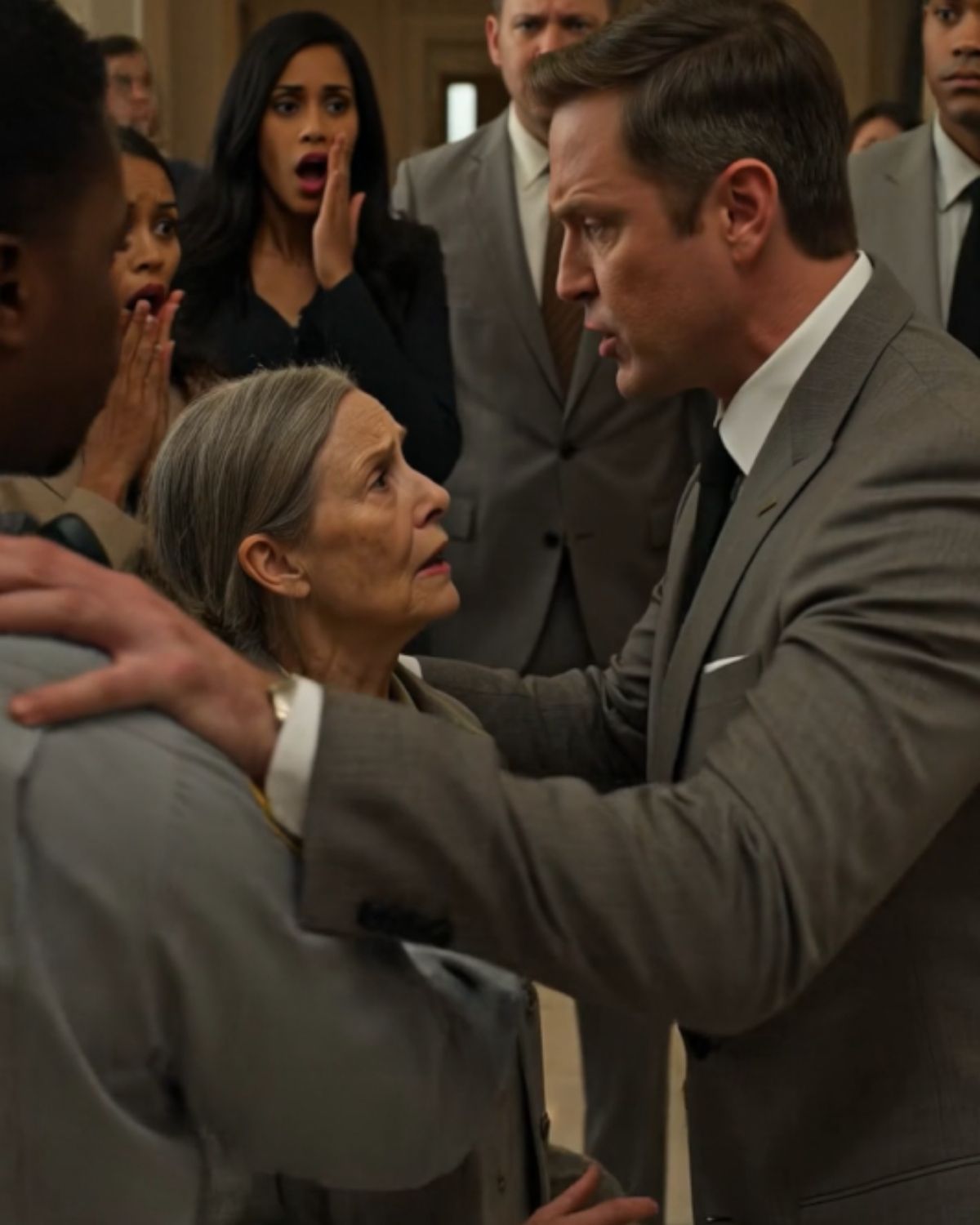
The first thing people noticed about Ruth Bennett was her coat.
It was too thin for the November cold and shiny at the elbows from years of wear. One button had been replaced with a darker one, and the hem had been repaired by hand.
The second thing they noticed was the hotel behind her.
The Monarch Crown rose above the city in glass and gold, its entrance lined with black cars, velvet ropes, and stone pillars wrapped in white lights. A corporate celebration was beginning inside. Executives stepped from luxury vehicles while photographers called their names.
Ruth stood at the edge of the driveway holding an old brown handbag against her chest.
She had taken two buses and walked six blocks because the final route had been canceled.
Now she looked up at the revolving doors and whispered to herself, “This must be the place.”
A doorman watched her approach.
“Can I help you, ma’am?”
Ruth smiled politely.
“I’m here to see my son.”
“Is he a guest?”
“He works here.”
The doorman glanced at her shoes. They were clean but badly worn, with rainwater darkening the fabric near the toes.
“What department?”
Ruth hesitated.
“He travels between several hotels. I’m not sure what department they call it.”
The doorman’s expression changed.
Behind Ruth, a black sedan pulled up. He immediately stepped around her to open its rear door.
“Please wait to the side.”
Ruth moved away as three men in tailored suits entered the hotel without being questioned.
She looked down at the envelope in her hand.
The address printed on it matched the gold letters above the entrance.
MONARCH CROWN HOTEL
Inside the envelope was an invitation her son had sent weeks earlier.
It had arrived with a note:
Mom, I’ll be in the city on Friday. I want you there for an important evening. Please let me send a car.
Ruth had tried to call, but her old phone had stopped charging that morning.
She had decided not to miss the occasion.
Her son had sounded excited.
And Ruth could count on one hand the number of times he had asked her to attend one of his business events.
She stepped through the revolving door.
Warm air touched her face.
The lobby was larger than the church she attended every Sunday. Crystal chandeliers reflected against marble floors. A pianist played near a wall of fresh flowers. Hotel employees moved quickly between guests carrying tablets and radios.
Ruth paused, uncertain which direction to take.
A security guard approached.
“Ma’am, this area is for registered guests and invited attendees.”
“I have an invitation.”
“May I see it?”
Ruth opened her envelope and handed him the card.
He studied it.
The front carried the Monarch Hospitality logo. The back contained no seat number, no barcode, and no department contact.
Only a handwritten message:
For the woman who made everything possible.
The guard turned it over.
“Who gave you this?”
“My son.”
“What is his name?”
“Daniel Bennett.”
The guard looked toward the reception desk.
Then back at Ruth.
“Do you have identification?”
Ruth searched inside her handbag.
She removed a handkerchief, a bus schedule, a small coin purse, and a pair of reading glasses held together with tape.
Her identity card was not there.
She checked again.
“I must have left it in my other purse.”
The guard returned the invitation.
“Without identification, I can’t allow you into the event area.”
“I don’t need to attend the event yet. Just tell Daniel I’m here.”
“Which Daniel?”
“Daniel Bennett.”
“Do you know how many employees work in this building?”
“He doesn’t work in this building every day.”
The guard’s patience thinned.
“Then you’ll need to call him.”
“My phone isn’t working.”
A couple waiting near the elevators glanced over.
Ruth lowered her voice.
“Could you please call the office?”
“What office?”
“My son’s office.”
The guard exhaled.
“Ma’am, you need to be more specific.”
Ruth looked toward the ballroom entrance. Employees were arranging a line of guests beneath a sign that read:
MONARCH HOSPITALITY — 30 YEARS OF SERVICE
She recognized the logo from the envelopes her son sometimes sent.
“That is his company,” she said.
The guard followed her gaze.
“Your son works for Monarch Hospitality?”
“Yes.”
“In what position?”
Ruth gave a small, embarrassed smile.
“He explains these things, but I never remember the titles. He says too many words when one would do.”
The guard did not smile.
A young receptionist named Lila had been listening from behind the desk.
She leaned toward a computer.
“I can search the employee directory.”
Before she could type, a man in a navy suit stepped out of the administrative hallway.
His name was Victor Hale, the hotel’s operations manager.
Victor had spent the entire week preparing for that evening. The company’s board, major investors, and executive leadership were arriving for the hotel’s thirtieth-anniversary celebration.
Every flower arrangement had been measured.
Every camera position had been approved.
Every employee had been warned that mistakes would be remembered.
Victor noticed Ruth immediately.
Not because she was loud.
Because she did not match the room.
“What is happening?” he asked.
The security guard lowered his voice.
“She claims she was invited by her son. No ID, no verified reservation, and no working phone.”
Victor looked at Ruth.
“May I see the invitation?”
She handed it to him.
He read the handwritten message and gave a short laugh.
“This could have been written by anyone.”
“My son wrote it.”
“Then call him.”
“I explained that my phone—”
“Yes, I heard.”
Victor looked toward Lila.
“Do not search the executive system for unidentified visitors. We have already discussed information security.”
Lila removed her hands from the keyboard.
Ruth looked from one employee to another.
“I’m not asking for private information. Just tell Daniel his mother is downstairs.”
Victor’s face tightened.
“Daniel Bennett?”
“Yes.”
“You expect me to believe Daniel Bennett invited you personally?”
Ruth frowned.
“Why wouldn’t he?”
Several guests nearby had begun watching.
Victor noticed them.
He lowered his voice, but his tone became colder.
“Because Mr. Bennett is not an ordinary hotel employee.”
“I know he works very hard.”
A man near the bar covered a smile.
Victor heard it.
His embarrassment turned into anger.
“Mr. Bennett is the chief executive officer of Monarch Hospitality.”
Ruth nodded.
“Yes. That sounds like one of the titles he uses.”
The lobby became quieter.
Victor stared at her.
The worn coat.
The taped glasses.
The old handbag.
The bus schedule still visible inside it.
Then he made the decision that would end his career.
“You need to leave.”
Ruth’s smile disappeared.
“But Daniel asked me to come.”
“Mr. Bennett’s invited guests are already registered.”
“There may have been a mistake.”
“There is no mistake.”
Victor signaled to security.
“Escort her outside before the board arrives.”
The guard stepped toward Ruth.
She held the invitation tightly.
“Please. Just let me wait near the door.”
“You are disturbing our guests.”
“I’m standing quietly.”
“You are creating a scene.”
Ruth looked around.
The people staring at her quickly looked away.
She had spent most of her life learning how to disappear when wealth entered a room.
She knew the expression on Victor’s face.
She had seen it in bank offices when she applied for loans.
In restaurants when she asked whether they were hiring.
In hospitals when she could not pay the full bill.
It was the look people gave when they had already decided that her explanation could not possibly be true.
“Call him,” she said. “Ask Daniel if Ruth Bennett is his mother.”
Victor stepped closer.
“I will not interrupt the CEO because a stranger walked in with a handwritten card.”
“I’m not a stranger.”
“To this hotel, you are.”
The security guard reached for her elbow.
Ruth pulled away.
“Don’t touch me.”
“Ma’am, cooperate.”
“I only want to see my son.”
Victor looked toward the driveway.
A line of black vehicles was turning beneath the entrance canopy.
The executive convoy had arrived.
His radio came alive.
“Mr. Bennett’s car is approaching.”
Victor’s face changed.
He needed the lobby cleared immediately.
He took Ruth by the upper arm.
“Outside. Now.”
The grip hurt.
Ruth tried to free herself.
“You’re hurting me.”
“Stop resisting.”
She reached toward his sleeve, trying to steady herself as her shoe slipped on the polished floor.
Victor mistook the movement for aggression.
Or perhaps he simply lost control.
His hand came across her face.
The sound was sharp.
Ruth’s glasses fell to the marble floor.
The lobby froze.
The pianist stopped in the middle of a song.
A woman near the elevators gasped.
The security guard stepped backward.
Even Victor seemed shocked by what he had done.
Ruth did not fall.
But she bent slightly, one hand pressed against her cheek.
A thin line of blood appeared where the broken frame of her glasses had scratched the skin beneath her eye.
No one moved.
Then the revolving door turned.
Daniel Bennett entered with six executives behind him.
At fifty-four, Daniel had spent three decades building Monarch Hospitality from a single failing roadside property into an international hotel group.
Business magazines called him disciplined.
Competitors called him relentless.
Employees knew him as a man who remembered numbers, names, and mistakes.
He entered the lobby speaking to the chairwoman of the board.
Then he saw the woman standing near the reception desk.
The old coat.
The brown handbag.
The hand pressed against her face.
Daniel stopped.
The executives behind him nearly walked into his back.
His eyes moved to the broken glasses on the floor.
Then to Victor’s raised hand.
All color left his face.
“Mom?”
Ruth looked up.
For the first time since entering the hotel, relief appeared in her eyes.
“Daniel.”
The CEO crossed the lobby so quickly that one of his assistants dropped a folder trying to follow him.
He knelt in front of Ruth.
“What happened?”
“I’m all right.”
“You’re bleeding.”
“It’s only a scratch.”
Daniel picked up her broken glasses.
One lens had cracked.
He looked at the security guard.
“Who did this?”
Nobody answered.
Daniel stood.
His mother touched his sleeve.
“Don’t shout.”
“Mom, who hit you?”
Ruth glanced at Victor.
That was enough.
Daniel turned.
Victor’s mouth opened.
“Mr. Bennett, there has been a serious misunderstanding.”
Daniel stared at him.
“What did you misunderstand?”
Victor struggled for words.
“She arrived without identification. She could not verify her invitation. She claimed to be related to you, and when we attempted to remove her—”
“You struck her.”
“She grabbed me.”
“I was trying not to fall,” Ruth said quietly.
The security guard looked at the floor.
Daniel noticed.
“Is that true?”
The guard swallowed.
“Yes, sir.”
Victor turned toward him.
“She became physically uncooperative.”
Lila stepped out from behind the reception desk.
“No, she didn’t.”
Victor stared at her.
The young receptionist’s hands were shaking, but she continued.
“Mrs. Bennett asked us to call you. I offered to check the directory. Mr. Hale told me not to.”
Daniel looked at the invitation still in his mother’s hand.
He took it gently.
It was the card he had written himself at his kitchen table three weeks earlier.
He had left her name off the printed list because he wanted to introduce her personally.
Only two people knew she was coming.
Daniel and his executive assistant.
The assistant stepped forward, horrified.
“I placed Mrs. Bennett under the private family arrival list. I sent the note to hotel operations this morning.”
Victor said nothing.
Daniel’s expression hardened.
“You received notice that my mother was arriving?”
Victor’s eyes shifted.
“There were many updates.”
“That was not my question.”
Victor looked down.
“Yes.”
The answer moved through the lobby like a cold wind.
Daniel’s mother had not been excluded because of a missing document.
She had been excluded because Victor saw her clothes and decided the truth was impossible.
Daniel looked toward the ballroom entrance, where hundreds of guests were waiting for his anniversary speech.
Then he looked at his mother.
She still held the old handbag he recognized from childhood.
The same one she had carried to night shifts at the factory.
The same one that had held his school lunches when there was barely enough food for both of them.
The same one she had taken to the bank when she asked for a loan to help him buy his first motel.
The bank rejected her.
So she sold the only piece of jewelry she owned—her wedding ring.
Daniel had been twenty-four.
His father had died two years earlier, leaving medical bills and a house with a leaking roof.
Ruth worked mornings in a school cafeteria and nights packaging machine parts. She slept four hours at a time.
When Daniel found a rundown motel for sale, everyone told him it was a mistake.
The roof leaked.
Half the rooms had broken air conditioners.
The previous owner had not paid taxes in two years.
Daniel needed $8,000 for the deposit.
He had $3,700.
His mother gave him the rest.
He did not learn until much later that she had sold her wedding ring, borrowed against her tiny pension, and spent an entire winter without proper heating to make the payment.
That failing motel became Monarch Hospitality.
Every hotel lobby Daniel had entered since then had been built, in part, by the woman now standing in front of him with a red mark across her face.
Daniel turned toward the gathering guests.
His anniversary speech was scheduled to begin in four minutes.
He took his mother’s hand.
“We are going inside.”
Ruth looked at her coat.
“Not like this.”
“Exactly like this.”
He turned to Victor.
“You are suspended effective immediately. Security will escort you to the administrative office. The police will review the lobby footage, and my company will cooperate fully.”
Victor’s face collapsed.
“Mr. Bennett, please. I have worked here for twelve years.”
“My mother worked for thirty-seven.”
The room became silent again.
“She cleaned offices, served food, and packed machine parts so I could afford school. Not once did she treat a person the way you treated her in twelve minutes.”
Victor lowered his head.
For the first time, he truly looked at Ruth.
Not at the coat.
Not at the shoes.
At her.
His shoulders sank as he realized every guest, employee, camera, and board member in the lobby had watched him strike the woman who had made the company possible.
He tried to speak.
Nothing came out.
Security led him away.
Daniel’s assistant called for the hotel physician, but Ruth shook her head.
“After the speech.”
“Mom—”
“You invited me to hear you speak.”
Daniel looked at her scratched cheek.
Then he nodded.
But he did not take her through the side entrance.
He walked with her through the center of the lobby.
Guests moved aside.
The same people who had ignored her now watched the CEO hold her hand as if it were the most important thing in the building.
At the ballroom doors, an employee reached for Ruth’s handbag.
“I can carry that for you, Mrs. Bennett.”
She smiled.
“No, thank you. I’ve carried it this far.”
Inside, hundreds of executives, investors, and employees stood beneath the chandeliers.
They expected Daniel to enter alone.
Instead, the CEO walked in beside an elderly woman wearing a faded coat and broken glasses.
Whispers moved across the tables.
Daniel led Ruth directly to the stage.
The event host approached with a microphone.
“Mr. Bennett, shall we begin with the company film?”
“No.”
Daniel helped his mother into the chair prepared for the chairwoman of the board.
Then he stood at the lectern.
The prepared speech appeared on the teleprompter.
Thirty years of growth.
Forty-two hotels.
Twelve thousand employees.
Record annual revenue.
Daniel ignored every word.
“A few minutes ago,” he began, “my mother entered this hotel and told our staff she was here to see her son.”
The ballroom became still.
“They looked at her clothes and decided she was lying.”
Ruth lowered her eyes.
Daniel continued.
“She was questioned, humiliated, and physically struck in a building that would not exist without her.”
Several guests turned toward the lobby doors.
Members of the board exchanged shocked glances.
Daniel placed the broken glasses on the lectern.
“This company began because Ruth Bennett believed in a young man who had given her no reason to believe.”
A photograph appeared on the screen behind him.
It showed Daniel at twenty-four, standing in front of a neglected roadside motel. Beside him stood Ruth, younger but already tired, holding the same brown handbag.
“The bank said no.”
Daniel looked at his mother.
“My friends said no. The people who understood business said no.”
He paused.
“She said, ‘Someone has to be first.’”
Ruth pressed a hand to her mouth.
Daniel told the room about the wedding ring.
The night shifts.
The winter without heat.
The envelopes of cash she slipped beneath his apartment door when his first motel could not make payroll.
He told them about the morning she cleaned twelve rooms because two housekeepers had called in sick.
He told them how she answered phones, washed sheets, and cooked meals for guests during the company’s first year.
“The woman everyone ignored today,” Daniel said, “is the reason I became who I am.”
The room remained silent.
Not because people had nothing to say.
Because every expensive suit in the ballroom suddenly seemed less important than the simple coat onstage.
Daniel walked to his mother and held out his hand.
She looked surprised.
“What are you doing?”
“Correcting an old mistake.”
He led her to the center of the stage.
“For thirty years, our company history has begun with the day I purchased one motel.”
He looked toward the screen.
“That story has always been incomplete.”
The photograph changed.
New words appeared:
MONARCH HOSPITALITY
FOUNDED BY DANIEL BENNETT
MADE POSSIBLE BY RUTH BENNETT
The first person to stand was Lila, the young receptionist who had tried to search the directory.
Then the security guard rose.
Then the board.
Within seconds, the entire ballroom was standing.
The applause began slowly.
Then it filled the room.
Ruth looked at the hundreds of people clapping for her.
She had entered the hotel asking only to see her son.
Now employees, investors, and executives knew her name.
Daniel leaned toward her.
“I’m sorry I didn’t send the car.”
Ruth touched his cheek.
“You did.”
“What?”
“I told the driver not to come.”
Daniel closed his eyes.
“Why?”
“You were always embarrassed by that neighborhood.”
“I was never embarrassed by you.”
“I know.”
She smiled.
“I wanted to see whether I could still find my way here on my own.”
Daniel looked down at her worn shoes.
“You never had to prove that.”
“I wasn’t proving it to you.”
He understood.
His mother had spent her whole life reaching places where people assumed she did not belong.
The following week, Victor Hale was dismissed after an independent investigation confirmed Ruth’s account. The hotel provided the lobby footage to police, and Victor was charged with assault.
Monarch Hospitality also changed its guest-access policy.
Employees were trained to verify claims without judging appearance. No single manager could remove an elderly or vulnerable visitor without documented review. Front-desk staff were given authority to contact executive offices directly when family members arrived unexpectedly.
Lila received a promotion.
The security guard, who admitted he had remained silent out of fear, was disciplined and required to complete additional training. He later sent Ruth a handwritten apology.
She answered it.
Not because she had forgotten what happened.
Because she believed people should have the opportunity to become better than their worst moment.
Three months later, Daniel invited his mother back to the Monarch Crown.
This time, a car picked her up.
She still wore the same coat.
But when she entered the lobby, every employee knew her name.
Near the reception desk stood a new bronze plaque.
It did not mention revenue, awards, or the number of hotels in the company.
It read:
RUTH BENNETT LOBBY
In honor of the woman who opened every door for others before anyone opened one for her.
Ruth read the words twice.
Then she looked at Daniel.
“This is too much.”
He shook his head.
“No. It is thirty years late.”
He offered his arm.
Together, they walked through the lobby beneath the chandeliers.
No one blocked her.
No one questioned her.
No one asked whether she belonged.
And the guests who watched them finally understood something wealth often makes people forget:
Never judge a person by the clothes they wear when you have no idea what they sacrificed to build the room you are standing in.


