The glass hit the table before anyone saw the child.
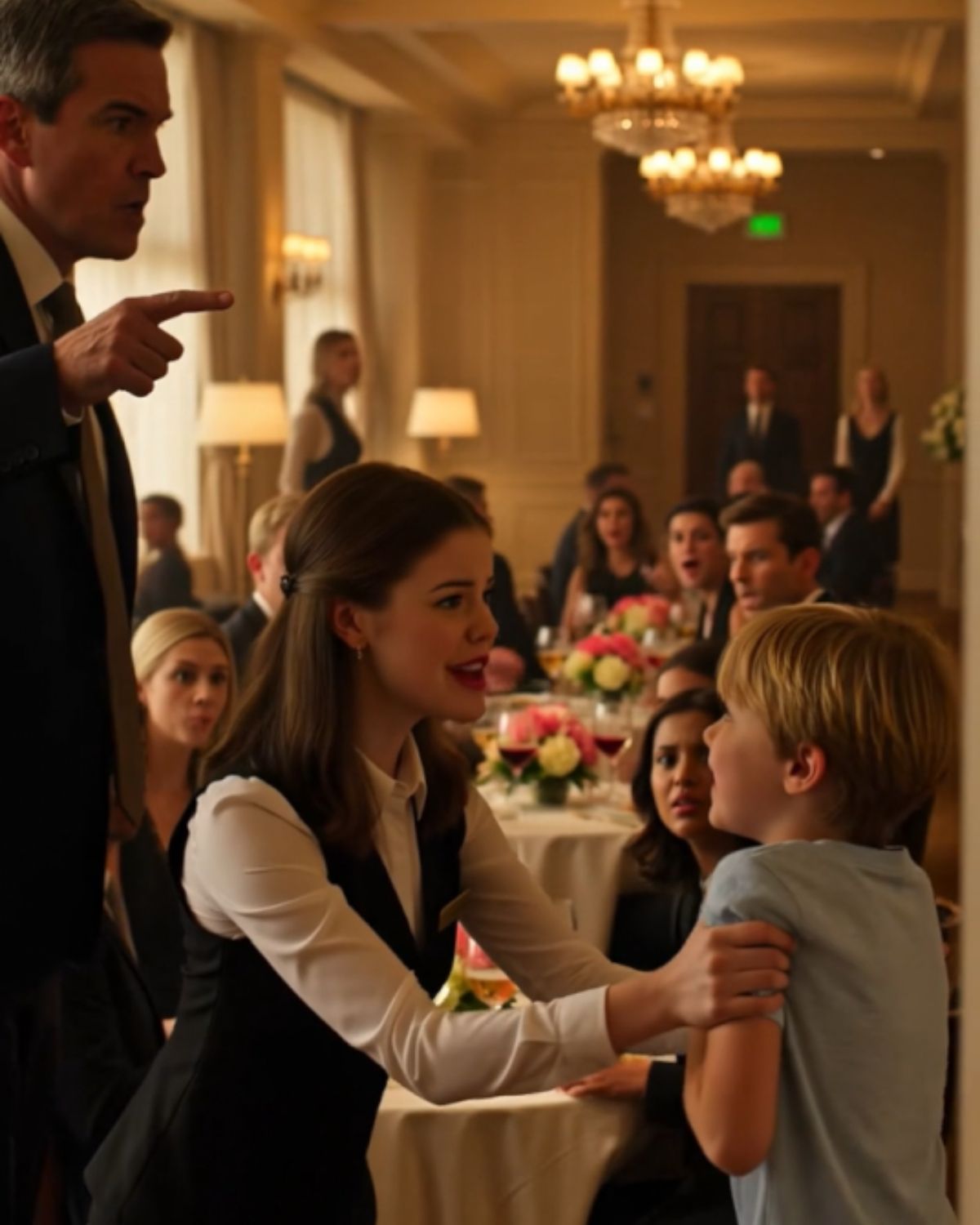
Red wine spilled across a white linen cloth, ran over a silver place setting, and splashed onto the jacket of one of the hotel’s most important guests.
A woman screamed.
A chair scraped backward.
At the center of the dining room, twenty-three-year-old waitress Ava Moreno stood frozen with an empty serving tray in one hand.
The restaurant manager pointed at her.
“You caused this!”
Every conversation in the room stopped.
Only a few seconds earlier, the Grand Bellmont Hotel restaurant had looked perfect.
Crystal lights glowed above the private dining area. White roses stood in tall glass vases. Waiters moved silently between tables while executives, investors, and political donors attended an invitation-only charity dinner.
The hotel had spent three weeks preparing for the event.
Each guest had been assigned a seat.
Every plate had been photographed before leaving the kitchen.
Staff members had been warned that one mistake could cost the hotel future contracts worth millions.
Ava had arrived two hours early.
She polished glasses, checked table numbers, and helped a new server memorize the evening’s menu. Her uniform was simple—a black dress, white shirt, and name badge—but everything about it was clean and carefully pressed.
She could not afford to lose the job.
Her younger brother had recently started college, and most of Ava’s wages helped pay his rent. Their mother cleaned offices at night. Their father had been gone for years.
Ava never complained.
She took extra shifts.
She carried heavy trays without asking for help.
And when guests spoke to her as though she were part of the furniture, she smiled and continued working.
That evening, Ava had been assigned to the VIP table nearest the center aisle.
The guest of honor was Charles Vane, a property developer whose company had invested heavily in the hotel’s new expansion. He sat beside his wife, several board members, and a television host who had brought her six-year-old son, Noah.
Children were not normally invited to Bellmont events.
But Noah’s babysitter had canceled at the last moment, and his mother had been told the hotel would “take care of everything.”
For the first hour, Noah remained seated.
Then he became restless.
While his mother spoke to a sponsor, he slipped from his chair and wandered toward the dessert display.
Ava noticed him.
She was carrying two glasses of wine toward Charles Vane’s table when she saw the boy duck between chairs.
“Noah,” his mother called distractedly. “Stay where I can see you.”
He did not hear her.
Near the end of the dining area, a marble step separated the restaurant from a sunken lounge. Beside it stood a decorative metal sculpture with a pointed base.
The hotel normally placed a rope barrier there.
That evening, the rope had been removed because the event photographer said it looked unattractive in pictures.
Noah ran toward the step.
One of his shoelaces was untied.
Ava saw his foot catch.
She placed her tray on the nearest table and rushed forward.
The boy pitched toward the edge.
Ava grabbed the back of his jacket and pulled him against her just before his face struck the metal corner.
His shoe flew off and landed in the lounge below.
Noah began to cry.
At the same moment, Ava’s tray shifted on the table where she had left it.
One glass remained upright.
The other began to slide.
A man sitting beside the table reached out instinctively, but his sleeve caught the base. The glass tipped and poured directly across Charles Vane’s place setting.
Ava heard the crash behind her.
She turned while still holding Noah.
Charles stood, staring at the dark red stain spreading across his cream-colored jacket.
“What happened?”
Restaurant manager Martin Keller came running.
He saw the overturned glass.
He saw Ava beside the table.
He saw dozens of guests watching.
What he did not see was the child’s untied shoe in the lower lounge.
Martin had managed the restaurant for four years. He was known for remembering wealthy guests’ preferences and forgetting almost everything about the employees who served them.
He knew Charles Vane hated delays.
He knew the hotel owner was expected to arrive later.
And he knew cameras from the charity’s media team were recording parts of the event.
Martin looked at Ava and made a quick decision.
“You caused this.”
Ava’s face changed.
“No, sir. The boy was falling.”
Noah clung to her sleeve.
His mother finally stood.
“Falling?”
Ava pointed toward the step.
“His shoe caught. I pulled him back.”
Martin looked at the child.
Noah was crying, but there was no visible injury.
Then he looked at Charles Vane’s jacket.
“What I can see,” Martin said, “is a drink spilled across our guest of honor.”
“The glass slid after I put the tray down.”
“You abandoned a loaded tray in the dining area.”
“I had to move quickly.”
“You should have called someone.”
“There wasn’t time.”
The guests nearest them watched in silence.
A few looked toward the dangerous corner.
Most looked at Ava.
Charles wiped wine from his sleeve with a napkin.
“This jacket was custom-made.”
“I’m sorry about the jacket,” Ava said. “But the child—”
Martin stepped closer.
“Stop making excuses.”
Ava lowered her voice.
“I’m not making excuses.”
The words were calm.
That made him angrier.
He had expected her to apologize, bow her head, and accept blame before the situation became more embarrassing.
Instead, she continued to mention the child.
Martin pointed toward the service hallway.
“You’re done for the evening.”
Ava stared at him.
“Sir?”
“Leave the floor.”
Noah’s mother looked uncertain.
“My son says she helped him.”
Martin gave her a reassuring smile.
“Of course. We’ll review everything. Right now, we need to restore order.”
Then he turned back to Ava.
“Go.”
Ava reached down and handed Noah his remaining shoe.
“It’s all right,” she whispered to him.
As she stepped away, Charles Vane spoke sharply.
“Someone should pay for the cleaning.”
Martin answered immediately.
“The hotel will handle it.”
He looked at Ava again.
“Most likely from the responsible employee’s wages.”
Ava stopped.
Her weekly paycheck would not cover the jacket.
“You can’t do that without checking what happened.”
Martin’s expression hardened.
“Do not tell me how to manage my staff.”
“I am asking you to look at the cameras.”
Several guests turned toward the ceiling.
Small black CCTV cameras covered the dining room entrances and main aisles.
Martin knew that.
But reviewing footage would take time.
And time would keep the accident alive in front of the VIP guests.
“We do not interrupt a private dinner over every employee mistake.”
Ava glanced toward Noah.
The child stood beside his mother, pale and silent.
“I was helping him.”
Martin stepped into her path.
“You embarrassed this hotel.”
“No,” Ava said. “I stopped him from getting hurt.”
Martin grabbed her upper arm.
The room went still.
“Let go of me.”
“Move.”
Ava pulled her arm back.
Martin pushed her toward the service hallway.
She stumbled into the side of an empty chair.
A spoon fell from the table and struck the floor.
The sharp sound carried across the room.
Noah’s mother covered her mouth.
Ava regained her balance.
Her eyes filled, but she did not cry.
Not there.
Not in front of the guests.
Martin pointed toward the hallway.
“Remove your badge and wait in the staff office.”
Ava unclipped the small silver name tag from her shirt.
She placed it on the service station.
Then she walked out of the restaurant while the guests watched.
No one applauded.
No one defended her.
The dinner resumed within minutes.
Fresh linens were placed over the stained table.
Charles Vane received a hotel blazer.
The musicians started playing again.
The child was returned to his seat.
Everything appeared normal.
But Noah would not eat.
In the staff hallway, Ava sat on a wooden bench near the kitchen door.
A red mark had begun to form on her arm where Martin grabbed her.
Her coworker Lena brought her a glass of water.
“I saw him push you.”
Ava stared at the floor.
“He’ll say I refused to follow instructions.”
“People saw it.”
“They saw what they wanted to see.”
Lena sat beside her.
“What happened with the boy?”
“He tripped near the sculpture.”
“I told them that corner was dangerous.”
“So did I.”
Two weeks earlier, Ava had written a maintenance report about the missing barrier. The report remained unanswered.
Lena looked toward the restaurant doors.
“You should go home.”
“If I leave, he’ll say I abandoned my shift.”
“So you’re going to sit here?”
“Until someone tells me what they’re doing.”
At 9:15, hotel owner Evelyn Hart arrived through the private entrance.
She was sixty-one, direct, and known for appearing at events without warning. Her father had opened the original Bellmont Hotel with twenty-eight rooms. Evelyn had expanded it into a small luxury group while still insisting that every property manager spend one day each year working beside housekeeping, kitchen, and service staff.
She believed hotels failed when executives forgot that guests remembered how employees made them feel.
Martin met her near the lobby.
“Everything is under control,” he said.
Evelyn looked through the restaurant doors.
“Why would it not be?”
“There was a minor service incident.”
“What kind of incident?”
“A waitress left a tray unattended. A drink spilled on Mr. Vane.”
“Was anyone hurt?”
“No.”
Martin hesitated.
“A child nearly fell, but there was no injury.”
Evelyn looked at him.
“A child nearly fell?”
“The waitress claims she moved to help him.”
“Claims?”
Martin adjusted his jacket.
“She caused a disruption and became argumentative when corrected.”
Evelyn’s eyes moved toward the staff hallway.
“Where is she?”
“Waiting for disciplinary review.”
“Did you review the footage?”
“We had two hundred guests in the dining room. I made a judgment based on what happened in front of me.”
“That was not my question.”
Martin’s mouth tightened.
“No.”
Evelyn handed her coat to an assistant.
“Then you made a judgment before checking what happened.”
She walked past him.
In the staff office, Ava stood when the owner entered.
She had met Evelyn only once during employee orientation.
“Ms. Hart.”
“Sit down.”
Ava remained standing.
“Mr. Keller says you left a tray unattended and caused a spill.”
“I placed it on a stable table because a child was falling.”
“He also says you refused to leave the dining room.”
“I asked him to check the cameras.”
Evelyn noticed the mark on Ava’s arm.
“What happened there?”
Ava pulled down her sleeve.
“Nothing.”
“Did someone grab you?”
Ava did not answer.
Lena stood near the doorway.
“Mr. Keller did.”
Ava looked at her.
“And he pushed her,” Lena continued. “In front of the guests.”
Evelyn’s expression changed.
“Security room. Now.”
Martin was waiting outside.
“There is no reason to turn this into a larger issue.”
Evelyn stopped.
“A staff member has accused you of physical contact.”
“She resisted when I asked her to leave.”
“Then the footage will show that.”
The security room was located behind the lobby, past a narrow corridor lined with electrical panels.
Four monitors showed live feeds from entrances, elevators, hallways, and public areas.
The security supervisor pulled up the restaurant footage.
Martin stood with his arms folded.
Ava waited near the door.
Evelyn watched the screen.
The video began two minutes before the spill.
Noah left his chair.
He moved between tables.
Ava noticed him while carrying the tray.
The angle showed the step clearly.
It also showed the missing safety barrier.
Noah’s shoe caught.
His body tipped forward.
Ava placed the tray down and ran.
She caught him less than a second before his head reached the metal sculpture.
Nobody spoke.
The supervisor replayed the moment more slowly.
Noah’s forehead passed within inches of the pointed base.
Evelyn leaned closer to the screen.
“She saved him.”
Martin shifted his weight.
“The spill still resulted from her decision to leave the tray.”
The supervisor changed the angle.
The second camera showed a man at the nearby table moving his chair backward. His elbow struck the tray. One glass slid. Another guest tried to catch it and accidentally knocked it toward Charles Vane.
Ava had not touched the glass.
She had not bumped the table.
She had been several feet away, shielding Noah’s body with her own.
The room was silent.
Evelyn looked at Martin.
“You told the guests she caused it.”
“It appeared that way.”
“You did not check.”
“I had to respond quickly.”
“You humiliated her quickly.”
Martin’s face tightened.
Evelyn pointed toward the screen.
“She protected a guest while everyone blamed her.”
The supervisor continued the footage.
They watched Martin approach.
They watched Ava explain.
They watched him grab her arm.
Then came the push.
On video, it looked worse than Ava remembered.
Her body struck the chair hard enough to move it several inches.
Martin stared at the monitor.
The confidence disappeared from his face.
His jaw loosened.
His arms fell to his sides.
For the first time that evening, he seemed to understand that the room no longer contained his version of events.
It contained proof.
Evelyn replayed the push.
Then she froze the image.
Martin stood with one hand extended.
Ava was off balance.
VIP guests looked on from behind them.
Evelyn turned slowly.
“You did this in my restaurant?”
Martin swallowed.
“She was refusing a direct instruction.”
“She asked you to review evidence.”
“She challenged me in front of guests.”
“And that embarrassed you.”
He said nothing.
Evelyn’s voice remained calm.
“That child could have suffered a serious head injury.”
“I agree.”
“No. You agreed after the camera forced you to.”
Martin looked toward Ava.
His eyes met hers.
The authority had left his posture.
He opened his mouth as if preparing to apologize, but Evelyn stopped him.
“Not in this room.”
She picked up the phone and called the event coordinator.
“Pause dinner service after the current course. I am coming to the restaurant.”
Martin stared at her.
“Evelyn, we should handle this privately.”
“You made it public.”
Five minutes later, the restaurant doors opened.
Evelyn entered first.
Ava walked beside her.
Martin followed several steps behind.
The guests noticed them immediately.
Charles Vane looked up from his replacement jacket.
Noah’s mother placed a hand on her son’s shoulder.
Evelyn walked to the center of the dining room and asked the musicians to stop.
“I apologize for interrupting the evening,” she said. “But an employee was publicly blamed in this room, so the truth should be stated in the same room.”
The guests became silent.
A television screen near the stage turned on.
Security footage began to play.
They watched Noah run toward the step.
They watched Ava drop the tray.
They watched her catch him.
A collective breath moved through the room when the boy’s head passed near the metal corner.
Noah’s mother pulled him closer.
Then the footage showed the glass spilling.
A guest’s chair.
A moving elbow.
A hand reaching too late.
Ava nowhere near the table.
Charles Vane slowly placed his napkin down.
Evelyn faced the room.
“Ava Moreno did not cause the accident.”
She gestured toward Noah.
“She prevented one.”
Noah’s mother stood.
“I should have spoken sooner,” she said.
Her voice shook.
“My son told me she saved him. I let everyone else continue as though the jacket mattered more.”
She turned to Ava.
“I’m sorry.”
Noah slipped from his chair and walked toward the waitress.
He held out his hand.
“Thank you for catching me.”
Ava crouched so they were at eye level.
“You’re welcome.”
“Were you scared?”
“A little.”
“I was too.”
He hugged her.
Several guests lowered their eyes.
Evelyn waited until Ava stood again.
Then she turned toward Martin.
The manager’s face had gone pale.
“Mr. Keller blamed an employee without reviewing evidence. He physically pushed her in front of this room. Effective immediately, he is suspended pending formal investigation.”
A murmur moved through the tables.
Martin looked at Ava.
“I made a mistake.”
Evelyn’s expression did not change.
“A mistake was the spilled drink.”
She pointed toward the screen.
“What you did after that was a series of choices.”
Martin looked toward Charles Vane, perhaps expecting support.
Charles remained seated.
“You told me she would pay for my jacket,” he said.
Martin nodded weakly.
“I was trying to resolve the matter.”
Charles looked at Ava.
“She will not pay for anything.”
He removed the borrowed hotel blazer.
“And neither will the hotel. I can clean my own jacket.”
Martin lowered his head.
The cameras near the stage captured the moment his remaining confidence disappeared.
His shoulders folded inward.
His hands clasped in front of him.
The guests who had once watched Ava leave in silence were now watching him escorted from the restaurant by security.
Evelyn picked up Ava’s name badge from the service station.
She had asked Lena to bring it from the hallway.
“You were told to remove this,” Evelyn said.
Ava nodded.
Evelyn pinned it back onto her uniform.
“You did exactly what this hotel stands for.”
Applause began at the table nearest Noah.
Then another table joined.
Within seconds, the restaurant was filled with it.
Ava stood beneath the crystal lights, still wearing the same uniform, still carrying the mark on her arm.
But the way the room looked at her had changed.
Not because she had become important.
Because the truth had forced them to recognize that she had been important all along.
The hotel’s investigation was completed three days later.
Martin was dismissed for misconduct, failure to follow incident procedures, and inappropriate physical contact with an employee.
The missing safety barrier was restored immediately. The metal sculpture was moved away from the step, and a child-safety review was ordered across every Bellmont property.
The hotel also changed its disciplinary policy.
No employee could be publicly blamed for a guest incident before available evidence was reviewed.
Managers were required to document staff concerns instead of dismissing them during high-profile events.
Ava received a formal apology, paid leave, and a promotion to guest safety coordinator—a new role created to help service teams identify risks before accidents happened.
She almost refused it.
“I’m a waitress,” she told Evelyn.
“You noticed what an entire room missed,” Evelyn replied. “That is exactly why you should have the job.”
A month later, Noah returned to the hotel with his mother.
He carried a small gift bag.
Inside was a framed drawing.
It showed a woman in a black uniform pulling a little boy away from a giant red triangle. Above them, in uneven blue letters, he had written:
AVA IS A HERO.
Ava laughed when she saw it.
Then she cried.
She placed the drawing in her new office beside the security monitors.
The stain on Charles Vane’s jacket disappeared after one cleaning.
The red mark on Ava’s arm faded after several days.
But the lesson remained in that restaurant long after the VIP dinner ended.
People often judge service workers by the tray in their hands, the uniform on their backs, or the speed with which they correct a mistake.
They forget that the person serving the table may also be the first person to notice danger.
That night, hundreds of wealthy guests saw a spilled glass.
One waitress saw a falling child.
And in the moment that mattered, she chose the child.