
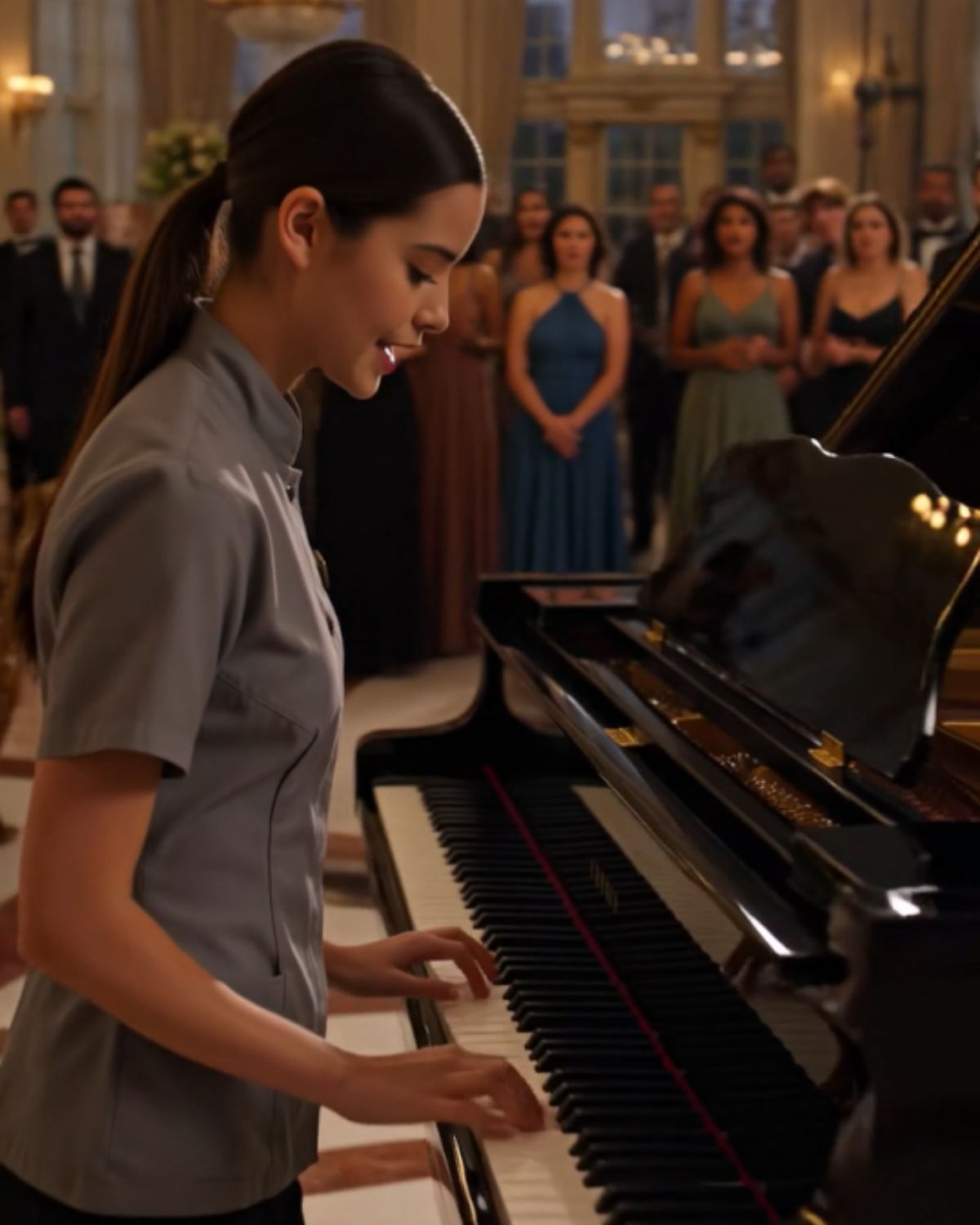
The sound of the slap carried farther than the broken piano note.
It cracked through the marble lobby of the Grand Aurelia Hotel just as hundreds of guests were gathering for the most important concert of the season.
Waiters stopped mid-step.
A woman near the entrance covered her mouth.
And twenty-one-year-old Lina Reyes stood beside the black grand piano with one hand pressed against her cheek.
On the floor near her shoes lay a thin strip of folded cardboard and a tiny silver bead she had removed from between two piano keys.
The hotel’s events supervisor, Richard Bell, pointed toward the service corridor.
“You were told not to touch it.”
Lina’s eyes were wet, but her voice remained steady.
“The key was stuck. I was only trying to help.”
“You’re a cleaner,” he said. “Not a piano technician.”
Across the lobby, several guests looked away.
None of them knew that the cleaner in the simple gray uniform had spent most of her childhood sitting beneath a piano while her father taught music.
And none of them knew that, within the hour, one of the world’s most famous musicians would stop an entire concert because of the melody she was about to play.
Earlier that evening, the Grand Aurelia had looked flawless.
Crystal chandeliers glowed above polished marble floors. White orchids stood in tall glass arrangements. A red carpet led from the entrance toward the hotel’s private concert hall.
The event was a charity performance by internationally known pianist Adrian Cole.
Tickets had sold for thousands of dollars.
Executives, film producers, politicians, and wealthy donors filled the lobby while photographers captured their arrival.
Near the main doors stood the hotel’s prized black Steinway grand piano.
It was not the instrument Adrian would use for the official performance. His concert piano had already been moved to the stage inside the ballroom.
The lobby piano was there for decoration and pre-event music.
A hotel pianist was scheduled to play softly as the guests arrived.
Lina had been assigned to clean the marble around it.
She moved quietly with a cloth and small supply cart, careful not to interrupt the staff arranging candles near the entrance.
Most guests did not notice her.
Those who did stepped around her without speaking.
Lina was used to that.
She had worked at the hotel for fourteen months, ever since her father died and the bills began arriving faster than her mother could pay them.
Her uniform was always clean.
Her hair was tied neatly behind her head.
Her shoes were inexpensive, but she polished them before every shift.
She never asked for special treatment.
She simply worked.
As Lina wiped dust from the base of the piano, the hotel pianist sat down to rehearse.
He played a soft scale.
Then stopped.
He tried again.
One note failed to rise properly.
The middle D key remained lower than the others.
The pianist pressed it several times.
“It’s sticking,” he said.
Richard Bell looked over from the registration desk.
“Can you work around it?”
“Not for two hours.”
“Then play in a different key.”
The pianist stared at him.
“That is not how a piano works.”
Richard checked his watch.
The first VIP guests were arriving in twenty minutes.
“Maintenance is dealing with the lighting system. We don’t have time for this.”
“I need a technician.”
“The technician who tuned the concert piano has already left.”
Lina remained beside her cart, listening.
The pianist pressed the key again.
It returned slowly with a faint scraping sound.
Lina recognized it immediately.
Her father had called it “a simple problem that becomes an expensive problem when impatient people force it.”
She looked between the narrow spaces beside the key.
Something small reflected beneath the ivory.
A silver bead from one of the hotel’s decorative table strands had fallen into the piano and lodged between two keys.
Every time the pianist pressed D, the bead rolled against the wood and prevented the key from returning.
Lina stepped closer.
“There’s something underneath it.”
The pianist looked at her.
“Where?”
She pointed.
“Between D and E. It’s catching near the front rail.”
Richard turned sharply.
“Return to your work.”
Lina lowered her hand.
The pianist leaned closer to inspect the gap.
“I think she’s right.”
Richard walked toward them.
“The lobby opens in fifteen minutes. We are not taking apart a piano.”
“You don’t need to,” Lina said. “The object is close to the surface.”
Richard looked at her uniform, then at the piano.
“And you know this because?”
“My father repaired pianos.”
The answer was partly true.
Tomas Reyes had never owned a repair shop.
He had been a public-school music teacher who earned extra money tuning old upright pianos in churches and community halls.
He taught Lina how to recognize loose pins, damaged felt, sticky keys, and warped action parts.
When she was eight, he showed her how to remove a coin from a piano without scratching the wood.
When she was twelve, she could tune a single string by ear.
When she was sixteen, she helped him restore an upright piano that a school planned to throw away.
Richard gave a short laugh.
“We hired you to clean floors.”
Lina looked at the sticking key.
“If people keep pressing it, they may damage the felt.”
The hotel pianist stopped touching it.
Richard did not.
He pressed the key hard several times.
The scraping sound became louder.
“See?” Lina said. “Please don’t force it.”
His face tightened.
He disliked being corrected, especially by an employee standing beside a cleaning cart.
“You are not responsible for the instrument.”
Lina stepped back.
But after Richard left, the pianist crouched beside her.
“Can you remove it without opening the case?”
Lina examined the gap.
“Yes.”
She took a clean piece of thin cardboard from the packaging beneath her cart. She folded it into a narrow strip and gently slid it between the keys.
The silver bead moved.
One more careful push brought it to the edge.
Lina caught it before it fell deeper.
Then she pressed the D key.
It moved smoothly.
The pianist smiled.
“You fixed it.”
Lina pressed the note again.
The sound was clear.
For the first time that evening, her expression softened.
She played three quiet notes.
Then four.
A small melody, almost like a question.
The pianist looked at her hands.
“You play?”
“Not anymore.”
Before he could ask why, Richard returned.
He saw Lina seated at the piano.
His face changed instantly.
“What are you doing?”
She stood.
“The key is working now.”
“I told you not to touch that instrument.”
“There was a bead between the keys.”
She held out her palm.
The small silver object rested in the center.
Richard barely looked at it.
“You could have damaged a piano worth more than you will earn in ten years.”
The hotel pianist stood.
“She didn’t damage it. She fixed it.”
Richard ignored him.
Guests were entering the lobby now.
Several turned toward the raised voices.
“Go to the service area,” Richard told Lina.
“I haven’t finished cleaning this section.”
“You are finished here.”
Lina picked up the folded cardboard.
Richard grabbed it from her hand and threw it onto the floor.
“You do not sit at a guest piano.”
Her voice became quieter.
“I was only testing the key.”
“You were pretending to be something you are not.”
Lina stared at him.
The words hurt more than she expected.
“My father taught me.”
Richard stepped closer.
“Your father is not employed by this hotel.”
“No,” Lina said. “He’s dead.”
The pianist looked down.
For one second, Richard appeared uncomfortable.
Then he noticed two executives watching from the registration area.
Embarrassment hardened his face again.
“Stop creating a scene.”
“I’m not.”
“Leave.”
Lina reached toward the piano bench to collect the cleaning cloth she had left there.
Richard thought she was touching the instrument again.
He struck her across the face.
The lobby went silent.
The pianist stepped forward.
“What is wrong with you?”
Richard lowered his hand.
A red mark appeared slowly across Lina’s cheek.
He looked around at the guests, realizing what they had seen.
But instead of apologizing, he pointed toward the service corridor.
“She was refusing a direct instruction.”
Lina pressed one hand against her face.
“I was picking up my cloth.”
“Security,” Richard called.
Two guards approached, uncertain.
The hotel pianist stood between them and Lina.
“She removed something from the keys. That is all.”
Richard straightened his jacket.
“She was interfering with hotel property.”
A woman near the entrance whispered, “He hit her.”
Another guest raised a phone.
Richard noticed.
“No filming in the lobby,” he said.
Lina bent down and picked up the cardboard strip.
Then she walked toward the service corridor without saying another word.
The crowd slowly began moving again.
The hotel pianist remained beside the black Steinway.
He pressed the repaired D key.
It sounded perfectly.
At seven-thirty, the ballroom doors closed.
More than six hundred guests faced the stage.
Adrian Cole entered beneath a white spotlight.
At forty-eight, Adrian had performed with the greatest orchestras in the world. He had played at royal events, state ceremonies, and sold-out halls from Vienna to New York.
Critics described his technique as controlled and exact.
But people who knew him well understood that Adrian built his life around one emotion he rarely discussed.
Gratitude.
He had grown up in a small apartment above a laundromat.
His mother worked nights.
His father disappeared before Adrian turned ten.
The first piano he ever touched stood in a public-school music room with a broken pedal and six missing key covers.
His first teacher had refused to let poverty decide how far his talent could go.
That night’s concert was part of Adrian’s national tour to raise money for music programs in underfunded schools.
He began with Chopin.
Then Debussy.
The ballroom remained completely still as his hands moved across the keys.
In the service area behind the lobby, Lina sat on a wooden bench holding a cold towel against her cheek.
A housekeeping supervisor named Rosa stood beside her.
“You should report him.”
Lina looked toward the closed ballroom doors.
“He’ll say I ignored instructions.”
“People saw him.”
“People see many things.”
Rosa lowered her voice.
“Security has cameras.”
Lina gave a tired smile.
“Cameras matter only when someone important decides to watch them.”
On the bench beside her lay the old music notebook she always kept inside her work bag.
The cover was faded green.
Her father’s name was written in black ink near the bottom.
Tomas Reyes
Lina opened it.
Between tuning diagrams and handwritten lesson plans was a piece called “The Window Above the Laundromat.”
Her father had written it decades earlier.
It was not a published composition.
Only three people had ever learned it.
Tomas.
Lina.
And a frightened thirteen-year-old boy who practiced at the public school every evening because his apartment had no piano.
Lina touched the first page.
Then she heard the lobby pianist struggling with the repaired instrument.
He had begun playing again during the concert intermission, but his sheet music kept slipping from the stand.
Lina stood.
“Where are you going?” Rosa asked.
“To return this.”
She held up the small silver bead.
“Why?”
“Because it came from the hotel decorations.”
Rosa looked at her.
“You were just assaulted.”
“I know.”
“Then let someone else return it.”
Lina closed the notebook.
“My father said leaving a problem unfinished only gives it time to become someone else’s problem.”
She walked back toward the lobby.
Most guests were inside the ballroom.
Only a few hotel employees remained near the entrance.
The pianist saw her.
“Are you all right?”
“Yes.”
“That man should be removed.”
Lina placed the bead on the piano lid.
“This is what was causing the key to stick.”
The pianist looked at the notebook beneath her arm.
“What were you playing earlier?”
“Nothing.”
“It wasn’t nothing.”
She hesitated.
“My father’s song.”
“Play it.”
Lina shook her head.
“I’m working.”
“The lobby is empty.”
“It isn’t my piano.”
He looked toward the service corridor where Richard had disappeared.
Then he stood from the bench.
“The key you fixed is part of the song, isn’t it?”
Lina looked at the repaired D.
“Yes.”
“Then test it properly.”
She sat down slowly.
Her fingers hovered above the keys.
For seven years, she had avoided playing in public.
After her father became ill, she stopped attending the conservatory program he had fought to get her into. She worked evenings, then full-time, to help pay for his medication.
When he died, the piano in their apartment was sold to cover funeral expenses.
The notebook was all she kept.
Lina placed her hands on the keys.
The first notes were soft.
A descending line.
Then a pause.
The melody rose again, warm and uncertain, like light appearing through a dirty window.
Inside the ballroom, Adrian Cole had just returned to the stage.
He sat before the concert piano while the audience settled.
Then he heard four notes coming from beyond the ballroom doors.
His hands stopped above the keyboard.
The audience waited.
The melody continued from the lobby.
Five notes.
A pause.
Then the phrase Adrian had not heard in thirty-one years.
His face changed.
The conductor seated near the stage looked at him.
“Adrian?”
He did not answer.
The melody reached the unfinished middle section.
Adrian stood.
A murmur spread through the ballroom.
He stepped away from the piano and walked toward the side of the stage.
The event director rushed to meet him.
“Is something wrong?”
“Open the doors.”
“We are live-streaming.”
“Open them.”
The ballroom doors swung apart.
Lina’s melody entered the hall.
Adrian froze.
For an instant, he was thirteen again.
He was standing in a school music room after dark, telling his teacher that he planned to quit because his mother could not pay for the upcoming competition.
Tomas Reyes had closed the piano lid and said, “Then we will enter without money.”
Adrian had laughed.
Tomas had not.
He found a sponsor.
He repaired Adrian’s shoes.
He spent three weeks helping him prepare.
And on the final evening before the competition, Tomas played a composition called “The Window Above the Laundromat.”
“I wrote it after visiting your home,” he told the boy. “One day, you will understand that where you begin is not the same as where you belong.”
Then Tomas taught him the melody.
No recording had ever been made.
No sheet music had ever been published.
Adrian had searched for his teacher years later, but the school had closed, records had been moved, and Tomas had changed addresses.
Now the melody was coming from the hotel lobby.
Adrian walked off the stage.
The audience followed him with their eyes.
Some guests stood.
The event director whispered into her radio, trying to understand what was happening.
Adrian crossed the ballroom, passed the VIP tables, and entered the lobby.
Lina stopped playing when she saw the crowd behind him.
She stood immediately.
“I’m sorry. I was told the lobby was empty.”
Adrian stared at her.
The gray cleaning uniform.
The red mark across her cheek.
The green notebook held against her chest.
His eyes moved to the name on the cover.
Tomas Reyes
His breathing changed.
“Who taught you that song?”
Lina looked confused.
“My father.”
Adrian stepped closer.
“What was his name?”
She turned the notebook so he could see it.
“Tomas Reyes.”
Adrian went completely still.
Behind him, hundreds of guests waited in silence.
“Your father was my first music teacher.”
Lina stared at him.
“That isn’t possible.”
“He taught at East Harbor School.”
Her fingers tightened around the notebook.
“Yes.”
“The music room was on the third floor. The B-flat key was chipped, and the heater never worked.”
Lina’s lips parted.
Adrian continued.
“He kept peppermint tea in a blue metal container. He tapped the piano twice before starting every lesson.”
Tears appeared in Lina’s eyes.
“My mother still has that container.”
Adrian looked down.
For years, he had believed Tomas Reyes had simply disappeared from his life.
Now his daughter stood in front of him wearing a cleaner’s uniform in a hotel lobby.
“What happened to him?”
“He died two years ago.”
Adrian closed his eyes.
The words landed visibly.
When he looked up, his voice was quieter.
“I searched for him.”
“He searched for you too.”
Lina opened the notebook.
Near the back was an envelope addressed in her father’s handwriting.
For Adrian, if he ever finds his way back.
Adrian stared at it.
“He wrote this during his final year,” Lina said. “He saw you performing on television. He said he always knew you would finish the song.”
Adrian took the envelope with both hands.
Inside was a short letter and an old photograph.
The photograph showed a thirteen-year-old Adrian sitting at a damaged upright piano. Tomas stood behind him with one hand resting on the boy’s shoulder.
Adrian read the letter silently.
Then again.
His eyes filled.
Lina looked away to give him privacy.
That was when Adrian noticed the mark on her face.
“What happened to you?”
She touched her cheek.
“Nothing.”
The lobby pianist spoke from beside the piano.
“It was not nothing.”
Richard had returned from the security office after hearing that the concert had stopped.
He pushed through the employees gathered near the corridor.
“Mr. Cole, I apologize for the interruption. This employee was using the instrument without permission.”
Adrian looked at him.
“Did you strike her?”
Richard’s confidence faltered.
“She repeatedly ignored instructions.”
“That was not the question.”
Guests began entering the lobby from the ballroom.
Phones rose.
The hotel’s general manager hurried toward them, followed by two security supervisors.
Adrian repeated the question.
“Did you hit her?”
Richard glanced at Lina.
“She became argumentative.”
The lobby pianist stepped forward.
“He slapped her because she removed a bead from between the keys.”
The general manager turned toward security.
“Review the footage.”
Richard’s face changed.
“There is no need to delay the concert over an internal staff matter.”
Adrian held Tomas’s letter in one hand.
“You made it a public matter when you struck her in front of guests.”
Security pulled the lobby recording onto a nearby monitor.
Everyone watched.
Lina found the bead.
She removed it carefully.
She tested the key.
Richard returned.
He threw the cardboard strip onto the floor.
Then he slapped her.
No one spoke.
On the screen, Richard’s hand remained frozen beside Lina’s face.
The real Richard stood several feet away, staring at the image.
His shoulders dropped.
The color left his face.
The authority he had used so easily against a cleaner disappeared the moment the camera showed the truth.
“I lost my temper,” he said.
Lina looked at him.
“You decided I could not know anything because of the uniform I wear.”
He opened his mouth.
Nothing came out.
The hotel’s general manager stepped forward.
“Mr. Bell, you are suspended immediately. Security will escort you from the property. The footage will be given to the police, and Ms. Reyes will receive full support if she chooses to file charges.”
Richard looked toward Adrian, perhaps hoping the famous musician would allow the evening to continue quietly.
Adrian did not move.
Security led Richard away through the same service corridor he had ordered Lina to use.
When the doors closed behind him, Adrian turned back to her.
“You said you no longer play.”
“My father’s piano was sold.”
“Why did you leave music school?”
She looked at the floor.
“He became sick. Someone had to work.”
Adrian understood before she finished.
Tomas had once sacrificed time and money for him.
Years later, Tomas’s daughter had sacrificed her future for her father.
The legacy had continued quietly, without applause.
Adrian walked toward the concert hall.
Then he stopped and held out his hand.
“Come with me.”
Lina shook her head.
“I’m still on shift.”
The general manager removed the cleaning cloth from her hand.
“Not tonight.”
Adrian led her into the ballroom.
Every guest stood as they entered.
Onstage, the concert piano waited beneath the light.
Adrian placed Tomas’s green notebook on the music stand.
Then he addressed the audience.
“The woman standing beside me was judged by her job before anyone asked what she knew.”
He looked at Lina.
“Her father taught me when my family could not afford lessons. He entered me into my first competition. He gave me access to a piano when I had none.”
Adrian held up the letter.
“Before anyone knew my name, Tomas Reyes treated my talent as though it mattered.”
The ballroom remained silent.
“And tonight, his daughter repaired a piano key, was punished for touching it, and then played the song that brought her father back into my life.”
He moved the piano bench slightly.
“Lina, will you finish it with me?”
She stared at the keys.
“I haven’t performed in years.”
“Neither had I when your father first put me on a stage.”
A small smile appeared through her tears.
She sat beside him.
Adrian began the left-hand accompaniment.
Lina joined with the melody.
“The Window Above the Laundromat” filled the ballroom for the first time.
The composition was simple.
It did not sound like music written for concert halls.
It sounded like a tired teacher returning to an empty classroom after work.
Like a boy practicing because someone had told him not to quit.
Like a daughter remembering the hands that first guided hers across the keys.
When the final note faded, the audience remained silent for one breath.
Then everyone stood.
The applause grew until it filled the ballroom and spilled into the lobby.
Lina looked toward the empty chair beside the stage as though her father might still be there.
Adrian placed Tomas’s notebook between them.
“She carries the legacy of the person who changed my life,” he said.
“But she should not have to carry it alone.”
That evening, Adrian announced the creation of the Tomas Reyes Scholarship for young musicians who had left education to support sick or struggling family members.
He also offered Lina a place in his foundation’s music program, with tuition, living expenses, and paid training included.
The Grand Aurelia Hotel paid for her medical evaluation, issued a public apology, and dismissed Richard after the investigation confirmed the assault.
The hotel pianist’s report also revealed that Lina’s warning had prevented possible damage to the piano mechanism.
She had not threatened the instrument.
She had protected it.
Six months later, Lina returned to the Grand Aurelia.
Not in a cleaning uniform.
She wore a simple black concert dress and carried the restored green notebook beneath her arm.
The lobby piano had been moved closer to the entrance.
Beside it stood a small plaque:
IN MEMORY OF TOMAS REYES
A teacher whose music traveled farther than he ever knew.
Adrian waited near the bench.
Guests gathered quietly around them.
Lina sat down and pressed the middle D key.
It moved perfectly.
Then she began her father’s song.
The first time she touched that piano, people saw only a poor cleaner who had forgotten her place.
The second time, they knew they were listening to the daughter of the man who had helped shape a legend.
A uniform can tell you what work someone does.
It can never tell you what knowledge they carry, what dreams they buried, or whose future once began beneath their hands.


