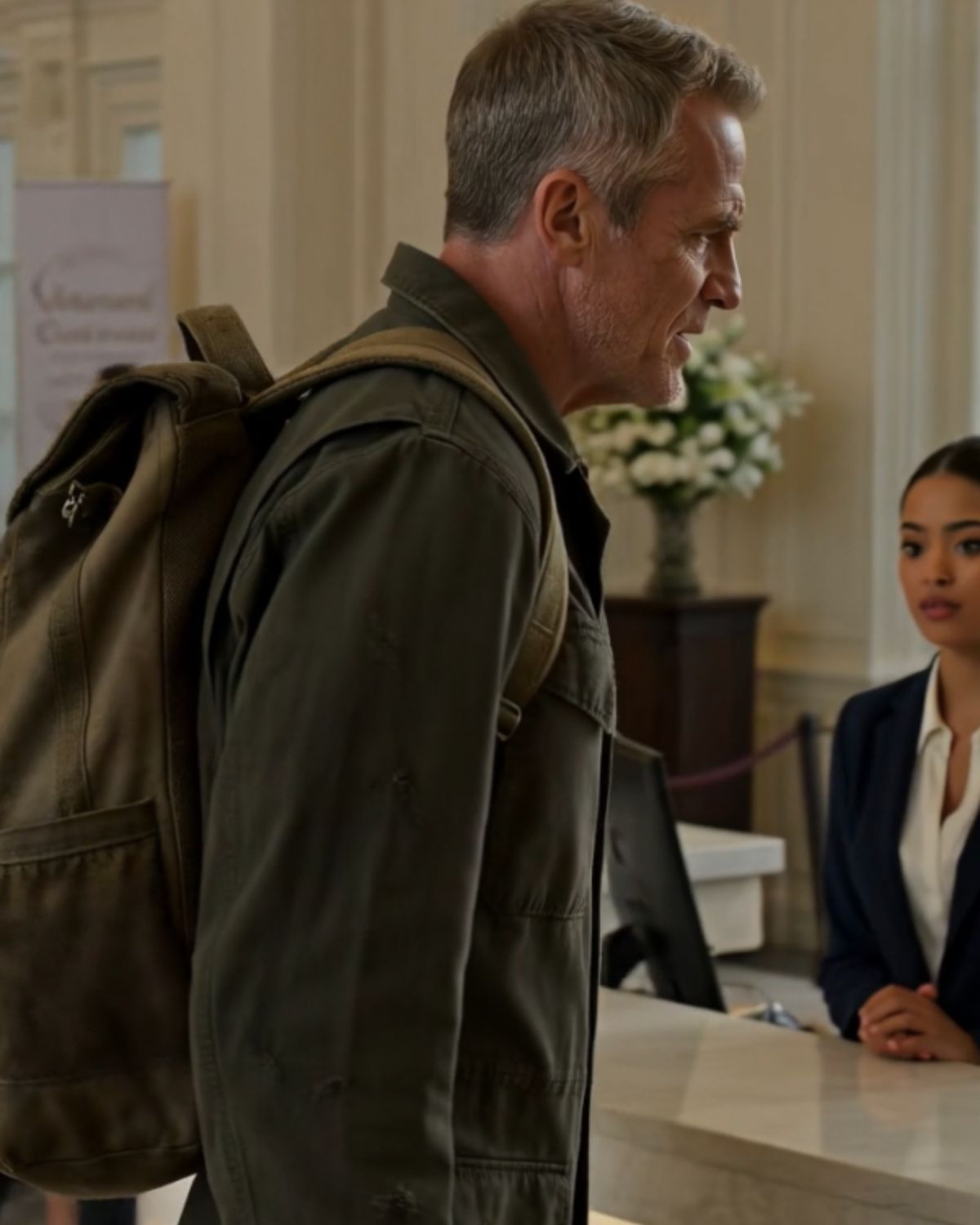
The old man did not look like he belonged beneath the chandeliers of the Harrington Grand Hotel.
His military-style jacket was faded at the shoulders. One sleeve had been repaired with dark thread, and the worn backpack hanging from his hand appeared to contain everything he owned.
Rainwater dripped from his boots onto the polished marble floor.
Above him, a large banner stretched across the lobby:
NATIONAL VETERANS EMPLOYMENT CONFERENCE
Executives, nonprofit leaders, and retired officers walked past in pressed suits. Some wore medals on formal jackets. Others carried expensive leather folders bearing the logos of major corporations.
The old man stood quietly near the entrance until the line at reception shortened.
Then he stepped forward.
“Excuse me,” he said. “Could you tell me where the veterans’ event is?”
The receptionist looked up.
Her practiced smile disappeared for half a second.
She glanced at his unshaven face, the plastic bag tied around one strap of his backpack, and the old coat that smelled faintly of rain and bus exhaust.
“The conference is private.”
“I understand.”
He reached into his jacket.
“I was told to come.”
The receptionist leaned backward.
A security guard standing near the elevators noticed the movement and approached immediately.
“Is there a problem?”
The receptionist lowered her voice.
“He says he is attending the veterans’ conference.”
The guard looked the man up and down.
“Sir, this area is for registered hotel guests and invited attendees.”
The old man nodded calmly.
“I’m only looking for the conference room.”
“Do you have identification?”
The man searched through his pockets.
He removed a bus transfer, two folded napkins, a small bottle of medication, and an envelope softened by rain.
“My identification was stolen at the shelter last month.”
The guard’s expression hardened.
“Then you cannot enter the event.”
“I have this.”
The old man held out the envelope.
The receptionist did not take it.
The paper was stained and creased, but the hotel logo remained visible in the corner. Beneath it was the name:
Mr. David Williams
The guard read it.
“This could belong to anyone.”
“It belongs to me.”
“Without identification, we cannot verify that.”
David looked toward the conference banner.
“I was asked to meet someone from the veterans’ housing program.”
“Then call them.”
“I don’t have a phone.”
A couple checking into the hotel moved farther down the desk.
The woman whispered something to her husband.
Both looked back at David.
He noticed.
He lowered his voice.
“I don’t want to disturb anyone. Just tell me which floor.”
The guard stepped between him and the elevators.
“You need to leave.”
David’s face remained composed.
“I took two buses to get here.”
“That does not change the security policy.”
“The invitation says registration ends at ten.”
The receptionist checked the clock.
It was 9:42.
David carefully opened the envelope.
Inside was an official conference invitation and a handwritten card.
The card read:
Please attend as our guest. We would be honored to hear your story.
Before the receptionist could examine it, another man approached.
His name was Grant Mercer, the hotel’s guest services manager.
Grant had spent the morning inspecting flower arrangements, correcting employees’ uniforms, and reminding the staff that the hotel chairman would arrive before the opening ceremony.
Every detail had to appear perfect.
The conference was being covered by national media.
One poorly handled incident could become a public embarrassment.
Grant looked at David and saw an incident.
“What is happening here?”
The security guard handed him the damp invitation.
“He claims he is registered for the conference.”
Grant barely read the first line.
“Does he have identification?”
“No.”
“Then remove him.”
David looked directly at Grant.
“My name is on that envelope.”
“Anyone could have found it.”
“I didn’t find it.”
Grant returned the invitation.
“Sir, you cannot enter a private hotel event without valid identification.”
“Could you call the veterans’ organization?”
“We are not interrupting conference staff to verify every person who walks in from the street.”
David’s jaw tightened slightly.
“I didn’t walk in from the street. I was invited.”
Grant glanced toward the lobby entrance.
Several luxury cars were beginning to arrive beneath the covered driveway.
Board members.
Sponsors.
Possibly the chairman’s executive team.
Grant lowered his voice.
“You are making our guests uncomfortable.”
David looked around.
Nobody had complained to him.
Nobody had spoken to him at all.
“They haven’t said anything.”
“They should not have to.”
A hotel employee passing with a tray slowed down.
The receptionist stared at her computer screen.
David folded the invitation carefully and placed it inside his jacket.
“All right,” he said. “I’ll wait outside and contact the organization another way.”
He bent to lift his backpack.
As he did, the front of his jacket opened.
Pinned beneath the left lapel was a small, weathered military badge.
It was blue and silver, with an eagle above two crossed rifles. A crescent-shaped piece was missing from one edge.
Below it, nearly hidden by the torn fabric, was a faded name strip.
WILLIAMS
The security guard glanced at it, but his expression did not change.
Grant noticed only that David was moving too slowly.
“The entrance needs to be clear.”
“I’m leaving.”
“Then leave.”
David lifted the backpack onto his shoulder.
The strap caught against the metal post of a velvet rope.
He stopped to free it.
Grant grabbed his arm.
“I said move.”
David pulled back instinctively.
“Don’t grab me.”
The reaction was quick and automatic.
His shoulders turned.
One hand rose defensively.
For a fraction of a second, the old man’s posture changed. The tiredness disappeared, replaced by the trained reflexes of someone who had once survived places where unexpected hands meant danger.
Grant saw the movement and stepped backward.
Then embarrassment flashed across his face.
Guests were watching.
Employees were watching.
He raised his hand and struck David across the side of the face.
The sound carried through the lobby.
David stumbled against the velvet barrier.
His backpack fell.
The contents spilled across the marble floor.
A rolled blanket.
A dented metal cup.
A photograph sealed inside a plastic bag.
Several envelopes from veterans’ clinics.
A small wooden box.
The lobby became silent.
The receptionist covered her mouth.
One guest gasped.
The security guard stared at Grant.
David remained on one knee, one hand pressed against his cheek.
A thin line of blood appeared at the corner of his lip.
Grant breathed heavily.
“He became aggressive.”
David looked up at him.
“I asked you not to touch me.”
“You raised your hand.”
“I protected my face.”
Grant pointed toward the entrance.
“Remove him.”
The guard hesitated.
“Sir…”
“Now.”
The guard bent down and took David by the elbow.
David did not resist.
He began collecting his belongings with one hand.
The photograph had slipped from its plastic covering.
It showed four young soldiers standing beside a damaged military vehicle in a desert.
One of them was David.
Younger.
Strong.
Smiling faintly beneath a dusty helmet.
Another soldier stood beside him with a bandage around his head and one arm in a sling.
Before David could pick up the photograph, a gust of air swept through the revolving doors.
A line of black cars had stopped outside.
The hotel chairman had arrived.
Michael Hale entered with three executives, two conference organizers, and a retired general scheduled to deliver the opening address.
Michael was sixty-two and had spent more than three decades expanding the Harrington hotel group. Employees described him as formal but fair. He rarely raised his voice, and he noticed details other executives missed.
He took three steps into the lobby.
Then he stopped.
His eyes moved across the scene.
The scattered belongings.
The security guard holding an elderly man’s arm.
Grant standing over him.
The blood near David’s mouth.
“What happened?”
Grant straightened immediately.
“Mr. Hale, we had an unauthorized individual attempting to enter the conference.”
Michael looked at David.
“Was he threatening anyone?”
“He became physically aggressive when asked to leave.”
The receptionist looked down.
The security guard loosened his grip.
David reached for the photograph on the floor.
As he leaned forward, the badge beneath his lapel caught the chandelier light.
Michael saw it.
His expression changed.
He walked closer.
The executives behind him fell silent.
“That badge…”
David picked up the photograph and placed it inside the plastic sleeve.
Michael stared at the blue-and-silver insignia.
Then at the small missing crescent along its edge.
He had seen that exact badge hundreds of times.
Not one like it.
That one.
It appeared in a photograph that had stood on his father’s desk for thirty years.
Michael’s father, Colonel Thomas Hale, had kept the picture beside the family Bible. Whenever Michael asked about the soldier standing next to him, his father gave the same answer.
“That man carried me when I couldn’t carry myself.”
Michael stepped closer.
“May I see your name?”
David looked at him cautiously.
The chairman pointed toward the faded strip beneath the badge.
David opened the jacket slightly.
WILLIAMS
Michael’s face went pale.
“Were you Sergeant David Williams?”
The old man froze.
Nobody in the lobby moved.
David studied the chairman’s face.
“I was.”
Michael’s voice dropped.
“Third Platoon, Company B?”
David stood slowly.
“Who are you?”
“My name is Michael Hale.”
For the first time, David’s calm expression broke.
“Hale?”
Michael nodded.
“Thomas Hale was my father.”
David looked away for a moment.
The sounds of the hotel seemed to disappear.
“He made colonel, then.”
“He did.”
“I heard he stayed in.”
“He served another eighteen years.”
A faint smile touched David’s face.
“That sounds like him.”
Michael’s eyes moved to the photograph in David’s hand.
“Is that from Al-Khafji?”
David looked down.
“Yes.”
The chairman’s voice became unsteady.
“My father said the convoy was hit before sunrise. He was trapped beneath part of the vehicle.”
David said nothing.
“He said everyone was ordered to fall back because of incoming fire.”
The retired general standing behind Michael lowered his head.
Michael continued.
“He told me one soldier came back.”
David’s eyes remained on the photograph.
“There were two of us.”
“My father said the other soldier was wounded before he reached the vehicle.”
David nodded.
“Private Lewis.”
“He said you pulled him free.”
“We pulled each other out of enough trouble.”
“My father had a shattered leg and internal bleeding.”
David looked toward the windows.
“He was too stubborn to pass out.”
Michael almost laughed, but the emotion caught in his throat.
“He said you carried him nearly half a mile.”
“Not half a mile.”
David shook his head.
“Maybe four hundred yards.”
“You carried him through fire.”
“I carried my platoon leader.”
“You saved his life.”
The lobby remained completely silent.
Grant stood several feet away, his face losing color.
Michael looked at the blood on David’s lip.
Then at the security guard.
“Release him.”
The guard stepped back immediately.
Michael turned to Grant.
“You struck this man?”
Grant swallowed.
“Mr. Hale, I believed he was becoming violent.”
The receptionist spoke before fear could stop her.
“He wasn’t.”
Grant turned toward her.
She continued.
“He asked us to call the veterans’ organization. He showed an invitation. Mr. Mercer refused.”
The security guard looked at Michael.
“He did raise his hand, sir, but only after Mr. Mercer grabbed him.”
Grant’s mouth opened.
The guard lowered his eyes.
“Then Mr. Mercer hit him.”
Michael stared at Grant.
The manager’s posture changed.
His shoulders tightened.
His hands moved toward each other as if he could hide them.
“I was trying to protect the guests.”
“From a man asking for directions?”
“He had no identification.”
“He had an invitation.”
“It could not be verified.”
“Did you try?”
Grant did not answer.
Michael’s voice remained quiet.
“That is what I thought.”
He turned toward David.
“Sergeant Williams, may I ask why you came today?”
David looked toward the conference banner.
“A woman from a veterans’ outreach office found me at a shelter. She said the conference had people who could help with housing and medical records.”
Michael’s face tightened.
“You are staying at a shelter?”
“Sometimes.”
“What happened?”
David took a slow breath.
“Life after service doesn’t always move in a straight line.”
He did not offer more.
He did not owe the lobby an explanation.
But the invitation in his pocket told part of the story.
After leaving the Army, David worked for twenty-two years as a mechanic. When the repair shop closed, he found temporary jobs.
Then a back injury made heavy work impossible.
His wife died after a long illness.
Medical bills consumed their savings.
He missed rent, then lost the apartment.
A backpack slowly replaced a home.
The medals remained in a storage unit until the payments stopped.
The old badge was the only piece of his service he still carried.
Michael looked at the conference organizers.
“Was Sergeant Williams invited?”
A woman in a blue suit stepped forward.
“Yes, Mr. Hale.”
Her face was horrified.
“Our outreach team reserved a place for him. We were supposed to meet him in the lobby.”
“Why was his name not at reception?”
“It was on a separate assistance list because he lacked current identification.”
Michael looked toward Grant.
“You received the assistance list this morning.”
Grant’s lips moved.
No sound came out.
The chairman had found the recognition he was trying to hide.
Not confusion.
Not a mistake.
A decision.
Grant had seen a poor man in worn clothing and decided verification was unnecessary because the man could not possibly belong.
Michael removed his coat and handed it to an assistant.
Then he stood directly in front of David.
He straightened his back.
Placed his arms at his sides.
And raised his right hand in a formal salute.
The entire lobby watched.
David’s eyes widened.
“Sir, you don’t have to do that.”
“My father died eight months ago,” Michael said.
David’s face fell.
“I’m sorry.”
“He spoke about you until the end.”
Michael kept his hand raised.
“He said every day he lived after that battle belonged partly to Sergeant David Williams.”
David’s chin trembled.
For years, people had passed him on sidewalks without looking.
They had stepped over his blanket near train stations.
They had called him lazy, dangerous, and unwanted.
Now the chairman of one of the country’s largest hotel groups stood beneath a veterans’ conference banner and saluted him before executives, guests, employees, and cameras.
David slowly set down his backpack.
His posture changed.
His shoulders moved back.
His hand rose.
The old veteran returned the salute.
The applause began near the conference hallway.
One retired officer started it.
Then the veterans beside him joined.
Within seconds, the entire lobby was standing.
David lowered his hand.
Michael stepped forward and held it firmly.
“You saved my father’s life.”
David’s voice was quiet.
“Your father saved men too.”
“Then let me honor both of you by making sure you are treated with the dignity you earned long before you entered this building.”
Michael turned toward the hotel staff.
“Mr. Mercer is suspended effective immediately. Security will preserve the lobby footage and provide it to the police. Sergeant Williams will decide whether he wishes to press charges.”
Grant’s face collapsed.
“Mr. Hale, please. I made a mistake.”
Michael looked at him.
“A mistake is misreading a room number.”
He glanced toward David’s scattered belongings.
“You looked at a human being and decided his appearance gave you permission to deny him respect.”
Grant looked at David for the first time without anger.
His gaze moved to the badge.
The photograph.
The blood at the veteran’s mouth.
His shoulders dropped.
The authority drained from his face as the meaning of what he had done became impossible to avoid.
“I’m sorry,” he whispered.
David looked at him.
“You should be.”
Michael’s assistant gathered the remaining items from the floor, but David reached for the backpack.
“I can carry it.”
Michael nodded.
“I believe you.”
He picked up the rolled blanket himself.
Then the chairman walked beside David toward the veterans’ conference.
Not behind him.
Not several steps ahead.
Beside him.
The ballroom was already full when they entered.
The event host had been preparing to announce Michael Hale.
Instead, Michael asked David to join him onstage.
David resisted.
“I only came to ask about housing.”
“And you will receive that help.”
Michael looked toward the audience.
“But first, people need to know who entered this hotel today.”
Onstage, the giant screen showed the name:
SERGEANT DAVID WILLIAMS
Michael told the story his father had repeated for decades.
He spoke about the damaged convoy.
The retreat order.
The soldier who returned.
He did not exaggerate David’s service.
He did not call him perfect.
He simply told the truth.
A veteran who had once carried an injured man through combat had entered a hotel seeking directions and been treated as a threat because he no longer had a home.
David stood beneath the lights holding his old backpack.
When Michael invited him to speak, he leaned toward the microphone.
“I did not come here for applause.”
The room became quiet.
“I came because someone told me there might be a path back to stable housing.”
He looked at the veterans seated before him.
“Many people who served do not need to be called heroes. They need someone to answer the phone, replace a missing document, treat an injury, or believe them when they say they are trying.”
Several people lowered their eyes.
“Respect is good,” David continued. “Help is better.”
Michael nodded.
That afternoon, the conference’s housing organization confirmed a temporary apartment for David. A legal team helped replace his identification and recover his military and medical records.
The Harrington Group offered him a paid position advising its new veteran-employment program.
David did not accept immediately.
“I don’t want a ceremonial job,” he told Michael.
“It won’t be ceremonial.”
“What would I do?”
“Tell us when our policies make sense on paper and fail people in real life.”
David considered that.
“Then you may not enjoy having me around.”
Michael smiled.
“My father said the same thing.”
David accepted.
Grant Mercer was dismissed after the investigation confirmed that he had ignored the assistance list, used unnecessary force, and lied about David’s behavior.
The hotel issued a public apology and changed its access procedures. Guests arriving through shelters, veterans’ programs, or social-service organizations could now be verified through designated staff without being forced to explain their circumstances in public.
Months later, David returned to the Harrington Grand wearing a clean suit.
The old badge remained pinned beneath his lapel.
Near the lobby entrance stood a photograph taken on the day Michael saluted him.
Below it were the words:
DIGNITY IS NOT A REWARD FOR APPEARING SUCCESSFUL.
David stopped beside the display.
A new security employee approached him.
“Sergeant Williams, the chairman is waiting in the conference room.”
David looked across the lobby.
The marble was the same.
The chandeliers were the same.
But no one asked whether he belonged.
He walked toward the veterans’ hallway with his head raised and his backpack replaced by a leather folder filled with housing applications from other former service members.
Years earlier, he had carried one wounded soldier away from danger.
Now he helped others find their way out of a different kind of battlefield.
A uniform can disappear.
A home can be lost.
A person’s circumstances can change beyond recognition.
But dignity does not expire when the medals are put away—and no one should need a chairman’s salute before the world remembers to treat them like a human being.