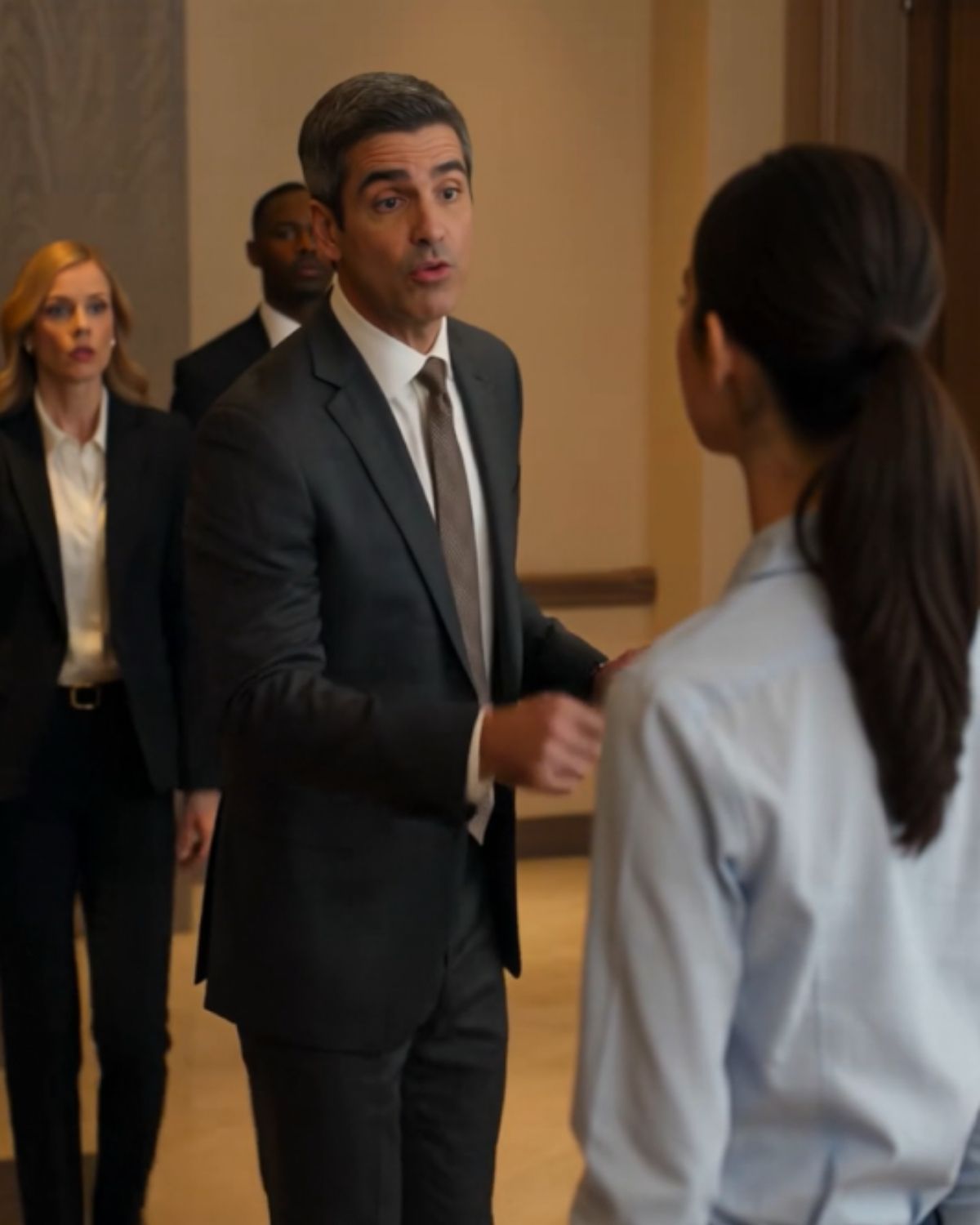
The young woman had been inside the executive meeting for less than thirty seconds when the chief operating officer ordered her out.
Nina Alvarez stood beside the long glass table holding a laptop against her chest.
Around her sat twelve senior executives, three lawyers, two investment advisers, and the leadership team of the Ashford Grand Hotel.
Every man at the table wore a tailored suit.
Nina wore black work trousers, plain shoes, and a navy hotel shirt with a small badge that read:
SYSTEMS SUPPORT — NINA
She had tied her hair back after working most of the night.
“I have the updated technology proposal for the hotel system,” she said.
Several executives looked at one another.
One of them, Martin Shaw, leaned back in his chair.
“You’re staff.”
Nina hesitated.
“Yes, sir.”
“This meeting is not for operational staff.”
“I was asked to bring the technical architecture.”
Martin looked toward the hotel’s technology director.
“Why is support personnel presenting our investment proposal?”
Technology Director Adrian Cole cleared his throat.
“She was only supposed to deliver the laptop.”
Nina turned toward him.
“That wasn’t what you told me this morning.”
The room became uncomfortable.
Adrian’s face tightened.
“Leave the materials and return to the control center.”
Nina did not place the laptop down.
“The investor asked for details about the system’s failure recovery, guest privacy controls, and energy prediction model. I wrote the technical responses.”
Martin gave a short laugh.
“You wrote them?”
“Yes.”
He looked at her name badge again.
Then at the executives.
“We are discussing a two-hundred-million-dollar expansion. We don’t have time for confusion.”
“There is no confusion,” Nina replied. “The model on this laptop is the updated version.”
Martin’s expression hardened.
A hotel manager named Lewis Grant stepped toward her.
“Please leave the room.”
Nina remained still.
“The presentation won’t be accurate unless someone explains how the system actually works.”
Adrian closed the folder in front of him.
“That will be handled.”
“By whom?”
No one answered.
Lewis placed one hand on the door.
“You need to go.”
Nina looked around the table.
The people preparing to sell the future of the hotel would not look at the person who had built the system they were selling.
She lowered her eyes.
Then she turned and walked out.
The glass door closed behind her.
Inside the meeting room, Martin exhaled sharply.
“Someone needs to speak to Human Resources about junior employees understanding boundaries.”
Adrian nodded.
But he did not look relieved.
He looked afraid.
Because Nina had not exaggerated.
Three years earlier, the Ashford Grand had been losing money.
The hotel was beautiful from the outside—forty floors of glass, marble, restaurants, ballrooms, and luxury suites overlooking the river.
But behind the chandeliers, its operations were failing.
Rooms were heated when empty.
Maintenance problems went unnoticed until guests complained.
Housekeeping teams were sent to rooms that had not been vacated.
Elevators were serviced too late.
Food orders were overestimated.
Guest requests were entered into separate systems that did not communicate with one another.
The hotel paid for six different software platforms, yet employees still relied on handwritten notes and radio calls.
Nina had been nineteen when she started working there.
Her official position was night operations assistant.
She reset guest key cards, helped with printer failures, checked billing terminals, and answered calls when the regular technology staff went home.
She took the job because it included health insurance for full-time employees.
Her mother had been injured in a warehouse accident and could no longer work regularly. Nina’s wages paid most of the rent.
She studied computer engineering at a community college during the day and worked at the hotel at night.
Most executives never saw her.
But night employees saw everything daytime leaders missed.
At 2:00 a.m., Nina watched front-desk workers enter the same guest request into three systems.
At 3:00 a.m., she watched engineering teams search twenty floors for a malfunctioning air-conditioning unit because the building software provided the wrong location.
At 4:00 a.m., she watched housekeeping supervisors call every floor to determine which rooms were ready.
The hotel did not have one large problem.
It had hundreds of small problems wasting minutes, electricity, supplies, and patience.
Nina began building a solution on her personal laptop.
At first, it was only a simple dashboard.
It combined housekeeping updates, maintenance alerts, room occupancy, and guest requests on one screen.
She called it Lumen because her mother always said a small light mattered most in a dark room.
The first person to use it was a night manager named Grace Patel.
Grace watched the dashboard identify a water leak on the twenty-second floor before it reached a guest room.
“How did you do that?” she asked.
“I connected the pressure sensor data to the maintenance request system.”
“Are you allowed to do that?”
“I used test data.”
Grace stared at the screen.
“Can it work with live data?”
Nina nodded.
“Then show engineering.”
The engineering supervisor tested it for two weeks.
Lumen reduced response times by almost forty percent.
Housekeeping asked for access.
Then the front desk.
Then security.
Nina kept adding features.
The system predicted which rooms would be ready early.
It identified unusual energy usage.
It alerted staff when elevators were becoming unreliable.
It translated guest requests into twelve languages.
It never stored sensitive payment details, and it separated employee access by role.
Within a year, complaints fell.
Utility costs dropped.
Rooms became available faster.
The hotel’s guest satisfaction score rose to the highest level in the company.
That was when senior management noticed.
Adrian Cole, the technology director, called Nina into his office.
He praised her initiative.
Then he told her the project needed “executive ownership.”
The hotel moved Lumen onto company servers.
Adrian became the official project sponsor.
Nina remained a systems support employee.
Her name appeared in technical documents, but not in press releases.
When hotel magazines wrote about Ashford’s “advanced digital transformation,” they interviewed Adrian.
Nina continued working nights.
She told herself recognition did not matter as long as the system worked.
But recognition began to matter when executives started making decisions that could damage it.
The Ashford Group was now seeking outside investment to install Lumen across eighteen properties.
The main investor, Rafael Bennett, had built his reputation funding technology that solved practical problems rather than fashionable ones.
His company had spent four months reviewing Ashford’s finances.
The investment team liked the hotels.
But they were most interested in Lumen.
The system had reduced annual operating costs by nearly fourteen million dollars across three pilot properties.
It had also improved response times without cutting staff.
Rafael wanted to meet the technical creator before approving the deal.
Adrian told the board that his department had developed the platform.
He described Nina as a junior employee who had contributed to “early implementation.”
That morning, he asked her to prepare answers to fifty-three technical questions.
He told her she would be present in the meeting if deeper explanations were needed.
But when Nina entered the room, Adrian saw the executives looking at her uniform.
He made a choice.
He protected his title instead of the truth.
Now Nina stood alone in the VIP hallway.
Through the glass walls, she could see Martin beginning the presentation she had created.
Slide one showed the Ashford Grand at night.
Slide two showed Lumen’s performance results.
Slide three carried the words:
BUILT BY ASHFORD’S EXECUTIVE TECHNOLOGY TEAM
Nina stared at the sentence.
Then she walked away.
Rapid footsteps carried her through the service corridor, down a private elevator, and into the technology control center beneath the lobby.
The room had no chandeliers.
It contained six workstations, dozens of monitors, and a wall-sized display showing the hotel’s operations in real time.
Green icons represented occupied rooms.
Blue lines tracked water and energy use.
Maintenance alerts appeared in yellow.
Security notifications appeared in red.
Nina placed the laptop on her desk.
Her coworker Jamal looked up.
“You’re back already?”
“They didn’t want me there.”
“But the investor’s technical questions—”
“Adrian said he would handle them.”
Jamal stared at her.
“He doesn’t know the recovery architecture.”
“He has the slides.”
“The slides don’t explain it.”
Nina sat down.
On the main display, a warning appeared beside Elevator Six.
The motor temperature had risen above the normal range.
Nina opened the diagnostic panel.
She sent an automatic service request and removed the elevator from guest rotation before it failed.
Upstairs, no guest noticed.
That was how Lumen was supposed to work.
The system protected people quietly.
No applause.
No headlines.
Just a problem prevented before it became visible.
At 10:15, three black cars arrived beneath the hotel canopy.
Rafael Bennett entered the lobby with his investment director, two engineers, and a lawyer.
The hotel executives hurried from the VIP room to greet him.
Martin shook his hand.
“Mr. Bennett, welcome to the Ashford Grand.”
Rafael looked around the lobby.
A digital panel near reception displayed check-in times, available rooms, and transportation updates.
A guest approached the concierge desk and asked for a medical clinic.
Before the concierge finished typing, Lumen displayed the nearest open clinic, estimated travel time, and a translated instruction sheet.
Rafael noticed.
“Is that the same system used for operations?”
Adrian smiled.
“Yes. Our technology team built an integrated platform across the guest journey.”
“Good.”
Rafael looked toward the elevators.
“Before the financial discussion, I want to see the control center.”
Martin hesitated.
“We prepared a full executive demonstration upstairs.”
“I’ve seen demonstrations.”
Rafael adjusted the cuff of his jacket.
“I want to see how the system behaves when nobody is presenting it.”
The executives exchanged glances.
Then they led him downstairs.
In the technology control center, employees stood when the group entered.
Nina did not notice immediately.
She was studying a cluster of room-temperature readings.
Jamal touched her arm.
She turned.
Adrian saw her.
His expression changed.
“Nina, you can take your break.”
Rafael looked at her.
Then at the laptop on her desk.
A diagram filled the screen.
It showed data moving between building sensors, hotel operations, privacy filters, and emergency systems.
“Is that the live architecture?” Rafael asked.
Nina looked toward Adrian.
He answered for her.
“It’s an internal support view.”
Rafael stepped closer.
“Who designed it?”
Adrian gave a practiced smile.
“My team developed the architecture collaboratively.”
Rafael looked at the code notes beside the diagram.
Several lines were marked with the initials N.A.
“What does N.A. mean?”
No one replied.
Nina spoke quietly.
“My initials.”
Rafael turned toward her.
“What is your role?”
“Systems support.”
“And your name?”
“Nina Alvarez.”
Something changed in Rafael’s expression.
He opened the technical review folder carried by his engineer.
“Alvarez?”
“Yes.”
He looked at Adrian.
“Why was her name not mentioned upstairs?”
Adrian shifted his weight.
“Nina contributed to early testing and operational support.”
Rafael’s lead engineer stepped toward the screen.
He studied the architecture.
Then he looked at Nina.
“Who created the fallback process when the central server disconnects?”
“I did.”
“How does it prevent duplicate maintenance commands?”
“Each floor controller generates a temporary event key. When the network returns, the central system compares the event key, time stamp, and device state before accepting the request.”
The engineer nodded.
“And if two devices report conflicting occupancy data?”
“The system does not choose automatically. It lowers the confidence score and asks the front desk or housekeeping team to verify the room.”
“Why?”
“Because automation should not turn uncertainty into a fact.”
Rafael looked at her.
That answer was not on the presentation slides.
His engineer asked another question.
“What prevents managers from using guest behavior data to evaluate individual employees?”
“Role separation. Supervisors can see service patterns, but not connect every guest action to a single worker unless there is a documented safety or security investigation.”
“Who requested that?”
“No one.”
“Then why include it?”
Nina glanced at the staff members around her.
“Because a system designed to help workers can become a system used to watch them.”
The room became quiet.
Rafael closed the folder.
“Where is the person who created this system?”
Martin looked confused.
“Our technology director is right here.”
Rafael pointed toward the wall display.
“I did not ask who manages the department.”
He looked at Adrian.
“I asked who created the system.”
Adrian’s face tightened.
“As I explained, it was a collaborative effort.”
Rafael’s engineer opened his tablet.
“We reviewed thirty-eight months of development history. The original architecture, core code, privacy layer, maintenance prediction model, and offline recovery process were all submitted under one account.”
He turned the screen toward the executives.
The account name was:
NALVAREZ_NIGHTOPS
The room went still.
The engineer continued.
“Later versions include contributions from other employees. But the original platform was built by Nina Alvarez.”
Rafael looked at Nina.
“Are you the creator of Lumen?”
Nina hesitated.
For three years, she had been told to say she was part of the team.
She had been warned that claiming too much credit would appear unprofessional.
She looked at the executives who had removed her from the meeting.
Then at the system she had built while most of them were asleep.
“Yes,” she said.
“I created the first version.”
Rafael nodded slowly.
“Why were you not in the VIP room?”
No one answered.
Nina looked at Martin.
“He said the meeting was not for staff.”
Rafael turned toward the executives.
“You removed the person who made this hotel successful.”
The words landed harder than shouting would have.
Martin’s face went pale.
Adrian stared at the floor.
Lewis, the manager who had held the door open for Nina to leave, folded his hands in front of him.
Rafael’s investment director looked through the glass wall toward the executive elevators.
“We were told the platform had been developed under senior technology leadership.”
Nina spoke before Adrian could answer.
“He approved the pilot after it was already working.”
Adrian looked at her.
“Nina, be careful.”
Rafael’s expression changed.
“No. You should be careful.”
Adrian fell silent.
Rafael walked to the wall display.
A timeline showed live hotel activity.
A maintenance warning disappeared as an engineer confirmed the elevator repair.
A housekeeping request changed from yellow to green.
Energy demand adjusted automatically as a ballroom emptied.
“Ms. Alvarez,” Rafael said, “how much authority do you have over Lumen’s development?”
“Officially?”
“Yes.”
“None.”
“What is your salary classification?”
“Hotel systems support, grade three.”
Rafael’s lawyer looked up sharply.
The lead engineer frowned.
Martin attempted to recover.
“Her title has not yet caught up with her contributions. We were already discussing a development plan.”
Nina looked at him.
They had never discussed one.
Rafael noticed her expression.
“When?”
Martin paused.
“The organization has been moving quickly.”
“That is not a date.”
Martin said nothing.
Rafael turned to the hotel’s board chair, who had just entered the control center after being called downstairs.
“Our investment proposal values Lumen as one of Ashford’s primary assets.”
The board chair nodded cautiously.
“Yes.”
“Then I need to understand why the person responsible for that asset has no authority, no executive access, and no visible credit.”
Adrian stepped forward.
“The platform belongs to the company. Ms. Alvarez developed it using hotel data and resources.”
Nina looked at him.
“I built the original system on my own laptop before the hotel gave me server access.”
“That does not change the ownership agreement.”
“I am not arguing ownership.”
Her voice remained calm.
“I am explaining what happened.”
Rafael looked at the board chair.
“The investment is paused.”
Martin’s head lifted.
“Mr. Bennett—”
“I will not invest two hundred million dollars in a company that hides the people who create its value.”
The room became completely silent.
Rafael continued.
“We need an independent review of authorship, compensation, intellectual property assignments, and every statement made to our technical team.”
Adrian’s face lost all color.
He understood before anyone said it.
The deal was no longer threatened by Nina’s presence.
It was threatened by the executives’ attempt to erase her.
The board chair looked toward Nina.
“Were you asked to prepare today’s technical presentation?”
“Yes.”
“Were you told you would be allowed to answer investor questions?”
“Yes.”
“Who removed you?”
Nina glanced at Martin, Adrian, and Lewis.
“All three of them.”
Martin loosened his tie.
Lewis looked toward the hallway.
Adrian finally looked directly at Nina.
For the first time, he was not looking at a junior employee.
He was looking at the person who could prove every claim.
His shoulders lowered.
His mouth opened, but no explanation came.
The authority he had carried into the VIP room disappeared in front of the same screens he had claimed as his department’s achievement.
Rafael closed the technical folder.
“The meeting will continue.”
Martin looked relieved for half a second.
Then Rafael added, “With Ms. Alvarez at the table.”
He turned to Nina.
“Bring your laptop.”
Nina looked down at her work shirt.
“I’m not dressed for an executive meeting.”
Rafael glanced at the employees in the control center.
“You are dressed like someone who understands how the hotel works.”
They returned upstairs.
Rapid footsteps moved through the lobby.
Executives entered the private elevator.
Nina followed with her laptop.
When the VIP meeting room doors opened, the lawyers and advisers inside stood automatically.
They expected Rafael Bennett.
They did not expect the young systems employee walking beside him.
Martin entered last.
He did not take his original seat at the head of the table.
Rafael gestured toward it.
“Ms. Alvarez, sit here.”
Nina hesitated.
“That is Mr. Shaw’s seat.”
“Today, it belongs to the person answering the technical questions.”
She sat down.
The same executives who had ignored her now opened their notebooks.
Nina connected her laptop to the screen.
She removed the first slide.
BUILT BY ASHFORD’S EXECUTIVE TECHNOLOGY TEAM
In its place, she opened the original Lumen architecture.
“This system was designed around one principle,” she began. “Hotel technology should reduce the distance between a problem and the person able to solve it.”
No one interrupted.
She explained how the platform worked.
She discussed its limitations.
She admitted where the prediction model sometimes failed.
She explained that some features should not be expanded until employee privacy protections improved.
Rafael asked difficult questions.
Nina answered them.
When she did not know something, she said so.
That impressed him more than the prepared financial projections.
The investment review continued for three weeks.
An independent investigation confirmed that Nina had created Lumen’s original code and architecture. It also found that Adrian had removed her name from two investor documents and described her work as departmental intellectual property without explaining her role.
He was dismissed.
Martin received a formal disciplinary action for excluding Nina from the meeting and making decisions based on her position rather than the purpose of her attendance.
Lewis was removed from executive event management and required to complete leadership training before returning to a supervisory role.
The board offered Nina a new position:
Director of Hotel Systems Innovation
The title came with authority over Lumen’s development, a salary reflecting her work, and funding to build a team that included employees from housekeeping, engineering, security, and front-desk operations.
Nina accepted under one condition.
“No system will be designed only by people who sit in executive offices.”
The board agreed.
Rafael Bennett approved the investment two months later.
But the final agreement included a new requirement.
At every hotel adopting Lumen, hourly workers would participate in design and testing.
The people who used the system would help shape it.
On the morning the deal was signed, Nina returned to the VIP meeting room.
She wore a simple dark jacket over the same navy hotel shirt.
Her mother sat quietly near the back.
Jamal and Grace joined employees from the control center.
Rafael asked Nina to sign the technical leadership agreement.
Afterward, Martin approached her.
For several seconds, he stood without speaking.
“I was wrong,” he finally said.
Nina looked at him.
“You did not ask one question before deciding I did not belong.”
He lowered his eyes.
“I know.”
“That is the part you should remember.”
He nodded.
This time, there was no excuse.
That evening, Nina walked through the technology control center before leaving the hotel.
The screens continued changing.
Rooms became ready.
Maintenance alerts cleared.
Guest requests moved through the system.
Lumen did not display her name.
It did not need to.
The employees in the room knew who had built it.
More importantly, they now knew they were allowed to speak when they saw something that could make it better.
Months earlier, Nina had been forced out of the VIP room because the people inside saw a simple uniform and assumed it marked the limit of her ability.
When she returned, they stood because an investor had revealed the truth.
But the truth had been present from the beginning.
Talent does not become valuable when powerful people finally recognize it.
It was valuable all along.