
At 3:30 in the afternoon on July 31, 1945, an ammunition depot exploded in the industrial outskirts of Ústí nad Labem.
The blast ripped through the Krásné Březno district with such force that windows shattered across the surrounding streets. A column of smoke rose above the Elbe River. Buildings shook. Workers ran from factories as burning debris fell around them.
Dozens were killed or wounded.
Within minutes, a rumor began moving faster than the smoke.
German saboteurs had done it.
There was no trial. No evidence had been presented. No investigation had reached a conclusion.
But in a city carrying seven years of occupation, humiliation, executions and grief, many people did not need proof.
They needed someone to punish.
And the Germans of Ústí were easy to identify.
They had been ordered to wear white armbands.
By sunset, the war in Europe had been over for nearly three months.
But on the Beneš Bridge, peace meant nothing.
To understand what happened that afternoon, it is necessary to return to 1938.
Ústí nad Labem was then widely known by its German name, Aussig. It stood in the Sudetenland, the border region of Czechoslovakia where large numbers of ethnic Germans had lived for generations.
Czechs and Germans had worked in the same factories, shopped in the same markets and crossed the same bridge over the Elbe.
They were neighbors.
But by the late 1930s, they were no longer looking at one another as neighbors.
Adolf Hitler claimed that ethnic Germans inside Czechoslovakia were being mistreated. Nazi propaganda encouraged resentment and separatism. Konrad Henlein’s Sudeten German Party increasingly aligned itself with Hitler’s demands.
Then came the Munich Agreement.
In September 1938, Britain, France, Germany and Italy agreed that Czechoslovakia would surrender the Sudetenland to Nazi Germany. Czechoslovak representatives were not permitted to take part in the decisive negotiations.
German troops entered the borderlands in October.

Many ethnic Germans welcomed them with flags, flowers and raised arms. Photographs showed crowds lining the roads as Wehrmacht vehicles passed.
For local Germans who supported annexation, it appeared to be a national victory.
For many Czechs, it was a betrayal.
Czech officials, teachers, railway workers and families fled or were forced from homes they had believed were secure. Businesses changed hands. Property was abandoned or confiscated. People who had spent their lives in the region suddenly became refugees inside their own country.
The emotional wound was deepened by a painful fact: some of the people celebrating Germany’s arrival had once been their colleagues and neighbors.
Six months later, Hitler violated even the agreement that had appeased him.
In March 1939, German forces occupied the remaining Czech lands. Bohemia and Moravia became a Nazi-controlled protectorate.
The occupation brought arrests, censorship, forced labor and executions.
Universities were closed after student demonstrations. Intellectuals, resistance members, Jewish families and political opponents disappeared into prisons and concentration camps. Germanization policies pushed the Czech language and national identity out of public life.
Then, in 1941, Reinhard Heydrich arrived in Prague.
Heydrich was one of the principal architects of the Holocaust and one of the most feared men in the Nazi system. As acting Reich Protector, he combined calculated rewards for compliant workers with merciless repression of resistance.
In May 1942, Czechoslovak agents trained in Britain attacked his car in Prague. Heydrich died from his wounds days later.
Nazi retaliation was immediate.
Thousands were arrested. Hundreds were executed.
The village of Lidice was selected for collective punishment despite the absence of reliable evidence connecting its residents to the assassination.
On June 10, German forces surrounded the village. The men were shot. Women were deported to Ravensbrück concentration camp. Most of the children were murdered or sent away for forced Germanization.
Lidice was then burned and physically erased.
Its destruction became a symbol of everything Nazi occupation had done to the Czech people.
And for the next three years, resentment continued to accumulate.
Not every Sudeten German had supported Hitler. Some had opposed Nazism. Some had suffered under it. Others had remained politically silent, trying only to keep their families alive.
But collective anger rarely respects individual histories.
By 1945, many Czechs no longer saw Germans as separate human beings with different choices and loyalties.
They saw a single group.
And they saw that group as responsible.
When Nazi Germany collapsed in May 1945, power changed hands almost overnight.
German signs were torn down. Nazi officials fled or were arrested. Czech authorities returned. Armed revolutionary guards appeared in towns across the country.
The victims of occupation were suddenly in control.
For years, they had been told when they could travel, what they could publish and which language they could use. They had watched people disappear into interrogation rooms. They had lived beneath portraits of Hitler and the threat of denunciation.
Now German civilians were the ones facing restrictions.
Many were dismissed from their jobs. Their property was seized. Their movement was controlled. In numerous towns, they were required to display a visible white cloth bearing the letter N, identifying them as German.
It meant Němec.
German.
The armband was supposed to distinguish a population awaiting official decisions about removal and resettlement.
In practice, it also turned every wearer into a target.
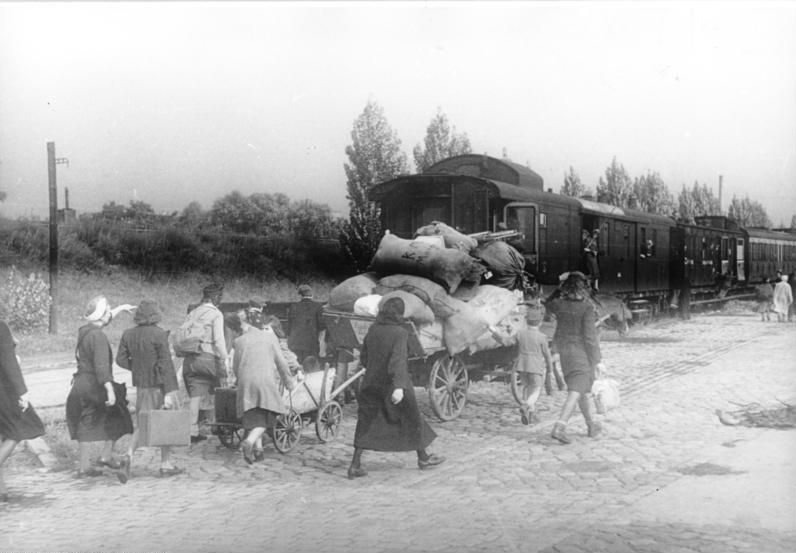
The months after liberation became known for the “wild expulsions”—a chaotic period before the organized transfers approved at Potsdam. Germans were driven across borders, placed in camps or forced onto marches with little food and few possessions.
Some were Nazi officials.
Some had actively supported annexation and occupation.
Others were elderly people, industrial workers, women and children whose only visible offense was the white band around an arm.
The distinction between guilt and ethnicity was disappearing.
And in Ústí, all that was needed was a spark.
It came from the ammunition depot at Krásné Březno.
The explosion tore through a storage complex containing military material and industrial supplies.
The first official suspicion fell upon the Nazi Werwolf organization, a planned network of German guerrillas intended to continue resistance behind Allied lines.
The word alone was enough to terrify people.
Werwolf.
It suggested hidden explosives, secret cells and Germans refusing to accept defeat.
No conclusive explanation for the Ústí explosion has ever been established. Historians have examined possibilities ranging from an accident to deliberate sabotage and political provocation.
But those uncertainties belonged to the future.
On July 31, there was only smoke—and the rumor that Germans had caused it.
The violence began almost immediately.
Revolutionary Guards, soldiers and civilians moved through the streets. Germans were stopped at tram platforms and outside factories. The white armbands that marked their status now worked like death warrants.
People were pulled from bicycles.
Workers were dragged away while returning home.
Some were beaten with rifle stocks. Others were kicked as they lay on the pavement. Witnesses reported shootings, stabbings and people being thrown into a fire reservoir.
The attacks were not confined to one place.
But the Beneš Bridge became their most infamous stage.
The bridge stretched across the Elbe, connecting the city’s industrial districts. Hundreds of workers used it every day.
That afternoon, ethnic German employees from nearby factories were walking home when groups of armed men and enraged civilians began blocking their path.
One German man, identified in historical accounts as Georg Schörghuber, reportedly shouted something that provoked the crowd.
Hands seized him.
He was pushed toward the railing.
For a moment, he clung to the edge.
Then he disappeared over it.
He struck the river below and surfaced, fighting against the current.
Shots followed him through the water.
People on the bridge watched as the river carried him away.
After that, the boundary collapsed.
Others were beaten and thrown over the railing. Some were shot before falling. Some entered the water alive and were fired upon when they attempted to swim.
The bridge was no longer a route home.
It had become an execution platform.
A German woman appeared among the crowd with a baby carriage.
Whether those nearest to her hesitated is impossible to know. What survives in accounts of the massacre is the image of a mother, a child and a carriage being forced toward the edge while armed men and spectators surrounded them.
The river below was filled with smoke, debris and bodies.
A Dutch vessel anchored beneath the bridge attempted to rescue people from the water. Its crew pulled survivors aboard and gave shelter to those they could reach, even as gunfire came from above.
Elsewhere, Czech residents tried to intervene.
Some warned German neighbors not to enter the streets. Some hid people inside homes and shops. Others confronted the attackers directly.
Ústí’s Czech mayor, Josef Vondra, reportedly attempted to stop the violence.
These actions mattered because they exposed the lie at the center of every mob.
The massacre was not inevitable.
People still had choices.
Some chose to kill.
Some chose to watch.
And some chose to save.
Eventually, the authorities declared emergency measures. Soldiers cleared the streets, and a curfew brought the open attacks to an end by evening.
The city fell quiet.
Shoes, torn clothing and abandoned belongings remained on the bridge.
The Elbe continued flowing north toward Germany.
No one knew precisely how many bodies it carried.
The official number of victims has never been settled.
Forty-three deaths were firmly documented in connection with the violence, while later researchers produced estimates closer to eighty. Much higher numbers circulated for decades, but historians have been unable to verify them reliably.
The uncertainty became part of the tragedy.
Some victims vanished into the river. Bodies recovered farther downstream could not always be linked conclusively to Ústí. Records were incomplete, political interests shaped later accounts, and the event was rarely discussed openly during decades of Communist rule.
The perpetrators were never held fully accountable.
The ammunition explosion was blamed by the postwar investigation on German saboteurs, yet no conclusive proof established who caused it. Later historians proposed other explanations, including the possibility that the blast had been deliberately engineered to inflame anti-German sentiment and strengthen the case for expulsion.
That theory remains disputed.
But one fact does not depend on solving the explosion.
The civilians attacked on the streets and bridge had not been tried for causing it.
Most had not even been accused by name.
Their armbands were considered evidence enough.
And that was the moment the crowd crossed a line that no memory of Nazi brutality could erase.
The most unsettling part of the Ústí massacre is not that people were angry.
Their anger had reasons.
Czechoslovakia had been dismantled. Czech families had been displaced. Resistance members had been tortured and executed. Lidice had been destroyed. Jewish communities had been deported and murdered. Forced labor and terror had entered ordinary homes.
To pretend that this suffering did not create rage would be dishonest.
But suffering can explain revenge without making revenge justice.
Justice asks who committed the crime.
Revenge asks who can be made to pay.
On the Beneš Bridge, people who had survived collective punishment reproduced its logic.
They did not ask whether the worker in front of them had supported Hitler.
They did not ask whether the woman with the armband had helped a persecuted neighbor.
They did not ask whether the old man had served the Nazi state or quietly hated it.
They saw German cloth on an arm.
And they decided that identity was guilt.
That was the poison Nazism had spread across Europe: the idea that entire categories of human beings could be judged, marked and punished together.
On July 31, 1945, Hitler was dead.
His regime had fallen.
But for several terrible hours in Ústí nad Labem, that idea survived him.
Sixty years later, in 2005, a memorial plaque was unveiled on the Beneš Bridge.
Its inscription was written in Czech and German.
It did not glorify one nation or condemn another.
It commemorated the victims of violence on July 31, 1945.
The plaque is small compared with the bridge. Thousands can cross without stopping. Cars pass. Trains move along the river. Modern Ústí continues around it.
But the location still carries a warning.
The massacre does not cancel the crimes of Nazi occupation.
The crimes of Nazi occupation do not excuse the massacre.
Both truths must stand together.
Because history becomes dangerous when people believe that acknowledging one victim somehow betrays another.
The Czechs who suffered under Nazi rule deserved liberation and justice.
The German civilians murdered without trial deserved to live.
Recognizing both is not moral confusion.
It is the difference between memory and propaganda.
The war in Europe officially ended in May 1945. Yet on a summer afternoon almost three months later, a crowd stood on a bridge and continued fighting it against unarmed people.
Somewhere among them, there must have been a moment when the shouting weakened.
A moment when a man looked down at the river and understood that the person struggling below was not the Nazi state, not Reinhard Heydrich, not the executioners of Lidice.
Just a human being.
By then, the recognition came too late.
That is why Ústí still matters.
The most important test of justice does not come when our enemies hold power over us.
It comes when they no longer do—and we must decide whether their crimes will turn us into them.
A nation proves it has defeated tyranny not when it gains the power to take revenge, but when it refuses to punish the innocent.
Historical note: The cause of the Krásné Březno explosion and the precise death toll remain disputed. Contemporary documentation confirms at least 43 victims, while several historians estimate that approximately 80 people were killed. Claims of dramatically higher totals have not been conclusively substantiated.