In the summer of 1940, Nazi Germany stood at the height of its power.
France had fallen.
The British Army had escaped Dunkirk but left behind much of its equipment.
Across Europe, Hitler’s victories created the belief that Germany was unstoppable.
Only one major obstacle remained.
Britain.
For the Nazi leadership, the next step seemed obvious: destroy the Royal Air Force, gain control of the skies, and prepare the way for Operation Sea Lion, the planned invasion of Britain.
But before the first aircraft crossed the English Channel, Germany had already made a dangerous mistake.
It believed a false story.
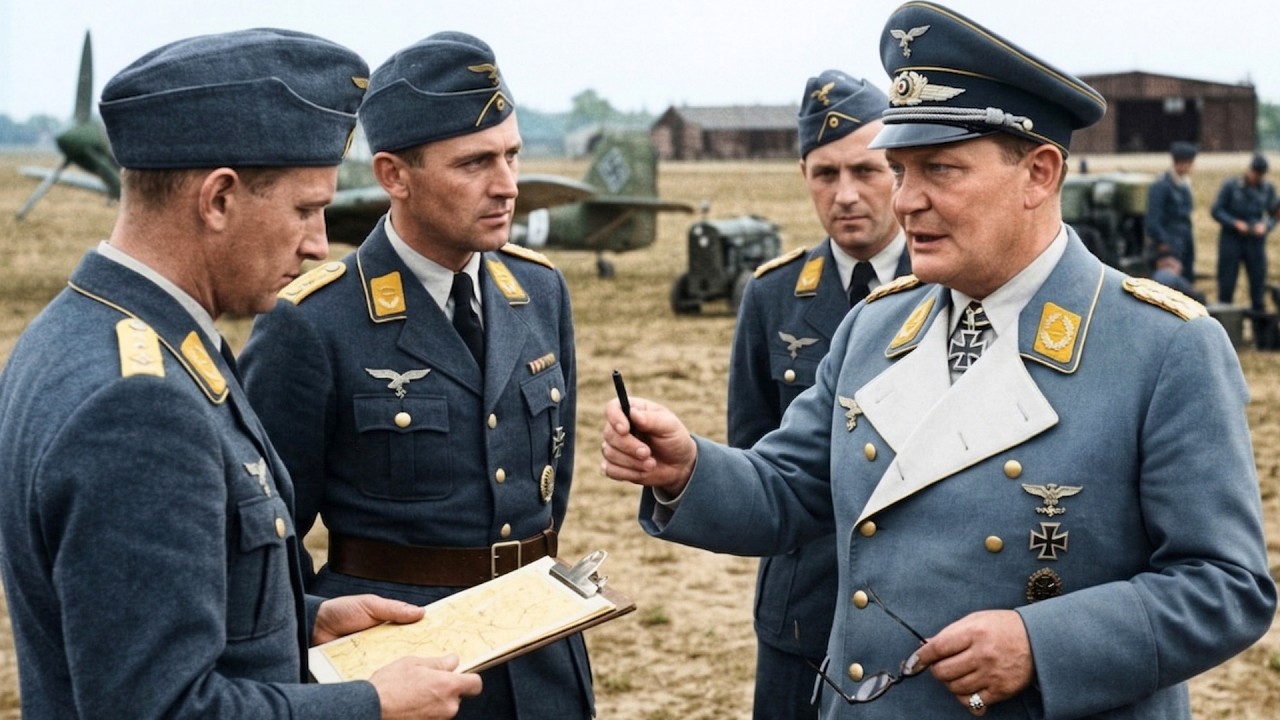
In late June 1940, Hermann Göring received an intelligence report from Josef Schmid, the Luftwaffe’s intelligence chief. The report confirmed exactly what German leaders wanted to hear.
The RAF was supposedly weak.
Its fighter numbers were supposedly collapsing.
Its pilots were supposedly exhausted.
The British air defense system, according to Schmid’s analysis, was close to breaking.
But the reality was very different.
The report underestimated British aircraft production, pilot training, and the strength of Fighter Command. Germany was not preparing to attack a weakened enemy.
It was preparing to attack an enemy it did not understand.
This was the first major failure of the campaign.
The problem was not only incorrect numbers.
It was the culture surrounding German command.
Göring believed air power alone could decide the war. After Germany’s victories across Europe, he became convinced that the Luftwaffe could force Britain to surrender through overwhelming attacks.
Nobody wanted to challenge that confidence.
The result was a strategy built on assumptions instead of reality.
Then came the second mistake.
Germany failed to understand the system protecting Britain.

Along the British coast stood the Chain Home radar stations. They were visible, massive structures that German aircraft could photograph.
But Luftwaffe commanders underestimated them.
They saw towers.
They did not see the network behind them.
The radar system was connected to filter rooms, command centers, and sector stations. When German aircraft approached, Britain could detect them, track their movements, and send fighters into the sky before the enemy reached its targets.
It was not just technology.
It was coordination.
Air Chief Marshal Hugh Dowding had built Fighter Command around this idea. Britain did not need to destroy every German aircraft immediately.
It only needed to survive long enough.
Keith Park, commander of 11 Group defending southeast England and London, turned that system into reality.
His pilots were not flying blindly into battle.
They were being directed.
They were being preserved.
They were fighting as part of a machine Germany had failed to recognize.
In August 1940, the Luftwaffe launched its main campaign.
The goal was clear:
Destroy RAF Fighter Command.
German aircraft attacked British airfields, communication centers, and military targets. Bases such as Biggin Hill, Kenley, and Hornchurch were repeatedly bombed.
The damage was serious.
Runways were destroyed.

Buildings were damaged.
Ground crews worked through the night.
Pilots flew again and again with almost no rest.
For a moment, it appeared Germany might succeed.
Between early and mid-August, RAF losses became dangerous. Fighter pilots were being killed faster than new ones could replace them.
Dowding knew the situation was critical.
But the Luftwaffe was suffering too.
German aircraft losses were heavy. Experienced pilots were difficult to replace. The assumption that Britain was close to collapse was proving wrong.
Instead of recognizing this, German commanders searched for new solutions.
Then came a mistake that changed everything.
On August 24, 1940, German bombers accidentally struck London.
Churchill responded by ordering a bombing raid on Berlin.
Hitler was furious.
The attack on the German capital damaged his pride and changed the direction of the campaign.
Göring shifted the Luftwaffe’s focus.
Instead of continuing to destroy RAF airfields, Germany began attacking London.
It was intended to break British morale.
But strategically, it gave Fighter Command something it desperately needed.
Time.
While German bombs fell on London, damaged RAF bases were repaired. Aircraft were maintained. Pilots rested. The defense system recovered.
The Luftwaffe had stopped attacking the target that mattered most.
Then came September 15, 1940.
Known as Battle of Britain Day, it became the turning point of the campaign.
German commanders believed the RAF was nearly defeated. They expected a weakened enemy.
Instead, hundreds of British fighters rose into the sky.
The Germans encountered a force that was still organized, still dangerous, and still capable of fighting back.
The surprise was not only military.
It was psychological.
The Luftwaffe had been told Britain was almost finished.
The battlefield showed the opposite.
German losses were severe. The confidence that had carried the campaign began to disappear.
Even inside the Luftwaffe, frustration grew. Some commanders argued that fighter tactics were being damaged by poor decisions from above. Adolf Galland and other experienced pilots criticized the restrictions placed on German fighters.
The problem was no longer courage.
It was strategy.
By October, Germany shifted away from daylight attacks and moved toward nighttime bombing raids known as the Blitz.
Cities were targeted.
Civilians suffered.
But Britain had survived.
The invasion plan was postponed and eventually abandoned.
The Battle of Britain ended without a German victory.
The cost was enormous.
The Luftwaffe lost thousands of aircraft and experienced aircrews. Fighter Command also suffered heavy losses, but it achieved the one thing that mattered most:
It remained operational.
The failure of Germany was not caused by one single mistake.
It was a chain of errors.
Bad intelligence.
Underestimating radar.
Misunderstanding British command.
Changing targets at the critical moment.
And believing victory was already guaranteed.
Hugh Dowding and Keith Park were not fighting with unlimited resources.
They were fighting with a system designed to survive pressure.
Germany had more aircraft.
It had experienced pilots.
It had confidence.
But confidence built on false information can become a weakness.
The Battle of Britain proved something Hitler and Göring failed to understand:
A nation does not fall simply because it is attacked.
Sometimes, the side that survives the first blow is the side that wins the war.