Chapter One: The Message
My father was holding a champagne glass when he told a room full of soldiers that I had never done anything dangerous in my life.
The ballroom went quiet in layers.
First, the young captain beside the stage stopped laughing.
Then the woman from the defense contractor lowered her wineglass.
Finally, the two men standing behind my father turned toward me with the slow curiosity people reserve for accidents they have not yet decided whether to watch.
Richard Reed smiled as though he had just delivered the evening’s best joke.
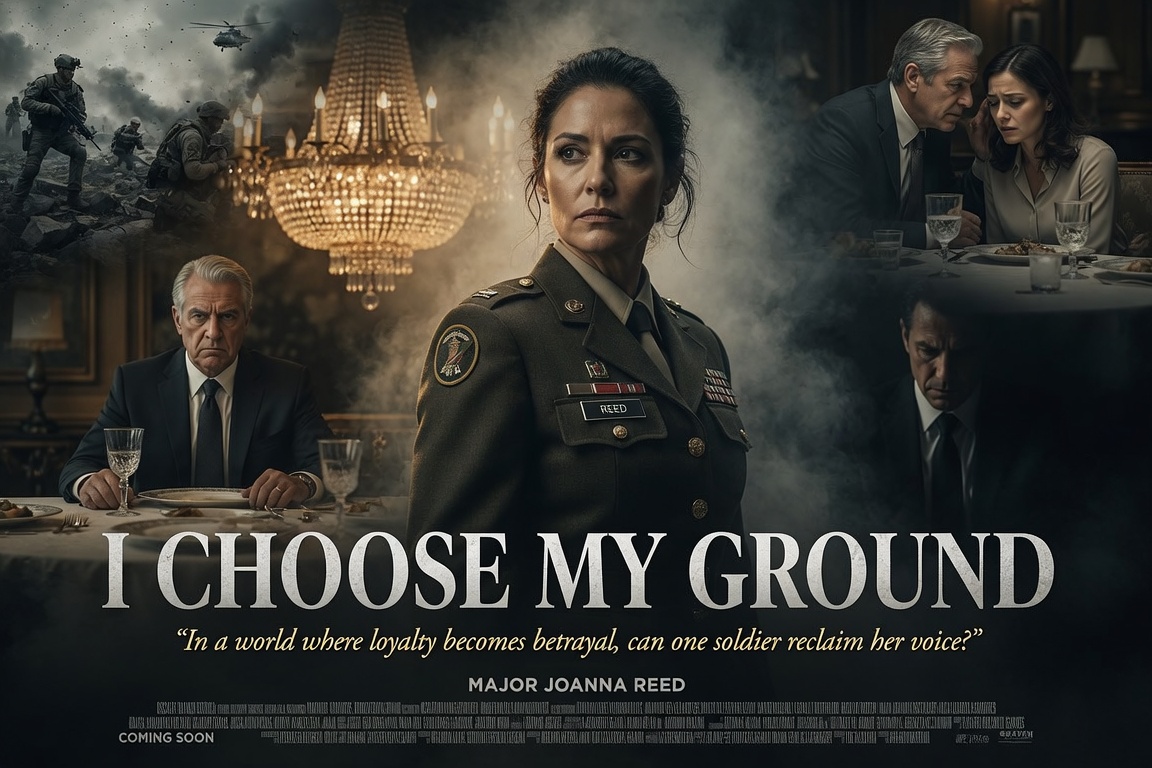
A few guests offered polite laughter.
My father drank it in.
At sixty-two, Richard still knew how to own a room. His silver hair was cut close at the sides, his tuxedo tailored within an inch of arrogance. The scar beneath his chin—earned in a bar fight when he was nineteen, though he told people it came from “government work”—caught the amber light from the chandeliers.
He looked every inch the decorated patriot.
That was why nobody noticed the man near the kitchen door quietly slipping his hand inside his jacket.
Nobody except me.
I stood ten feet from my father in a black evening dress chosen specifically because it allowed me to carry a concealed radio against my left thigh. My right hand rested lightly on a cocktail table. My pulse had not changed.
Across the ballroom, General Elias Ward was accepting congratulations beneath a gold banner commemorating the fiftieth anniversary of Fort Halcyon’s intelligence command.
Four stars gleamed on each shoulder.
He was seventy years old, broad as a doorframe, with white hair and the tired eyes of a man who had signed letters to too many families. To everyone else in the room, he was the guest of honor.
To me, he was Raven Actual.
The man near the kitchen door adjusted his cuff.
A second man near the orchestra platform touched his ear.
The fire alarm panel beside the east corridor blinked once.
Then went dark.
My father kept talking.
“She was always serious,” he said. “Even as a child. Lined up her stuffed animals and interrogated them.”
More laughter.
I removed my phone from my clutch.
Richard saw the movement.
“Oh, don’t run away, Jo. I’m complimenting you.”
I typed five words.
Raven, leave through the kitchen. Now.
Then I pressed send.
General Ward’s phone vibrated inside his dress uniform.
He glanced down.
For half a second, nothing happened.
Then his entire face changed.
The warmth vanished first.
His shoulders settled.
His eyes found mine across a hundred people.
He did not nod.
He did not ask why.
He simply turned to the colonel beside him and said, “Seal the east wing. Quietly.”
The colonel blinked. “Sir?”
“You heard me.”
General Ward walked toward the kitchen exit.
The two men who had been watching him moved at the same time.
So did I.
I crossed the ballroom as the orchestra slid into another song. My heels struck marble with measured clicks. The first man pushed through the kitchen door after the general.
The second reached inside his jacket.
I caught his wrist before he cleared the weapon.
He was stronger than he looked.
He drove his shoulder into me, knocking over a tray of champagne. Glass exploded across the floor. Guests screamed. The orchestra stopped in the middle of a note.
The man twisted hard, trying to break my grip.
I stepped inside his reach, drove my elbow under his jaw and used his momentum to send him face-first across the nearest table.
White roses scattered.
Silverware spun.
The pistol slid beneath a chair.
Three military police officers reached us seconds later, but by then I had my knee between the man’s shoulder blades and his wrist folded behind him.
My father stood ten feet away.
The champagne glass was still in his hand.
His mouth had gone slack.
Then the fire doors slammed shut.
A voice cracked over the ballroom speakers.
“Security lockdown. Remain in place.”
General Ward reappeared from the kitchen corridor with two armed agents beside him.
His gaze swept the room, landed on the man under my knee, then shifted to my father.
“Major Reed,” he said.
Richard’s face twitched.
He looked at the general.
Then at me.
The champagne glass slipped from his fingers and shattered at his feet.
Because my father had just heard the one title I had never told him I held.
And the man I had pinned to the floor was wearing a ring I had seen once before—on a dead courier in Prague.
Chapter Two: The Daughter He Invented
The military police cleared the ballroom in eleven minutes.
That was fast for a room filled with donors, officers, politicians, spouses and civilians who believed rules applied most efficiently to other people.
My father was among the last to move.
He remained near the broken champagne glass, staring as two agents dragged the gunman away in restraints.
“Major?” he said when I approached him.
His voice was quieter than I remembered it ever being.
I picked up the pistol using a handkerchief and passed it to Special Agent Naomi Bell from the Defense Criminal Investigative Service.
“Unregistered Makarov,” Naomi said. “Old, clean, no visible serial.”
“Check the magazine base.”
She turned it over.
A thin red triangle had been etched into the metal.
Naomi’s eyes sharpened.
“Vesper.”
I nodded.
Behind me, my father said, “What is Vesper?”
I turned.
He looked offended now, which was familiar territory for him. Fear had entered the room, and Richard Reed’s oldest defense was anger.
He stepped closer. “What is going on?”
“Go home.”
His jaw tightened. “You don’t order me around.”
“This building is under federal lockdown.”
“I know how military security works.”
“No,” I said. “You know how contractors describe it at dinner.”
The words landed harder than I intended.
His eyes narrowed.
There had been a time when hurting him would have made me feel powerful. At thirty-nine, I found it only made me tired.
General Ward approached us with Colonel James Alvarez at his side.
Ward’s uniform was immaculate except for a smear of flour on one sleeve from the kitchen evacuation route.
“You saw the signal failure?” he asked me.
“The alarm panel blinked before it died. Two-man movement pattern. One watching you, one controlling the room.”
“Why the kitchen?”
“The east corridor had three bottlenecks. Kitchen had service stairs and reinforced access to the motor pool.”
Ward glanced at Alvarez. “Exactly what she said in Warsaw.”
My father looked between us.
“Warsaw?”
Ward finally acknowledged him.
“Mr. Reed.”
“General.”
My father straightened automatically. Respect came easily to Richard when rank was visible.
Ward’s voice remained neutral. “Your daughter just prevented an armed attack.”
Richard swallowed.
Then, because he could not tolerate a world in which his assumptions had become evidence against him, he gave a thin smile.
“Well. Joanna has always had good instincts.”
Ward looked at him for a long moment.
“No,” he said. “She has training.”
My father’s smile vanished.
Naomi returned with a tablet.
“We have a preliminary match on one suspect,” she said. “Milo Saran. Dual Serbian-Cypriot citizenship. Financial facilitator for Vesper-linked procurement routes.”
My father stopped breathing.
It lasted less than a second, but I saw it.
So did Naomi.
Ward saw me see it.
That was the problem with rooms full of professionals. Secrets did not disappear. They merely became visible to more dangerous people.
“Mr. Reed,” Naomi said, “do you know that name?”
Richard shifted his weight.
“No.”
The answer came too quickly.
I looked at his left hand.
He was rubbing the side of his index finger with his thumb.
He had done that since I was eight years old.
When he lied to police after backing into a parked car.
When he told my mother he had stopped gambling.
When he promised me he would attend my commissioning ceremony.
Naomi tapped her screen.
“Interesting.”
“What?”
“Because Mr. Saran entered the country four days ago using travel documents sponsored by a consulting firm called Meridian Strategic Logistics.”
My father’s company.
The name sat between us like a body.
Richard looked at me.
Not at Naomi.
Not at General Ward.
At me.
And for the first time in my life, I saw my father ask for help without saying a word.
I did not give it to him.
Chapter Three: The Man in the Family Photograph
Three hours later, rain hammered the windows of Fort Halcyon’s secure interview building.
The room smelled of burnt coffee, damp wool and antiseptic.
My father sat on the opposite side of a metal table beneath lighting that made every person look guilty.
He had removed his tuxedo jacket.
Without it, he appeared smaller.
Not weak.
Richard Reed had never been weak.
But stripped of the tailoring, the applause and the mythology he carried into rooms, he looked like what he was: an aging man with trembling hands and a stubborn refusal to examine where his choices had led him.
Naomi sat beside me.
General Ward watched through the observation glass.
“We need to establish your relationship with Milo Saran,” Naomi said.
“I don’t have one.”
“His travel was sponsored by your firm.”
“I employ forty-three people. My office processes hundreds of documents.”
“Your electronic signature appears on his sponsorship letter.”
“Then somebody copied it.”
Naomi slid a photograph across the table.
It showed my father leaving a restaurant in Baltimore with Milo Saran six months earlier.
Richard stared at it.
The color drained from his face.
I remembered the restaurant. He had invited me there the same night, then canceled by text, claiming a client emergency.
Naomi placed down a second photograph.
A private terminal at Dulles.
My father, Saran and a woman I recognized as Lidia Krauss, a financial broker suspected of laundering money through postwar reconstruction contracts.
A third image followed.
A lakeside house in Virginia.
My father shaking hands with a retired colonel named Thomas Vale.
Vale had disappeared three weeks before a classified communications breach in Germany.
My father pushed the photographs away.
“You’ve built a story out of pictures.”
Naomi leaned back. “Then tell us the real story.”
Richard glanced at me.
“Joanna, I think I should speak with you alone.”
“No.”
“I’m your father.”
“And she is the lead investigator,” I said, nodding toward Naomi. “You answer her.”
A vein pulsed near his temple.
“You think your little title changes who you are?”
The words came out sharp enough to cut.
Naomi did not move.
My father pointed at me. “You disappeared for years. You missed birthdays. You never called your mother when she was sick. Then you walk into a ballroom and expect everyone to salute because some general knows your name?”
My chest tightened.
He saw it.
He had always known where to press.
My mother had died eleven years earlier from ovarian cancer. I had been deployed during the final month of her life.
What Richard did not know was that I had spoken with her every night through a secure relay.
What he did not know was that I had flown home under an alias and sat beside her during her last sixteen hours.
She had asked me not to tell him.
“He would turn your grief into a weapon,” she had whispered.
She had been right.
Naomi watched my face.
I kept it still.
“You are not here to discuss my mother.”
My father laughed once, without humor.
“Of course not. Because Joanna Reed never discusses anything real.”
He stood.
Two guards outside the door shifted.
“Sit down,” Naomi said.
“I’m done.”
“You are being questioned in connection with attempted murder, financial crimes and suspected espionage activity.”
“I want an attorney.”
Naomi closed her folder.
“Then this interview is over.”
Richard looked at me.
The anger on his face broke for one instant, revealing something beneath it.
Not shame.
Terror.
“Jo,” he said softly.
I had not heard that tone since I was twelve, the night he woke me at two in the morning and told me to pack a bag because men were coming to the house.
No men came.
We drove until sunrise while my mother cried silently in the passenger seat.
Years later, I learned he had lost thirty thousand dollars in an illegal poker room.
That night became the shape of my childhood: danger arriving without explanation, my father demanding trust he had not earned.
“I need you to understand,” he said.
The door opened.
His attorney entered wearing a rain-darkened coat.
Martin Coyle.
Former federal prosecutor.
Current crisis counsel for three multinational defense firms.
And a man whose encrypted name had appeared in a Vesper ledger eighteen months earlier.
Coyle gave me a courteous smile.
“Major Reed.”
I did not return it.
My father watched us recognize each other.
Then he realized his attorney might be more dangerous than the people questioning him.
Chapter Four: The Debt
At 4:20 in the morning, Naomi found me standing alone beneath the covered loading dock behind the interview building.
Rainwater rushed along the gutters.
The security lights turned every drop silver before it vanished into the dark.
She handed me a paper cup.
“Coffee.”
“It smells like engine cleaner.”
“It may be engine cleaner.”
I took it anyway.
Naomi was forty-four, compact, sharp-eyed and impossible to impress. A burn scar ran from her right wrist beneath the sleeve of her gray suit. She never explained it.
We had met in Moldova seven years earlier, when both of us were pretending not to investigate the same shipping company.
She leaned against the concrete wall.
“You should recuse.”
“No.”
“He’s your father.”
“That is precisely why I shouldn’t leave the room.”
“That is precisely why every defense attorney in the country will say you should.”
I watched rain strike the asphalt.
“He reacted to Saran’s name.”
“I saw.”
“He knew Coyle.”
“I saw that too.”
“Then you know he’s connected.”
Naomi sipped her coffee and grimaced. “Connected is not the same as willing.”
I looked at her.
She continued, “Saran’s people do not recruit everyone with ideology. Some they buy. Some they blackmail. Some they trap one bad decision at a time.”
“My father has spent his life making bad decisions and calling them misunderstandings.”
“That doesn’t make him a traitor.”
“No. Moving money for foreign procurement networks might.”
She studied me.
“What are you actually afraid of?”
I nearly told her I was not afraid.
The lie rose automatically.
Then I thought of my mother in the hospital, fingers thin around mine.
I thought of my father standing in the interrogation room, saying my childhood nickname as if it were a rope he could still pull.
“That he did it,” I said.
Naomi waited.
“And that he has a reason I’ll understand.”
Wind blew rain across the concrete.
For a moment, neither of us spoke.
Then Naomi’s phone vibrated.
She read the message.
Her face hardened.
“What?”
“Financial crimes found a pattern.”
We returned inside.
An analyst had projected my father’s company records across three screens.
Meridian Strategic Logistics had transferred $8.4 million over four years through consulting agreements, equipment leases and shell vendors.
The money moved from U.S. subcontractors to Cyprus, from Cyprus to Malta, from Malta to reconstruction firms in Eastern Europe.
At first glance, it looked like laundering.
At second glance, it looked worse.
The destination accounts overlapped with Vesper procurement channels.
On the center screen, one transaction had been highlighted.
Two hundred fifty thousand dollars.
Sent eleven years earlier.
The date was three days before my mother began an experimental treatment program not covered by insurance.
I stared at the number.
Naomi said nothing.
My father had told everyone a veterans’ charity had covered the treatment.
I had believed him.
On the screen, the payment originated from a holding company controlled by Lidia Krauss.
Below it was a scanned contract.
My father’s signature appeared on the final page.
The agreement required Meridian to provide “strategic routing assistance” for overseas cargo.
Eleven years ago, Richard Reed had sold his first favor to keep my mother alive.
The later transfers became larger.
More frequent.
More classified in their implications.
One bad decision at a time.
Naomi stood beside me.
“Now you understand,” she said quietly.
I looked at the growing chain of payments.
“No.”
My voice sounded distant.
“Now I understand how it started.”
The final line on the screen showed a transfer initiated forty-eight hours earlier.
Three million dollars.
Destination pending.
Authorization source: Richard Reed.
And attached to the transaction was an access credential belonging to General Elias Ward.
Chapter Five: The Hearing
By noon, the attempted attack had become a matter of national security.
The suspect from the ballroom refused to speak.
Milo Saran had escaped the initial lockdown by changing into a kitchen uniform and leaving inside a medical transport vehicle.
The second man I had taken down carried no identification, had altered fingerprints and possessed a dental implant manufactured by a clinic used by Balkan intelligence services.
General Ward’s credential had been embedded inside my father’s outgoing transaction.
That made Richard either the architect of the attack or its most convenient scapegoat.
A sealed emergency hearing was scheduled at the federal courthouse in Alexandria.
Rain had given way to hard winter sunlight.
The courthouse rose above King Street in pale stone and glass, surrounded by satellite trucks, black SUVs and reporters pretending not to photograph everyone who entered.
My father arrived in handcuffs.
The sight struck me harder than expected.
Not because he looked innocent.
Because he looked old.
Martin Coyle walked beside him, whispering near his ear.
Richard kept his eyes forward until he saw me near the security barrier.
Then he stopped.
The marshal tugged his arm.
“Keep moving.”
My father obeyed.
Inside the courtroom, the air smelled of polished wood and old paper.
Judge Miriam Halloway entered at 1:07 p.m.
She was sixty-eight, silver-haired and famous for listening longer than lawyers wanted her to.
The government requested continued detention.
Coyle argued that my father was a respected businessman, a former military contractor and the victim of compromised digital systems.
Then he made his mistake.
“My client’s daughter,” he said, turning toward me, “occupies a mid-level analytical position and appears to have allowed longstanding family resentment to influence the direction of this investigation.”
General Ward sat behind the prosecution table.
He looked at Coyle.
Then at me.
Coyle continued. “The dramatic events at the gala created an emotionally charged environment. Major Reed’s interpretation of those events should not substitute for evidence.”
Judge Halloway glanced down. “Counsel, are you suggesting Major Reed initiated this detention?”
“I am suggesting she may have shaped it.”
The judge looked toward the government attorney.
“Call your witness.”
Naomi took the stand first.
She described the money transfers, the photographs and the use of General Ward’s credential.
Then Coyle asked whether I had participated in the investigation.
“Yes,” Naomi said.
“In what capacity?”
“That answer involves classified information.”
“So the court is expected to trust an unnamed role?”
Judge Halloway’s expression cooled. “Mr. Coyle, the court has appropriate clearance.”
Coyle smiled. “Then perhaps we should hear from Major Reed herself.”
I took the stand.
My father would not look at me.
Coyle approached.
“How would you describe your relationship with your father?”
“Relevant only where it intersects with evidence.”
A few people shifted in the gallery.
Coyle smiled faintly. “That is not what I asked.”
“It is the only answer your question deserves.”
Judge Halloway hid something behind her hand.
Coyle’s smile vanished.
“Did your father publicly embarrass you at the gala?”
“Yes.”
“Did that anger you?”
“It clarified his understanding of my career.”
“Did you feel humiliated?”
“No.”
He paused.
“Why not?”
“Because his opinion had no operational significance.”
A low breath moved through the courtroom.
My father finally looked up.
Coyle circled back.
“You sent General Ward a text ordering him to leave the ballroom.”
“I warned him to use the kitchen exit.”
“And he obeyed you?”
“Yes.”
“Why would a four-star general obey a text from a major without question?”
The courtroom became still.
That was the question everyone had been carrying since the gala.
Coyle expected the answer to expose exaggeration.
Instead, the government attorney stood.
“Your Honor, the response requires a sealed sidebar.”
Judge Halloway looked at Coyle. “You opened the door.”
The courtroom was cleared except for cleared counsel, the judge, General Ward, Naomi, my father and me.
Even the marshals were replaced.
A white-noise system activated along the walls.
Judge Halloway folded her hands.
“Proceed.”
General Ward rose from his seat.
He did not take the witness stand.
He faced the judge.
“Major Joanna Reed is the commanding field authority of Task Group Lantern, a joint interagency unit operating under executive compartmentalization.”
My father stared at him.
Ward continued.
“Her rank is intentionally lower than her operational authority. In designated threat environments, she has command priority over personnel assigned to Lantern missions, including general officers.”
Coyle’s face changed.
Not dramatically.
Just enough.
The corners of his mouth loosened. His eyes flicked toward the exit.
My father looked at me as though the walls had shifted.
General Ward said, “When Major Reed sends an emergency directive, I do not debate it. I follow it.”
The silence that followed had weight.
My father’s hand trembled against the table.
For years, he had introduced me as his daughter who “worked behind a computer.”
Now a four-star general had told a federal judge that he trusted my judgment with his life.
Richard’s face folded inward.
His lips parted.
No sound emerged.
That was the moment he understood.
Not simply that he had underestimated me.
That he had never known me at all.
Then the courtroom lights went out.
Chapter Six: The Escape
Emergency lights washed the courtroom in red.
Someone shouted.
A gunshot cracked from the hallway.
Glass fractured.
I was off the witness stand before the echo faded.
“Down!”
General Ward pulled Judge Halloway behind the bench.
Naomi drew her weapon.
Coyle dropped flat beside the defense table.
My father remained frozen.
I crossed the distance, grabbed the back of his shirt and dragged him behind a stone column as a second shot punched through the courtroom door.
The handle turned.
I fired twice through the lower panel.
A body struck the floor outside.
The door opened three inches.
A black cylindrical object rolled through the gap.
“Flash!”
I kicked it beneath the witness box and covered my father’s head.
The blast filled the room with white light and pressure.
My ears rang.
Smoke curled near the ceiling.
Through the haze, I saw Coyle crawling toward a side door.
Naomi saw him too.
“Stop!”
He ran.
I followed.
The side door opened into a records corridor lined with gray filing cabinets. Sprinklers had activated, turning the tile floor slick.
Coyle sprinted toward the stairwell with surprising speed.
“Martin!”
He glanced back.
That was enough.
His shoe slipped.
He struck the wall, recovered and reached inside his coat.
I drove him into the filing cabinets before he could draw.
Metal doors burst open. Paper files spilled around us like frightened birds.
Coyle slammed an elbow into my ribs.
Pain flashed through my side.
He was not an attorney who had learned self-defense.
He moved with close-quarters training.
He hooked my arm, turned his hips and tried to send me over his shoulder.
I dropped my weight and drove my forehead into his nose.
Bone cracked.
He staggered.
Naomi arrived, weapon raised.
“Hands!”
Coyle looked at her.
Then at me.
Blood ran over his lips.
“You have no idea what your father did for you.”
My grip tightened.
“What does that mean?”
He smiled through the blood.
The stairwell door burst open.
My father stood there holding a fallen marshal’s revolver.
Naomi swung toward him.
“Drop it!”
Richard aimed past us.
For one terrible second, I thought he was going to shoot me.
Instead, he fired.
A man in tactical gear collapsed behind Naomi.
Richard fired again.
The second round struck the attacker’s shoulder and spun him into the wall.
Naomi moved fast, kicking the weapon from the man’s hand.
My father stared at the revolver as though it had appeared there by accident.
Coyle used the distraction to lunge for the stairs.
Richard stepped into his path.
Coyle stopped.
“You don’t want to do this,” he said.
My father’s arm shook.
“You said nobody would get hurt.”
Coyle’s expression hardened.
“You stopped being useful.”
My father looked at me.
There was blood on my dress, smoke in my hair and a pistol in my hand.
He saw none of those things.
He saw the daughter he had mocked twelve hours earlier.
The daughter he had sold part of his soul to protect.
Then he lowered the revolver.
And Coyle smiled.
Until my father turned the gun sideways and handed it to me.
“I kept records,” Richard said. “All of them.”
Coyle’s smile disappeared.
Chapter Seven: The Ledger
The records were hidden inside an abandoned drive-in theater outside Fredericksburg.
My father had purchased the property through a shell company seven years earlier, telling everyone it was a failed real estate investment.
We arrived after dark in an armored convoy.
The winter air cut through my coat. Dead grass moved beneath a colorless sky. The old movie screen towered above the field, its white surface stained by rain and time.
A rusted sign still promised FAMILY NIGHTS UNDER THE STARS.
My father led us to the projection building.
Inside, dust lay thick over broken film reels and collapsed seats.
He moved to an electrical panel, removed four screws and pulled out a steel key.
Naomi watched him.
“You built a vault in a drive-in?”
Richard gave a humorless shrug. “Your mother loved old movies.”
He unlocked a trapdoor beneath the projection desk.
Cold air rose from below.
The underground room contained six filing cabinets, three encrypted servers and a wall covered in photographs.
Shipping manifests.
Bank records.
Passport copies.
Pictures of politicians, executives, colonels and foreign brokers.
At the center was Martin Coyle.
Younger.
Standing beside Lidia Krauss and Thomas Vale.
My father switched on a lamp.
“When Evelyn got sick,” he said, “the insurance company denied the trial treatment. I called everyone I knew. Banks. Charities. Veterans’ groups. Nobody could move fast enough.”
His gaze drifted toward the wall.
“Coyle called me.”
“You already knew him?” I asked.
“He had represented Meridian in a contract dispute. He said one of his clients could advance the money.”
“In exchange for routing assistance.”
Richard nodded.
“At first, it was harmless. A customs introduction. A warehouse recommendation. Nothing classified.”
“There is no harmless favor from people like Coyle.”
“I know that now.”
“No,” I said. “You knew it then. You just needed the lie.”
He flinched.
Naomi moved between the cabinets, photographing labels.
Richard continued.
“After your mother died, I tried to stop. Coyle showed me the first contract. Said he would give it to federal investigators. Said everyone would think I had sold access while Evelyn was alive.”
“So you kept helping.”
“I started copying everything.”
“Why?”
His eyes met mine.
“Because I knew one day they would ask for something I could not survive.”
I looked around the room.
“You survived plenty.”
He absorbed that without defense.
Then he pointed toward the rear server.
“Three years ago, they asked me to identify personnel attached to overseas intelligence reviews. I refused. Coyle threatened you.”
My chest went still.
“He knew my work?”
“Not the details. He knew enough to know you traveled.”
“What did you give him?”
“Nothing about you.”
“Then what?”
Richard looked toward General Ward.
“I gave him a list of retired officers, dead programs and false routing codes.”
Ward’s eyes narrowed. “You fed Vesper disinformation.”
“For three years.”
Naomi stopped moving.
“That would explain Bucharest,” she said.
I turned.
Eighteen months earlier, Lantern had intercepted a Vesper operation in Bucharest based on routing errors so precise we assumed they came from an internal rival.
My father had created those errors.
Ward stepped closer. “Why didn’t you contact authorities?”
Richard laughed bitterly.
“And say what? Hello, I laundered millions for a foreign network, but lately I’ve been lying to them for patriotic reasons?”
“You had evidence.”
“I also had a daughter inside the target zone.”
He looked at me.
“Every time I considered confessing, Coyle sent me a photograph of you.”
He walked to a cabinet and removed a folder.
Inside were surveillance photographs.
Me boarding a train in Berlin.
Me leaving a hotel in Amman.
Me at my mother’s grave.
The last image showed me entering the gala the previous night.
On the back, someone had written:
WARD FIRST. DAUGHTER NEXT.
I stared at the words.
Richard rubbed his index finger with his thumb.
“I authorized the three-million-dollar transfer because it was not a payment.”
“What was it?”
“A tracer.”
He pointed to the server.
“I embedded a financial beacon Coyle taught me to use years ago. He thought I was moving their money. I was mapping their accounts.”
Naomi looked at the screens.
“If the transfer completed, it would identify the central settlement network.”
“It completed at 2:13 this morning.”
My father inserted a drive.
A map appeared.
Red lines spread across Europe, the Middle East and the United States, converging on one domestic account.
The account holder’s name filled the center screen.
General Elias Ward.
Everyone turned.
Ward did not move.
Then Richard said, “That is not his account.”
I looked closer.
The routing number matched a Pentagon-controlled covert fund.
The authorization key matched Ward’s credential.
But the biometric signatory belonged to someone else.
Colonel James Alvarez.
Ward’s aide.
The man who had stood beside him in the ballroom.
The man who had escorted him toward the kitchen.
The man who knew exactly where the general would be during the attack.
My phone rang.
Alvarez’s name appeared on the screen.
I answered.
His voice was calm.
“You found the theater.”
Behind him, I heard the faint metallic echo of a large room.
“Where are you?”
“Correcting a problem.”
A gun clicked near the phone.
Then Naomi’s deputy, Agent Peter Shaw, cried out in the background.
Alvarez said, “Bring Richard Reed to Hangar Twelve. Come alone, Joanna.”
Ward stepped closer.
Alvarez continued, “Or the next body will belong to someone who trusted you.”
The line went dead.
Chapter Eight: Hangar Twelve
Hangar Twelve sat on the abandoned edge of Fort Halcyon’s airfield.
Snow began falling as we approached.
The hangar doors stood open, revealing a cavern of blue darkness lit by work lamps and the blinking red lights of an old transport aircraft.
I entered alone.
At least, that was what Alvarez believed.
My father wore a wire beneath his coat.
Naomi’s team moved through drainage tunnels beneath the runway.
General Ward remained in a command vehicle outside the perimeter, despite arguing for six full minutes that he was perfectly capable of entering his own hangar.
Inside, Agent Shaw knelt beside the aircraft with blood on his face and zip ties around his wrists.
Colonel Alvarez stood behind him.
He had removed his dress uniform and changed into black tactical clothing. Without the ribbons and polished shoes, he looked ten years younger and far more honest.
Milo Saran leaned against a cargo crate nearby.
Two armed men guarded the exits.
Alvarez smiled when he saw me.
“Major Reed.”
“Colonel.”
He looked at my father.
“Richard. You have disappointed a great many people.”
My father’s breath smoked in the cold air.
“I’ve been doing that most of my life.”
Saran laughed.
Alvarez did not.
“Bring me the drive.”
I held it up.
“You release Shaw.”
“You are not negotiating.”
“That must be difficult for you,” I said. “Spending twenty-eight years standing beside more important men.”
His eyes changed.
There it was.
The wound beneath the uniform.
Alvarez had served brilliantly. Bosnia, Iraq, Afghanistan, Syria. He had watched officers with better family names rise faster. Ward had been decorated for operations Alvarez helped design.
Resentment had not made him a traitor.
But it had made treason feel like recognition.
“You think this is about rank?” he asked.
“I think you need it to be about something nobler.”
His jaw tightened.
“General Ward spent decades making deals with regimes we publicly condemned. He called it strategy. I learned from him.”
“You sold targeting data.”
“I balanced power.”
“You arranged an assassination at a charity gala.”
“I removed a liability.”
My father shifted beside me.
Alvarez pointed his weapon at him.
“And Richard Reed became a liability the moment he stopped understanding his place.”
My father looked at the gun.
Then at Alvarez.
For most of my life, Richard had filled silence with excuses.
This time, he let the silence stand.
Alvarez said, “The drive.”
I tossed it onto the concrete between us.
Saran stepped forward.
“Careful,” Alvarez said.
Saran picked it up and inserted it into a laptop on the crate.
Numbers scrolled across the screen.
Then the display went black.
A single sentence appeared.
THANK YOU FOR CONFIRMING YOUR NETWORK.
Alvarez looked at me.
I pressed the transmitter hidden in my sleeve.
The hangar lights died.
Gunfire erupted.
I moved left, dropped behind a wheel assembly and fired toward the muzzle flash near the eastern door.
Naomi’s team breached from below.
Saran ran for the aircraft.
Alvarez dragged Shaw upright and pressed a pistol to his neck.
“Stop!”
Emergency lamps flickered on.
Naomi froze ten yards away.
I stood slowly.
Alvarez backed toward the cockpit ladder with Shaw in front of him.
“You always were Ward’s favorite,” he said to me.
“No.”
Snow blew through the open doors.
“He trusted me because I told him when he was wrong.”
Alvarez smiled.
“That is what favorites believe.”
He reached the ladder.
My father stepped into the open.
“James.”
Alvarez swung the gun toward him.
Richard raised both hands.
“You want recognition?” my father said. “Take mine.”
Alvarez stared.
“I spent eleven years doing what men like you told me to do. I let fear dress itself as duty. I let money dress itself as love. Every time I crossed a line, I invented a reason noble enough to forgive myself.”
His voice shook, but he kept walking.
“You are not different from me.”
Alvarez’s face hardened.
“I am nothing like you.”
“That is what I told myself too.”
He fired.
The bullet struck my father high in the chest.
Richard fell.
For one fraction of a second, Alvarez looked down to confirm the hit.
That was all I needed.
I fired once.
The round struck his weapon hand.
Naomi fired the next shot into his thigh.
Shaw dropped and rolled away.
Alvarez collapsed beside the ladder, screaming through clenched teeth.
Saran reached the cockpit.
General Ward’s voice roared over the hangar speakers.
“Aircraft systems are disabled. You have nowhere to go.”
Saran froze.
Outside, armored vehicles sealed the runway.
Inside, agents surrounded him.
I ran to my father.
Blood spread beneath his coat.
His eyes found mine.
“I thought body armor would hurt less,” he whispered.
I tore open his shirt.
A ballistic vest showed beneath it.
The round had cracked the plate but not penetrated.
I stared at him.
He gave me a weak smile.
“Naomi insisted.”
I almost laughed.
Instead, I pressed my forehead to his for one second.
Then I heard Alvarez groaning behind us.
My father turned his head.
The colonel lay on the concrete, staring at the shattered insignia that had torn from his vest.
Ward entered the hangar surrounded by agents.
Alvarez looked up at him.
The anger left his face.
What remained was not remorse.
It was recognition.
He saw Ward standing over him.
He saw Joanna Reed—the “mid-level analyst” he had tried to use as leverage—commanding the operation that had dismantled his network.
He saw Richard alive.
He saw Saran in restraints.
The hangar had become a courtroom without a judge, and every witness had already reached the same verdict.
Alvarez lowered his eyes.
For the first time that night, he had nothing to say.
Chapter Nine: The Trial
The trial began four months later.
Spring rain darkened the courthouse steps.
Reporters crowded behind barricades as armored vehicles delivered the defendants one by one.
Colonel James Alvarez faced charges of espionage, conspiracy, attempted murder and treason-related offenses.
Martin Coyle faced racketeering, money laundering, conspiracy and obstruction.
Milo Saran was transferred under an international prosecution agreement.
Lidia Krauss was arrested in Vienna after the financial beacon identified three of her protected accounts.
My father pleaded guilty to money laundering, unlawful export facilitation and conspiracy.
The prosecutor offered him a reduced sentence in exchange for cooperation.
He refused the first deal.
The courtroom murmured when his attorney announced it.
Judge Halloway leaned forward. “Mr. Reed, do you understand the government is offering substantial consideration?”
“Yes, Your Honor.”
“And you wish to reject it?”
“I wish to correct it.”
His new attorney looked uneasy.
My father continued.
“The agreement describes me as an unwilling participant beginning eleven years ago.”
Halloway adjusted her glasses.
“Were you not coerced?”
“Eventually.”
He looked toward the jury.
“But coercion did not sign the first contract. I did.”
The courtroom went still.
“I wanted to save my wife,” he said. “That desire was human. What I did with it was criminal.”
He glanced at me.
“I spent years telling myself that love made the first lie acceptable. Then I used the first lie to excuse the second, and the second to excuse the third. By the time dangerous men owned me, I had already sold myself to my own justifications.”
No one moved.
My father had always been gifted with words.
For once, he was not using them to escape.
He received a sentence of six years in federal custody, with credit for cooperation and eligibility for review after forty months.
Some people called it too harsh.
Others called it too lenient.
My father called it accurate.
Alvarez was sentenced to life.
At the final hearing, he entered wearing prison khakis instead of a uniform.
He looked smaller without rank.
When General Ward testified, Alvarez refused to meet his eyes.
When I took the stand, he looked directly at me.
“You think you won,” he said before the judge silenced him.
I waited.
He leaned toward the microphone.
“You were hidden because they were ashamed to claim you.”
My father sat behind the defense table awaiting transfer.
He turned toward Alvarez.
“No,” Richard said.
Every head in the room shifted.
The judge frowned. “Mr. Reed—”
But my father continued.
“She was hidden because men like you would have destroyed entire countries to find her.”
Alvarez looked at him.
Richard’s voice was calm.
“You mistook secrecy for insignificance.”
Then he faced forward.
The judge ordered the comment stricken.
No one forgot it.
Chapter Ten: The Visit
I visited my father for the first time six months into his sentence.
The federal facility stood beyond a stretch of highway lined with bare trees and low industrial buildings.
The visiting room had beige walls, bolted chairs and vending machines loud enough to fill every silence.
Richard entered wearing a khaki uniform.
He had lost weight.
His hair had grown unevenly around his ears.
For the first time in my life, he looked like a man who could not talk his way past a locked door.
We sat across from each other.
A plastic table separated us.
“How is the food?” I asked.
He smiled. “You always did start with the emotional questions.”
I looked at him.
The smile faded.
“Food is terrible.”
“I heard.”
“You speak to Ward?”
“Regularly.”
“And Naomi?”
“She says your evidence opened twelve investigations.”
He nodded.
A child laughed near the vending machines.
Richard watched a young mother help her son open a bag of chips.
“I rehearsed apologies,” he said.
“That sounds like you.”
“I had one for mocking you. One for lying about your mother’s treatment. One for the money. One for making you feel responsible every time I was ashamed of myself.”
He rubbed his index finger with his thumb.
Then stopped.
“But every version made me sound better than I was.”
I waited.
“So I won’t give you one.”
His eyes met mine.
“I was cruel to you because your discipline exposed my lack of it. I dismissed your career because I feared what you might see if you ever looked closely at mine. And when I called you cold, what I meant was that you had learned to survive me.”
The vending machine hummed.
Somewhere behind the wall, a door clanged shut.
I had imagined this moment in dozens of ways.
In some, I forgave him.
In others, I walked out.
The truth was less dramatic.
I sat there with a man who had loved my mother enough to commit a crime, feared consequences enough to commit many more, betrayed his country, then risked his life to help repair part of the damage.
No single verdict could hold him.
“I did survive you,” I said.
He nodded.
“And I loved you anyway.”
His face tightened.
He looked down at his hands.
That was the first time I saw my father cry without turning it into a performance.
No shaking shoulders.
No dramatic apology.
Just two tears falling onto a plastic table beneath fluorescent lights.
I let him have the silence.
Epilogue: The Empty Chair
Two years later, General Ward retired.
The ceremony took place on the same military base where my father had mocked me.
The ballroom had been restored.
New chandeliers hung above the polished floor.
The kitchen alarm panel had been replaced.
I checked it anyway.
Ward stood at the podium in full dress uniform, his wife and grandchildren seated in the first row.
Naomi stood beside me wearing a navy suit.
“You know normal people attend ceremonies without inspecting fire systems,” she whispered.
“Normal people are statistically vulnerable.”
She smiled. “There she is.”
When Ward finished his remarks, he looked toward me.
“Major Reed.”
I walked to the stage.
He held out a small wooden box.
Inside was no medal.
No ribbon.
Only a black metal token stamped with a lantern.
The symbol of our unit.
“Command transition,” he said quietly.
I looked at him.
“I thought Washington wanted someone with more stars.”
“They did.”
“And?”
“I reminded them stars are easier to see in the dark than lanterns.”
Applause rose across the ballroom.
Near the back of the room, one chair remained empty.
My father was still incarcerated, though his sentence review was approaching.
I had not saved the chair for him.
Not exactly.
I had saved it for the possibility that people could face what they had done without pretending it had never happened.
After the ceremony, Ward and I stepped onto the terrace.
Evening sunlight stretched across the parade field. Flags snapped in the spring wind. Somewhere in the distance, recruits shouted cadence.
Ward leaned against the stone railing.
“Your father wrote me.”
“I know.”
“He asked me to stop calling you Major.”
I looked at him.
“What did he suggest?”
Ward handed me the letter.
My father’s handwriting had become smaller in prison.
General Ward,
For years, I introduced Joanna as my daughter because I believed that made me larger in the telling.
I understand now that I was the smallest part of her story.
The next time someone asks who she is, please do not tell them who her father was.
Tell them what she chose to become.
—Richard Reed
I read it twice.
Then folded it along the original crease.
Inside the ballroom, officers, families and civilians moved beneath warm light.
Some had known my title.
Most had not.
It no longer mattered.
Hidden authority is not the power to make important people obey.
It is the discipline to act before anyone knows they should listen.
My father spent his life demanding respect from every room he entered.
In the end, he learned the truth too late to avoid punishment—but not too late to change:
The people we underestimate are often the ones quietly holding the door open while the rest of us escape.