My father pointed at my uniform before the lawyer had even opened the envelope.
“Look at her,” he said.
His voice carried through the old dining room with the confidence of a man who had spent his entire life mistaking volume for authority.
Rain tapped against the tall windows of my grandmother’s house in Annapolis. Beyond the glass, the Chesapeake was a sheet of hammered gray metal. Inside, eighteen members of my family sat beneath a brass chandelier that buzzed faintly whenever the wind pressed against the roof.
My father stood at the head of the table.
I stood near the doorway.
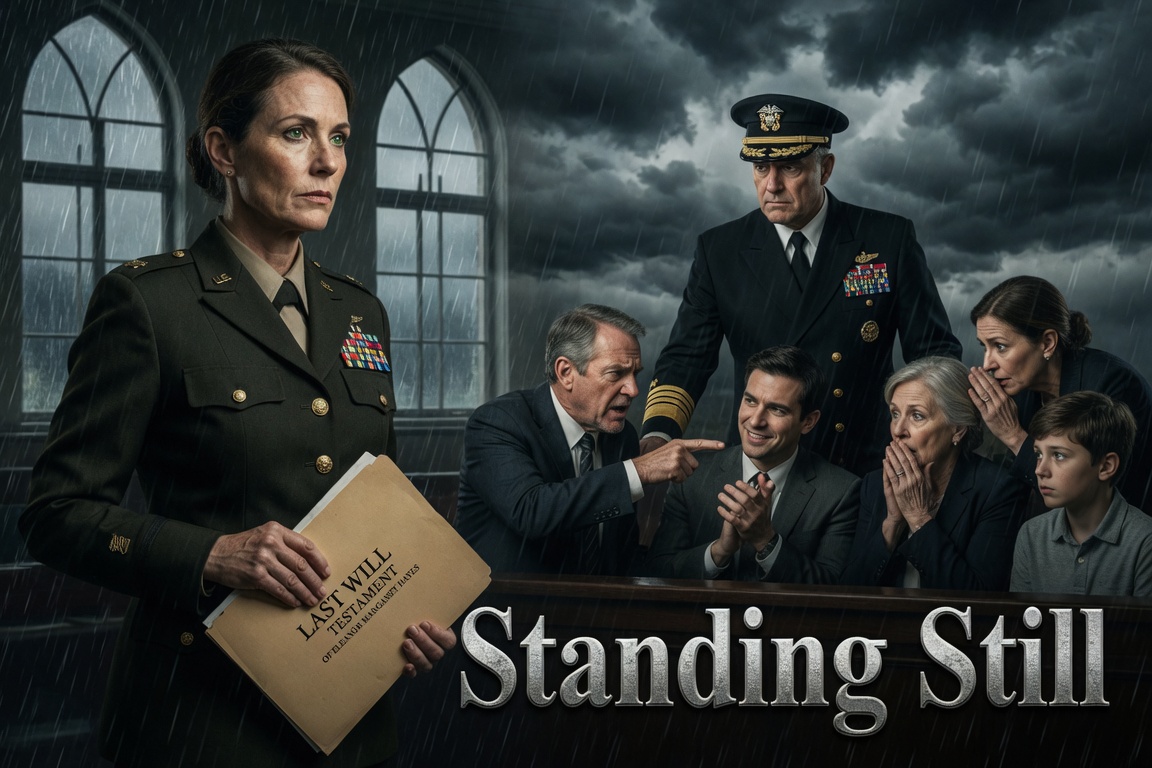
And between us, on the polished mahogany, lay my grandmother’s sealed will.
“She abandoned this family for a meaningless military career,” he continued. “And now she walks in here wearing that uniform as if it makes her honorable.”
My younger brother, Daniel, leaned back in his chair and gave three slow claps.
A few people laughed.
Not loudly.
Just enough.
My aunt Marjorie pressed her lips together and whispered, “She doesn’t deserve a single dollar.”
She intended for me to hear it.
They all did.
I looked down at the sleeve of my Navy dress uniform. The fabric was dark, nearly black in the storm light. My ribbons sat perfectly aligned above my left breast. The silver eagle on my shoulder caught the chandelier’s pulse.
No one in that room knew what any of it meant.
That had always been the arrangement.
I did not defend myself.
I did not explain why I had missed Thanksgiving two years earlier, or why my phone had been turned off for seven months, or why my grandmother had once mailed me a handwritten note that contained only one sentence:
Some duties cannot be explained to people who have never carried them.
My father mistook my silence for shame.
He always had.
He stepped closer, his face flushed beneath carefully combed silver hair.
“You know what your grandmother believed in?” he asked. “Loyalty. Family. Sacrifice.”
His finger rose toward my chest.
“And you sacrificed us.”
At the far end of the room, someone shifted in a leather chair.
The sound was small.
A shoe against hardwood.
Most of the family ignored it.
I did not.
The man seated in the shadow near the bookcase had arrived twenty minutes before me. He wore a charcoal suit, no tie, and carried himself with the stillness of someone who never needed to announce that he was dangerous.
My father had assumed he was part of the legal team.
Aunt Marjorie thought he was a banker.
Daniel had not looked at him once.
I knew exactly who he was.
Admiral Nathaniel Cross.
Commander of Naval Special Warfare Command.
One of the few people in the United States authorized to know where I had been during those seven silent months.
He watched my father point at me.
Then he stood.
The room changed before he said a word.
Some men rise from chairs.
Others alter the pressure around them.
Admiral Cross buttoned his jacket, walked into the chandelier light, and looked directly into my father’s eyes.
His face held no anger.
That made it worse.
Then he said three words.
“She saved us.”
The laughter died so quickly I could hear rainwater ticking inside the copper gutters.
My father’s finger remained suspended in the air.
Daniel stopped smiling.
The lawyer, Mr. Harlan, lowered the envelope.
No one moved.
Admiral Cross let the silence stretch until everyone in the room understood that something had already happened.
They simply did not know what.
My father recovered first.
He lowered his hand.
“I’m sorry,” he said, forcing a laugh that cracked in the middle. “And you are?”
The admiral took one more step forward.
“Nathaniel Cross.”
The name meant nothing to most of them.
It meant something to my father.
His face changed.
The blood left his cheeks so fast it looked as though someone had pulled a plug behind his eyes.
Years earlier, he had served as a civilian defense contractor. He had spent three decades building a reputation around proximity to powerful people. He collected names the way other men collected art.
He knew that one.
He knew exactly who had just stood up for me.
But Daniel still did not.
He crossed his arms.
“Saved who?”
Admiral Cross turned toward him.
“A great many people.”
His gaze moved around the table.
“Most of whom will never know her name.”
No one laughed now.
I felt every pair of eyes shift toward my uniform.
Not with respect.
Not yet.
With calculation.
My family had always understood rank in the civilian way: money, property, influence, proximity to power. They did not understand why an admiral would attend a private will reading for a thirty-eight-year-old woman they had spent years describing as a disappointment.
My father understood enough to be afraid.
He pulled out the chair beside him and sat slowly.
Mr. Harlan cleared his throat.
“Perhaps we should begin.”
But the will was no longer the only sealed thing in the room.
And everyone could feel it.
My grandmother had been dead for six days.
Eleanor Vale died at eighty-eight in an upstairs bedroom overlooking the river, with one hand resting on a wool blanket and the other wrapped around the brass compass my grandfather had carried during the Korean War.
She had built Vale Maritime Systems from a two-room machine shop into one of the most respected naval engineering firms on the East Coast.
My father, Richard Vale, had spent most of his adult life preparing to inherit it.
He had never imagined she might have prepared something else.
Mr. Harlan broke the wax seal.
The rain intensified.
“In the matter of the last will and testament of Eleanor Ruth Vale,” he began, “I ask that all present remain until the reading is complete.”
Daniel checked his watch.
Aunt Marjorie folded her hands over her purse.
My father stared at the pages as though he could force them to say what he expected.
I remained near the door.
Admiral Cross returned to his chair, but he did not sit.
He stood behind it with both hands resting on the leather back.
Mr. Harlan read the usual declarations first.
Sound mind.
No coercion.
Previous documents revoked.
Then came the personal bequests.
My grandmother left Aunt Marjorie her collection of first-edition maritime histories, which produced a visible flicker of disappointment.
She left Daniel the restored 1967 Mustang he had been asking about since college.
Daniel smiled.
My father received the Annapolis house, including its surrounding acreage, “subject to the conditions stated later in this document.”
His smile returned.
Small.
Careful.
Triumphant.
Then Mr. Harlan turned the page.
“To my granddaughter, Commander Evelyn Vale—”
The room stirred.
Daniel looked at my shoulder insignia as though seeing it for the first time.
My father’s jaw tightened.
“—I leave my personal correspondence, my late husband’s brass compass, and all controlling interest held by me in Vale Maritime Systems.”
No one reacted at first.
The sentence was too large.
It entered the room slowly, like cold water under a door.
Then my aunt gasped.
Daniel sat forward.
My father did not move at all.
Mr. Harlan continued.
“This includes fifty-one percent of voting shares, authority over all board appointments, and final approval regarding the company’s future sale, restructuring, or dissolution.”
A chair scraped backward.
My father stood so hard the table shook.
“That is not possible.”
The lawyer looked up.
“It is explicit.”
“She promised me the company.”
Mr. Harlan did not blink.
“Mrs. Vale made several revisions over the past three years.”
My father turned toward me.
For the first time that afternoon, his anger was no longer theatrical.
His eyes searched my face for evidence of conspiracy.
“You knew.”
“No,” I said.
It was the first word I had spoken since entering the room.
My voice sounded quieter than everyone expected.
That made them lean closer.
My father’s nostrils flared.
“You expect us to believe that?”
“I didn’t know.”
Daniel laughed once.
There was no humor in it now.
“This is insane. She’s never run a company.”
Admiral Cross lowered his gaze toward him.
Neither have most men who inherit one.
He did not say it.
He did not need to.
Daniel felt the thought anyway and looked away.
My father turned back to Mr. Harlan.
“She has been gone for fifteen years. She knows nothing about Vale Maritime.”
“I know your propulsion division has missed three compliance deadlines,” I said.
The room went still again.
My father stared at me.
I stepped away from the doorway.
“I know the dry dock expansion is fourteen months behind schedule. I know your new turbine housing failed stress testing twice. I know you blamed the metallurgy team in Norfolk even though the material substitution was approved in this house, during a private meeting on March third.”
The only sound was the rain.
My father’s lips parted.
Aunt Marjorie looked from him to me.
Daniel slowly lowered his arms.
I stopped at the opposite end of the table.
“And I know Grandmother found out.”
My father’s hand curled against the chair.
“You have no idea what you are talking about.”
Admiral Cross finally sat.
His expression did not change, but his eyes remained on my father.
Mr. Harlan turned another page.
“There is an additional condition.”
My father looked at the lawyer.
The words seemed to cost him effort.
“What condition?”
Mr. Harlan adjusted his glasses.
“Before Commander Vale may assume controlling authority, all beneficiaries must view a recorded statement left by Mrs. Vale.”
He nodded toward a small screen mounted between two bookcases.
My grandmother had used it for family photographs, quarterly reports, and one disastrous Christmas when Daniel insisted on showing everyone drone footage of his vacation in Cabo.
Mr. Harlan lifted a remote.
The screen flickered.
For one brief second, it reflected the room back at us: pale faces, dark windows, the sealed tension of old wood and old money.
Then my grandmother appeared.
She sat in her library wearing a navy cardigan and the pearl earrings my grandfather had given her after their fortieth anniversary.
She looked smaller than I remembered.
But her eyes had not changed.
“Richard,” she said.
My father flinched.
Not because she had named him.
Because she had begun with him.
“If you are watching this, then I am dead, and you are probably angry.”
Daniel glanced at our father.
My grandmother smiled faintly.
“You have always preferred anger to uncertainty. Anger makes you feel taller.”
No one breathed.
My father’s fingers tightened on the chair.
She continued.
“I built Vale Maritime because ships fail when small defects are ignored. Families do too.”
The recording had been made months earlier. Morning light stretched across the carpet behind her. On the table beside her rested a yellow folder stamped CONFIDENTIAL.
“I spent too many years confusing peace with silence,” she said. “I allowed Richard to believe that inheritance was entitlement. I allowed Daniel to believe charm was competence. And I allowed Evelyn to believe that distance was the only way to remain decent.”
My throat tightened.
She looked directly into the camera.
“Evelyn, that last failure is mine.”
The room blurred for half a second.
I focused on the brass handle of the fireplace poker.
Solid.
Cold-looking.
Real.
My grandmother folded her hands.
“Three years ago, I became aware of irregularities inside Vale Maritime Systems. Components approved for naval auxiliary vessels did not match the certified specifications submitted to federal inspectors.”
Aunt Marjorie turned toward my father.
He did not look at her.
“I asked Richard for an explanation,” my grandmother said. “He told me the substitutions were temporary, lawful, and necessary to preserve the company.”
My father shook his head.
“She didn’t understand the supply crisis.”
The recording continued over him.
“I wanted to believe him.”
The screen showed a woman who had negotiated union strikes, bank collapses, hostile acquisitions, and two wars’ worth of government contracts.
Yet her voice softened when she said the next words.
“He is my son.”
My father looked down.
For the first time, there was pain beneath his anger.
It did not excuse him.
But it made him human.
“I gave him six months to correct the problem,” she said. “Instead, he concealed it.”
Daniel stood.
“Dad?”
“Sit down.”
“But what is she talking about?”
“I said sit down.”
Daniel remained standing.
The old family rhythm broke in that moment.
My father had issued an order.
His son had not obeyed.
On the screen, my grandmother reached for the yellow folder.
“When I realized company records were being altered, I contacted Evelyn.”
Every face turned toward me.
My father’s chair groaned beneath his grip.
My grandmother continued.
“She did not answer as my granddaughter. She answered as a naval officer.”
My father’s voice dropped.
“What did you do?”
I looked at him.
“Exactly what she asked.”
His face hardened.
“You investigated your own family?”
“No.”
I held his gaze.
“I reported a threat to naval personnel and federal procurement integrity.”
The distinction landed harder than accusation.
My father’s mouth opened.
Closed.
On the screen, my grandmother leaned forward.
“Evelyn refused access to the investigation. She told me she could not interfere, protect us, or warn us. I accused her of choosing the Navy over her blood.”
A flicker of shame crossed her face.
It was gone almost immediately.
“I was wrong.”
Admiral Cross’s eyes shifted toward me.
He had been present the day I received my grandmother’s first message.
I had been in a secure briefing room in Virginia Beach, halfway through a presentation on maritime interdiction risks, when an aide handed me a handwritten note.
Call Eleanor Vale. Personal emergency.
I called from a private line.
She did not greet me.
She said, “I think your father is going to get sailors killed.”
I had spent my whole career preparing for sentences like that.
I had never expected one in my grandmother’s voice.
The screen cut briefly to black, then returned with a date stamped in the corner.
My grandmother’s expression was sharper in the second recording.
“Richard believes Evelyn abandoned this family,” she said. “The truth is that Evelyn protected it longer than it deserved.”
My father stepped away from the table.
“This is manipulation.”
Mr. Harlan lowered the remote.
“The recording is not finished.”
“I don’t care.”
Admiral Cross spoke from the back.
“You should.”
Two words.
Low.
Flat.
My father turned.
Something passed between them.
Not recognition this time.
Assessment.
My father had spent decades around men who borrowed authority from organizations.
The admiral did not borrow his.
He carried it.
Mr. Harlan resumed the recording.
My grandmother inhaled carefully.
“Last November, federal investigators discovered that the substituted components had not merely failed compliance. They had been deliberately sourced through an intermediary linked to a foreign intelligence network.”
The room seemed to contract.
Daniel’s face emptied.
Aunt Marjorie whispered, “Oh my God.”
My father shook his head.
“No.”
On the screen, my grandmother looked older.
“The components contained embedded vulnerabilities designed to compromise navigation and communication systems during deployment.”
“No,” my father repeated.
This time the word was smaller.
I watched the moment denial stopped being defense and became fear.
My grandmother continued.
“Richard did not know the intermediary’s true affiliation.”
He froze.
“He did, however, know the supplier was unauthorized. He accepted falsified certifications because the cost savings kept the company solvent and preserved a pending acquisition.”
My father struck the table with his palm.
“We would have gone under!”
The sound cracked through the room.
Daniel flinched.
My father turned in a circle, searching for someone who understood.
“Do you hear me? Payroll was collapsing. The bank was ready to call the line. Twelve hundred people would have lost their jobs.”
His eyes found mine.
“You think decisions come clean? You think leadership is some parade-ground fantasy where everyone follows the manual and goes home with polished medals?”
His voice shook now.
Not with rage.
With the terror of a man forced to look at the bridge he had burned while still standing on it.
“I saved that company.”
I looked at him across the table.
“You saved its name.”
His jaw flexed.
“You risked the people inside it.”
He pointed toward the screen.
“She knew what was at stake.”
“Yes.”
“And she still chose you.”
“No.”
I glanced at my grandmother’s frozen image.
“She chose accountability.”
My father laughed, but his eyes were wet.
“Easy word for the child who left.”
There it was.
The old wound.
Not the company.
Not the Navy.
Not the will.
The morning I left Annapolis at twenty-two, my father had stood on the porch with both hands in his pockets.
He had not hugged me.
He had said, “You’ll be back when you get tired of taking orders.”
I had waited fifteen years for him to ask why I never came home.
He never had.
Instead, he turned my absence into betrayal because betrayal hurt less than rejection.
I knew that now.
I had not known it then.
The recording resumed.
“If Richard is wondering why Evelyn never warned him,” my grandmother said, “it is because she could not.”
Admiral Cross moved away from his chair.
My father noticed.
His breathing changed.
“Commander Vale was reassigned under classified orders,” my grandmother continued. “For seven months, she worked with a joint task force to identify how deeply the compromised supply chain had penetrated naval systems.”
Daniel looked at me.
“You were investigating Dad?”
“No,” I said. “I was hunting the network behind the supplier.”
Admiral Cross stepped into the center of the room.
This time, everyone watched him.
“The organization used legitimate American manufacturers as cover,” he said. “Some executives were bribed. Some were blackmailed. Most never knew they had been compromised.”
My father sank into his chair.
The admiral’s voice remained calm.
“The vulnerability discovered in Vale components appeared in seventeen additional contractors across four states. It had reached two destroyers, a submarine support platform, and a communications relay scheduled for deployment.”
Aunt Marjorie covered her mouth.
Daniel looked at the medals above my chest again.
“What did she do?”
The admiral studied him for a moment.
Then he looked toward me.
I wished he would say nothing.
Not because I was ashamed.
Because some memories become bearable only when kept inside rooms without windows.
But he had not come for my comfort.
He had come because my grandmother had asked for the truth.
“Commander Vale led the recovery operation.”
My father stared at me.
The admiral continued.
“She identified the maritime transfer route, coordinated the seizure of three shipments, and exposed the internal access point that allowed the network to alter certification data.”
The storm pressed hard against the windows.
Somewhere upstairs, an old pipe knocked in the wall.
“During the final operation,” he said, “her team boarded a cargo vessel in the North Atlantic under severe weather conditions.”
I could smell diesel again.
Salt.
Hot wiring.
Blood in cold air.
I could hear Lieutenant Harris shouting through the corridor as emergency lights pulsed red.
My hand drifted toward the pale scar beneath my right cuff.
I stopped it before anyone noticed.
“The vessel crew attempted to scuttle the ship,” Admiral Cross said. “Commander Vale remained below deck to recover the encryption system and release two trapped sailors.”
Daniel whispered, “Jesus.”
The admiral did not look at him.
“The intelligence recovered that night allowed us to neutralize the network before compromised systems entered active combat service.”
He turned toward my father.
“So when I said she saved us, I was not speaking figuratively.”
No one moved.
My father looked at me as though a stranger had taken my face.
His eyes traveled from my ribbons to the scar near my wrist, then back to my face.
“You never said anything.”
“I wasn’t allowed.”
“To me.”
The words came out rough.
“You never said anything to me.”
I held his gaze.
“You had already decided what my silence meant.”
That struck him harder than the admiral’s revelation.
His shoulders lowered.
Only an inch.
But I saw it.
My father had always stood as though the room owed him space.
Now the room seemed too large for him.
Mr. Harlan cleared his throat.
“There is more.”
Daniel let out a disbelieving breath.
“More?”
The lawyer turned the page.
My grandmother reappeared on the screen.
Her face had softened.
“Evelyn never told me what happened during that operation,” she said. “Admiral Cross did, after I asked why she returned home with a scar she refused to explain.”
Every eye dropped toward my cuff.
I kept my hands at my sides.
“She protected this country,” my grandmother said. “Then she protected this family from the full consequence of Richard’s choices.”
My father looked up sharply.
Admiral Cross’s expression tightened.
That part had not been in the briefing.
My grandmother lifted a document toward the camera.
“When investigators prepared charges, Evelyn submitted evidence that Richard had not knowingly collaborated with a foreign agent. She separated criminal recklessness from treason.”
My father’s face collapsed.
Not dramatically.
No gasp.
No cry.
His mouth simply lost its shape.
He stared at me.
“You did that?”
I did not answer.
He pushed back from the table and stood.
The chair tipped behind him and struck the floor.
No one bent to pick it up.
“You did that?” he repeated.
“Yes.”
His throat moved.
“Why?”
The question had taken fifteen years to reach me.
It arrived wearing the wrong clothes, but it was finally the right question.
I looked at the man who had called me a traitor in front of our entire family.
The man who had turned my career into a punch line because he could not bear that I had built a life beyond his control.
The man whose decisions had nearly killed strangers and destroyed everything my grandmother built.
And still, beneath all of it, I saw the father who once sat beside my hospital bed for three nights when I had pneumonia at nine years old.
The father who taught me how to read tide charts.
The father who had once lifted me onto his shoulders to watch the Blue Angels cut across the Annapolis sky.
People are rarely one thing.
That is what makes loving them dangerous.
“Because you were guilty of cutting corners,” I said. “You were guilty of lying. You were guilty of putting pride above safety.”
His face tightened with each word.
“But you were not a traitor.”
The word hung between us.
The same one he had thrown at me.
Now returned.
Cleanly.
Without cruelty.
My father looked down.
His hand found the edge of the table as though the floor had shifted.
No one came to support him.
Not Daniel.
Not Marjorie.
Not me.
Some moments must be survived standing alone.
Mr. Harlan waited until the silence settled.
Then he read the final condition.
“Mrs. Vale directs that controlling interest be transferred immediately to Commander Evelyn Vale. However, Richard Vale may remain with the company in an advisory capacity if, and only if, Commander Vale determines that his cooperation serves the employees and national interest.”
My father’s head lifted.
The balance of power changed so completely that everyone felt it.
For years, I had been the daughter who left.
The granddaughter who missed holidays.
The sister who did not explain herself.
Now my father’s future depended on the woman he had humiliated less than an hour earlier.
Daniel looked between us.
Aunt Marjorie sat perfectly still.
Outside, thunder rolled over the bay.
My father straightened his jacket.
Habit.
Instinct.
A final attempt to gather the pieces of himself into the shape everyone recognized.
“Well,” he said.
His voice was hoarse.
“I suppose this is the part where you enjoy it.”
I studied him.
“Enjoy what?”
“This.”
He gestured around the room.
“The victory. The humiliation.”
Daniel looked away.
My father noticed.
That hurt him more than anything else.
He gave a short, bitter laugh.
“You waited a long time.”
“No.”
I stepped closer.
“I stopped waiting years ago.”
His eyes met mine.
There was no triumph in my voice.
That unsettled him.
Cruelty would have given him something to fight.
Calm left him nowhere to hide.
“I don’t want the company to punish you,” I said. “And I won’t use twelve hundred employees to settle a family debt.”
His jaw tightened.
“But you will not remain chief executive.”
The room absorbed the sentence.
My father’s face went rigid.
Daniel whispered, “Evelyn…”
I raised one hand.
He stopped.
My father stared at me.
“You can’t remove me.”
“I can.”
“You know nothing about running Vale.”
“I know enough to appoint people who do.”
His nostrils flared.
“You think an admiral can walk into my mother’s house, praise your medals, and make you a businesswoman?”
Admiral Cross’s expression did not change.
I moved one step closer to my father.
“No.”
I kept my voice low.
“Your decisions made me controlling owner. Grandmother’s will made it legal. Your behavior today made it necessary.”
A pulse jumped in his temple.
For a moment, I thought he would shout again.
Instead, his gaze moved around the room.
He saw Marjorie’s disappointment.
Daniel’s confusion.
The lawyer’s composure.
The admiral’s silence.
And finally, me.
That was the moment he understood.
Not when Admiral Cross said I had saved lives.
Not when the will gave me the company.
Not when the recording exposed his decisions.
He understood when he realized I did not need to destroy him.
I had the authority to do it.
And chose restraint.
His face went white.
His shoulders folded inward.
The room stopped breathing.
My father lowered himself into the nearest chair.
Not the one at the head of the table.
A chair along the side.
For the first time in my life, he sat where someone else had placed him.
Mr. Harlan gathered the pages.
“The board has been notified of the transfer. An emergency meeting is scheduled for tomorrow morning.”
Daniel looked at me.
“You’re really taking over?”
“For now.”
“What happens to Dad?”
I turned toward him.
“He cooperates with investigators. He turns over every record. He answers every question. He helps repair what he damaged.”
My father did not look up.
“And after that?” Daniel asked.
“That depends on what he does when no one is applauding.”
The words struck Daniel too.
His face tightened.
He remembered the clapping.
So did everyone else.
Aunt Marjorie rose from her chair.
“Evelyn, I had no idea.”
I looked at her.
She stopped.
There are apologies that seek forgiveness.
And apologies that seek escape.
Hers had not yet decided which it was.
“You said I didn’t deserve a single dollar,” I said.
Color climbed into her cheeks.
“I was upset.”
“You were comfortable.”
She lowered her eyes.
I let the silence do the rest.
Daniel stood slowly.
He looked younger than thirty-four.
For most of his life, he had followed our father’s emotional weather. If Richard praised someone, Daniel admired them. If Richard mocked them, Daniel laughed. It was easier than forming his own judgment.
He shoved his hands into his pockets.
“I shouldn’t have clapped.”
“No.”
“I thought…”
He stopped.
The sentence had nowhere honorable to go.
I waited.
His eyes glistened.
“I thought you looked down on us.”
I glanced toward the windows.
Rain streamed down the glass, warping the masts in the marina beyond.
“I stayed away because every time I came home, I had to become smaller to fit inside this family.”
Daniel’s face tightened.
“I didn’t know.”
“You didn’t ask.”
He nodded once.
It was not redemption.
But it was the first honest thing he had done all afternoon.
Admiral Cross checked his watch.
“I should leave.”
My father looked up.
The admiral walked toward him.
No one knew what he was going to say.
He stopped beside the chair.
“Mr. Vale.”
My father’s eyes lifted.
“You made serious decisions under financial pressure. That does not make you unique.”
A flicker of relief crossed my father’s face.
The admiral continued.
“Blaming your daughter for having the courage to face what you avoided does.”
The relief vanished.
Admiral Cross buttoned his coat.
“You are alive, free, and sitting in your mother’s home because Commander Vale understood the difference between justice and vengeance.”
He glanced toward me.
“Do not force her to teach it twice.”
Then he left.
The front door opened.
Wind rushed through the hall, carrying the smell of wet brick and cold river air.
A moment later, the door closed.
No one spoke.
The house felt different without him.
Larger.
More exposed.
My father stared at the empty doorway.
Then he looked at me.
“What was it like?”
I knew what he meant.
The ship.
The storm.
The seven months.
The part of my life he had mocked because he had never seen it.
I could have told him about the waves striking the hull like trucks.
About crawling through black water below deck while the vessel listed twelve degrees.
About Harris screaming that the bulkhead was closing.
About the trapped sailor whose hand I held through a gap in twisted steel.
About the moment I thought I would die beneath forty feet of freezing ocean while my father believed I was missing Thanksgiving because work mattered more than family.
Instead, I said, “It was my job.”
My father closed his eyes.
A tear slid down the side of his nose.
He wiped it away before it reached his mouth.
“I called it meaningless.”
“Yes.”
“I called you a traitor.”
“Yes.”
His fingers trembled against his knee.
“I was angry that you left.”
“I know.”
“I thought you were punishing me.”
“I was surviving you.”
His eyes opened.
The words landed without force.
That made them impossible to reject.
Behind him, my grandmother remained frozen on the screen, hands folded, eyes steady.
My father followed my gaze.
“She always chose you,” he said.
“No.”
I walked to the table and picked up the brass compass Mr. Harlan had placed beside the documents.
Its lid was scratched. The hinge had been repaired twice. My grandfather’s initials were engraved on the back.
“She chose the person she believed would protect what mattered.”
My father looked toward the rain-dark windows.
“And you think that’s you?”
I opened the compass.
The needle trembled.
Then settled north.
“I think I’m responsible for proving it.”
The emergency board meeting began at eight the next morning.
By seven forty-five, protesters had gathered outside Vale Maritime’s main gate.
The federal investigation had not yet been made public, but rumors moved faster than legal filings. Employees stood in clusters beneath umbrellas. News vans lined the road. Security officers checked credentials twice.
The headquarters building rose beside the shipyard, all glass and steel, reflecting a pale strip of dawn above the river.
Inside the lobby, every conversation stopped when I entered.
I wore a dark civilian suit.
No ribbons.
No insignia.
No uniform to point at.
My father arrived six minutes later.
He had not slept.
That was obvious from the grayness beneath his eyes and the slight drag in his left foot. For thirty years, employees had stepped aside when he crossed that lobby.
They did so again.
But differently.
Not from confidence.
From uncertainty.
Daniel followed him, carrying two archive boxes.
My father stopped at the security desk.
The guard, a former Marine named Ellis, looked at me.
Not him.
“Ma’am?”
My father noticed.
A tiny movement in his jaw.
I nodded.
“Mr. Vale is authorized for the board floor.”
Ellis printed him a temporary badge.
VISITOR.
The word appeared in red beneath my father’s name.
He stared at it for several seconds.
Then clipped it to his jacket.
That was the second moment of recognition.
Quieter than the first.
More painful.
The company he believed belonged to him had just asked permission to let him upstairs.
The boardroom overlooked the dry docks.
Cranes moved beyond the glass. Welding sparks flashed along the skeleton of a vessel under construction. The low thunder of machinery traveled through the floor.
Twelve directors waited around the table.
Some had known me as a child.
Some had never met me.
All had received the preliminary findings at dawn.
I took the chair at the head.
My father sat three places down.
No one commented.
The meeting lasted four hours.
There were resignations.
There were denials.
There were lawyers who used phrases like exposure containment and reputational continuity.
I ended the first presentation after a consultant referred to the compromised components as “an optics challenge.”
“People could have died,” I said.
The room went silent.
“Do not call it optics again.”
He did not.
We suspended three executives.
We established an independent safety review.
We froze the acquisition.
We authorized full cooperation with federal investigators and created a protected channel for employee disclosures.
Then came my father’s position.
One director recommended immediate termination.
Another wanted to retain him quietly for six months to reassure clients.
My father sat with both hands folded.
He did not argue.
That frightened everyone more than his anger would have.
I looked at him.
“You will remain as an unpaid technical adviser for ninety days.”
Several directors shifted.
My father raised his eyes.
“You will have no authority over procurement, personnel, contracts, or communications. Your sole responsibility will be to help investigators trace every decision connected to the unauthorized supplier.”
He gave one slow nod.
“At the end of ninety days,” I continued, “your access ends.”
He absorbed the finality.
“And my shares?”
“Placed in a restitution trust for affected employees if civil penalties threaten pensions or payroll.”
His face tightened.
The old Richard surfaced.
“You cannot take everything.”
I leaned forward.
“I am trying to keep your decisions from taking everything from them.”
Beyond the glass, a crane lifted a steel section into the morning sky.
My father followed it with his eyes.
For years, he had believed the company existed because he carried it.
Now he saw hundreds of workers below—welders, engineers, machinists, electricians—moving with or without him.
His voice lowered.
“What happens to the Vale name?”
I looked around the boardroom.
“That depends on what we do next.”
He nodded.
This time without resistance.
Three weeks later, federal agents cleared my father of espionage but charged him with procurement fraud, falsification of compliance records, and obstruction.
He accepted a plea agreement.
Eighteen months of home confinement.
Five years barred from government contracting.
Full financial restitution.
Daniel attended every hearing.
Aunt Marjorie attended none.
Vale Maritime survived.
Barely.
We lost two contracts and gained something more valuable: the chance to rebuild without pretending nothing had happened.
The company established an independent ethics office led by a former inspector general. Every component used in naval systems underwent third-party verification. Employees who had been threatened into silence received legal protection and back pay.
The first person to use the new reporting system was a twenty-six-year-old quality engineer named Priya Shah.
She flagged a pressure seal that had passed inspection but failed under repeated thermal cycling.
The old company might have buried it to protect a deadline.
We stopped production for eleven days.
It cost us six million dollars.
No one was punished for telling the truth.
Six months after the will reading, I returned to my grandmother’s house.
Winter had stripped the trees along the water. Ice edged the stone steps leading toward the dock. The air smelled of wood smoke and salt.
My father sat alone in the dining room.
The same room.
The same chandelier.
The same table.
But he was no longer at its head.
He sat near the window with a stack of handwritten letters before him.
One for every senior employee whose warnings he had ignored.
He had written forty-three.
He was on number forty-four.
His hair had thinned.
His face looked older without anger holding it together.
I set my coat over a chair.
He looked at the brass compass in my hand.
“You kept it.”
“Yes.”
He nodded toward the seat across from him.
I sat.
For a while, neither of us spoke.
Outside, rigging clinked against sailboat masts in the cold wind.
He placed his pen down.
“I used to think respect was something people owed the person in charge.”
I waited.
He looked at the letters.
“Your grandmother tried to tell me it was something people gave when they felt safe.”
His mouth tightened.
“I thought safety made people soft.”
A humorless smile touched his face.
“Turns out fear makes them quiet. Quiet looks a lot like loyalty until the walls come down.”
The sentence sounded like something my grandmother might have said.
Perhaps that was why it hurt.
My father folded his hands.
“I don’t expect forgiveness.”
“Good.”
He nodded.
“I hoped for it.”
“That’s different.”
He looked toward me.
For once, he did not rush to fill the silence.
“I was proud of you,” he said.
My shoulders stiffened.
He noticed.
“Not after the admiral spoke. Before that.”
I said nothing.
“The day you were commissioned, I sat in the back.”
I remembered scanning the crowd.
My grandmother had been there.
Daniel had been there.
My father had told me he had a business emergency.
“You left before the ceremony ended,” I said.
“Yes.”
“Why?”
His eyes dropped.
“Because you looked happy.”
The answer struck somewhere I had not armored.
He continued.
“You stood there in that white uniform, and everyone around you understood something about you that I didn’t.”
His fingers closed around the pen.
“I realized you had found a place where my opinion wasn’t the largest thing in the room.”
The old chandelier hummed.
“And I hated it.”
Honesty can sound uglier than cruelty.
But it can also be the first clean thing after years of rot.
My father pushed one of the letters toward me.
It was addressed to Lieutenant Commander Evelyn Vale.
“I wrote one to you.”
I did not take it.
“You can say it.”
His throat moved.
He looked at my face.
Not my rank.
Not my uniform.
Me.
“I was wrong.”
The words were quiet.
No admiral in the room.
No lawyer.
No audience.
No inheritance at stake.
“I called your service meaningless because it proved your life had meaning without me.”
His eyes reddened.
“I called you disloyal because I could not admit that I had made home a place you needed to escape.”
His voice broke.
“I called you a traitor while you were the only person in this family still trying to save me.”
The room blurred.
I pressed my thumb against the edge of the brass compass until the metal hurt.
My father looked down.
“I am sorry, Evelyn.”
There are apologies that erase nothing.
There are apologies that repair everything.
Most live somewhere in between.
I reached for the letter.
Not because the past had changed.
Because he finally had.
A year later, Vale Maritime launched its first fully redesigned naval support vessel under the new compliance program.
Employees and their families gathered along the dry dock beneath a bright October sky. Children sat on their parents’ shoulders. Flags snapped in the wind. The hull towered above us, dark blue and newly painted.
Admiral Cross stood near the platform.
Daniel was beside him.
My brother had returned to school for engineering management and now worked in quality control under a supervisor who had strict instructions not to treat him like family.
Aunt Marjorie sent flowers.
They remained unopened in the reception office.
My father attended without a title.
He stood among the retired machinists near the back.
No reserved seat.
No special introduction.
When the applause began, he did not step forward.
He simply watched.
The master of ceremonies handed me the microphone.
I looked across the crowd.
At the welders who had rebuilt defective sections.
At the engineers who had redesigned vulnerable systems.
At Priya Shah, standing beside her mother.
At Daniel.
At Admiral Cross.
At my father.
The wind carried the smell of steel, river water, and fresh paint.
“This ship does not represent a perfect company,” I said.
The crowd quieted.
“It represents a corrected one.”
My father lowered his eyes.
“We used to believe strength meant never admitting weakness. We were wrong. Strength is finding the defect before it becomes a disaster. It is listening to the person others ignore. It is choosing truth while there is still time to repair the damage.”
The vessel’s hull gleamed behind me.
“No uniform, title, family name, or executive office makes a person honorable. Honor begins when we do the right thing after it becomes expensive.”
I stepped away from the microphone.
The applause came slowly.
Then all at once.
I saw my father clap.
Not the mocking three beats Daniel had given me at the will reading.
Not the polished applause of a man protecting his image.
His hands came together with tears on his face, surrounded by people who no longer feared him and did not yet fully forgive him.
For the first time, he was not asking to be admired.
He was learning how to witness someone else’s worth.
Admiral Cross leaned toward Daniel and said something I could not hear.
Daniel smiled.
The ship’s horn sounded across the river.
Deep.
Shaking the platform beneath our feet.
I opened my grandfather’s compass in my palm.
The needle trembled in the vibration.
Then it found north.
It always did.
Not because the world stopped moving.
Not because the storm passed.
But because, no matter how violently it was shaken, it remembered what it was built to follow.
And sometimes the person a family calls a traitor is simply the first one brave enough to stop following them in the wrong direction.