“You should watch your brother,” Dad said loudly. “That’s what a real marksman looks like.”
His voice carried across the firing range with the clean force of a command.
Twenty-four recruits turned toward Daniel.
A few nodded. Most smiled.
Then they looked at me.
I stood ten yards behind the firing line with an old bolt-action rifle resting against my shoulder, its walnut stock scarred pale from decades of use. No custom scope. No bipod. No spotter waiting beside me with a range card and binoculars.
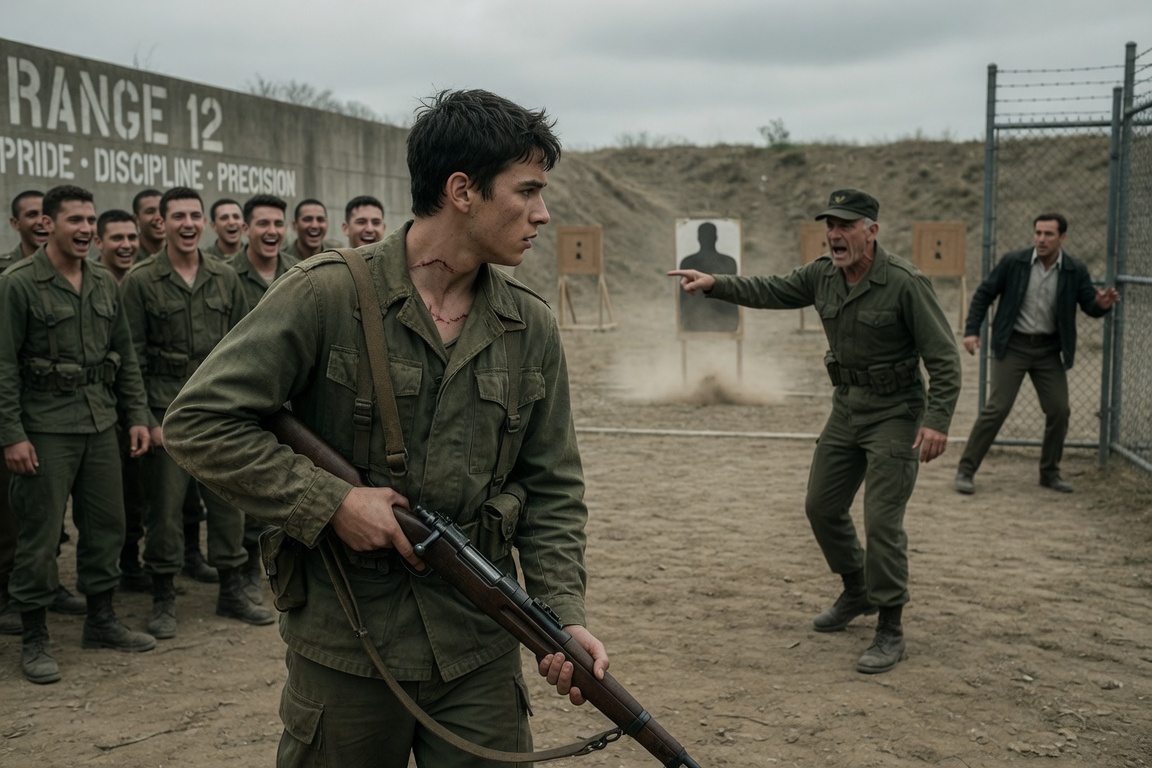
Just a leather sling, five cartridges, and a weapon everyone at Fort Carden believed belonged in a museum.
The first laugh came from somewhere near the ammunition table.
Another followed.
Within seconds, the sound moved through the recruits like wind through dry grass.
My father did not stop them.
Brigadier General Thomas Mercer stood beneath the shade canopy in pressed fatigues, silver hair cut close, posture straight despite the arthritis that had begun to stiffen his left knee. At sixty-three, he still had the kind of presence that made younger officers lower their voices when he entered a room.
He looked at Daniel with pride.
Then he looked at me with the careful, public disappointment he had perfected over fifteen years.
“You don’t have to do this, Claire,” he said.
He used the tone people reserved for frightened children and unstable dogs.
Daniel removed his hearing protection and stepped away from the bench. At thirty-four, he was broad-shouldered, handsome, and polished in the effortless way of someone who had always been told the room was waiting for him. His rifle cost more than my first car. The optic mounted above it had enough electronics to calculate distance, angle, atmospheric pressure, and probably the shooter’s self-esteem.
He had just put five rounds inside a four-inch group at six hundred yards.
It was excellent shooting.
The recruits knew it.
My father knew it.
Daniel knew it most of all.
He gave me a sympathetic smile.
“Claire, seriously,” he said. “That thing hasn’t been properly serviced in years.”
“It has.”
“You checked it?”
“I rebuilt it.”
That earned another round of laughter.
Daniel glanced toward the range commander, Lieutenant Colonel Evan Rourke, as if apologizing for me.
Rourke stood near the observation tower, one hand hooked beneath his tactical vest. He was fifty-one, lean and sharp-featured, with gray threaded through his black hair. His expression had not changed since I arrived.
But his eyes had.
The moment he saw the rifle, his attention had left my face and settled on the stock.
There was a shallow crescent cut beneath the bolt handle.
Most people would have mistaken it for damage.
Rourke did not.
His right hand tightened around the edge of his vest.
Then he looked away.
That was when I knew coming here had not been a mistake.
The Nevada sun pressed down with a white, merciless heat. Beyond the firing line, the desert rolled toward low brown mountains, every rock trembling in the distance. Brass casings glowed against the packed dirt. The air smelled of dust, hot metal, sunscreen, and burned propellant.
A red flag snapped above the tower.
No wind at ground level.
Different story past four hundred yards.
The heat mirage bent the horizon.
I slipped on my hearing protection.
“Five rounds?” I asked.
The range safety officer looked toward Rourke.
Rourke hesitated.
My father’s mouth hardened. “Claire, this is a qualification demonstration, not a family argument.”
“No,” I said. “It stopped being a family argument a long time ago.”
Daniel’s smile disappeared.
My father’s face went still.
For one second, nobody moved.
Then Rourke raised his chin.
“Five rounds,” he said. “Standard targets. Three hundred through seven hundred yards.”
“Make the last one nine hundred.”
A recruit near the back actually laughed out loud.
Rourke did not.
“Nine hundred isn’t part of today’s course.”
“Neither am I.”
He studied me.
A hawk circled above the range, its shadow sliding over the dirt between us.
Finally, Rourke spoke into his radio.
“Add Target Seven.”
The range crew moved.
A steel silhouette rose near the base of the far ridge, so distant it looked no larger than a thumb pressed against the horizon.
Daniel stepped closer to me.
His voice dropped.
“What are you doing?”
I opened the rifle’s bolt and checked the chamber.
“Finding out who remembers.”
His eyes narrowed. “Remembers what?”
I loaded the first cartridge.
Across the range, Colonel Rourke began walking toward the exit.
Not quickly.
Not yet.
But he had already decided to leave before I fired.
I settled behind the rifle.
And beneath the collar of my shirt, the old scar along my left shoulder began to burn.
Chapter One
The first target stood at three hundred yards.
A generous distance.
A warm-up.
I lay flat against the shooting mat and pressed my cheek to the weathered stock. The wood smelled faintly of linseed oil and rain, though it had not seen rain in years.
My grandfather had carried the rifle before I was born.
My father had taught Daniel to shoot with it.
He had refused to teach me.
“Your hands are too small,” he told me when I was twelve.
At fourteen, he said I lacked patience.
At seventeen, he said I was too emotional.
At twenty-nine, after I returned home with a scar beneath my collar and no official explanation for three missing years, he stopped asking what I had become.
I breathed in.
The world narrowed.
Steel.
Dust.
Heat.
The tiny twitch of the range flag.
A shimmer above the ground.
The pressure of the trigger against the center pad of my finger.
I fired.
The rifle kicked into my shoulder with an old, familiar authority.
Half a second later, the target dropped.
The laughter thinned.
I worked the bolt.
The second target was four hundred and fifty yards out, partially concealed behind a low dirt berm. Only the upper half of the steel silhouette showed.
The recruits leaned forward.
Daniel folded his arms.
My father watched without blinking.
I fired.
The target snapped backward.
Someone near the ammunition table whispered, “Damn.”
The third target stood at six hundred yards.
A crosswind moved through the middle distance, invisible except for a slight shift in the mirage and the restless flick of pale grass near the berm.
I adjusted nothing.
The old rifle had no dialable turret. No digital correction. No illuminated reticle.
Only iron, glass, wood, and memory.
I held left.
Fired.
The steel rang.
This time, no one laughed.
The sound traveled back from the ridge, thin and delayed, like a bell heard across water.
Daniel’s arms lowered.
My father glanced toward the observation tower, where two senior officers had stepped out onto the platform.
At the far edge of the range, Rourke had stopped walking.
He stood with his back to us.
The fourth target rose at seven hundred yards.
Smaller plate.
Oblique angle.
I felt sweat slide between my shoulder blades.
Not nerves.
Heat.
The rifle’s barrel had warmed. The old stock pressed against the scar hidden under my collar.
My left hand trembled once.
A memory opened before I could close it.
A concrete room beneath a foreign airfield.
A bare bulb swaying overhead.
A man bleeding through his uniform while I tried to keep pressure on the wound.
A radio hissing with a voice that kept repeating, “Hold position. Extraction denied.”
Then another voice.
American.
Calm.
Familiar.
“Burn the route. No witnesses.”
I blinked.
The range returned.
The target waited.
I forced my breathing down.
One count in.
Two counts out.
I fired.
The fourth target fell.
The recruits were silent now.
The range safety officer stared at me, then at the rifle, as if trying to decide whether one of them was counterfeit.
Daniel walked closer.
“Who trained you?”
I did not answer.
My father stepped out from beneath the canopy. “Claire.”
There was no condescension in his voice anymore.
Only warning.
I opened the bolt and chambered the final round.
Nine hundred yards.
The target stood against the dark base of the ridge, nearly swallowed by distortion. The angle was wrong. The sun was behind it. Wind slid differently across three separate bands of desert.
No spotter could give me a clean call.
That was the point.
A murmur passed through the officers on the tower.
Someone had brought binoculars.
Someone else was speaking into a phone.
Rourke turned around.
Even from that distance, I could see the change in him.
His face had lost color.
He knew the rifle.
More importantly, he knew what it meant that I was holding it.
I settled behind the stock.
Nine hundred yards was not an impossible shot.
People liked to call difficult things impossible because it protected them from having to recognize skill in someone they had already dismissed.
I studied the mirage.
The air nearest the firing line drifted right.
At five hundred yards, it flattened.
Near the ridge, dust curled left around a rock face.
Three winds.
One bullet.
I lowered my eye from the scope.
My father stood beyond the rifle barrel.
For years, I had imagined this moment differently.
I thought I would want him ashamed.
I thought I would want Daniel humiliated.
I thought the recruits’ silence would feel like justice.
It did not.
Justice had never been the shot.
The shot was only the knock on the door.
I returned to the scope.
Held high.
Held right.
Waited.
The red range flag sagged.
The grass near the berm paused.
A breath of stillness crossed the desert.
I fired.
The rifle slammed into my shoulder.
The bullet vanished into heat.
One second.
Two.
Nothing.
A few recruits shifted.
Daniel exhaled.
Then the last target dropped.
Every officer on the observation platform stood.
The recruits turned toward me as one body.
My father’s mouth opened, but no sound came out.
I was not watching any of them.
I was watching Colonel Rourke.
He stepped backward.
Then he turned and moved fast toward the exit.
I rose, cycled the empty bolt, and shouted the words I had waited eleven years to say.
“Evan Rourke!”
He froze.
The name cracked across the range louder than the rifle.
Several heads turned.
Rourke looked over his shoulder.
I reached beneath my shirt collar and pulled out a thin black chain. A scorched metal tag hung from it, warped by heat. Three letters were still visible beneath the soot.
VLR.
Rourke stared at the tag.
His lips parted.
For the first time since I had known his face, he looked afraid.
“Ask him,” I said, looking at my father, “why he told the Pentagon that everyone on Valor Route died.”
Chapter Two
No one spoke for several seconds.
The desert seemed to absorb everything—the gunfire, the heat, the sudden pressure of two dozen people realizing they had stepped into a story that had begun long before they arrived.
My father recovered first.
He always did.
“Clear the range,” he ordered.
The recruits looked at one another.
“Now.”
The range safety officer began moving them toward the transport trucks. Most obeyed, though slowly. They kept glancing back at me, at Rourke, at the blackened tag hanging against my shirt.
Daniel remained where he was.
“So this is what?” he asked. “Some classified operation?”
My father turned on him. “Leave.”
Daniel flinched.
Dad had never spoken to him that way.
“Sir—”
“That is an order.”
Daniel’s jaw tightened. His eyes moved to me, searching my face for help or explanation.
I gave him neither.
He walked away.
Rourke did not.
Two military police officers had appeared near the range entrance. They had not been there a minute earlier.
I recognized one of them, Captain Lena Ortiz, head of installation investigations. Forty-two, close-cropped hair, expression like locked steel. She had interviewed me in a windowless office three days earlier and pretended not to believe a word I said.
Now she approached with her right hand near her holster.
“Colonel,” she said to Rourke. “I need you to remain on the range.”
His smile came back too quickly.
“Captain, I’m due at headquarters.”
“No, sir. You’re not.”
My father looked at her. “What is this?”
Ortiz stopped beside me.
“This is an active investigation, General.”
“Into one of my officers?”
“Into several.”
Something shifted behind my father’s eyes.
Not surprise.
Calculation.
He looked at me.
“You brought investigators onto my range.”
“No,” I said. “You brought them here eleven years ago. They just took a long time to arrive.”
His face hardened. “You will explain yourself.”
“I tried.”
“When?”
“The night I came home.”
The words landed harder than I expected.
My father’s shoulders drew back.
The Nevada heat, the uniforms, the armed police—all of it disappeared for a heartbeat.
I saw our kitchen in Virginia.
Rain against the windows.
My mother’s empty chair six months after the funeral.
Daniel asleep upstairs.
I had stood under the yellow light wearing clothes borrowed from a nurse at Landstuhl. My left arm was in a sling. My face was twenty pounds thinner. There were burn marks along my neck and dried blood under my nails that did not belong to me.
Dad had opened the door and stared as if a dead woman had come home.
I told him there had been a mission.
I told him our extraction had been canceled.
I told him an American officer had given the order to erase us.
He listened until I said the name.
Evan Rourke.
Then he shut the door behind me and spoke in a whisper.
“You need to be very careful.”
Not, Are you hurt?
Not, Who did this?
Not, I believe you.
Be careful.
The next morning, two men from Washington arrived.
By sunset, every piece of evidence I carried had vanished.
The official record said I had spent three years as a civilian logistics contractor in Germany.
My father said it was safer that way.
I had not called him Dad since.
On the range, he looked older than he had five minutes earlier.
“I protected you,” he said.
Rourke gave a quiet laugh.
Every face turned toward him.
It was not a confident sound. It was dry and brittle.
“You protected the institution,” I said.
My father’s eyes flashed. “Sometimes they are the same thing.”
“No. That’s what men inside institutions tell themselves when they decide people are expendable.”
Captain Ortiz lifted a hand. “We need to move this conversation indoors.”
Rourke’s posture changed.
It was subtle.
His left foot shifted half a step backward. His shoulders angled toward the gate. His hand drifted near his radio.
I saw it.
Ortiz saw it.
My father did not.
“Colonel,” Ortiz said. “Keep your hands visible.”
Rourke smiled at her.
“You think she’s a witness?”
“She is a witness.”
“No,” he said. “She’s a casualty with survivor’s guilt and a talent for theater.”
My fingers closed around the metal tag.
Rourke looked at me.
His expression softened into something almost paternal.
That made it worse.
“Claire,” he said, “you were under enormous stress. You were injured. You lost people. Memory changes when the mind is trying to survive.”
I took one step toward him.
“You were on the command channel.”
“So were dozens of officers.”
“You used the phrase ‘burn the route.’”
His eyelid twitched.
Captain Ortiz noticed.
“What route?” she asked.
Rourke ignored her.
My father moved between us.
“Enough.”
I looked at him. “You know what Valor Route was.”
His silence answered for him.
Daniel had stopped near the transport trucks.
He was still close enough to hear.
His face changed.
Not shock.
Recognition.
“Valor,” he said.
My father closed his eyes for half a second.
Daniel walked back toward us.
“Dad,” he said, “your old commendation. The one in the study. Operation Valor.”
“Leave this alone.”
“You told us it was a communications exercise.”
“It was classified.”
Daniel looked at me. “Were you there?”
“Yes.”
“But you were a contractor.”
“No.”
He glanced at the scar beneath my collar, the old rifle, the officers on the tower.
Pieces moved behind his eyes.
He had spent his whole life believing he was the soldier in the family.
Now he was trying to understand that the family had been built around a locked room—and I had lived inside it.
“What were you?” he asked.
Before I could answer, Rourke moved.
His hand shot toward Ortiz.
Not for her weapon.
For the radio clipped to her vest.
He tore it free, shoved her backward, and ran.
The military police reacted late.
I did not.
Rourke sprinted toward a utility vehicle parked near the observation tower. One officer reached for him. Rourke drove an elbow into the man’s throat and kept moving.
I grabbed the old rifle.
“Claire!” my father shouted.
Rourke reached the vehicle.
The engine turned over.
Ortiz drew her sidearm, but three soldiers were crossing behind him. No clean shot.
The vehicle lurched forward.
I dropped to one knee.
The rear tire was moving.
Forty yards.
No scope needed.
I fired.
The tire burst.
The vehicle swerved hard, struck a concrete barrier, and stopped with its front axle twisted beneath it.
Rourke climbed out the passenger side, blood running from his forehead.
He raised both hands.
For an instant, everyone thought it was over.
Then a black SUV exploded near the range gate.
The blast lifted dust and flame into the white sky.
Recruits screamed.
The observation tower windows shattered.
I hit the ground as glass and metal rained across the firing line.
Through the smoke, a second vehicle crashed through the outer barrier.
Men in civilian clothes leaned from the windows.
One of them raised a rifle.
And aimed directly at my father.
Chapter Three
I reached him before the first burst crossed the range.
We hit the dirt together.
Rounds tore through the canopy behind us, shredding canvas and splintering the wooden support posts. Someone shouted for cover. Someone else screamed for a medic.
My father rolled onto his back.
For the first time in my life, he looked at me without rank, judgment, or history between us.
He looked at me like a man who had just realized his daughter knew how to keep him alive.
“Move,” I said.
We crawled behind a concrete ammunition divider as bullets snapped overhead.
Daniel dragged Captain Ortiz behind the next barrier. Blood covered one side of her face, but she was conscious.
The second vehicle cut across the range, using the smoke as cover.
Three shooters.
Possibly four.
Their movements were disciplined but hurried. Not military assault formation. Contractors. Men trained well enough to kill frightened people, not well enough to adapt when the frightened people shot back.
The old rifle held one remaining cartridge in the magazine.
I chambered it.
My father stared at the weapon.
“That rifle was in my study.”
“I replaced it with a replica two months ago.”
His eyes went to me.
“You broke into my house?”
“You changed the alarm code to Daniel’s birthday.”
Even then, in the middle of gunfire, his face tightened with offended pride.
A round struck the divider and sprayed us with gray dust.
“Stay down,” I said.
One shooter stepped out from behind the vehicle. He fired toward the observation tower, forcing the officers back.
I sighted through the fractured gap between two barriers.
The shooter’s knee appeared.
I fired.
He went down.
I worked the bolt on an empty chamber.
My father looked at the rifle, then at me. “You’re out.”
“I know.”
A pistol slid across the dirt from behind the next divider.
Daniel had pushed it toward me.
“I have two magazines,” he shouted.
I picked it up.
“You still shoot low left under pressure?”
His head appeared above cover for half a second. “Not since college.”
“Last Thanksgiving, you missed a stationary propane tank at fifteen yards.”
“That was a bad trigger.”
My father looked between us as if we had chosen an inappropriate moment for sibling rivalry.
Another burst cracked overhead.
Daniel checked his magazine.
“I’ll take the right.”
“You’ll stay behind cover.”
“I’m not one of your recruits.”
“No,” I said. “They follow instructions.”
His mouth twisted.
Then he nodded.
That surprised me more than the explosion.
Captain Ortiz shouted into a backup radio. “Base response is two minutes out.”
“We don’t have two minutes,” I said.
The vehicle had stopped near the tower. Two men moved toward Rourke’s damaged utility cart.
They were not trying to rescue him.
Rourke saw it too.
He crawled away from the wreck, leaving a dark smear of blood on the ground.
The nearest shooter raised his weapon toward him.
Rourke shouted, “Wait!”
The man fired.
Rourke twisted aside. The rounds struck the vehicle.
Whatever arrangement they had was over.
My father’s face changed.
“You recognize them,” I said.
He did not answer.
“Who are they?”
“Orion Strategic.”
The name settled into place.
Orion was a defense consulting company with offices in Virginia, Dubai, and three countries whose governments denied allowing them to operate. They provided intelligence analysis, convoy protection, aviation support, and every other service that allowed nations to wage war without putting certain decisions on official paper.
Rourke had joined Orion’s board six months earlier while still serving as an adviser to my father’s command.
Daniel looked toward Dad. “You gave Orion the training contract.”
My father did not deny it.
Another shooter moved along the barrier line.
I tracked his shadow beneath the concrete gaps.
“Why are they killing Rourke?” Ortiz asked.
“Because he tried to leave,” I said.
Rourke dragged himself behind a steel drum.
One of the gunmen advanced toward him.
I leaned from cover and fired twice.
The first round struck the dirt near his boot.
The second hit his shoulder.
He spun and fell.
Daniel fired from the adjacent barrier, forcing the remaining men back toward their vehicle.
He was not the shooter I was.
But he was steady.
More important, he listened.
“Two left,” he said.
“Three,” I replied.
“I saw two.”
“Driver never exited.”
My father watched us.
Something passed across his face.
Pride, perhaps.
But pride arriving this late looked too much like grief.
The vehicle engine roared.
The driver reversed toward the gate.
One shooter ran beside it, firing wild bursts toward the barriers. The other stayed low behind the hood.
Sirens rose in the distance.
The attackers knew their window had closed.
They also knew they could not leave witnesses.
The driver turned the vehicle directly toward our position.
Daniel’s face went pale.
“He’s going to ram us.”
The concrete divider was thick enough to stop bullets.
Not a six-thousand-pound armored SUV at forty miles per hour.
I looked left.
Thirty yards of open ground separated us from the ammunition building.
Too far.
Right side, twelve yards to a drainage trench.
Possible.
“On my count,” I said.
My father grabbed my wrist.
“Claire.”
His voice was low.
There were a thousand things behind it.
Apologies.
Orders.
Questions.
None of them mattered yet.
“Not now.”
The SUV accelerated.
I watched the front wheels.
Listened to the engine.
Waited until the driver committed.
“Go!”
We ran.
Daniel pulled Ortiz with him.
My father stumbled after three steps, his bad knee folding beneath him.
I turned back.
The SUV came through the smoke.
Windshield black.
Grille bent.
Fifty feet.
I grabbed my father under the arm and dragged him toward the trench.
Thirty feet.
Daniel shouted my name.
Twenty.
My father tried to push me away.
“Leave me!”
I hooked both hands into his vest.
“No.”
Ten feet.
We fell into the trench as the SUV struck the concrete barrier.
The impact sounded like a building collapsing.
The divider flipped, struck the vehicle’s hood, and drove through the windshield.
The SUV spun sideways.
Its passenger door opened.
A man crawled out holding a compact rifle.
I lay half on top of my father.
My pistol was gone.
The shooter raised his weapon.
A single shot cracked from behind us.
The man jerked backward and fell.
Daniel stood above the trench with both hands around his pistol.
Smoke curled from the barrel.
His face was white.
His eyes stayed on the body.
“I didn’t shoot low left,” he said.
I almost laughed.
Instead, I reached up and took his hand.
He pulled me out first.
Then we lifted our father between us.
Base security vehicles poured onto the range. Armed soldiers spread across the dirt, weapons trained on the crashed SUV, the wounded attackers, and Rourke.
Captain Ortiz limped toward him.
He sat behind the steel drum with both hands pressed against his bleeding side.
His eyes found mine.
“You don’t understand,” he said.
I walked toward him.
The metal tag bounced against my chest.
“What don’t I understand?”
He looked at my father.
Then he smiled.
Blood touched his teeth.
“Ask the general who approved the original order.”
Chapter Four
The command building had no windows in the lower-level conference room.
The air conditioning ran too cold, pushing the smell of burnt fabric and antiseptic through the recycled air. A digital clock glowed above the door.
4:17 p.m.
Three hours since the range attack.
One hour since federal investigators arrived from Las Vegas.
Twenty minutes since surgeons removed a bullet from Rourke’s side.
He had survived.
The men sent to kill him had not all been so fortunate.
One was dead. Two were in custody. The driver had suffered massive head injuries and was being flown to a trauma center under guard.
My father sat at one end of the conference table with a bandage across his temple. His uniform was torn at the shoulder. Gray dust coated his boots.
For the first time I could remember, there was no American flag behind him.
No rank on the wall.
No podium.
Nothing to make him larger than the man he was.
Daniel stood near the door.
He had washed the blood from his hands, but he kept rubbing his palms against his trousers as though he could still feel it.
Captain Ortiz sat beside a woman from the Defense Criminal Investigative Service named Mara Vance. Vance was in her late fifties, with silver braids pinned at the nape of her neck and a voice that never needed to rise.
She placed a recorder in the center of the table.
“General Mercer,” she said, “Colonel Rourke has alleged that you authorized a command decision resulting in the deaths of an unacknowledged American unit eleven years ago.”
My father looked at the recorder.
“He’s lying.”
“Which part?”
“The entire allegation.”
Vance folded her hands. “Then help us separate the lie from the truth.”
He looked at me.
I had waited years for this room.
Yet sitting across from him, I felt no triumph.
Only exhaustion.
He seemed to see it.
His gaze dropped to the tag at my throat.
“Where did you get that?” he asked.
“From Sergeant Elias Vale.”
The name moved through him.
His fingers pressed flat against the table.
Daniel looked up. “Who was that?”
My father said nothing.
I answered.
“My team leader.”
Vance opened a file. “Elias Vale, Army Special Activities detachment. Officially killed in a helicopter accident over the Adriatic twelve years ago.”
“He died in Syria eleven months later,” I said.
Daniel frowned. “You were in Syria?”
“It wasn’t called Syria in our paperwork.”
The room went quiet.
I looked at the black recorder.
When I spoke again, I did not see the conference room.
I saw the airfield.
Night.
Red emergency lights.
Sand pushing beneath a steel door.
“We were six people,” I said. “The operation was compartmentalized through Orion before Orion was publicly incorporated. We were sent to retrieve an intelligence officer named Dr. Samir Nassar. He had records showing that weapons purchased through a regional security program were being redirected to militias.”
Vance did not interrupt.
“Those weapons were bought with congressional funds,” I continued. “Serial numbers removed. Inventories falsified. Nassar had shipping records, voice logs, photographs, authorization chains.”
“And Rourke?” Ortiz asked.
“He was our operational liaison.”
My father’s jaw tightened.
“He was supposed to coordinate extraction,” I said. “Instead, the air corridor closed. Our transport was diverted. Local forces surrounded the airfield.”
Vance’s eyes stayed on me. “Why?”
“Because someone warned them we were coming.”
Daniel moved away from the door and sat down slowly.
I could hear the old radio in my head.
Static.
Gunfire.
Elias breathing through a punctured lung.
Nassar whispering prayers behind an overturned desk.
“We held the building for five hours,” I said. “Then Rourke came over the command channel. He told us extraction was impossible.”
My father stared at the table.
“He said the evidence could not be allowed to fall into hostile hands. Then another officer joined the channel.”
Vance glanced at him.
“General Mercer?”
I looked at my father.
“I never heard the second officer’s name. The signal was distorted. But Rourke said, ‘Confirming authority from Mercer.’”
Daniel’s head turned sharply.
Dad’s face remained still.
“What did the officer say?” Vance asked.
I swallowed.
The scar beneath my collar felt tight, as if the skin remembered fire.
“He said, ‘Burn the route. No witnesses.’”
Daniel stood so fast his chair scraped backward.
“No.”
My father’s eyes closed.
Daniel pointed at him. “Tell her no.”
My father did not speak.
“Tell her,” Daniel shouted.
The door opened. Two federal agents looked in.
Vance lifted one hand, and they remained outside.
My father finally raised his head.
“I did not know Americans were on the ground.”
The words were barely audible.
Daniel stared at him.
“What?”
“I was told the asset had been compromised. I was told the site contained hostile personnel and stolen intelligence that would expose ongoing operations.”
I felt something cold move through me.
“You gave the order.”
“I approved destruction of the site.”
“You gave the order.”
“I did not know you were there.”
“You knew Elias Vale’s team was operating in the region.”
“Not at that location.”
“Rourke told you?”
“He gave me the intelligence summary.”
“And you trusted him.”
My father struck the table with his palm.
“I had ninety seconds to prevent a strategic disaster.”
The recorder jumped.
No one moved.
His breathing came hard now.
“I had reports of chemical transfer routes, militia financing, compromised allied officers. If the material at that site became public, governments would fall. Bases would close. Thousands of troops would be exposed.”
“So you burned six people,” I said.
“I made a decision with the information I had.”
“That is what you told yourself afterward.”
His face twisted. “You think command gives you clean choices?”
“No. I think command makes people responsible for the dirty ones.”
The room held its breath.
My father looked at me across twelve feet of polished wood.
Eleven years collapsed between us.
“I heard your voice,” I said.
His expression changed.
It happened slowly.
First disbelief.
Then fear.
Then the terrible recognition of a memory he had buried so deeply he had mistaken it for death.
“What?”
“After the strike.”
He shook his head. “There was no transmission after the strike.”
“There was for seventeen seconds.”
Rourke had not known.
Neither had Ortiz.
Even Vance leaned forward.
I reached inside the lining of my jacket and removed a small waterproof data capsule.
My father stared at it.
“Nassar carried redundant storage,” I said. “When the first explosion hit, Elias pushed him into a maintenance shaft. I went after them. The roof came down before the others could reach us.”
My voice thinned, but I kept going.
“We stayed inside that shaft for thirty-one hours. Nassar died before sunrise. Elias lasted until the second night.”
Daniel sat with both hands over his mouth.
“Before Elias died, he gave me the tag and the capsule. He told me the original rifle in your study had a cavity beneath the butt plate. He said it was the only place Rourke would never think to search, because Rourke believed you had already destroyed anything connected to Valor.”
My father looked toward the wall, but there was nowhere for his eyes to escape.
“I came home,” I said. “I told you Rourke betrayed us. That night, you called him.”
His head snapped back toward me.
“You thought I was asleep. I heard you in the study.”
Rain against the windows.
My father’s voice behind a closed door.
She remembers too much.
Rourke answering through the speaker.
Then we make the memory useless.
“I heard you ask him whether the channel recording had been erased,” I said. “He told you yes.”
Vance’s gaze sharpened. “It wasn’t?”
I placed the capsule beside the recorder.
“No.”
My father stared at it as if it were an explosive device.
In a way, it was.
“Why wait eleven years?” Daniel whispered.
I looked at him.
“Because the files were encrypted through a one-time military key. Nassar designed the archive to open only when matched with an authorization signature from the original command system.”
Vance understood first.
“The range network.”
I nodded.
“Today’s demonstration used a restored legacy command terminal for the anniversary event. Rourke arranged it because he wanted the old officers impressed. When the terminal came online, the capsule authenticated.”
Ortiz looked at the rifle. “And the shooting?”
“I needed Rourke on the range. I needed him to see the rifle. I needed him frightened enough to make contact with whoever had protected him.”
The room went silent.
Daniel stared at me with something between awe and hurt.
“You used us.”
“I used his fear.”
Vance took the capsule carefully.
“You anticipated an assassination attempt?”
“No.”
“Then why were federal tactical teams already near the base?”
“Because Captain Ortiz believed me enough to call you.”
Ortiz’s expression did not change.
“I believed the evidence,” she said.
It was the closest thing to kindness she had offered.
My father leaned back in his chair.
The authority seemed to drain from him.
Not all at once.
It left in small pieces—the lowered shoulders, the unfocused eyes, the hands no longer arranged neatly before him.
“I tried to protect you after you came home,” he said.
I looked at him.
“You erased me.”
“I gave you a life.”
“You gave me a cover story.”
“You would have been hunted.”
“I was hunted.”
His gaze moved to the door, where armed agents stood beyond the glass.
Only then did he understand.
The hidden accounts.
The vanished witnesses.
The attack on the range.
The years I spent checking every car mirror and restaurant exit.
His protection had not saved me.
It had only made me silent.
Daniel’s voice broke.
“Did Mom know?”
My father flinched.
That was the first question that truly wounded him.
“No.”
“She died believing Claire had abandoned us.”
“I told her Claire was working overseas.”
“She asked every week why Claire didn’t call.”
“I was trying to keep all of you safe.”
Daniel laughed once.
It was an ugly sound.
“You kept your career safe.”
My father looked at his son—the one he had praised in front of recruits, the one whose achievements he displayed, the one he had shaped in his own image.
Daniel removed the challenge coin my father had given him at graduation.
He placed it on the table.
The small metallic click filled the room.
My father’s face went empty.
That was the moment he finally understood what had fallen at the range.
Not the targets.
Not Rourke.
Him.
The door opened.
Mara Vance stood.
“General Thomas Mercer, you are being relieved of command pending investigation into unlawful military action, obstruction of justice, destruction of evidence, and conspiracy.”
Two agents entered.
My father rose automatically.
His body remembered dignity even when the room no longer granted it.
As they approached, he looked at me.
Not at Daniel.
Not at the agents.
At me.
“I did love you,” he said.
I believed him.
That was the most painful part.
“I know,” I replied. “You just loved being right more.”
They took him away.
But before the door closed, Captain Ortiz’s phone rang.
She listened for three seconds.
Then her eyes found mine.
“Rourke is awake,” she said. “And he says Mercer wasn’t the highest authority on that recording.”
Chapter Five
Evan Rourke looked smaller in the hospital bed.
Machines surrounded him. Clear tubes ran into his arms. A drainage line disappeared beneath the blanket near his ribs. The hard angles of his face had softened under pain medication, but his eyes remained alert.
Mara Vance stood at the foot of the bed.
Captain Ortiz remained near the door.
I sat in the only chair.
Daniel had wanted to come.
I told him no.
He had spent thirty-four years trying to become the man our father respected. He needed time to decide who he was without that audience.
Rourke watched me enter.
“You always did choose dramatic timing,” he said.
His voice was weak but controlled.
“You sent armed men to a military base.”
“I did not.”
“Orion did.”
“Orion is not one person.”
“You were on its board.”
“So were twelve others.”
Vance stepped forward. “Colonel, this is your opportunity to cooperate.”
Rourke smiled faintly. “That phrase means you already have enough to bury me, but not enough to bury everyone else.”
“No,” I said. “It means the people who tried to kill you failed.”
His smile vanished.
He looked toward the dark hospital window. Night had covered the desert. His own reflection stared back at him, pale and diminished.
“They weren’t supposed to attack the range,” he said.
“What were they supposed to do?”
“Intercept the capsule after authentication.”
“How did they know about it?”
He looked at me.
“I knew Nassar built redundancies. We never found them. When you arrived with the rifle, I understood where Vale had hidden it.”
“Why didn’t you search the rifle eleven years ago?”
“Your father would have noticed.”
I almost laughed at the irony.
My father had noticed nothing about me, yet Rourke had feared his attention enough to leave the evidence inside his house.
Vance opened a notebook. “Who ordered the strike?”
Rourke’s eyes moved to her.
“Mercer approved it.”
“That’s not what you told investigators.”
“I said he wasn’t the highest authority.”
“Who was?”
Rourke pressed his head deeper into the pillow.
For the first time, the confidence left his face completely.
Not because of pain.
Because of the answer.
“Deputy Secretary William Harlan.”
Vance did not react.
Ortiz did.
Her shoulders stiffened.
William Harlan had spent four decades moving between government and defense companies. He had served under three presidents, advised congressional committees, and built a reputation as the man sent into rooms where America’s interests needed to survive public scrutiny.
He was seventy-two now.
Retired.
Respected.
A frequent television guest.
And chairman emeritus of Orion Strategic.
Rourke continued.
“Harlan created the diversion network. Officially, it armed regional security partners. Unofficially, it funded groups that could operate where Congress would never authorize troops.”
“Nassar discovered it,” I said.
“He helped design it,” Rourke replied. “Then he developed a conscience.”
“You say that like it was a disease.”
“In our profession, it often is.”
Vance’s pen stopped moving.
“Why did Mercer approve the strike?”
“Because I told him the site had been seized by hostile forces. Harlan was on the line. He confirmed the intelligence.”
“And the team?” I asked.
Rourke looked at me.
“I told them you had already been killed.”
The heart monitor continued its steady rhythm.
I felt no shock.
Some betrayals are so complete that confirmation brings only stillness.
“You heard us transmitting.”
“Yes.”
“You heard Elias request extraction.”
“Yes.”
“You heard me give our position.”
“Yes.”
Each answer came quietly.
Not defiantly.
That made them worse.
“Why?”
He looked toward the window again.
“When I was twenty-six, I watched a convoy burn because an intelligence officer delayed approval for air support. He wanted more confirmation. Eleven men died while people in a safe room debated certainty.”
His fingers tightened against the blanket.
“I decided then that hesitation was a luxury paid for by other people. Harlan understood that. He promoted officers who acted.”
“You didn’t act,” I said. “You lied.”
“I prevented a network from collapsing.”
“You protected your future.”
“I protected operations that prevented larger wars.”
“You don’t know that.”
“Neither do you.”
His eyes brightened with anger.
There it was—the belief beneath everything.
He had not considered himself corrupt.
He considered himself necessary.
Men like Rourke rarely imagined themselves villains. They imagined history as a locked door and themselves as the only people strong enough to hold the key.
“You erased six Americans,” I said.
“Five.”
The word came too quickly.
Vance looked up.
Rourke realized his mistake.
I leaned forward.
“There were six people on the team.”
“Nassar wasn’t American.”
“I’m not counting Nassar.”
Silence.
The heart monitor quickened.
I saw it then.
Not in his words.
In his face.
A flicker.
A calculation.
One missing body in the official record.
One person I had assumed died when the roof collapsed.
“Who survived?” I asked.
Rourke said nothing.
I stood.
“Who survived the airfield?”
Ortiz stepped closer to the bed.
Rourke’s mouth tightened.
“Colonel,” Vance said, “answer the question.”
He looked at me with something almost like pity.
“Elias Vale didn’t die in that shaft.”
The room tilted.
I gripped the bed rail.
“I watched him die.”
“You watched a man lose consciousness.”
“He stopped breathing.”
“For forty-three seconds.”
My scar burned.
The maintenance shaft returned around me—dust, darkness, Elias’s blood on my hands, his metal tag pressed into my palm.
Take it home.
Make him remember.
His last breath against my cheek.
“No,” I said.
“Local forces recovered him after you left.”
“I didn’t leave him. The rescue team separated us.”
“The rescue team worked for Harlan.”
My grip tightened until the rail hurt my fingers.
“Where is he?”
Rourke closed his eyes.
“Harlan kept him alive because Vale knew where Nassar’s secondary archive was hidden.”
“For eleven years?”
“Not as a prisoner.”
The words struck deeper than anything else he had said.
Rourke opened his eyes.
“Vale joined him.”
Chapter Six
Elias called me at 2:13 in the morning.
I was sitting alone in a secured office beneath the hospital when the encrypted phone on the desk began to ring.
No caller ID.
No routing data.
Mara Vance had left twenty minutes earlier to coordinate a warrant for William Harlan’s home in Maryland.
Captain Ortiz was interviewing the surviving attackers.
My father was in federal custody.
Daniel had gone to the base chapel, though neither of us had attended church since our mother died.
The phone rang a third time.
I answered.
No one spoke.
I could hear faint breathing.
Then a man’s voice said, “You still pull left when you’re tired.”
Every muscle in my body locked.
The room disappeared.
Elias had been forty-one when I last saw him. A former reconnaissance officer with a broken nose, patient eyes, and a habit of chewing cinnamon gum before missions. He believed courage was mostly preparation and that anyone who bragged about not feeling fear was either a liar or a liability.
He taught me to shoot in crosswinds.
He taught me how to sleep sitting up.
He taught me never to confuse obedience with honor.
On the phone, his voice was older.
Rougher.
But it was his.
“You’re dead,” I whispered.
“Some days.”
I stood so fast the chair rolled into the wall.
“Where are you?”
“Not somewhere you can reach before Harlan’s people do.”
“You joined him.”
Silence.
That hurt more than denial would have.
“Why?” I asked.
“Because the archive was bigger than we knew.”
“Nassar’s records?”
“Not just weapons transfers. Elections. Assassinations. Manufactured intelligence. Operations used to create the threats they later received funding to stop.”
I pressed the phone to my ear.
“Then expose it.”
“That archive would not expose one criminal network, Claire. It would compromise active sources in twenty countries. It would identify families. Pilots. Translators. People who never knew what they were supporting.”
“So Harlan gets away with it?”
“No.”
His answer came hard.
“I’ve spent eleven years dismantling him from inside.”
I laughed once, but there was no humor in it.
“By serving on his operations?”
“By keeping him convinced I had nowhere else to go.”
“You had me.”
The line went quiet.
I had not meant to say it.
The words hung between us, too personal for an evidence room, too late for the desert.
When Elias spoke again, the roughness in his voice was gone.
“I thought you were dead for six years.”
“Rourke knew.”
“Rourke lied to everyone.”
“You could have looked.”
“I did.”
“Not hard enough.”
The silence that followed was not empty.
It held eleven birthdays, eleven winters, eleven years of checking crowds for a face I had buried.
Finally, Elias said, “Your cover identity was sealed under your father’s authority. Every search led to a contractor who had moved to Europe and cut contact with her family.”
I closed my eyes.
Even my father’s protection had become another wall between the living.
“Why call now?”
“Because Harlan is leaving the country.”
“Vance is getting a warrant.”
“The warrant will find an old man in a clean house with excellent lawyers. The evidence she needs is at Redstone Farm.”
“Where?”
“West Virginia. Private property held through an Orion subsidiary. Harlan keeps the original command archive there.”
I reached for a pen.
“Send the coordinates.”
“No.”
“Elias.”
“He knows the capsule authenticated. He knows Rourke survived. He expects law enforcement.”
“Then why tell me?”
“Because he doesn’t expect you.”
A cold understanding settled through me.
“You want me to go alone.”
“I want you to bring the rifle.”
I looked through the interior glass toward the evidence locker where the old weapon had been secured.
“Why?”
“Because Harlan remembers it.”
“Everyone remembers that rifle.”
“No,” Elias said. “He remembers who owned it before your father.”
My grandfather.
Master Sergeant Joseph Mercer.
A man who died when I was nine and left behind a rifle, three medals, and a family rule against asking what any of them had cost.
“What does my grandfather have to do with Harlan?”
Elias exhaled slowly.
“He was the first person Harlan erased.”
The call ended.
Chapter Seven
Redstone Farm sat beyond a narrow road cut through the Appalachian mountains.
Rain moved across West Virginia in silver sheets, drumming against the windshield of my rental car. Trees crowded both sides of the road, black trunks rising through fog. There were no streetlights, no neighboring houses, no signs except a rusted mailbox with no number.
I had sent the coordinates to Mara Vance before leaving Nevada.
I did not tell Elias.
I did not go alone.
Daniel sat in the passenger seat, wearing civilian clothes and a borrowed body armor vest beneath his jacket.
“You know this is a terrible idea,” he said.
“Yes.”
“And yet here we are.”
“You could have stayed.”
He looked through the windshield.
“No, I couldn’t.”
The old rifle lay between us in a padded case.
After the federal agents released it, Daniel had run his hand over the walnut stock and asked the question I had avoided for years.
“Did Grandpa teach you?”
“No.”
“Then who did?”
“Elias.”
Daniel nodded as if he had expected the answer.
We reached the farm gate shortly before dawn.
It stood open.
Beyond it, a gravel drive curved between bare trees toward a stone house glowing with warm light.
No guards visible.
That meant nothing.
We parked beneath the tree line and continued on foot.
Rain soaked through my collar. Mud pulled at my boots. Somewhere beyond the house, machinery hummed steadily.
A generator.
The archive would have independent power.
Daniel touched my arm and pointed.
A man stood beneath the porch roof.
Tall.
Gray hair.
Hands visible.
Elias.
For a moment, I could not move.
He was sixty now. Thinner than I remembered. A pale scar ran from his left temple to his jaw. He favored one leg.
But the way he watched the tree line had not changed.
He found me in the darkness.
Even at fifty yards.
Even after eleven years.
His face broke.
Not into a smile.
Into grief.
I walked toward him with the rifle case in one hand.
Daniel remained several paces behind me.
Elias stepped off the porch.
Rain struck his shoulders.
We stopped an arm’s length apart.
I had imagined embracing him.
Hitting him.
Demanding answers.
Instead, I looked at the new lines around his eyes and the old break in his nose, and I said, “Forty-three seconds?”
He nodded.
“That’s how long I was gone?”
“That’s how long your heart stopped.”
He looked down.
“I’m sorry.”
My hand rose before I decided what it meant to do.
His body tensed.
I touched the scar along his jaw.
He closed his eyes.
Behind us, Daniel shifted his weight but said nothing.
Then the porch light went out.
A voice spoke from the doorway.
“Joseph carried that rifle in Laos.”
William Harlan stepped into view.
He wore a dark cardigan over a white shirt, as if we had arrived for breakfast. His hair was neatly combed. He held no weapon.
At seventy-two, he looked like someone’s retired professor.
That, perhaps, had always been his greatest protection.
He smiled at me.
“You have your grandmother’s eyes,” he said.
I did not move.
“You knew her?”
“I knew your family before your father earned his first bar.”
Daniel stepped forward. “You ordered the strike.”
Harlan looked at him.
“The celebrated son.”
Daniel’s mouth hardened.
Harlan’s gaze returned to me.
“And the hidden daughter.”
“Where is the archive?” I asked.
“Inside.”
“Then move.”
He smiled wider.
“You came all this way and still believe the archive is evidence against me.”
Elias turned toward him. “William.”
Harlan’s face softened. “You should have left before she arrived.”
“You knew I wouldn’t.”
“Yes.” He looked between us. “Loyalty is the most predictable weakness.”
Lights came on across the property.
Not house lights.
Floodlights.
The yard turned white.
Armed men appeared near the barn, the garage, and the tree line behind us.
Daniel reached beneath his jacket.
A red laser settled on his chest.
“Don’t,” I said.
He lowered his hand.
Harlan descended the porch steps.
Rain beaded on his silver hair.
“Your grandfather discovered an earlier program,” he said. “Weapons, money, influence. Different decade. Same necessity.”
“He tried to expose you.”
“He tried to expose everyone. There is a difference.”
“What happened to him?”
Harlan looked at the rifle case.
“His helicopter developed a mechanical failure.”
Daniel’s breathing changed.
I felt nothing at first.
No shock.
No rage.
Only a strange clarity.
My grandfather.
My team.
My father.
Rourke.
Elias.
The same machine had passed through all of us, turning choices into secrets and secrets into inheritance.
“You recruited my father afterward,” I said.
“I mentored him. Thomas wanted to be good. Men who want to be good are useful because they can be persuaded that every compromise is temporary.”
“And when he stopped noticing?”
“He became successful.”
Elias stepped between us.
“It’s over, William.”
Harlan looked at him with genuine sadness.
“No. It’s changing hands.”
The machinery beneath the house grew louder.
A deep vibration moved through the wet ground.
Elias turned.
His face changed.
“The servers.”
Harlan checked his watch.
“The archive is transferring.”
“To where?” I asked.
“Everywhere.”
For the first time, fear entered Elias’s eyes.
Harlan continued calmly.
“If I am arrested, the files are released without redaction. Names, families, operations. Entire intelligence networks will burn by sunrise.”
Daniel stared at him. “You built a dead man’s switch.”
“I built insurance.”
“You’ll kill thousands.”
“I will make governments understand the price of pretending men like me acted alone.”
Sirens rose beyond the mountain.
Vance.
Federal vehicles.
Harlan heard them.
He did not turn.
“The transfer completes in four minutes,” he said. “Kill me, arrest me, expose me. The result is the same.”
I looked at Elias.
“There has to be a stop command.”
“There is,” he said.
Harlan’s smile vanished.
Elias pointed toward the rifle case.
“The stock.”
I understood.
The cavity beneath the butt plate had not only hidden Nassar’s capsule.
My grandfather had built it decades earlier.
For something else.
Harlan moved first.
His hand disappeared beneath his cardigan.
Daniel drew his pistol.
The yard erupted.
Chapter Eight
Gunfire broke the floodlights.
Darkness swallowed the yard.
Daniel pulled me behind a stone planter as rounds tore through the porch rail. Federal sirens screamed beyond the gate. Harlan’s men fired toward the approaching vehicles.
Elias disappeared into the house.
Harlan went with him.
“Stay here,” I told Daniel.
He grabbed my sleeve. “We’ve established I’m bad at that.”
“This isn’t a range.”
“I know.”
Another burst shattered the front windows.
I opened the rifle case and removed the old bolt-action.
Daniel stared at it.
“You have ammunition?”
“Two rounds.”
“That’s your plan?”
“No. That’s my inheritance.”
We moved along the side of the house while the federal team engaged Harlan’s guards near the driveway.
A basement door stood open beneath the rear porch.
Warm air poured from it, carrying the smell of dust and overheated electronics.
We descended.
The archive room stretched beneath the house, larger than the building above it. Server racks stood in long blue-lit rows. Fans roared. Cables crossed overhead in steel trays.
At the far end, Harlan held a pistol against Elias’s neck.
A monitor beside them displayed the transfer status.
Eighty-seven percent.
Elias’s hands were raised.
Blood ran from his left arm.
Harlan looked at me over his shoulder.
“Open the rifle stock.”
I stopped ten yards away.
Daniel took cover behind a server rack.
“Why?” I asked.
“Joseph built a hardware key. He stole the command seed from the original program and hid it inside that weapon. I spent thirty years searching for it.”
“You had the rifle in my father’s house.”
“I could never remove it without making Thomas suspicious.”
“So you killed teams, built wars, and waited for an old man to stop looking at his father’s gun.”
Harlan’s mouth tightened.
“Open it.”
The transfer reached ninety percent.
I lowered the rifle.
My fingers found the butt plate release.
A narrow compartment opened inside the stock.
There was no digital key.
Only a small brass cylinder wrapped in waxed cloth.
Harlan’s breath caught.
There.
The moment of recognition.
His pistol lowered half an inch.
His eyes widened, not with victory but with the stunned terror of a man seeing the ghost he had spent his life denying.
My grandfather had beaten him.
Not with rank.
Not with money.
With patience.
Elias moved.
He struck Harlan’s wrist and twisted.
The pistol fired into the ceiling.
Daniel came from behind the server rack.
Harlan shoved Elias into him and ran toward the rear exit.
The monitor showed ninety-four percent.
Elias grabbed the brass cylinder.
“Cover me!”
He reached the central terminal.
I followed Harlan.
The rear exit opened onto a narrow service tunnel cut into the mountain. Emergency lights glowed red along the walls. Harlan ran with surprising speed, one hand pressed against his side.
I raised the rifle.
“Stop.”
He did.
Slowly.
Rain blew through the open tunnel mouth behind him.
Federal lights flashed among the trees below.
Harlan turned.
“You won’t shoot me.”
“Why?”
“Because you want the truth made public.”
“I want the truth preserved.”
“Without me, people will shape it into whatever protects them.”
“That’s what courts are for.”
He smiled.
“You still believe in institutions.”
“No. I believe institutions should fear witnesses.”
The smile faded.
Behind me, the server fans rose to a howl.
Ninety-seven percent.
Harlan glanced toward the tunnel exit.
He was calculating distance.
Angle.
Risk.
I had seen the same look on targets before they moved.
“You have one bullet,” he said.
“Two.”
“You won’t hit me in this light.”
I rested my cheek against the stock.
“You should have watched my brother.”
Confusion crossed his face.
“He’s the one who shoots low left.”
Daniel fired from behind me.
The round struck the tunnel wall beside Harlan’s right foot.
Harlan recoiled left.
Exactly where I knew he would.
I fired.
The bullet hit his thigh.
He collapsed before reaching the exit.
Daniel lowered his pistol.
“I do not always shoot low left.”
“You did when it mattered.”
Behind us, the machinery stopped.
Every server light turned red.
Then black.
Elias’s voice came through the darkness.
“Transfer canceled.”
Federal agents rushed into the tunnel.
Harlan lay against the wall, one hand pressed to his leg. Blood spread through his trousers.
Mara Vance approached him with her weapon drawn.
“William Harlan, put your hands where I can see them.”
He looked past her.
At me.
At the rifle.
At the brass cylinder in Elias’s hand.
His face seemed to fold inward.
The arrogance left first.
Then the certainty.
Then the illusion that he had been the only man in the room who understood history.
For decades, officers had stood when he entered.
Presidents had returned his calls.
Executives had hidden their fear behind handshakes.
Now he sat on a wet concrete floor while agents locked steel around his wrists.
No speech.
No grand final defense.
Only the sound of his breathing and the rain moving through the mountain.
As they lifted him, he looked at Elias.
“You think they’ll thank you?”
Elias pressed a hand against his bleeding arm.
“No.”
“Then why?”
Elias glanced at me.
“Because she came home.”
Epilogue
The hearings lasted eight months.
Some were public.
Most were not.
William Harlan was charged with conspiracy, unlawful weapons transfers, obstruction, attempted murder, and offenses whose full names never appeared in newspapers.
Evan Rourke accepted a plea agreement and testified for six days.
Orion Strategic lost its federal contracts, then its board, then its name. Three executives fled the country. Two allied officials resigned. One senator claimed he had never heard of the programs his signature had funded.
The truth did not arrive cleanly.
Truth rarely does.
It came in redacted pages, sealed testimony, leaked emails, frightened witnesses, and photographs officials first called fabricated and later called misunderstood.
But it came.
My father pleaded guilty to obstruction and destruction of evidence.
The unlawful strike charge was more complicated. Prosecutors agreed he had acted on falsified intelligence, but they also proved he had helped conceal what happened after learning I survived.
At sentencing, he wore a dark suit instead of a uniform.
He looked smaller without the stars.
Daniel sat beside me in the courtroom.
When the judge asked whether my father wished to speak, he stood slowly.
He did not defend his career.
He did not mention service or sacrifice.
He looked at me.
“I believed responsibility meant carrying decisions no one else could bear,” he said. “But I was not carrying them. I was placing them on people who had no power to refuse.”
His voice broke once.
“I mistook silence for protection. I mistook rank for wisdom. And I mistook my daughter’s survival for permission not to face what I had done.”
The courtroom remained still.
He received six years.
As marshals led him away, Daniel rose.
My father stopped.
For a moment, I saw the range again.
The proud general.
The celebrated son.
The daughter with the old rifle.
Daniel stepped into the aisle.
Dad waited.
Daniel did not salute.
He embraced him.
My father closed his eyes.
Then Daniel let go.
That was the first honest thing either of them had done for years.
Elias spent three weeks in the hospital.
We did not pretend eleven years could be repaired by one conversation.
Some mornings we spoke for hours.
Some days I could not look at him.
He had survived.
He had lied.
He had fought Harlan from the inside.
He had also let me mourn him while he decided the mission was more important than returning to the people who loved him.
There was no simple verdict for that.
People are not targets.
You cannot reduce them to hit or miss.
One year after the range incident, Fort Carden renamed its long-distance training complex after the members of Valor Route.
All of them.
The official plaque listed six names.
Mine was not among them.
I had survived, and I was done allowing institutions to honor me by pretending I belonged to them.
Daniel became the range commander.
On the morning of the dedication, the desert was cool. Thin clouds softened the sun. New recruits gathered beneath the same shade canopy where they had once laughed at me.
Daniel stood before them.
The old rifle rested in a glass case behind him.
He told the recruits about ballistics, patience, wind, and discipline.
Then he told them the part that mattered.
“The easiest shooter to underestimate,” he said, “is the one who doesn’t need you to know what they can do.”
After the ceremony, a young private approached me.
She was small, nervous, and trying not to show either.
“Ma’am,” she said, “is it true you made a nine-hundred-yard shot with that rifle?”
“It is.”
“Without a spotter?”
“Yes.”
She looked at the glass case.
Then at me.
“How?”
Across the range, Daniel heard the question.
He smiled.
My father had once told a crowd to watch my brother because that was what a real marksman looked like.
He had been wrong about the reason.
I looked at the young private and nodded toward Daniel.
“Watch my brother,” I said. “He’ll show you how to read the wind.”
Daniel raised an eyebrow.
“And you?” she asked.
I touched the scar beneath my collar.
“I learned to read the people who create it.”
Beyond us, steel targets rose against the desert.
Recruits moved toward the firing line.
Officers gave commands.
The morning filled with the careful sounds of preparation.
No one laughed when the young private chose the oldest rifle on the rack.
And when her first shot missed, Daniel did not take the weapon from her.
He knelt beside her.
He asked what she had seen.
Then he listened.
Because power is not proven by making others feel small.
It is proven by what you do when the person everyone ignored finally takes their shot.


