On November 6, 1943, inside Hitler’s headquarters at Wolf’s Lair in East Prussia, one question dominated the room:

Could Germany still hold Italy?
The situation looked desperate.
The Allies had invaded Sicily. Mussolini had fallen from power. The Italian government had secretly changed sides. Germany’s southern position was collapsing.
Many German commanders believed the answer was simple:
Retreat.
Field Marshal Erwin Rommel argued that the German army should withdraw north and establish stronger defensive positions. He believed the Allies’ control of the sea and air would eventually destroy any force left in southern Italy.
But another commander saw the battlefield differently.
Albert Kesselring believed Italy could still be defended.
Not just the mountains in the north.
Not just a temporary line.
He promised Hitler that Germany could hold southern Italy, including the area around Rome, for at least six months against the British and Americans.
It was a bold promise.
Some officers considered it impossible.
But Kesselring understood something Rommel underestimated:
Italy was not a normal battlefield.
The geography itself was a weapon.
The Italian peninsula was narrow, dominated by mountains, rivers, valleys, and limited roads. An attacking army could not simply move around defensive positions. Every bridge, pass, and hill could become a battlefield.
Kesselring believed a smaller German force could delay a much larger enemy by turning the landscape into a fortress.
Hitler had to choose between two strategies.
A planned retreat.
Or a costly defense.
The decision would shape the war in Italy for the next two years.
The first test came at Salerno.
On September 9, 1943, Allied forces landed near Salerno expecting to push inland quickly. Instead, German forces were waiting.
The 16th Panzer Division launched immediate counterattacks. Other German units rushed toward the beaches. The Allies suddenly faced a much harder battle than expected.
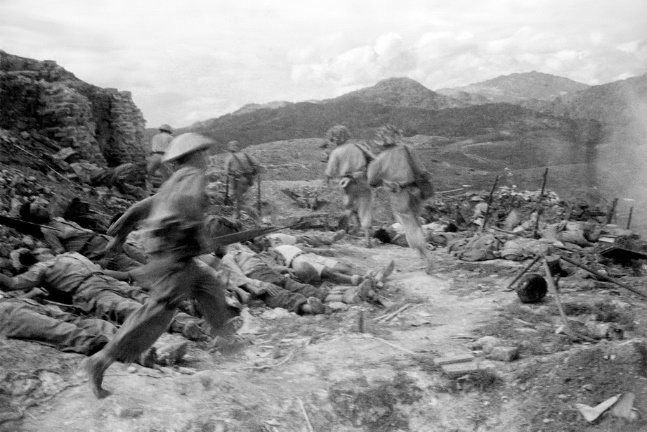
For several days, the situation became dangerous. American commanders considered whether the landing force could survive.
But Kesselring remained calm.
He organized German resistance while using the terrain to slow the Allied advance.
Roads were destroyed.
Bridges were demolished.
Mountain routes were blocked.
German engineers turned every kilometer into a problem.
The Allies eventually held their position, but Salerno proved something important:
Southern Italy could not be taken easily.
Kesselring had survived his first major test.
After Salerno, he transformed his defense into a complete system.
Instead of trying to win one decisive battle, he created a series of defensive lines stretching across Italy.
The Volturno Line.
The Barbara Line.
The Bernhardt Line.
The Gustav Line.
Each one was designed to delay the enemy, force attacks through difficult terrain, and buy time.
The most important was the Gustav Line.
Built across the narrowest part of Italy, it became one of the strongest defensive positions in Europe.
Concrete bunkers.
Machine-gun positions.
Minefields.
Barbed wire.
Destroyed roads.
Everything was designed to make every Allied advance slow and expensive.
Kesselring’s strategy was not to defeat the Allies completely.
It was to exhaust them.
Every day gained in Italy was another day Germany could prepare elsewhere.
The strategy reached its peak at Monte Cassino.
The mountain monastery became the center of one of the most brutal battles of the Italian campaign.
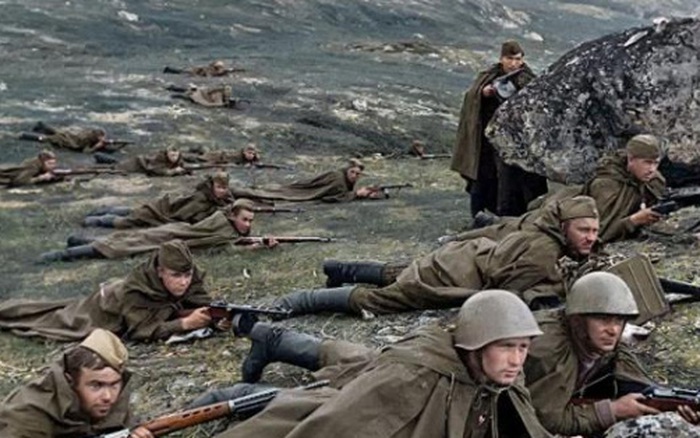
From January to May 1944, Allied forces launched repeated attacks against German positions.
The terrain favored the defenders.
Steep mountains.
Narrow approaches.
Hidden artillery.
The Allies suffered heavy casualties.
The bombing of the monastery created controversy, but the ruins also became a stronger defensive position for German troops.
Monte Cassino became a symbol of the entire Italian campaign:
A place where victory was measured not in kilometers gained, but in lives lost.
At the same time, another Allied operation faced disaster.
Anzio.
The goal was to land behind German lines and threaten the rear of the Gustav Line.
Instead, Kesselring reacted quickly.
The Allied landing force became trapped.
What was supposed to be a breakthrough became a siege.
British Prime Minister Winston Churchill had hoped Anzio would become a powerful strike against Germany.
Instead, it became a costly struggle.
The German commander had repeatedly turned Allied plans into slow battles of exhaustion.
But Kesselring’s success came with another side that could never be ignored.
As commander in Italy, he was also responsible for policies that led to brutal reprisals against civilians.
The massacre at the Ardeatine Caves in Rome in March 1944 became one of the most infamous examples. After a partisan attack killed German soldiers, German forces executed 335 Italian prisoners in retaliation.
Other civilians across Italy were killed during anti-partisan operations.
Kesselring was praised by some military historians for his defensive ability, but his command was also connected to serious war crimes.
The Italian campaign continued.
Rome finally fell on June 4, 1944.
But even then, the German army escaped destruction.
A major Allied opportunity was lost when forces pushed toward Rome instead of cutting off the retreating German formations.
Kesselring successfully withdrew north and continued building new defensive positions.
For many Allied soldiers fighting in Italy, the campaign became a forgotten war.
While the world focused on Normandy after D-Day, troops in Italy continued fighting through mountains, mud, winter storms, and endless battles.
The campaign lasted 607 days.
The Allies eventually advanced through the Gothic Line and northern Italy. Germany surrendered in Italy on May 2, 1945.
Kesselring’s promise from Wolf’s Lair had become reality.
Germany had held Italy far longer than many expected.
His defensive strategy had delayed one of the strongest military forces in history.
But the cost was enormous.
Thousands of soldiers died.
Italian towns were destroyed.
Civilians suffered under occupation and retaliation.
After the war, Kesselring was tried for war crimes and sentenced to death, though the sentence was later reduced and he was eventually released.
His legacy remains deeply controversial.
He was a highly skilled military commander who created one of the most effective defensive campaigns of World War II.
But he was also a senior Nazi commander whose actions contributed to suffering and crimes against civilians.
The story of Italy is therefore not only about military genius.
It is about the dangerous reality that tactical brilliance can exist alongside moral responsibility.
Kesselring proved that one commander could transform geography into a weapon.
But history remembers both sides of the battlefield:
The battles he delayed.
And the lives lost because of them.