Black CEO Mocked by a White CEO at a Tech Summit — She Canceled the $7.8B Merger
The handshake lasted less than a second because Victor Hale never took it.
Olivia Blackwell stood beneath the white glare of the Ascendant Tech Summit stage, her right hand extended between them, while four thousand executives watched from the darkened auditorium.
Victor glanced at her hand.
Then he looked past her toward the cameras.
A smile tugged at one corner of his mouth.
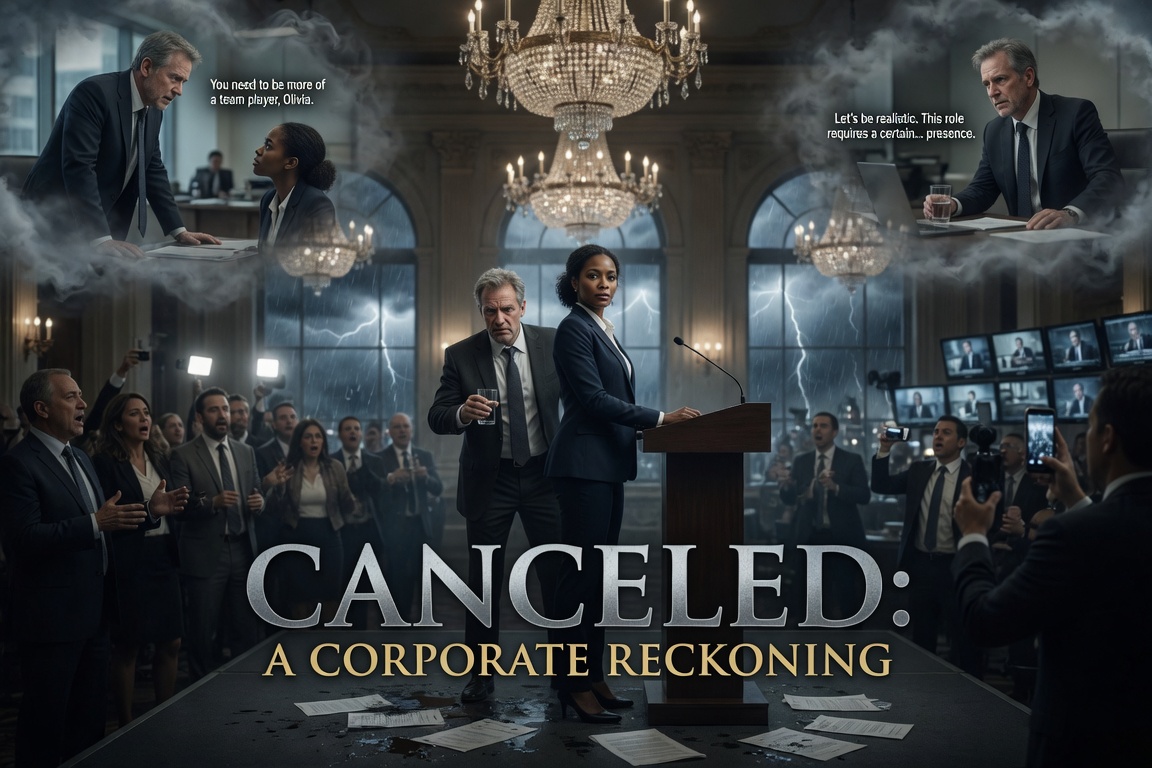
“Let’s save the ceremony until the adults finish the paperwork,” he said.
A few people laughed.
Not many.
Enough.
The sound traveled through the convention hall like loose change skittering across marble.
Olivia slowly lowered her hand.
Above them, a forty-foot LED screen displayed both their faces in merciless detail: Victor’s silver hair, bright teeth, and practiced amusement; Olivia’s smooth brown skin, tailored navy suit, and expression so still it made the room uneasy.
The moderator shifted in her chair.
“Mr. Hale,” she said carefully, “Ms. Blackwell is the chief executive of Meridian Systems. She is leading the transaction.”
Victor lifted both palms as if calming a child.
“Of course she is. Officially.”
More laughter.
This time, even less.
Olivia heard the faint electric hum of the stage lights. She smelled hot cables, expensive perfume, and the burned coffee drifting from the lobby beyond the security doors.
Outside, rain struck the glass walls of the Seattle Convention Center in hard silver sheets.
Inside, Victor Hale had just mocked the woman holding the only pen that could save his company.
He did not know that yet.
He turned toward the audience.
“For those unfamiliar with how these deals work,” he said, “Meridian’s board will have the final conversation with people who understand scale. Olivia has done an admirable job getting us this far.”
There it was.
Not rage.
Not insult.
Erasure.
Delivered with a smile.
Olivia’s chief legal officer, Daniel Cho, sat in the front row with one ankle resting over his knee. He stopped moving entirely.
Three seats away, Meridian’s board chair, retired Admiral Evelyn Ross, removed her glasses and folded them in her lap.
Victor’s son, Preston Hale, leaned toward one of Halcyon Dynamics’ bankers and whispered something that made both men grin.
The moderator attempted to recover.
“This merger has been described as the largest infrastructure software transaction of the decade. Ms. Blackwell, what does the combined company—”
Victor leaned across her words.
“It creates an adult-sized balance sheet around Meridian’s very promising little platform.”
A silence opened.
Olivia looked at him for the first time since lowering her hand.
Victor had the broad, healthy face of a man whose doctors, trainers, lawyers, and employees had spent thirty years removing consequences from his path. At sixty-one, he carried his age like an asset. His charcoal suit had been cut in London. His watch cost more than the average American home.
He had built Halcyon Dynamics from a regional defense contractor into a global data infrastructure company worth nearly twenty-two billion dollars.
He believed scale proved virtue.
He believed survival proved intelligence.
And, above all, he believed humiliation was merely negotiation performed in public.
Olivia picked up the glass of water beside her.
She drank once.
Then she placed it back on the table without a sound.
“Victor,” she said, “are you finished?”
The smile remained on his face, but something behind it tightened.
The audience shifted.
Victor laughed softly. “That sounded almost prosecutorial.”
“It was a simple question.”
“Then yes,” he said. “I’m finished.”
Olivia turned toward the moderator.
“So is the merger.”
No one moved.
For half a heartbeat, the entire room seemed to misunderstand the English language.
Then camera shutters exploded.
Victor’s smile did not disappear all at once. It broke in stages.
First the left corner.
Then the right.
Then the muscles around his eyes.
“What did you say?”
Olivia leaned toward the microphone.
“Meridian Systems is terminating the proposed merger with Halcyon Dynamics, effective immediately.”
The giant screen behind them still showed the merger logo: two silver lines converging beneath the words BUILDING THE TRUST LAYER OF TOMORROW.
Olivia looked up at it.
“Daniel,” she said.
In the front row, Daniel Cho opened the black leather folder resting on his knee.
At the same moment, every banker, lawyer, director, and senior officer affiliated with Halcyon received the same email.
Subject: Notice of Termination Pursuant to Sections 8.4(b), 8.7(a), and 10.2(c).
Phones began vibrating across the auditorium.
One after another.
Then dozens.
Then hundreds.
The room filled with the dry mechanical buzzing of panic.
Victor stared at Olivia.
“You cannot do that.”
She met his eyes.
“I just did.”
The moderator’s mouth had fallen open. Someone backstage spoke frantically into a headset.
Preston Hale stood so fast his chair struck the floor.
Victor did not look at his son.
He did not look at the cameras.
He looked only at Olivia.
For the first time that morning, he was no longer performing.
“On what grounds?”
Olivia’s gaze dropped briefly to his untouched right hand.
Then she said, “Material breach. Fraudulent disclosure. Obstruction of due diligence. Retaliation against a protected whistleblower.”
A murmur moved through the auditorium.
Victor’s face changed.
Not much.
A slight slackening at the jaw.
A single blink held half a second too long.
It was the smallest movement Olivia had seen from him all morning.
It told her everything.
He knew exactly which whistleblower she meant.
And that was when the real meeting began.
Six months earlier, Victor Hale had sent Olivia a bottle of 1961 Château Latour and a handwritten note.
To the future.
The wine arrived at Meridian’s headquarters in a cedar box lined with cream silk. Daniel Cho had carried it into Olivia’s office as though it might contain a listening device.
“Retail price is around twelve thousand,” he said.
Olivia did not look up from the draft merger agreement on her screen.
“Send it back.”
Daniel set the box on the conference table. “Compliance says we can accept gifts below two hundred.”
“Then remove eleven thousand eight hundred dollars’ worth of wine.”
Daniel smiled.
Olivia didn’t.
At forty-seven, Olivia had spent most of her life learning the price of being underestimated.
The lesson had begun in a courthouse in St. Louis, where her father, Marcus Blackwell, worked maintenance during the night shift. He wore gray coveralls and carried peppermint candies in his shirt pocket. When Olivia was nine, he sometimes brought her to the courthouse after school because childcare cost more than the family could afford.
She did homework at the back of empty courtrooms while her father polished the floors.
Judges entered through oak doors.
Lawyers entered carrying leather briefcases.
Men in handcuffs entered between deputies.
Her father entered pushing a mop.
One winter evening, Olivia watched a defense attorney step around a puddle without looking at Marcus.
“Someone should clean that,” the attorney said.
Marcus looked down at the mop in his hands.
Then at the attorney.
“Yes, sir.”
That night, in their kitchen, Olivia asked why he had not said anything.
Marcus peeled an orange over the sink.
“Because I knew who I was before he walked into that hallway,” he said. “He needed the hallway to tell him who he was.”
Olivia never forgot it.
Years later, as an assistant United States attorney, she built fraud cases against executives who spoke in calm voices while pension funds burned behind them. She learned that powerful men rarely imagined themselves as villains. They imagined themselves as exceptional.
Rules, in their minds, were guardrails for ordinary people.
Olivia’s courtroom strength was silence. She did not shout. She did not pound tables. She asked a question, then let the guilty person rush to fill the quiet.
But her greatest strength was also her weakness.
She could wait too long.
She could endure insult after insult while calculating the perfect response, never admitting that each one left a mark.
Her marriage ended partly because her husband grew tired of trying to enter rooms she kept locked even from herself.
“You treat pain like evidence,” he told her the night he moved out. “You label it, archive it, and never let anyone touch it.”
After twelve years at the Justice Department, Olivia left public service and joined Meridian Systems, then a struggling cybersecurity company with fifty-three employees and ten months of cash.
She became chief executive four years later.
Under her leadership, Meridian built a threat-detection platform used by hospitals, airports, electric grids, and federal agencies. The company did not make glamorous consumer products. It made software that noticed when someone in a dark room thousands of miles away began touching systems they should not touch.
Meridian’s value lived in what did not happen.
Planes did not lose navigation.
Hospitals did not lose patient records.
Power grids did not go dark.
By the time Halcyon approached with a merger proposal, Meridian was valued at $7.8 billion.
Victor Hale called it “a promising little platform.”
Olivia called it the most important company no one had heard of.
The merger made strategic sense on paper. Halcyon owned infrastructure in forty-three countries. Meridian owned the security architecture Halcyon desperately needed. Together, analysts predicted the companies could dominate the industrial cloud market for a decade.
But Victor wanted control.
He wanted Meridian’s technology.
He wanted Olivia’s federal relationships.
He wanted her credibility.
He did not particularly want Olivia.
During their first private dinner in Manhattan, Victor ordered for the table without asking.
“Sea bass,” he told the waiter. “Olivia will appreciate something light.”
“I’ll have the steak,” she said.
Victor smiled. “Of course.”
He spoke for forty minutes about his father, who had started Halcyon from a rented warehouse in Ohio. He described sleeping under desks, missing Christmases, risking everything.
Olivia listened.
Most vanity contained useful information.
Victor’s father had treated affection like a quarterly bonus. Victor had spent his childhood competing with an older brother, Grant, who later became Halcyon’s general counsel. Their mother kept score. Their father changed the rules.
Victor built his company partly because he loved technology.
Mostly because he wanted to construct a room where no one could tell him he did not belong.
The irony would have amused Olivia if he were not so dangerous.
Near dessert, Victor finally asked about her father.
“He worked in a courthouse, didn’t he?”
Olivia put down her fork.
“He did.”
“Law?”
“Maintenance.”
A pause.
Victor sipped his wine.
“Well,” he said, “that’s one hell of a climb.”
He intended it as praise.
That made it worse.
The merger negotiations began the following week.
Olivia insisted on one condition that Victor’s attorneys called excessive.
Section 8.7(a).
The Integrity Termination Provision.
It allowed either party to cancel the transaction if senior leadership concealed conduct likely to trigger major regulatory action, criminal exposure, or material reputational harm.
Victor’s brother objected.
“This is broad enough to drive a truck through.”
Olivia sat across from him in a glass conference room high above Park Avenue.
“Then don’t park a truck in it.”
Grant Hale looked at Victor.
Victor laughed.
“Give her the clause. Meridian needs to feel safe.”
Olivia remembered his choice of words.
Not be safe.
Feel safe.
She wrote the final version herself.
Victor signed it without reading beyond the summary.
That signature would later cost him $2.3 billion.
But first, it would cost him his family.
The first warning arrived ninety-three days before the summit.
No name.
No company email.
Just a secure message routed through Meridian’s external whistleblower portal.
HALCYON IS LYING ABOUT ORION.
Attached were three spreadsheets and a photograph of a handwritten ledger.
Orion was Halcyon’s proposed data-center expansion across Eastern Europe and Central Asia. Victor had presented it as a $4.1 billion growth engine backed by stable government contracts.
The spreadsheets suggested something else.
Consulting payments routed through shell companies.
Unexplained “facilitation fees.”
Government contracts recognized as revenue before approval.
Side agreements hidden from auditors.
Daniel read the documents twice.
“This could be fabricated.”
Olivia enlarged the photograph.
The ledger had been written in blue-black ink, with initials beside payment amounts.
V.H.
P.H.
G.H.
The Hales.
A family business in the oldest sense.
“Or it could be incomplete,” Olivia said. “Incomplete is more dangerous.”
They initiated enhanced due diligence without alerting Halcyon’s leadership.
Within two weeks, Meridian’s forensic accountants found inconsistencies in Orion’s reported margins. Within three, a former Halcyon regional controller agreed to speak through counsel.
He described a system in which revenue targets traveled downward like threats.
Executives did not order employees to falsify records.
They asked whether employees were “committed to the family.”
Those who resisted were transferred, isolated, or dismissed.
Victor rarely sent direct instructions.
Preston did.
At thirty-three, Preston Hale held the title of chief strategy officer. He had his father’s jaw, his mother’s pale green eyes, and the restless entitlement of a man who had inherited access but not authority.
He wanted Victor’s approval with the hunger of a starving child.
He feared his younger sister had already earned it.
Elise Hale was thirty-six, Halcyon’s chief risk officer, and almost invisible in the company’s public materials. She had dark hair, an unsmiling mouth, and a habit of reading every footnote before speaking.
Victor called Preston “the future.”
He called Elise “our conscience.”
In the Hale family, conscience was not a compliment.
It was a warning.
Olivia first met Elise during a due-diligence session in Chicago. The room had no windows. Fluorescent lights flattened everyone’s face.
Elise corrected a revenue figure in a presentation.
Grant Hale frowned.
“That level of precision isn’t necessary.”
“It’s wrong by seventy-eight million dollars,” Elise said.
Preston leaned back in his chair.
“See? This is why no one invites you to weddings.”
Elise did not look at him.
Victor laughed as if the insult were affectionate.
Olivia watched Elise’s left thumb press into the edge of her notebook until the skin turned white.
Later, in the hallway, Olivia found her alone beside a vending machine.
“You were right about the number,” Olivia said.
Elise stared at the rows of candy behind the glass.
“That has never been the relevant question in my family.”
The elevator arrived.
Before stepping inside, Elise looked at Olivia.
“My father respects people who can hurt him.”
The doors began to close.
Then she added, “He hates them afterward.”
That night, a second message arrived through Meridian’s whistleblower portal.
DO NOT TRUST THE BOARD MINUTES. THE REAL VOTES HAPPEN AT SUNDAY DINNER.
Attached was an audio file.
Victor’s voice filled Olivia’s office.
“We close the merger, move the Orion exposure into the combined reporting structure, and let Meridian’s reputation carry us through the first year.”
Then Grant:
“What if Blackwell finds it?”
A chair scraped.
Victor answered.
“She wants the deal too badly.”
Olivia stopped the recording.
Daniel stood by the window, watching snow drift between the Chicago towers.
“He thinks ambition makes you blind.”
“No,” Olivia said. “He thinks humiliation makes people eager to prove themselves.”
“Does it?”
Olivia looked at the frozen frame of the audio file.
Her father’s courthouse hallway appeared in her mind: the mop, the puddle, the lawyer who never looked up.
“Sometimes.”
She did not tell Daniel that Victor’s strategy had nearly worked.
Meridian needed Halcyon’s international infrastructure. The merger would allow its security software to protect systems across entire continents. Thousands of employees held stock options that could change their families’ lives.
Olivia wanted the deal.
More than that, she wanted to prove she could enter Victor Hale’s world without becoming smaller inside it.
That desire frightened her.
Because the most dangerous lies were the ones that offered something true.
At the summit, eleven minutes after Olivia canceled the merger, Halcyon’s private security team tried to remove her from the stage.
The attempt lasted fourteen seconds.
A broad-shouldered man in a dark suit approached from stage left and murmured into his sleeve.
Daniel Cho stepped into the aisle.
Admiral Ross stood beside him.
Then half of Meridian’s executive team rose from their seats.
The security man stopped.
Cameras turned toward him.
Olivia remained seated.
Victor bent toward her, blocking the moderator’s microphone with his hand.
“You have no idea what you’ve done.”
His breath carried coffee and mint.
Olivia kept her voice low.
“I know to the decimal.”
“This company employs thirty-one thousand people.”
“And you used them as cover.”
His eyes hardened.
“You’re going to destroy billions in value because your feelings got hurt on a stage?”
There it was.
His last refuge.
Reduce the evidence to emotion.
Reduce the woman to injury.
Olivia looked at the giant screen, where their faces hovered above the room.
“No, Victor. Your performance today was not the cause.”
“Then what was it?”
“It was confirmation.”
His fingers tightened around the microphone.
“Of what?”
“That you still believe public confidence is more important than private truth.”
The moderator stood.
“We are ending this session.”
“No,” Victor said.
His voice cracked through the speakers.
The room froze.
He released the microphone and turned to the audience.
“This is a negotiating stunt.”
His old authority returned by instinct. Stronger voice. Broader stance. Familiar rhythm.
“Our companies remain bound by an executed agreement. Any suggestion otherwise is irresponsible, potentially defamatory, and destructive to shareholders.”
Phones were held high throughout the auditorium.
Victor pointed toward Olivia without looking at her.
“Ms. Blackwell has chosen spectacle over fiduciary duty. Halcyon will pursue every remedy available.”
Olivia rose.
She buttoned her jacket.
“Good,” she said. “Discovery will save us time.”
A sound moved through the audience—not laughter, not quite.
Recognition.
Victor heard it.
His shoulders drew back.
Olivia stepped away from the table.
As she passed him, she leaned close enough that only he could hear.
“Merger canceled.”
Then she walked offstage.
For the next forty-seven minutes, Halcyon’s market value fell by $3.9 billion.
Trading was temporarily halted.
Cable networks replayed the handshake rejection in a continuous loop.
Some commentators called the moment racist.
Others called it reckless.
A few called Olivia emotional, despite the fact that she had spoken fewer than sixty words.
By noon, #MergerCanceled was trending nationwide.
By 12:17, Halcyon filed an emergency motion seeking to prevent Meridian from formally terminating the deal.
By 12:31, Victor called Olivia’s personal phone.
She did not answer.
By 12:42, Preston sent her a text.
You have no idea who you’re dealing with.
Olivia took a screenshot.
Daniel glanced over her shoulder.
“Subtle family.”
“They confuse intimidation with punctuation.”
They were in a secured conference room on the twenty-eighth floor of the Summit Hotel. Rain streaked the windows. Below, television trucks crowded the curb.
Admiral Ross stood near the coffee station, reading Halcyon’s court filing.
“They’re claiming your announcement was retaliatory.”
“For what?”
Ross looked over the pages.
“For Victor challenging your leadership in public.”
Daniel let out a breath through his nose.
“They’re putting the insult into the official record?”
“Apparently.”
Olivia removed her earrings and placed them beside her laptop.
The adrenaline had begun to leave her body. In its absence came a deep, cold exhaustion.
She had expected litigation.
She had expected the market reaction.
She had expected Victor to attack her competence, judgment, temperament, and motives.
She had not expected her father’s voice.
But there it was, carried by memory across twenty-eight floors of rain.
He needed the hallway to tell him who he was.
Her phone lit up again.
This time, the message came through the secure whistleblower portal.
HE KNOWS SOMEONE TALKED.
A second message followed.
HE THINKS IT WAS ME.
Olivia read it twice.
Then a third appeared.
MY BROTHER IS COMING TO MY OFFICE.
Daniel saw the color leave her face.
“What is it?”
Olivia was already standing.
“Call outside counsel. Then call federal enforcement.”
“SEC?”
“SEC and Justice.”
Daniel moved toward the door.
Admiral Ross blocked him with one question.
“Who is the source?”
Olivia looked at the screen.
Until that moment, they had suspected.
Now they knew.
“Elise Hale.”
Elise’s office occupied the least desirable corner of Halcyon’s executive floor.
No panoramic city view.
No private restroom.
No art selected by consultants.
The windows faced an adjoining tower of smoked glass that reflected Halcyon back at itself.
At 12:49 p.m., Elise sat at her desk with her phone recording inside an open drawer.
She heard Preston before she saw him.
His shoes struck the polished concrete hard enough to announce him.
The door opened without a knock.
Preston entered, followed by Grant Hale and Halcyon’s head of internal security.
Elise kept both hands visible on the desk.
“You watched the summit?” Preston asked.
“Yes.”
“You enjoyed that?”
“No.”
“You always did like seeing him bleed.”
Grant closed the door.
“Elise, we need your devices.”
“My company devices?”
“All devices.”
“For what stated purpose?”
Preston laughed once.
“This isn’t a deposition.”
“No,” Elise said. “Those usually have rules.”
His face reddened.
For years, Preston had treated her restraint as weakness. He mistook the absence of noise for the absence of anger.
He moved behind her desk.
“You leaked documents.”
“That’s an accusation.”
“It’s a fact.”
“Then you don’t need my devices.”
Grant stepped forward.
“Enough. The merger collapse has created an emergency. Under company policy, security can preserve relevant materials.”
Elise looked at her uncle.
Grant had taught her to play chess when she was seven. He had shown up to school concerts when Victor forgot. When she graduated from law school, he gave her their grandfather’s fountain pen.
Then, slowly, year by year, he had become the family’s cleanup crew.
Not because he enjoyed corruption.
Because he feared exile.
The Hales did not merely fire people.
They revised history until the fired person had never mattered.
Elise opened her desk drawer.
Preston reached for the phone.
She picked it up first.
His hand closed around her wrist.
The room went silent.
Not metaphorically.
Even the ventilation seemed to stop.
Elise looked down at his fingers on her skin.
Then up at his face.
“Remove your hand.”
Preston held on.
“You smug little—”
The office door opened.
Halcyon’s deputy general counsel stood in the doorway with two outside attorneys.
Behind them, a federal marshal displayed his credentials.
Preston released Elise.
The movement was immediate and small, like a child dropping something stolen.
The marshal entered.
“Elise Hale?”
“Yes.”
“We’re here to escort you pursuant to arrangements made through counsel.”
Grant’s face went gray.
Preston looked from the marshal to Elise.
Then to the phone still in her hand.
The realization reached him slowly.
The voice recorder.
The outside attorneys.
The timing.
The fact that she was not surprised.
His mouth opened, but no words came.
For the first time in his life, Preston understood that his sister had made a move without asking the family’s permission.
And that she had made it several moves ago.
As Elise walked past him, he whispered, “You’re killing Dad.”
She stopped in the doorway.
Rain-light turned the office glass the color of steel.
“No,” she said. “I’m refusing to die for him.”
Then she left.
Victor Hale did not return home that night.
He remained in Halcyon’s executive suite while lawyers filled the conference rooms and news helicopters circled the headquarters.
At 8:06 p.m., the board convened an emergency session.
At 8:19, Victor demanded that Elise be terminated.
At 8:24, the board learned she had protected whistleblower status.
At 8:31, Halcyon’s outside counsel disclosed that federal authorities had issued preservation demands involving Orion, revenue recognition, foreign payments, and potential obstruction.
At 8:44, the board asked Victor whether he had known about the side agreements.
Victor answered no.
At 8:45, Grant asked for a recess.
At 8:53, a board member received a copy of the Sunday dinner recording.
By 9:10, no one was calling the merger collapse a negotiating stunt.
Victor sat at the head of the table beneath a portrait of his father.
The old man had been painted standing beside Halcyon’s first manufacturing plant, one hand tucked into his coat, the Ohio sky behind him flat and gray.
Victor had always hated the portrait.
His father looked disappointed even in oil.
Across the table, Halcyon’s lead independent director, Margaret Sloan, removed her reading glasses.
“Did you make that statement?”
Victor looked around the table.
People he had promoted.
People he had enriched.
People who had laughed at his jokes for years.
No one met his eyes for long.
“The recording lacks context.”
“Did you say Meridian’s reputation would carry Orion through the first year?”
Victor leaned back.
“We were discussing integration strategy.”
“Did you say Olivia Blackwell wanted the deal too badly to find the problem?”
A muscle jumped in his cheek.
“This is exactly why private board conversations should remain private.”
Margaret stared at him.
“That was not my question.”
Victor looked toward Grant.
His brother sat three chairs away, hands folded over a yellow legal pad.
They had survived their father together.
They had built Halcyon together.
They had lied for each other so many times the lies had hardened into family tradition.
Grant looked down.
Victor understood.
Not yet betrayal.
Permission.
Grant was giving himself permission to survive without him.
Victor’s fear had never been prison.
It had never been poverty.
His deepest fear was becoming the man outside the room.
The one people discussed after the door closed.
He stood.
“You’re all panicking because a woman staged a scene on television.”
Margaret’s expression did not change.
“This board is not discussing the summit.”
“You should be. She ambushed us.”
“She provided notice under a provision you signed.”
“A provision she manipulated.”
“A provision created because you concealed material exposure.”
Victor’s palm struck the table.
Water trembled inside the glasses.
“I built this company.”
“No,” Margaret said quietly. “Thirty-one thousand people built this company.”
Victor stared at her.
Across the room, the city glittered beyond the rain. Red aircraft lights blinked above the towers. Traffic crawled below in narrow ribbons.
For decades, rooms changed when Victor Hale entered them.
Voices sharpened.
Spines straightened.
Decisions bent.
Now the room remained exactly as it was.
Margaret slid a document across the table.
It stopped in front of him.
Temporary Administrative Leave.
“You’re removing me?”
“Pending investigation.”
“You don’t have the votes.”
Grant’s voice came from three seats away.
“They do.”
Victor turned.
His brother’s face had collapsed inward, twenty years older than it had been that morning.
Victor looked at the signature page.
Grant Hale.
The name appeared in blue ink.
For several seconds, Victor did not breathe.
Then he looked toward the portrait of their father.
The old man still looked disappointed.
Only now, Victor could not tell which son he was judging.
The next morning, Olivia entered federal court through the same kind of revolving glass doors she had watched lawyers use as a child.
Reporters crowded the steps.
Microphones pushed toward her.
“Ms. Blackwell, did you plan the summit announcement?”
“Did Victor Hale’s comments influence your decision?”
“Are you using allegations of racism to escape the merger?”
“Has Meridian been contacted by the SEC?”
Olivia stopped halfway up the stairs.
Rain had given way to a pale, wind-scoured sky. Water shone in the seams of the stone.
She turned toward the cameras.
“The evidence will answer questions I will not litigate on courthouse steps.”
A reporter called out, “Were you offended by Mr. Hale?”
Olivia looked directly at him.
“He was counting on that being the most important thing he did.”
Then she entered the building.
Inside Courtroom 7B, Halcyon asked for an injunction compelling Meridian to continue toward closing.
Victor did not attend.
Grant sat behind Halcyon’s counsel.
Preston was absent.
Elise waited in a secured room with federal investigators.
The hearing lasted three hours.
Halcyon argued that Meridian had acted precipitously.
Meridian presented the Integrity Termination Provision.
Halcyon argued that the alleged misconduct remained unproven.
Meridian presented sworn statements, forensic findings, hidden side agreements, internal messages, and the Sunday dinner recording.
Then Daniel Cho introduced the document Victor had not known existed.
A draft restructuring memorandum prepared two months before the merger announcement.
It described a plan to transfer Orion liabilities into a newly formed subsidiary after closing. The subsidiary would be legally controlled by the combined company but economically isolated from key Hale family holdings.
At the bottom of the final page appeared an approval line.
Victor Hale.
The signature was electronic.
The metadata showed it had been applied from his home network at 11:43 p.m. on a Sunday.
Halcyon’s counsel requested a recess.
The judge denied it.
Olivia sat at counsel table, hands folded, while the courtroom absorbed the shape of the plan.
This was not merely accounting aggression.
It was an attempt to use Meridian as a shield.
Its technology.
Its reputation.
Its Black female chief executive, a former federal prosecutor whose presence would reassure regulators while the Hale family moved risk into the shadows.
Victor had not just underestimated Olivia.
He had selected her credibility as an instrument of concealment.
That was the twist no one in the media had seen.
The merger had never been a rescue for Meridian.
It had been a laundering mechanism for Halcyon.
And Olivia had known before she walked onto the summit stage.
The handshake was never the reason she canceled the deal.
It was Victor’s final test.
Meridian’s board had authorized termination the night before, contingent on one question: would Halcyon disclose the Orion exposure during the summit’s private executive session that morning?
Olivia had given Victor one final opportunity.
At 7:10 a.m., in a small greenroom behind the stage, she placed a sealed report in front of him.
“Is there anything material about Orion you need to tell me before we sign the final certification?” she asked.
Victor did not open the report.
He looked at her for a long moment.
Then he smiled.
“Olivia, at this altitude, every company has weather.”
He pushed the envelope back across the table.
“Don’t confuse clouds with storms.”
That was his answer.
So when he refused her hand three hours later, he was not causing the merger to collapse.
He was celebrating too early.
The judge denied Halcyon’s injunction.
Then she addressed the termination penalty.
Under the merger agreement, ordinary withdrawal would have required Meridian to pay Halcyon $420 million.
But fraudulent concealment triggered the reverse penalty provision.
Halcyon owed Meridian $2.3 billion.
The courtroom remained quiet as the figure was read.
Two point three billion dollars.
Not damages.
Not a future possibility.
A contractual obligation.
Victor had approved that clause himself after insisting Halcyon’s financial strength made it meaningless.
Outside the courtroom, Halcyon’s stock fell another eighteen percent.
Inside, Grant Hale lowered his face into his hands.
Olivia watched him for a moment.
She felt no triumph.
Only the heavy relief of a structure finally collapsing in the direction engineers had predicted.
Three weeks later, Victor asked to meet.
Not through lawyers.
Not at Halcyon.
Not in a private club.
He chose a diner near the federal courthouse in St. Louis.
Olivia almost declined.
Then she saw the address.
The diner sat two blocks from the courthouse where her father had worked.
She arrived at 6:30 in the morning.
Rain polished the sidewalks. A delivery truck idled near the alley. Inside, bacon hissed on a griddle, silverware clinked against ceramic, and an old ceiling fan turned slowly beneath yellow light.
Victor sat in a rear booth.
No security.
No tailored London suit.
He wore a dark overcoat over an open-collar shirt. Purple half-moons sat beneath his eyes.
For the first time, he looked sixty-one.
Olivia slid into the booth across from him.
A waitress poured coffee.
Victor waited until she walked away.
“My lawyers told me not to come.”
“They were right.”
He looked down at the steam rising from his cup.
“Preston is cooperating.”
Olivia said nothing.
“Grant too.”
Still nothing.
“Elise won’t speak to me.”
The diner door opened. Cold air moved across the floor.
Victor wrapped both hands around his coffee.
“When did you know?”
“Which part?”
“That she was the source.”
“I suspected in Chicago.”
“And the merger?”
“We authorized termination before the summit.”
His eyes lifted.
The answer struck harder than he expected.
“The whole thing was theater.”
“No.”
“You knew what you were going to do before I walked onstage.”
“I knew what I was permitted to do. You decided whether I had to.”
Victor looked toward the window.
Across the wet street, the courthouse rose in pale stone columns.
“You expected me to confess in a greenroom?”
“I expected you to tell the truth when the lie became more dangerous.”
He gave a short, humorless laugh.
“You really believe people operate that way?”
“I believe they can.”
“That’s not an answer.”
“It’s the only answer that matters.”
Victor rubbed a thumb over a chip in the coffee cup.
“My father used to bring me into rooms full of men and let them tear apart my presentations. I was sixteen the first time. He made me stand there while they laughed.”
Olivia watched him.
“He said shame was useful. Said it burned weakness out of you.”
“And did it?”
Victor looked at her.
For a second, the swagger returned. Faint, reflexive.
Then it passed.
“No,” he said. “It taught me to get there first.”
First to laugh.
First to dismiss.
First to make another person smaller before they could notice how small he felt.
He leaned back.
“I thought you needed the deal.”
“I did.”
“Then why destroy it?”
“Because needing something does not make it worth becoming dishonest to keep.”
His jaw tightened.
“That’s easy to say when you win.”
Olivia’s gaze moved to the courthouse.
“My father cleaned those floors for twenty-seven years.”
Victor followed her eyes.
“He spent his life being overlooked by people who believed their titles made them taller. He died before Meridian went public.”
“I’m sorry.”
“You don’t have to be.”
She turned back to him.
“But he taught me something you never learned.”
Victor waited.
“The person with the least power in a room is often the only one who can see the room clearly.”
The waitress returned and placed a plate of eggs in front of Victor.
He had not ordered them.
“On the house,” she said.
He looked confused.
She nodded toward the television mounted over the counter.
A news banner showed Halcyon’s board announcing a restructuring agreement and victim compensation fund.
The waitress recognized him.
Her kindness was not admiration.
It was pity.
Victor looked down at the plate.
His face went still.
There it was.
The moment of recognition.
Not when the stock fell.
Not when the board removed him.
Not when his brother signed against him.
Now.
In a diner where no one feared him, a waitress had seen the former king of Halcyon Dynamics and decided he looked like a man who needed breakfast.
His eyes reddened.
He blinked and turned toward the window.
Olivia allowed him the dignity of silence.
After a while, he said, “Did you come here to forgive me?”
“No.”
The answer made him flinch.
“I came because consequences are not the same as cruelty.”
He looked back at her.
“What happens now?”
“You testify truthfully. You stop protecting Preston from choices he made as an adult. You stop asking Elise to carry your shame. You return what can be returned.”
“And then?”
“Then you live with the part that cannot.”
Victor stared at the untouched eggs.
“Do you think people change?”
Olivia stood and buttoned her coat.
“I think people change when the story they tell about themselves becomes more painful than the truth.”
She placed cash beside her coffee.
At the end of the booth, Victor’s hand rested on the table.
For a moment, Olivia thought he might offer it.
He did not.
Neither did she.
Some gestures arrived too late to mean what they once could have meant.
Over the following year, the Halcyon case reshaped the technology industry.
Federal prosecutors charged Preston Hale and two regional executives with conspiracy, securities fraud, and obstruction. Grant entered a cooperation agreement and resigned from every corporate board he held.
Victor was not charged with bribery, but he pleaded guilty to making false statements and certifying misleading disclosures. He surrendered control of the Hale family voting trust and agreed to a permanent ban from serving as an officer or director of a public company.
The $2.3 billion reverse termination penalty was paid after Halcyon sold three non-core divisions.
Meridian used part of the money to create an employee equity fund, protecting workers whose jobs had been threatened by the failed merger. Another portion financed independent cybersecurity grants for rural hospitals and municipal utilities.
Olivia refused a personal transaction bonus.
When the compensation committee insisted, she redirected it into a scholarship program for children of courthouse, hospital, and school maintenance workers.
She named it the Marcus Blackwell Fellowship.
Elise Hale became the key witness in the federal case.
She left Halcyon and spent six months out of public view. When she returned, it was not as an executive.
She founded a nonprofit that provided legal and financial support to corporate whistleblowers.
At her first public event, a reporter asked whether betraying her family had been difficult.
Elise looked toward the cameras.
“I did not betray my family,” she said. “I stopped helping my family betray everyone else.”
The quote appeared in newspapers across the country.
But the moment people remembered most remained the summit.
The refused handshake.
The dismissive smile.
Olivia’s lowered hand.
Merger canceled.
For months, strangers sent her letters describing boardrooms, hospitals, schools, factories, churches, and dinner tables where they had been treated as though silence meant weakness.
Some praised her.
Some criticized her.
Some insisted the story was about race.
Others insisted it was only about corporate misconduct.
Olivia understood that it was about both, and more.
Power rarely traveled alone.
It arrived wearing money, family history, race, gender, confidence, and the assumption that some people would always be required to prove what others were simply allowed to be.
One evening, nearly a year after the summit, Olivia returned to Meridian’s Seattle headquarters after most employees had gone home.
The city glowed beyond the windows. Ferries moved across the dark water like slow constellations.
In the lobby, a young facilities worker polished the stone floor.
His name was Aaron. He was studying computer science at community college and worked nights to support his daughter.
Olivia had spoken to him several times.
As she crossed the lobby, two visiting bankers entered behind her. One stepped around Aaron’s equipment without looking at him.
“Careful,” the banker said. “Someone could trip over that.”
Aaron pulled the cart aside.
“Sorry, sir.”
Olivia stopped.
The hallway from her childhood seemed to open beneath the polished floor.
Her father in gray coveralls.
The peppermint in his pocket.
The man who needed the hallway to tell him who he was.
She turned toward the bankers.
“This is Aaron Lewis,” she said. “He keeps this building running after the rest of us go home.”
The men paused.
Aaron looked up.
Olivia continued.
“He also found a badge-access vulnerability last month that our audit team missed. We’re paying for his final two years of school, and he’ll join Meridian’s security engineering group when he graduates.”
One banker recovered first.
“That’s impressive.”
“It is,” Olivia said.
Then she held out her hand to Aaron.
He looked at it, startled.
His palm was damp from work. A faint line of cleaning solution marked one wrist.
Olivia waited.
Aaron wiped his hand once on his pants and shook hers.
The gesture lasted less than a second.
But this time, no one laughed.
And the men who had walked into the room believing they knew where the value was standing finally looked in the right direction.
Because the most expensive mistake powerful people make is not underestimating someone’s anger.
It is underestimating their worth.