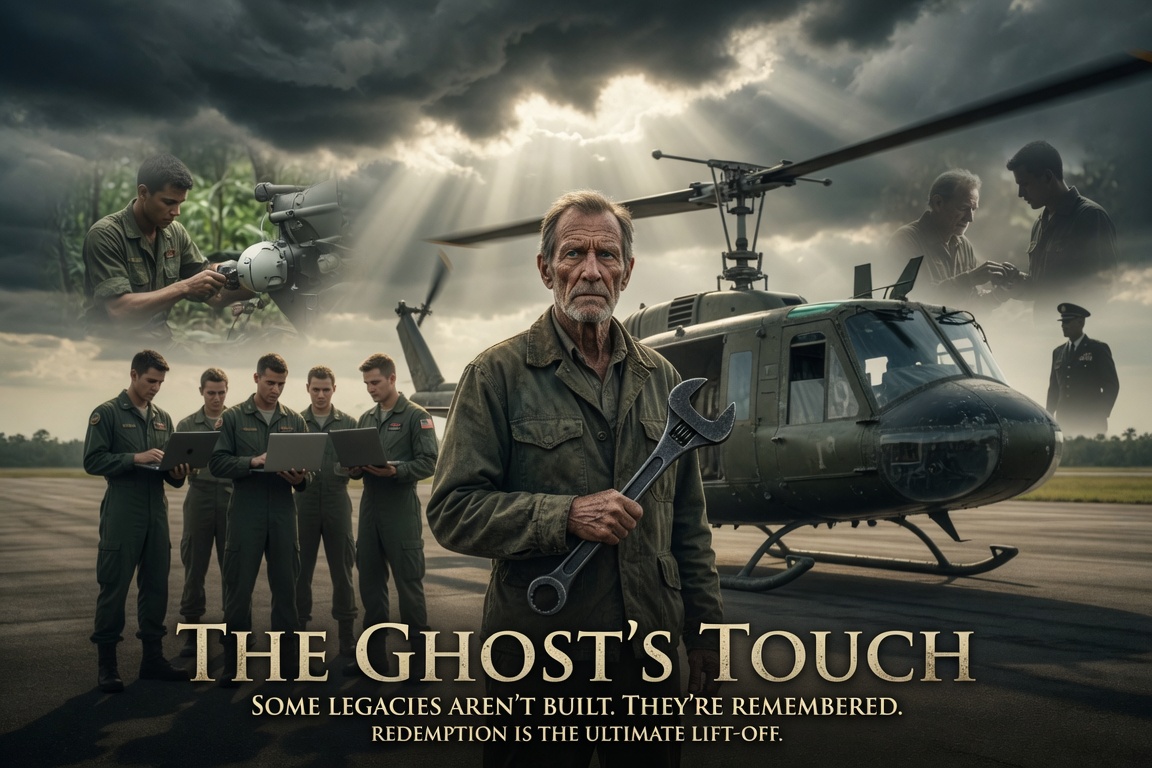
The helicopter died thirty-eight minutes before the ceremony.
One moment, the olive-drab UH-1 Huey sat beneath the white glare of the Arizona sun, its twin blades beginning their slow, heavy rotation. The next, the engine coughed twice, spat a ribbon of gray smoke across the flight line, and fell silent.
The sudden quiet felt wrong.
Two hundred folding chairs faced the aircraft from beneath canvas shade tents. Gold-star families were already arriving at the gate. A military band tuned brass instruments near the hangar. Television crews ran cables across the concrete, preparing to broadcast the memorial dedication live.
Above the temporary stage hung a black banner with silver lettering:
WELCOME HOME, RAVEN SIX
The Huey had carried wounded soldiers out of the A Shau Valley in 1969. In less than an hour, it was supposed to lift off again for the first time in twenty-seven years.
Instead, it sat motionless beneath the heat.
Major Ethan Vale lowered his tablet and stared at the cockpit.
“Run it again.”
Chief Warrant Officer Lena Ortiz did not move.
She stood beside the open engine cowling with sweat darkening the collar of her flight suit. At forty-two, Ortiz had spent half her life around military aircraft. She could identify a failing turbine bearing by sound and smell. She could strip a T700 engine faster than most technicians could find the correct manual.
But the Huey was not using a T700.
It was powered by a rebuilt Lycoming T53-L-13, an analog machine born in a time when mechanics listened with their whole bodies.
Ortiz glanced at the digital diagnostic cart. Every green indicator had turned red.
“Sir, we’ve run it six times.”
“And?”
“The start sequence aborts at twenty-eight percent compressor speed. Fuel pressure is stable. Ignition is stable. Exhaust temperature spikes, then collapses.”
Vale’s mouth tightened.
“Then something isn’t stable.”
Behind them, a young civilian contractor gave a nervous laugh.
No one joined him.
Major Vale turned toward the technicians gathered beneath the rotor disk. Eight people had worked for eleven months restoring the aircraft. They had scanned every maintenance record they could find. They had fabricated discontinued parts, rebuilt wiring harnesses, and recreated faded markings from photographs pulled out of veterans’ closets.
The project had become a showcase for Vale’s modernization unit.
It was also supposed to become his promotion.
Three Pentagon representatives were already seated in the hangar conference room. A defense manufacturer had pledged funding for the next restoration. News outlets had been told the flight would demonstrate how modern diagnostic engineering could preserve historic military aircraft.
Vale checked his watch.
7:52 a.m.
The dedication began at nine.
“Replace the control unit.”
Ortiz looked at him.
“We already replaced it.”
“Replace it again.”
“With what?”
“The backup.”
“The backup is the original unit.”
“Then use the original.”
Ortiz wiped her forearm across her mouth. The wind carried the sharp smell of jet fuel, hot rubber, and desert dust.
“That unit was removed for a reason.”
Vale stepped closer.
“And right now, Chief, the aircraft is not flying for a reason.”
The words landed hard enough that two junior technicians looked away.
Ortiz held his gaze.
She knew what Vale feared.
Not the dead helicopter.
The cameras.
Major Ethan Vale was thirty-six years old, clean-shaven, precise, and careful with every visible detail. His boots were always polished. His reports contained no stray commas. His career had been built on fixing systems other people had declared unfixable.
Three years earlier, an engine failure during a stateside training mission had killed two pilots from his test program. The official investigation blamed a manufacturing defect. Vale had been cleared.
But people who worked near him noticed that he never boarded an aircraft without checking the maintenance log himself.
They also noticed that he had not flown since.
“Get the original unit,” he said.
Ortiz did not answer.
A black staff car rolled through the security gate.
Every officer on the flight line straightened.
General Miriam Holt stepped out before the driver reached her door.
At fifty-nine, Holt had the compact posture of someone who had spent decades entering rooms where people underestimated her. Her silver hair was cut close. Four stars flashed on each shoulder. She wore no sunglasses despite the brutal morning light.
She crossed the flight line without waiting for an escort.
“What happened?”
Vale met her halfway.
“Temporary start-system fault, General. We have it contained.”
The Huey sat behind him in absolute silence.
Holt looked past his shoulder.
“Contained?”
“We’re swapping the control unit.”
“Will it fly?”
“Yes, ma’am.”
Ortiz lowered her eyes.
General Holt saw it.
She saw everything.
“How long?”
Vale checked his watch again.
“Twenty minutes.”
Holt studied his face, then turned toward the aircraft.
Her gaze moved across the faded fuselage, the patched skin, the open engine compartment, and finally the black letters painted beneath the cockpit window:
RAVEN SIX
For a moment, the general’s expression changed.
Not much.
Just enough for Ortiz to notice.
“Who has inspected the bleed-air bypass?”
Vale blinked.
“The what?”
“The bypass assembly.”
Ortiz stepped forward.
“We borescoped the line yesterday. No obstruction.”
“You pressure-tested the valve?”
“Yes, General.”
Holt looked toward the engine.
“And the manual governor linkage?”
“Within tolerance.”
“The accumulator?”
“Charged.”
“The starter-generator brushes?”
“New.”
Holt nodded slowly.
Then she asked, “Did anyone call Mercer?”
No one spoke.
Vale glanced at Ortiz.
She looked equally confused.
“Mercer, ma’am?”
“Caleb Mercer.”
The general’s tone implied the name should have been enough.
Vale lifted his tablet.
“I don’t see anyone by that name on the restoration roster.”
“He wouldn’t be.”
“Is he with the contractor?”
“No.”
“A former engineer?”
“No.”
Holt faced him.
“He kept Raven Six alive when men were shooting at it.”
The wind lifted a corner of the memorial banner.
Vale hesitated.
“With respect, General, this platform has been completely rebuilt. The original field modifications are obsolete. We’re dealing with integrated systems, replacement components, modern instrumentation—”
“You’re dealing with a helicopter that won’t start.”
Vale’s jaw flexed.
Holt took out her phone.
“Call him.”
Her aide stepped closer.
“General, Mr. Mercer declined the invitation.”
“I’m not inviting him.”
She looked at the dead Huey.
“I’m asking him to bring her back.”
Caleb Mercer answered on the seventh ring.
He was standing behind a hardware store in Sierra Vista, loading bags of potting soil into the trunk of a twelve-year-old Buick.
At seventy-eight, he had a narrow face, a stooped left shoulder, and hands that looked carved from dry wood. A pale scar ran from the base of his right thumb to his wrist. His hearing aid whistled when he held the phone too close.
He listened without interrupting.
General Holt finished speaking.
Mercer looked at the three bags of soil.
“No.”
The general stood twenty-four miles away beneath the Huey’s motionless blades.
“Caleb.”
“I said no.”
“We need you.”
“You needed me eleven months ago.”
Holt turned away from the technicians.
“I called.”
“You sent a captain with a release form.”
“It was an archive authorization.”
“It said the Air Force could use my name, photographs, and recollections in perpetuity.”
“I didn’t draft it.”
“You signed it.”
A military transport roared overhead, forcing Holt to wait.
When the sound passed, her voice lowered.
“The aircraft is down.”
Mercer shut the Buick’s trunk.
“Aircraft go down.”
“The dedication is in less than an hour.”
“Then dedicate it sitting still.”
“Families flew across the country to see it in the air.”
He leaned one hand against the car.
The hardware store’s loading dock shimmered in the heat.
“Whose families?”
Holt did not answer immediately.
“Raven crew families.”
Mercer’s fingers curled around the phone.
“All of them?”
“Most.”
A long silence followed.
Holt heard traffic behind him. A shopping cart rattled across asphalt. Somewhere near the flight line, the band began playing a scale.
Mercer closed his eyes.
“What did it do?”
“Light-off is normal. Temperature rises. Compressor reaches twenty-eight percent. Then the engine loses combustion.”
“Fuel control?”
“Rebuilt.”
“Starter?”
“Bench-tested.”
“Battery cart?”
“Stable.”
“Did it cough before it died?”
“Yes.”
“Once?”
“Twice.”
“Gray smoke?”
Holt glanced at Ortiz.
The chief nodded.
“Gray.”
Mercer opened his eyes.
“And they replaced the cabin harness?”
“Yes.”
“With shielded wiring?”
“I believe so.”
“Tell them to stop touching it.”
Holt turned toward Vale.
“Stop all work.”
Vale frowned.
“General—”
“Now.”
Ortiz immediately raised one hand.
“Tools down!”
Around the Huey, wrenches froze in midair.
Mercer heard the command through the phone.
“You put it on speaker?”
“No.”
“Good.”
He looked across the parking lot toward the mountains.
“I’ll come.”
Holt exhaled.
“Thank you.”
“I’m not doing it for you.”
“I know.”
“And Miriam?”
“Yes?”
“If they’ve cut out my bypass, it isn’t a Huey anymore.”
The call ended.
General Holt lowered the phone.
Major Vale stood waiting.
“How soon can he be here?”
“Twenty minutes.”
Vale stared toward the gate.
“With respect, ma’am, who exactly are we waiting for?”
Holt slipped the phone into her pocket.
“A crew chief.”
Vale’s eyebrows rose.
“That’s all?”
The general looked at him.
“No, Major. That was never all.”
Caleb Mercer arrived in the Buick at 8:21.
The guard at the gate held him for six minutes.
His name was not on the updated access list.
By the time Holt’s aide reached the checkpoint, Mercer was standing beside his car with his faded green field jacket folded over one arm. Beneath it he wore a white shirt buttoned to the throat, dark work pants, and brown orthopedic shoes.
The young security airman handed back his driver’s license.
“Sorry about that, sir.”
Mercer studied him.
“You followed procedure.”
“Yes, sir.”
“Don’t apologize for doing your job. Just do it faster when there’s a general shouting into your radio.”
The airman almost smiled.
Mercer drove onto the base.
He parked far from the hangar despite three open spaces reserved for distinguished guests.
The heat struck him the moment he stepped out.
It smelled the same.
Dry dust. Fuel. Sun-baked metal.
For one disorienting second, he saw not the Arizona flight line but a red dirt clearing surrounded by green mountains and white smoke.
Men ran beneath spinning blades.
Someone screamed for plasma.
A pilot slumped over his harness with blood filling one boot.
Mercer gripped the car door until the image passed.
Then he put on the jacket.
The olive fabric had faded nearly gray along the shoulders. The zipper was broken. One cuff had been repaired with dark thread. No medals showed on the front.
Only a rectangular name strip above the right pocket:
MERCER
Across the flight line, several technicians watched him approach.
One of them, Staff Sergeant Nolan Pike, leaned toward the civilian contractor beside him.
“That’s him?”
The contractor squinted.
“Maybe the general’s grandfather.”
Pike snorted.
At twenty-nine, he had graduated at the top of his avionics course and carried himself with the nervous arrogance of someone terrified that one mistake would reveal he did not belong. He had spent the night before the ceremony sleeping beneath a workbench for forty minutes at a time.
He looked at Mercer’s shoes.
“We’re saved.”
Ortiz heard him.
“Enough.”
Pike lowered his voice.
“I’m just saying, Chief, the engine has a digital monitoring package he’s probably never seen.”
Mercer was still thirty yards away.
Without turning his head, he said, “It’s a signal-conditioning module tied into six sensors, three of which you installed too close to the ignition exciter.”
Pike’s smile disappeared.
Mercer kept walking.
“And if your routing diagram told you to do that, your diagram was wrong.”
Ortiz looked at Pike.
He stared at the aircraft.
General Holt met Mercer at the edge of the rotor disk.
For a few seconds, neither spoke.
Thirty-four years earlier, Holt had been a young medical evacuation pilot with two broken ribs, a bleeding forehead, and a helicopter full of wounded men. Mercer had been the crew chief who refused to let her aircraft burn after enemy fire ruptured the fuel line.
They had not seen each other in nine years.
“You came,” she said.
Mercer looked beyond her at Raven Six.
“No,” he replied. “I came for her.”
Holt accepted that.
Major Vale stepped forward.
“Mr. Mercer. Major Ethan Vale, restoration program director.”
Mercer shook his hand.
Vale noticed the old man’s grip was weak.
He also noticed the scar across his palm.
“We appreciate your historical perspective,” Vale said. “But I need to be clear that this aircraft contains several modern substitutions. Before you make any adjustments, my team will need to review—”
Mercer walked past him.
Vale turned.
“Mr. Mercer.”
The old man stopped beneath the open engine cowling.
For almost a minute, he said nothing.
His eyes moved over the turbine housing, the fuel manifold, the replaced clamps, the polished fittings, and the braided lines. He leaned closer, not touching anything.
Then he inhaled.
Pike folded his arms.
Mercer looked toward him.
“Who started it last?”
“I did.”
“Throttle position?”
“Idle detent.”
“Battery voltage?”
“Twenty-eight point four.”
“Outside temperature?”
“Eighty-nine.”
“Wind?”
Pike hesitated.
Mercer looked at the windsock.
“Southwest at six knots,” Pike said.
“Was the aircraft pointed this direction?”
“Yes.”
“Cowling open?”
“No.”
“Fuel boost on how long before ignition?”
“Ten seconds.”
“Manual says five.”
“Modern guidance says ten.”
Mercer nodded.
“That guidance written for this fuel pump?”
Pike said nothing.
Mercer crouched beneath the engine. His left knee trembled as he lowered himself. Ortiz moved forward to help.
He raised one hand.
She stopped.
He examined the underside of the compartment, then placed two fingers against a narrow aluminum tube.
Everyone watched.
Vale glanced at the clock mounted above the hangar door.
8:29.
“You finding something?” he asked.
Mercer closed his eyes.
His fingers remained against the tube.
Pike exchanged a look with the contractor.
Finally Mercer stood.
“The machine is choking.”
Vale stepped closer.
“Our airflow readings are within limits.”
“I didn’t say airflow.”
“What did you mean?”
Mercer brushed dust from his knee.
“The compressor is getting air. The combustor is getting fuel. But the pressure pulse is arriving out of rhythm.”
Pike let out a small breath through his nose.
Mercer heard it.
“You disagree?”
“We measured pulse timing.”
“With what?”
“A digital transducer.”
“Where did you mount it?”
Pike pointed.
Mercer followed his finger to a polished bracket.
“That’s not where pressure lives.”
Pike blinked.
“Pressure doesn’t live anywhere.”
Mercer looked at him.
“Everything lives somewhere, Sergeant. Heat lives in corners. Vibration lives in joints. Pressure lives in spaces engineers forget to measure.”
The civilian contractor coughed to hide a laugh.
This time, it was not aimed at Mercer.
Vale stepped between them.
“We don’t have time for metaphors.”
“No,” Mercer said. “You had eleven months for metaphors. Now you need an answer.”
Vale’s eyes hardened.
“Then give me one.”
Mercer pointed toward the cockpit.
“Start it.”
Ortiz looked at him.
“You want to recreate the fault?”
“I want to hear it.”
Vale shook his head.
“We already know the fault.”
“You know what the screen says.”
“And you know better?”
Mercer’s gaze settled on the major.
“I know that helicopter coughed twice before your machine noticed it was sick.”
The technicians fell silent.
General Holt stepped forward.
“Start it.”
Vale’s face tightened, but he nodded.
Ortiz climbed into the pilot’s seat. Pike connected the external power cart. The technicians moved back.
Mercer did not.
He stood beside the open engine bay.
Ortiz leaned out the window.
“You need hearing protection.”
Mercer tapped his hearing aid.
“At this point, Chief, I’m mostly protecting the engine from me.”
A few people smiled.
Vale did not.
Ortiz began the sequence.
The starter engaged with a rising metallic whine.
Rotor blades shifted overhead.
The turbine spun faster.
Mercer placed one palm flat against the fuselage.
At twelve percent compressor speed, fuel entered.
Ignition cracked.
Flame caught.
The Huey began to wake.
Its body trembled beneath Mercer’s hand. The exhaust shimmered. The blades turned faster, beating the air into hot circles.
Twenty percent.
Twenty-four.
Twenty-six.
Mercer’s eyes narrowed.
Twenty-eight.
The engine coughed.
Once.
Twice.
Gray smoke burst from the exhaust.
The turbine died.
The rotor blades slowed.
Mercer kept his hand against the aircraft until the final vibration disappeared.
Then he looked at Ortiz.
“Again.”
Vale stepped forward.
“No.”
Mercer did not turn.
“I need one more.”
“You heard it.”
“I heard part of it.”
“The ceremony begins in twenty-two minutes.”
“And if you start it now, it’ll die at thirty-one percent instead of twenty-eight.”
Vale stared at him.
“How could you possibly know that?”
Mercer finally faced him.
“Because the first cough moved.”
Ortiz leaned from the cockpit.
“He’s right.”
Pike checked the recorded data.
“It occurred four-tenths later.”
Mercer pointed toward the fuel control linkage.
“Your system compensates after the fault. That changes the next failure.”
Vale looked at the tablet.
The graphs showed exactly that.
His expression barely shifted, but his thumb stopped moving.
Mercer walked toward the cockpit.
“Again.”
This time, Vale allowed it.
The second start reached thirty-one percent.
The engine coughed once, surged violently, then died.
Mercer nodded to himself.
“What?” Vale demanded.
“The governor isn’t failing.”
“We know.”
“The fuel control isn’t failing.”
“We know that too.”
“No. Your screens know what stops working. They don’t know what begins it.”
Mercer climbed onto the maintenance step. His movements were slow, and the effort pulled his mouth tight.
He reached into the engine compartment and touched a small line routed along the firewall.
“Who moved this?”
Pike stepped forward.
“It interfered with the new sensor bracket.”
“So you rerouted it.”
“Two inches.”
Mercer traced the line.
“Three and a quarter.”
Pike checked his diagram.
“Three point two.”
Mercer looked at him.
“That extra twentieth of an inch make you feel better?”
Pike flushed.
Mercer followed the line to a clamp.
“What was here before?”
“A rubber isolation mount.”
“Where is it?”
“We replaced all rubber mounts with modern heat-resistant polymer.”
Mercer looked toward Vale.
“Put the old mount back.”
Vale shook his head.
“It was degraded.”
“Then find one like it.”
“The polymer has a higher temperature rating.”
“It’s too stiff.”
“The specification—”
“Is wrong.”
Vale’s voice cooled.
“Based on what calculation?”
Mercer tapped the line with one fingernail.
The thin aluminum answered with a faint metallic note.
“Based on that.”
Pike laughed before he could stop himself.
The sound carried beneath the rotor blades.
Mercer turned slowly.
Pike straightened.
“Something amusing?”
“With respect, sir, you’re diagnosing an engine failure by tapping a tube.”
“No. I’m diagnosing your mistake.”
Pike’s face sharpened.
“My mistake?”
“You moved a pressure line into a vibration node and clamped it with material that can’t absorb the frequency.”
“That’s not possible.”
“You want the long explanation or the useful one?”
Pike crossed his arms.
“The accurate one.”
Mercer moved closer.
“At low compressor speed, the fuel control sends a pressure signal through this line. The line now touches the bracket’s harmonic field. The new mount doesn’t dampen it. It reflects it. The reflected pulse reaches the governor diaphragm a fraction late. The governor corrects for a condition that no longer exists, leans the mixture, and kills combustion.”
Pike opened his mouth.
Mercer continued.
“The first attempt heats the line. Heat changes its resonant frequency. That’s why the cough moved on the second start.”
The contractor stared at the line.
Ortiz climbed down from the cockpit.
“That would explain the shifting fault.”
Vale’s eyes moved between Mercer and the aircraft.
“Would it explain the temperature spike?”
“Yes,” Ortiz said. “Temporary lean surge.”
Pike looked at his data.
His shoulders had begun to sink.
Vale noticed the television crews gathering near the shade tents.
He lowered his voice.
“Can we isolate the line?”
Mercer nodded.
“With the right mount.”
“We don’t have the right mount.”
“Yes, you do.”
“Where?”
Mercer pointed toward the maintenance table.
“Your coffee machine.”
Everyone looked.
A black commercial coffee urn sat beside a stack of paper cups.
Vale’s expression turned flat.
“You want to repair a military aircraft with a coffee machine.”
“I want the silicone vibration foot under it.”
The civilian contractor checked beneath the urn.
Four small conical feet supported the base.
He removed one and carried it over.
Mercer squeezed the silicone between his fingers.
“Too soft.”
Vale exhaled.
“Of course.”
Mercer looked around the hangar.
His eyes stopped on a dented red toolbox near the wall.
“Whose?”
Ortiz raised one hand.
“My father’s.”
“May I?”
She nodded.
Mercer opened the box.
Inside were old safety-wire pliers, worn sockets, a brass punch, and a collection of small parts wrapped in oily cloth. He searched beneath a tray and found a dark rubber grommet.
Ortiz stared.
“I haven’t opened that compartment in years.”
Mercer held the grommet to the light.
“This is from a Bell hydraulic isolation kit.”
“My father worked on 205s.”
“So did half the men who kept us alive.”
He carried it to the aircraft.
Pike stepped forward.
“That part isn’t certified.”
Mercer looked at him.
“Neither were most of the men flying into Laos.”
“This isn’t Laos.”
“No. Here, failure comes with paperwork.”
Pike’s face reddened.
Vale raised one hand.
“He’s right about certification. We cannot install an unverified component minutes before a public flight.”
General Holt had remained silent through the entire exchange.
Now she spoke.
“Will it hold?”
Mercer examined the grommet again.
“For a ground start, yes.”
“For flight?”
“Maybe.”
Holt’s expression did not change.
“Maybe isn’t enough.”
“No.”
The memorial band stopped tuning.
An announcer’s voice drifted from the stage as the first guests were asked to take their seats.
8:44.
Sixteen minutes.
Vale looked toward the general.
“We should cancel the flight.”
Holt stared at Raven Six.
A row of elderly men had entered through the hangar doors. Some wore veterans’ caps. One used a walker. Another carried a framed photograph against his chest.
They had come to hear the Huey fly.
Not see it displayed.
Hear it.
For some of them, that sound was the last thread connecting them to men who never grew old.
Holt looked at Mercer.
“What do you need?”
He glanced at the arriving families.
“A part you threw away.”
Ortiz’s brow furrowed.
“What part?”
“The original bypass damper.”
“We don’t have it.”
“You removed it during restoration.”
“Yes.”
“Then you logged disposal.”
Pike opened the maintenance archive on his tablet.
“Obsolete components were transferred to salvage.”
“Where?”
“Building Twelve.”
Mercer started walking.
Vale stepped in front of him.
“Building Twelve is across the base.”
“Then we’d better stop discussing geography.”
“We have fifteen minutes.”
Mercer looked past him at the helicopter.
“You have less.”
“Why?”
“Because the third start will damage the diaphragm.”
Vale glanced toward the cockpit.
“No one is starting it again.”
Mercer’s gaze shifted to the external power cart.
A green indicator was still glowing.
“Someone already is.”
Every head turned.
Inside the cockpit, a junior technician had climbed into the left seat. His hands hovered near the controls.
Pike shouted.
“Kill the master!”
The starter engaged.
The turbine whined.
Ortiz sprinted toward the aircraft.
“Abort! Abort!”
The junior technician froze.
He had misunderstood an instruction from the contractor and begun an automated test cycle.
Fuel entered.
The engine lit.
Mercer moved faster than anyone expected.
He climbed onto the step, reached through the open cockpit door, and slapped the fuel switch shut.
The engine died before twenty percent.
Rotor blades continued their slow turn.
The junior technician stared at him, pale.
“I thought Sergeant Pike said—”
“You thought wrong,” Mercer said.
The young man’s mouth trembled.
Mercer’s anger vanished almost as quickly as it had appeared.
He pointed toward the start panel.
“What do you see?”
The technician swallowed.
“Master on. Starter engaged. Ignition armed.”
“What don’t you see?”
“I don’t know.”
“The man standing outside the door telling you to stop.”
Mercer leaned closer.
“Machines narrow your attention. Fear narrows it more. Next time, widen it.”
The technician nodded.
Mercer stepped down.
Behind him, Vale stared at the aircraft.
“How did you know the diaphragm would fail?”
Mercer did not answer.
Vale followed.
“Mr. Mercer.”
The old man stopped.
Vale lowered his voice.
“You’ve seen this exact failure before.”
Mercer’s shoulders became still.
Ortiz noticed.
So did General Holt.
Vale stepped closer.
“That bypass was not standard equipment, was it?”
Mercer’s eyes remained on Building Twelve in the distance.
“No.”
“Then who designed it?”
Mercer looked at him.
“A man who was tired of watching helicopters fall out of the sky.”
Before Vale could ask another question, Mercer walked away.
The general’s aide brought a utility cart.
Holt climbed into the passenger seat beside Mercer. Ortiz stood on the rear platform.
Vale joined them.
Pike was left staring at the dead Huey and the old rubber grommet in his hand.
Then he saw something inside the open toolbox.
A black-and-white photograph lay beneath the parts tray.
He picked it up.
Six young men stood in front of a Huey riddled with bullet holes.
One of them was Caleb Mercer.
On the back, written in faded blue ink, were four words:
Raven Six. Dak To.
Below the words were five signatures.
The sixth man had not signed.
Building Twelve was not a building so much as a graveyard with walls.
Rows of metal shelving stretched beneath weak fluorescent lights. Old instruments, cracked panels, corroded fittings, and obsolete avionics units sat in gray bins marked for disposal. The air smelled of dust, machine oil, and sun-heated insulation.
Mercer moved down the aisles without looking at labels.
“How do you know where it would be?” Vale asked.
“Because salvage crews sort by component family.”
“You’ve been here before?”
“I’ve been in a thousand rooms like this.”
Ortiz followed with a flashlight.
General Holt remained near the entrance, speaking quietly into her phone as the ceremony outside was delayed.
Mercer stopped at a shelf marked FUEL/AIR—LEGACY ROTARY WING.
Three bins sat at eye level.
He opened the first.
Empty housings.
The second contained clamps and tubing.
The third was filled with blackened valves.
Mercer searched each one.
Nothing.
Vale checked his watch.
8:51.
“Nine minutes.”
Mercer ignored him.
Ortiz crouched to inspect a lower shelf.
“What exactly are we looking for?”
“A copper diaphragm housing. About four inches across. Two ports, one filed flat.”
“Why filed?”
“So it would clear the frame.”
“Factory modification?”
Mercer gave her a look.
She understood.
“No.”
Vale stood at the end of the aisle.
“You built it.”
Mercer continued searching.
“You designed an unauthorized pressure bypass and installed it on an active combat aircraft.”
“We installed lots of things.”
“That isn’t an answer.”
“It’s the only one you need.”
Vale’s restraint began to crack.
“This aircraft is about to carry two pilots over a crowd of civilians. I need to know whether the system you’re asking us to trust was engineered or improvised.”
Mercer turned.
“It was both.”
“By whom?”
“Three crew chiefs, a hydraulic specialist, and a twenty-two-year-old pilot who could do differential equations in her head while bleeding through her flight suit.”
Holt looked up from her phone.
Vale followed Mercer’s gaze to her.
The general said nothing.
Mercer continued.
“We had lost two aircraft in six weeks to hot-start flameout. The official repair was a redesigned governor that never reached us. So we built a damper from a gun-gas regulator, a brake accumulator diaphragm, and a piece of plumbing stolen from an Australian shower unit.”
Vale stared at him.
“You flew with that?”
“We flew because of that.”
Ortiz found a shallow crate beneath the shelf.
“Here.”
Inside lay a corroded metal disk with two narrow ports.
One edge had been filed flat.
Mercer lifted it with both hands.
Dust coated the copper housing. A faded red line crossed one side.
For the first time since arriving, his face softened.
“There you are.”
Vale stepped closer.
The component looked crude beside the polished modern parts in the restoration hangar.
“This kept the aircraft flying?”
“This kept the fuel governor honest when heat and vibration made it lie.”
“Why wasn’t it in the records?”
Mercer’s thumb brushed the red mark.
“Because the officer who approved it was killed the next morning.”
The fluorescent lights hummed overhead.
Holt watched Mercer’s hand.
Vale asked, “Who?”
Mercer put the part under his jacket.
“Captain Daniel Cross.”
General Holt turned away.
The name struck her with visible force.
Ortiz noticed the movement.
So did Vale.
Outside, loudspeakers carried the memorial announcer’s voice across the base.
“Ladies and gentlemen, due to a temporary mechanical delay…”
Mercer started toward the exit.
Vale remained in the aisle.
“You knew him.”
Holt did not answer.
Mercer stopped beside her.
“She knew all of us.”
Something passed between them.
A history no one else in the room understood.
Then Mercer said, “We’re out of time.”
They returned to the flight line at 8:56.
The crowd had grown silent.
Nearly four hundred people now faced the stage. Children shifted in folding chairs. Veterans turned their heads as the utility cart sped past. Camera operators swung their lenses toward the commotion.
Pike met them beneath the rotor.
He held out the photograph.
“You dropped this.”
Mercer took it.
Pike’s eyes searched his face.
“My grandfather was at Dak To.”
“A lot of grandfathers were.”
“He was with the 173rd.”
Mercer slid the photograph into his pocket.
“Then he knew what rain sounded like on a steel helmet.”
Pike nodded once.
His earlier smirk was gone.
Vale pointed to the salvaged damper.
“We install it for a ground test only.”
Mercer shook his head.
“You install it, test it, then inspect the diaphragm.”
“And if it holds?”
“General’s decision.”
Vale faced Holt.
“No. Flight authority is mine.”
The words cut across the group.
Holt studied him.
He stood rigid beneath the aircraft, sunlight striking the sweat at his temples.
“This isn’t about your authority,” she said.
“It becomes my authority the moment those blades turn.”
Mercer watched Vale carefully.
There was more than ambition in the major’s voice.
There was fear.
Not cowardice.
Memory.
Mercer stepped toward him.
“Who did you lose?”
Vale’s expression closed.
“No one.”
“You check the fire bottle every time you pass the aircraft.”
Vale said nothing.
“You watch the starter indicator even when the battery is disconnected. And every time someone says ‘flight,’ you look at the left seat.”
Ortiz slowly turned toward Vale.
Mercer’s voice lowered.
“Who was sitting there?”
The major’s throat moved.
“Captain Lucas Bell.”
The name meant nothing to Mercer.
But Ortiz knew it.
She had read the investigation report.
Vale continued before anyone could stop him.
“Three years ago. Test flight out of Edwards. Compressor disk ruptured at four hundred feet.”
His eyes remained on Raven Six.
“I signed the release.”
“The disk passed inspection,” Ortiz said quietly.
“It passed my inspection.”
Mercer waited.
Vale’s fingers tightened around the tablet.
“The report said manufacturing defect. Everyone told me there was nothing I could have seen.”
“You believe them?”
Vale looked at him.
“No.”
Mercer nodded toward the helicopter.
“So you trust the numbers because numbers don’t forgive you. They only agree or disagree.”
Vale’s face hardened.
“You think you know me after ten minutes?”
“No.”
Mercer held up the corroded damper.
“But I know what it looks like when a man mistakes control for safety.”
The crowd waited behind them.
The band had gone silent.
General Holt stepped between the two men.
“Install it.”
Vale looked at her.
“General—”
“Ground test. Nothing more.”
He held her gaze for three seconds.
Then he nodded.
Ortiz and Pike moved to the engine bay. Mercer guided their hands but touched nothing himself.
“Rotate the housing.”
Pike turned it.
“Other way.”
“The ports align this way.”
“The frame twists under load.”
Pike reversed it.
Mercer pointed to the filed edge.
“That flat side faces the gearbox. Whoever installed the replica saw the wear mark and assumed it came from contact. It didn’t. We filed it to prevent contact.”
Ortiz secured the first fitting.
Pike attached the second.
Mercer examined the line routing.
“Loosen that clamp.”
Pike did.
“Half turn.”
He adjusted it.
“Now move the line back where it was.”
“The bracket blocks it.”
Mercer looked at Vale.
“Remove the sensor.”
Vale frowned.
“We need that sensor for engine data.”
“You need the engine more.”
Vale hesitated, then nodded.
Pike removed the new sensor bracket.
The pressure line settled into its original position as though remembering where it belonged.
Mercer placed two fingers against it.
This time, when he tapped, the note was lower.
“Good.”
Ortiz climbed into the cockpit.
Vale stood at the door.
“Ground idle only.”
She nodded.
Mercer remained beside the engine.
Pike handed him ear protection.
The old man accepted it.
That small gesture drew more attention than either man realized.
At 9:03, the starter engaged.
The turbine began to spin.
The crowd rose from their chairs.
Fuel entered.
Ignition cracked.
Raven Six shuddered.
Twenty percent.
Twenty-four.
Twenty-eight.
The point of failure came and passed.
Thirty.
Thirty-five.
Forty.
The engine’s whine deepened into a steady roar.
Rotor blades gathered speed, carving the air into thunder.
A gust rolled beneath the tents. Programs flew from people’s hands. Children covered their ears. Elderly veterans stood without assistance.
Mercer kept his eyes closed.
The sound moved through him.
Not as noise.
As names.
Daniel Cross laughing with blood on his teeth.
Tommy Vance asleep beneath a poncho.
Luis Ortega writing letters for men who could not read.
Miriam Holt at twenty-two, gripping the controls while tracer fire lifted around them like red rain.
And a boy named Caleb Mercer promising a dying pilot that Raven Six would fly again.
The engine reached ground idle.
No cough.
No smoke.
No failure.
Ortiz looked down from the cockpit.
A smile broke across her face.
Pike stared at the gauges, then at Mercer.
The crowd began to applaud.
Vale did not.
He watched the engine instrumentation.
Stable.
Every number stable.
Mercer opened his eyes.
General Holt stepped beside him.
“You were right.”
“No,” he said. “She was.”
Vale climbed onto the step and inspected the panel.
“Hold ground idle.”
Ortiz nodded.
He checked the fuel pressure, temperature, vibration levels, and response curves.
All remained within limits.
Pike moved toward the engine compartment.
“Damper temperature is rising.”
Mercer looked at the copper housing.
“How fast?”
“Two degrees per minute.”
“Normal.”
“The manual limit is one.”
“There is no manual limit for that part.”
Pike almost smiled.
Vale climbed down.
“The aircraft stays grounded.”
The applause faded.
Holt turned.
“On what basis?”
“The installed component is undocumented, uncertified, and more than fifty years old.”
“It is functioning.”
“For now.”
Mercer looked at Vale.
“He’s right.”
Holt’s eyes narrowed.
Mercer continued.
“It hasn’t flown in twenty-seven years. A clean ground start doesn’t make it airworthy.”
Vale seemed surprised by the support.
Mercer stepped toward the engine bay.
“But that isn’t the only reason he’s grounding it.”
The major’s face changed.
“Careful.”
“You’re not afraid the damper will fail.”
Vale’s voice dropped.
“You’ve made your point.”
“You’re afraid it will work.”
Silence opened beneath the rotor thunder.
Vale looked toward the crowd.
Mercer moved closer.
“If this helicopter flies because of a part three field mechanics built in 1969, then your eleven months of models and reports missed the most important thing on the aircraft.”
“That is not why—”
“And if it fails, you lose another pilot.”
Vale’s eyes flashed.
“That’s enough.”
“No. It isn’t.”
The general looked between them.
Mercer’s voice softened.
“You’ve been punishing every aircraft for what happened to Captain Bell.”
Vale’s nostrils flared.
“You know nothing about him.”
“I know you still say his rank before his name.”
Vale stepped forward until they stood inches apart.
“And you still wear a jacket from a war that ended before half these technicians were born.”
Mercer looked down at the faded fabric.
“Yes.”
The answer was so quiet that Vale’s anger lost its target.
Mercer unzipped the jacket.
“I wear it because memory is heavy, Major. And some of us need the weight.”
As the jacket opened, the left side became visible.
Pike saw it first.
Then Ortiz.
Pinned to the inner lining—hidden from casual view—was a small black leather patch bearing the emblem of a raven in flight.
Beneath it were two lines of embroidered text:
RAVEN SIX
CREW CHIEF—C. MERCER
Below the patch rested a tarnished silver object no larger than a thumb.
General Holt’s breath caught.
Mercer removed it carefully.
A pair of pilot wings.
Bent in the center.
Vale stared.
“You were a pilot?”
“No.”
Mercer turned the wings over.
A name had been engraved on the back.
D. CROSS
The general stepped closer.
“Where did you get those?”
Mercer looked at her.
“You gave them to me.”
Holt shook her head.
“No.”
“After the valley.”
Her face drained of color.
“I gave them to the casualty officer.”
“He gave them back.”
“Why?”
“Because Cross was alive.”
The words cut through the engine roar.
Holt did not move.
Vale looked between them.
“What?”
Mercer closed his fingers around the wings.
“The official report said Captain Cross died when Raven Six went down in the valley on August nineteenth, 1969.”
Holt’s voice became thin.
“I saw the aircraft burn.”
“You saw the decoy burn.”
The entire maintenance team had stopped working.
Even Ortiz turned in the cockpit.
Mercer looked toward the memorial banner.
“Cross survived the crash. So did two wounded soldiers. We moved them before the second strike.”
Holt stared at him as though the ground beneath her had shifted.
“That’s impossible.”
“No. It was classified.”
“For fifty-seven years?”
“Forty-two.”
Her eyes sharpened.
“Then why didn’t you tell me?”
“Because by the time the file opened, you had built a life on believing he was gone.”
Holt’s face tightened with something deeper than anger.
“You had no right.”
“No.”
Mercer’s voice broke on the word.
It was the first weakness anyone had heard from him.
“No, I didn’t.”
The Huey thundered behind them.
The crowd beyond the maintenance line sensed something had changed. Cameras zoomed in.
Vale looked at the wings.
“What happened to Captain Cross?”
Mercer opened his hand.
“He lived nine more days.”
Holt shut her eyes.
Mercer continued because stopping would have been cruelty.
“He was captured during the evacuation. A reconnaissance team found the camp. Cross had been beaten. Fever. Shrapnel in his abdomen.”
The general’s mouth trembled once.
“He asked about the aircraft.”
Mercer nodded.
“He asked whether you got out.”
Holt looked toward Raven Six.
The spinning blades blurred the sky.
“What did you tell him?”
“That you flew her home.”
A tear slipped down Holt’s cheek.
She did not wipe it away.
Mercer placed the bent wings in her hand.
“He said you’d understand why he stayed behind.”
Holt closed her fingers around them.
For several seconds, the four-star general stood beneath the helicopter like a young lieutenant again.
Then Vale asked, “What does this have to do with today?”
Mercer looked at him.
“Everything.”
He pointed toward the fuselage.
“The helicopter outside isn’t Raven Six.”
No one spoke.
Vale’s face emptied.
Ortiz shut the engine down.
The turbine wound lower. Rotor thunder softened into heavy beats.
Mercer’s words carried farther as the noise faded.
“The serial number belongs to Raven Six. The records belong to Raven Six. The paint scheme is Raven Six.”
He touched the aircraft’s skin.
“But the airframe does not.”
Pike stared at the tail number.
“We verified it.”
“You verified the plate.”
Vale stepped forward.
“You’re saying the identification plate was transferred?”
“After the decoy burned.”
“That would be fraud.”
“It was war.”
Holt’s eyes remained on the wings in her palm.
Mercer continued.
“The original Raven Six was recovered in sections over three nights. The forward cabin was destroyed. The tail boom came from a maintenance bird. The transmission deck came from another wreck. We rebuilt her from three aircraft because the unit had no replacement.”
Ortiz climbed down from the cockpit.
“So this airframe—”
“Is the one we assembled.”
“Then it is Raven Six.”
Mercer looked at her.
“That depends on what you think makes a machine itself.”
The words hung in the heat.
Pike’s expression changed as he understood.
“The bypass.”
Mercer nodded.
“We built it because the replacement fuel system didn’t match the original engine controls. It wasn’t an optional field modification. It was the only part connecting the rebuilt aircraft to the way she actually flew.”
Vale looked at the copper damper.
“When the restoration team removed it…”
“You removed the one thing that made the records true.”
The major’s face went still.
Behind him, television cameras continued recording.
Mercer had not raised his voice.
He did not need to.
Vale looked toward the technicians, the general, and the veterans gathered beyond the barriers.
He saw their faces.
Ortiz’s disappointment.
Pike’s dawning shame.
Holt’s grief.
And Mercer’s exhausted certainty.
That was the moment the major understood that he had not merely dismissed an old mechanic.
He had almost erased the history he had been assigned to preserve.
The color left his face.
His tablet lowered slowly to his side.
No one laughed now.
Mercer’s eyes rested on him without triumph.
That made it worse.
Vale glanced at the polished sensor bracket lying on the concrete.
Eleven months of work.
Thousands of pages of analysis.
Every modern upgrade aligned, documented, and approved.
And the helicopter had failed because the team had treated an undocumented part as meaningless.
Because it looked old.
Because its purpose was not in the database.
Because the man who understood it wore orthopedic shoes and a faded jacket.
Pike broke the silence.
“Why didn’t you tell the restoration team?”
Mercer looked toward the memorial chairs.
“I tried.”
Vale turned sharply.
Mercer reached into his jacket and removed a folded envelope.
The paper was worn at the corners.
He handed it to General Holt.
The return address belonged to Caleb Mercer.
The destination was the restoration office.
The envelope had been stamped nine months earlier.
Across the front, in red ink, were the words:
RETURN TO SENDER—UNSOLICITED HISTORICAL MATERIAL
Vale stared at it.
Ortiz looked at him.
“Your office returned this?”
Vale opened his mouth.
Nothing came out.
Pike’s gaze dropped.
He knew the stamp.
His section handled incoming restoration correspondence.
Mercer turned toward him.
Pike’s breathing became shallow.
“I processed those letters.”
Mercer said nothing.
“There were hundreds,” Pike continued. “Veterans sending stories, photos, parts. We were told only to accept documented maintenance records.”
“Who told you?”
Pike looked at Vale.
The major’s face tightened.
“I did.”
General Holt unfolded the letter.
Inside was a hand-drawn diagram of the bypass system.
There were pressure values, installation notes, heat-cycle warnings, and a sentence underlined twice:
DO NOT REMOVE. AIRCRAFT WILL START COLD AND FLAME OUT UNDER HEAT OR VIBRATION.
The general looked up.
Vale stared at the handwriting.
The warning had existed.
The failure had been predicted.
The answer had been mailed directly to him.
And his own process had sent it back unopened.
The television cameras captured everything.
Vale swallowed.
“I was trying to protect the integrity of the restoration.”
Mercer nodded.
“I know.”
The response struck harder than accusation.
Vale looked at him.
“You know?”
“You thought undocumented stories would contaminate the engineering record. You were afraid memory would replace evidence.”
“Yes.”
“You weren’t entirely wrong.”
Vale’s eyes flickered.
Mercer gestured toward the letter.
“But evidence sometimes arrives in an old envelope.”
Pike stepped forward.
“This was my fault.”
Vale turned.
“No. The policy was mine.”
“I stamped it.”
“Because I ordered you to.”
Their voices carried toward the crowd.
General Holt folded the letter carefully.
“We will address responsibility later.”
Vale looked at the aircraft.
“The ceremony is already delayed.”
Holt’s face hardened again into command.
“Then we stop delaying it.”
She turned to Mercer.
“Can Raven Six fly?”
Mercer looked toward Ortiz.
“That depends on the pilot.”
Ortiz’s eyebrows rose.
“I’m qualified on the platform.”
“Qualification isn’t the question.”
She crossed her arms.
“What is?”
“Can you feel a governor surge before the gauge shows it?”
Ortiz glanced at the helicopter.
“Yes.”
“Can you autorotate into that gravel strip beyond the north fence?”
She studied the distance and wind.
“Yes.”
“Will you abort if I tell you to, even if every instrument says continue?”
Ortiz looked him in the eye.
“Yes.”
Mercer nodded.
“Then she can fly.”
Vale stepped forward.
“I still have authority.”
Everyone turned toward him.
For a moment, the old instinct returned to his posture—the need to control the outcome, prevent the risk, protect himself from another name added to a report.
Then he looked at Captain Cross’s wings in General Holt’s hand.
He looked at the returned envelope.
He looked at Pike, who had spent the morning trying to hide fear behind ridicule.
And finally he looked at Mercer.
Vale removed the flight-release card from his tablet case.
His hand trembled once.
He signed.
“Ground run. Hover check. One circuit inside the perimeter. No passengers.”
Holt said, “The plan calls for two veterans aboard.”
“The plan was written before we installed a fifty-seven-year-old field component.”
Mercer spoke quietly.
“He’s right.”
The general looked at him.
“You keep agreeing with the man who insulted you.”
“I’m not here to defeat him.”
Mercer nodded toward Raven Six.
“I’m here to keep people alive.”
Vale’s eyes dropped.
It was the first time Mercer had given him a way to stand without pretending he had not fallen.
Ortiz climbed into the right seat.
A second pilot took the left.
Mercer stood at the open door while the crew strapped in.
Pike approached with the maintenance checklist.
His face was tight.
“Mr. Mercer.”
“Caleb.”
Pike swallowed.
“Caleb… I was disrespectful.”
“Yes.”
Pike blinked at the bluntness.
Mercer waited.
“I thought because you didn’t know the systems we added, you couldn’t understand the aircraft.”
“You weren’t the first.”
“That doesn’t excuse it.”
“No.”
Pike looked toward the returned letter.
“My grandfather stopped talking about Vietnam when I was ten. I thought silence meant he didn’t remember.”
Mercer’s expression softened.
“Sometimes silence means a man remembers too much.”
Pike nodded.
“What can I do?”
Mercer handed him the old pressure line clamp.
“Learn why this worked.”
Pike turned the part over in his palm.
“And then?”
“Teach someone younger before they laugh at the next old man.”
The Huey started cleanly.
The engine passed twenty-eight percent without hesitation.
At ground idle, Pike monitored the damper temperature. Ortiz tested the controls. The blades accelerated until their familiar thunder rolled across the flight line.
Veterans in the audience rose one by one.
Some saluted.
Some covered their mouths.
One man removed his cap and pressed it against his chest.
Raven Six lifted three feet from the concrete.
Dust exploded outward in a golden ring.
Mercer stood inside it.
His jacket snapped against his body. His white hair blew across his forehead. He did not shield his eyes.
Ortiz held the hover.
The aircraft drifted left, corrected, and steadied.
Mercer watched the pitch of the blades, the flex in the skids, the tremor along the tail boom.
Then he raised one thumb.
Raven Six climbed.
The Huey crossed the flight line at fifty feet, banking gently beneath the hard blue sky.
The sound hit the crowd like a door opening into the past.
General Holt stood at the front row with Captain Cross’s wings clenched in one hand.
Beside her, Major Vale watched the aircraft circle the perimeter.
He did not look at the cameras.
He looked at Mercer.
The old man’s face held no smile.
Only relief.
When the Huey landed seven minutes later, applause rolled across the base.
It began beneath the tents, spread through the hangar, and reached the maintenance line in waves.
Ortiz shut down the engine.
The blades slowed.
As the doors opened, General Holt walked onto the flight line.
She did not climb onto the stage.
She stopped beside Mercer.
The live television announcer began to speak, but the general raised one hand.
A microphone was brought to her.
She faced the audience.
“Today’s ceremony was intended to honor an aircraft.”
Her voice carried across the concrete.
“But machines do not become legends by themselves.”
She looked toward the restoration team.
“They become legends because human beings carry knowledge, courage, judgment, and memory into places where manuals end.”
Vale stood behind her.
His face remained composed, but his shoulders had lowered.
Holt held up the returned envelope.
“This morning, Raven Six failed because we preserved its appearance and discarded part of its truth.”
Murmurs moved through the crowd.
The general turned toward Mercer.
“For fifty-seven years, Caleb Mercer carried that truth.”
Mercer’s jaw tightened.
He disliked stages.
He disliked ceremonies even more.
Holt continued.
“In 1969, Specialist Five Mercer served as Raven Six’s crew chief. During combat operations, he helped design the field system that kept this aircraft flying after its documented configuration ceased to exist.”
Pike glanced toward the copper damper visible beneath the open cowling.
“He maintained the aircraft under fire. He evacuated wounded service members. And during the final recovery of Raven Six, he remained behind enemy lines for thirty-six hours after being ordered to withdraw.”
Mercer looked sharply at Holt.
She met his eyes.
He had never told the technicians that part.
The audience had gone silent.
“He did so,” Holt said, “because three men were still alive.”
An elderly veteran in the front row began to cry.
Mercer looked away.
Holt’s voice softened.
“History recorded a helicopter. It did not properly record the man who kept returning for the people inside it.”
She removed the four-star command coin from her pocket.
Mercer shook his head once.
Holt ignored him.
“Caleb, step forward.”
He remained still.
The general lowered the microphone.
“This is not optional.”
A ripple of laughter moved through the audience.
Mercer gave her a tired look and stepped forward.
Holt placed the coin in his palm.
Then she did something no one expected.
She saluted him.
A four-star general standing at attention before an elderly man in a faded jacket.
For one heartbeat, Mercer seemed unable to move.
Then his damaged right hand rose.
The fingers did not straighten fully.
The salute was imperfect.
No one there had ever seen anything more exact.
Behind them, Major Vale turned to Pike.
“Bring me the rejection log.”
Pike nodded.
“And Sergeant?”
“Yes, sir?”
“Every letter. Every photograph. Every recording veterans sent us.”
“All of them?”
Vale looked toward Mercer.
“All of them.”
Pike left at a run.
Vale approached the old crew chief after the ceremony.
The crowd had begun gathering around Raven Six. Children touched the skids. Veterans traded names and dates. Ortiz explained the engine system to a group of young maintainers while pointing toward the copper damper.
Mercer stood alone near the edge of the hangar, preparing to leave.
Vale stopped beside him.
“I owe you an apology.”
Mercer looked toward the aircraft.
“Yes.”
Vale almost laughed.
He did not.
“I confused precision with wisdom.”
“Precision is useful.”
“Not enough.”
“No.”
Vale took a breath.
“I also made this project about proving I could control every failure.”
Mercer studied him.
“What will you make it about now?”
Vale watched Pike carrying boxes of returned correspondence from the office.
“Listening before deciding what counts as evidence.”
Mercer nodded once.
Vale looked at his faded jacket.
“Why didn’t you ever request recognition for what happened in the valley?”
“I did.”
Vale waited.
Mercer’s eyes followed a boy in the crowd wearing a flight helmet too large for his head.
“Recognition isn’t always a medal.”
He started toward the parking lot.
Vale called after him.
“Mr. Mercer.”
The old man stopped.
“What should we put on the restoration plaque?”
Mercer looked back at Raven Six.
The helicopter gleamed beneath the desert sun, but now the open cowling revealed the scarred copper component inside.
Not hidden.
Not discarded.
Part of the story.
Mercer said, “Put every name you left off the first time.”
Then he walked away.
Three months later, Raven Six returned to the museum floor.
The polished display plaque had been removed.
In its place stood a larger one.
It listed the pilots, gunners, medics, crew chiefs, sheet-metal workers, radio operators, and recovery teams whose labor had kept the aircraft alive.
At the bottom, beneath Caleb Mercer’s name, appeared one final sentence:
This aircraft survives because knowledge was passed from hand to hand, even when history failed to write it down.
Major Vale ordered the old copper damper displayed behind clear glass beside the engine.
Not cleaned.
Not repainted.
Not improved.
The red line remained faded across its face. Tool marks remained visible along the filed edge. A small label explained that the component had once been rejected because no official document proved its importance.
Beside it sat the returned envelope.
Visitors often spent longer looking at those two objects than at the helicopter itself.
Pike became the first instructor in the restoration program’s new oral-history initiative. Every technician was required to interview a veteran before removing or replacing an undocumented modification.
Ortiz flew Raven Six at six memorial events that year.
General Holt kept Daniel Cross’s wings in her office, not in a display case, but on the corner of her desk where she could touch them.
And Caleb Mercer returned to his garden.
He planted tomatoes in the soil he had left in his Buick that morning.
He never spoke to the television crews. He declined interviews, awards, and a formal consulting position.
But once a month, a military staff car appeared outside his small house.
Young mechanics arrived carrying diagrams, broken components, and questions.
Mercer always made them leave their tablets in the car for the first hour.
“Listen before you measure,” he told them.
Some understood immediately.
Others needed time.
He never mocked either kind.
Because he had learned, long before any of them were born, that machines rarely fail without warning.
They whisper first.
Through vibration.
Through heat.
Through a change in rhythm so slight that only someone patient enough to listen can hear it.
People are the same.
They tell us who they are through the pauses in their sentences, the scars they hide beneath sleeves, the names they still speak with care, and the weight they carry without asking anyone to notice.
The tragedy is not that experience grows old.
The tragedy is that arrogance often stops listening before wisdom has finished speaking.