The first guard put his palm against the old man’s chest.
Not hard enough to knock him down.
Just hard enough to make sure everyone watching understood who had the power.
“Invitation,” Staff Sergeant Nolan Vance said.
The old man looked at the white-gloved hand resting on his threadbare black suit. His eyes moved slowly from the guard’s fingers to the polished brass nameplate above them.
VANCE.
“I was told my name would be on the list,” he said.
His voice was quiet, worn smooth by age and weather.
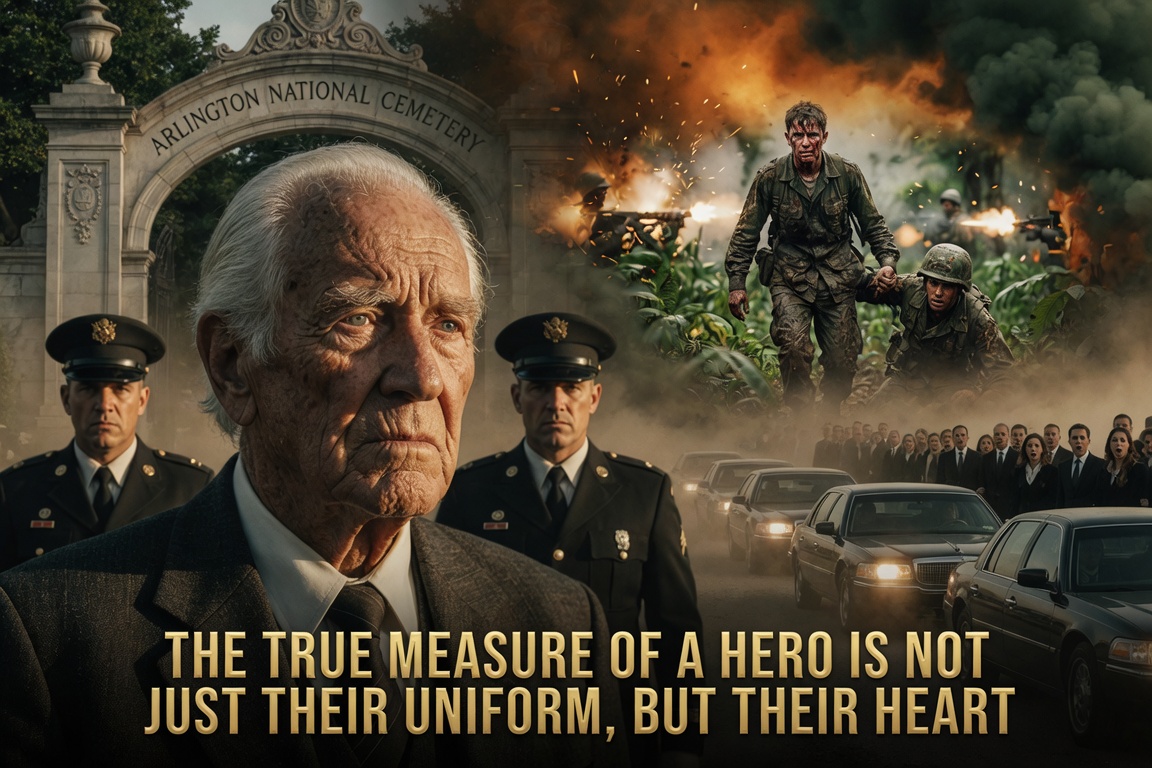
Behind him, a line of black government sedans curved along the road beneath Arlington’s bare November trees. Headlights glowed in the pale morning fog. Marines stood at intervals beside the iron gates, motionless beneath their dress caps. Farther up the hill, the low concussion of a ceremonial cannon rolled through the cemetery and faded among thousands of white stones.
General Thomas Bellamy was being buried with full military honors.
Cabinet officials were arriving. Senators. Foreign defense attachés. Decorated officers whose chests carried enough metal to catch the gray light.
And in the middle of them stood an eighty-two-year-old man in a suit with shiny elbows, holding a folded paper in one hand.
Staff Sergeant Vance removed his palm but did not step aside.
“Your name?”
“Elias Mercer.”
Vance checked the tablet held by the younger guard beside him.
Private First Class Owen Price scrolled through the guest registry, frowned, then scrolled again.
“No Mercer.”
The old man unfolded the paper. It was not an invitation. It was a letter, creased so many times the edges had begun to separate.
“General Bellamy’s office sent this to me three weeks ago.”
Vance did not take it.
“His office sent formal credentials to approved guests.”
“This came from Thomas himself.”
A woman in a dark wool coat glanced over from the security line. A camera operator near the press enclosure adjusted his lens. The old man’s suit hung loosely from narrow shoulders, and his shoes had been polished with care, though the leather was cracked near the toes.
Vance’s eyes dropped to the lapels.
No service pin.
No campaign ribbon.
No unit insignia.
Nothing.
“You served?” Vance asked.
The old man’s jaw shifted almost imperceptibly.
“Yes.”
“Branch?”
“Army.”
“What unit?”
There was a pause.
The fog drifted between them.
“I served where I was sent.”
Vance gave a small breath through his nose. Not quite a laugh, but close enough.
“That’s not a unit.”
“I know.”
“Rank?”
The old man looked past the gate toward the long rows of headstones disappearing into the mist.
“Not one that matters today.”
That answer changed something in Vance’s face.
The sergeant had spent the previous seventy-two hours being told that one mistake at this funeral could end his career.
The deceased had not been merely a general. Thomas Bellamy had served as Chairman of the Joint Chiefs, advised two presidents, and commanded coalition forces in three theaters. Intelligence agencies had warned of credible threats. Protest groups had announced plans to disrupt the burial. A defense contractor under federal investigation had sent anonymous messages to Bellamy’s family. Every credential had been triple-checked.
Vance had slept four hours in three days.
He had a mortgage in Fredericksburg, a wife who had stopped believing his promises about promotion, and a disciplinary notation in his file from an embassy detail eight years earlier, when he had allowed an elderly visitor through a restricted entrance because the man claimed to know the ambassador.
The man had not known the ambassador.
He had been carrying a knife.
No one had died, but Vance still woke some nights hearing the alarm.
He no longer made exceptions for old men.
“Step out of the line, sir,” he said.
Elias Mercer did not move.
“I came twelve hundred miles.”
“That doesn’t change the list.”
“He asked me to stand near his family.”
“Then his family should have issued you a credential.”
“They tried.”
Vance’s mouth tightened.
“Sir, I’m going to ask you once more.”
A black SUV stopped at the curb. Two officers stepped out beneath umbrellas. One wore three stars. The other wore the uniform of the British Army.
People began moving around Elias, parting as if he were a piece of luggage left in the wrong place.
He held the letter out.
“Read the last paragraph.”
Vance stared at it.
“I don’t need to.”
“You might.”
Price glanced at his sergeant, then at the old man.
“Staff Sergeant, maybe we can call the family liaison.”
Vance’s head turned a fraction.
It was enough to silence him.
“We are not calling a grieving family because a man arrived without credentials.”
Elias lowered the letter.
The cannon fired again.
This time, he flinched.
Only once.
His shoulders locked. His right hand closed around the paper. His eyes lost focus for the length of a breath, as if he were no longer standing at the gates of Arlington but somewhere much hotter, louder, and full of men who had not yet learned they were going to die.
Price saw it.
Vance saw only hesitation.
“Sir, move.”
“I promised him.”
“You are obstructing a secured entrance.”
“I promised Thomas I would come.”
“And I’m telling you General Bellamy is not available to confirm your story.”
The sentence landed harder than Vance intended.
Elias’s eyes returned to him.
For the first time, something in the old man’s face broke—not weakness, exactly, but the visible strain of holding a door shut against a room full of ghosts.
A few people in line looked away.
Vance felt the discomfort ripple through the crowd, and because embarrassment often disguises itself as authority, he straightened his shoulders.
“Escort him to the public viewing area,” he ordered.
Price hesitated.
“Sergeant—”
“Now.”
The public area was nearly half a mile from the gravesite, beyond a temporary barrier where ordinary visitors could watch the procession pass but would hear none of the eulogies.
Elias looked toward the hill.
“His daughter will expect me.”
“Then she’ll be disappointed,” Vance said.
Price’s eyes widened.
The woman in the wool coat stopped walking.
Vance heard himself, knew instantly that he had crossed a line, and still did not retreat from it. Too many senior officers were arriving. Too many people were watching. Backing down now would make him appear uncertain.
In Vance’s world, uncertainty was blood in the water.
Elias studied him for a long moment.
Then the old man folded the letter with careful fingers and placed it inside his jacket.
“You ever carry someone who was dying, Sergeant?”
Vance blinked.
“What?”
“Not in training. Not on a stretcher with a medic standing by. I mean carry a man while part of him is trying to stay alive and the rest already knows better.”
Price looked down.
Vance’s expression hardened.
“This conversation is over.”
Elias nodded.
“Yes,” he said. “I suppose it is.”
He turned away from the gates.
No protest.
No demand.
No attempt to invoke a famous name.
He simply walked toward the public barrier, one uneven step at a time, while the funeral of the man he had crossed a continent to bury proceeded without him.
And behind the iron gates, no one yet understood that the most important guest at Arlington had just been turned away.
Major General Rebecca Shaw arrived six minutes later.
At forty-nine, Shaw had the lean, disciplined stillness of someone who never wasted motion. Silver threaded the hair at her temples. A pale scar crossed the knuckle of her left hand, disappearing beneath a black glove.
She had commanded troops in Afghanistan and Syria. She had survived a helicopter crash outside Kandahar and spent eleven hours pinned beneath twisted aluminum beside a dead crew chief whose wife she later visited every Memorial Day.
She did not frighten easily.
But as her vehicle passed through the gate, she saw an elderly man walking alone beside the temporary fencing.
Something about his gait pulled at her attention.
Not the limp.
The rhythm.
Three steps. A slight pause. Then two more.
She turned in her seat.
“Stop.”
Her driver glanced at the security officer beside him.
“Ma’am?”
“I said stop.”
The SUV braked.
Shaw lowered the window. Cold air entered the cabin, carrying wet earth, exhaust, and the faint sulfur scent of ceremonial gunfire.
The old man had his back to her.
“Mr. Mercer?”
He stopped.
Shaw opened the door before her aide could reach it.
“Elias Mercer?”
He turned.
She had seen him only once before, in a photograph stored inside a sealed personnel archive at Fort Belvoir.
The picture had been taken in 1971. It showed twelve men standing outside a corrugated-metal operations hut somewhere the government still refused to name. Eleven wore uniforms.
The twelfth wore jungle fatigues without insignia.
He was twenty-seven years old, with a narrow face and watchful eyes.
Everyone else in the photograph had been identified by rank.
His name had been typed beneath the image in red.
MERCER, ELIAS J. — CIVILIAN STATUS COVER.
Thirty feet away, Staff Sergeant Vance was explaining the incident to a security captain.
Shaw looked from Elias to the distant gates.
“Why are you out here?”
Elias tucked his hands into his coat pockets.
“They didn’t find my name.”
Shaw’s eyes narrowed.
“Did you show them General Bellamy’s letter?”
“I tried.”
“Who stopped you?”
Elias glanced toward Vance.
Shaw followed his gaze.
The security captain saw her and immediately straightened.
“Ma’am.”
Vance turned.
His face changed when he recognized her rank, but only slightly. He had the rigid composure of a man who believed procedure would shelter him.
Shaw walked toward them.
Her aide hurried behind.
“What happened?” she asked.
Vance saluted.
“Ma’am, the gentleman arrived without approved credentials. His name was absent from the registry, and he could not provide verifiable service information.”
Shaw looked at Price.
“Is that accurate?”
Price’s throat moved.
“Yes, ma’am. But he had a letter.”
Vance cut in.
“An unverifiable personal document.”
“Did you read it?” Shaw asked.
“No, ma’am.”
“Why not?”
“Because handwritten correspondence does not supersede the security list.”
Shaw turned to Elias.
“May I see it?”
For a moment, the old man did not respond.
Then he removed the folded page.
Shaw opened it.
The handwriting was shaky, but the signature was unmistakable.
Elias—
Doctors say I have weeks, though doctors have underestimated my stubbornness before.
Rebecca has the funeral instructions. Laura knows your name. I have told them you are not to be seated behind the generals.
You are to stand with my family.
There are medals in my house because you refused to take them.
There is a career attached to my name because you carried me out.
There are grandchildren alive because fifty-five years ago you decided I was not too heavy.
Come to Arlington.
Do not make me outrank you from the grave.
—Tom
Shaw read the letter twice.
Her face revealed nothing, but the hand holding the paper became very still.
“Staff Sergeant,” she said, “you told him to leave?”
“I directed him to the designated public viewing area.”
“You refused to contact the family liaison?”
“The threat protocol—”
“Did not forbid verification.”
Vance’s jaw tightened.
“Ma’am, we’ve had three attempts this morning by individuals claiming personal relationships with the deceased.”
“And did any of those individuals carry a letter from General Bellamy?”
“No, ma’am.”
“Did any of them give you the name Elias Mercer?”
“No, ma’am.”
Shaw handed the letter back.
Vance saw the signature and felt the first cold movement beneath his ribs.
Still, he held his ground.
“Ma’am, even if the letter is authentic, his absence from the registry presents a security concern.”
Shaw looked at him for a long time.
“You’re correct.”
Price looked surprised.
Vance’s shoulders eased by a degree.
Then Shaw continued.
“That is why you should have escalated the discrepancy instead of humiliating him.”
The relief vanished.
“I maintained the perimeter.”
“You protected the gate from a man who can barely walk uphill.”
“Ma’am, with respect, age does not eliminate threat potential.”
Elias spoke from behind her.
“He’s right about that.”
Everyone turned.
There was no sarcasm in the old man’s voice.
That made it worse.
Elias looked at Vance.
“Fear keeps men alive. But fear without judgment turns a uniform into a costume.”
Vance’s face darkened.
Major General Shaw stepped between them before he could answer.
“Mr. Mercer, please come with me.”
Elias shook his head.
“The service has started.”
“We can still get you there.”
“No.”
Shaw lowered her voice.
“General Bellamy specifically requested—”
“I know what he requested.”
His gaze moved up the hill. The mist had begun to lift. White headstones emerged in long, precise ranks, each one carrying a name, a date, and a silence too large to measure.
“I won’t enter because someone with stars decides I’m suddenly worth letting through.”
Shaw absorbed the words.
Behind them, another convoy approached.
Police motorcycles.
Two armored vehicles.
A long black limousine bearing four small flags across its front fender.
The four-star general had arrived.
General Marcus Creed did not resemble the men who played generals in films.
He was not broad-shouldered or theatrically stern. He was sixty-three, compact, and slightly stooped from three decades of leaning over maps, casualty lists, and tables where younger men waited for him to decide who would go into danger.
Four silver stars rested on each shoulder.
As Chief of Staff of the Army, he was accustomed to rooms standing when he entered.
He hated it.
The moment his limousine stopped, an aide opened the door. Creed stepped onto the pavement, buttoning his overcoat. His wife emerged behind him.
He was halfway toward the entrance when he saw Major General Shaw standing outside the security perimeter with an elderly man.
Creed slowed.
The old man had removed his hat. Wind moved thin white hair across his forehead.
Creed’s expression emptied.
“Sir?” his aide said.
The general handed him his gloves.
“Stay here.”
Creed walked past the greeting party.
A lieutenant colonel hurried forward with a folder.
“General, the Bellamy family is assembling at the—”
Creed kept moving.
The officer stopped mid-sentence.
Cameras turned.
A senator paused beneath the gate.
The procession coordinator checked his watch, then looked up as the Army’s highest-ranking officer crossed the road toward a man dressed like someone who had arrived to repair a furnace.
Vance saw the four stars approaching and felt his stomach draw tight.
Major General Shaw came to attention.
Creed barely acknowledged her.
His eyes remained on Elias.
For three seconds, neither man spoke.
Then the general did something that no one expected.
He removed his service cap.
“Mr. Mercer,” he said.
Elias’s mouth moved, though no sound came.
Creed stepped closer.
“I’m Marcus Creed.”
“I know who you are.”
“My father was Daniel Creed.”
The old man stared at him.
Something shifted behind his eyes.
“Danny Creed?”
“Yes, sir.”
The general’s voice nearly failed on the last word.
Vance looked at Price.
Price looked back, confused.
Creed reached inside his overcoat and removed a black-and-white photograph protected in a clear sleeve. The corners were softened with age.
He held it out.
The image showed a young soldier sitting on a riverbank, shirtless and bandaged, one arm around another man whose face had been turned away from the camera.
“My father kept this in his Bible,” Creed said. “He told me the man beside him saved his life twice in one night and then disappeared before anyone could put him in for a medal.”
Elias did not take the photograph.
“He exaggerated.”
“He said you always said that.”
For the first time that morning, the old man smiled.
It was small and painful and gone almost immediately.
“Your father made it home?”
“He did. Thirty-nine more years.”
Creed swallowed.
“Long enough to raise three children. Long enough to meet seven grandchildren. Long enough to see me earn my first star.”
Elias looked down at the photograph.
“I didn’t know.”
“He tried to find you.”
“He wasn’t supposed to.”
The words sharpened the air.
Creed glanced at Shaw.
She gave the slightest nod.
The general looked toward the gate, then at the guards.
“Why is Mr. Mercer outside?”
No one answered.
Creed’s gaze settled on Vance.
“Staff Sergeant?”
Vance saluted.
“Sir, the individual was not on the authorized access registry.”
“The individual?”
Vance realized too late what he had said.
“Mr. Mercer, sir.”
“And when Mr. Mercer produced a personal letter from General Bellamy?”
“I did not verify it, sir.”
“Why?”
“Operational security.”
Creed’s face did not change.
His voice became softer.
“Operational security is not a phrase you use to end thought.”
Vance stood rigidly.
“No, sir.”
Creed turned to the cemetery entrance.
“Stop the procession.”
The coordinator stared at him.
“General?”
Creed looked over.
“Stop everything.”
The command traveled outward in stunned fragments.
An officer raised a hand.
The honor guard halted.
The caisson horses shifted beneath black harnesses, steam rising from their nostrils. The military band lowered its instruments. A chaplain closed his folder. Drivers turned off engines one after another until the road fell silent.
Even the cannon detail received the order.
For the first time that morning, Arlington held no sound but wind.
General Creed faced Elias.
“Thomas Bellamy waited fifty-five years to bury a secret,” he said. “I will not let him be buried before it is spoken.”
Elias’s face closed.
“No.”
Creed stepped nearer.
“Sir—”
“I said no.”
The four-star general stopped.
The crowd had expanded around them. Officers, mourners, press, security personnel. Bellamy’s family was visible near the caisson, confused by the interruption.
A woman in her fifties broke away from them.
Laura Bellamy moved quickly despite her heels, gathering her coat as she crossed the road. Her father’s eyes lived in her face—clear gray, direct, impatient with ceremony.
When she saw Elias, she covered her mouth.
“Oh, God.”
Elias looked at her.
“You’re Laura.”
She nodded, tears already rising.
“You came.”
“I tried.”
Her gaze moved to Vance, then to the letter in Elias’s hand.
Understanding arrived piece by piece.
“My father had your name placed at the top of the list.”
Vance turned toward Price.
Price pulled up the registry again.
“It isn’t here,” he whispered.
Laura reached them.
“I gave it to Colonel Dyer myself. Elias Mercer. Family section. No screening delay.”
Creed’s eyes shifted toward the funeral staff.
“Find Colonel Dyer.”
An aide moved instantly.
Elias looked at Laura.
“He talked about you.”
“He talked about you more.”
“He shouldn’t have.”
“He said you would say that too.”
She took his hands.
The moment she touched them, she felt the scar tissue.
Both palms were ridged with pale, uneven bands. The little finger of his left hand bent inward and would not straighten. Two fingernails were permanently darkened.
Laura turned them upward.
“What happened?”
Elias tried to pull away.
She held on.
“My father wrote that you carried him.”
Creed answered for him.
“He carried more than General Bellamy.”
Elias’s eyes hardened.
“Marcus.”
The use of the general’s first name drew a murmur from somewhere behind them.
Creed did not react.
“He deserves his privacy,” Major General Shaw said quietly.
Creed looked at her.
“He has had privacy for half a century. Other men turned his silence into their glory.”
Elias’s head lifted.
“That wasn’t Thomas.”
“No,” Creed said. “It wasn’t.”
A gust of wind moved through the trees. Somewhere in the crowd, a camera shutter clicked.
Creed took a breath.
“My office declassified portions of Operation Lantern last month.”
Elias looked as if someone had struck him.
“You had no right.”
“The order came from the Secretary of Defense.”
“Then he had no right either.”
Laura released his hands.
Operation Lantern meant nothing to most of the people listening.
But several older officers went still.
Major General Shaw watched recognition move through them.
Lantern had existed for decades as a rumor passed between intelligence veterans: an unauthorized extraction in Laos after official American ground operations were supposed to have ended. A surveillance team had been compromised. Aircraft support was denied. The men were written off to preserve diplomatic deniability.
Seven returned.
The files listed the eighth rescuer only as CROW.
General Creed faced the crowd, but he spoke to Elias.
“My father told me there were fourteen of you at the landing zone.”
“Thirteen.”
“He said fourteen.”
“One was dead before we moved.”
“And how many could walk?”
“Four.”
“How many did you carry?”
Elias said nothing.
Creed’s jaw tightened.
“How many?”
“Enough.”
Laura’s eyes moved to the old man’s shoulders, as if trying to imagine the weight they had once carried.
Creed lifted the photograph.
“My father said you crossed the river six times under fire.”
Vance stared at Elias.
The threadbare suit was unchanged.
The cracked shoes were unchanged.
But the man inside them was becoming unrecognizable.
Not transformed.
Revealed.
“The bridge was gone,” Creed continued. “The extraction helicopters could not land. Enemy patrols were closing from the north. Captain Bellamy had a shattered pelvis. Sergeant Daniel Creed had a sucking chest wound. Two others were unconscious.”
“Stop,” Elias said.
“You used parachute cord to bind them to your back.”
“Stop.”
“You carried them through a river during flood season.”
Elias took one step toward the general.
“I said stop.”
The force in his voice silenced the road.
Creed looked into his face.
What he saw there was not modesty.
It was terror.
Not fear of attention.
Fear of memory.
The four-star general lowered the photograph.
Elias’s breathing had changed. Quick, shallow. His scarred hands trembled. He looked beyond the crowd at something none of them could see.
Rain hammering black water.
Flares burning over jungle.
A young Thomas Bellamy whispering that his legs were gone.
Danny Creed choking on his own blood.
A boy named Luis Ortega begging Elias not to leave his brother behind.
The old man pressed a fist to his chest.
Major General Shaw moved first.
“Give him space.”
Laura stepped back.
Creed’s anger disappeared.
“Mr. Mercer?”
Elias bent forward.
Price reached him before he fell.
The young guard caught his arm, and Elias’s hand clamped around Price’s sleeve with astonishing strength.
“Don’t let them see me like this,” he whispered.
Price looked at the ring of uniforms and cameras.
Then he did something Staff Sergeant Vance had not taught him.
He removed his ceremonial overcoat and held it up between Elias and the press.
Major General Shaw stepped beside him and did the same.
General Creed turned toward the camera crews.
“Lower every lens.”
No one moved quickly enough.
Creed’s voice cracked across the road.
“Now.”
Cameras dipped.
Elias stood behind the shelter of dark wool, breathing through the past.
One breath.
Then another.
When he finally straightened, Price kept a hand near his elbow without touching him.
The old man nodded once.
“I’m all right.”
No one believed him.
But they allowed him the dignity of pretending.
Colonel Andrew Dyer arrived under escort three minutes later.
He was Bellamy’s former military aide, a polished officer in his early forties with a reputation for flawless logistics and a career path angled sharply toward general rank.
He approached General Creed with the controlled urgency of someone who had already learned the shape of the disaster.
“Sir.”
“Mr. Mercer’s name was removed from the access list,” Creed said.
Dyer’s eyes moved toward Elias.
“Yes, sir.”
Laura’s head snapped around.
“You removed it?”
Dyer faced her.
“Ms. Bellamy, I made a security judgment.”
“You told me everything was arranged.”
“I believed it was inappropriate to place an unverified individual in the family section of a state funeral.”
“My father verified him.”
“Your father was receiving morphine and experiencing periods of confusion.”
Laura’s face drained.
Elias looked away.
Dyer continued, speaking now to Creed.
“Sir, we could find no current service record, no award citation, no official confirmation of the claims in General Bellamy’s letter. Mr. Mercer declined previous requests to participate in the historical review. Given the threat environment, I removed him pending further authentication.”
“You did not notify the family,” Creed said.
“No, sir.”
“You did not notify my office.”
“No, sir.”
“You altered a principal guest list authorized by the deceased.”
“Yes, sir.”
Dyer’s throat tightened.
“But I did so to protect the integrity of the ceremony.”
Elias gave a quiet, humorless laugh.
Everyone looked at him.
Dyer’s eyes narrowed.
“With respect, Mr. Mercer, you must understand how this appeared.”
Elias looked at the colonel’s uniform.
The ribbons.
The badges.
The silver eagle at his collar.
“I understand exactly how it appeared.”
Dyer’s voice gained confidence.
“Then you understand my position. We receive false claims constantly. Men invent service histories. They purchase uniforms. They attach themselves to decorated officers and grieving families. I had no way to distinguish you from—”
“From a fraud,” Elias said.
Dyer paused.
“Yes.”
The word hung between them.
Staff Sergeant Vance looked at Dyer as if he had been handed a life raft. His own decision had not begun at the gate. The list itself had been altered by a colonel.
Procedure had failed before he ever touched the old man.
But relief lasted only a second.
Elias turned toward Vance.
“The colonel erased my name,” he said. “You erased me.”
Vance’s lips parted.
Elias continued.
“He made a decision in an office. You looked into my face.”
No one moved.
“You saw an old suit,” Elias said. “You saw empty lapels. You saw a man who could not prove himself quickly enough for your patience.”
Vance swallowed.
“I saw a security discrepancy.”
“No. You saw someone safe to disrespect.”
The words struck with surgical precision.
Price lowered his eyes.
Vance’s face reddened.
“I was carrying out my duty.”
Elias stepped closer.
Despite the limp, despite the tremor still visible in his hand, something in him now commanded the space more completely than rank.
“I have heard men use duty to excuse cruelty in six languages.”
Vance’s jaw flexed.
“You think I enjoyed this?”
“I think you enjoyed being obeyed.”
A murmur moved through the witnesses.
The sergeant looked around and saw what Elias saw: the phones, the cameras, the officers, the family of the dead general.
Public humiliation.
The very thing he had inflicted had turned toward him.
His breathing sharpened.
“You don’t know anything about me.”
Elias’s gaze did not shift.
“You’re right.”
The answer robbed Vance of momentum.
Elias looked at the scar near Vance’s right ear, the slight stiffness in his neck, the old burn mark visible above his collar.
“I don’t know where you got hurt. I don’t know who failed you before you decided no one would ever make a fool of you again. I don’t know what mistake taught you that mercy is weakness.”
Vance’s eyes flickered.
Elias had found the hidden door.
“But I know this,” the old man said. “Pain does not make you cruel. It only gives you something to blame when you choose cruelty.”
Vance’s face went still.
For a second he was not at Arlington.
He was twenty-nine again, standing inside the American embassy in Amman while alarms screamed. He was watching blood run down a marble wall from the hand of the security officer who had tackled the old man with the knife. He was hearing his commander tell him, You wanted to be kind. Now remember what kindness costs.
Vance looked at Elias Mercer.
At the suit.
At the hands.
At the letter he had refused to read.
The certainty drained from his posture first.
His shoulders lowered.
Then his chin.
Then his eyes.
The moment of recognition was almost silent.
A four-star general stood ten feet away, yet Vance no longer seemed aware of him. The crowd vanished. The cameras vanished. There was only the old man and the unbearable fact that Vance had mistaken humiliation for vigilance.
His mouth opened.
Nothing came out.
Elias waited.
When Vance finally spoke, his voice was rough.
“I was wrong.”
No one moved.
Vance drew a breath that shook despite his effort to control it.
“I should have read the letter. I should have called the liaison. I should not have touched you.”
Elias’s eyes dropped briefly to the sergeant’s hand.
Vance looked at it too, as if seeing it again against the old man’s chest.
“I was wrong,” he repeated.
Elias nodded once.
It was not forgiveness.
But it was not contempt either.
Then he turned to Colonel Dyer.
“You removed my name because my history could not be verified?”
Dyer stood straighter.
“Yes.”
Elias reached inside his coat.
The movement caused two security agents to tense.
What he withdrew was not a weapon.
It was a small brass key.
Old, tarnished, attached to a faded red cord.
He placed it in General Creed’s palm.
Creed stared at it.
“I gave Thomas the other one in 1971,” Elias said. “He kept the box.”
Laura’s breath caught.
“What box?”
Elias looked at her.
“Your father knew his reports would be rewritten. He knew men in Washington would call the operation a navigational accident and classify the survivors into silence.”
Creed closed his fingers around the key.
“What is in it?”
“The original radio logs. Photographs. Coordinates. Names. An audio recording your father made three days after we returned.”
Colonel Dyer’s face changed.
Only slightly.
But Elias saw it.
So did Major General Shaw.
Dyer said, “General Bellamy’s secured papers were transferred to the Army historical office last month.”
“Not all of them,” Laura whispered.
Her father had left instructions concerning a locked steel box in the basement of his Virginia home. She had assumed it contained personal letters and had honored his request not to open it until after the funeral.
Elias looked at Dyer.
“You knew about the review.”
Dyer’s eyes sharpened.
“Of course. I coordinated portions of it.”
“And you knew the official record named Colonel Nathan Dyer as the officer who organized the extraction.”
The colonel’s face lost color.
Nathan Dyer had been Andrew’s grandfather.
A celebrated intelligence officer.
Recipient of the Distinguished Service Cross.
The foundation of the younger Dyer’s military identity.
Creed’s hand tightened around the key.
Andrew Dyer spoke carefully.
“My grandfather’s citation is a matter of public record.”
“Yes,” Elias said. “So is the lie inside it.”
The cemetery seemed to tilt around them.
Laura Bellamy stared at Dyer.
Major General Shaw’s eyes hardened.
Elias’s voice remained level.
“Nathan Dyer was forty miles away when the team was compromised. He denied air support because he feared exposing the operation. Thomas spent the rest of his life trying to correct the record without destroying the families of men who had already died.”
Dyer’s face had gone rigid.
“That is an allegation made by a man who refused every formal inquiry.”
“I refused because the inquiry was designed to protect the institution.”
“And now we are expected to accept your account because you appear at a funeral with a key?”
“No,” Elias said. “You are expected to listen to your grandfather’s voice on the radio log.”
Dyer stopped breathing for a second.
That was all the confirmation Creed needed.
The four-star general looked at Major General Shaw.
“Secure the Bellamy residence. Place the historical transfer under review. No document leaves custody.”
“Yes, sir.”
Dyer stepped forward.
“General, I strongly object to—”
Creed turned.
The force in his expression stopped the colonel mid-step.
“You removed a dying man’s chosen guest from his funeral because that guest threatened your family’s mythology.”
“That is not what happened.”
“Then you will welcome the investigation.”
Dyer’s eyes moved across the watching officers.
He saw careers calculating their distance from him.
He saw the press cameras rising again.
He saw Laura Bellamy’s grief changing shape.
Most of all, he saw Elias Mercer standing in the suit Dyer had assumed would make him invisible.
Dyer had built his life on control.
On credentials.
On the careful inheritance of honor.
Now an old brass key rested in the hand of the Army Chief of Staff, and the foundation beneath him had begun to crack.
“Sir,” Dyer said, “whatever my grandfather may have done has no bearing on today’s access decision.”
Elias answered before Creed could.
“It has everything to do with it.”
Dyer looked at him.
“You didn’t remove my name because I was unverified,” Elias said. “You removed it because you were afraid I might be believed.”
Dyer’s mouth tightened.
There it was.
Not a confession.
Something more revealing.
Silence.
Laura Bellamy stepped closer to him.
“My father trusted you.”
Dyer looked at her, and for the first time his composure failed.
“He also intended to destroy my family.”
“No,” Elias said. “He intended to tell the truth.”
“You think truth arrives clean?” Dyer snapped.
The restraint vanished from his voice.
“My grandfather is buried here. My father spent his life defending his name. My children carry it. One recording, one disputed account, and everything becomes fraud.”
Elias looked past him toward the rows of graves.
“The men we left in that jungle had families too.”
Dyer’s face twisted.
“You survived.”
“Not all of me.”
The words landed quietly.
No one mistook them for poetry.
Elias opened his left hand.
The damaged finger.
The scar tissue.
The tremor he could not fully hide.
“I came home,” he said. “That is not the same thing.”
The fury left Dyer as quickly as it had appeared.
He looked at the white stones.
At the old man.
At General Bellamy’s flag-draped casket waiting in the road.
His shoulders sank.
For years he had told himself he was preserving honor.
Now, in the stillness of Arlington, he could hear the uglier truth beneath it.
He had been preserving inheritance.
General Creed addressed two military police officers.
“Colonel Dyer is relieved of ceremonial duties effective immediately. Escort him from the restricted area.”
Dyer looked at Creed.
“Am I under arrest?”
“Not today.”
The words were colder than an arrest.
Dyer turned toward Elias.
For a moment, it seemed he might speak.
Apologize.
Accuse.
Beg.
Instead, he removed his ceremonial gloves one finger at a time and handed them to the nearest aide.
Then he walked between the white stones without looking back.
No one followed except the officers assigned to ensure he kept moving.
The funeral resumed twenty-four minutes late.
But not as planned.
General Creed ordered the senior military delegation moved back one row.
The Cabinet members moved with them.
So did the foreign officers.
At the front, beside Laura Bellamy and her children, an empty chair waited.
Elias stood before it.
“I’d rather stand,” he said.
Laura touched his arm.
“My father said you would.”
The caisson approached over the wet road.
Six black horses.
A seventh, riderless horse followed behind, boots reversed in the stirrups.
The band played softly. The notes moved through the trees like breath against glass.
Elias watched the flag-draped casket come near.
For fifty-five years, Thomas Bellamy had existed in fragments: a young captain bleeding into Elias’s shoulder, a voice over a telephone every Christmas, a handwritten card after Elias’s wife died, a photograph of Laura graduating college, a message left six months earlier asking him to visit.
Elias had not gone.
That was his shame.
Thomas had become famous. Elias had become private. Every invitation felt like a demand to walk back into a night he had spent a lifetime escaping.
Then the letter arrived.
Come to Arlington.
Do not make me outrank you from the grave.
Elias had laughed when he read it.
Then he had sat alone at his kitchen table until dawn.
Now the casket stopped before him.
The honor guard lifted it from the caisson.
For one impossible instant, Elias saw not an eighty-year-old statesman inside a coffin but a twenty-three-year-old captain tied to his back with parachute cord.
Tom’s breath hot against his neck.
Don’t drop me, Crow.
You’re too ugly to carry twice.
Promise you won’t leave Danny.
Shut up and breathe.
The old man’s knees weakened.
Price stood several yards away with the security detail.
He saw it and took half a step forward.
Vance stopped him with a hand.
Not to restrain him.
To say, Let him choose.
Elias steadied himself.
The casket passed.
He raised his right hand.
The salute was imperfect.
Two fingers would not fully straighten. His elbow shook. His shoulder had not moved correctly since 1971.
Yet every officer present understood what they were seeing.
General Creed saluted.
Major General Shaw followed.
Then the three-star general.
The British officer.
The Marines at the gate.
Price.
Finally, after a hesitation visible to everyone, Vance raised his hand too.
Elias held the salute until the casket reached the grave.
Three rifle volleys cracked across the cemetery.
The first made him flinch.
The second made his eyes close.
By the third, Laura had slipped her hand into his.
The bugler lifted his instrument.
“Taps” began.
No one moved.
No one whispered.
And when the final note thinned into the cold air, the silence afterward seemed to belong not only to Thomas Bellamy, but to every man whose courage had been classified, reassigned, polished, and pinned to someone else’s chest.
The flag was folded.
General Creed received it and carried it to Laura.
But before presenting it, he turned toward Elias.
“Mr. Mercer.”
Elias shook his head.
Creed continued.
“By order of General Bellamy’s family, this flag is to be presented jointly.”
Laura stepped beside the general.
Together, they held the folded flag between them.
Elias stared at the white stars.
“I don’t have a place for that.”
Laura’s voice broke.
“Yes, you do.”
He looked at her.
“My father came home because you carried him. Everything he became happened after that river.”
She placed the flag in his scarred hands.
“This belongs to the part of his life that belonged to you.”
Elias lowered his head.
The old man who had endured armed patrols, drowning water, interrogation rooms, and fifty-five years of official silence began to cry without sound.
No one looked away.
The investigation lasted nine months.
The steel box was opened under joint military and congressional supervision.
Inside were six magnetic tapes sealed in waxed cloth, two rolls of undeveloped film, maps marked by Thomas Bellamy’s hand, and a notebook containing the names of everyone involved in Operation Lantern.
The radio logs confirmed that Lieutenant Colonel Nathan Dyer had denied extraction support, then altered the after-action report.
They also confirmed that Elias Mercer, operating under civilian cover, had disobeyed orders and crossed into hostile territory alone after command declared the surveillance team unrecoverable.
He found thirteen men.
Seven were alive when he reached the river.
Six survived the crossing.
Thomas Bellamy was one of them.
Daniel Creed was another.
Elias had made repeated trips through floodwater while under rifle fire, using a length of communication wire as a guide line. On the final crossing, an explosion burned both his hands and drove metal into his shoulder.
The classified recommendation for the Medal of Honor had been suppressed because acknowledging his actions would have exposed an illegal operation.
Colonel Andrew Dyer resigned his commission before a formal board could remove him.
He issued no public statement.
Staff Sergeant Nolan Vance received an official reprimand for failure to follow verification protocol and for conduct unbecoming the standards of the ceremonial security command.
Many expected that to be the end of his career.
It was not.
Three weeks after the funeral, Vance drove to West Virginia.
Elias lived outside a town small enough that the post office closed at noon. His house stood at the end of a gravel road beneath bare maple trees. A rusted pickup rested beside a shed. Wind chimes moved on the porch without making sound because one of the strings had broken.
Vance parked at the gate and sat in his truck for almost ten minutes.
Then he walked to the door.
Elias opened it wearing a flannel shirt and holding a wrench.
He looked at the sergeant’s civilian clothes.
“You lost?”
“No.”
Vance held out an envelope.
Elias did not take it.
“What is it?”
“My written apology.”
“I heard the spoken one.”
“It wasn’t enough.”
“No,” Elias said. “It wasn’t.”
Vance absorbed the blow.
Then he nodded.
“I know.”
They stood in the cold.
Finally, Elias took the envelope but did not open it.
Vance looked toward the shed.
“You working on something?”
“Generator.”
“Problem?”
“Doesn’t generate.”
Vance almost smiled.
“I was a mechanic before the Army.”
Elias stepped aside from the doorway.
“Then you can make yourself useful.”
They repaired the generator in silence.
Vance returned the next month.
Then again in spring.
He never asked Elias to forgive him.
Elias never said that he had.
Some things changed without announcing themselves.
A new directive was issued for ceremonial security teams: discrepancies involving elderly veterans, Gold Star families, or personally invited guests required immediate liaison review. Guards were retrained to distinguish firmness from degradation.
Price earned a commendation for protecting Elias from media exposure during his trauma response.
Major General Shaw personally pinned it to his uniform.
“You saw the man before you knew the story,” she told him. “Do not lose that.”
A year after Thomas Bellamy’s funeral, the President presented Elias Mercer with the Medal of Honor in the East Room of the White House.
Elias accepted only after the citation was rewritten to include the names of the men who did not return.
He wore the same black suit.
Laura had offered to buy him a new one.
He refused.
“Nothing wrong with this suit,” he said.
Before the ceremony, an aide tried to attach a small Army service pin to his lapel.
Elias stopped her.
“Leave it empty.”
She looked confused.
“Sir?”
He glanced toward the crowd, where General Creed stood beside his family, and where Nolan Vance watched from the last row in a borrowed jacket.
“People should have to decide how to treat me before they know what I’ve done.”
The aide lowered her hand.
When Elias entered the East Room, everyone stood.
But he did not look at the President.
He looked at Vance.
The former guard came to attention.
For a heartbeat, neither man moved.
Then Elias gave him a small nod.
Vance’s eyes shone.
He returned it.
Years later, visitors to Arlington would sometimes hear a story about the morning an old man was refused at the gates.
The story usually focused on the four-star general stopping the funeral.
People remembered the halted horses, the silent band, the senior officers stepping aside. They remembered the hidden operation, the old key, and the hero who had carried wounded men through a river under fire.
But those who had been there remembered something else.
They remembered a white-gloved hand pressed against a worn black suit.
They remembered how easily a crowd had accepted the judgment of a uniform.
And they remembered the instant that judgment collapsed—not because the old man changed, but because the truth forced everyone else to see what had been standing in front of them all along.
Honor had never been absent from Elias Mercer’s chest.
It had simply been waiting to discover who required a medal before offering respect.