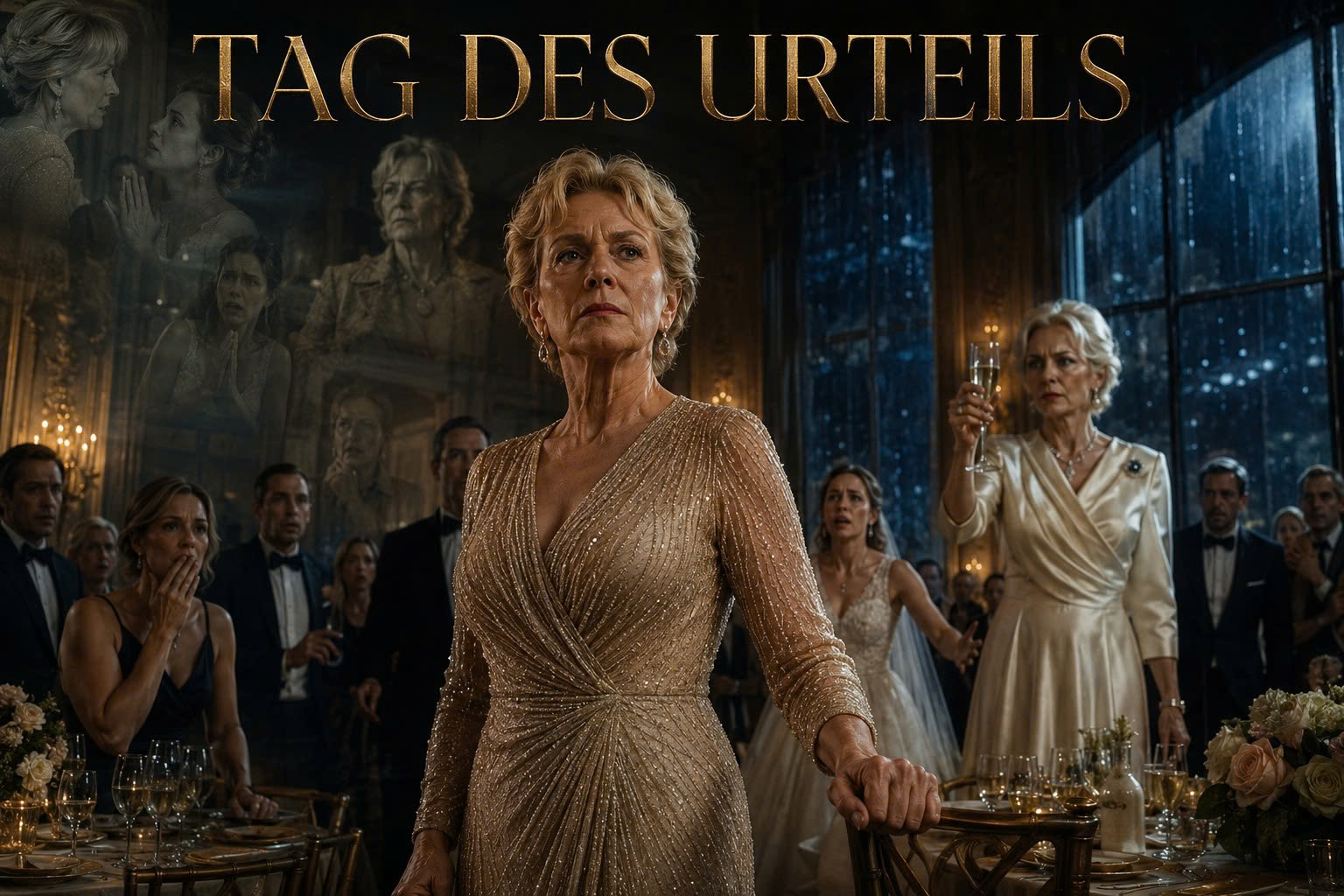
Chapter One: The Toast
The first thing I noticed was that my husband had chosen my grandmother’s champagne.
Not the inexpensive sparkling wine he kept for real-estate clients. Not the bottle we opened every Christmas and pretended tasted better because it came with memories.
He had taken the 1989 Veuve Clicquot from the locked cabinet in the dining room. The one my grandmother Eleanor had bought the year she sold her first painting. The one she had told me never to open for a celebration that did not deserve it.
The cork had already been fired.
It lay beneath the sideboard, damp and crushed beneath someone’s heel.
I stood in the doorway with rainwater dripping from my coat, my overnight bag still hanging from one shoulder. The chandelier threw gold light across the long walnut table. Twelve people sat around it: Caleb’s business partners, two women from the country club, his younger brother and his wife, and at the far end, Vivienne Hart.
Vivienne wore red.
Not a bright red. A deep, polished shade, like the inside of a wound that had stopped bleeding but never truly healed.
Her hand rested on Caleb’s forearm.
My husband saw me and smiled as if he had been expecting a delivery.
“There she is,” he said.
No one stood.
No one said hello.
I looked at the table. At the silverware that had belonged to my mother. At the blue-and-white china my grandmother had carried across the Atlantic in a crate after marrying my grandfather. At the roses cut from the garden I had spent ten years restoring.
Then I looked at Caleb.
His tie was loosened. His cheeks were flushed from champagne. He looked handsome in the way that had once made strangers assume he was kinder than he was.
“Why is everyone here?” I asked.
Caleb lifted his glass.
“To new beginnings.”
A few people laughed too quickly.
Vivienne didn’t.
She was watching me with the tense stillness of someone waiting for a car crash she had caused.
I set my bag on the floor.
“New beginnings?” I repeated.
Caleb leaned back in his chair. “Don’t make this difficult, Mara.”
The room contracted around his voice.
He had used that phrase for years. When I asked why his business account had been emptied. When I found lipstick on the collar of a shirt he said he had worn to a conference. When he disappeared for an entire weekend and came back with an apology so polished it could have been sold in a jewelry store.
Don’t make this difficult.
As if difficulty were something women created by noticing what men did.
His brother Grant stared into his plate. His wife, Lila, pressed her lips together. She had always hated this house because it made her feel small, though she never understood that the house was never trying to do that. Houses don’t humiliate people. People do.
Caleb rose and placed both palms on the table.
“I’ve been patient,” he said. “God knows I’ve been patient.”
The sentence landed so heavily that even the rain against the windows seemed to pause.
“I supported you after your mother died. I supported you while you drifted from project to project. I supported you while you hid in this place and called it grief.”
My fingers closed around the strap of my bag.
Vivienne’s gaze flickered toward the fireplace. Above it hung my grandmother’s final painting: a woman standing on a cliff in a black dress, her face turned toward a violent gray sea.
Caleb had once told me it made him uncomfortable.
Now he had positioned himself beneath it.
“I built a life for us,” he continued. “I built a company. I built a future. And all you’ve done is sit here, spending money you didn’t earn, acting like this house gives you some kind of authority.”
A silence spread over the table.
Not the kind born from respect.
The kind born from appetite.
People liked a public unraveling as long as it wasn’t theirs.
Caleb reached for Vivienne’s hand. This time, he did not bother hiding it.
“I’m done carrying dead weight,” he said.
Vivienne inhaled sharply, almost too softly to hear.
My chest didn’t ache. That surprised me.
There had been a time when one cruel word from Caleb could ruin an entire week. A time when I would replay his tone, his expression, the exact angle of his mouth, searching for a version of the conversation in which I had deserved mercy.
But something inside me had gone quiet three days earlier.
Not numb.
Quiet.
Like the moment before a courtroom verdict.
I looked around the table. At the guests who had eaten from my family’s silver. At the woman in red. At the man who had spent six years telling everyone that he had rescued me from my own life.
Then I walked to the sideboard.
Caleb frowned. “What are you doing?”
I picked up the champagne bottle and read the label.
“Grandmother bought this in 1989,” I said.
He gave a hard little laugh. “Seriously?”
“She bought it after her first gallery in Manhattan. She was forty-two. Divorced. Broke. Everyone told her she should sell the house because a woman alone couldn’t maintain it.”
“Mara.”
“She kept it anyway.”
Vivienne’s face had changed.
It was not dramatic at first. Just a tiny loss of color around the mouth. Her fingers slipped from Caleb’s arm.
I turned toward her.
“You know who Eleanor Vale was, don’t you?”
Caleb’s jaw tightened. “Leave Vivienne out of this.”
But Vivienne was no longer looking at him.
She was looking at the painting above the fireplace.
At the signature in the corner.
E. Vale.
I had seen that expression before, years ago, on the face of a man who discovered the land he planned to develop was protected by a decades-old conservation trust. It was the expression of someone who had arrived at a locked door with a stolen key.
“I’m sorry,” Vivienne said.
Caleb blinked. “For what?”
She stood so abruptly that her chair scraped across the oak floor.
“Mara,” she said, and my name sounded strange in her mouth. Fragile. “You said this house was your grandmother’s.”
“It is.”
Caleb laughed again, but there was no humor in it now. “It’s our house.”
I looked at him.
“Actually,” I said, “this house was never yours.”
The champagne glass slipped from Vivienne’s hand.
It struck the floor and shattered.
For one second, no one moved.
Then Caleb’s face changed.
Not with understanding.
With fear.
And I knew he had finally remembered the envelope I had found in my mother’s safety-deposit box.
The envelope with his name written across the front.
Chapter Two: The Envelope
Three days earlier, I had been standing in a bank vault beneath downtown Boston, holding a key that had belonged to my mother.
The vault smelled like metal, dust, and old paper. A young employee in a navy suit had walked me to a narrow room with a polished table and left without speaking.
The box was smaller than I expected.
My mother, June, had died nine months before. A stroke at sixty-two. No warning. No final conversation. One moment she was calling me to complain about a neighbor’s dog; the next, I was standing beside a hospital bed listening to machines make decisions no daughter should have to understand.
Afterward, I found dozens of things she had kept from me.
Letters. Receipts. A photograph of my father I had never seen.
And the key.
At the bottom of the box was a leather folder stamped with the name of my grandmother’s estate attorney, Malcolm Reed. Beneath it lay a bundle of letters tied in blue ribbon and one sealed envelope.
MARA, IF CALEB EVER TELLS YOU THIS HOME BELONGS TO HIM, OPEN THIS.
The handwriting was my mother’s.
I stared at it for a long time before I touched it.
My hands shook when I broke the seal.
Inside was a copy of a legal trust agreement, a property deed, and a letter.
My daughter,
If you are reading this, then I either waited too long to tell you, or your husband has begun doing what I feared he would do.
The house at 18 Wrenfield Road is held in the Eleanor Vale Preservation Trust. You are the sole lifetime beneficiary. Caleb has never owned it, despite what he has told you, despite what he may have placed before you to sign.
Your grandmother made this arrangement because she knew charm can look like love when a woman is tired enough.
There was more.
A list of dates.
A list of wire transfers.
One name repeated three times: Caleb Rowe.
I called Malcolm Reed that afternoon.
He was eighty-one and lived in a small brick house in Cambridge where the front steps leaned slightly to the left. He opened the door wearing a cardigan and the expression of a man who had been waiting for bad news for years.
“I was wondering when you’d find it,” he said.
“You knew?”
“I knew enough.”
His living room was lined with books. Legal volumes, art books, photographs of Eleanor Vale in different decades. Eleanor on a ladder, paint in her hair. Eleanor at a protest in the seventies. Eleanor holding me as a baby, looking less like a grandmother than a woman who had simply decided I was hers to protect.
Malcolm poured tea with both hands.
“Your grandmother didn’t trust Caleb,” he said.
“She barely knew him.”
“That was enough for Eleanor.”
I almost laughed. Instead, I looked at the documents again.
“He told me the house was in both our names.”
“He could not have legally done that.”
“I signed papers.”
“Yes.”
The room seemed to tilt.
Malcolm sat across from me, quiet.
“He said we were refinancing after his first company struggled,” I said. “He said it was temporary.”
“I know.”
“You know?”
He nodded. “Your mother came to me six years ago. She had found a second mortgage application in Caleb’s files. He had forged portions of your signature.”
The tea in my cup trembled.
“Why didn’t she tell me?”
“Because you were pregnant then.”
The word cut through the room.
I had not been pregnant for long. Ten weeks. Long enough to imagine a crib beneath the bedroom window. Long enough to think perhaps Caleb would become gentle when he had someone small to protect.
Then I lost the baby.
Caleb was away when it happened. He said he couldn’t get a flight home. Later, I learned he had been in Miami with investors.
And Vivienne.
At the time, I didn’t know her name.
My mother had sat beside my hospital bed and stroked my hair until the sun came up. She never told me that while I was bleeding in a hospital room, she had been collecting evidence against my husband.
“She thought grief had made you too vulnerable,” Malcolm said. “She wanted to wait until you were stronger.”
I looked at my mother’s letter again.
There was one final line.
Do not mistake being quiet for being powerless. Your grandmother taught me that. I failed to teach you soon enough.
“I don’t understand the transfers,” I said.
Malcolm pulled a file from beneath the table.
The money came from a family trust created after Eleanor’s death. It was intended for the restoration of the house and for your work. Your art, your teaching, whatever life you chose. But Caleb had accessed the account through documents he said you had approved.”
“How much?”
Malcolm did not answer immediately.
That was how I knew it was bad.
“Three point eight million dollars over seven years.”
The number did not sound real.
It sounded like a building collapsing somewhere far away.
“He used my inheritance?”
“He used part of it. We believe he moved the money through several companies. One of them has a connection to a property-development group in Rhode Island.”
My mother’s unfinished notes were in the file.
Names. Dates. Account numbers.
And one item circled in red ink:
HART HERITAGE GROUP.
Vivienne Hart’s family company.
The same company that had recently announced plans to purchase historic homes along the coast and turn them into “private wellness residences.”
I saw Vivienne differently then. Not as Caleb’s beautiful secret. Not as the woman he had chosen because she was younger, shinier, and untouched by the years he had spent grinding me down.
I saw her as a person who might have entered my life long before I knew her name.
“Does she know?” I asked.
Malcolm looked toward the window.
“I don’t know,” he said. “But I suspect she knows more than she should.”
That night, I drove home through rain so heavy the road disappeared beneath a silver sheet of water.
Caleb was not there.
His car was parked in the garage, but the house felt empty in the way it had felt during my grandmother’s funeral: full of furniture, full of history, and stripped of the one person who could explain what came next.
I walked into his office.
His desk was locked.
But I knew where he kept the spare key.
Inside the bottom drawer, beneath old tax folders and a bottle of bourbon, I found a thin black notebook.
The first pages contained business figures.
The later pages contained something else.
Names of investors. Notes about properties. Personal observations.
“Mara won’t ask questions if she thinks she is protecting the house.”
“Need to keep June out of it.”
“V.H. expects title clearance by October.”
And on the final page, written in Caleb’s quick, impatient handwriting:
If Eleanor’s trust surfaces, shift blame to Mara. She signed enough.
I sat on the floor beside his desk until dawn.
By morning, I knew exactly what I would do.
I would let him invite his witnesses.
I would let him call me a leech.
And then I would make him explain why his mistress had gone pale.
Chapter Three: The Woman in Red
Back in the dining room, Caleb’s guests were still frozen around the shattered champagne glass.
Grant stood first.
“Caleb,” he said quietly, “maybe this isn’t the time.”
Caleb turned on him. “Stay out of it.”
“I’m trying to help you.”
“No. You’re trying to look innocent.”
Grant flinched.
That was when I understood something I should have seen sooner. Caleb didn’t need people to support him. He needed them to orbit him. To reflect his version of events back at him until he believed it was truth.
Vivienne stepped away from the table.
“I need to leave,” she said.
Caleb caught her wrist.
“No.”
The word was soft.
That made it worse.
She looked down at his hand. “Let go.”
“You knew about the trust?” he asked.
Her eyes closed briefly.
Not guilt. Not exactly.
Exhaustion.
“You told me your wife inherited the house outright,” she said. “You said she had agreed to sell.”
“I said she was emotionally attached to it.”
“You said she had no idea how to manage money.”
His guests shifted in their chairs.
I watched Caleb’s face. He was calculating now. Rebuilding the scene in real time. Searching for the weakest person in the room.
His gaze settled on me.
“Mara has been struggling,” he said. “Since her mother died.”
There it was.
The old weapon, polished and ready.
Vivienne pulled her wrist free.
“You told me she didn’t know anything about the development plans.”
“She doesn’t.”
“I know about the plans,” I said.
Every head turned toward me.
I reached into my coat pocket and took out a photocopy of the trust agreement. I laid it on the table between the wine stains and the ruined glass.
“The house cannot be sold without my consent,” I said. “Not now. Not ever, unless the preservation board approves it.”
Caleb’s mouth tightened.
“I’m not trying to sell the house.”
“No?”
He stared at me.
I placed another page beside the first.
A preliminary development proposal from Hart Heritage Group. A row of photographs. My house. The carriage house. The greenhouse. The garden where my grandmother had painted in spring.
At the bottom: WRENFIELD COASTAL RESTORATION PROJECT.
Vivienne took one step toward the document.
“I’ve never seen this,” she said.
Caleb’s expression became almost gentle. “Vivienne, don’t let her manipulate you.”
She looked at him.
For the first time all evening, she looked at him as if she had never seen him before.
“You asked me to fast-track a heritage review,” she said. “You said the owner was ready to move.”
“You said the property was dying.”
I folded my hands in front of me.
“My grandmother built the garden wall herself,” I said. “At sixty-eight. It took her two summers.”
Caleb’s eyes flashed.
“Do you hear yourself?” he asked. “This is exactly what I mean. You cling to stories because you don’t know how the real world works.”
The sentence entered the room like a knife.
I had spent years believing Caleb’s cruelty was spontaneous. A temper. A flaw. Something he regretted afterward.
But now I saw its design.
Every insult had been a brick.
Every lie had been mortar.
He had been building a version of me weak enough that no one would question why he took everything.
“I know exactly how the real world works,” I said.
His smile faded.
“I know that you used my inheritance to keep your company alive. I know you promised investors a property you did not own. And I know you used a forged signature to secure a loan against a trust you were never allowed to touch.”
Grant’s chair scraped backward.
Lila covered her mouth.
Caleb gave a short, disbelieving laugh. “You’re accusing me of fraud?”
“I’m telling you what Malcolm Reed has already documented.”
At the mention of Malcolm’s name, Caleb went still.
There are moments when a person realizes a lie has survived longer than it deserved to.
His face did not collapse.
It hardened.
“You went through my office,” he said.
“You went through my life.”
For a second, something flickered beneath his anger.
Not remorse.
Panic.
Then he reached for the documents.
I put my hand over them first.
“Don’t.”
The word came out calm.
Caleb hated calm when he was losing control.
He leaned closer. I smelled champagne and cedar cologne. Beneath it, something sourer. Fear, perhaps. Or rage.
“You don’t know what you’re doing,” he whispered.
“No,” I said. “But I know what you did.”
Vivienne backed away from him.
Her face was nearly colorless now.
“I have to make a call,” she said.
Caleb turned sharply. “To whom?”
“My father.”
That landed harder than any accusation.
Caleb’s fingers curled around the edge of the table.
Vivienne’s father, Arthur Hart, owned Hart Heritage Group. He had built his reputation on restoring landmark buildings and preserving old neighborhoods. He was also a man who despised scandal, not because he was moral, but because scandal frightened investors.
If he learned Caleb had built a project around a property he did not own, the deal would collapse.
If he learned Caleb had forged documents to access an inheritance trust, Caleb’s company would collapse with it.
But Vivienne did not call her father.
She looked at me instead.
“There’s something else you should know,” she said.
Caleb moved toward her.
“Vivienne.”
She ignored him.
“Your mother came to see me last year.”
The room seemed to lose its air.
“My mother was sick last year,” I said.
“I know.” Vivienne’s voice shook. “She came to my office. She had a folder. She asked whether I knew anything about the Wrenfield project. I told her I didn’t. I thought she was confused.”
Caleb’s face turned white.
Vivienne swallowed.
“She left something for you.”
Chapter Four: The Photograph
Vivienne’s apartment overlooked the Charles River.
It was too clean for someone who lived there alone. White walls, pale rugs, glass tables with nothing on them except carefully arranged books. The kind of home designed to prove that its owner had never made a mistake messy enough to leave a mark.
Caleb had left the house before we did.
He said he needed air.
I knew he needed time.
Grant followed him to the driveway, calling his name. Caleb did not answer.
The rest of the guests disappeared in pairs, their polite goodbyes breaking apart under the pressure of everything they had heard. No one looked directly at me. They had come to watch me be humiliated. They were leaving with the uncomfortable realization that they had been seated at the wrong table.
Vivienne drove in silence.
Rain slid over the windshield in silver lines. The city lights blurred beyond them.
“You can say it,” she said finally.
“What?”
“That you hate me.”
I looked at her profile. Her red dress had been hidden beneath a black wool coat now. Her hands gripped the steering wheel so tightly her knuckles had gone pale.
“I don’t know you well enough to hate you.”
“That’s worse.”
“No,” I said. “Worse is knowing someone well enough to love them and discovering they built a life around what they could take from you.”
She gave a small, broken laugh.
“You think I didn’t know he was married?”
“I think you knew enough to make yourself uncomfortable.”
She nodded.
It was an honest movement. Not a defense.
“My mother left when I was fourteen,” she said. “She walked out one morning with two suitcases and a note. My father said she was selfish. He said women who leave are always selfish.”
The wipers moved back and forth.
“Caleb told me you had stopped loving him,” she continued. “He said you stayed because you wanted the house and the lifestyle. I believed him because it fit the story I already knew.”
“The story?”
“That women either abandon people or use them.”
Her voice was quiet now.
“I didn’t ask enough questions.”
“No,” I said. “You didn’t.”
At her apartment, she led me to a narrow desk near the window. From the bottom drawer, she took out a large manila envelope.
My mother’s handwriting was on the front.
FOR MARA. IF YOU CAN’T FIND THE COURAGE, GIVE HER THIS WHEN IT MATTERS.
I held it without opening it.
“When did she give you this?”
“Eight months ago.”
My throat tightened.
“Eight months?”
“I tried to call you twice. Caleb answered once. He said you didn’t want to hear from me.”
I almost laughed.
Of course he had.
He had not just kept secrets. He had curated the walls around me. He had decided which voices reached me, which warnings sounded credible, which doors remained closed.
Inside the envelope was a photograph.
It had been taken in front of Wrenfield House thirty years earlier.
My mother stood beside my grandmother, both younger than I had ever known them. Between them was a man in a gray suit with dark hair and a broad, familiar smile.
Arthur Hart.
Vivienne’s father.
Behind the photograph was a letter from my mother.
Mara,
Your grandmother and Arthur Hart made a promise in 1994. Arthur asked Eleanor to sell the land around Wrenfield to his first development company. He wanted to build luxury cottages along the shoreline. Eleanor refused. She knew the wetlands would be destroyed.
Arthur threatened to ruin her professionally. Instead, Eleanor made him a deal.
He could use her influence to gain financing for another project if he signed a covenant protecting Wrenfield and the surrounding land permanently.
He signed because he needed her more than he admitted.
Years later, he tried to break that covenant.
Your father helped him.
I read the sentence twice.
Then a third time.
Your father helped him.
My father had been dead since I was six. I remembered him only in fragments: the smell of tobacco in his jacket, a watch with a cracked brown strap, the sound of him whistling in the kitchen.
My mother had always said he died in a boating accident off Cape Cod.
I looked up at Vivienne.
“My father was involved?”
“I don’t know,” she whispered. “But I found something after your mother visited.”
She opened a drawer and took out a small leather-bound journal.
“This was my mother’s.”
The pages smelled faintly of mildew and perfume.
Vivienne had marked one entry with a paperclip.
April 14, 1997. Arthur came home drunk. Said Eleanor would regret embarrassing him. Said Daniel Vale had finally agreed to cooperate. I asked what he meant. Arthur said, “He’ll do anything to keep June from finding out what he’s done.”
Daniel Vale.
My father.
The rain battered the windows.
I felt suddenly cold despite the heat in the apartment.
“What did he do?” I asked.
Vivienne shook her head.
“There’s more.”
She turned to the next marked page.
June came today. She was crying. Said Daniel was missing. Arthur told her to stop coming here. After she left, he burned something in the fireplace. I found a piece of paper afterward. It had a number and the words WRENFIELD TITLE.
My father had not died in an accident.
Or at least, the accident had never been the whole story.
A knock sounded at the apartment door.
Vivienne and I both froze.
Then the knock came again.
Three slow strikes.
Vivienne went pale.
“Who has your address?” I asked.
She looked at me.
“Caleb.”
Chapter Five: The Things Men Bury
Caleb stood outside the door, soaked to the bone.
His hair clung to his forehead. His expensive coat was dark with rain. He looked less like the man who had humiliated me at dinner than a man who had run out of places to hide.
Vivienne didn’t open the door.
“What do you want?” she asked through it.
His answer came muffled. “To talk.”
“You can talk from there.”
“Mara,” he said. “Please.”
I stepped closer, but I did not unlock the door.
“Did you follow us?”
“No.”
“Then how did you know where we were?”
A pause.
“I knew Vivienne had something.”
That answer was more honest than he intended.
Vivienne’s shoulders rose sharply.
“You knew about the letter?”
“I knew June had been asking questions.”
“What questions?”
His hand struck the door once.
Not hard enough to break anything.
Hard enough to make us both jump.
“Open the door.”
I stepped back.
“No.”
Silence.
Then his voice softened.
“Mara, I made mistakes.”
I looked at Vivienne. She was crying quietly now, but she did not look away.
“What mistakes?” I asked.
“I took money.”
“That’s not a mistake. That’s a decision.”
“I was trying to save the company.”
“With my inheritance.”
“With our future.”
I almost opened the door then.
Not to forgive him.
To see if he could say the lie without flinching.
But I stayed still.
“My father,” I said. “What do you know about Daniel Vale?”
The silence on the other side became enormous.
Vivienne put one hand over her mouth.
Caleb exhaled.
“Your father was not a good man.”
“That doesn’t answer the question.”
“He made deals with Arthur Hart. Bad ones. He was in debt. He needed money.”
“And?”
“And he tried to sell the Wrenfield land.”
“My grandmother owned it.”
“He had forged documents.”
The words settled between us.
My knees weakened, but I locked them.
“He forged Eleanor’s signature,” Caleb continued. “Your mother found out. They fought. Your father panicked.”
“Did he die because of it?”
“I don’t know.”
“You do.”
“No, Mara. I don’t.”
I could hear the truth inside the lie. Not the full truth. But its outline.
Caleb had not invented the darkness in my family. He had simply learned how to use it.
“Why did you marry me?” I asked.
The question escaped before I could stop it.
On the other side of the door, he went quiet.
For years, I had asked myself that in different forms. Why had he pursued me so intensely after we met at a gallery opening? Why had he memorized every detail I mentioned about my grandmother? Why had he seemed so fascinated by the house before he knew anything else about me?
He answered in a voice almost too low to hear.
“At first?”
Vivienne shut her eyes.
“At first,” Caleb said, “because I knew who you were.”
The room blurred around me.
“You knew about the trust?”
“I knew there was money. I didn’t know how much.”
“And after?”
Another silence.
Then: “After, I loved you.”
I wanted to believe him.
That was the most humiliating part.
Even after everything, some wounded part of me wanted the man outside the door to be capable of having loved me. Not because I needed him back, but because I wanted to know that I had not spent ten years being studied like a locked safe.
I picked up my mother’s letter.
“What happened to my father?”
Caleb’s breath caught.
“I don’t know.”
“Then why are you afraid?”
The building elevator dinged somewhere down the hall.
Caleb said nothing.
Vivienne stepped toward the door.
“Mara,” she whispered, “don’t.”
But I had already understood.
He was not afraid of what he had done.
He was afraid of what he had found.
“Caleb,” I said, “what did you take from my mother’s house after she died?”
Nothing.
Then the sound of footsteps retreating toward the elevator.
I ran to the window.
Below, Caleb crossed the wet sidewalk and climbed into his car. He did not look back.
The next morning, police found his office empty.
His computer had been wiped.
The black notebook was gone.
So was the lockbox from his desk.
But he had left one thing behind.
Taped beneath the drawer where he once kept bourbon, I found a brass key wrapped in a strip of yellowed paper.
On the paper were six words in my mother’s handwriting:
THE BOATHOUSE. UNDER THE THIRD BOARD.
Chapter Six: The Waterline
Wrenfield’s boathouse sat at the edge of the property, half hidden behind reeds and willow trees.
My grandmother had used it for storage after my grandfather died. Old oars. Fishing nets. Canisters of paint. A broken radio that still sat on a shelf, its knobs rusted solid.
As a child, I had loved the place.
As an adult, I avoided it.
The lake behind the house had been too closely tied to the story of my father’s death. My mother never took me there. She said the water was dangerous. She said some places kept what they were given.
The morning after Caleb disappeared, the sky was bright and mercilessly blue.
Malcolm met me in the garden. Vivienne came too.
She had changed from red to gray. No makeup. Hair tied back. She looked younger and older at the same time.
“I called my father,” she told me.
“And?”
“He denies everything.”
“Of course.”
“He said Eleanor hated him. He said your mother was unstable. He said Caleb is trying to save himself by inventing stories.”
“Is he?”
Vivienne stared at the boathouse.
“I don’t know anymore.”
That was the first honest thing anyone had said about Arthur Hart.
Malcolm used the brass key to open a narrow cabinet built into the back wall. I had never noticed it before. Behind the cabinet were three floorboards, darker than the rest.
Third board.
My fingers found the nail heads.
The wood came up with a groan.
Beneath it was a metal box.
The lock had rusted, but the key turned.
Inside lay a stack of sealed documents, a cassette tape, and a small silver watch with a cracked brown strap.
My father’s watch.
I held it in my palm.
The leather was stiff with age.
For a moment, I saw him again in the kitchen, whistling while he cut oranges. I saw him kneel beside me to tie my shoes. I saw my mother watching from the doorway, her face unreadable.
There was a letter addressed to my mother.
June,
If anything happens to me, Arthur did it.
I should have told you before it got this far. I borrowed from people I should never have known. Arthur offered a way out. He said the Wrenfield paperwork was harmless. He said Eleanor would never find out.
But Eleanor did.
She told me she would protect Mara from all of us.
I was angry. I was ashamed. I was scared.
Arthur wants the land because the wetlands connect to the coast. He says it’s worth millions. I told him I was done. He said no one gets to be done.
If I don’t come back, don’t let him near our daughter.
I sat on the boathouse floor with the letter against my chest.
My father had made terrible choices.
But he had tried, at the end, to stop.
That did not erase what he did. It did not return the years my mother spent raising me alone, carrying the truth like a stone in her mouth.
But it made him human again.
Not the saint I had imagined as a child.
Not the coward Caleb had described.
A frightened man who had failed, then tried to speak.
Malcolm picked up the cassette tape.
“Your grandmother recorded everything,” he said softly.
We found an old player in the boathouse. It took three tries before the tape began to turn.
First came static.
Then my grandmother’s voice.
Older. Clear. Furious.
“If you are hearing this, Arthur, then you have finally gone too far.”
Vivienne made a sound behind me.
The tape continued.
“Daniel has confessed that you pressured him to forge documents. He says you threatened his family. I have copies of the covenant, copies of the title records, and a statement from Daniel. I am sending them to Malcolm Reed.”
The tape crackled.
Then another voice.
Arthur Hart.
“You don’t understand what you’re doing, Eleanor.”
“Oh, I understand perfectly.”
“You’re protecting a house.”
“I’m protecting a shoreline. And a child.”
“You think you can ruin me?”
“No,” my grandmother said. “I think you are perfectly capable of doing that yourself.”
The recording ended abruptly.
In the silence, Vivienne began to cry.
Not gently.
The kind of crying that bends a person forward, that makes their body confess what their mouth cannot.
“My father did this,” she said.
“We don’t know everything yet,” Malcolm replied.
She looked at him through tears. “I do.”
Her phone rang.
Arthur’s name lit the screen.
Vivienne stared at it.
Then she answered.
“Dad.”
His voice was loud enough for all of us to hear.
“Where are you?”
She looked at the open box, the watch, the papers.
“At Wrenfield.”
A long pause.
Then Arthur said, “Leave there immediately.”
“No.”
“Vivienne.”
“Did you kill Daniel Vale?”
Malcolm closed his eyes.
On the other end of the line, Arthur breathed once.
Twice.
Then he said, “You have no idea what people are capable of when they think they’re about to lose everything.”
The line went dead.
Chapter Seven: The Last Room
The police reopened the investigation into my father’s death four days later.
They did not promise justice. Detectives rarely promise anything after so much time has passed. Evidence had gone missing. Witnesses had died. Memories had warped.
But the boathouse documents were real.
The covenant was real.
The financial records were real.
And the forensic accountant Malcolm hired found the thread Caleb had hoped no one would pull.
My inheritance had not merely funded his failing company.
Part of it had been transferred into a shell company linked to Arthur Hart’s original development group.
The same group involved in my father’s forged documents almost thirty years earlier.
Caleb had found an old debt and tried to turn it into a future.
In exchange for clearing the way for the Wrenfield project, he would receive a stake large enough to repay his investors and disappear before the fraud surfaced.
But there was a problem.
Arthur Hart had never intended to let Caleb disappear with anything.
And Caleb, it turned out, had discovered that too late.
They found him in a motel in New Hampshire.
Not dead.
Not dramatic.
Just sitting on the edge of a bed in a room that smelled of bleach and stale coffee, staring at a television with the volume turned all the way down.
When detectives asked where the missing lockbox was, he told them.
When they asked why he ran, he said, “Because I thought Arthur would find me first.”
He agreed to cooperate.
The news spread quietly at first, then loudly. Hart Heritage Group suspended its projects. Arthur resigned from the board before he was forced out. His attorneys issued statements about “historical misunderstandings” and “unverified claims.”
But some truths do not need to be polished to be seen.
Vivienne testified about the journal. About my mother’s visit. About the development plans Caleb had shown her without showing her enough.
She lost her position at her father’s company.
“I deserved that,” she told me over coffee one afternoon.
“No,” I said. “You deserved consequences for what you chose. Not punishment for who he is.”
She looked out the window.
“I don’t know what the difference is yet.”
“You will.”
That was not forgiveness.
Not fully.
But it was the beginning of something cleaner than hate.
Months later, I stood in the upstairs room that had been locked since my grandmother died.
The key was hidden inside the frame of her painting. Malcolm had known about it, but he had waited until the legal battle over the trust ended.
“This room belongs to you now,” he told me.
The door opened inward.
Dust moved through the late-afternoon light.
It was my grandmother’s studio.
Not the public studio behind the house where visitors came for gallery events. This was the private one. The room where she kept unfinished work, failed work, work she did not want anyone to see.
Canvases leaned against every wall.
Some were landscapes. Some were portraits. Some were only color and shadow, furious and alive.
On a worktable sat a letter with my name on it.
My grandmother’s handwriting.
My dearest Mara,
If you are reading this, then you have survived something that tried to make you smaller.
I hope you understand now why I left you this house. Not because a house can save anyone. It cannot.
But because every person deserves one place in the world where they do not have to beg permission to exist.
Your mother understood that. She fought for you in ways you may never know.
And if Caleb taught you anything, let it be this: people who call you a burden are often angry because they cannot carry what you carry quietly.
Do not build your life around proving them wrong.
Build it around becoming free.
I sat in the quiet room until the sun went down.
Outside, wind moved through the trees. Somewhere beyond the garden wall, the lake struck softly against the shore.
I thought of my father’s watch.
My mother’s hidden letter.
Vivienne standing in the rain, finally seeing the man she had spent her life defending.
And Caleb, in a motel room, discovering that control is not the same thing as safety.
The house had survived all of them.
Not unchanged.
Nothing survives unchanged.
But still standing.
A week later, I opened the studio windows for the first time in years.
The room filled with cold spring air.
I placed a blank canvas on an easel.
Then I picked up a brush.
For a long moment, I did not move.
I had spent so much of my life preserving what other people had broken that I had forgotten I was allowed to make something new.
Below me, the front gate creaked open.
A car rolled slowly up the driveway.
Through the window, I saw a woman step out holding a small cardboard box.
She was in her sixties, thin, silver-haired, wearing a coat too light for the weather.
She looked toward the house as if she had been afraid of it for decades.
Then she looked up at me.
And I recognized her.
Not from real life.
From an old photograph in my grandmother’s studio.
She had been standing beside Arthur Hart on the day everything began.
In her hands, she held a box marked with my father’s name.
And beneath it, in black ink, were four words that made my breath stop.
DANIEL VALE DIDN’T DROWN.