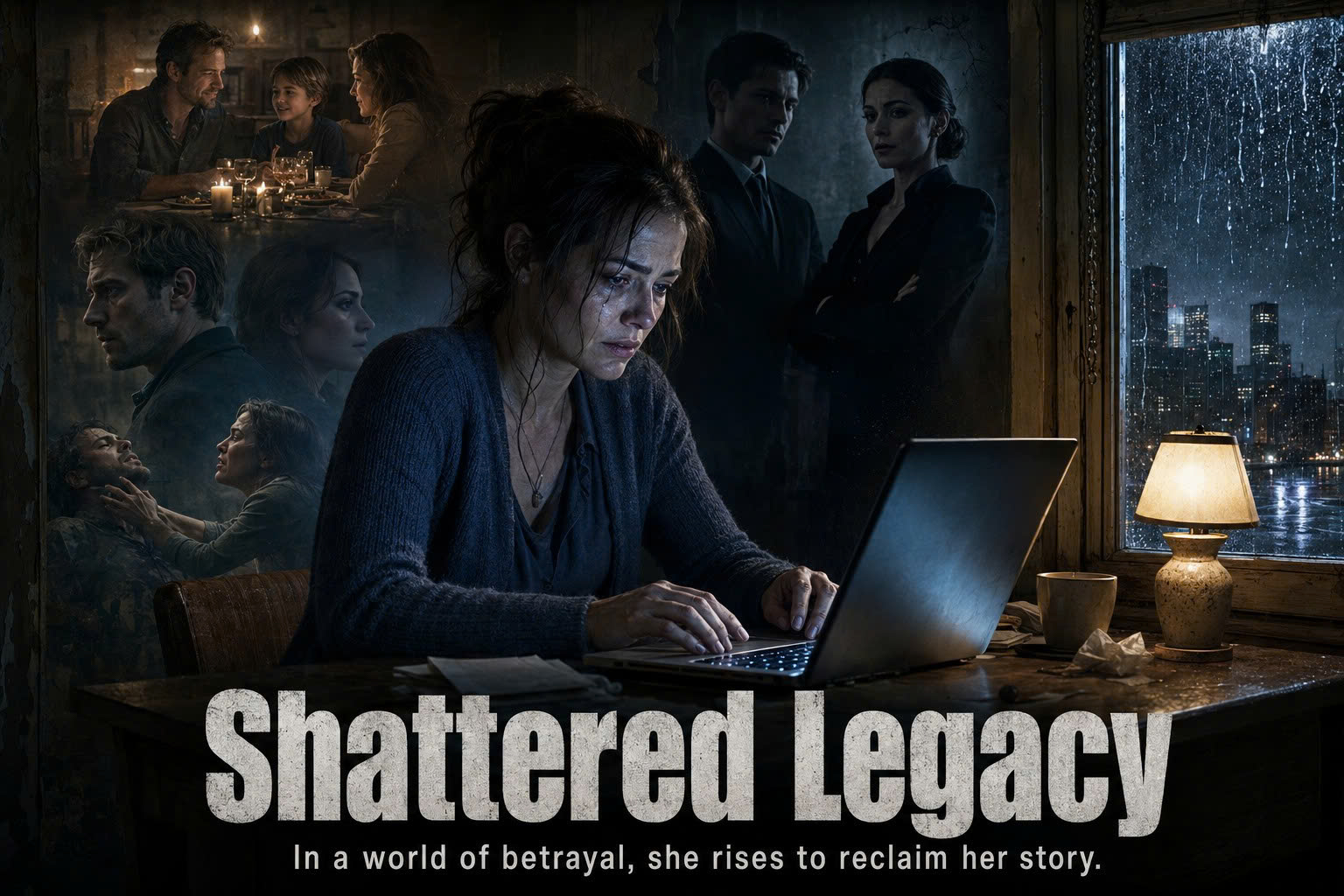
Lauren Whitmore was sitting on the edge of a motel bed that smelled of bleach and old cigarettes when her laptop displayed the most dangerous sentence she had ever seen:
TRANSFER PENDING: $50,340,000.
Her husband was dead.
Her bank accounts had been frozen.
Her keys had been taken.
And somewhere across Boston, the people who had thrown her out of her own home were waiting for that transfer to fail.
Lauren had forty-two dollars in her wallet, a dying phone, and less than thirty hours before the money moved.
But the fifty million dollars was not an inheritance.
It was evidence.
And the people trying to take it from her had no idea that Lauren had spent twelve years learning how criminals hid money.
Thirty-six hours earlier, she had been sitting across from Harrison Whitmore in the dining room of their Beacon Hill home.
Rain struck the tall windows in violent sheets. The November wind pressed against the old brick mansion, rattling the glass in its frames.
Harrison barely touched his dinner.
At fifty-eight, he was still considered one of the sharpest operators in the technology-logistics industry. He had built Whitmore Global from a regional freight software company into a multinational empire valued in the billions.
But that night, he looked older.
His skin had a gray cast. His breathing was shallow. His right hand trembled each time he reached for his water.
Lauren noticed because she always noticed.
“Your cardiologist said the new medication could cause dizziness,” she said. “You should call him.”
Harrison looked toward the doorway before answering.
“Not my cardiologist.”
Lauren stopped.
“What?”
He leaned closer.
“The doctor Naomi found.”
The name settled between them.
Naomi was Harrison’s daughter-in-law. Elegant, controlled, and socially flawless, she had spent years treating Lauren as if she were an embarrassing administrative error.
Lauren was thirty-four, twenty-four years younger than Harrison.
To Jackson, Harrison’s only son, that age difference proved everything he wanted to believe.
Lauren was a gold digger.
A temporary wife.
A threat to the inheritance Jackson had already begun spending in his mind.
It did not matter that Lauren had earned her own money before meeting Harrison. It did not matter that she had worked as a forensic accountant investigating corporate fraud. It did not matter that Harrison had pursued her for nearly a year before she agreed to have dinner with him.
To the Whitmore family, facts were less useful than suspicion.
Harrison pushed his plate away.
“Lauren, listen carefully.”
His voice had changed.
It was quieter, but more urgent.
He stood, reached for the back of his chair, and suddenly winced.
His left hand pressed against his chest.
Lauren was beside him before the chair hit the floor.
“Harrison?”
He grabbed her wrist with surprising strength.
“Study. Laptop. Alpha fund.”
His knees buckled.
Lauren lowered him to the floor, shouting his name.
“Call an ambulance,” he gasped.
“I am.”
“Then transfer it.”
She froze.
“What?”
“Fifty million. Alpha fund. Transfer it to the account I created for you.”
His face twisted in pain.
“Harrison, what are you talking about?”
“The code is in the blue ledger.”
She grabbed her phone with one hand while supporting his head with the other.
“Why would you move fifty million dollars?”
“Because they know.”
“Who knows?”
His eyes shifted toward the doorway again.
“Jackson. Naomi.”
Lauren’s pulse hammered in her ears.
“Harrison, tell me what’s happening.”
“Do it before they lock you out.”
Then his body convulsed.
Lauren screamed for the emergency operator to hurry.
She performed chest compressions until the paramedics arrived. She watched them cut open his shirt, attach electrodes, inject medication, and shock his heart on the dining room floor.
For twelve minutes, the home Harrison had spent twenty years restoring became an emergency room.
As the paramedics rushed him outside, one of them turned to Lauren.
“You’re his wife?”
“Yes.”
“Follow us to Massachusetts General.”
Lauren looked at the study.
At the closed door.
At the blue leather ledger she had seen Harrison use for private investment notes.
She had spent her career telling clients never to move money under pressure.
Never act without documentation.
Never execute an unexplained transfer involving offshore accounts.
Yet Harrison had not sounded confused.
He had sounded terrified.
Lauren ran into the study.
The ledger contained a sequence of numbers, two passwords, and an account in her name that she had never seen before.
Harrison’s laptop was already open.
The alpha fund held $50,340,000.
Lauren stared at the amount.
Then she saw the recent access logs.
Three failed attempts had been made from Jackson’s executive credentials less than an hour earlier.
Lauren entered the transfer.
A security notice appeared.
INTERNATIONAL COMPLIANCE REVIEW REQUIRED. ESTIMATED PROCESSING TIME: 48 HOURS.
She almost canceled it.
Then she remembered Harrison’s hand around her wrist.
Do it before they lock you out.
Lauren confirmed the transfer and drove to the hospital.
Harrison never regained consciousness.
For nine hours, she sat beside him in the ICU while machines breathed and pumped and measured what remained of his life.
At 6:12 the next morning, his heart stopped.
Lauren held his hand when the monitor became a single line.
She was still sitting there twenty minutes later when the door opened.
Jackson entered first.
He looked like Harrison had twenty years earlier—tall, dark-haired, sharply dressed—but grief had not softened him.
Naomi followed in a cream wool coat. Her makeup was perfect. Behind them stood Bradley Cross, the family’s longtime attorney.
Jackson looked at his father’s body.
Then at Lauren.
“Where’s the laptop?”
Lauren blinked.
Not What happened?
Not Was he in pain?
Not Did he say anything?
“The laptop?” she repeated.
“The company laptop Harrison used last night.”
Naomi crossed her arms.
“We received a security notification about an attempted transfer.”
Lauren felt something inside her become very still.
“How did you receive a notification from Harrison’s private fund?”
Jackson ignored the question.
“Did you initiate it?”
“Harrison instructed me to.”
Naomi gave Bradley a glance.
It was small, but Lauren saw it.
Bradley stepped forward and opened a leather folder.
“Mrs. Whitmore, we have obtained an emergency preservation order from Suffolk Probate and Family Court.”
Lauren stared at him.
“Harrison died twenty minutes ago.”
“The petition was prepared overnight.”
“Overnight?”
Bradley removed several documents.
“The order temporarily freezes Mr. Whitmore’s personal assets, corporate-controlled accounts, jointly held investment vehicles, and any transfers initiated during the final forty-eight hours of his life.”
Lauren looked at Jackson.
“You filed against me while your father was dying?”
“We protected him while you exploited him,” Jackson said.
The words struck harder than she expected.
Naomi stepped closer.
“Harrison had been declining for months. He was confused after the stroke. Everyone saw it.”
“That is not true.”
“You isolated him.”
“I lived with him.”
“You manipulated a sick man into transferring fifty million dollars.”
Lauren stood.
“Harrison knew exactly what he was doing.”
Bradley’s tone became formal.
“That determination will be made during the probate investigation. Until then, any attempt to complete the transfer could be treated as financial elder abuse.”
Jackson leaned toward her.
“And if the money lands in your account, we call the police.”
Lauren looked from one face to the next.
They were not improvising.
The court filing, the accusations, the synchronized language—everything had been prepared.
“When did you learn about the alpha fund?” she asked.
No one answered.
That silence told her more than a confession would have.
Two hours later, security met Lauren at the Beacon Hill house.
She was allowed to pack one small suitcase under observation.
Jackson demanded the house keys, company credit card, garage access, and Harrison’s devices.
Her personal accounts had been frozen because they were connected to joint marital assets. Her car was titled through a Whitmore company entity. Her phone plan was corporate.
By noon, Lauren had lost her husband, her home, her transportation, and access to nearly every dollar she legally owned.
Naomi stood in the foyer while Lauren zipped her suitcase.
“You should cancel the transfer,” she said.
Lauren looked up.
“If you really loved him, you would stop making this uglier.”
Lauren studied her face.
Naomi did not look angry.
She looked impatient.
That frightened Lauren more.
Outside, the rain had turned colder.
The cab driver asked where she wanted to go.
Lauren opened her wallet.
Forty-two dollars.
She chose a motel near Logan Airport because it was the only place she could afford for one night.
Room 217 had a broken heater and a view of a parking lot flooded with rainwater.
Lauren sat on the bed in her black dress and stared at the transfer screen.
$50,340,000.
Pending.
For nearly an hour, she did nothing.
Then she washed her face, tied back her hair, and opened the laptop.
Grief would have to wait.
Lauren had spent years tracing money through layered entities designed to make investigators give up. She knew that fraud rarely began with one enormous theft. It began with patterns too small for anyone important to notice.
She downloaded the alpha fund’s transaction history.
At first, it looked chaotic.
Vendor reimbursements.
Fleet software expenses.
Fuel adjustments.
Consulting fees.
Thousands of transactions, most below internal audit thresholds.
But after sorting them by timing, destination, approval code, and invoice language, Lauren saw the structure.
The money had been smurfed out of Whitmore Global through thousands of small payments.
Those payments flowed into a Delaware transportation company with no vehicles.
From Delaware, the funds moved to a holding company in Panama.
From Panama, they were consolidated into a trust in the Cayman Islands.
Lauren opened the trust authorization file.
Her breath caught.
The controlling financial officer listed on the encrypted signature chain was Naomi Whitmore.
The contingent beneficiaries were Naomi and Jackson.
Lauren leaned back.
Fifty million had not appeared from nowhere.
It had been stolen from Harrison’s company over years.
She kept digging.
Harrison’s executive credentials had begun reversing the transfers six months earlier. Quietly, he had pulled money back from the offshore structure and collected it inside the alpha fund.
He had not been hiding money from Lauren.
He had been building a case.
A trap.
Lauren searched his private archive and found a folder labeled N.T. MEDICAL.
Inside were invoices from Dr. Aerys Thorne, a private concierge physician Naomi had recommended after Harrison’s stroke.
There were also payments totaling two million dollars routed through a Belgian biomedical research company.
Lauren compared the payment dates with Harrison’s medical records.
Three days after the first payment, Dr. Thorne changed Harrison’s medication.
Six weeks later, the dosage doubled.
The drug was experimental. It carried serious warnings for patients with Harrison’s cardiac history.
Lauren stared at the screen until the numbers blurred.
Then she found an audio memo Harrison had recorded but never sent.
His voice was weak.
“Lauren, if you find this, I was right about the accounts. Naomi arranged the medical change. Jackson knows about the fund. I need enough documentation to go to federal authorities without alerting them.”
There was a pause.
“I should have told you sooner. I thought I was protecting you.”
Lauren covered her mouth.
For the first time since his death, she cried.
Not loudly.
Not dramatically.
She bent over the motel desk as the full truth settled into her body.
Harrison had not died while hiding a fortune.
He had died while trying to recover stolen money and expose the people closest to him.
And Lauren had been removed from the house before she could discover why.
At 2:17 in the morning, she purchased a prepaid phone from the motel lobby’s vending kiosk and called a number she had not used in four years.
Special Agent David Carter answered on the fifth ring.
“Carter.”
“This is Lauren Mercer Whitmore.”
A pause.
“The forensic accountant from Chicago?”
“I need a secure upload channel.”
“What happened?”
“My husband was murdered.”
By sunrise, Carter had the transaction maps, medical records, payment trails, signature logs, and Harrison’s audio memo.
At 8:40, he called back.
“We verified the shell entities,” he said. “The Delaware company exists only on paper. The Belgian payment route is connected to Dr. Thorne.”
Lauren closed her eyes.
“So I’m right.”
“You have enough for an active federal investigation. But we need them to make a move.”
Lauren looked at the pending transfer.
“They already have.”
Carter and Lauren built the plan over three calls.
She would not cancel the wire.
Instead, federal technicians would redirect it into a Department of Justice escrow account when the transfer cleared.
The money would become protected evidence.
But they needed Naomi, Jackson, and Bradley to expose their knowledge of the fraud in front of witnesses.
That opportunity arrived sooner than expected.
Jackson contacted Lauren that afternoon and told her to meet them at an espresso bar near Copley Square.
Naomi slid a settlement agreement across the table.
“One million dollars,” she said. “You sign the NDA, surrender all estate claims, cancel the transfer, and leave Massachusetts.”
Lauren stared at the agreement.
“And if I refuse?”
Naomi placed a second folder beside it.
“A preliminary toxicology report.”
Lauren opened it.
The report suggested Harrison had received an incorrect dose of medication in the hours before his collapse.
Jackson leaned forward.
“You were alone with him.”
Lauren let fear enter her face.
Not because she felt it.
Because they expected to see it.
“You’re going to accuse me of killing him?”
“We are giving you a way out,” Naomi said.
Lauren’s hands began to tremble.
She made sure they noticed.
“I’ll sign,” she whispered. “But not here.”
Jackson’s shoulders relaxed.
Lauren continued.
“I want the board present. At the memorial tomorrow. I want witnesses so you can’t change the agreement later.”
Naomi almost smiled.
“That can be arranged.”
Lauren lowered her eyes.
“Then I’ll cancel the transfer in front of everyone.”
The following evening, the Four Seasons ballroom was filled with Boston executives, investors, attorneys, politicians, and members of Harrison’s extended family.
A memorial video played across three enormous screens.
Jackson had already controlled the story.
Online articles described Lauren as a younger wife under investigation for suspicious financial activity. Anonymous sources claimed Harrison had been cognitively impaired. One post suggested she had pressured him to change his estate plan.
When Lauren entered the ballroom, conversations stopped.
People looked away.
A woman Lauren had hosted at Christmas stepped backward to avoid greeting her.
Jackson stood near Harrison’s portrait, accepting condolences as if he were already chairman of the company.
Naomi wore black silk and the expression of a grieving daughter.
Lauren wore the same coat she had left home in.
She looked exhausted because she was exhausted.
That made the performance easier.
After the public remarks, Bradley escorted her into a private conference room.
Twelve board members sat around a polished table.
Jackson, Naomi, Bradley, and Chairman Robert Thompson sat together at the opposite end.
A chair had been placed for Lauren by herself.
Bradley pushed the agreement toward her.
“You understand the terms?”
Lauren nodded.
“One million dollars. No inheritance claims. Full confidentiality.”
“And cancellation of the wire,” Naomi added.
Jackson folded his hands.
“Do that now, and this ends.”
Lauren opened Harrison’s laptop.
At Carter’s instruction, she connected it to the conference room display.
The transfer appeared on the wall.
$50,340,000 — FINAL AUTHORIZATION REQUIRED.
Naomi leaned forward.
“Cancel it.”
Lauren placed her fingers on the keyboard.
The room was silent.
Then she looked at Chairman Thompson.
“Before I do, I want to ask one question.”
Bradley frowned.
“This is not the time.”
Lauren continued.
“How many people in this room believed I was an interior decorator before I married Harrison?”
Several board members shifted uncomfortably.
Jackson sighed.
“What does that have to do with anything?”
“Because that’s what you told people, isn’t it?”
Lauren clicked a file.
Her professional credentials appeared on the screen.
Certified Public Accountant.
Certified Fraud Examiner.
Former senior forensic auditor.
Consultant on multiple federal money-laundering investigations.
Lauren’s voice changed.
The uncertainty disappeared.
“I was never an interior decorator.”
Naomi’s face tightened.
Lauren opened the transaction map.
“I spent twelve years tracing stolen money through systems designed to hide ownership. And the fifty million dollars you are so desperate to recover was stolen from Whitmore Global through 8,417 microtransactions.”
No one moved.
She enlarged the Delaware entity.
“Funds were routed through North Atlantic Freight Solutions, a company with no employees, no trucks, and no operating address.”
Another click.
“Then to Solano Holdings in Panama.”
Another.
“Then into the Caldera Trust in the Cayman Islands.”
Jackson stood.
“This is absurd.”
Lauren displayed the signature authorization.
“Naomi Whitmore controlled the financial authorization chain.”
Naomi’s face lost color.
“And Naomi and Jackson Whitmore were the trust beneficiaries.”
Chairman Thompson turned toward them.
“Is that your digital signature?”
Naomi recovered quickly.
“Documents can be fabricated.”
Lauren nodded.
“They can. Which is why Harrison used his executive override to pull the money back over six months.”
She opened the alpha fund logs.
“He discovered the theft after his stroke. The alpha fund was not a hidden marital asset. It was a recovery account.”
Bradley rose from his chair.
“This meeting is over.”
“No,” Chairman Thompson said.
It was the first time anyone had openly refused him.
Bradley slowly sat down.
Lauren opened the medical folder.
“The fraud investigation explains why Harrison became dangerous to them.”
Naomi’s composure cracked.
“Do not do this.”
Lauren looked directly at her.
“You introduced Harrison to Dr. Aerys Thorne.”
“He needed specialized care.”
“You paid two million dollars through Veridian Biotech in Belgium three days before Dr. Thorne changed Harrison’s medication.”
Jackson looked at Naomi.
For the first time, real confusion crossed his face.
Lauren displayed the prescription records.
“The replacement drug was not approved for a patient with Harrison’s cardiac profile. His dosage was later doubled.”
Naomi stood so quickly her chair struck the wall.
“You have no idea what you’re talking about.”
Lauren played Harrison’s audio memo.
His voice filled the conference room.
“Naomi arranged the medical change. Jackson knows about the fund.”
Every eye turned toward them.
Jackson’s jaw fell open.
Naomi did not look at the board.
She looked at the door.
That was the moment she understood.
Her shoulders stiffened. Her eyes widened. Her mouth opened, but no words came.
The confidence drained from her face so completely that, for one second, she looked smaller than everyone in the room.
Lauren had seen that expression before.
It was the look fraudsters wore when they realized the person they had underestimated had already found the ledger.
Naomi reached for the laptop.
Lauren pressed one key.
The screen changed.
TRANSFER COMPLETE.
Jackson lunged forward.
“Where did you send it?”
Lauren turned the display toward him.
UNITED STATES DEPARTMENT OF JUSTICE — EVIDENTIARY ESCROW ACCOUNT.
The conference room doors opened.
Special Agent David Carter entered with six federal agents.
“Jackson Whitmore and Naomi Whitmore,” he said, “you are under arrest in connection with wire fraud, conspiracy, money laundering, and the homicide investigation of Harrison Whitmore.”
Naomi backed into the wall.
Jackson stared at Lauren as an agent took his wrists.
“This was your plan?”
Lauren looked at him.
“No.”
She closed Harrison’s laptop.
“It was his.”
Bradley tried to move toward the side exit.
Two agents blocked him.
Carter held up a copy of the emergency court affidavit.
“Bradley Cross, you are being detained for questioning regarding fraudulent filings, obstruction, and conspiracy.”
The board watched in silence as all three were led away.
No one apologized until the handcuffs were visible.
Then everyone did.
Chairman Thompson approached Lauren in the ballroom corridor.
“We failed you,” he said. “The board wants to restore your access immediately.”
Lauren looked through the glass doors at Harrison’s memorial portrait.
“You did not fail me because the facts were unclear.”
Thompson lowered his eyes.
“You failed because protecting the share price felt safer than protecting the truth.”
Three weeks later, Lauren returned to probate court with Eleanor Vance, one of the most respected estate litigators in Massachusetts.
Eleanor presented the financial timeline, Carter’s affidavit, Harrison’s verified will, the fraudulent injunction record, and the evidence showing that Bradley had withheld material facts from the court.
Judge Harmon vacated the emergency order.
Lauren’s accounts were restored.
The Beacon Hill property was returned to her.
Harrison’s personal estate was recognized as legally hers under the valid will.
Lauren went home that afternoon.
The locks had already been changed.
She replaced the household staff members who had helped Jackson remove her belongings. She converted Harrison’s study into an evidence archive for the federal case.
For months, she woke expecting someone to take everything again.
Eventually, the house stopped feeling like contested property.
It became a sanctuary.
Whitmore Global underwent a complete federal audit. Several executives resigned. The board established independent compliance oversight and recovered additional funds connected to Naomi’s network.
Dr. Thorne lost his medical license and faced separate criminal charges.
Bradley was disbarred.
Naomi was convicted of conspiracy, money laundering, financial exploitation, and second-degree murder. She received twenty-five years in prison.
Jackson, who had helped hide the theft and intimidate Lauren, received twenty years.
Many relatives who had ignored Lauren during the investigation suddenly wanted reconciliation.
Some wrote long emails.
Some claimed they had always believed her.
Some said grief had affected their judgment.
Lauren blocked every number.
She did not need revenge against them.
She needed distance.
One year after Harrison’s death, Lauren used ten million dollars from her inheritance to create the Harrison Shield Foundation.
The foundation provided forensic accountants, probate litigators, and private investigators to elderly people, widows, and vulnerable families facing financial coercion.
Its first client was a seventy-two-year-old woman whose nephew had changed the locks on her house after placing her in temporary medical care.
The foundation recovered the home in eleven days.
On the anniversary of Harrison’s death, Lauren visited his grave alone.
She placed white flowers beneath his name and stood in the cold morning air.
“The company is clean,” she said quietly. “The money is helping people now. And they didn’t get away with it.”
The cemetery was still.
Lauren touched the edge of the headstone.
For most of her marriage, people had assumed Harrison’s money was the source of her security.
They were wrong.
Money could be frozen.
Homes could be taken.
Families could lie.
Powerful people could manufacture stories and make an innocent woman look guilty before she had time to bury her husband.
What they could not take was the skill she had earned, the discipline she had built, and the courage to remain calm while everyone else expected her to collapse.
Lauren walked away from the grave without looking back.
Because the most dangerous person in any room is not always the one with the most money.
Sometimes, it is the quiet person everyone has already decided to underestimate.


