The first thing Rook Halden noticed about Astra Kepler was that she did not look impressed.
Coronado was loud that morning.
Instructors shouted across the wet concrete. Boots hammered the grinder. Pacific wind drove salt through the training compound while a class of young men stood in formation with the rigid confidence of people who had survived everything placed in front of them.
Then Astra walked into the center of it.
Gray T-shirt.
Faded cargo pants.
Worn boots with repaired stitching along one heel.
No makeup. No jewelry. No expensive tactical gear. Just an old duffel bag hanging from one shoulder and a thin personnel file tucked beneath her arm.
She did not look nervous.
That bothered Bravo 9 immediately.
The men had expected someone trying to prove she belonged. Someone overly prepared, overly loud, or visibly afraid.
Instead, Astra stood off to the side like a still point in moving water.
Rook took her file from the operations chief and opened it.
One page.
Name. Age. Medical clearance. Weapons qualifications. A waiver signed by an authority whose title had been blacked out.
No previous unit.
No service history.
No deployment record.
No explanation for how a woman with “no prior service” had completed a selection course with a failure rate severe enough to break experienced operators.
Rook looked up.
“This is it?”
The operations chief kept his face neutral.
“That’s what you’re cleared to see.”
Rook hated those words.
He had led Bravo 9 through hostage rescues, ship seizures, desert insertions, and two missions that officially had never happened. He believed in competence, earned trust, and scars that could be explained.
Astra Kepler arrived with none of those things.
To him, she looked like politics wearing old boots.
He stepped in front of her while the rest of the team watched.
“You know where you are?”
“Yes.”
Her voice was calm, almost quiet.
Rook waited for “sir.”
It did not come.
“This isn’t a diversity program. Nobody here cares who signed your waiver.”
Astra looked directly at him.
“I didn’t ask them to.”
A few men exchanged glances.
Merrick Shaw, the team’s breacher, looked down at her boots.
“Those things survive the trip from the parking lot?”
A couple of men laughed.
Dalia Voss, their drone and surveillance specialist, studied Astra’s duffel.
“You pack lunch in there too?”
Astra said nothing.
Rook moved closer.
“You passed a course that drops ninety-seven percent of candidates.”
“Yes.”
“With no prior service.”
“That is what the file says.”
“Did you complete it to standard?”
“Yes.”
“No shortcuts?”
“No.”
“No adjusted requirements?”
“No.”
Rook tapped the single-page file against his palm.
“Then why is there nothing here?”
Astra’s eyes lowered briefly to the blacked-out authorization.
“Because you are not cleared for the rest.”
The laughter died.
Rook’s expression changed.
Not much.
Just enough for Astra to see that she had touched the exact nerve he wanted hidden.
He leaned closer.
“Here’s what happens now. No special treatment. No excuses. No mysterious paperwork protecting you. You fail once, you’re gone.”
Astra nodded.
Rook expected an argument.
Instead, she placed her duffel beside the formation and stepped into line.
That was the moment Bravo 9 decided they would test her every day until she broke.
At first, they called it training.
The first altered piece of equipment was her flak jacket.
One shoulder buckle had been shaved just enough to slip under weight. It held during inspection, then loosened during movement.
Astra discovered it before the morning run.
She sat on a bench, removed a thin wire from the seam of her duffel, and reinforced the latch without reporting the damage.
The second was her breathing mask.
A hairline crack had been cut near the lower seal.
She found it by holding the mask near a steam pipe and watching condensation pull unevenly through the fracture.
She sealed it with adhesive and a strip of material cut from the inside of her cargo pocket.
The binoculars came next.
Dalia shifted one prism slightly off alignment, enough to cause eye strain and nausea after prolonged use.
Astra raised them once, lowered them, loosened the side casing with a knife, and corrected the angle using a sliver of folded foil.
Each time, the team watched.
Each time, she refused to complain.
That silence irritated them more than anger would have.
They wanted her to accuse someone.
They wanted tears, outrage, or a threat to report them.
Instead, Astra repaired what they damaged and kept moving.
During a four-mile cold-water swim, the Pacific temperature dropped low enough to numb fingers within minutes.
Merrick expected Astra’s smaller frame to fail first.
Halfway through, a recruit named Ellis lost coordination and began swallowing water. Two swimmers passed him, assuming the safety boat would intervene.
Astra changed direction.
She hooked one arm beneath Ellis’s chin, rolled him onto his back, and continued swimming while towing him.
She did not call for help.
She did not sacrifice her pace.
She crossed the finish line carrying another human being and ranked fourth overall.
When Ellis was wrapped in thermal blankets, he looked toward her.
“You saved me.”
Astra squeezed water from her sleeve.
“You were in reach.”
That was all she said.
During log physical training, Merrick deliberately shifted his weight toward her side.
The timber dropped.
The men expected Astra’s knees to buckle.
Instead, she moved one hand six inches, changed the angle of her shoulder, and redirected the load across the line.
The entire team suddenly found the log easier to carry.
Merrick looked at her.
She kept her eyes forward.
During night navigation, Dalia placed a magnetic shaving beneath the housing of Astra’s compass. It was small enough to pull the needle several degrees west.
Those few degrees would have led her directly into a restricted impact zone.
Astra checked the compass once.
Then she looked at the stars.
She noted the slope of the terrain, the wind direction, and the position of distant coastal lights. She opened the compass casing, found the dark speck beneath the pivot, and flicked it into the dirt.
She reached the checkpoint eight minutes early.
Keon Vale, the team medic, accused her of using stimulants after she finished a twenty-mile ruck march without visible exhaustion.
He drew blood himself.
The results came back clean.
No stimulants.
No performance enhancers.
No abnormal markers.
Just an unusually efficient heart rate and lung capacity.
Keon stared at the report.
“That’s impossible.”
Astra folded a blister pad into her boot.
“No. It’s uncommon.”
The team stopped calling her by name.
They called her Princess.
Paper Soldier.
The Senator’s Daughter.
They mocked her clothes, her age, her quiet voice, and the way she cleaned her weapon after every drill.
Astra never defended herself.
She simply completed each task.
Rook began to feel something he refused to name.
Not respect.
Not yet.
Uncertainty.
The mock-captivity drill was supposed to expose her.
She was hooded, restrained, and placed in a concrete room under pulsing lights. High-frequency noise cut through the air. A low infrasound generator vibrated through the floor, creating nausea and panic without an obvious source.
Interrogators shouted conflicting questions.
Astra sat motionless.
Her breathing slowed.
An instructor struck the table beside her.
“Tell us what unit you belong to.”
Astra tilted her head.
“The infrasound source is behind the eastern wall.”
The instructor paused.
“What?”
“Approximately eighteen hertz. The fluorescent pulse is off-cycle by three-tenths of a second. Your left speaker is damaged.”
The men behind the observation glass stopped smiling.
Her pulse never passed sixty-two.
Later, Keon handed her a corrupted field-encryption program and told her to repair it under a time limit.
Astra scanned the screen.
“Line four hundred and nineteen.”
Keon crossed his arms.
“You haven’t run it.”
“The recursive call lacks a termination condition. It will overflow the stack.”
He ran the program.
It crashed exactly where she said it would.
Dalia tried a different approach.
She placed a newspaper clipping on the table beside Astra’s equipment. The article described a defense procurement scandal involving a classified program called CAD-7.
Several officials had resigned.
One contractor had disappeared.
A senior intelligence officer named Saurin Cade had been reported killed six years earlier.
Dalia watched Astra’s face.
For half a second, Astra’s eyes rested on Cade’s photograph.
Then she returned to cleaning her rifle.
“You know him?” Dalia asked.
Astra ran a cloth along the bolt.
“No.”
It was the first answer Dalia did not believe.
After six weeks, Rook gathered Bravo 9 in the range-control building.
A topographic map lay across the table.
A red section marked the northern edge of the training complex.
Everyone knew what it was.
The dead zone.
It was an abandoned live-fire training corridor built decades earlier and shut down after a series of accidents. The terrain contained collapsed trenches, old pressure systems, hidden pits, automated thermal targets, and unexploded training devices.
Nobody entered without an engineering sweep.
Norah Quinn, the range-safety chief, stood at the end of the table.
“You cannot send a trainee through there.”
Rook kept his eyes on Astra.
“She isn’t a normal trainee.”
“That’s not an answer.”
“There will be observers.”
“Half the camera network is unstable. Chemical residue has been detected in two sectors. We haven’t certified that ground in years.”
Rook pointed to the map.
“She enters here. She exits at the southern gate. Fifteen minutes.”
Norah stared at him.
“That is not a test.”
“No,” she said quietly. “It’s punishment.”
Rook ignored her.
He looked at Astra.
“You make it out on time, you stay with the team.”
“And if I don’t?”
“You’re removed from the roster.”
Astra studied the map.
A corner had been cut away, removing the legend.
Her flashlight had an almost-dead battery.
The radio assigned to her produced mostly static.
She checked each item without complaint.
Merrick stepped behind her while she adjusted her pack and slipped a small lead weight into a side pocket. It would not slow her much, but it would shift her balance on narrow ground.
Astra entered the dead zone at 0700.
Bravo 9 watched through a wall of monitors.
The first camera showed her crossing between two concrete barriers. Fog drifted low across the earth.
Ten steps in, she stopped.
Merrick smiled.
“Already lost?”
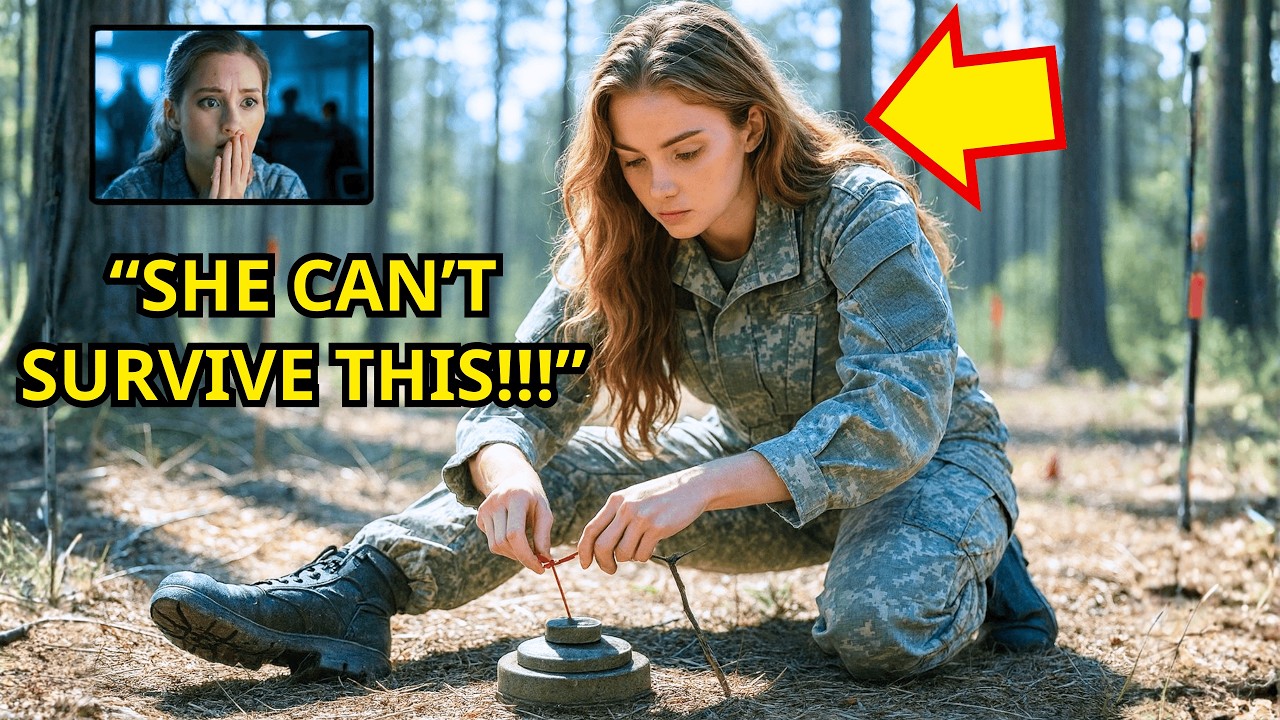
Astra reached into the side pocket, removed the lead weight, looked at it for a moment, and tossed it ahead.
It landed beside a patch of dirt.
A metallic click sounded.
The ground erupted as a buried pressure mechanism snapped upward.
Not an explosive.
A steel training spike.
Had Astra stepped there, it would have driven through her boot.
Merrick’s smile disappeared.
Astra crouched beside the plate.
She removed one shoelace, looped it around a branch, and used the branch to redistribute pressure while she passed.
The second obstacle was a concealed pit lined with sharpened stakes.
The surface looked solid.
Astra tapped the dirt with the handle of her knife.
Hollow.
She backed up two steps and cleared it without breaking stride.
At minute four, she reached a narrow corridor between rock walls.
A nearly invisible monofilament line crossed the path at shin height. It was attached to an old grenade-trigger simulator.
A spiderweb had caught along one section.
The web bent at an unnatural angle.
Astra saw it.
She knelt, removed the same wire she had used to repair her flak jacket, and pinned the trigger mechanism within its tolerance gap.
Then she stepped over.
No alarm.
No detonation.
In the control room, Dalia leaned toward the screen.
“How did she see that?”
Nobody answered.
The thermal grid activated at minute seven.
Automated sensors tracked heat signatures through a field of moving barriers. If a target crossed the wrong sector, compressed-air cannons fired marking rounds at lethal training velocities.
Astra lowered herself into cold mud.
She coated the front of her clothing, slowed her breathing, and waited for the moving barriers to warm beneath the sun.
Then she crossed beside them, matching her thermal outline to the larger background signatures.
The sensors failed to distinguish her.
The cannons never fired.
Rook stared at the monitor.
“That system doesn’t miss.”
Norah looked at him.
“It didn’t.”
At minute eleven, Astra reached a trench.
The ground collapsed beneath her.
The camera shook, then lost sight of her.
Merrick exhaled.
“There.”
The team waited.
Five seconds.
Ten.
The feed remained empty.
Then a hand appeared over the trench wall.
Astra pulled herself up using a compact hook attached to the inside frame of her pack.
She had prepared it before entering.
At fourteen minutes and forty-two seconds, the southern gate opened.
Astra walked out.
Her breathing was controlled.
Her clothes were lightly marked with mud, but she was not injured.
She handed the useless radio to Rook.
“Battery contacts were reversed.”
Then she placed the cut map on the table.
“The legend was missing.”
Rook looked around the room.
No one met his eyes.
Astra had not merely survived their test.
She had documented every act of sabotage.
The dead zone should have ended the campaign against her.
Instead, humiliation turned it into something worse.
Two weeks later, Bravo 9 received an emergency deployment.
A hostage group had been located inside an abandoned industrial settlement in a mountainous border region. Intelligence indicated fourteen armed captors and at least six civilians.
Rook assigned Astra to rear overwatch.
“Stay on the western ridge,” he said. “Do not enter the compound unless ordered.”
Merrick altered one waypoint in her GPS.
The false coordinate led to a narrow kill corridor.
Dalia assigned her a drone with a degraded battery.
Keon gave her an obsolete radio.
They told themselves they were limiting her role.
In reality, they were constructing the conditions for her failure.
The helicopter dropped them before dawn.
Bravo 9 approached the compound through a dry canal.
Astra separated toward the western ridge.
Five minutes later, the drone died.
Then communications collapsed.
Rook raised a hand.
The lead operator stopped.
A mortar round struck the ridge behind them.
The blast threw dirt across the canal.
Gunfire opened from three directions.
Bravo 9 had entered a prepared ambush.
Their designated extraction route was blocked.
Their drone was gone.
Their communications were dead.
Merrick looked at his GPS and realized the marked enemy position had been shifted.
The false data he had intended for Astra had contaminated the entire mission map.
A second mortar struck.
Dalia fell behind a concrete wall with blood running from her ear.
Keon crawled toward an injured operator.
A sniper round cut through the space where his head had been seconds earlier.
Rook pressed against the canal wall.
For the first time in years, he had no plan.
Then a muted shot came from the western ridge.
The enemy sniper disappeared from the rooftop.
Another shot.
A mortar spotter dropped beside a radio mast.
A third.
The machine-gun position above the canal fell silent.
Rook looked toward the ridge.
Astra was moving down the slope.
Not toward her assigned false coordinate.
Toward them.
She reached Keon first, grabbed the wounded operator by his harness, and pulled him behind cover.
“Your route is compromised,” she said.
Rook stared at her.
“How did you know?”
“You changed one coordinate. You forgot to change the terrain.”
She removed a small mirror from a shattered vehicle and positioned it against a rock.
Sunlight flashed across the opposite ridge.
Enemy fire shifted toward the reflection.
Astra moved the team through a narrow seam between two structures, a blind corridor invisible from the compound’s elevated positions.
Dalia looked at the dead drone controller.
“How are you tracking them?”
Astra pointed to the windows.
“Heat distortion.”
She marked three positions with chalk.
Each one fired moments later.
Rook watched her place a laser marker on the ridge and pulse it in a strange sequence.
Three short.
Two long.
Four short.
The sky remained empty.
Then two unidentified aircraft crossed the horizon at low altitude.
Precision strikes destroyed the enemy mortar positions without touching the hostage building.
Rook turned toward Astra.
“Who did you signal?”
She lowered the laser.
“People who were listening.”
Bravo 9 entered the compound under cover.
The hostages were recovered alive.
Every member of the team returned.
Back at Coronado, Astra was not congratulated.
She was detained.
Two security officers escorted her into a sealed briefing room while Rook and Bravo 9 were ordered to remain outside.
The official claim was “identity verification.”
Nobody believed it.
Three hours later, alarms sounded across the base.
An unauthorized vehicle had crossed the outer checkpoint.
Security teams surrounded the administration building.
A black transport stopped outside.
The rear door opened.
A man in a dark civilian coat stepped onto the pavement.
He had gray hair, a scar along his jaw, and the slow posture of someone who knew nobody present would dare shoot him.
Dalia recognized him first.
Her face drained of color.
“That’s Saurin Cade.”
Merrick stared.
“He’s dead.”
Cade walked past the armed guards and entered the building.
Minutes later, Bravo 9 was ordered inside.
Astra sat at the far end of a conference table, still wearing field clothes.
Cade stood beside her.
Several senior officers lined the wall.
Rook noticed none of them were looking at Astra as a detainee.
They were looking at her as if she outranked the room.
Cade placed a thick file on the table.
“Six years ago, a classified operational program designated CAD-7 was compromised from within the defense contracting system.”
He opened the file.
Photographs showed burned facilities, missing personnel, and redacted mission reports.
“Most of the program’s field assets were declared dead to protect their identities.”
Dalia looked toward Astra.
Cade continued.
“Astra Kepler was the youngest operational evaluator assigned to CAD-7.”
Rook’s jaw tightened.
“Evaluator?”
“She was not sent here to join Bravo 9.”
Silence filled the room.
“She was sent to assess it.”
Merrick shifted in his chair.
Cade opened another folder.
Inside were photographs from the barracks, equipment room, navigation course, dead zone, and hostage mission.
Every act of sabotage had been documented.
The shaved buckle.
The damaged mask.
The altered compass.
The lead weight.
The false coordinates.
The dying drone battery.
The obsolete radio.
Rook looked at Astra.
She had known.
From the beginning.
Cade turned to the senior officers.
“Bravo 9 was flagged after repeated concerns involving internal discipline, retaliation, and unauthorized testing of new personnel. We needed to know whether the problem was isolated or cultural.”
Rook placed both hands on the table.
“You let this happen?”
Astra answered.
“No.”
Everyone looked at her.
“You made it happen.”
Rook’s face hardened.
“You could have reported us after the first day.”
“Yes.”
“Why didn’t you?”
“Because people behave differently when they believe nobody important is watching.”
Merrick looked down.
Dalia’s eyes filled with anger, but not at Astra.
At herself.
Cade removed one final document.
“The dead-zone test was not authorized.”
Norah Quinn stood near the doorway with her arms crossed.
“The operational sabotage constituted reckless endangerment.”
Keon swallowed.
Cade looked at each member of Bravo 9.
“Your team nearly died because you preferred to prove one person unworthy rather than ask why she had been selected.”
Nobody moved.
Rook looked at Astra.
For weeks, he had imagined the moment when she would finally be exposed.
Now the exposure belonged entirely to him.
His shoulders lowered.
The muscles in his jaw relaxed.
His eyes moved from the evidence to the woman he had called a political favor, a fraud, and a liability.
For the first time since Astra arrived, he had nothing to say.
That was the moment she defeated him.
Not in the water.
Not in the dead zone.
Not under enemy fire.
In the silence after he finally understood that every test had revealed more about him than it had about her.
Cade closed the file.
Rook was removed from command pending investigation.
Merrick and Dalia were suspended from operational duty.
Keon was reassigned and required to testify.
Bravo 9 was placed under full review.
Norah’s warnings were added to the official record, along with evidence that leadership had ignored them.
Astra was offered command of the restructured team.
She declined.
“Why?” Cade asked her outside the conference room.
She looked through the glass at the men sitting around the table.
“They are still deciding whether they regret what they did or only regret being caught.”
Cade nodded.
“And when they decide?”
“Then they might be ready to serve again.”
Three months later, a new class formed on the same Coronado grinder.
The trainees stood in neat lines under the Pacific wind.
Astra walked past them wearing the same gray shirt and the same repaired boots.
One recruit whispered to another.
“That’s her?”
His friend nodded.
“The one who cleared the dead zone.”
Astra heard them.
She did not turn.
Near the administration building, Rook stood in a plain training uniform without command insignia. His investigation had ended his leadership role, but he had been permitted to remain as an instructor under supervision.
He saw Astra approaching.
For a moment, the old defensiveness returned to his face.
Then it disappeared.
He stepped aside.
Not dramatically.
Not fearfully.
Simply with the respect he should have shown on the first day.
Astra stopped.
Rook looked at the repaired stitching on her boots.
“I thought the file was empty because you had done nothing.”
Astra waited.
He looked up.
“It was empty because everything you had done was above my clearance.”
“Yes.”
“I sent you into that zone to expose you.”
Astra’s expression did not change.
“You did.”
Rook breathed out slowly.
“And you walked out alone.”
“No.”
He frowned.
Astra looked toward the grinder, where another class was beginning its first punishing day.
“I walked out carrying everything your team had shown me.”
Then she continued across the compound.
The recruits watched her pass.
Most saw a quiet woman in old boots.
Rook saw something else.
He saw every warning he had ignored, every weakness he had mistaken for confidence, and every act of cruelty he had disguised as standards.
He had believed leadership meant testing people until they broke.
Astra had taught him the harder truth.
Real leadership is revealed by what you do when you think the person in front of you has no power to fight back.