
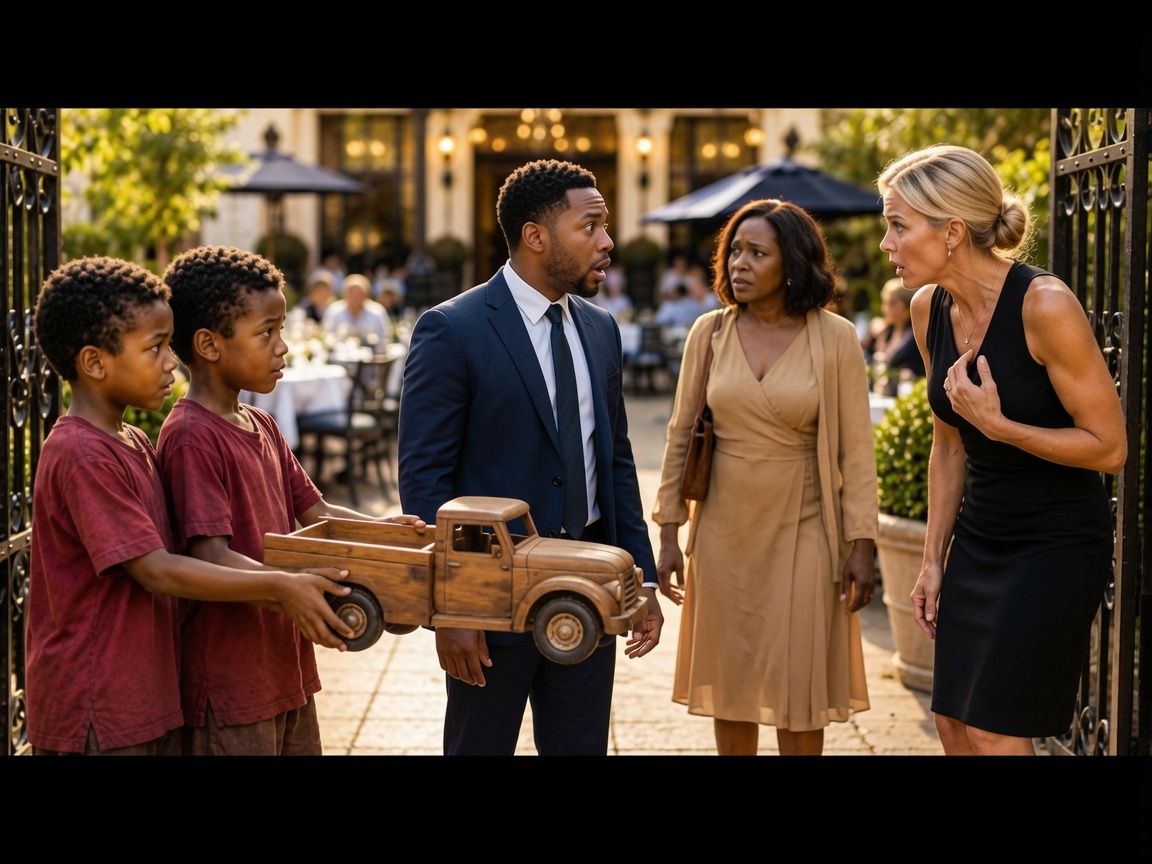
“Sir… would you buy our cart?”
The voice was so small that Malik almost didn’t hear it over the traffic.
He and Ava were standing beneath the gold-lit entrance of The Marlowe, one of the most exclusive restaurants in the city. A valet had just taken the keys to Malik’s car. Through the tall glass doors, a pianist played beside a wall of white roses while couples in evening clothes raised crystal glasses beneath hanging chandeliers.
It was supposed to be an important night.
Ava had spent three weeks arranging it.
They were there to inspect the private dining room where she wanted to hold their wedding reception. The event planner was waiting inside with champagne, fabric samples, a tasting menu, and a presentation showing exactly how the room would look when Ava walked in wearing the dress she had already chosen.
Everything had been timed perfectly.
Then the two boys stepped out from beside a newspaper stand.
The older one looked about eight. His little brother could not have been more than six. Both wore clean shirts that had been washed so many times the colors had faded. The smaller boy’s sneakers were held together near the toe with a strip of black tape.
Between them, they carried a wooden truck.
It was nearly two feet long, with a flat cargo bed, round wheels, and a small carved steering wheel inside the cab. One side had been sanded smooth. The other still showed faint tool marks. The paint had once been dark blue, but years of hands running across it had worn the edges down to pale wood.
Ava glanced at the boys, then toward the restaurant doors.
“We’re late,” she said quietly.
Malik barely heard her.
The older boy held the wooden truck out with both hands.
“Sir, please,” he said. “Would you buy it?”
Malik looked at the toy, then at the child.
“How much are you selling it for?”
The boy swallowed.
“Whatever you think is fair.”
Ava shifted beside him.
“Malik.”
There was a warning in the way she said his name.
He turned slightly. “One minute.”
“We have an appointment.”
“I know.”
The smaller boy had not looked up once. He kept one hand on the rear wheel of the truck, turning it back and forth with his thumb.
Malik crouched so he was closer to their height.
“What are your names?”
“I’m Elias,” the older boy said. He nodded toward his brother. “That’s Josiah.”
“Did you make this?”
Elias shook his head.
“Our dad did.”
Malik looked more closely at the truck.
There was no factory stamp underneath it. No plastic. No screws visible from the outside. The axles had been cut by hand, and the tires were made from thick wooden disks. On the bottom of the cargo bed, someone had carved three small initials.
J. M. R.
“This took a long time to make,” Malik said.
Elias nodded.
Josiah’s fingers tightened around the wheel.
Ava folded her arms.
“Ask them how much,” she said. “Pay them, and let’s go.”
Elias’s face changed at once.
“We’re not asking for money,” he said quickly. “We’re selling it.”
“I understand,” Malik replied.
“No,” Elias said, more firmly now. “People keep trying to give us money. My mom says we don’t take things for nothing.”
Malik studied him.
The boy was trying to sound brave, but his lower lip trembled between sentences.
“Why are you selling it?” Malik asked.
For the first time, Josiah looked up.
“Mom needs her medicine.”
Elias glanced at him, as though they had agreed in advance who would explain.
Then he spoke.
“The pharmacy said they can’t send it unless we pay today. She’s been sick for a while, but it got worse this morning. Our neighbor took us to the clinic. The doctor gave us the paper, but the medicine costs more than we have.”
“Where is your mother now?” Malik asked.
“At home,” Elias said. “Mrs. Green is sitting with her.”
“And your father?”
Neither boy answered.
Josiah stopped turning the wheel.
Elias looked down at the sidewalk.
“Our dad died.”
The traffic continued behind them. A bus rolled through the intersection. Somewhere inside the restaurant, the pianist changed songs.
Malik looked again at the initials carved into the truck.
“How long ago?”
“Eight months,” Elias said.
Ava released a slow breath.
“Malik, you don’t know if any of this is true.”
The boys heard her.
Josiah immediately pulled the truck closer to his chest.
Elias’s face reddened, but he did not argue.
Malik stood.
“Ava.”
“What?” she whispered. “I’m being realistic. We’re outside a luxury restaurant. Children are sent here all the time because people walking in have money.”
“They’re not begging.”
“It’s the same thing with an extra step.”
Elias lowered his eyes.
Malik felt something in his chest tighten.
He had grown up around pride like that—the kind poor families carried because sometimes dignity was the only thing they owned that nobody could repossess.
He knew what it looked like when a child had been coached to perform.
This was not it.
Children running a scam watched your wallet.
Josiah watched the wooden truck.
He touched its rear wheel again. Then the roof. Then the corner of the cargo bed. Every movement looked less like a sales pitch and more like goodbye.
Malik reached into his jacket.
“How much does the medicine cost?”
Elias named the amount.
Ava stared at Malik when he took out his wallet.
“That is ridiculous,” she said.
Malik removed several bills.
Elias looked at them, then at the truck.
“That’s too much.”
“It’s what I’m willing to pay.”
“But the truck isn’t worth that.”
Malik ran a finger along the hand-sanded edge.
“To the right person, it might be.”
Elias still hesitated.
Malik extended the money.
“I’m not giving you anything,” he said. “I’m buying something your father made. That means it belongs to me after I pay you. Is that fair?”
The boy looked at Josiah.
Josiah’s eyes had filled with tears, but he nodded.
Elias accepted the money.
For one second, neither child let go of the truck.
Then Elias slowly released his side.
Josiah did not.
His small hand remained wrapped around the wooden wheel until his brother whispered, “We have to go.”
Josiah’s fingers opened one at a time.
Malik took the truck carefully.
It was heavier than he expected.
Elias counted the bills twice, separated the amount needed for the pharmacy, and folded the rest into his pocket.
“Thank you, sir,” he said.
Malik nodded toward the restaurant. “Do you need a ride home?”
“No, sir. The pharmacy is two blocks away. We have to go before it closes.”
Elias took Josiah’s hand.
They had only gone a few steps when Elias turned back.
“When our mom gets better,” he called, “she’ll want to meet you.”
Malik held the truck against his chest.
“I’d like that.”
The boys disappeared into the evening crowd.
For a moment, Malik remained beneath the restaurant lights, staring in the direction they had gone.
Ava was already halfway through the glass doors.
He followed her inside carrying the wooden truck.
The hostess looked at it, then at Malik, unsure whether to ask if he wanted it checked with his coat.
“No,” he said. “I’ll keep it with me.”
The private dining room was exactly as Ava had described it.
Long ivory tablecloths. Gold-rimmed plates. Floating candles. White orchids arranged in narrow glass cylinders. At each place setting, the planner had placed a printed card with Malik and Ava’s names intertwined in elegant script.
Ava sat at the head of the table.
Malik placed the wooden truck carefully on an empty chair beside him.
The event planner began describing the lighting options, but Ava interrupted her.
“Could you give us a moment?”
The woman smiled professionally and left the room.
As soon as the door closed, Ava turned to Malik.
“You paid those children enough to buy ten toys like that.”
Malik unfolded his napkin.
“They weren’t buying toys.”
“You don’t know what they were doing.”
“I know what I saw.”
“You saw what you wanted to see.”
Her voice was low, but every word landed sharply.
Malik leaned back.
“And what do you think I wanted to see?”
“A problem you could solve.”
He glanced toward the wooden truck.
Ava continued.
“You do this all the time. Someone tells you a sad story, and suddenly nothing else matters. Not your schedule. Not our plans. Not me.”
“Two children were trying to buy medicine for their sick mother.”
“According to them.”
“They wouldn’t take money without selling something.”
“That does not prove anything.”
“No,” Malik said. “But the little one touching that truck like he was saying goodbye proved enough for me.”
Ava stared at him.
“You really believe you can read strangers in thirty seconds.”
“I believe children don’t fake that kind of grief very well.”
“And I believe people know exactly how to manipulate men like you.”
“Men like me?”
“Men who need to feel like heroes.”
The words hung between them.
Outside the room, the pianist continued playing. Through the open doorway, a server passed carrying a silver tray of champagne glasses.
Malik looked at the woman he was supposed to marry.
Ava was beautiful in a way that made people turn when she entered a room. Everything about her was deliberate: her dress, her posture, the slight tilt of her chin when she believed she was right.
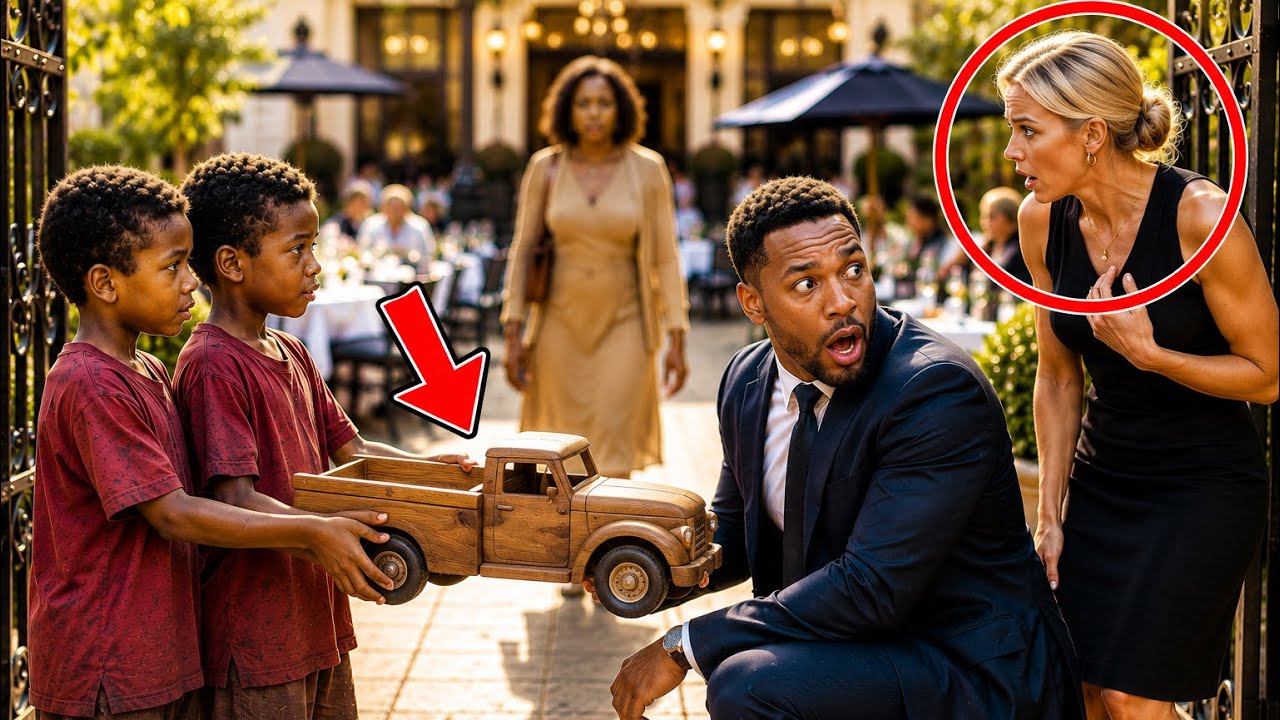
For nearly three years, Malik had admired her certainty.
That night, it felt colder than he remembered.
“I didn’t do it to feel like a hero,” he said.
“Then why?”
“Because I could help.”
“We were here for our wedding.”
“We still are.”
“No, Malik. We arrived here for our wedding. Then two strangers appeared, and you gave the entire evening to them.”
“It took five minutes.”
“It always takes five minutes.”
She pushed her untouched wineglass aside.
“Five minutes to stop for someone on the road. Five minutes to listen to an employee who should have made an appointment. Five minutes to answer a call during dinner because somebody’s rent is late or their mother needs surgery or their cousin needs a job.”
“Those things matter.”
“I matter.”
He held her gaze.
“I never said you didn’t.”
“You don’t have to say it. You show me.”
The planner returned before Malik could answer.
Ava smiled as though nothing had happened.
For the next hour, they discussed centerpieces, meal courses, flower arrangements, and the number of guests who could be seated comfortably without obstructing the dance floor.
Malik approved nearly everything.
But he barely tasted the food.
The wooden truck sat on the chair beside him.
Every time he looked at it, he saw Josiah’s fingers opening one by one.
When they left the restaurant, Ava asked the valet to place it in the trunk.
Malik put it on the back seat instead.
At home, he carried it into his study.
He set it on the shelf behind his desk, between a framed photograph of his late mother and the first business award he had ever received.
Ava stood in the doorway.
“You’re displaying it?”
“Yes.”
She laughed once, without humor.
“Of course you are.”
Over the next seven days, the truck became impossible for Malik to ignore.
He noticed new details each time he looked at it.
A tiny split in the wood had been repaired with glue and clamped so precisely that the seam was almost invisible. The wheels had been carved from a different type of wood than the body. Beneath the cab, a date had been written in faded pencil.
June 14.
There were small scratches along the cargo bed, the kind left by children who had spent years loading it with stones, toy soldiers, bottle caps, and whatever else their imaginations could carry.
This had not been built to sell.
It had been built to last.
Malik found himself wondering whether the medicine had arrived.
He wondered whether the boys had told their mother what they had done.
He wondered whether she was angry.
On Wednesday afternoon, he drove past the pharmacy near The Marlowe and slowed down without meaning to. He did not see Elias or Josiah.
On Thursday, Ava found him wiping dust from the truck with a soft cloth.
“You’ve thought more about those children this week than you have about our wedding,” she said.
“That isn’t true.”
“What flowers did we choose?”
He paused.
Her expression hardened.
“Exactly.”
“The white ones.”
“There were six kinds of white flowers.”
“Ava, I told you I trust your judgment.”
“That’s not the same as caring.”
He put down the cloth.
“You wanted control of the details.”
“I wanted a partner.”
“You rejected every suggestion I made.”
“Because your suggestions were things like inviting three hundred employees and replacing the champagne tower with a scholarship announcement.”
“I thought it would mean something.”
“It is our wedding. It is supposed to mean something to us.”
“And generosity can’t be part of that?”
“Not everything has to become a charity event.”
He looked at her for a long moment.
She crossed her arms.
“Don’t look at me like that.”
“Like what?”
“Like you’re disappointed in me.”
“I’m trying to understand you.”
“No. You’re judging me because I don’t fall apart every time a stranger has a sad life.”
Malik’s jaw tightened.
“That’s not what I’m doing.”
“It is. You think compassion makes you morally superior.”
“I have never said that.”
“You don’t need to. You built your entire identity around being the man who remembers where he came from.”
Her words struck deeper than she seemed to realize.
Malik had grown up in a two-bedroom apartment with his mother and grandmother. During difficult months, his mother skipped dinner and claimed she had eaten at work. When Malik was twelve, a church volunteer left groceries outside their door in unmarked bags so no one in the building would know they needed help.
He never discovered the person’s name.
But he remembered what dignity felt like in those bags.
He had promised himself that if he ever had enough, he would notice people others walked past.
That promise had shaped his company, his foundation, and nearly every decision Ava now called naive.
“Remembering where I came from is not an identity,” he said quietly. “It’s memory.”
Ava picked up her purse.
“Sometimes I wish you could leave the past where it belongs.”
Then she walked out.
Malik remained in the study.
On the shelf behind him, the carved initials on the truck seemed darker than before.
J. M. R.
Friday afternoon, Ava sent him a message.
Lunch tomorrow. One o’clock. Bellini’s. We need to finalize the guest list and stop fighting.
Malik agreed.
Bellini’s was across town from The Marlowe, but only a few blocks from the pharmacy where the boys had said they were going.
He told himself that was a coincidence.
Still, before leaving home on Saturday, he took the wooden truck from the shelf.
He placed it in the back seat of his car.
He did not tell Ava.
Lunch began politely.
Ava had arrived first. The guest list was printed and marked with colored tabs. She had divided the names into family, business, friends, obligations, and people she considered unnecessary.
Malik recognized several long-time employees in the last category.
They discussed seating arrangements for twenty minutes.
Then Ava drew a line through the name of Malik’s former high school teacher.
“He won’t fit the atmosphere,” she said.
“He changed my life.”
“He’s eighty-two and barely knows anyone else.”
“He knows me.”
“We have limited space.”
“We’re inviting a cosmetics executive you met twice.”
“She has influence.”
“He taught me how to write a business plan when I couldn’t afford college.”
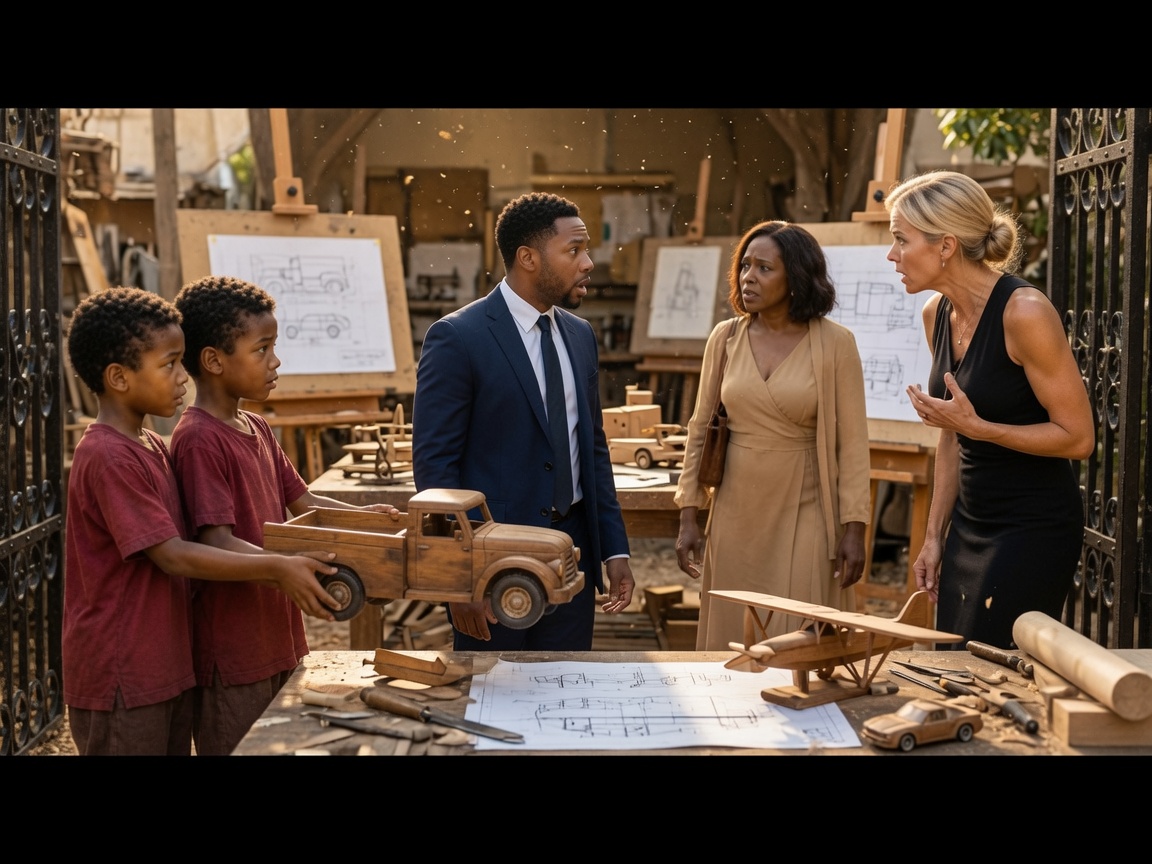
Ava placed the pen down.
“There. You’re doing it again.”
“Doing what?”
“Turning everything into a debt you have to repay.”
“It isn’t a debt. It’s gratitude.”
“To you, maybe. To everyone else, it’s exhausting.”
Malik looked at the list.
For the first time, he wondered how many people in his life Ava tolerated only because they mattered to him.
For the first time, he wondered whether she saw his past as something unfortunate he had survived or something embarrassing she wanted him to hide.
They finished lunch without resolving the guest list.
Outside, the afternoon was bright and windy. People moved along the sidewalk carrying shopping bags and coffee cups. A delivery driver leaned against his bicycle near the curb.
Ava was checking her phone when Malik heard someone shout.
“Mr. Malik!”
He turned.
Elias was running toward him.
Josiah followed, waving both arms.
They looked different.
Their clothes were still worn, but their faces were clean and rested. Josiah had new laces in his shoes. Elias wore a green jacket that was slightly too large for him, probably borrowed or donated.
Both boys were smiling.
Malik felt a wave of relief so strong he laughed.
“You found us,” Elias said, breathing hard.
“I was hoping I’d see you again.”
“Our mom got the medicine,” Josiah announced. “It worked.”
“She’s much better,” Elias added. “The doctor said she has to rest, but she can walk outside now.”
Malik crouched beside them.
“I’m glad.”
“We had money left,” Elias said proudly. “We bought soup, bread, and the medicine she needs next week.”
Ava stepped closer.
The boys’ smiles faded slightly when they recognized her.
Malik noticed.
“How did your mother feel about you selling the truck?” he asked.
Elias looked guilty.
“She was mad.”
Josiah nodded. “Very mad.”
“At us,” Elias clarified quickly. “Not at you.”
“She cried,” Josiah said.
Elias shot him a look.
“What?” Josiah asked. “She did.”
“Why did she cry?” Malik asked, though he already knew.
“Because it was the last truck our dad made,” Elias said. “He made it for Josiah’s birthday before he got too sick to work.”
Josiah stared at the sidewalk.
“He said it could carry anything.”
Malik felt something twist inside him.
Behind them, Ava checked the time.
“Where is your mother now?” Malik asked.
Elias pointed across the street.
“She’s coming.”
A woman stood on the opposite corner waiting for the pedestrian signal.
She wore a long brown coat over a simple blue dress. One hand rested against the metal pole beside her, as though she still tired easily. Her hair was pulled back, and the wind had loosened several curls around her face.
Malik’s attention fixed on her before he understood why.
Something about the way she stood.
The slight angle of her shoulders.
The way she pressed her lips together while waiting, patient but restless.
The light changed.
She stepped into the crosswalk.
Malik stopped breathing.
The years between them collapsed so quickly that for one disorienting second, he was no longer forty-one years old, standing outside an Italian restaurant with his fiancée and two children.
He was seventeen again.
He was sitting on the hood of an old car beneath a broken streetlight while a girl with bright eyes stole fries from his paper bag.
He was twenty, promising her that poverty would not decide the size of their future.
He was twenty-three, standing at a bus station with two bags and a scholarship letter, telling her he would come back when he had built something worthy of them.
He was twenty-four, holding an unopened envelope because pride had convinced him there would be time to answer later.
He was twenty-five, learning from a mutual friend that she had moved away.
He was every age he had been when he still believed he might see Zara Bennett again.
The woman reached the curb.
She looked first at her sons.
Then at Malik.
Her steps slowed.
The color left her face.
For a long moment, neither of them moved.
Elias looked from his mother to Malik.
Josiah did the same.
Ava lowered her phone.
“Wait,” she said.
Zara’s eyes filled with recognition.
“Malik?”
No one had said his name that way in years.
Not with surprise, relief, and old hurt all living inside the same two syllables.
“Zara,” he said.
Ava turned sharply toward him.
The boys stood between the adults, confused.
“You know our mom?” Elias asked.
Malik could not look away from her.
Zara appeared thinner than he remembered. There were faint shadows beneath her eyes, and illness had left her skin pale. But the expression was the same. The same steady eyes. The same small crease between her brows when she was trying not to reveal too much.
She looked at the expensive suit, the watch, the restaurant behind him, and finally the woman standing at his side.
“I heard you had done well,” Zara said.
Malik nodded.
“I heard you left the city.”
“I did.”
Silence settled over the group.
Ava looked at Malik, then Zara, then back at Malik.
“Do you two know each other?”
The question was simple.
The silence answered before either of them did.
Zara lowered her eyes.
Malik finally spoke.
“We grew up together.”
Ava’s expression did not change, but her grip tightened around her purse.
“How well together?”
Malik glanced at the boys.
“This isn’t the place.”
“No,” Ava said. “I think this is exactly the place.”
Zara stepped back.
“I don’t want to cause trouble.”
“You didn’t,” Malik said quickly.
Ava gave a quiet laugh.
“Of course she didn’t.”
Zara looked at Malik again.
“We were friends,” she said.
Malik heard the protection in the word. She was trying to reduce their past to something harmless.
He could not let her carry the lie alone.
“We were more than friends,” he said.
Ava’s face went still.
“How much more?”
Malik took a breath.
“She was my first love.”
The city seemed to continue around them without noticing.
Cars passed.
People entered and left the restaurant.
A man walked by holding a small dog.
But within the circle formed by Malik, Zara, Ava, and the two boys, everything had stopped.
Ava stared at Zara.
Then she looked at the children.
“And these are your sons.”
Zara placed a hand on Elias’s shoulder.
“Yes.”
“Where is their father?”
Elias answered before his mother could.
“He died.”
Zara’s hand tightened gently around him.
Ava looked away for a moment.
Malik saw the brief flash of discomfort cross her face—not grief, but irritation at being trapped in a situation where sympathy was expected.
“I’m sorry,” Malik said to Zara.
She nodded.
“Eight months ago.”
“The boys told me.”
Zara looked at them.
“They told you?”
“They sold me the truck.”
Her expression changed.
She closed her eyes for one second.
“So it was you.”
Elias reached for her hand.
“Mom, we had to.”
“I know,” she said softly. “I know why you did it.”
She looked at Malik.
“They came home with the medicine and more money than the truck was worth. They said a man outside a restaurant bought it. They didn’t know your last name.”
“I didn’t know they were your children.”
“I believe you.”
Ava shifted beside him.
Zara reached into her bag.
“I brought the money,” she said.
Malik frowned.
“What?”
“The boys told me they might see you here. They’ve been checking this street every afternoon with Mrs. Green. I told them if they found you, they should bring me.”
She took out a white envelope.
“I want to pay you back.”
“No.”
“Malik.”
“No.”
“It was too much.”
“It paid for what they needed.”
“It was still too much.”
“They sold me something.”
Her voice tightened.
“They sold you the last thing their father made for them.”
Malik looked at the boys.
Josiah’s chin trembled.
Zara lowered the envelope.
“My husband’s name was Jonah,” she said. “He was a carpenter. Not the kind who built expensive furniture for showrooms. He repaired cabinets, made shelves, fixed doors, whatever people could afford.”
Her fingers pressed against the envelope.
“At night, he made toys from the scraps.”
Elias smiled faintly.
“He made a train too.”
“And a boat,” Josiah added.
Zara nodded.
“When he got sick, he kept working. Even after his hands started shaking. Even after the doctor told him to stop.”
She looked down at her sons.
“That truck was the last toy he finished. He gave it to Josiah on his sixth birthday. Three weeks later, he went into the hospital.”
Josiah rubbed his eyes with his sleeve.
Zara placed her arm around him.
“When I found out they had sold it, I was angry because grief makes people angry at the wrong things. I knew why they did it. I knew they were scared. But I kept thinking about Jonah sanding those wheels when he could barely hold the paper.”
Malik swallowed.
“I’m sorry.”
“You helped my children save my life,” she said. “I’m not blaming you. I just can’t let you pay that much for our memories.”
Malik looked toward the parking lot.
“My car is around the corner.”
Ava stared at him.
“What does that have to do with anything?”
Malik ignored the question.
He asked Elias and Josiah to stay with their mother.
Then he walked to his car.
Ava followed.
“You brought it with you,” she said when he opened the rear door.
Malik lifted out the wooden truck.
Her face hardened.
“You planned this.”
“I hoped I might see them.”
“You brought a dead man’s toy to lunch with your fiancée because you hoped to find your former lover’s children?”
“I didn’t know they were hers.”
“But now they are.”
He closed the car door.
Ava stepped in front of him.
“Look at me.”
He did.
There was anger in her eyes, but beneath it was something else.
Recognition.
Not of Zara.
Of Malik.
As if, for the first time, she was seeing a part of him she had always believed she could eventually remove.
“You carried that thing around for a week,” she said. “You displayed it in our home. You drove past the pharmacy. You brought it here. And now the woman attached to it happens to be the love of your life.”
“I said she was my first love.”
“You didn’t have to say the rest.”
“There is no rest.”
“Your face said it when she crossed the street.”
Malik looked down at the truck.
He could not deny what had happened inside him.
Seeing Zara had opened a locked room.
But opening a room was not the same as living in it.
“I didn’t know she would be here,” he said.
“That almost makes it worse.”
He carried the truck back to the sidewalk.
The boys saw it first.
Josiah gasped.
“Our truck!”
He ran forward, then stopped before touching it.
Malik crouched and set it gently on the pavement.
“I bought this from you,” he said.
Elias nodded.
“So it belongs to me.”
The boy’s shoulders fell.
Malik continued.
“And since it belongs to me, I can decide what to do with it.”
He pushed the truck toward Josiah.
“I’m giving it back.”
Josiah looked at his mother.
Zara covered her mouth.
Elias did not move.
“Really?” Josiah whispered.
“Really.”
The boy dropped to his knees and wrapped both arms around the wooden truck.
His cheek pressed against the faded blue roof.
Elias turned away quickly, but not before Malik saw tears spill down his face.
Zara’s eyes shone.
“I can’t accept this and keep the money.”
“You can.”
“No, Malik.”
“You’re not keeping my money. I bought the truck. Then I chose to return it. Those are two separate decisions.”
She almost smiled.
“You always did argue like that.”
“And you always pretended not to understand when you were losing.”
For one brief second, they both laughed.
It was quiet and instinctive.
The kind of laugh born from a private language two people had once spoken fluently.
Ava heard it.
Her face changed.
The anger disappeared.
What replaced it was colder.
She looked at Malik with perfect clarity.
“This is who you are,” she said.
Malik stood.
“Ava.”
“No. I finally understand.”
She glanced toward Zara and the boys.
“You will always find someone whose pain matters more than whatever we are building.”
“That isn’t fair.”
“Isn’t it?”
She pointed toward the wooden truck.
“We were choosing our wedding venue, and you turned the night into a rescue mission. We were planning our guest list, and you brought that toy because some part of you wanted this story to continue.”
“I wanted to know whether two children were safe.”
“You always have a noble explanation.”
“Because helping them was not wrong.”
“I never said it was wrong.”
“You called them liars.”
“I said you did not know them.”
“And now that I do?”
Ava looked directly at Zara.
“Now it’s worse.”
Zara flinched.
Malik stepped between them.
“Do not speak to her that way.”
The words came out sharper than he intended.
Ava went silent.
Then Malik saw it.
The exact moment she understood.
Her eyes moved from him to Zara.
Her lips parted, but no words came.
The color drained slowly from her face as she realized Malik had not instinctively stepped beside his fiancée.
He had stepped in front of Zara.
A bus stopped near the curb. Several passengers turned at the sound of the raised voices. A waiter standing near the restaurant entrance pretended to adjust the menu display while watching them through the glass.
Ava reached for her engagement ring.
Malik’s stomach dropped.
She twisted it once, pulled it from her finger, and held it between them.
“Three years,” she said quietly. “And I have spent all three believing your past was something we would eventually outgrow.”
“My past made me who I am.”
“I know.”
Her eyes were wet now, but her voice remained controlled.
“That is what I finally understand.”
She placed the ring in his palm.
It felt impossibly small.
“Ava, don’t do this here.”
“Where would you prefer? At the venue? During the tasting? In front of the employees you plan to invite because you think gratitude is a seating arrangement?”
“This is not about a guest list.”
“No. It’s about values.”
She looked at the boys holding their father’s truck.
Then she looked at Zara.
Then back at Malik.
“You think love means stopping for every person who needs you. I think love means choosing the person you promised to build a life with.”
“Choosing you should not require me to become indifferent.”
“And loving you should not require me to compete with every broken person you see.”
The words landed heavily.
Malik closed his fingers around the ring.
Ava’s voice softened.
“I don’t think you are a bad man.”
He said nothing.
“I think you are exactly the man you want to be. And I think I kept expecting that after the wedding, there would be less room for everyone else.”
She stepped back.
“There won’t be.”
Malik could not lie to her.
“No,” he said. “There won’t.”
Ava nodded once.
It was not the answer she wanted.
But it was the truth she needed.
She turned and walked toward the waiting cars.
No shouting.
No final insult.
No dramatic glance over her shoulder.
The crowd moved aside, and within seconds, she disappeared behind the closing door of a taxi.
Malik remained on the sidewalk with the ring pressed into his palm.
Zara spoke first.
“You should go after her.”
He looked at the traffic.
“She doesn’t want me to.”
“You don’t know that.”
“I do.”
“This happened because of us.”
“No.”
He closed his hand more tightly.
“This happened because she and I finally told each other the truth.”
Elias stood beside the truck, watching him carefully.
“Are you still getting married?”
Malik looked down.
“No.”
Josiah hugged the truck harder.
“Because we sold this?”
“No,” Malik said immediately. “None of this is your fault.”
“Then why?”
Malik crouched in front of him.
“Because sometimes two people can care about each other and still need different things from life.”
Josiah frowned.
“That doesn’t make sense.”
Malik almost smiled.
“It doesn’t make much sense to adults either.”
Zara placed a hand on Josiah’s shoulder.
“Mr. Malik did something kind for us,” she said. “What happened between him and Miss Ava belongs to them.”
Malik looked at her.
She had always done that.
Even when they were young, Zara could take chaos and place each piece where it belonged.
She had been the first person to believe Malik’s ambition was not arrogance.
When he stayed up late writing business ideas in a spiral notebook, she brought him coffee from the diner where she worked.
When he was offered a scholarship in another state, she packed his bag before he had decided to accept.
She had not asked him to stay.
That had hurt him then.
Years later, he understood it had been love.
“What happened to us?” he asked before he could stop himself.
Zara’s eyes lifted to his.
The boys were focused on the truck. The city moved around them.
But the question had been waiting for more than fifteen years.
“You left,” she said.
“I wrote.”
“Three times.”
“I never received anything from you.”
Her expression sharpened.
“I sent letters every month for almost a year.”
Malik stared at her.
“No.”
“Yes.”
“To the address near campus?”
“To the apartment first. Then to the office after you started the company.”
“I never got them.”
Zara’s face changed.
The certainty in her eyes gave way to confusion.
“I thought you chose not to answer.”
“I thought you stopped writing.”
“I waited.”
“So did I.”
The words left them both shaken.
Malik searched his memory.
During his first year away, he had lived with two roommates. Mail was often misplaced. After launching his company, he moved offices three times in eighteen months. Letters could have disappeared anywhere.
Or perhaps someone had withheld them.
His mother had been ill then. His business partner had handled most of the office mail. There were too many possibilities and no way to reclaim the years.
Zara looked away.
“Eventually, I married Jonah.”
“Did he know about me?”
“Yes.”
Malik absorbed that.
“He knew I had loved someone before him. He never made me feel guilty for it.”
She looked at the boys.
“He was a good man.”
“I believe you.”
“And I loved him.”
“I believe that too.”
There was no jealousy in Malik’s answer.
Only grief for a man he had never met and gratitude that Zara had not been alone.
She reached for the envelope again.
“Please take the money.”
He shook his head.
“Keep it for the next prescription.”
“I can’t owe you.”
“You don’t.”
“I already did once.”
He knew what she meant.
Years ago, when Malik received his scholarship, the bus ticket cost more than he had. Zara had quietly sold a gold bracelet her grandmother gave her and placed the money inside his notebook.
He had promised to repay her.
She had refused.
He remembered her words exactly.
One day, when you can help someone else leave for something better, do that.
Malik looked at the envelope.
Then at the boys.
“This isn’t repayment,” he said. “It’s continuation.”
Zara understood.
Her eyes filled again.
This time, she did not argue.
Josiah placed the truck on the sidewalk and pushed it forward.
The wooden wheels rattled over the cracks.
“It still works,” he said.
“It was built well,” Malik replied.
“My dad said good things should outlive the person who made them.”
Malik looked at the faded blue wood.
“Your father was right.”
Elias traced the initials underneath.
“Those are his letters.”
“I saw them.”
“J. M. R.,” Elias said. “Jonah Matthew Reed.”
Malik nodded.
“Take care of it.”
“We will.”
“And don’t sell it again.”
Elias looked embarrassed.
“We won’t.”
Malik softened his voice.
“You did what you had to do. Your father would know that.”
Zara closed her eyes briefly.
When she opened them, she looked lighter.
Not healed.
But less alone.
A heavy silence followed.
Malik glanced at the restaurant. The half-finished guest list was still on the table inside. Ava’s name was printed beside his on every page. An hour earlier, his future had seemed fixed.
Now the engagement ring sat in his pocket.
The woman he once planned to marry was gone.
The woman he once thought he would never see again stood before him with two boys and a wooden truck.
Nothing about the moment felt simple enough to celebrate.
So Malik looked at Elias.
“Do you like ice cream?”
The boy blinked.
“Yes.”
“Josiah?”
“Yes.”
“What flavor?”
“Chocolate.”
Elias rolled his eyes. “He always gets chocolate.”
“Because chocolate is the best.”
“It is not.”
“It is.”
For the first time since Ava left, Malik smiled.
“There’s a place around the corner,” he said. “I think this situation requires professional judgment.”
Zara shook her head, but a tired smile appeared.
“You just ended an engagement.”
“I’m aware.”
“And your solution is ice cream?”
“My solutions have improved with age.”
She studied him.
“You don’t have to do this.”
“I know.”
He looked at the boys.
“I want to.”
Zara hesitated.
Then she nodded.
“All right. One ice cream.”
Josiah lifted the wooden truck.
“It can come too?”
“It has survived death, sickness, a sidewalk sale, and a week in a millionaire’s study,” Malik said. “I think it has earned ice cream.”
The boys laughed.
They began walking together.
Elias and Josiah went ahead, taking turns pulling the truck by a short piece of string tied to the front axle. Its wooden wheels bumped loudly over every seam in the sidewalk.
Zara walked beside Malik.
For several steps, neither spoke.
Then she glanced at his hand.
“You still rub your thumb against your palm when you’re upset.”
Malik looked down.
He had been doing exactly that.
“You still notice everything.”
“Not everything.”
“No,” he said. “Neither of us did.”
She understood.
They did not speak about the missing letters again that afternoon.
They did not speak about lost years, unfinished love, or whether finding each other meant they were supposed to reclaim anything.
Some moments were too fragile to carry the weight of a future.
For the moment, it was enough to walk.
At the ice cream shop, Elias chose strawberry. Josiah chose chocolate. Zara ordered vanilla and said she would only have a few bites, then finished the entire cup.
Malik chose coffee, the flavor he had eaten as a teenager because he thought it made him look older.
Zara laughed when she saw it.
“You still hate coffee ice cream.”
“I do not.”
“You used to trade yours for mine.”
“I was being generous.”
“You were being dishonest.”
The boys listened with fascination.
“You knew Mr. Malik when he was a kid?” Elias asked.
“He was never a kid,” Zara said. “He was born wearing a serious face and worrying about bills.”
Malik looked offended.
“I had fun.”
“You made schedules for fun.”
“They were efficient schedules.”
Josiah laughed so hard that chocolate ice cream dripped onto the wooden truck.
He froze.
Zara reached for a napkin.
Malik stopped her.
“Let it leave a mark.”
She looked at him.
“Why?”
“Because history is not supposed to stay perfect.”
Josiah wiped the drop with his sleeve, leaving a faint dark stain near the cargo bed.
Years later, that stain would still be there.
So would the scratches.
So would Jonah’s initials.
So would the repaired split in the wood.
The truck would never become valuable in the way Ava understood value. It would never sit beneath museum glass or appear in an auction catalog. No expert would call it rare.
But it had carried a father’s love.
It had carried two boys’ fear.
It had carried medicine home to their mother.
And for one week, it had carried a man back toward the part of himself he had almost allowed someone else to erase.
Malik did not lose his engagement because he helped two strangers.
He lost it because kindness revealed a truth that comfort had hidden.
Ava wanted a life protected from interruption.
Malik wanted a life that could still stop when someone small stood on a sidewalk and asked to be seen.
Neither belief made them evil.
But only one could guide the man Malik had spent his entire life becoming.
When they left the ice cream shop, the afternoon sun had begun to sink between the buildings.
Elias pulled the truck.
Josiah ran beside him.
Zara walked slowly, still recovering, and Malik matched her pace without mentioning it.
At the next corner, the boys stopped and waited for the light.
The same way their mother had waited before crossing toward Malik.
The wooden truck rested between them.
Its blue paint was faded.
One wheel squeaked.
A chocolate stain marked the side.
And still, it carried everything.
Because sometimes the smallest act of kindness does more than save a stranger.
Sometimes it exposes the wrong future, returns what grief tried to take, and leads you face-to-face with the life you were never meant to forget.


:format(jpg)/f.elconfidencial.com%2Foriginal%2F71d%2Faa0%2Fc24%2F71daa0c241269833a13557a41ef362c2.jpg)