The Homeless Girl Saved the Wounded Mafia Boss — Now He Refuses to Let Her Leave His Sight
The man bleeding behind St. Catherine’s Church had a gun in one hand and enough blood on his coat to turn the snow beneath him black.
Mara Quinn saw him just after midnight.
She was digging through a bakery dumpster for the bread they threw away in sealed plastic bags, the kind she could warm over the vent behind the public library. Snow clung to the frayed shoulders of her army surplus coat. Her fingers had gone numb twenty minutes earlier.
At first, she thought the man was dead.
Then the barrel of his pistol lifted toward her face.

“Walk away,” he said.
His voice was quiet, almost polite.
That frightened her more than shouting would have.
Mara slowly raised both hands. She was twenty-four, five-foot-three, and thin enough that strangers sometimes looked through her as if she were smoke. A faded scar crossed her left eyebrow. Her dark hair had been hacked short with drugstore scissors. Everything she owned fit inside the blue backpack hanging from one shoulder.
The wounded man looked forty, perhaps a little older. Expensive black wool coat. Italian shoes. Gray at the temples. A face built from hard angles and old decisions.
Blood seeped between the fingers pressed against his abdomen.
“You’re going to pass out,” Mara said.
“I’ve had worse.”
“No, you haven’t.”
His eyes sharpened.
Mara had seen that look before—men measuring danger, deciding whether kindness was weakness. She had learned not to fill silence just because someone powerful expected her to.
The man’s pistol trembled.
Then his arm dropped.
His head struck the brick wall behind him.
Mara could have left.
She should have left.
Sirens wailed somewhere beyond the snow-covered buildings of West Chicago, but they were moving farther away. A black sedan sat half a block down with its driver’s door open and both front windows shattered. Steam hissed from beneath the hood.
Someone had tried very hard to kill this man.
Someone might still be nearby.
Mara stared at him for three seconds.
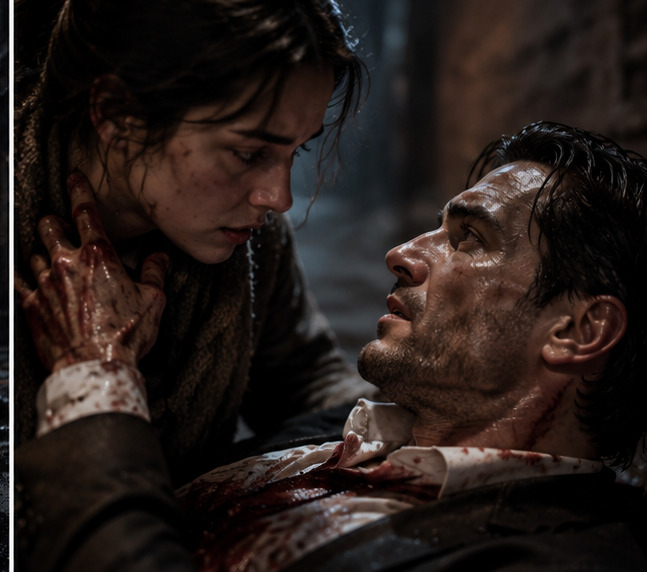
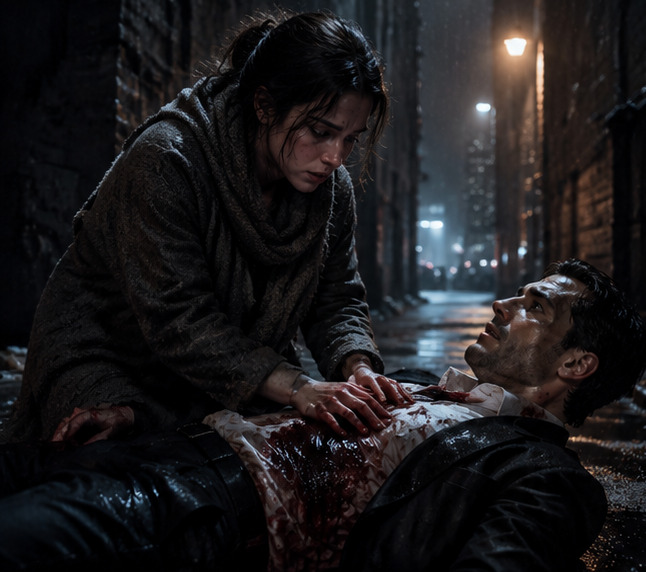
Then she knelt in the blood.
“Sir?”
No response.
She reached beneath his coat and found an entry wound low on the right side. No exit wound. The bleeding was heavy but not spraying. She pulled a clean T-shirt from her backpack, folded it, and pressed down.
The man jerked awake and seized her wrist.
His grip was astonishingly strong.
“Don’t,” he whispered.
“I’m stopping the bleeding.”
“No hospital.”
“You have a bullet inside you.”
“No hospital.”
“That wasn’t a suggestion.”
His eyes locked on hers. Even half-conscious, he carried authority like a second skeleton.
“If you call an ambulance,” he said, “men will come before the paramedics arrive.”
Mara glanced at the empty street.
Snow fell beneath the amber streetlights. A train groaned in the distance. Somewhere inside the church courtyard, a loose metal sign tapped against a post.
Tap.
Tap.
Tap.
“Your men?” she asked.
“Not mine.”
That answered enough.
Mara dragged him through the unlocked service door of St. Catherine’s basement.
She knew the building well. Father Elias opened the lower hall during dangerous weather, though city inspectors had recently forced him to stop letting people sleep there overnight. Mara still knew which window latch was broken and where the old boiler pipes ran warm.
The man weighed nearly twice as much as she did.
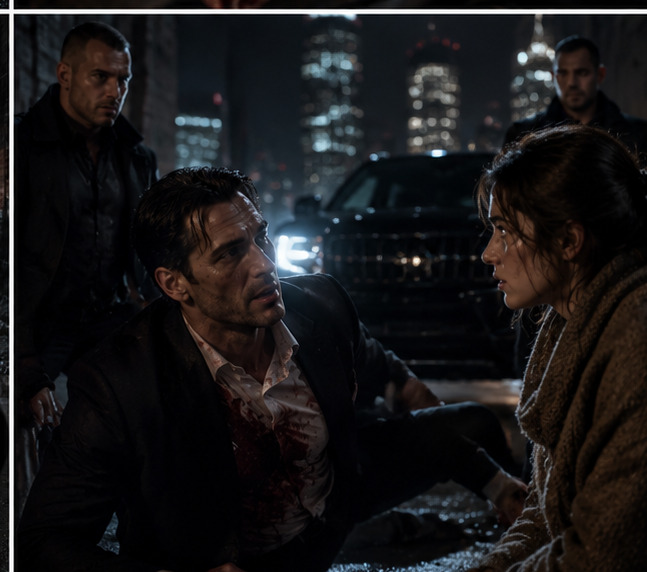
By the time she got him onto a folding table in the church kitchen, her lungs burned and blood soaked through both knees of her jeans.
She switched on a single fluorescent light.
It buzzed above them.
The stranger’s face had gone gray.
Mara took out a small first-aid pouch.
His eyes flickered toward it.
“You carry medical supplies?”
“I carry useful things.”
“You a nurse?”
“No.”
“A doctor?”
“No.”
“What are you?”
Her hands stopped for half a heartbeat.
“Currently?”
Something in his expression shifted, but pain pulled it away before it could become a smile.
Mara cut open his shirt with a pair of trauma shears. Beneath the blood and tailored fabric, old scars crossed his torso—knife wounds, surgical lines, a circular burn near his ribs.
He was not a businessman who had taken a wrong turn.
She cleaned the wound, packed it, and checked his pulse.
Too fast.
His skin was cold.
“You’re going into shock.”
“I know.”
“Then stop wasting oxygen.”
That time, he did smile.
It was barely there.
And then he lost consciousness.
Mara stood over him, listening to the wind batter the basement windows.
She could use the church phone.
She could disappear before anyone came.
She could leave the armed stranger to the consequences of whatever life had brought him bleeding into the snow.
Instead, she removed his pistol, checked the safety, and placed it out of reach.
Then she opened his coat to search for identification.
The card inside his wallet displayed a name in clean black lettering.
VINCENT MORETTI
MORETTI URBAN DEVELOPMENT
CHAIRMAN AND CHIEF EXECUTIVE OFFICER
Mara looked at the unconscious man.
She knew the name.
Everyone in Chicago knew the name.
Moretti Development owned towers, hotels, freight yards, riverfront property, and half the boarded-up neighborhoods politicians promised to revive every election season.
News anchors called Vincent Moretti a private financier.
Federal prosecutors called him a person of interest.
Men living in shelters called him something else.
The last real boss in Chicago.
Mara closed the wallet.
Then a phone inside his coat began to vibrate.
The screen showed no contact name.
Only a red circle.
She answered without speaking.
A man’s voice said, “Mr. Moretti?”
Mara stayed silent.
“Mr. Moretti, if you can hear me, do not go to St. Joseph’s. The emergency room is compromised. Your home is compromised. The driver is dead.”
Mara looked toward the basement stairs.
A board creaked above her.
The caller’s voice changed.
“Who is this?”
The church door opened upstairs.
Heavy footsteps crossed the sanctuary.
Mara hung up.
She killed the kitchen light and reached for the gun.
Three men descended the basement stairs.
The first carried a suppressed pistol.
The second carried a plastic sheet.
The third carried a camera.
Mara crouched behind the kitchen counter as their shadows stretched across the floor.
“Find the body,” one of them said. “Mr. Bellini wants proof.”
Mara looked at Vincent Moretti, unconscious beneath a church table, and understood that she had not rescued a dying man.
She had stepped into an execution that was not yet finished.
The first man entered the kitchen slowly.
Mara watched his shoes beneath the gap in the cabinet.
Black boots. Snow melting around the soles.
He moved with care, but not enough.
People rarely noticed someone they had already decided was powerless.
Mara waited until his leg passed the counter.
Then she swung the cast-iron skillet.
The edge struck the side of his knee.
Bone gave with a dry crack.
He collapsed before he could shout. Mara seized his wrist, slammed it against the tile, and kicked his pistol beneath the industrial refrigerator.
The second man came through the doorway.
She threw a pot of boiling water from the tea urn.
He screamed and covered his face.
The third raised his camera as if the device could protect him.
Mara aimed Vincent’s pistol at his chest.
“Don’t.”
The word came out steady.
The man froze.
Behind her, Vincent lifted his head.
His eyes found the standing gunman.
“Missed one,” he murmured.
The man spun.
Vincent reached beneath the folding table, snatched the fallen attacker’s ankle, and pulled. The man crashed face-first into the floor. Mara drove her heel onto his wrist until he released the camera.
The burned gunman staggered backward, clawing at his face.
Then the basement door burst open again.
A broad-shouldered man in a charcoal suit rushed down with two armed men behind him.
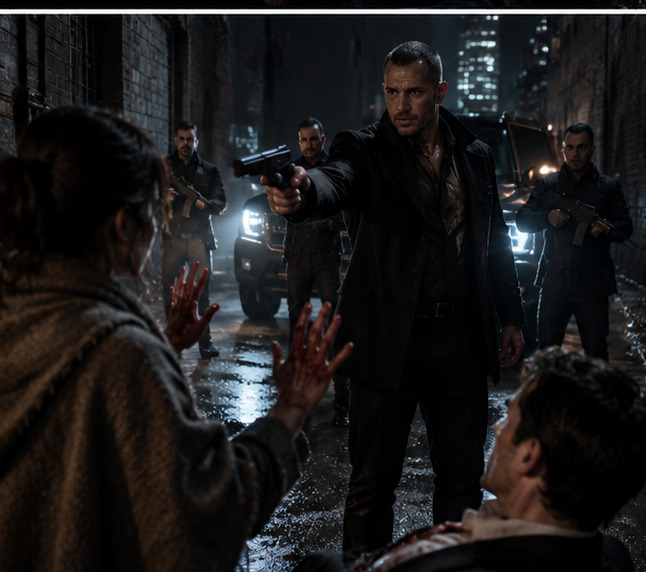
He had close-cropped silver hair and a healed cut through one corner of his mouth.
His weapon found Mara first.
Vincent spoke from the table.
“Rafe.”
The silver-haired man went completely still.
Then he lowered his gun.
“Boss.”
His gaze shifted from Vincent’s wound to Mara’s bare hands, the skillet, and the three attackers on the floor.
“What happened?”
Vincent looked at Mara.
“She happened.”
Rafe Conti ordered the church locked down.
Within minutes, the basement filled with men who spoke into radios and carried themselves with the quiet discipline of former soldiers. They removed the attackers, swept the building, and brought in a trauma surgeon named Dr. Nolan Pierce.
Pierce had tired eyes, a cashmere scarf, and the expression of a man who had been summoned to repair the same dangerous family too many times.
He examined Vincent and swore under his breath.
“Bullet’s lodged near the liver. You need an operating room.”
“Bring one.”
“To a church basement?”
Vincent’s eyes moved toward Mara.
“She kept me alive here.”
“That doesn’t make the place sterile.”
“Then sterilize it.”
Rafe stepped closer. “We have the clinic on Halsted.”
“Compromised,” Vincent said.
“You don’t know that.”
“They knew the hospital. They knew my route. They knew the driver.”
A silence fell across the room.
Not fear.
Something colder.
Betrayal.
Vincent’s gaze traveled over each face before returning to Mara.
She felt the attention of every man in the basement move with it.
“Who are you?” Rafe asked her.
“Mara.”
“Last name?”
“Quinn.”
“Address?”
She zipped her first-aid pouch.
“None.”
Rafe frowned.
Vincent did not.
“What do you want?” he asked.
Mara glanced at him. “For what?”
“For saving my life.”
“I haven’t saved it yet.”
Dr. Pierce pressed gauze against the wound. “She’s right. We’re running out of time.”
Vincent’s breathing had become shallow, but his mind remained frighteningly clear.
He pointed toward Mara’s backpack.
“Search it.”
Rafe moved.
Mara stepped between them.
“No.”
Every weapon in the room seemed to become more visible.
Rafe’s mouth tightened. “That wasn’t a request.”
“I know.”
Vincent studied her.
“Why protect a backpack?”
“Because it’s mine.”
“I need to know whether you were placed here.”
“You think someone hired a homeless woman to dig through trash in a blizzard, hoping you’d get shot near the right dumpster?”
One of the younger men looked down to hide a smile.
Rafe did not.
Vincent’s expression gave nothing away.
Then he nodded once.
“No one touches the bag.”
Rafe stared at him. “Boss—”
“No one.”
The order ended the discussion.
Dr. Pierce began transforming the church kitchen into an improvised surgical room. Tables were covered. Instruments appeared from sealed cases. Rafe’s men hung plastic sheeting around the operating area.
Mara moved toward the stairs.
“Stop.”
Vincent’s voice was weaker now, but everyone obeyed it—including her.
He turned his head on the pillow.
“Where are you going?”
“Away from men with guns.”
“You used one effectively.”
“I pointed it.”
“You didn’t shake.”
“I was busy.”
His eyes narrowed as though she were a puzzle he resented being unable to solve.
“Stay until I wake up.”
Mara almost laughed.
“You don’t give me orders.”
The room became dangerously quiet.
Vincent looked at her for a long moment.
Then he said, “Please.”
That word seemed to disturb his men more than the shooting had.
Mara glanced at Dr. Pierce.
“If I leave, will he die?”
Pierce adjusted his gloves. “He might die whether you stay or not.”
Vincent’s eyes never left hers.
Mara hated hospitals.
She hated the smell of antiseptic, the metallic rattle of instruments, the way men in authority spoke gently while deciding things about your body.
But there was something beneath Vincent’s command.
Not entitlement.
Fear.
He did not fear death.
He feared waking up surrounded by the wrong people.
Mara set down her backpack.
“I’ll stay until you wake up.”
His eyelids lowered.
“Good.”
As the sedative entered his vein, his hand moved across the table.
His fingers closed around her wrist.
Not hard.
Just enough to make certain she was real.
He held on until he could no longer keep his eyes open.
Vincent woke nine hours later in the master bedroom of a limestone mansion overlooking Lake Michigan.
The storm had buried the city beneath ten inches of snow.
Morning light pressed pale and cold against the tall windows. A fire burned behind a marble grate. Medical equipment hummed beside the bed.
Mara sat in an armchair across the room, wearing the same bloodstained coat.
Her boots were planted near the door.
Her backpack rested between her feet.
Vincent looked at her first.
Only then did he check the room.
Rafe stood near the fireplace. Dr. Pierce reviewed a monitor. Two guards waited in the hall.
“You brought me home,” Vincent said.
Rafe nodded. “We secured the east wing.”
“My home was compromised.”
“We replaced the staff and locked down the property.”
“Where’s my sister?”
“At the downtown penthouse with security.”
“Who knows I’m alive?”
“Six people.”
Vincent glanced at Mara. “Seven.”
Rafe followed his gaze. “She won’t give us anything. No address history. No family contacts. No social media. Her fingerprints aren’t in the local system.”
Mara’s eyes remained on the window.
“I’m sitting right here.”
“I know,” Rafe said.
Vincent shifted and pain cut across his face. Dr. Pierce immediately pushed him back.
“You move again, I’ll sedate you for twelve hours.”
“You’ve threatened me with better vacations.”
Pierce checked the bandage. “The bullet missed the hepatic artery by less than half an inch. Whoever packed the wound bought you time.”
Vincent looked at Mara.
She did not turn around.
Rafe said, “The attackers were working for Luca Bellini.”
“Bellini doesn’t have the reach to compromise my route.”
“No.”
“Someone gave it to him.”
“Yes.”
“Who?”
“We don’t know yet.”
Vincent’s gaze hardened. “Then find out.”
Mara stood.
The room reacted.
One guard’s hand moved toward his jacket. Rafe stepped away from the fireplace.
Mara slung the backpack over her shoulder.
“You’re awake.”
Vincent’s eyes narrowed. “And?”
“I said I’d stay until you woke up.”
“You can’t leave.”
There it was.
Not a request this time.
Mara gave him a tired look. “Watch me.”
“You saw faces. You heard names. Bellini’s people will know someone helped me.”
“They didn’t see me leave the church.”
“The cameraman transmitted footage before we arrived.”
Her hand stopped on the strap.
Rafe placed a tablet on the bed.
A frozen video frame showed Mara standing beneath the fluorescent kitchen light, Vincent’s pistol extended in both hands.
Her face was fully visible.
“The upload reached a remote server,” Rafe said. “We intercepted the first relay, but we can’t confirm whether copies were sent.”
Mara stared at the image.
For two years, she had survived by being forgettable.
Now violent men had a photograph of her face.
Vincent watched her process it.
“You stay here until Bellini is contained.”
“No.”
“You’ll have a private room. Security. Anything you need.”
“No.”
His voice cooled. “This isn’t negotiable.”
Mara stepped closer to the bed.
The guards tensed.
She bent until her face was level with his.
“I spent nineteen months being told when to sleep, when to eat, when to speak, and when I was allowed outside. I would rather freeze under a bridge than become someone’s prisoner again.”
Vincent’s face changed.
Not much.
A slight stillness around the eyes.
“What happened for nineteen months?” he asked.
“None of your business.”
She straightened and walked toward the door.
Vincent looked at Rafe.
“No one stops her.”
Rafe blinked. “Boss?”
“No one touches her.”
Mara paused in the doorway.
Vincent continued, “But put two cars on her. Distance surveillance. If she enters a shelter, buy the building.”
Mara turned.
“You’re unbelievable.”
“I’ve been called worse.”
“I don’t need your protection.”
“That’s fortunate, because this isn’t protection.”
“What is it?”
His voice became quiet.
“A debt.”
Mara looked at the bandages beneath his shirt.
Then at the armed men in the hallway.
“Men like you don’t repay debts,” she said. “You turn them into chains.”
For the first time since waking, Vincent had no answer.
Mara left the mansion.
He watched the doorway long after she was gone.
Then he said, “Find out who held her for nineteen months.”
Rafe’s scarred mouth tightened.
“She won’t like that.”
Vincent looked toward the snow-covered lake.
“I’m beginning to understand that.”
Mara made it three blocks before she spotted the first surveillance car.
It was a black Lincoln with tinted windows and a driver pretending to read a newspaper.
The second vehicle was subtler—a gray SUV parked beside a florist shop.
Mara crossed the street.
Both vehicles waited.
She entered a coffee shop through the front door, passed the restrooms, and exited through the kitchen after convincing a busboy that her violent boyfriend was following her.
For twenty minutes, she moved through alleys, loading docks, and a hotel parking garage.
Then she climbed onto a city bus heading south.
She knew how to vanish.
She had learned from professionals.
At 2:40 p.m., Mara entered a laundromat in Pilsen. She paid cash for a washer, locked herself in the restroom, and removed a water-damaged envelope from the lining of her backpack.
Inside were three items.
A photograph of a smiling woman in hospital scrubs.
A brass key.
And a corporate access card bearing Mara’s own face.
The name printed beneath it was not Mara Quinn.
It read:
DR. AMARA QUINTON
DIRECTOR OF CLINICAL SYSTEMS
VALECREST MEDICAL TECHNOLOGIES
She ran one thumb over the photograph.
Her mother’s face had faded around the edges.
“Not yet,” Mara whispered.
Then every light in the laundromat went out.
The washing machines spun into silence.
Someone locked the front door.
A man in a camel-colored coat stepped from behind the row of dryers.
He was clean-shaven, elegant, and old enough to have learned patience.
“Dr. Quinton,” he said. “Your father has been looking everywhere.”
Mara reached for the fire extinguisher mounted beside the restroom.
The man smiled.
“Please don’t make this unpleasant.”
The back door exploded inward.
Rafe Conti entered first.
Two men followed.
The stranger in the camel coat reached inside his jacket, but Rafe crossed the space in three steps and drove him face-first onto a folding table.
The laundromat owner screamed.
Rafe twisted the man’s arm behind him.
“Unpleasant enough?”
Mara backed against the wall.
Rafe’s gaze moved to the access card on the sink.
Then to her.
“Dr. Quinton?”
Her expression closed.
“You had me followed.”
“Yes.”
“I lost your cars.”
“You lost the cars you were supposed to see.”
The camel-coated man laughed against the table.
Rafe pressed harder on his arm.
“Who sent you?”
“Ask her father.”
Mara seized the access card and shoved it back into her bag.
Rafe watched her.
“Vincent said no one touches you.”
“You work for him, not me.”
“At the moment, keeping you alive serves both interests.”
The man on the table turned his head enough to see her.
“Your sister is getting married Saturday,” he said. “Your father thought you should know.”
Mara’s face drained of color.
Rafe noticed.
The stranger smiled wider.
“He’s announcing the sale after the ceremony. Once Valecrest signs, there’ll be nothing left for you to come back to.”
Mara stared at him.
“Tell Conrad I died.”
“He won’t believe that twice.”
Rafe dragged the man upright.
“Who’s Conrad?”
Mara looked through the dark front windows, where snow had begun falling again.
“My father.”
Vincent was furious when Mara returned to the mansion.
He did not raise his voice.
That made it worse.
He stood in the library against Dr. Pierce’s orders, one hand braced on a mahogany desk. Beneath his open collar, fresh blood spotted the edge of his bandage.
“You vanished.”
Mara took off her coat. “I walked outside.”
“You disabled two tracking devices.”
“They were poorly hidden.”
“You entered a building without a secondary exit.”
“It had one.”
“The man waiting for you carried a syringe filled with ketamine.”
Her eyes moved toward Rafe.
He nodded.
Mara’s jaw tightened.
Vincent took one step forward and winced.
“You knew someone might come.”
“I suspected.”
“You brought danger into a public laundromat.”
“I didn’t invite him.”
“You could have been taken.”
“But I wasn’t.”
Vincent struck the desk with his palm.
The sound cracked through the room.
Mara did not flinch.
Everyone else did.
He saw it.
Saw the way she went unnaturally still instead of stepping back.
His anger altered shape.
“Who is Conrad?” he asked.
“My father.”
“Full name.”
“No.”
“Rafe already found the company.”
“Then why ask?”
“I wanted to hear whether you’d lie to me.”
Mara’s eyes flashed. “You don’t get to test me.”
Vincent lowered himself carefully into a leather chair.
On the desk beside him lay a thin file.
He opened it.
“Amara Rose Quinton. Twenty-four years old. Biomedical engineer. Graduated from Northwestern at nineteen. Designed a diagnostic data platform now used in thirty-seven hospitals. Disappeared two years ago after being accused of stealing seven million dollars from Valecrest Medical Technologies.”
The room seemed to shrink.
Mara stared at the file.
Vincent continued, “Your father, Conrad Quinton, founded Valecrest. Your older sister, Evelyn, is chief operating officer. Your mother, Dr. Lena Quinton, died in a car accident six years ago.”
“Stop.”
“You were arrested in Milwaukee. Charges were dropped after the company declined to cooperate. Three days later, you entered a private psychiatric facility under an emergency guardianship order signed by your father.”
“Stop.”
“You remained there nineteen months.”
Mara crossed the room and swept the file from the desk.
Pages scattered across the Persian rug.
Her chest rose and fell.
“You had no right.”
Vincent looked up at her.
“No. I didn’t.”
The admission disarmed her more effectively than denial would have.
He rested his forearms on his knees.
“But men used my name to locate you. Bellini knew my route. Your father’s company is selling its controlling interest to Bellini Capital on Saturday. Someone tried to kill me forty-eight hours before that sale.”
Mara stared at him.
Rafe placed a photograph on the desk.
It showed Luca Bellini shaking hands with Conrad Quinton outside a private club.
Bellini was young for a syndicate leader—thirty-eight, handsome, smooth-faced, with the polished ease of someone who preferred to outsource cruelty.
Vincent watched Mara read the connection.
“Valecrest owns more than hospital software,” he said. “It controls access architecture for prescription databases, insurance networks, and medical supply chains across six states.”
Mara’s voice dropped. “Bellini wants the distribution system.”
“And someone inside my organization is helping him get it.”
Her gaze moved to the fire.
“What does that have to do with me?”
“You built Valecrest’s central platform.”
“I built the original framework.”
“Can Bellini use it to hide narcotics shipments?”
“Not without the master authentication layer.”
“Who has that?”
Mara said nothing.
Vincent studied her.
Then he understood.
“You do.”
She picked up her coat.
Vincent stood too quickly.
Pain bent him over, but he caught the edge of the desk and forced himself upright.
“You’re not leaving.”
Her head snapped toward him.
“Don’t start.”
“Bellini wants you. Your father wants you. Someone inside this house may want you. Until I know why, you stay where I can see you.”
“I am not one of your assets.”
“No.”
His voice softened.
“You’re the only reason I’m alive.”
Mara held his gaze.
Behind the anger in his face was something she recognized.
Not ownership.
Terror.
The terror of a man who had built his life around controlling every door, only to discover death had entered through one he had never seen.
She spoke more quietly.
“You cannot protect someone by taking away her choices.”
Vincent’s hand loosened on the desk.
The room waited.
Finally, he said, “Then choose.”
Mara looked toward the windows. Beyond them, Lake Michigan moved beneath a skin of winter steel.
“Choose what?”
“Stay here under your own terms. Name them.”
“No locked doors.”
“Agreed.”
“No guards inside my room.”
“Agreed.”
“No searching my belongings.”
Rafe shifted.
Vincent did not look at him. “Agreed.”
“No one investigates my mother.”
A pause.
Long enough for Mara to notice.
“Agreed,” Vincent said.
“And when this is over, I leave.”
The muscles along his jaw tightened.
“That will be your choice.”
Mara nodded once.
Vincent returned the gesture.
An agreement between two people who trusted no one.
Then the library door opened.
A woman in a cream-colored suit entered without waiting to be announced.
She was tall, silver-blond, and composed with the deliberate elegance of old wealth.
Her gaze went first to Vincent’s wound.
Then to Mara’s secondhand clothes.
The warmth left her face.
“Vincent,” she said. “Why is Conrad Quinton’s unstable daughter in your house?”
Mara’s fingers curled around her backpack strap.
Vincent’s voice became glacial.
“Celeste, meet the woman who saved my life.”
Celeste Moretti looked Mara up and down.
“What an unfortunate complication.”
Celeste was Vincent’s half sister.
She was also the president of the Moretti Foundation, a patron of three museums, and the polished public face of every charitable project that kept reporters from asking how the family had acquired its first hundred million dollars.
At dinner, she sat across from Mara beneath a chandelier containing enough crystal to pay for a small apartment building.
The table was set for twelve.
Only four people ate.
Vincent sat at one end, pale beneath the warm light. Celeste occupied the other. Rafe remained standing near the door. Mara had been placed halfway between the siblings, as though neutrality could be assigned by seating chart.
A housekeeper served wild mushroom soup.
Mara did not touch it.
Celeste unfolded her napkin.
“I’m told you slept outdoors.”
Mara looked at her. “Sometimes.”
“How distressing.”
“It has its moments.”
Celeste’s spoon paused.
Vincent drank water to hide the beginning of a smile.
Celeste continued, “Your father told the press you were ill.”
“My father tells people what makes him look patient.”
“He seemed devastated by your disappearance.”
“He hired men to bring me back.”
“Parents sometimes make difficult decisions when a child is unwell.”
Mara’s expression did not change, but her thumb rubbed the scar near her wrist.
Vincent noticed.
“Celeste,” he said.
His sister ignored the warning.
“I only mean that gratitude can become confused with trust. My brother is recovering from a traumatic event. He has always been susceptible to wounded things.”
The spoon in Vincent’s hand touched the bowl with a soft click.
Mara leaned back.
“Is that what you think I am?”
Celeste met her eyes. “Isn’t it?”
Mara considered the question.
Then she looked toward the oil painting above the fireplace.
A stern man in a black suit stood beside two solemn children. Vincent looked about fifteen. Celeste, perhaps nine. Their father’s hand rested on Vincent’s shoulder with the weight of a threat.
Mara turned back.
“No,” she said. “I think wounded things are what your family keeps creating so it can feel generous for feeding them.”
Rafe looked down.
Celeste’s face remained composed.
Only the tendons in her neck tightened.
Vincent’s gaze moved from Mara to the portrait.
For several seconds, the dining room held no sound but the fire.
Then Celeste placed her spoon beside the bowl.
“You’re clever.”
“I’ve had to be.”
“Cleverness without discipline becomes self-destruction.”
“Discipline without conscience becomes cruelty.”
Vincent said, “Enough.”
Mara expected him to look at her.
He looked at Celeste.
His sister rose from the table.
“You nearly died, and your response is to bring a fugitive into the family home. Bellini is circling our companies. The board is panicking. Federal investigators are reopening old files. Yet you are protecting a stranger who may have engineered the entire attack.”
Mara went still.
Vincent’s voice lowered.
“Careful.”
Celeste faced him.
“You think because she held gauze to your body, she is innocent? Her company is in business with Bellini. She carries access codes worth billions. She conveniently appeared seconds after the shooting.”
“I was behind a dumpster,” Mara said.
“How theatrical.”
Vincent pushed back his chair.
Dr. Pierce had warned him not to stand for more than ten minutes, but he rose anyway.
The movement cost him.
Sweat appeared at his temples.
Still, the room belonged to him.
“Mara stays,” he said. “Anyone who treats her as a suspect answers to me.”
Celeste’s gaze dropped to the blood seeping through his shirt.
Something like grief crossed her face.
Then it disappeared.
“You always confuse defiance with loyalty,” she said.
She left without dessert.
Mara watched the doors close behind her.
“She’s afraid of you dying.”
Vincent sat down slowly.
“She has an unusual way of expressing it.”
“So do you.”
His eyes lifted to hers.
Mara finally tasted the soup.
It had gone cold.
Over the next three days, the mansion became a fortress.
Security teams rotated every six hours. Phones were replaced. Kitchen staff were vetted. Vincent held meetings from the library while pretending the bullet wound did not tear open each time he leaned forward.
Mara watched the Moretti organization move around him.
Accountants, lawyers, former detectives, construction executives, union representatives. Some kissed Vincent’s cheek. Some called him sir. Some feared him. A few loved him.
All of them needed something.
Mara sat quietly during the meetings, usually near a window with a legal pad on her knees.
At first, the men ignored her.
Then she began noticing things.
A logistics manager who claimed a server outage had delayed shipping reports by six hours, though the metadata showed the files had been manually altered.
A vice president who referred to Bellini’s acquisition price before the figure had been made public.
A security chief whose watch displayed a private encrypted-message notification seconds before a confidential route change appeared on Vincent’s screen.
Mara wrote everything down.
Vincent read her notes after midnight.
On the fourth morning, he found her in the kitchen repairing a broken espresso machine.
“You’re an engineer,” he said.
She tightened a valve. “That is the rumor.”
“You could have asked someone.”
“They would have replaced a thirty-dollar part with a six-thousand-dollar machine.”
“That is generally how wealth works.”
“That is why wealthy people are constantly surrounded by new things that don’t work.”
He leaned against the counter, one hand unconsciously protecting his side.
Without his jacket, he looked less like a criminal legend and more like a tired man approaching middle age too quickly.
Mara glanced at his bandage.
“You’re bleeding again.”
“I’m healing.”
“You’re leaking.”
“I have a meeting.”
“You have stitches.”
“Both can be true.”
She washed her hands and stepped closer.
Vincent did not move as she unbuttoned the lower half of his shirt.
Her fingers were cold against his skin.
He watched her examine the dressing.
“You’ve done this before,” he said.
“My mother was a trauma surgeon.”
“The woman in the photograph?”
Mara’s head lifted.
“You searched my bag.”
“No.”
“Then how do you know about the photograph?”
“I saw the edge of it at the laundromat.”
She held his gaze long enough to make the lie uncomfortable.
Vincent looked away first.
Mara removed the bandage.
The incision was red but intact.
“You need antibiotics.”
“Pierce prescribed them.”
“Have you taken them?”
Silence.
She looked at him.
He glanced toward the espresso machine.
Mara laughed once, without humor.
“The most feared man in Chicago is afraid of pills.”
“I’m not afraid.”
“You’d rather be shot again than admit it.”
His jaw flexed.
Mara reached for the prescription bottle on the counter and shook one tablet into her palm.
Vincent did not take it.
She waited.
Finally, he said, “My father used to sedate me before meetings.”
Her hand lowered slightly.
He kept his gaze on the marble countertop.
“I was sixteen. He said emotion made men weak. If I objected to what he wanted done, he had his doctor give me something that made it difficult to speak.”
The kitchen felt warmer than before.
Mara placed the pill on the counter instead of offering it directly.
“My father did something similar.”
Vincent looked at her.
“In the facility?”
She nodded.
“What did he want you to forget?”
Mara opened a fresh bandage.
“That I owned thirty-one percent of Valecrest.”
Vincent’s eyes sharpened.
“Your file said twelve.”
“My father rewrote the corporate records after my mother died.”
“And the seven million?”
“Moved into an account bearing my credentials. I found it and reported it to the board. My sister testified that I had become paranoid.”
“Why?”
Mara pressed the new dressing into place.
“Because Evelyn was the one who moved the money.”
Vincent caught her wrist.
Gently this time.
“Why would your sister frame you?”
Mara’s face became unreadable.
“I don’t know.”
That was the first lie he heard her tell.
He released her.
She slid the pill toward him.
“Your choice.”
Then she walked away.
Vincent stared at the tablet for a long time.
At last, he picked it up.
Saturday arrived beneath a hard blue sky.
Evelyn Quinton’s wedding was being held at the Bellweather Hotel, a lakefront landmark recently purchased by Moretti Urban Development.
Seven hundred guests had been invited.
Politicians, hospital executives, philanthropists, surgeons, investors, and enough reporters to turn any disruption into national news.
At noon, Mara stood before a mirror in one of the mansion’s guest rooms.
A dark green dress had been laid across the bed.
She had not asked for it.
There was no tag, no designer label, and no note.
The fabric was simple, long-sleeved, and cut to move rather than display.
Beside it sat a pair of flat black shoes.
Vincent had learned.
No cage disguised as a gift.
Mara wore the dress.
The woman in the mirror looked like someone she had buried.
Her hair was still short. The scar across her eyebrow remained. But her shoulders no longer curled inward beneath layers of donated clothing.
When she entered the foyer, Vincent was waiting.
He wore a black tuxedo with no tie. His face had regained color, though the stiffness in his movements betrayed him.
For several seconds, he said nothing.
Mara lifted one eyebrow. “Is it that bad?”
“No.”
His voice had gone rough.
“It’s dangerous.”
She looked down at the dress. “It has pockets.”
“I noticed.”
Rafe approached with an earpiece.
“The ballroom is secure. Quinton’s private security is on the north entrance. Bellini arrived twenty minutes ago.”
Vincent offered Mara his arm.
She stared at it.
“I can walk.”
“I know.”
“Then why?”
“Because everyone in that ballroom needs to understand that reaching for you means reaching through me.”
Mara looked into his face.
“That sounds like a threat.”
“It is.”
“To them or to me?”
Vincent slowly lowered his arm.
The question struck exactly where she intended.
He stepped aside and opened the door for her.
“To them,” he said. “Always to them.”
Mara walked out first.
The Bellweather ballroom glittered beneath thousands of suspended lights.
A string quartet played near the marble staircase. White roses covered the tables. Champagne moved through the crowd on silver trays. Beyond the glass wall, Lake Michigan flashed beneath the winter sun.
Conversation dimmed when Vincent entered.
Then it stopped completely when Mara walked beside him.
Conrad Quinton stood near the center of the room.
He was sixty-one, silver-haired, and beautifully preserved. His tuxedo fit without a wrinkle. His public smile had reassured investors through lawsuits, recalls, and the death of his wife.
When he saw Mara, the smile remained.
Everything behind it vanished.
Evelyn stood beside him in a wedding gown that shimmered like frost.
She was thirty-two, taller than Mara, with their mother’s dark eyes and their father’s controlled mouth.
The champagne glass slipped in her hand.
Luca Bellini caught it before it fell.
He smiled at Mara.
“Dr. Quinton,” he said. “The dead return in such excellent taste.”
Vincent stepped between them.
Bellini’s smile widened.
“Vincent. I heard you were unwell.”
“You heard wrong.”
“I often do. People lie.”
His gaze drifted toward Rafe, Celeste, the board members, the security teams.
Then back to Vincent.
“Even family.”
Conrad approached.
The crowd opened for him.
He stopped three feet from Mara and studied her face as though evaluating damage to company property.
“Amara.”
“My name is Mara.”
“You’ve embarrassed us long enough.”
A few nearby guests pretended not to listen.
Every phone in the room seemed to tilt closer.
Conrad lowered his voice.
“You are ill. Come home quietly, and I will prevent this from becoming uglier.”
Mara’s hands remained at her sides.
“No.”
His smile tightened.
“Your sister is getting married.”
“To the man who purchased the company you stole from me?”
Evelyn flinched.
Conrad did not.
“You signed away your shares.”
“While sedated.”
“You were treated by respected physicians.”
“I was imprisoned by doctors you paid.”
A murmur moved through the room.
Conrad looked around, performing sorrow.
“This is exactly what we feared. She creates elaborate conspiracies. She accused her sister of theft, her doctors of kidnapping, and me of forging legal documents.”
Vincent’s voice cut through the whispers.
“Did you?”
Conrad’s gaze moved to him.
“This is a family matter.”
“You conducted part of it through my city.”
“Your city?”
Bellini laughed softly.
The quartet stopped playing.
Evelyn came down the steps.
“Please,” she said. “Not today.”
Mara turned toward her.
For two years, she had imagined this moment.
In some versions, she screamed.
In others, she slapped her sister.
In the darkest ones, she begged Evelyn to admit the truth.
Instead, Mara saw the tremor in Evelyn’s left hand.
The bruise hidden beneath makeup near her collarbone.
The way Bellini’s fingers rested at the base of her spine—not lovingly, but precisely, as though reminding her where he could reach.
Mara’s anger faltered.
“Did you move the money?” she asked.
Evelyn’s lips parted.
Conrad answered for her.
“Enough.”
Mara kept looking at her sister.
“Seven million dollars. Did you move it?”
Evelyn looked at Bellini.
Then at their father.
Her eyes filled, but no tears fell.
“Yes.”
The word barely carried.
Conrad’s face went still.
The crowd inhaled as one body.
Mara took a step forward.
“Why?”
Evelyn’s voice cracked. “Because Dad told me to.”
Conrad seized her elbow.
“You’re overwrought.”
Evelyn pulled away.
For the first time, her perfect posture broke.
“He said the company was failing. He said investors would destroy us if they learned the hospital contracts had been falsified. He told me to transfer the money through Mara’s credentials because she was the only one clever enough for people to believe she’d planned it.”
Mara stared at her.
Evelyn continued, words spilling faster.
“He promised no one would prosecute. He said you would spend a few weeks in treatment until the audit passed.”
“Nineteen months,” Mara whispered.
“I know.”
“You visited me once.”
Evelyn’s face folded.
“I tried to get you out.”
“You told the doctors I was delusional.”
“Because Dad said if I contradicted him, he would have you moved somewhere we could never find.”
Conrad’s pleasant mask disappeared.
“You ungrateful little fool.”
He reached for Evelyn.
Bellini caught his wrist.
Not to protect her.
To protect the spectacle.
“Let her finish,” Bellini said.
Vincent looked at Mara.
Something was wrong.
Bellini was too calm.
Conrad was too exposed.
Rafe touched his earpiece.
His face changed.
He moved toward Vincent, but the ballroom screens lit up before he arrived.
The wedding photographs vanished.
Security footage appeared.
St. Catherine’s Church.
Mara dragging a wounded Vincent through the basement door.
Mara holding his gun.
Then another clip.
Mara entering the laundromat with her corporate access card.
A final image filled the screen: a schematic of Valecrest’s master authentication system.
Bellini turned toward the guests.
“Ladies and gentlemen, you are watching a conspiracy in progress.”
Reporters raised their phones.
Bellini pointed at Mara.
“Dr. Amara Quinton fabricated evidence against her family, disappeared to avoid prosecution, and resurfaced beside Vincent Moretti hours after he was shot. She possesses stolen security credentials capable of compromising American hospital systems.”
Mara’s pulse pounded in her throat.
Bellini continued, “Mr. Moretti then used violence to abduct one of our investigators and conceal her identity. This wedding was supposed to mark a partnership that would save Valecrest. Instead, we have uncovered a criminal attempt to sabotage it.”
Police officers entered through the north doors.
Not city patrol.
Federal agents.
Conrad’s shock looked real.
Evelyn covered her mouth.
Rafe whispered, “The warrant names Mara and Vincent.”
Celeste stood near the stage, motionless.
Vincent looked at her.
She did not meet his eyes.
And Mara finally understood.
The leaked route.
The compromised hospital.
The video relay.
The knowledge of Vincent’s medication.
Celeste had not come to the mansion because she feared a stranger.
She had come to see whether her brother had survived.
Vincent followed Mara’s gaze.
His sister slowly turned toward him.
For one suspended second, neither moved.
Then Celeste’s chin trembled.
That was all.
Vincent’s face emptied.
The moment of recognition was quieter than a gunshot and far more devastating.
His own sister had opened the door.
Federal agents surrounded Vincent and Mara.
A special agent with a square face displayed a warrant.
“Vincent Moretti, you are being detained in connection with attempted murder, obstruction, kidnapping, and conspiracy to compromise protected medical infrastructure.”
Vincent did not look at him.
He looked at Celeste.
“Why?”
Her composure cracked.
“You were destroying everything.”
“What did you give Bellini?”
“Routes. Personnel. Nothing that should have gotten you killed.”
Bellini smiled.
Celeste turned on him. “You said they would frighten him.”
“I said the problem would be resolved.”
Vincent took one step toward his sister.
Agents raised their weapons.
Mara moved between them.
“Don’t.”
Vincent’s eyes remained fixed on Celeste.
She pressed one hand to her throat.
“You refused to modernize,” she said. “You kept protecting neighborhoods that lose money. Union contracts. Clinics. Housing projects. You call it loyalty, but it is vanity. Bellini offered us a legitimate future.”
“A narcotics distribution network through hospitals?”
Her eyes flickered.
She had not known.
Bellini’s smile faded.
Conrad looked at him. “What is she talking about?”
Mara almost pitied them.
Each had believed they were using the others.
None understood the entire plan.
Bellini stepped toward the agents.
“This woman is unstable. She has no evidence.”
Mara reached into the pocket of her dress.
Security reacted.
She slowly removed the brass key.
“My mother did.”
Conrad’s face lost color.
Mara held up the key.
“Six months before she died, Dr. Lena Quinton created an independent archive of Valecrest’s system activity. She suspected someone was altering clinical trials and billing records.”
Conrad whispered, “You’re lying.”
“She gave me this key the night before her car went through the barrier on Lake Shore Drive.”
Evelyn stared at their father.
Mara continued, “The archive is stored offline in a private data vault beneath the original Valecrest research center. It requires two authentication factors. The physical key and the biometric signature of the platform’s creator.”
Bellini’s eyes moved toward the exits.
Rafe noticed.
So did Vincent.
Mara looked at the federal agent.
“You’re not here because Bellini reported us. You’re here because an anonymous packet told you I planned to breach medical infrastructure tonight.”
The agent said nothing.
“The packet included enough accurate code to establish probable cause,” Mara continued, “but one line was wrong. A deliberate flaw copied from a decoy system I wrote when I was seventeen.”
She looked directly at Bellini.
“The only people who possessed that decoy were my father, my sister, and Valecrest’s outside acquisition counsel.”
Bellini’s attorney took one step backward.
Rafe blocked him.
Mara’s voice remained calm.
“Three days ago, I accessed the decoy remotely. I knew whoever was searching for the master layer would steal it. The moment they opened the package, the system mirrored every command, message, and authorization on their network.”
Bellini stopped smiling.
Vincent looked at her.
“You set a trap.”
“No,” Mara said. “I left a door open and waited to see who believed they were entitled to walk through it.”
Rafe removed a drive from his jacket.
“We delivered the mirrored archive to the U.S. Attorney’s Office ninety minutes ago.”
The square-faced agent touched his earpiece.
Across the ballroom, other agents received the same message.
Their positions shifted.
Weapons that had been aimed at Vincent now turned toward Bellini, Conrad, and three Valecrest executives.
Bellini stared at Mara.
The confidence drained from his face in visible stages.
His mouth opened.
Closed.
His eyes moved to the exits, calculating distances that no longer mattered.
The ballroom had gone completely silent.
Even the cameras seemed to wait.
Conrad backed away from his daughters.
“This was Bellini’s operation.”
Evelyn looked at him.
Something inside her finally broke free.
“No,” she said. “It started with Mom.”
Conrad froze.
Evelyn’s voice strengthened.
“You disabled the safety alerts on her car because she was taking the archive to regulators.”
Mara turned to her sister.
Conrad’s face became waxy.
“That’s absurd.”
“I saw the maintenance request,” Evelyn said. “You made me delete it.”
“You were confused.”
“I kept a copy.”
Conrad stared at her.
His hand began to shake.
Evelyn removed a small memory card from beneath the lace at her wrist.
“I kept everything.”
Mara could not breathe.
For six years, she had believed her mother’s death was suspicious.
Belief was not the same as hearing it spoken aloud beneath wedding chandeliers.
Conrad looked around the room.
At investors.
At reporters.
At the daughters he had controlled through fear.
At the agents approaching him.
His shoulders lowered by an inch.
His face did not collapse dramatically.
It simply aged.
The smooth authority drained away, leaving an old man who had mistaken obedience for love and silence for innocence.
“You don’t understand what I built,” he said.
Mara’s eyes burned.
“No. You never understood what we built.”
Agents handcuffed Conrad Quinton in front of the Valecrest board.
Bellini tried to run.
He reached the service corridor before Rafe stopped him with one hand against his chest.
Bellini looked toward Vincent.
“You touch me, every camera in this room sees it.”
Vincent stood ten feet away.
He glanced at the cameras.
Then at the federal agents closing in.
“I don’t need to touch you.”
Bellini’s gaze sharpened with hatred.
Vincent’s expression did not change.
“That is the difference between power and panic,” he said. “Power knows when to step aside.”
Rafe removed his hand.
The agents took Bellini.
Celeste remained near the stage.
No one approached her at first.
She looked at Vincent.
He had been shot because of her.
A driver had died because of her.
Men had entered a church carrying plastic sheets because she had believed she could arrange violence without becoming responsible for it.
“I was trying to save the family,” she whispered.
Vincent walked toward her.
Each step pulled at his wound, but he did not stop.
When he reached her, Celeste lifted her chin, preparing for rage.
He gave her none.
“That was always Father’s excuse.”
Her face crumpled.
Vincent looked at the sister he had protected since childhood.
Then he signaled to the agents.
Celeste’s breath caught.
“Vincent.”
He turned away before they placed the handcuffs on her.
Behind him, she began to cry.
He did not look back.
The story dominated national news for six weeks.
Federal prosecutors charged Luca Bellini and fourteen associates with racketeering, attempted murder, narcotics conspiracy, cybercrime, and corruption.
Conrad Quinton was charged with fraud, unlawful confinement, obstruction, and conspiracy related to Lena Quinton’s death.
Celeste Moretti pleaded guilty to conspiracy and providing material assistance in the attack on her brother. She agreed to testify in exchange for a reduced sentence.
Evelyn’s wedding never took place.
For a month, she stayed in a private residence under federal protection. Then she resigned from Valecrest and publicly admitted her role in framing Mara.
She did not ask for forgiveness.
Mara respected her for that.
The Valecrest board attempted to remove both sisters and sell the company before regulators could freeze the transaction.
They failed.
Lena Quinton’s archive proved that Mara owned thirty-one percent of the company, not twelve. It also showed that much of Valecrest’s original diagnostic system had been developed under her patents.
Investors who had once accepted the family’s story now competed to call her courageous.
Mara refused every interview.
She spent most mornings in a borrowed office reviewing code and most nights at St. Catherine’s Church, helping Father Elias convert the basement into a legal winter shelter.
Vincent financed the renovation anonymously.
Mara discovered his name on the permit application and crossed it out with a black marker.
He watched her from the doorway.
“You removed the donor acknowledgment.”
“You said anonymously.”
“I meant discreetly.”
“That’s not what the word means.”
Vincent had lost weight during recovery. The scar beneath his ribs still pulled when he moved, but he no longer pretended it did not hurt.
He entered the kitchen carrying two coffees.
“One black,” he said. “One with enough sugar to violate health codes.”
Mara took the sweet one.
Outside, volunteers assembled bunk beds. Hammers struck wood. Father Elias argued with a fire inspector about emergency exits.
Vincent leaned against the counter.
“The board vote is tomorrow.”
“I know.”
“They’ll offer you the chief executive position.”
“I know.”
“You should take it.”
Mara looked at him over the coffee lid.
“You hate corporate executives.”
“I hate incompetent corporate executives. The distinction matters.”
She smiled.
It came more easily now.
“What will you do?” he asked.
“I’ll take control long enough to divide the medical platform into a public-benefit trust. Hospitals keep access. Patients keep privacy. Valecrest’s commercial division can survive without owning people’s data.”
“You’ll lose money.”
“Yes.”
“Possibly hundreds of millions.”
“Yes.”
Vincent looked almost offended.
“You’re very strange.”
“I slept behind a library. Money stopped looking magical.”
The hammering in the next room ceased.
A group of volunteers carried in a wooden sign for the shelter.
THE LENA QUINTON CENTER
WARMTH WITHOUT CONDITIONS
Mara stared at it.
Her throat tightened.
Vincent watched her face.
“You did that.”
“Father Elias chose the name.”
“You paid for the sign.”
“I may have expressed support.”
She turned toward him.
“You don’t have to keep doing things for me.”
“I know.”
“You don’t owe me anymore.”
“I know.”
“Then why are you here?”
Vincent looked through the doorway at the shelter beds, the donated blankets, the people building something that would remain after winter.
When he answered, the authority was gone from his voice.
“I spent my life making certain no one could leave me without permission.”
Mara said nothing.
He turned back to her.
“You were right. Debts become chains when men like me hold them.”
His fingers tightened around the coffee cup.
“I don’t want you to stay because I saved you. I didn’t. I don’t want you to stay because you saved me. You did, but that cannot become your sentence.”
Mara’s heart beat harder.
Vincent continued, “I want you near me because every room changes when you enter it. Powerful men become careless. Frightened people become honest. And I remember that survival is not the same as living.”
He exhaled slowly.
“But if leaving is what makes you free, I will open the door myself.”
Mara studied him.
The feared man in the tailored coat.
The wounded boy who had once been drugged into silence.
The brother who had chosen justice over blood.
The criminal who had finally learned that protection without consent was only another form of control.
She set down her coffee.
“Open it, then.”
Something flickered across his face.
Pain, quickly hidden.
But he obeyed.
Vincent walked to the rear door of the church and pushed it open.
Cold sunlight spilled across the basement floor.
Outside, Chicago moved beneath a clear winter sky. Buses groaned along the avenue. Snow slid from rooftops. Somewhere beyond the buildings, the lake shone like hammered silver.
Mara put on her coat.
She picked up the blue backpack that had carried everything she owned.
Vincent stepped aside.
No guards waited outside.
No cars blocked the alley.
No one reached for her.
Mara walked through the doorway.
She crossed the courtyard.
Ten feet.
Twenty.
At the gate, she stopped.
Vincent remained where she had left him, one hand resting against the open door, his face unreadable.
For once, he did not call after her.
He did not order.
He did not follow.
Mara looked down at the backpack.
Inside were the photograph of her mother, the access card she no longer needed, and keys to a small apartment overlooking the river.
She had spent two years learning how to disappear.
Now, for the first time, no one was forcing her to.
She turned around.
Vincent’s breath caught.
Mara walked back across the courtyard.
When she reached him, she removed the backpack from her shoulder and placed it on the floor inside the church.
“This doesn’t mean you get to watch me every second,” she said.
The corner of his mouth lifted.
“Every other second?”
“No.”
“Every third?”
“Vincent.”
“All right.”
She stepped closer.
“What does it mean?” he asked.
Mara looked at the open door, then at the man who had finally trusted her enough not to close it.
“It means I’m not staying because you won’t let me leave.”
She took his hand.
“I’m staying because now I can.”
For years, everyone who claimed to love Mara had tried to own her brilliance, control her voice, or rewrite her truth.
In the end, the most dangerous man she ever met became the first one brave enough to set her free—and that was the only reason she chose to walk back through his door.