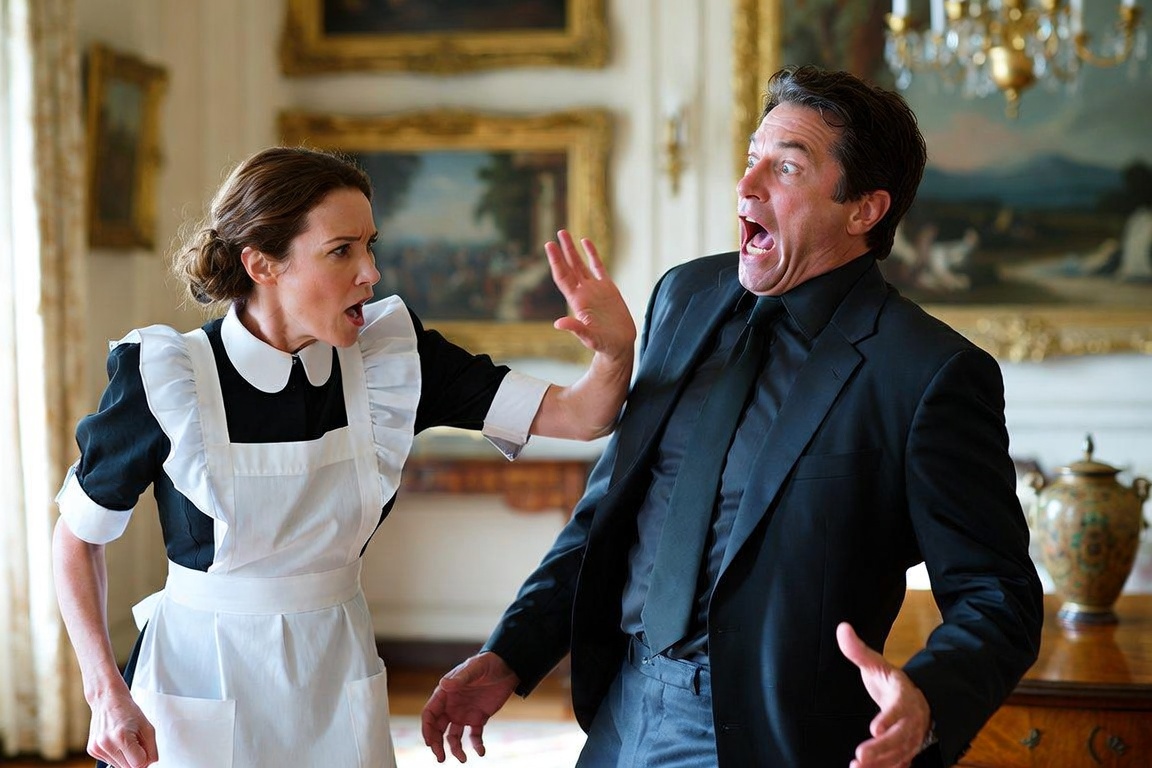
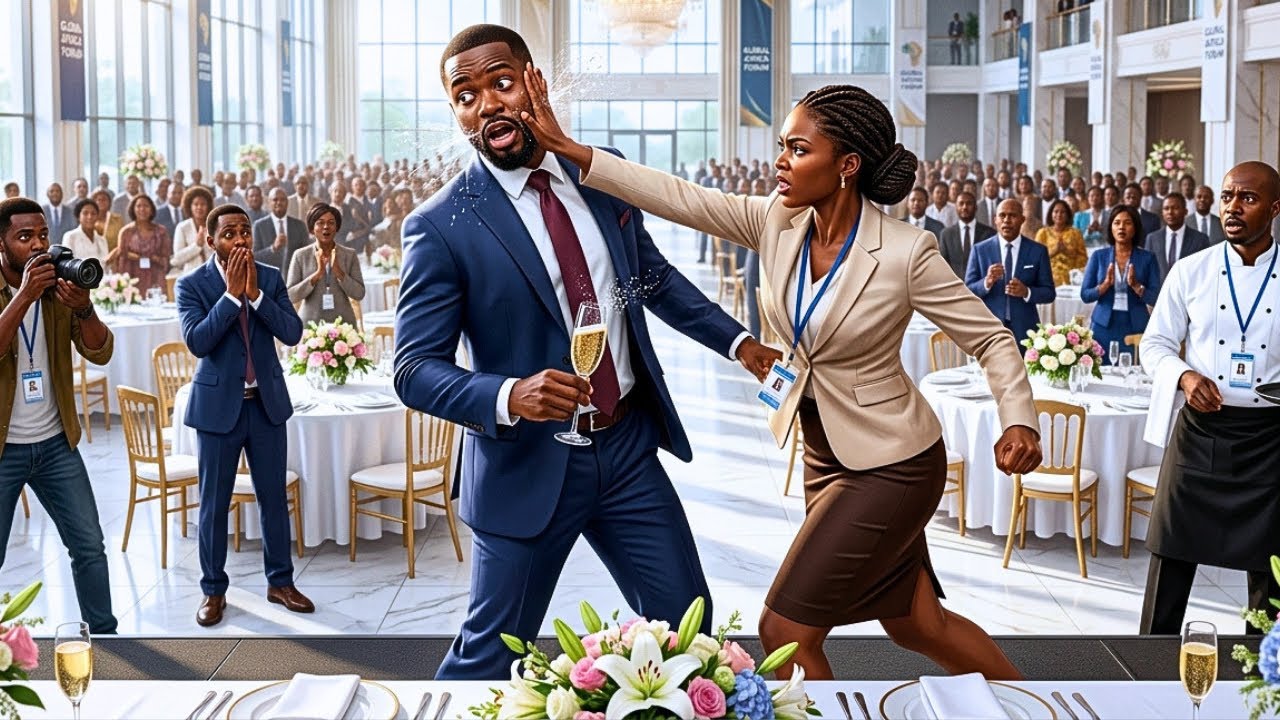
The sound of the slap cracked through the ballroom like a gunshot.
Doran Moyo’s champagne glass flew from his hand, struck the marble floor, and shattered beneath the feet of three stunned investors.
For one frozen second, nobody moved.
Then two hundred guests turned toward the young maid standing in front of the billionaire with her palm still raised.
Neca’s breathing came in short, painful bursts. Her white uniform was spotless, but her eyes were wild with fear.
Doran slowly touched the red mark forming across his cheek.
Behind him, cameras were still recording.
The signing ceremony had been broadcast live to three countries. Government officials, bankers, foreign investors, and the entire executive board of Moyo Global had just watched a household employee strike one of the richest men in the country.
“Have you lost your mind?” someone shouted.
Doran’s head of security rushed forward.
Neca did not step back.
“Don’t let him drink anything,” she said.
Her voice shook, but it carried across the silent room.
“That glass was poisoned.”
A murmur spread through the crowd.
Then came the laughter.
It started near the back, nervous and uncertain, before growing louder as people convinced themselves the scene had to be some kind of absurd misunderstanding.
Farai Chuma, Doran’s oldest business partner, stepped out from beside the signing table.
He was sixty-two, silver-haired, and perfectly composed. For more than thirty years, he had stood beside Doran at every major company announcement. Newspapers called them brothers. Employees called Farai the only man Doran trusted completely.
Farai looked at Neca as if she were something unpleasant on the bottom of his shoe.
“This woman should be removed immediately,” he said.
Neca turned toward him.
And the color in Farai’s face changed.
Only for a moment.
But she saw it.
So did no one else.
Security seized both of Neca’s arms.
Doran watched her carefully. He had not shouted. He had not demanded her arrest. That silence was somehow more frightening than anger.
“Explain yourself,” he said.
Neca looked at the broken glass on the floor.
“I heard them talking.”
“Who?”
Her eyes moved toward Farai.
“Mr. Chuma and another man. In your study.”
The murmuring stopped.
Farai gave a slow, disappointed smile.
“Doran, this is ridiculous.”
Neca struggled against the guards.
“He said the poison would act like a heart attack. He said no one would question it because of your medical history.”
Every head in the room turned toward Doran.
Only a handful of people knew that he had suffered a mild cardiac episode eighteen months earlier.
Farai’s smile disappeared.
Doran noticed.
“Release her,” he said.
The guards hesitated.
“I said release her.”
They let go.
Neca’s arms dropped to her sides, but she did not run. She stood alone in the center of the ballroom while guests stared at her with open contempt.
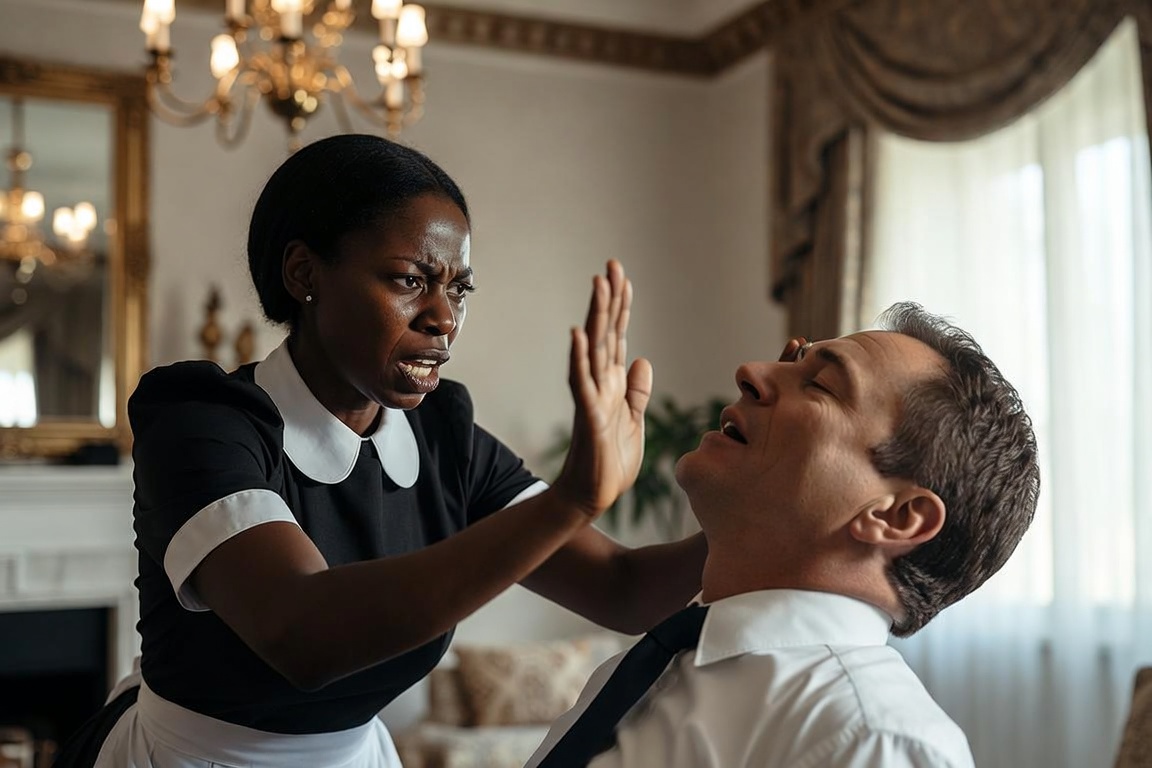
To them, she was only the maid who had ruined a historic evening.
The contract on the table was worth nearly four billion dollars. It would merge Moyo Global’s transport division with a European logistics giant and make Doran the most powerful private infrastructure owner in the region.
He had spent seven years building the deal.
Neca had destroyed the signing in seven seconds.
Farai stepped closer to Doran.
“You cannot possibly be entertaining this,” he said quietly. “She is a domestic worker who was caught listening outside a private room.”
“I was carrying tea,” Neca replied.
“No one asked you.”
Doran raised one hand, and Farai went silent.
“Where is the other glass?” Doran asked.
The room shifted uneasily.
A waiter pointed toward the signing table.
There had been two glasses prepared for the ceremonial toast. One for Doran and one for the European company’s chairman, Henrik Voss.
Voss’s glass remained untouched.
Doran looked down at the shattered crystal near his shoes.
Then he looked at Neca.
“How did you know which glass was mine?”
“I saw Mr. Chuma move the gold marker.”
Farai laughed once, sharply.
The champagne glasses had small decorative markers around their stems. Doran’s was gold. Voss’s was silver.
“That is a lie,” Farai said.
Neca kept her eyes on Doran.
“When the waiter brought the tray, the gold marker was on the glass to the left. Mr. Chuma switched it to the right after asking the waiter to adjust the curtains.”
Now everyone looked at the waiter.
The young man’s face went pale.
“He did speak to me about the curtains,” he said. “But I didn’t see him touch the glasses.”
Farai spread his hands.
“There. A frightened employee inventing details to support another frightened employee.”
Doran’s chief legal officer stepped forward.
“Sir, the safest course would be to suspend the event and have both glasses tested.”
Farai turned on her.
“Do you understand what suspension would do? The market is watching this live.”
Doran glanced toward the cameras.
Small red lights still glowed above the lenses.
“Turn off the broadcast,” he ordered.
Technicians scrambled.
Within seconds, the screens went black.
But it was already too late.
Clips of the slap were spreading across social media before the guests had even left their chairs.
By the time police arrived, the headline had written itself:
ARROGANT MAID ASSAULTS BILLIONAIRE DURING FOUR-BILLION-DOLLAR CEREMONY
No outlet mentioned poison.
Not at first.
Neca was taken to a private room and questioned for nearly three hours.
She told the same story each time.
Earlier that afternoon, she had been bringing tea to Doran’s study when she heard voices through the half-open door.
Farai had been inside with Dr. Elias Gondo, Doran’s private physician.
“The dose must be exact,” the doctor had said.
Farai replied, “It only needs to resemble another episode. By the time anyone asks questions, the board will already have activated the succession clause.”
Neca had remained still outside the door, afraid even to breathe.
Then a floorboard creaked beneath her shoe.
The voices stopped.
She hurried away before either man came out.
For the next hour, she tried to reach Doran alone.
Every attempt failed.
His assistant told her not to interrupt him. Security refused to let her near the preparation room. Farai himself saw her waiting near the corridor and ordered the household manager to keep “unnecessary staff” away from the guests.
Then the signing began.
Neca watched from the edge of the ballroom as champagne was poured.
She saw Farai touch the stem markers.
She saw Doran lift the glass.
And she understood that words would not reach him in time.
So she slapped him.
By midnight, Neca was no longer being questioned as a witness.
She was being treated as a suspect.
The laboratory’s first examination found no obvious poison in the liquid recovered from the floor.
Farai’s lawyers immediately demanded her arrest for assault, defamation, and disruption of a commercial agreement.
Dr. Gondo denied ever discussing poison.
He claimed he had visited Doran’s study to review routine medical results.
The security cameras in the study corridor had been offline for maintenance.
The household manager said Neca had recently asked for a salary advance and had been refused.
That detail spread quickly.
By morning, commentators were calling her unstable, bitter, and desperate for money.
No one mentioned that Neca had graduated first in her university class with a degree in forensic accounting.
No one mentioned that she had once been offered a position at one of the largest auditing firms in the capital.
No one mentioned why she had turned it down.
Her mother, Lindiwe, had been diagnosed with kidney failure two weeks before Neca’s graduation.
The hospital bills arrived faster than job offers.
The auditing firm required three months of training in another city. Doran’s estate offered immediate accommodation, meals, and enough money to keep her mother’s treatment going.
So Neca packed away her certificates, put on a maid’s uniform, and learned to become invisible.
She polished tables where executives discussed acquisitions.
She served coffee during legal disputes.
She emptied wastebaskets full of discarded reports and spreadsheets.
People spoke freely around her because powerful people rarely notice the person clearing their plate.
Farai had noticed her only once before the signing.
Three months earlier, he had found her reading an annual report that someone left in the library.
“You understand that?” he had asked.
Neca closed the report.
“Yes, sir.”
Farai smiled as if she had made a joke.
“Then perhaps you should advise us at the next board meeting.”
Two executives laughed.
Neca placed the report back on the table and returned to work.
What Farai did not know was that she had already seen something strange.
Moyo Global’s transport division had been paying unusually large “route consultation fees” to a company called Kestrel Advisory.
The payments were small enough to avoid immediate attention but consistent enough to form a pattern.
Kestrel Advisory had no public office, no listed employees, and no evidence of actual consulting work.
Neca remembered the name because her final university project had been about shell companies used in internal procurement fraud.
She said nothing.
She needed the job.
But after hearing the conversation in the study, the old numbers returned to her mind.
The merger agreement gave Farai control of the company if Doran died or became medically incapacitated before the final regulatory approval.
That clause had seemed harmless when Doran signed it.
Now it looked like a motive.
Doran spent the morning after the ceremony in his penthouse office, watching the world tear Neca apart.
One television presenter said she had probably staged the scene to become famous.
Another suggested she had developed an obsession with her employer.
Farai sat across from Doran, calm and concerned.
“You need to make a statement,” he said. “Support her prosecution. Reassure the investors. We may still save the deal.”
Doran said nothing.
“You cannot allow a servant to damage everything we built.”
At that word, servant, Doran looked up.
He had grown up on Kuronda Street, where his mother washed clothes for wealthy families and his father repaired bicycles from a wooden shed.
At fourteen, Doran owned two bicycles.
He rented one and used the other to deliver parcels.
That became six bicycles, then three motorbikes, then a delivery company, then a transport network.
He had spent his life proving that poverty was not the same as stupidity.
Yet somewhere along the way, he had surrounded himself with men who had forgotten that lesson.
“What did the second test show?” Doran asked.
Farai’s jaw tightened.
“The police said there was insufficient liquid from your glass.”
“And Voss’s glass?”
“Clean.”
Doran leaned back.
“Convenient.”
Farai stared at him.
“You believe her?”
“I believe she believed I was going to die.”
“That does not make her right.”
“No,” Doran said. “But it makes me curious.”
That afternoon, Doran refused to file assault charges.
Farai was furious.
The board was worse.
Three directors demanded Neca be dismissed immediately. Investors threatened to withdraw. The European partners gave Doran forty-eight hours to restore stability or lose the agreement.
Neca was allowed to return to the estate only to collect her belongings.
The household staff stood in the corridor as she packed.
Some avoided her eyes.
Others whispered openly.
“You should be ashamed,” the head housekeeper said. “Mr. Moyo gave you work.”
Neca folded her uniforms into a small suitcase.
“I was trying to keep him alive.”
“You embarrassed him in front of the world.”
Neca closed the suitcase.
“Being embarrassed is better than being buried.”
A voice came from the doorway.
“Leave us.”
Everyone turned.
Doran stood there alone.
The staff disappeared within seconds.
Neca faced him.
Without the ballroom, the cameras, and the security guards, he looked less like a billionaire and more like a tired man who had not slept.
“Did you find anything else?” he asked.
She hesitated.
“About what?”
“Farai.”
Neca studied his face.
Then she reached beneath her folded clothes and pulled out a notebook.
For six weeks, she had been writing down figures from documents left in meeting rooms and wastebaskets.
Payment dates.
Invoice numbers.
Bank references.
Names of companies.
Doran took the notebook.
“You copied confidential information?”
“Yes.”
“That could be a crime.”
“So could murder.”
He looked at her for a long time.
Then he opened the notebook.
His expression changed before he reached the second page.
The payments to Kestrel Advisory were authorized through Farai’s office.
Some were approved using Doran’s digital signature on dates when Doran had been outside the country.
One transfer had been made on the same day Farai purchased a villa through a property trust.
Another had gone to a medical supply distributor partly owned by Dr. Gondo’s brother.
Doran sat down.
“How did my auditors miss this?”
“They were not looking for separate payments,” Neca said. “The amounts were divided across departments. Individually, they appeared ordinary.”
“And together?”
“More than eighty million dollars over five years.”
Doran looked up slowly.
Neca had expected anger.
Instead, she saw something worse.
Recognition.
He had trusted Farai for thirty-four years.
Farai had been at his wedding.
Farai had carried his wife’s coffin.
Farai was godfather to his only son.
Some betrayals do not arrive like strangers.
They use the front door.
Doran closed the notebook.
“Can you prove this?”
“Not with these notes.”
“Then what do we need?”
“Access to the original transaction logs, board amendments, and server records.”
Doran stood.
“You have until tomorrow morning.”
Neca blinked.
“I no longer work here.”
“You do now.”
He opened the door and called his chief legal officer.
“Bring Neca a laptop. Give her full read-only access to the company’s archived financial systems.”
The lawyer stared at him.
“Sir, she is a maid.”
Doran’s voice turned cold.
“No. She is the only person in this building who appears to have been paying attention.”
For the next fourteen hours, Neca worked at the same dining table she had polished every morning for two years.
She followed payments through subsidiaries, trusts, and false suppliers.
Each path led back to Farai.
But the financial fraud was only the beginning.
At 3:17 a.m., she found a restricted insurance document attached to the merger agreement.
Moyo Global had taken out a two-hundred-million-dollar key-person policy on Doran.
The beneficiary was the company.
But six weeks earlier, an amendment had redirected a large portion of the payout into a “stability trust” controlled by the acting chairman.
Under the succession clause, that chairman would be Farai.
Doran read the document twice.
“I never approved this.”
“Your digital signature did.”
“Can we prove it was forged?”
Neca turned the laptop toward him.
“The authorization came from your office terminal while you were giving a speech in Dubai.”
For the first time that night, Doran smiled.
It was not a happy smile.
It was the expression of a man who had finally found the door out of a burning room.
But Farai was already moving.
At 7:00 a.m., he called an emergency board meeting.
By 8:30, every director was seated in Moyo Global’s top-floor conference room.
Farai stood at the head of the table.
He declared that Doran’s judgment had become compromised. He cited the canceled signing, the company’s collapsing share price, and Doran’s refusal to discipline Neca.
Then he introduced Dr. Gondo.
The doctor placed a sealed medical report on the table.
“In my professional opinion,” he said, “Mr. Moyo is showing signs of cognitive impairment associated with cardiovascular stress.”
The room erupted.
Doran sat silently at the opposite end of the table.
Neca stood behind him in a simple dark suit borrowed from the chief legal officer.
Farai looked at her and laughed.
“This is who advises you now?”
Doran folded his hands.
“Continue.”
Farai proposed an immediate vote to remove Doran temporarily and appoint himself acting chairman.
One by one, directors lowered their eyes.
Farai had prepared them.
Some were frightened.
Others had been bought.
The vote began.
Five directors supported Farai.
Then six.
He needed eight.
As the seventh hand rose, Farai leaned back with the confidence of a man already imagining his name on Doran’s office door.
Then Neca placed a folder on the table.
Farai barely looked at it.
“What is this?”
“Your retirement plan,” she said.
He smiled.
Several directors shifted uncomfortably.
Neca opened the folder.
She showed them the Kestrel payments.
The insurance amendment.
The forged digital approvals.
Property purchases tied to shell companies.
Farai’s smile remained in place.
“These are interpretations made by an unqualified domestic employee.”
Neca clicked a remote.
The large conference-room screen lit up.
A security video began playing.
It showed Farai entering Doran’s study with Dr. Gondo on the afternoon of the signing.
Farai stood abruptly.
“The corridor cameras were offline.”
“The visible cameras were,” Neca said.
The room went quiet.
Doran’s estate had installed a second security system after a burglary attempt two years earlier.
It was hidden, encrypted, and known only to Doran, the security chief, and the external company that maintained it.
Farai had disabled the obvious cameras.
He did not know about the backup.
The video had no sound.
But it showed Dr. Gondo removing a small bottle from his medical case.
It showed Farai placing the bottle inside his jacket.
It showed them leaving the study separately.
Still, Farai recovered.
“A bottle proves nothing.”
Neca nodded.
“You’re right.”
She played the next video.
It came from the ballroom.
The footage was zoomed in on the signing table.
Farai was visible speaking to the waiter.
As the young man turned toward the curtains, Farai reached into his jacket, shielded his hand with a document folder, and tilted something over one champagne glass.
Then he switched the gold marker.
No one in the room moved.
Farai stared at the screen.
The confidence drained from his face so slowly that everyone saw it happen.
His lips parted.
His right hand tightened around the back of his chair.
For the first time in thirty-four years, he looked at Doran not as a partner, not as a friend, but as a man who had failed to kill him.
Dr. Gondo stood so quickly that his chair fell backward.
Security blocked the door.
Farai looked around the table, searching for support.
The directors who had voted for him would not meet his eyes.
Doran rose.
“You poisoned the glass.”
Farai said nothing.
“You forged my signature.”
Silence.
“You stole from the company.”
Farai’s face had turned gray.
Then he looked at Neca.
“You have no idea what you have done.”
Neca held his gaze.
“I stopped you from doing it.”
Police officers entered the room.
That was the second part of the surprise.
Doran had not come to fight for his position.
He had come to give investigators enough time to obtain warrants.
Farai and Dr. Gondo were arrested in front of the same board they had tried to manipulate.
Before the officers led him away, Farai turned to Doran.
“We built this together.”
Doran’s expression did not change.
“No. I built it with people you taught me not to see.”
The investigation lasted eleven months.
The poison was eventually identified from residue found inside the decorative gold stem marker. Farai had chosen a compound designed to dissolve quickly in liquid and trigger cardiac failure.
When Neca slapped the glass away, most of the champagne spilled.
The remaining traces on the floor had been too diluted for the first test.
The stem marker had been collected later with the broken crystal and stored as evidence.
No one had thought to test it until Neca asked one simple question:
“If the poison was poured before the markers were switched, what touched the glass?”
That question solved the case.
Farai was convicted of attempted murder, fraud, conspiracy, and theft.
Dr. Gondo lost his medical license and received a prison sentence for his role in the plot.
Three board members resigned after investigators discovered they had accepted payments through Kestrel-linked companies.
The merger still happened.
But not under Farai’s control.
Six months later, Doran walked onto the stage at the rescheduled signing ceremony.
The same ballroom had been restored.
The same cameras were present.
Many of the same guests had returned.
But this time, there was only one glass of water on the table.
Before signing, Doran asked Neca to join him.
She walked onto the stage wearing a navy suit and carrying no tray.
The audience stood.
Doran waited for the applause to stop.
“Most people know Neca as the woman who slapped me,” he said.
A ripple of laughter moved through the room.
“What they should know is that she was the only person brave enough to act while everyone else was busy protecting appearances.”
He announced that Neca had been appointed director of internal investigations and corporate integrity at Moyo Global.
Reporters shouted questions.
One asked whether she had apologized for the slap.
Doran touched his cheek and smiled.
“She saved my life. I believe we are even.”
Neca leaned toward the microphone.
“No, sir. You still owe me for the broken glass.”
The room burst into laughter.
But later, away from the cameras, Doran gave her something more important than a job title.
He paid the remaining cost of her mother’s treatment—not as charity, but as part of a new company program providing emergency medical support to lower-paid employees and their families.
The program was named after Doran’s mother.
Neca’s mother lived long enough to see her daughter return to the career she had once sacrificed.
And the white maid’s uniform Neca had worn on the day of the slap was eventually framed and displayed inside Moyo Global’s ethics training center.
Beneath it was a small plaque.
It read:
Authority can demand silence. Integrity knows when to make a scene.
Because sometimes the person standing closest to the truth is the one everyone has trained themselves not to notice—and justice begins the moment that person refuses to remain invisible.