A man who has spent nearly four decades on death row will be strapped to a gurney in Florida on Tuesday and injected with three drugs, becoming the oldest inmate the state has ever executed in the modern era, despite a jury vote that under current law would not be enough to sentence anyone to death today.
Dominic Anthony Occhicone, now 80 years old, can no longer get in and out of the shower without help. His hands shake. His body has been failing him for years in the ordinary ways that bodies fail at that age.
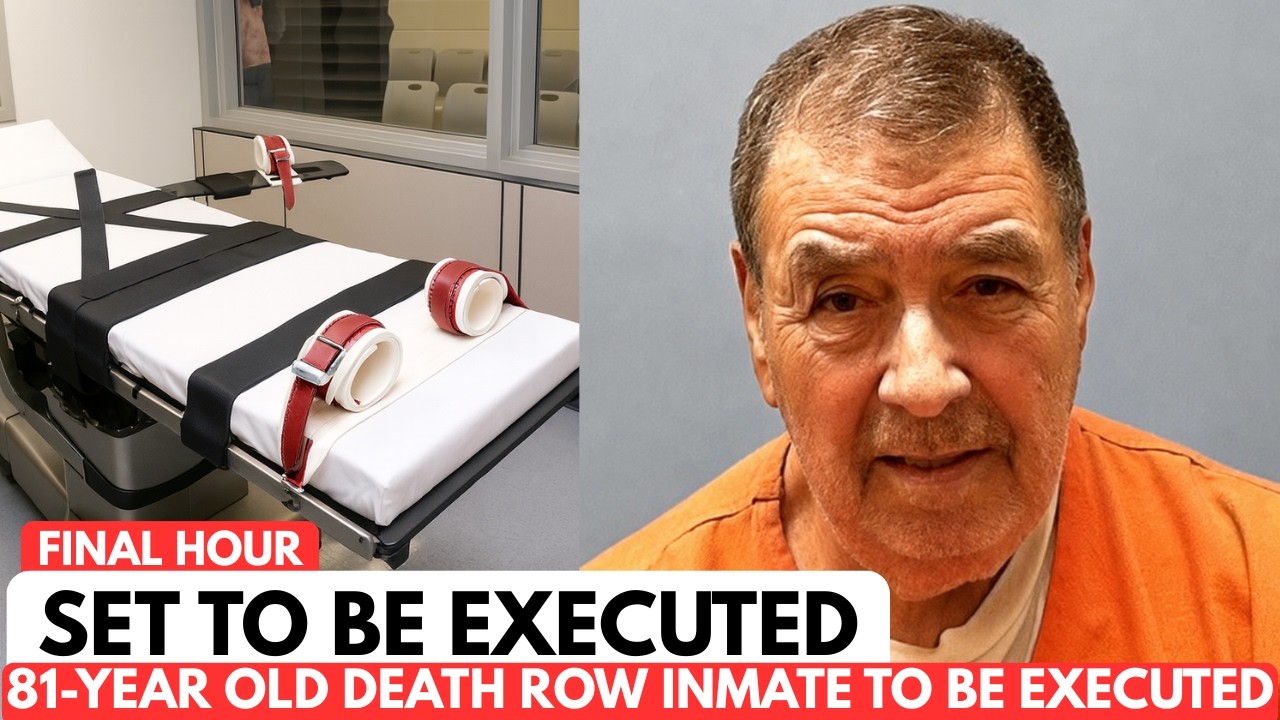 But the state of Florida still intends to end his life by lethal injection on July 28, 2026, for two murders he committed in cold blood on a quiet residential street in Holiday, Pasco County, in June 1986.
“He wasn’t too old or too frail when he murdered two people, and he killed them in cold blood,” a prosecutor said in earlier proceedings, framing the moral question that has haunted this case for decades. “So, you know, if the issue is he’s too old, well then maybe the issue is it took too long to execute him.”
Occhicone has spent 39 years waiting for this date. That is longer than some people watching this news report have been alive. And the legal foundation upon which his death sentence rests is remarkably thin: a seven-to-five jury recommendation in 1987, a margin that Florida itself has since deemed insufficient.
Here is the part that should give anyone pause. Five jurors back in 1987 looked at what Occhicone did and said, “Don’t kill him.” Seven said otherwise.
That two-vote margin has been the entire foundation of this death sentence for almost four decades. Under Florida’s own current law, that same vote would not be enough to sentence anyone to death today. The state abolished non-unanimous death recommendations in 2016, then reinstated a modified version in 2023 that requires at least eight jurors out of twelve to recommend a death sentence.
Not seven.
The crime itself was brutal and personal. On the morning of June 10, 1986, Occhicone walked up to a sliding glass door at the back of a modest single-story home in a neighborhood where nothing much happened. Inside was Anita Gerardi, a woman he had been engaged to marry.
The engagement had ended. Her parents had not approved of him in the first place.
Anita did not open the door. She warned him she would call the police if he did not leave. He left, but returned after cutting the phone lines to the house.
This time he had a gun.
Anita’s father, Raymond Artzner, stepped outside carrying a broomstick. It was not a weapon, but the kind of thing you grab on instinct when someone refuses to leave your property. He ordered Occhicone to go.
Occhicone shot him in the chest. As Raymond fell, the shooter forced his way through a locked door into the house. Inside, Anita and her daughter had already fled out the back toward a neighbor’s house.
 Martha Artzner, Anita’s mother, did not make it out in time. He shot her four times.
A Pasco County Sheriff’s Deputy arrived to find Raymond Artzner still alive, bleeding out on the ground. Before he died, he managed to say one word to the deputy kneeling beside him: “Dom.” That dying word became one of the most important pieces of evidence in the case.
A K-9 unit picked up a scent trail leading away from the house toward a set of nearby railroad tracks. Deputies found Occhicone there and placed him under arrest. He had been engaged to marry the daughter of the people he killed.
These were not strangers. These were the parents of a woman he had planned to spend his life with.
His defense later pointed to a documented history of alcohol abuse and a genuine emotional collapse after the breakup. The court did not accept that as a legal excuse. Occhicone was convicted on two counts of first-degree murder on September 18, 1987.
Then came the sentencing phase, and the split that would echo for forty years. For the murder of Raymond Artzner, the jury recommended life imprisonment. For the murder of Martha Artzner, the vote was seven to five in favor of death.
The trial judge followed the seven. Occhicone received life without parole on one count and death on the other.
What followed was nearly forty years of appeals, moving from state courts to federal courts and back again. Post-conviction motions, constitutional challenges, all of it ultimately unsuccessful. Occhicone remained on death row, growing older in a cell at Florida State Prison while the outside world moved on.
By 2026, he was not the man who knocked on that sliding glass door. He was 80 years old, with kidney and prostate problems, needing assistance to shower.
On June 26, 2026, Governor Ron DeSantis signed his death warrant. It was the twelfth warrant the governor had signed that year alone, and it came exactly one day after Florida executed Dusty Ray Spencer, a 74-year-old man who had just become the oldest person the state had put to death since capital punishment was reinstated in 1976. Occhicone’s execution was scheduled to break that record within weeks.
His attorneys moved quickly, filing for a stay on two separate grounds. The first was age and incapacity. Under existing Supreme Court precedent, the only recognized exemption from execution based on age applies to people who were under eighteen at the time of their crime.
 Being eighty, being frail, needing help in the shower – none of that on its own is enough. To succeed, attorneys would have to prove Occhicone lacks the mental capacity to understand what is happening to him and why. One attorney with Florida’s Capital Collateral Regional Counsel put it plainly: “You’d have to argue it’s unconstitutional to execute an 80-year-old because he’s mentally deficient and doesn’t have the capacity to understand the execution.
Advanced age by itself doesn’t get you there.”
The second argument was more unusual and specific to this moment in time. Florida’s lethal injection protocol opens with a sedative called etomidate, the drug meant to render an inmate unconscious before the other two drugs are administered. In the weeks before Occhicone’s warrant was signed, the American Society of Health System Pharmacists documented an active, ongoing, nationwide shortage of that same drug – a drug hospitals rely on for emergency sedation in operating rooms and ICUs.
His attorneys argued the state should not be using scarce, potentially life-saving medication to carry out executions on elderly, infirm inmates while hospitals across the country are short on it for actual medical emergencies. The motion asked the court to enter a stay until the shortage was resolved.
The Florida Court of Appeals denied the request.
It is worth noting, without editorializing, what the broader landscape looks like here. No Florida governor has granted clemency to a death row inmate since 1976. Five decades of executions and not a single commutation.
The same office that signs a death warrant into motion is also the only office with the power to stop it. There is no independent clemency board with real authority to override that decision.
Look at the calendar, because the pattern is hard to ignore. Dusty Ray Spencer, 74 years old, executed June 25, 2026. Dennis Sochor, 74, executed July 14, less than three weeks later.
And now Occhicone, 80, scheduled for July 28. A date that, according to reporting, was also set for another death row inmate, James Duckett, convicted in a separate 1987 case out of Lake County. Three of the state’s oldest death row inmates executed back-to-back-to-back, each older than the last.
If Occhicone’s execution proceeds as scheduled, he becomes only the second person over the age of 80 executed in the modern history of the United States. The only other is Walter Leroy Moody Jr., who was 83 when Alabama executed him in 2018 for the mail bomb killing of a federal judge and a black civil rights attorney.
If no court intervenes in the days remaining, here is what the process looks like. Occhicone will be moved to a death watch cell adjacent to the execution chamber in the final days before July 28. He is permitted final visits, a last meal request honored within the state’s reasonable cost and security limits.
 On the day itself, he is offered a shower, a change of clothes, and time with a spiritual adviser if he wants one. Given his documented mobility issues, some of these final logistics – the shower, the walk to the chamber – may require more assistance than they would for a younger, healthier inmate. That is not confirmed in any filing, but it follows from what his attorneys have already told the court about his physical condition.
Then, the chamber itself. Two intravenous lines are set into his arms. He is secured to a gurney with straps across his chest, waist, and limbs.
The warden reads the death warrant aloud. He is given the opportunity to make a final statement. Some inmates use that moment.
Some choose silence instead. Witnesses – typically members of the victim’s family, members of the media, and corrections officials – watch through a window, but only once he is already fully secured to the gurney.
Then, three drugs administered in sequence. Etomidate first, to render him unconscious. Then rocuronium bromide, a paralytic that stops all voluntary muscle movement, including breathing.
Then potassium chloride, which stops the heart. A physician monitors the process and confirms death, typically within ten to twenty minutes of the first injection.
Florida is currently the only state in the country using etomidate for this purpose. It was introduced into the state’s protocol in 2017, after drug manufacturers stopped supplying midazolam, the sedative Florida had relied on previously for use in executions. How reliably etomidate renders an inmate fully unconscious before the paralytic takes effect has been challenged in litigation more than once.
Florida’s courts have consistently upheld the current protocol each time it has been challenged.
On the morning of June 10, 1986, a man knocked on a sliding glass door because a woman he used to love would not talk to him. By the time he walked away from that house, two people who had done nothing except tell him to leave were dead. Thirty-nine years later, the state of Florida plans to end his life for it.
So the question remains, as the clock ticks down to Tuesday’s scheduled execution: Does age and time serve to change what justice should look like? Or is a life sentence, however long delayed, still just a debt that was always owed?