The first knock came at 11:47 p.m.
Not a polite knock.
Three heavy blows shook the narrow front door hard enough to rattle the framed photograph hanging beside it.
Evelyn Shaw stopped halfway across her kitchen, one hand wrapped around a chipped ceramic mug, the other pressed to the ache beneath her ribs.
Outside, the Wyoming blizzard screamed across the prairie like something alive.
Snow battered the windows in white sheets. Wind clawed beneath the eaves. The porch light had vanished behind a crust of ice, leaving only a pale yellow smear in the darkness.
Then came the second knock.
Slower this time.
Boom.
Boom.
Boom.
Evelyn set the mug down.
On the radio, the county dispatcher repeated the warning she had already heard four times.
“All roads north of Laramie are closed. Visibility near zero. Temperatures expected to fall below minus twenty before dawn.”
The lights flickered.
Evelyn looked toward the old twelve-gauge shotgun resting above the pantry door.
Then toward the photograph beside the entrance.
A young man in desert camouflage stood beneath a sun-bleached Afghan sky, his arm around a woman half his height. He had Evelyn’s gray eyes and his father’s crooked grin.
Captain Daniel Shaw.
Her only son.
Dead nine years.
The third knock came weaker than the first two.
And behind it, barely audible through the storm, a man shouted.
“Ma’am! We need help!”
Evelyn crossed the room.
She did not reach for the shotgun.
Instead, she unlatched the deadbolt.
The wind ripped the door from her hand.
Snow exploded into the hallway.
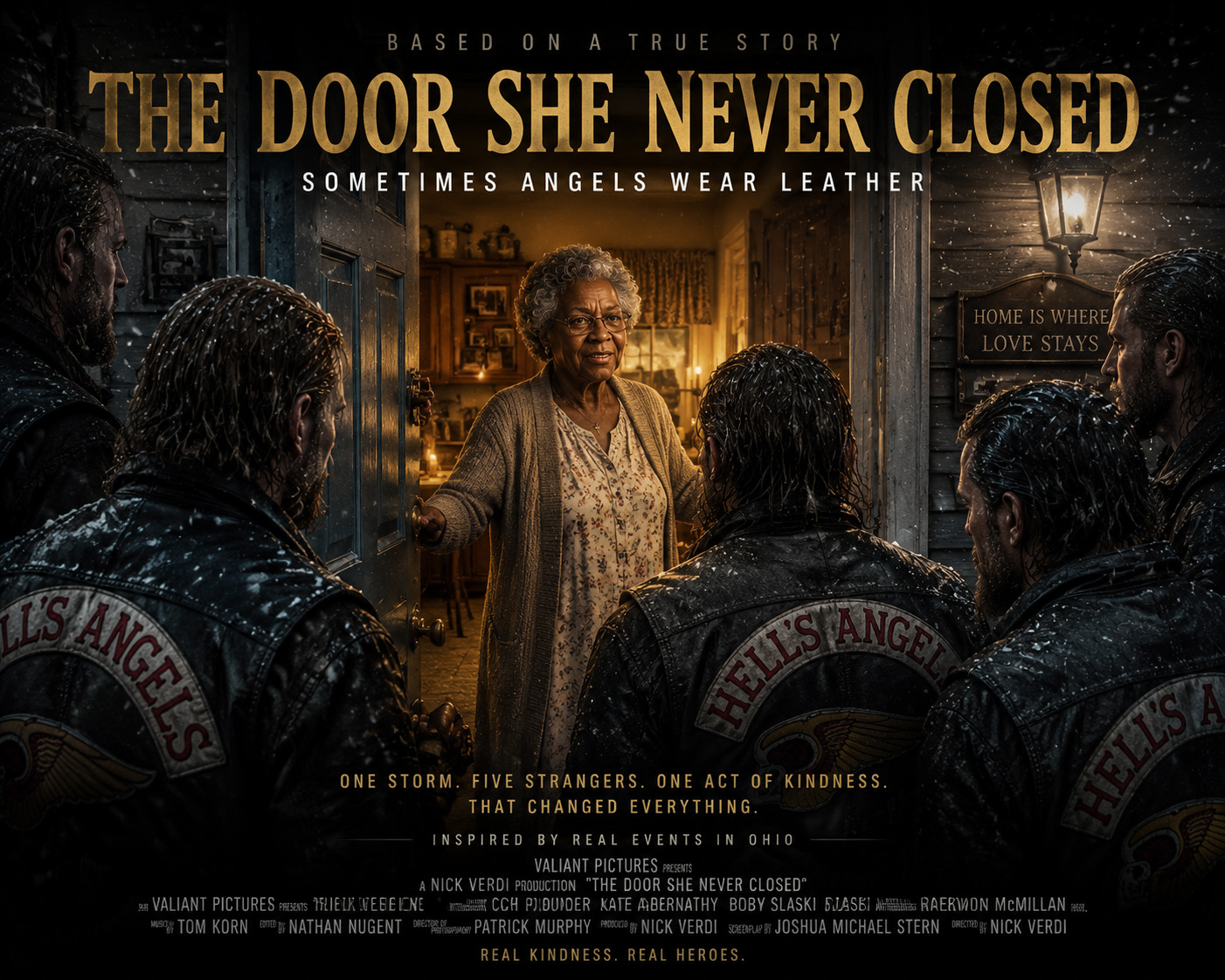
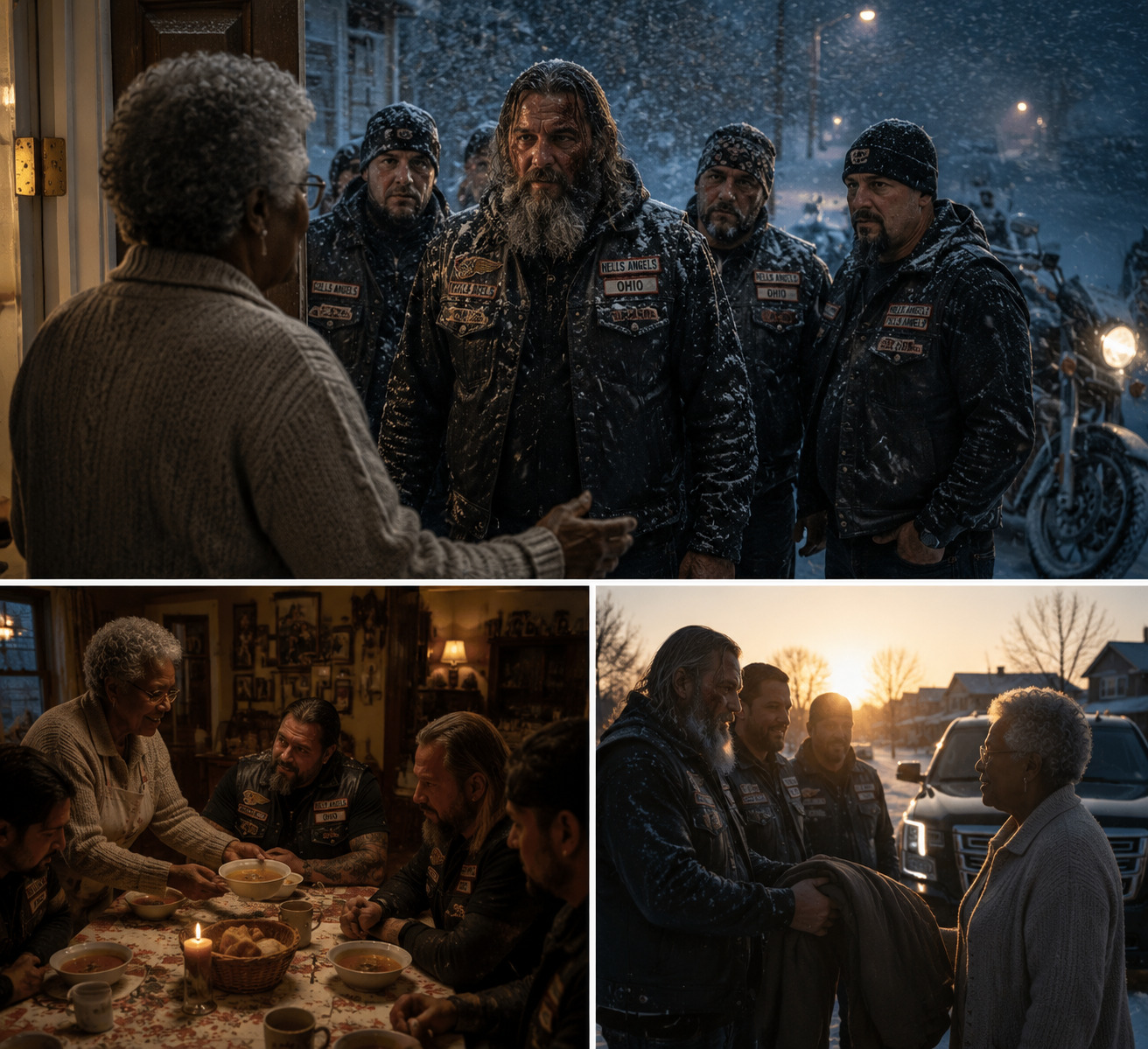
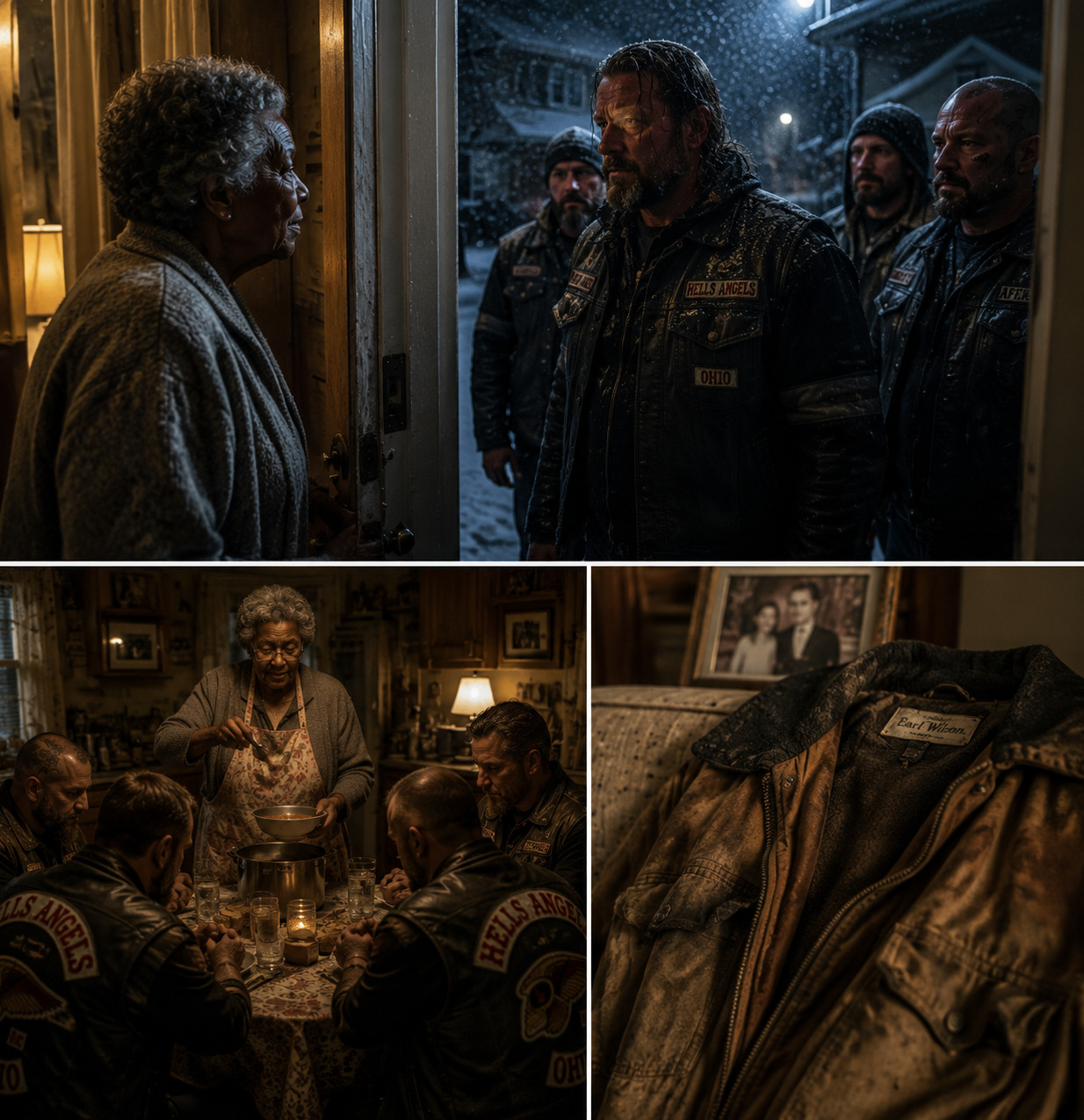
Five men stood on her porch.
Leather vests.
Frozen beards.
Black boots buried in drifting snow.
The largest man was holding another upright beneath the arms. A third was bent over, coughing into a blood-darkened glove. Their motorcycles lay scattered along the county road behind them, half-swallowed by the storm.
Across the back of every vest, visible even beneath snow and ice, was the winged death’s-head insignia that had frightened half the country for generations.
HELLS ANGELS.
The man in front raised both hands.
He was in his late forties, broad across the shoulders, his face cut by old scars and hard winters. Ice clung to his eyelashes.
“We’re not here to cause trouble,” he said. “Our brother’s going into hypothermia.”
Evelyn studied him.
The trembling in his jaw.
The man hanging between the others.
The blue lips.
The stiff fingers.
Behind them, the storm erased the road.
Evelyn stepped aside.
“Get him in.”
The big man blinked.
“Ma’am?”
“You heard me.”
He glanced over her shoulder into the warm, dimly lit house.
Then back at her.
“You know who we are?”
Evelyn’s gaze dropped to the patch on his chest.
His name was stitched there in red.
MACE.
“I know what frostbite looks like,” she said. “Bring him inside before he loses more than his pride.”
For the first time that night, Mason “Mace” Calder had no answer.
He turned and barked orders.
“Brick, take his legs. Rabbit, shut that damn door. Colt, get those wet gloves off.”
They moved quickly.
Not gracefully.
Not quietly.
But with the obedience of men who had survived by listening when it mattered.
Within seconds, Evelyn’s small farmhouse was filled with leather, snow, gasoline, wet wool, and five strangers who looked as though they belonged in a police lineup rather than around her kitchen table.
The unconscious rider was carried to the couch.
He was the youngest of them, no more than twenty-six, with a narrow face and a tattoo of a sparrow beneath one ear. His breathing came shallow and uneven.
“What’s his name?” Evelyn asked.
“Tommy,” Mace said. “We call him Bird.”
“Take off his boots.”
Brick, a thick-necked man with a graying beard, hesitated.
“You a nurse?”
“No.”
“A doctor?”
“No.”
Evelyn crossed to the linen cupboard and pulled out blankets.
“I spent thirty-two years getting stubborn men through bad situations. Start with the boots.”
Something in her voice ended the discussion.
Brick dropped to one knee and began unlacing them.
Evelyn moved around the room with the economy of someone who wasted neither motion nor words. She turned the thermostat higher, set water to boil, pulled towels from a drawer, and directed Rabbit—the wiry rider with a nervous twitch in his left eye—to bring in firewood from the shed.
“Warm him slowly,” she said. “No rubbing his hands. No hot bath. Wrap his chest first.”
Mace watched her work.
There was no panic in her.
No staring at their patches.
No trembling hand hidden beneath a sleeve.
She treated them as if they were deliverymen caught in bad weather.
Or soldiers.
“Phone’s dead,” Colt said from the wall.
He was the one coughing blood into his glove. Younger than Mace, lean and sharp-featured, with the restless eyes of a man who measured every doorway.
“Landline freezes every winter,” Evelyn replied.
“No cell service either.”
“There never is in weather like this.”
Mace stepped closer.
“We need an ambulance.”
“The nearest ambulance is thirty-eight miles south. It won’t reach us before morning.”
Colt looked toward the windows.
“He might not have until morning.”
Evelyn knelt beside Bird.
She placed two fingers against his throat, then pressed her ear near his mouth.
“His pulse is slow, but steady.”
“You sure?” Brick asked.
Evelyn looked up.
“No. But being frightened won’t make it faster.”
Brick lowered his eyes.
Mace studied the room.
The old oak table.
The flowered curtains.
The cast-iron stove.
The faded rug.
A jar of peppermint candies.
Nothing expensive. Nothing new.
There was a bucket beneath a leak near the back window.
The refrigerator hummed with the tired rattle of an appliance that should have been replaced years ago.
Yet the woman standing before them had opened her door in the middle of a deadly storm without asking for names, money, or explanations.
“Why?” Mace asked.
Evelyn glanced at him.
“Why what?”
“Why let us in?”
She draped another blanket across Bird’s chest.
“Because he knocked.”
Mace stared at her.
“That simple?”
“No.” She tucked the blanket beneath Bird’s shoulders. “Simple would’ve been pretending I didn’t hear.”
The room fell silent except for the storm.
Then the power went out.
Everything vanished.
The lights.
The furnace.
The low hum of the refrigerator.
For one breath, five dangerous men and one seventy-two-year-old widow stood together in perfect darkness.
Then Evelyn struck a match.
The flame illuminated her face.
Deep lines.
Silver hair pinned behind her head.
A scar beneath her left ear.
And eyes that did not belong to someone who had lived a small life.
“Candles are in the blue cabinet,” she said. “Generator’s in the barn.”
Rabbit looked toward the black windows.
“The barn?”
“Sixty yards east.”
“In that?”
“You rode motorcycles into it.”
“That was before I knew better.”
Evelyn handed him a lantern.
“Congratulations. You’ve learned something.”
Brick laughed.
It came out unexpectedly, a low rumble that broke the tension.
Even Colt smiled.
Mace did not.
He was still watching Evelyn.
Because beneath the wool sweater and house slippers, beneath the soft voice and thinning hands, he had begun to notice details.
The way she always kept the doorway in view.
The way she evaluated each man’s injuries before asking questions.
The way she gave instructions once and expected them to be followed.
The way she never stood with her back to more than one stranger at a time.
He had known men like that.
Men who had lived in places where hesitation killed.
But he had never known a woman like her.
Not yet.
The generator coughed to life twenty minutes later.
Rabbit and Brick returned from the barn covered in snow, dragging a fuel can between them.
By then, Evelyn had forced warm broth between Bird’s lips and wrapped heated bricks in towels around his torso.
His skin had lost some of its bluish cast.
Mace stood near the fireplace, steam rising from his vest.
“You saved fuel for us,” he said.
“I saved fuel for emergencies.”
“We’re the emergency?”
“Unless you plan to become furniture.”
He looked toward the kitchen.
The broth pot was nearly empty.
Six bowls sat on the counter.
“You got enough food?”
Evelyn did not answer immediately.
She opened a cabinet.
One box of crackers.
Two cans of beans.
A bag of rice folded shut with a clothespin.
Mace saw it all.
So did Colt.
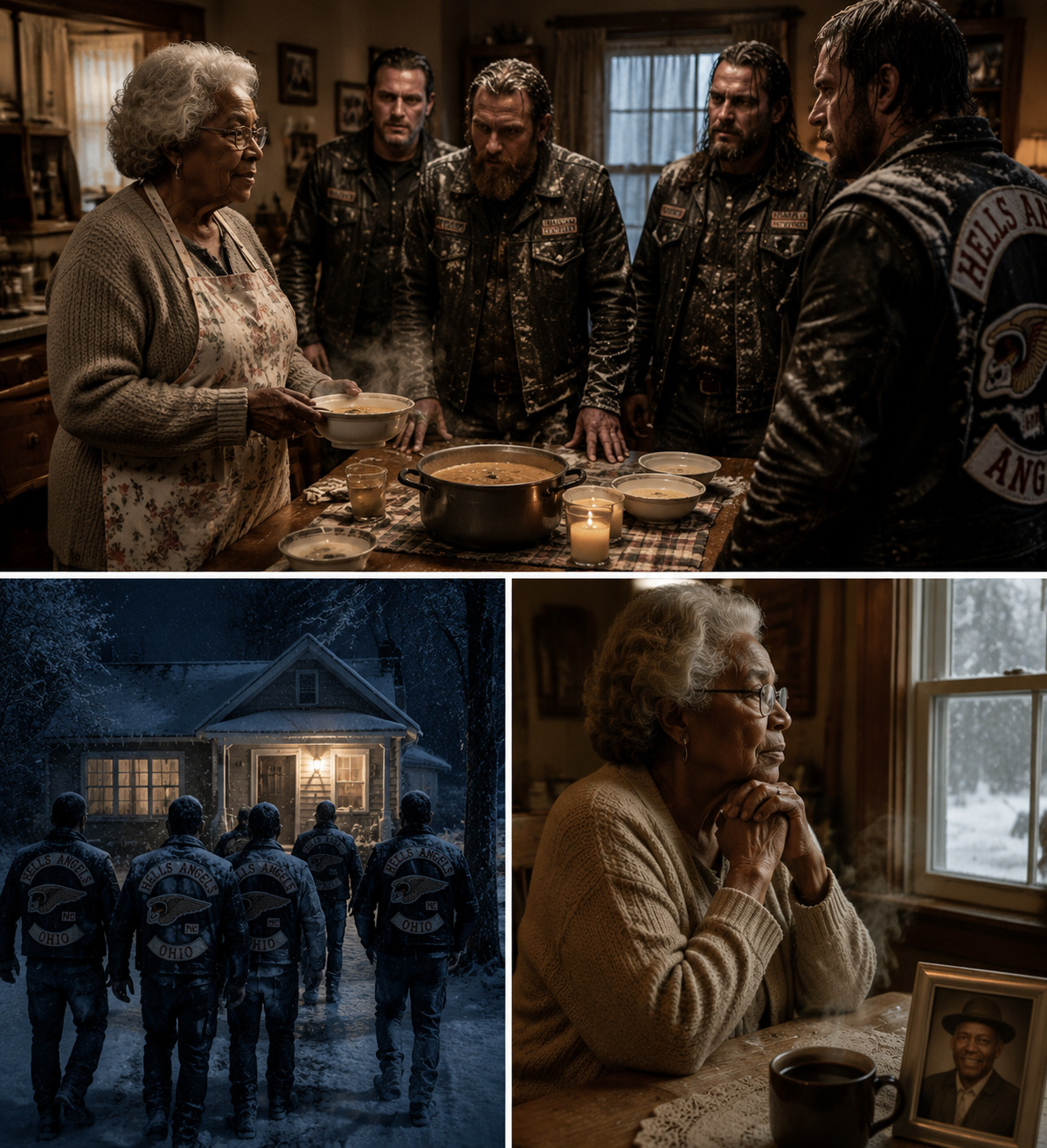
Evelyn poured the remaining broth into bowls.
“Sit down.”
Mace remained standing.
“You don’t have enough.”
“I have enough for tonight.”
“What about tomorrow?”
“Tomorrow hasn’t earned a meal yet.”
Colt gave a dry laugh, then winced and pressed a hand to his side.
Evelyn noticed.
“What happened to you?”
“Nothing.”
“The blood says otherwise.”
“Bit my cheek.”
“You’re holding your ribs.”
Colt’s face tightened.
Mace stepped between them.
“He went down hard when the bike slid.”
“Shirt off,” Evelyn said.
Colt stared at her.
“Lady—”
“Evelyn.”
“Evelyn, I appreciate the soup, but I’m not stripping in your kitchen.”
“Then bleed internally with your dignity intact.”
Rabbit choked on a cracker.
Brick looked away to hide a grin.
Colt slowly removed his vest, then his shirt.
Purple bruising spread across his right side.
Evelyn’s fingers pressed along the ribs with clinical precision.
Colt sucked air through his teeth.
“Two might be cracked,” she said. “Maybe three. You’re lucky.”
“Doesn’t feel lucky.”
“If your lung were punctured, you’d know.”
“How?”
“You’d be turning blue faster than your friend.”
Colt looked toward Bird.
His expression changed.
The sarcasm disappeared.
He sat down without another word.
Mace noticed that too.
Evelyn had done in less than an hour what most men could not do in years.
She had earned obedience without demanding submission.
He took the bowl she handed him.
It was thin broth with rice, carrots, and the last pieces of chicken from what had clearly been meant to last several days.
Mace held it but did not eat.
“You live out here alone?”
Evelyn sat across from him.
“Yes.”
“No neighbors?”
“Two miles west. Four east.”
“Family?”
Her eyes moved toward Daniel’s photograph.
“One son.”
Mace followed her gaze.
“Army?”
“Was.”
The single word sat between them.
Mace lowered his spoon.
“I’m sorry.”
Evelyn’s thumb traced the rim of her bowl.
“So am I.”
No one spoke for several moments.
Outside, the wind struck the side of the house with enough force to make the dishes tremble.
Bird moaned from the couch.
Brick went to him immediately.
The big man’s hands, rough enough to bend steel, adjusted the blanket with surprising gentleness.
Evelyn watched.
“Your son serve overseas?” Mace asked.
“Afghanistan. Iraq before that.”
“What unit?”
Evelyn’s gaze lifted.
“Why?”
Mace shifted.
“Just asking.”
“Then ask something useful.”
He almost smiled.
Almost.
“Fair enough.”
The riders ate.
Slowly at first.
Then like men whose bodies had remembered hunger.
Evelyn drank only tea.
Mace noticed she never touched the broth.
At 1:12 a.m., Bird began to convulse.
The bowl fell from Brick’s hand and shattered.
Bird’s body jerked against the couch, heels pounding the cushions.
“Hold him!” Colt shouted.
Brick pinned Bird’s shoulders.
Rabbit grabbed his legs.
Mace froze for half a second.
That half second would haunt him later.
Evelyn moved first.
She dropped beside the couch, turned Bird onto his side, and swept the blankets away from his face.
“Don’t restrain him!”
“He’s going to hurt himself,” Brick said.
“You’ll hurt him worse. Move your hand.”
Bird’s teeth snapped together.
Foam gathered at the corner of his mouth.
Evelyn pressed two fingers beneath his jaw and watched the clock above the mantel.
“Has this happened before?”
“No,” Mace said.
“Drugs?”
Colt bristled.
“He’s clean.”
“I didn’t ask for his character reference.”
“No drugs,” Mace said. “Not tonight.”
“Diabetic?”
“No.”
“Epilepsy?”
“Not that we know.”
The seizure continued.
Ten seconds.
Twenty.
Thirty.
Evelyn’s face remained calm, but one hand tightened around the couch cushion.
“Come on,” she whispered. “Come back.”
Bird’s body went still.
The silence that followed was worse.
Brick bent over him.
“He breathing?”
Evelyn placed her ear near Bird’s mouth.
Nothing.
She checked his pulse.
Then she shoved the coffee table aside.
“Floor. Now.”
They lowered him.
Evelyn tilted his head and began chest compressions.
Her shoulders drove downward with disciplined force.
One.
Two.
Three.
Four.
“Get me the red case from the hall closet,” she ordered.
Rabbit ran.
“Red case?”
“Top shelf.”
Evelyn continued compressions.
Mace stared at her hands.
The rhythm was exact.
Not learned from a television show.
Not remembered from some distant first-aid class.
Thirty compressions.
Two breaths.
Again.
Rabbit returned carrying a battered metal case.
He opened it.
Inside were medical supplies arranged with military neatness.
Airway tubes.
Bandages.
Syringes.
A portable oxygen regulator.
Mace looked at Evelyn.
“You said you weren’t a nurse.”
“I wasn’t.”
She fitted an airway mask over Bird’s face and squeezed the ventilation bag.
“Then what the hell were you?”
“Busy.”
She continued.
Two minutes passed.
Then three.
Brick stood with both fists pressed against his skull.
Rabbit whispered a prayer.
Colt looked toward the door as if willing an ambulance through the storm.
Mace knelt beside Evelyn.
“Tell me what to do.”
She looked at him once.
“Take over compressions.”
“I don’t know how.”
“I’ll count.”
He placed his hands where she showed him.
“Harder,” she said.
He pressed.
“Harder.”
“I’ll break his ribs.”
“Better than burying him.”
Mace drove down.
A crack sounded beneath his palms.
His face twisted.
Evelyn did not flinch.
“Keep going.”
He did.
At 1:19 a.m., Bird gasped.
One ugly, desperate breath.
Then another.
Brick covered his mouth with both hands.
Rabbit sat hard on the floor.
Mace remained frozen over Bird’s chest.
Evelyn checked the pulse.
“Move back.”
Bird coughed.
His eyes opened.
Confused.
Terrified.
Alive.
Mace looked at Evelyn.
She sat beside Bird with one hand resting on his shoulder.
No celebration.
No speech.
Just a breath she released slowly through her nose.
The kind of breath a person lets go only after keeping fear locked behind their teeth.
“Welcome back,” she said.
Bird’s eyes fluttered.
“Where…”
“You’re in my living room.”
He swallowed.
“Did we die?”
“Not for lack of trying.”
Brick laughed and cried at the same time.
The sound filled the house.
Then Mace saw Evelyn’s hand shaking.
Only once.
A small tremor.
She closed it into a fist before anyone else noticed.
But Mace noticed.
And with it, he understood something.
She was not fearless.
She was practiced at moving while afraid.
That was different.
And far rarer.
At 2:40 a.m., the storm worsened.
The generator’s fuel gauge dropped below one-quarter.
Bird slept near the fire, breathing more evenly.
Colt sat at the kitchen table while Evelyn taped his ribs.
Brick and Rabbit dozed in chairs.
Mace stood by the window, staring into a wall of snow.
“How far were you trying to go?” Evelyn asked.
“Cheyenne.”
“From where?”
“Casper.”
“In this weather?”
“It wasn’t supposed to hit until morning.”
“The sky doesn’t read forecasts.”
Mace’s jaw tightened.
Evelyn tied off the bandage around Colt’s ribs.
“That storm surprise you,” she asked, “or did you decide the warning didn’t apply?”
Colt looked toward Mace.
Mace kept his eyes on the glass.
“We had somewhere to be.”
“Everyone in a hurry says that.”
“It mattered.”
Evelyn waited.
Mace finally turned.
“One of our guys has a daughter at the children’s hospital in Denver. Seven years old. Needs surgery. We were carrying money from three chapters.”
“How much?”
“Eighty-six thousand.”
Rabbit opened one eye.
“Mace.”
“What?”
“We don’t tell strangers that.”
Evelyn cut the tape with scissors.
“He’s right.”
Mace looked at her.
“You don’t want to know?”
“No.”
“That much cash is sitting in saddlebags on the road.”
“Then telling me was foolish.”
“You could rob us.”
Evelyn looked around her kitchen.
Five large men.
One elderly woman.
A storm strong enough to bury evidence.
“Try to recover from the shock of my missed opportunity.”
Colt laughed, then grabbed his ribs.
Mace studied her face.
“You don’t trust us.”
“I let you into my home.”
“That’s not what I asked.”
“No,” Evelyn said. “I don’t trust you.”
The honesty landed harder than accusation.
Rabbit straightened.
“After everything tonight?”
“I don’t know you.”
“We could’ve hurt you.”
“Yes.”
“But we didn’t.”
“That earns gratitude. Not trust.”
Brick’s eyes opened.
The room shifted.
Mace crossed his arms.
“What earns trust?”
“Time. Consistency. The truth when lying would be easier.”
Mace’s face became unreadable.
Evelyn set the scissors down.
“Which part are you struggling with?”
Colt looked at the table.
Rabbit looked at Mace.
Brick stopped pretending to sleep.
The fire snapped.
Mace’s hand moved slowly to the inside pocket of his vest.
Evelyn’s eyes followed it.
He removed a folded newspaper clipping.
The paper was soft from years of handling.
He placed it on the table.
A black-and-white photograph showed a younger Mace standing outside a courthouse, wrists chained at his waist.
The headline read:
LOCAL MAN SENTENCED IN ARMED ROBBERY.
“I did twelve years,” he said.
Evelyn read the clipping.
“For the robbery?”
“For driving.”
“You knew what the others planned?”
“Yes.”
“Anyone hurt?”
“A guard got shot.”
“By you?”
“No.”
“But you drove them there.”
“Yes.”
Evelyn refolded the clipping.
Mace waited for disgust.
Or fear.
Or the subtle retreat people made when they learned what lived behind his eyes.
Evelyn slid the paper back across the table.
“Why carry it?”
“So I don’t start believing the story I tell people.”
“What story is that?”
“That I was just the driver.”
The wind groaned through the chimney.
Mace looked toward Bird.
“When I got out, nobody would hire me. Nobody except a shop owner named Hector Ruiz. Angel. Vietnam vet. Meanest old man I ever met.”
A faint smile touched his mouth.
“He made me sweep floors for six months before he let me touch an engine. Said a man who wants respect should learn what dirt looks like.”
“What happened to him?” Evelyn asked.
“Cancer.”
Mace tapped the patch on his vest.
“He left me the shop.”
“So you joined his club.”
“He gave me a place when the world wanted me gone.”
“That doesn’t make every choice after that good.”
“No.”
“But it makes some of them understandable.”
Mace looked at her more carefully.
“You always talk like this?”
“Only when people wake me up after eleven.”
A gust struck the house.
Somewhere outside, metal tore loose and slammed against the barn.
Rabbit stood.
“What was that?”
“Roof panel,” Evelyn said.
“You sure?”
“No.”
The second sound was not metal.
It was an engine.
Low.
Grinding.
Close.
Headlights appeared through the snow.
They swept across the front window, vanished, then returned.
Mace moved before anyone spoke.
“Lights out.”
Evelyn reached for the lamp.
Colt stood despite his ribs.
Brick went to the couch and pulled Bird lower.
Rabbit drew a handgun from beneath his vest.
Evelyn saw it.
“Put that away.”
“No offense, ma’am—”
“In my house.”
The engine stopped outside.
Doors opened.
Mace looked through the curtain.
A black county SUV sat crooked in the yard.
Blue emergency lights flashed silently against the snow.
“Sheriff,” he said.
Rabbit did not lower the weapon.
Evelyn stepped closer.
“Put it away.”
His eyes flicked to Mace.
Mace nodded.
Rabbit holstered the gun.
A fist struck the door.
“Sheriff’s office!”
Evelyn opened it.
Deputy Sheriff Wade Mercer stood on the porch with snow crusted across his tan uniform.
He was fifty-four, tall and thick through the middle, with a face built for smiling at campaign dinners and frowning at traffic stops.
Behind him stood two younger deputies.
Mercer’s flashlight beam moved past Evelyn.
It landed on the leather vests.
His expression changed instantly.
His hand dropped to his holster.
“Mrs. Shaw, step outside.”
“No.”
His eyes narrowed.
“Ma’am, there are armed gang members in your home.”
“There are injured travelers in my home.”
Mace moved into view.
Mercer drew his weapon.
“Hands where I can see them!”
The room hardened.
Brick rose.
Colt shifted his weight.
Rabbit’s jaw clenched.
Evelyn stepped between Mercer’s gun and the men.
“Lower it.”
“Move aside, Evelyn.”
“You’re pointing a loaded weapon into my living room.”
“They’re Hells Angels.”
“They’re cold.”
Mercer looked at the broken bowl, the blankets, Bird on the floor beside the couch.
Then at Mace.
“We got a report of shots near Route 34.”
“No shots here,” Mace said.
“Did I ask you?”
“No.”
“Then shut your mouth.”
Mace’s eyes went flat.
Evelyn recognized the look.
It was the moment before pride became damage.
She turned slightly.
“Mace.”
He looked at her.
“Sit down.”
For one stretched second, no one moved.
Then Mace sat.
Mercer’s brows lifted.
He had not expected obedience.
Neither had his deputies.
Evelyn faced him again.
“Search the porch. Search the yard. You’ll find five motorcycles and enough bad judgment to fill your report.”
Mercer lowered the gun but did not holster it.
“We need to search the house.”
“Get a warrant.”
“Exigent circumstances.”
“Name them.”
“Potential firearms. Possible stolen property. Known criminal affiliation.”
“You saw a patch through an open door.”
“I heard one of them has a gun.”
“You heard?”
Mercer glanced at the younger deputy behind him.
The deputy avoided Evelyn’s eyes.
Someone had reported them before Mercer arrived.
But there were no nearby homes with a clear view of the road.
Mace understood it too.
“You tracking us?” he asked.
Mercer’s gaze snapped toward him.
“I told you to shut up.”
Evelyn saw something pass between them.
Recognition.
Not personal.
But purposeful.
Mercer had not found them by accident.
The storm had grounded aircraft, closed roads, and buried fence posts.
Yet he had driven directly to her farmhouse.
Mace rose slowly.
“What’s in your cruiser, Sheriff?”
Mercer raised the gun again.
“Sit down.”
“What’s in the back?”
“Mace,” Evelyn said.
He did not look at her.
Mercer’s two deputies moved apart.
One toward the window.
One toward the kitchen entrance.
Colt’s hand drifted near his vest.
Brick stepped in front of Bird.
The room narrowed into breath, fingers, and distance.
Evelyn moved to the wall and lifted Daniel’s photograph from its hook.
Behind it was a small brass key.
She crossed to the old rolltop desk.
Mercer kept the gun on Mace.
“Evelyn, what are you doing?”
“Preventing stupidity.”
She unlocked a drawer.
Inside lay a dark leather wallet.
She opened it.
Mercer’s face changed.
Only slightly.
But enough.
The color left the skin around his mouth.
Evelyn held the identification where the sheriff could see it.
A gold federal seal caught the firelight.
The younger deputies glanced at one another.
Mace stared.
Mercer lowered his weapon.
“Where did you get that?”
“It was issued to me.”
“That credential expired fifteen years ago.”
“Authority expires,” Evelyn said. “Evidence doesn’t.”
She removed a second item from the drawer.
A satellite phone.
Mercer’s breathing changed.
His eyes fixed on it.
Evelyn noticed.
So did Mace.
“Your landline’s dead,” Mercer said.
“This isn’t.”
Mercer holstered his weapon.
“That thing won’t work in this storm.”
“Let’s disappoint you.”
She extended the antenna.
Mercer stepped forward.
Mace moved between them.
The sheriff stopped.
No one spoke.
The old house creaked around them.
Evelyn dialed.
A signal light blinked red.
Then amber.
Then green.
Mercer’s right hand twitched.
Not toward his gun.
Toward the radio clipped to his shoulder.
Evelyn watched him.
“You came here too quickly,” she said.
Mercer forced a laugh.
“We patrol the county.”
“Not this road. Not tonight.”
“You think I should leave citizens stranded?”
“I think someone told you exactly where they were.”
Mercer’s smile vanished.
Mace looked at Evelyn.
“What is this?”
She raised one finger.
The phone connected.
A male voice answered through static.
“Operations.”
Evelyn’s voice changed.
Still quiet.
But the age seemed to fall out of it.
“This is Shaw, Evelyn. Retired credential seven-one-four-six. Authentication phrase: October keeps the ledger.”
Silence.
Then the voice sharpened.
“Stand by for verification.”
Mercer stepped backward.
One of his deputies looked at him.
“Sheriff?”
Mercer ignored him.
Mace’s eyes moved from Evelyn to the credential in her hand.
Federal seal.
Old photograph.
Her face twenty years younger, hair dark, expression severe.
Title beneath it:
SPECIAL AGENT IN CHARGE.
UNITED STATES DEPARTMENT OF JUSTICE.
The verification came through.
“Identity confirmed. What is your emergency, Director Shaw?”
Every person in the room became still.
Director.
Not agent.
Not nurse.
Not widow.
Director.
Evelyn looked directly at Mercer.
“I have five civilians sheltered at my residence. One critical medical case. I also have reason to believe an elected county officer may be interfering with a protected federal transfer.”
Mercer’s jaw clenched.
“Evelyn, careful.”
She did not look away.
“I am being careful.”
Mace reached into his vest.
Mercer’s hand snapped toward his gun.
“Don’t.”
Mace slowly removed a sealed envelope wrapped in plastic.
He placed it on the table.
Across the front was a red stripe and a printed case number.
Evelyn saw the initials.
OIG.
Office of Inspector General.
Mercer stared at the envelope.
And in that instant, Evelyn saw the whole shape of the night.
The riders were not merely carrying money.
Or not only money.
They were carrying something else.
Something the sheriff feared more than an armed gang.
“What’s in it?” Evelyn asked.
Mace looked at Mercer.
Then at her.
“Records.”
“Of what?”
“County contracts. Seized property auctions. Cash that disappeared before it reached evidence.”
One of Mercer’s deputies turned toward him.
“Sheriff?”
Mercer’s eyes stayed on Mace.
“You have no idea what you’re talking about.”
Colt leaned against the table, one hand pressed to his ribs.
“We know enough.”
“Where did you get those documents?”
Mace smiled without humor.
“That sounds like confirmation.”
Mercer’s nostrils flared.
Evelyn’s grip tightened around the phone.
“Why are bikers carrying federal evidence?”
Mace answered carefully.
“Because the man who collected it didn’t trust anyone wearing a badge in this county.”
“Who collected it?”
“Hector Ruiz’s son.”
Mercer’s face went rigid.
Mace saw it.
“He worked county impound for nine years,” Mace continued. “Found titles being altered. Vehicles sold below value to companies connected to Mercer’s brother-in-law. Cash seizures logged, then reduced before deposit.”
“That’s a lie,” Mercer said.
“Then why’ve you been following us since Casper?”
Mercer looked toward the deputies.
“That package is stolen evidence. I’m confiscating it.”
“No,” Evelyn said.
His gaze turned to her.
“You don’t have jurisdiction.”
“I have a phone.”
He took another step.
Evelyn spoke into the satellite receiver.
“Operations, initiate emergency relay to the Denver field office and state attorney general. Possible corruption breach. Send this location to the nearest federal response team.”
Mercer lunged.
He moved faster than anyone expected.
His hand struck the phone from Evelyn’s grasp.
It hit the floor and skidded beneath the table.
Mace surged forward.
One deputy drew his weapon.
Rabbit reached inside his vest.
Brick shouted.
Bird woke with a gasp.
Then Evelyn drove the heel of her palm upward beneath Mercer’s chin.
His head snapped back.
Before he could recover, she turned his wrist, used his momentum, and sent him face-first across the kitchen table.
Bowls crashed.
The sealed envelope slid to the floor.
Mercer roared and reached for his gun.
Evelyn pinned his wrist with both hands.
“Don’t,” she said.
The word came low.
Not loud.
Not dramatic.
But Mercer stopped.
Because something in her face had changed.
The grandmother was still there.
The widow.
The woman who had served them soup from nearly empty cabinets.
But behind her eyes stood the person she had once been.
The person men with weapons had learned to obey.
One of the deputies slowly lowered his gun.
The other did the same.
Mace stared at Evelyn.
“Remind me never to refuse your soup.”
Evelyn kept Mercer pinned.
“Pick up the phone.”
Rabbit scrambled beneath the table and retrieved it.
The line was still connected.
“Director Shaw?” the voice called.
Evelyn took the phone.
“I’m here.”
Mercer’s cheek pressed against the wood.
His face had gone gray.
The moment of recognition moved through him visibly.
First disbelief.
Then calculation.
Then fear.
His eyes shifted toward his deputies.
Neither stepped forward.
Outside, the storm continued.
But the power in the room had changed hands.
Completely.
By 4:15 a.m., Mercer sat in a dining chair with his own handcuffs around his wrists.
His deputies, Nolan Price and Jesse Alvarez, stood near the door.
Both looked sick.
Neither had known what Mercer was doing.
At least, that was what they claimed.
Evelyn believed Alvarez.
He could not stop looking at the floor.
Price was harder to read.
Mace knelt near Bird while Brick checked his breathing.
Colt guarded the envelope.
Rabbit watched the sheriff with open satisfaction.
“You should wipe that look off your face,” Evelyn told him.
Rabbit blinked.
“What look?”
“The one enjoying this too much.”
“He was gonna rob us.”
“Justice and revenge may sit at the same table,” Evelyn said, “but they don’t eat from the same plate.”
Rabbit looked away.
Mercer laughed bitterly.
“You always talk in sermons?”
Evelyn faced him.
“Only when men confuse consequences with persecution.”
He leaned back.
“You think that envelope makes me guilty?”
“No.”
“You think those animals will be believed over me?”
Mace’s shoulders tightened.
Evelyn held up a hand before he could move.
Mercer smiled.
“There it is. You know exactly who they are.”
“I know who you are,” Evelyn replied.
“You don’t know anything.”
“I know you pointed a weapon at an unconscious man. I know you attempted to seize protected material without documenting it. I know you assaulted a federal witness.”
“You’re retired.”
“The witness isn’t.”
Mercer’s smile weakened.
Evelyn picked up the envelope.
“Is this the only copy?”
Mace hesitated.
“No.”
Mercer turned sharply.
Mace saw his reaction and smiled.
“There are three.”
“Where?” Evelyn asked.
“One with the inspector general’s office. One with a lawyer in Denver. This is the original set.”
“Then why carry it through a blizzard?”
Mace’s eyes moved toward Bird.
“Because the lawyer stopped answering.”
Evelyn looked at Mercer.
“What did you do?”
“Nothing.”
Mace stepped closer.
“Hector’s son, Luis, mailed one copy two weeks ago. Three days later, somebody ran him off the road.”
Mercer’s face did not move.
But his left knee began bouncing.
Small.
Fast.
Involuntary.
“Luis alive?” Evelyn asked.
“Barely.”
“And the lawyer?”
“Missing since yesterday.”
The deputies exchanged a look.
Alvarez whispered, “Jesus.”
Mercer rounded on him.
“Don’t be stupid.”
Alvarez’s face flushed.
“You told us this was a weapons trafficking stop.”
“It is.”
“You said they stole narcotics from evidence.”
Mercer leaned forward.
“They’re criminals. You think criminals don’t lie?”
Mace stepped into the firelight.
“Some do.”
His voice was quiet.
“So do sheriffs.”
Mercer looked at him with naked hatred.
“You want to know what I think?” he said. “I think men like you poison towns and then act shocked when decent people stop playing by the rules.”
Mace’s face hardened.
Mercer continued.
“I spent twenty-seven years cleaning up wrecks you people caused. Meth houses. Bar fights. Dead kids in stolen cars. I buried a deputy because one of your little brother clubs shot him during a traffic stop.”
No one spoke.
The anger in Mercer’s voice was real.
So was the grief beneath it.
“My county was dying,” he said. “Businesses were leaving. Roads were collapsing. The state cut funding every year. I moved money where it was needed.”
“You stole it,” Alvarez said.
“I redirected it.”
“To your family?”
“To people I trusted.”
“To shell companies,” Mace said.
Mercer’s cuffed hands clenched.
“You have no idea what it takes to keep a place alive.”
Evelyn studied him.
For the first time, she saw not only the corruption but the road that had led him there.
A man who had once believed rules mattered.
Then decided outcomes mattered more.
Then decided he alone should choose the outcomes.
Power had not changed him all at once.
It had simply stopped correcting him.
“You may have started by saving the county,” Evelyn said.
Mercer looked at her.
“But somewhere along the way, you began saving yourself.”
His eyes sharpened.
“You think you’re different?”
The question landed.
Evelyn’s face went still.
Mercer saw it and pressed.
“You hid out here for fifteen years with your medals in a drawer. Your son dies, and suddenly the great Director Shaw disappears.”
Mace looked at Evelyn.
Mercer smiled.
“Yes. I know who she is. Everyone in law enforcement over fifty knows.”
Evelyn’s fingers tightened around the envelope.
“You ran counterintelligence task forces,” Mercer said. “Put agents undercover for years. Sent people into rooms you were too important to enter.”
“Stop,” Evelyn said.
“Daniel asked you to help get him transferred out of that deployment, didn’t he?”
The entire room seemed to inhale.
Evelyn’s face lost color.
Mace looked toward Daniel’s photograph.
Mercer had found the one wound she had never let close.
“You had contacts,” he continued. “Could’ve made one call.”
“Stop.”
“But you told him duty mattered more than fear.”
Evelyn crossed the room in two steps.
Mace caught her wrist before she struck him.
She turned on him.
For the first time, fury broke through her control.
Her eyes shone.
Her breathing came hard.
Mace did not release her.
Mercer leaned back in the chair.
“There she is.”
Evelyn looked at Mace’s hand around her wrist.
Then at his face.
He loosened his grip but did not let go.
“Don’t give him what he wants,” Mace said.
Her jaw trembled.
“He doesn’t know what he’s talking about.”
“Then don’t answer him.”
Mercer laughed.
“He knows.”
Mace turned.
The expression on his face silenced the room.
“I know what it looks like when a man uses someone’s dead child as a weapon.”
Mercer’s smile disappeared.
Mace released Evelyn.
She stepped back.
For several seconds, she stood with her back to them.
Her shoulders rose and fell beneath the wool sweater.
When she turned again, the director was gone.
So was the unshakable widow.
What remained was a mother.
“My son called me two nights before his convoy was hit,” she said.
No one moved.
“He had a bad feeling. That was how he put it. A bad feeling.”
Her eyes stayed on the photograph.
“He asked whether fear meant he was failing.”
The wind whispered against the glass.
“I told him courage was doing the job anyway.”
Mace’s face softened.
Evelyn swallowed.
“He died believing I wanted him to stay.”
“You don’t know that,” Brick said.
His voice was rough.
Evelyn looked at him.
Brick stared at his hands.
“My boy died in prison,” he said. “Overdose. Last call we had, I told him to quit whining and take responsibility.”
His beard trembled.
“He hung up on me.”
No one interrupted.
“For six years, I’ve rewritten that call every night.” Brick looked at Evelyn. “Never once changed the ending.”
Evelyn’s eyes filled, but the tears did not fall.
Brick leaned forward.
“The dead don’t get trapped in our worst sentence. We do.”
The words settled over them.
Even Mercer looked away.
At 5:03 a.m., headlights appeared through the snow.
Not one vehicle.
A convoy.
Black federal SUVs.
State patrol trucks.
An ambulance pushing through the drifts behind a county snowplow.
The response team had arrived.
Mercer heard the engines.
His face emptied.
No rage now.
No argument.
Only the slow collapse of a man watching the walls close in.
Alvarez opened the door.
Cold air swept through the house.
Agents entered in dark jackets marked FBI and OIG.
They secured the room, collected the envelope, separated the deputies, and led Mercer outside.
As he passed Evelyn, he stopped.
Snow swirled through the doorway behind him.
“You think this town will thank you?” he asked. “You think they’ll understand what I did to keep it alive?”
Evelyn looked at the manacles around his wrists.
“No.”
Mercer’s mouth tightened.
“They’ll hate you.”
“Some will.”
“You’ll be the woman who destroyed their sheriff.”
“No,” Evelyn said. “You did that before you knocked on my door.”
Mercer held her gaze.
Then the agents led him into the storm.
The ambulance crew examined Bird.
His core temperature was dangerously low, but stable.
Colt was given oxygen and a proper rib brace.
Brick refused treatment until the medics threatened to sedate him.
Rabbit asked if sedation came with breakfast.
No one laughed except Evelyn.
It was enough.
As dawn broke, the blizzard finally weakened.
The eastern sky turned from black to iron gray.
Snowdrifts rose like dunes around the house.
The five motorcycles were nearly buried.
A federal agent approached Evelyn near the porch.
“Director Shaw?”
“Not anymore.”
He smiled politely.
“Assistant Director Hale said to tell you the office owes you.”
“The office owes me nothing.”
“He said you’d say that.”
Mace stood nearby, wrapped in an emergency blanket.
His leather vest hung open.
Without the storm, without the threat, he looked older.
More tired.
Human.
“You knew who she was?” Rabbit asked the agent.
The man glanced at Evelyn.
“Everyone did, once.”
Mace looked toward her.
“What exactly did you do?”
Evelyn stepped onto the porch.
The snow reflected the first weak light of morning.
“I made decisions.”
“That’s it?”
“Mostly bad ones with expensive consequences.”
The agent laughed.
Mace did not.
He studied her.
“You ran federal operations.”
“Yes.”
“Counterintelligence?”
“Yes.”
“Hostage recovery?”
“For a time.”
“And you live here?”
Evelyn looked back at the farmhouse.
Peeling paint.
Sagging gutter.
A porch rail Daniel had repaired when he was seventeen.
“I live where my memories know the address.”
Mace nodded slowly.
Then reached inside his vest.
He removed a thick bundle of cash.
Evelyn’s expression hardened.
“Put that away.”
“For the food. Fuel. Medicine.”
“No.”
“You saved Bird’s life.”
“That doesn’t create a debt.”
“It does to us.”
Evelyn looked at the money.
Then at the men.
Brick with snow in his beard.
Colt holding his ribs.
Rabbit clutching a paper cup of ambulance coffee.
Bird pale but conscious on a stretcher, lifting two fingers in greeting.
Mace extended the money again.
Evelyn closed his hand around it.
“You have a child waiting for surgery.”
“We have enough.”
“Then make sure she does too.”
Mace’s face tightened.
“You always this stubborn?”
“Yes.”
“That a medical condition?”
“Hereditary.”
For the first time since the knock, Mace smiled fully.
It changed his face.
Made him look almost like the young man in the courthouse clipping.
Before prison.
Before scars.
Before the world taught him to enter every room as if it might turn hostile.
He tucked the money away.
“We won’t forget this.”
Evelyn looked at the ruined kitchen, the broken bowl, the wet floor, the empty cabinets.
“I expect you to forget most of it.”
“Not likely.”
The medics loaded Bird into the ambulance.
The riders climbed into separate vehicles.
Mace was last.
At the passenger door, he turned.
“Why’d you really open the door?”
Evelyn stood beneath the porch light, wrapped in Daniel’s old Army jacket.
Snow had gathered in her silver hair.
She looked past him toward the road.
“Because my son once knocked on someone’s door in a country where he didn’t speak the language.”
Mace waited.
“A family let him in during a firefight,” she said. “They gave him water. Hid him under their floor. Risked everything for a stranger.”
Her eyes moved back to his.
“He came home because someone opened a door.”
Mace lowered his head.
Then he got into the SUV.
The convoy disappeared into the white morning.
Evelyn remained on the porch until the last taillight vanished.
Then she went inside.
The house felt larger without them.
And emptier than before.
On the couch, beneath the blanket where Bird had nearly died, she found a small silver pin.
A winged wheel.
On the back, scratched by hand, were three words.
FOR THE DOOR.
Evelyn held it in her palm.
Then she sat in the quiet kitchen and finally allowed herself to cry.
The arrest of Sheriff Wade Mercer tore Elk Ridge County open.
For weeks, satellite trucks lined Main Street.
Reporters filled the diner.
Federal agents seized boxes from county offices and locked the impound yard behind chain-link fencing.
Mercer was charged with conspiracy, obstruction, theft of public funds, evidence tampering, and attempted witness intimidation.
Two contractors cooperated.
A county clerk turned over emails.
Bank records exposed years of payments routed through development firms owned by Mercer’s relatives.
Some of the money had gone toward public projects.
That was the part Mercer’s defenders repeated.
A new fire engine.
Repairs to the elementary school roof.
Emergency generators for the nursing home.
But more had gone elsewhere.
Vacation property.
Private accounts.
A ranch purchased through a shell corporation.
People argued in grocery aisles.
Old friends stopped speaking.
Some called Mercer a criminal.
Others called him a man who had broken laws to save a forgotten town.
Evelyn refused every interview.
She covered her windows when reporters came.
She disconnected the phone when producers called.
At the diner, people whispered when she walked in.
Some thanked her.
Some turned away.
One man spat near her boots.
She paid for her coffee and left.
The town had learned who she had been.
But that did not mean it understood who she was.
Three months passed.
Winter loosened its grip.
Snow retreated from the fields, leaving mud, broken branches, and rusted fence wire.
Evelyn’s roof began leaking in three places.
The generator finally died.
She received an estimate for repairs and folded it into a drawer without responding.
The amount was more than half her annual pension.
On an April morning, she stood in the yard with a ladder braced against the gutter.
Her left knee had swollen overnight.
She climbed anyway.
Halfway up, an engine growled in the distance.
Then another.
Then ten.
Evelyn froze on the ladder.
Motorcycles appeared over the hill.
Black frames.
Chrome flashing beneath the spring sun.
They came in a long line, two by two, rolling slowly toward the farmhouse.
Not five riders.
Fifty.
Then trucks.
Trailers.
Work vans.
A cement mixer.
A roofing company pickup.
A lumber flatbed.
Evelyn climbed down.
Mace parked at the edge of the yard.
He removed his helmet.
The others stopped behind him, engines idling like distant thunder.
Evelyn crossed her arms.
“What did you do?”
Mace smiled.
“Brought breakfast.”
Rabbit climbed from a van carrying twelve boxes of donuts.
Brick emerged from a truck with a tool belt around his waist.
Colt held blueprints.
Bird stepped from the passenger side of a pickup.
He looked healthy.
Color in his face.
Sparrow tattoo visible beneath his ear.
Beside him stood a little girl with no hair beneath a pink knit cap.
She was small enough that Bird’s leather vest hung to her knees.
Mace’s expression softened.
“This is Lily Ruiz.”
The child raised one hand.
“Hi.”
Evelyn looked at Mace.
“The surgery?”
“Successful.”
Lily stepped forward.
“My dad said you helped the men who brought the papers.”
Evelyn crouched slowly.
“I helped a young man who forgot coats were invented.”
Bird placed a hand over his heart.
“I was making a fashion statement.”
“You made several medical statements.”
Lily giggled.
Mace handed Evelyn a clipboard.
She did not take it.
“What is that?”
“Permit.”
“For what?”
He looked around the property.
“Roof. Generator. Porch. Plumbing. Barn siding. Electrical panel.”
Evelyn stared at him.
“No.”
“We already bought materials.”
“Return them.”
“Custom order.”
“I don’t care.”
“Nonrefundable.”
“You’re lying.”
“Little bit.”
Evelyn stepped closer.
“I told you there was no debt.”
Mace’s smile faded.
“This isn’t repayment.”
“What is it?”
He looked toward the road.
More vehicles were arriving.
Not bikers now.
Town residents.
The diner owner.
A retired teacher.
Two volunteer firefighters.
Deputy Alvarez, no longer in uniform.
A group of high school students carrying paint rollers.
Even the man who had spat near Evelyn’s boots stood beside a truck loaded with shingles.
He would not meet her eyes.
Mace turned back to her.
“The county nearly lost its federal grants after the investigation. Businesses started pulling out. People thought Mercer’s arrest would finish the town.”
Evelyn waited.
“Then Lily’s hospital fund became public,” he continued. “So did the evidence transfer. People found out five men they were scared of had crossed a blizzard to save a child they didn’t know.”
Rabbit raised a donut box.
“We’re very inspirational.”
Brick elbowed him.
Mace nodded toward the townspeople.
“They started asking what else strangers might do for one another.”
Evelyn looked at the vehicles filling her yard.
“What does that have to do with my roof?”
“Nothing.”
He picked up a hammer from the truck.
“That’s why we’re starting there.”
The work lasted three days.
They replaced the roof.
Rewired the kitchen.
Installed a generator large enough to power the house and barn.
Repaired the porch.
Painted the siding.
Restored Daniel’s weathered flagpole.
No one asked Evelyn’s permission after the first hour because she would have said no.
Instead, they gave her jobs.
Lemonade.
Inventory.
Lunch assignments.
By the second day, she was directing crews with a clipboard.
By the third, everyone called her Director.
She pretended to hate it.
No one believed her.
On the final afternoon, Mace led her behind the barn.
A newly graded path curved toward the east field.
At the end stood a small timber building with wide windows and a red metal roof.
A sign hung above the entrance.
THE OPEN DOOR CENTER.
Evelyn stopped walking.
Inside were cots.
Medical supplies.
A commercial freezer.
Emergency radios.
Shelves for food and winter clothing.
A generator panel.
Maps of the county.
“What is this?” she whispered.
Mace stood beside her.
“Storm shelter. Food pantry. Emergency station.”
Evelyn looked around.
“On my land?”
“You donated an acre.”
“I did no such thing.”
Colt held up a notarized form.
“You signed it yesterday.”
“That was a delivery receipt.”
“The print was very small.”
Evelyn glared at him.
He stepped behind Brick.
Mace smiled.
“The county approved it. State matched the construction fund. Volunteers will staff it.”
Evelyn walked inside.
On the far wall hung Daniel’s photograph.
Below it, a brass plaque.
CAPTAIN DANIEL SHAW COMMUNITY RELIEF CENTER
NO ONE LEFT OUTSIDE.
Evelyn stopped beneath the plaque.
The room blurred.
She reached up and touched her son’s name.
Mace stood several feet away.
For once, he had nothing clever to say.
Neither did she.
Outside, townspeople gathered in the late afternoon sun.
Children chased one another between motorcycles.
Firefighters shared coffee with men in leather vests.
Deputy Alvarez helped Lily hang paper snowflakes in the front window even though winter was months away.
Evelyn turned toward Mace.
“You did this.”
“No.”
He looked through the open doors at the crowd.
“You did.”
“I made soup.”
“You opened the door.”
The words struck deeper than he knew.
Evelyn looked again at Daniel’s picture.
For nine years, she had believed her final gift to her son was a sentence that sent him toward death.
Courage is doing the job anyway.
Now his name stood above a doorway built to save people from storms.
Maybe words did not control endings.
Maybe one terrible night could produce another night when someone survived.
Maybe grief was not a grave.
Maybe it was a foundation.
Six months later, the first blizzard of the new winter closed Route 34.
At 10:18 p.m., a family of four slid into a ditch three miles north of Elk Ridge.
Their cell phone had no signal.
The father carried his youngest child through waist-deep snow while his wife supported their teenage daughter.
They followed a red emergency light mounted above the Open Door Center.
When they reached it, the doors were already open.
Inside, cots had been prepared.
Soup warmed on the stove.
Dry coats hung beside the entrance.
Evelyn stood behind the counter wearing Daniel’s Army jacket.
Beside her, Mace stacked firewood.
Rabbit argued with a coffee machine.
Brick checked the generator.
Colt logged supplies.
Bird sat on the floor helping Lily with homework.
The father stared at the patches.
Then at Evelyn.
“I’m sorry,” he said. “We didn’t know where else to go.”
Evelyn looked at the snow collecting on his shoulders.
At the frightened child in his arms.
At the open doorway behind them.
“Yes, you did,” she said.
She stepped aside.
“Come in.”
And in a town once divided by uniforms, reputations, fear, and pride, people began measuring one another by a different standard.
Not by the patch on a back.
Not by the title on a door.
Not by the worst thing a person had ever done.
But by what they chose to do when someone knocked in the middle of a storm.
Because hidden power is not the authority to make others afraid.
It is the courage to open the door when fear gives you every reason to keep it closed.