The first time Corporal Ryan Davis noticed the woman in the red flight jacket, he assumed she had wandered into the wrong building.
She was sitting alone near the far wall of the Marine Corps mess hall, eating grilled chicken and rice while the room roared around her. Trays clattered. Boots scraped the floor. A television above the beverage station played highlights from a football game no one was really watching.
Nothing about the woman demanded attention.
She looked to be in her late thirties, perhaps early forties. Her blonde hair was pulled into a simple knot. No makeup. No jewelry except a plain black watch. She ate slowly, occasionally glancing at a folder beside her tray.
But the jacket caught Davis’s eye.
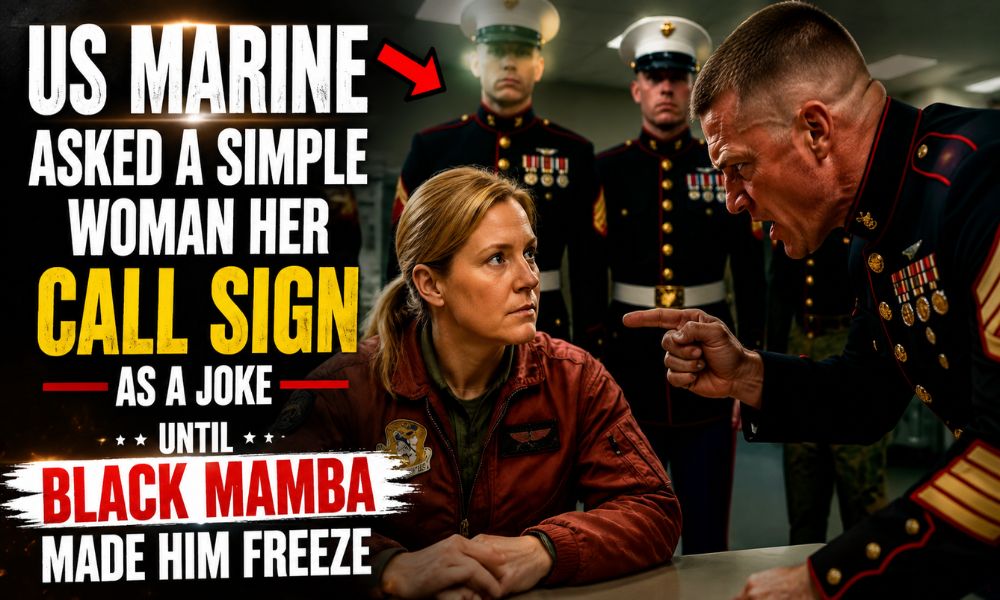
It was faded red, the color worn soft around the elbows and shoulders. A leather name patch sat over the left breast. On the right was a Weapons and Tactics Instructor patch. Beneath it were squadron insignia, an American flag, and several smaller emblems that meant something to anyone who had spent time around Marine aviation.
Davis knew enough to recognize them.
Or at least, he believed he did.
He leaned back in his chair and nudged Lance Corporal Mike Foster with one elbow.
“Check that out.”
Foster followed his gaze.
“The lady?”
“The jacket.”
A third Marine, Private First Class Nolan Price, turned around to look. “Maybe her husband flies.”
Davis smirked.
“That’s not a spouse jacket.”
“How do you know?”
“Because spouses wear squadron hoodies. They don’t walk around with WTI patches like they earned them.”
The woman did not look toward them. She kept eating.
That made Davis more interested.
He had been assigned to base security for five months after returning from an infantry deployment. The job frustrated him. He had expected patrols, arrests, and high-stakes responsibility. Most days involved checking badges, writing reports about damaged gates, and telling young Marines not to park in reserved spaces.
Davis compensated by treating every irregularity as a test.
He was twenty-six years old, broad-shouldered, sharp-jawed, and confident in the way young men sometimes became confident after surviving enough danger to believe they understood all forms of it.
He had also spent the previous ten minutes entertaining Foster and Price with a story about catching a civilian contractor using an expired credential.
The woman in the red jacket appeared at exactly the wrong moment.
“You going to say something?” Foster asked.
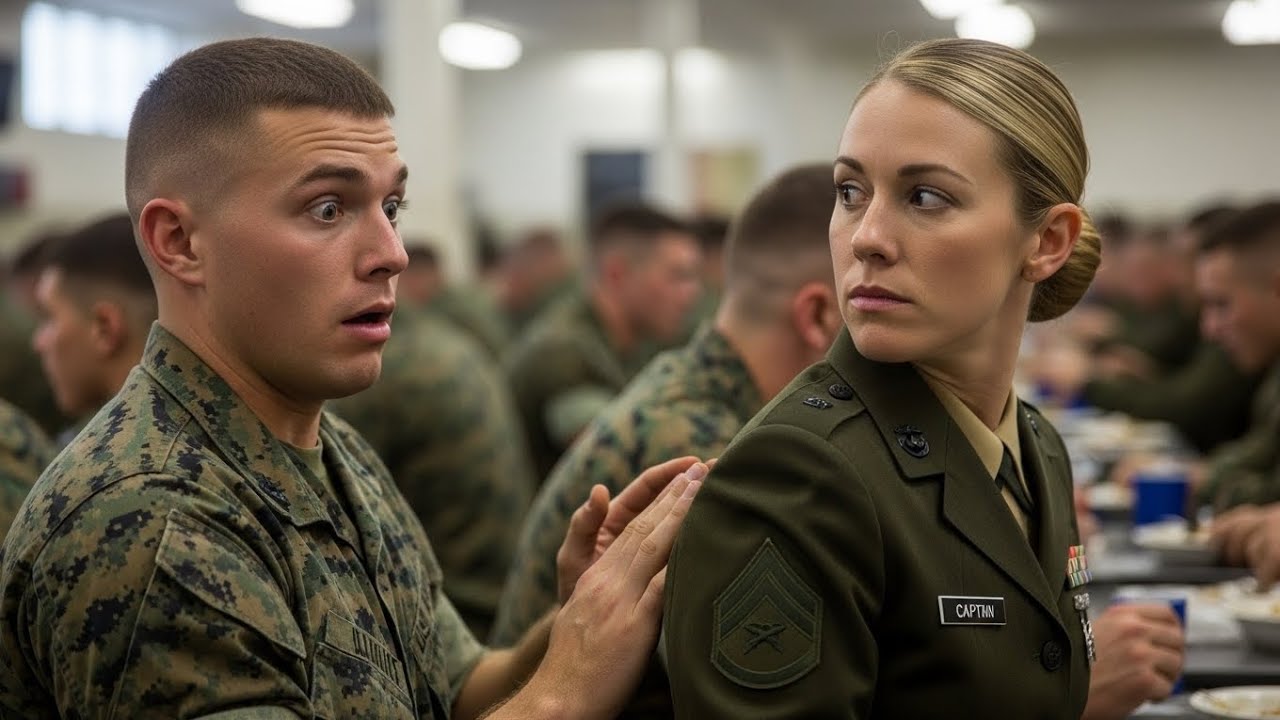
Davis stood.
“Someone should.”
He carried his coffee across the mess hall with the relaxed swagger of a man approaching an audience rather than a stranger.
Several Marines at nearby tables noticed him move. Davis had a reputation for making inspections feel like interrogations. Some admired it. Others had learned to look away.
He stopped beside the woman’s table.
Up close, the jacket looked even older.
The fabric near the collar bore tiny white marks, as though salt had dried there many times. One sleeve had been repaired with stitching that did not quite match. The name patch read:
TAYLOR
Below it, in smaller letters:
BLACKMAMBA
The woman looked up.
Her eyes were a calm, steady blue.
“That’s a pretty serious jacket,” Davis said.
She glanced at his uniform, reading his name tape and rank without appearing to do so.
“It has been useful.”
Davis waited for more.
Nothing came.
He rested one hand on the empty chair opposite her. “You a big fan of naval aviation?”
A few Marines nearby stopped talking.
The woman lifted her water and took a drink.
“You could say that.”
Behind Davis, Foster laughed quietly.
Encouraged, Davis looked at the patch again.
“Most people buy souvenir jackets outside the gate. Yours looks custom.”
“It is.”
“Your husband’s?”
“No.”
“Boyfriend?”
“No.”

Davis nodded as though her answers confirmed something.
“Brother?”
The woman cut another piece of chicken.
“No.”
Davis glanced over his shoulder. His friends were watching. So were two tables of enlisted Marines behind them.
He decided to give them the punch line they expected.
“What do they call you?” he asked. “Top Gun’s girlfriend?”
The laughter came quickly.
Not from the entire mess hall, but from enough people to reward him.
The woman did not react.
She chewed, swallowed, and placed her fork beside the plate with quiet precision.
Then she looked directly at Davis.
“Blackmamba.”
The word was not spoken loudly.
It did not need to be.
At a corner table, an older staff sergeant stopped with a coffee cup halfway to his mouth.
Near the entrance, a Navy chief turned his head.
Two captains seated beside the window exchanged a glance.
Davis heard the laughter behind him weaken.
For a moment, he felt something he could not explain. It was not recognition exactly. More like the sense of standing near machinery that had suddenly powered on.
He covered the feeling with a grin.
“Black Mamba?”
“One word.”
“Of course it is.”
The woman picked up her fork again.
Davis remained beside the table.
He could have walked away.
Later, he would think about that moment more than any other. He would remember the angle of the sunlight on the table. The smell of burnt coffee. The faint hum of the vending machine behind him.
He would remember that she gave him every opportunity to leave with his dignity intact.
But Foster and Price were watching.
And Davis had already made the room laugh.
“What unit?” he asked.
The woman continued eating.
“Are you conducting an official inquiry, Corporal?”
The use of his rank irritated him.
“No. I’m asking a question.”
“Then I’m eating lunch.”
A Marine at the next table looked down to hide a smile.
Davis heard it.
His face warmed.
“You’re wearing restricted insignia on a military installation.”
The woman looked at the red sleeve.
“Am I?”
“You know you are.”
“I know what I’m wearing.”
“That patch is WTI.”
“Yes.”
“You understand civilians aren’t supposed to impersonate military personnel?”
She held his gaze.
“Do I appear to be impersonating a corporal?”
The Marine at the next table coughed into his fist.
Foster stopped smiling.
Davis straightened.
“This isn’t funny.”
“I agree.”
The answer landed harder than an insult.
Davis looked down at her clothes. Civilian pants. Black boots. Flight jacket. No visible rank.
“Let me see your ID.”
The woman’s expression did not change.
“On what grounds?”
“You’re wearing military insignia and making claims about a call sign associated with Marine aviation.”
“I stated my call sign after you asked for it.”
“You expect me to believe you’re an aviator?”
“I haven’t asked you to believe anything.”
That calmness was becoming unbearable.
To Davis, anger made sense. Nervousness made sense. Apologies made sense.
This woman gave him none of them.
She reached into the inside pocket of the jacket and removed a Common Access Card.
She held it between two fingers.
Davis extended his hand.
Instead of giving it to him, she said, “You may inspect it here.”
He laughed once.
“That’s not how this works.”
“It is exactly how this works unless you are detaining me.”
The room had grown quieter.
Davis became aware of dozens of faces pretending not to watch.
He lowered his voice.
“Hand me the card.”
The woman studied him for a second, then placed it in his palm.
Davis looked down.
The photograph showed the same woman, though her hair was shorter. The card was worn but valid.
Name: LAUREN M. TAYLOR.
Branch: USMC.
Status: ACTIVE.
Grade: O-4.
Major.
Davis stared at the card longer than necessary.
For one clean second, the truth presented itself.
She was a commissioned officer.
A field-grade officer.
He should have returned the card, stepped back, and corrected himself.
But behind him, someone shifted in a chair.
Davis imagined Foster seeing the rank. He imagined Price telling the story in the barracks. He imagined the laughter changing direction.
His mind searched for another explanation.
The card could be fake.
The photograph could have been altered.
The jacket could belong to someone else.
The database might reveal an inconsistency.
He looked at the woman.
“If you’re a major, why aren’t you in uniform?”
“I’m authorized civilian attire today.”
“By whom?”
“My chain of command.”
“What command?”
She folded her hands beside the tray.
“You have confirmed my identity and active-duty status. Return the card.”
Davis turned it over.
The security markings looked correct.
That made him feel worse.
“There have been cases of fraudulent CACs.”
“There have also been cases of Marines exceeding their authority.”
A ripple moved through the room.
Davis’s jaw tightened.
“You’re getting defensive.”
“No. I’m describing what is happening.”
He held up the card.
“If this is legitimate, you won’t mind coming with me while I verify it.”
The woman’s eyes moved from his face to the card and back again.
“You have access to a reader?”
“At the security office.”
“You intend to escort a field-grade officer across the base because you do not like her jacket?”
“I intend to investigate suspected stolen valor.”
This time, the silence around them became complete.
The woman leaned back slightly.
Davis mistook it for surrender.
He pointed toward one of the patches.
“Let’s start with this. WTI. Weapons and Tactics Instructor. That isn’t something you buy because it looks good. That represents one of the hardest aviation programs in the Corps.”
“I’m familiar with it.”
“You expect me to believe you graduated?”
“Yes.”
“When?”
She gave him the year.
Davis searched his memory for something useful. He had once attended a briefing where an aviator described the WTI course. Davis had remembered the acronyms and forgotten most of the context.
“What platform?”
“F/A-18C initially. Later the F/A-18D.”
“Squadron?”
“Which deployment?”
The question caught him.
“Your last one.”
“VMFA-312.”
A captain near the window slowly set down his fork.
Davis continued.
“Combat hours?”
The woman’s expression changed, but only slightly.
Not fear.
Not pride.
Something more private.
“Enough.”
“That’s not an answer.”
“It is the answer you’re getting.”
Davis reached toward the WTI patch.
His finger brushed its edge.
The woman’s hand closed around his wrist before he understood she had moved.
She did not twist it.
She did not squeeze.
She simply stopped him.
The speed of it made his breath catch.
“Do not touch that patch,” she said.
Her voice was still quiet.
But the room heard every word.
For Lauren Taylor, the mess hall disappeared.
For one instant, the fluorescent lights became the green glow of cockpit instruments.
The clatter of trays became warning tones.
The stale smell of coffee became hot metal, fuel, and oxygen inside a damaged Hornet.
She saw a dark ridgeline beneath her canopy.
She heard the forward air controller shouting coordinates.
She saw tracers rising through the night in slow red arcs.
A recon team was trapped below, six Marines pinned against a dry riverbed while enemy fighters moved down from the north.
Her wingman had already gone low on fuel.
Her own aircraft had taken a hit beneath the right wing.
The caution panel was lit like a Christmas tree.
Then came the voice over the radio.
“Mamba, we need one more pass.”
She remembered looking at the fuel state.
She remembered the vibration in the stick.
She remembered knowing that one more pass might leave her without enough control to cross the mountains.
She went anyway.
The patch Davis touched had been presented to her years earlier after a course designed to make capable aviators confront how much they still did not know.
But in her mind, the patch was tied to every decision that came after it.
The Marines who came home because she understood terrain, timing, weapons effects, and the difference between confidence and competence.
She released Davis’s wrist.
He pulled his arm back as though burned.
“You put your hands on me,” he said.
“I prevented you from putting your hands on me.”
Davis looked around.
No one laughed now.
At a table near the rear, Master Gunnery Sergeant Thomas Cole had stopped eating.
Cole was fifty years old and built like a doorframe. His hair had gone gray at the temples, and his face carried the permanent squint of a man who had spent decades looking into sunlit flight lines.
He had served in Marine aviation maintenance for twenty-seven years.
He knew patches.
He knew squadrons.
More importantly, he knew names.
Taylor.
Blackmamba.
VMFA-312.
The details had been sitting separately in his mind. Now they came together.
Years earlier, Cole had been deployed to an airfield where a damaged Hornet limped home after supporting a recon element cut off beyond the planned engagement zone.
He had not seen the pilot’s face that night.
He had seen the aircraft.
The right stabilator had been shredded. Hydraulic fluid streaked the fuselage. Part of the wing root looked as though someone had attacked it with an industrial saw.
The plane had landed hard, veered, and stopped near the end of the runway.
The pilot had climbed out without celebration.
Cole remembered one of the maintainers asking who had flown it home.
Someone answered with one word.
Blackmamba.
Cole rose from his chair.
He did not approach the confrontation.
Instead, he walked toward the side exit and removed his phone.
Inside the mess hall, Davis was still holding Lauren’s CAC.
“Stand up,” he ordered.
Lauren looked at him.
“Excuse me?”
“You’re coming with us to the Provost Marshal’s office.”
“Us?”
Davis glanced at Foster and Price.
Both men hesitated, but the glance itself pulled them into the confrontation.
They stood.
Lauren remained seated.
“You have verified that I am an active-duty major,” she said.
“I’ve verified that the card says that.”
“And now you are accusing me of producing a fraudulent military credential?”
“I’m saying it needs to be checked.”
“Then call your supervisor.”
“I don’t need permission to investigate.”
“No. But you may soon need representation.”
The words struck Foster first.
His posture changed.
“Corporal,” he said quietly, “maybe we should just run the card number.”
Davis did not look at him.
“I know what I’m doing.”
Across the courtyard, Master Gunnery Sergeant Cole reached Colonel James Matthews on the second ring.
“Sir, this is Master Guns Cole.”
“What is it?”
“We have an incident in the main mess.”
“What kind?”
“A corporal from base security is challenging a woman’s identity.”
“Then let security handle it.”
Cole looked through the glass door.
The woman in the red jacket was still seated. Davis stood over her, holding the card.
“Sir, the woman says her name is Major Lauren Taylor.”
Silence.
Cole continued.
“Call sign Blackmamba.”
The silence changed.
“Are you certain?”
“I’m certain enough that I left the room before I said something unhelpful.”
“Keep eyes on them.”
“Yes, sir.”
“Do not let her leave.”
Cole glanced back inside.
“I don’t think she’s the one trying to leave.”
At headquarters, Colonel Matthews turned from his desk to the secure terminal behind him.
He entered Lauren Taylor’s name.
The personnel record appeared within seconds.
Major Lauren M. Taylor.
United States Marine Corps.
Naval Aviator.
F/A-18 pilot.
Weapons and Tactics Instructor.
More than 2,100 total flight hours.
More than 600 combat hours.
Multiple deployments.
The awards list filled the screen.
Air Medals.
Navy and Marine Corps Commendation Medal with combat distinguishing device.
Strike/Flight awards.
And there, near the top:
Distinguished Flying Cross.
Matthews opened the citation.
He read the operational summary once.
Then again.
Taylor had continued an emergency close-air-support mission after her aircraft sustained combat damage. She had coordinated attacks against multiple hostile positions, protected an isolated reconnaissance team, and flown the damaged Hornet beyond normal recovery limits to prevent the loss of the aircraft and sensitive systems.
Matthews knew the story.
Most Marine aviators did.
The pilot’s name had not always been included when the story was repeated. The call sign had.
Blackmamba.
Matthews stood so quickly his chair rolled backward.
His executive officer looked up from the next office.
“Sir?”
“Call the sergeant major. Tell him to meet me at the main mess. Now.”
Matthews lifted another phone.
“Get Brigadier General Keller.”
“Sir, he’s in a wing readiness meeting.”
“Interrupt it.”
Back in the mess hall, Davis had begun listing potential violations.
“Unauthorized wear of insignia. False representation. Possible impersonation of an officer. Possible fraudulent credential.”
Lauren listened without interrupting.
When he finished, she asked, “Are you recording this?”
Davis tapped the body camera clipped near his chest.
“Yes.”
“Good.”
That single word made Price step backward.
Davis pointed toward the exit.
“Stand up.”
Lauren placed her napkin on the tray.
“I will give you one final opportunity to return my identification.”
“Not until it’s verified.”
“It has a scannable certificate.”
“At the office.”
“You have a handheld reader on your duty belt.”
Davis froze.
Lauren nodded toward the device clipped behind his radio.
Several people looked at it.
Foster closed his eyes briefly.
Davis had forgotten about the reader.
It was capable of confirming whether a CAC was active and whether the certificate matched the printed identity. He had used it twice that morning.
He reached for an explanation.
“The connection in here is unreliable.”
A lieutenant at the next table lifted his phone.
“Full signal.”
Davis turned.
The lieutenant held his gaze for half a second, then looked back at his lunch.
The humiliation Davis had feared was now happening in slow motion.
He could feel control slipping away.
So he did what frightened people often do when they confuse control with authority.
He escalated.
“Major or not, you’re interfering with a security check.”
Lauren’s expression hardened.
“I have complied with every lawful request you have made. You asked for identification. I provided it. You inspected it. You refused to return it. You possess equipment capable of verifying it, yet you have chosen not to use it. You attempted to touch me, and now you are blocking my movement with two armed Marines.”
She looked at Foster and Price.
Both men moved aside immediately.
Davis did not.
“You don’t get to tell me how to do my job.”
“No,” Lauren said. “Your orders do.”
The doors at the far end of the mess hall slammed open.
Every head turned.
Colonel Matthews entered first.
Beside him walked Sergeant Major Harold Greene, whose reputation could straighten spines from across a parade deck. Behind them came the wing operations officer, two lieutenant colonels, and Brigadier General Robert Keller, the installation’s senior aviation commander.
Conversation died instantly.
Chairs shifted.
Marines began to stand.
Davis turned toward the group.
For one hopeful second, he believed reinforcements had arrived.
Colonel Matthews did not look at him.
Neither did Sergeant Major Greene.
The entire command group walked straight past Davis and stopped beside the seated woman.
Lauren rose.
Matthews came to attention.
“Major Taylor.”
He saluted.
Lauren returned it.
The room seemed to stop breathing.
“Colonel.”
Matthews lowered his hand.
“Ma’am, on behalf of this installation, I apologize.”
Davis’s fingers went numb around the CAC.
Brigadier General Keller stepped forward.
He was a compact man with silver hair and a voice that rarely needed volume.
“Major,” he said, “I was not informed you had arrived.”
“My travel moved up, sir.”
“You were supposed to report to wing headquarters.”
“I planned to. After lunch.”
Keller glanced at her half-finished tray.
Then he turned slowly toward Davis.
The corporal looked as though the floor had tilted beneath him.
Sergeant Major Greene noticed the card in Davis’s hand.
“What,” he asked, “are you holding?”
Davis swallowed.
“An identification card, Sergeant Major.”
“Whose identification card?”
“Major Taylor’s.”
“Why?”
Davis opened his mouth.
No sound came out.
Greene stepped closer.
He did not shout.
That was worse.
“Corporal, I asked you a question.”
Davis found his voice.
“I suspected fraudulent use of military insignia and possible stolen valor.”
Greene’s eyes moved to the body camera.
“Did the major provide identification?”
“Yes, Sergeant Major.”
“Did the identification state that she was an active-duty officer?”
“Yes.”
“What rank?”
“Major.”
“Did you scan the card?”
Davis’s face tightened.
“No, Sergeant Major.”
“Were you equipped to scan it?”
“Yes.”
“Then explain why a corporal is standing in a crowded mess hall holding a field-grade officer’s credential while accusing her of stolen valor.”
Davis looked toward Lauren.
She gave him nothing.
No anger.
No satisfaction.
No rescue.
His gaze returned to Greene.
“I thought the card might be fake.”
“And the scanner?”
Davis said nothing.
General Keller looked at the name patch on Lauren’s jacket.
Then he faced the room.
Some of the younger Marines did not understand what was happening beyond the obvious collapse of Davis’s authority. Keller appeared to recognize that.
“You heard the call sign,” he said.
No one moved.
“Blackmamba is not a nickname Major Taylor invented for lunch.”
Lauren’s jaw tightened slightly.
Keller continued.
“Fourteen years ago, a Marine reconnaissance team was isolated during a night operation after its extraction route collapsed. Enemy forces occupied high ground on three sides. Weather blocked the planned support package. Communications were intermittent.”
Davis stared at the floor.
“Major Taylor, then a captain, was one of two Hornet pilots diverted to support them. Her aircraft took damage during the second attack. She was advised to disengage.”
Keller looked around the mess hall.
“She did not.”
Lauren’s eyes remained forward.
“She coordinated multiple passes while managing a hydraulic failure and degraded flight controls. Her actions broke the enemy movement long enough for the recon team to reach an alternate extraction point.”
A Marine near the beverage station slowly removed his cap.
Keller’s voice stayed level.
“She then flew the damaged aircraft across hostile terrain and recovered it at a forward airfield. The Distinguished Flying Cross on her record is connected to that mission.”
Davis’s face had lost its color.
Keller gestured toward the red jacket.
“The insignia on that jacket is not decoration. Those patches are receipts. They represent schools completed, units served, aircraft flown, and decisions made when people on the ground did not have the luxury of waiting for perfect conditions.”
He turned fully toward Davis.
“You saw a woman eating alone and decided her record was impossible before you checked whether it was real.”
Davis tried to speak.
“Sir, I was attempting to protect—”
“No,” Keller said.
The word cut through the room.
“You were protecting your pride.”
Davis’s mouth closed.
Sergeant Major Greene stepped within arm’s reach of him.
“You had a legitimate opening to ask a professional question. Then you had identification. Then you had a scanner. Then you had two Marines beside you suggesting that you slow down.”
Greene pointed toward Davis’s chest.
“At every stage, you were given a way to correct course.”
Davis’s breathing became shallow.
“You refused each one because you had already decided what she was.”
The sergeant major’s voice dropped lower.
“That is not vigilance. That is prejudice wearing a duty belt.”
Davis finally looked at Lauren.
The moment of recognition arrived without drama.
His eyes went first to the red jacket.
Then to the WTI patch he had tried to touch.
Then to the name strip.
BLACKMAMBA.
He looked at the woman herself, and for the first time he was not searching for evidence that she did not belong.
He was seeing what had been in front of him from the beginning.
A pilot who had survived years of operational flying.
An officer who had stayed calm while a junior Marine humiliated her.
A person whose restraint had prevented his mistake from becoming something far worse.
The realization moved across his face.
His jaw loosened.
His shoulders dropped.
The confidence drained out of him until he looked younger than he had ten minutes earlier.
Around the mess hall, no one spoke.
Davis extended the CAC with both hands.
“Major Taylor.”
Lauren waited.
His hands began to tremble.
“I was wrong.”
The words were barely audible.
Greene’s eyes narrowed.
Davis tried again.
“I was wrong, ma’am. I made assumptions about you. I ignored the evidence when it didn’t match what I believed. I acted outside my authority, and I disrespected you in front of the entire mess hall.”
Lauren took the card.
Davis forced himself to meet her eyes.
“I apologize.”
The room waited for her response.
She could have ended his career with a sentence.
She could have demanded charges, formal discipline, or removal from duty.
No one there would have blamed her.
Instead, Lauren inspected the card, returned it to her pocket, and looked toward Foster and Price.
“Did either of you believe the identification was fraudulent?”
Foster answered first.
“No, ma’am.”
Price shook his head.
“No, ma’am.”
“Then next time, say so before the situation reaches this point.”
“Yes, ma’am,” they said together.
She looked at Davis.
“You are assigned to security?”
“Yes, ma’am.”
“Security requires judgment. Not suspicion alone. Anyone can become suspicious. Judgment is what prevents suspicion from becoming misconduct.”
Davis stood motionless.
Lauren nodded toward his scanner.
“Technology was available to answer your question in seconds. Your fellow Marines gave you reason to pause. I gave you clear information. You ignored all three.”
“Yes, ma’am.”
“You were not wrong because you questioned something unusual. You were wrong because you decided the answer before you investigated.”
Davis’s eyes dropped.
Lauren’s tone did not soften, but it lost its edge.
“Do you understand the difference?”
“Yes, ma’am.”
“Good.”
She collected the folder beside her tray.
“Then learn it.”
That was all.
No speech about forgiveness.
No public demand for revenge.
Just an order he would remember for the rest of his career.
Learn it.
The command group escorted Lauren from the mess hall.
As she passed the nearest tables, Marines came to attention without being told.
Not because of the general.
Not because of the colonel.
Because they now knew who walked among them.
Davis remained beside the abandoned tray.
No one mocked him.
That would have been easier.
Instead, the room slowly resumed movement around him. Forks touched plates. Chairs scraped. Conversations returned in low, careful voices.
His friends stood nearby but did not know what to say.
Sergeant Major Greene stayed behind.
He waited until the doors closed.
Then he pointed at Davis, Foster, and Price.
“My office. Ten minutes.”
The incident spread across the installation before the end of the day.
By evening, the details had grown in every retelling. Some said Davis had tried to arrest a decorated fighter pilot. Others claimed General Keller had threatened to reduce him to private on the spot.
The truth was less theatrical and more serious.
Davis was temporarily removed from security duties pending investigation. His body-camera footage was reviewed. Statements were collected from witnesses. His conduct was found to be unprofessional, needlessly escalatory, and inconsistent with installation procedures.
He was not discharged.
Lauren did not request that.
But a formal reprimand entered his record. His recommendation for promotion was delayed. He and the Marines who had supported him were assigned corrective training in professional conduct, equal opportunity, lawful identification procedures, and de-escalation.
The installation also revised its security standard operating procedure.
The new instructions were simple.
Verify first.
Escalate only when facts justify it.
Maintain courtesy regardless of rank, gender, clothing, or appearance.
The policy should have existed in that form already.
Sometimes institutions improve only after someone pays for a lesson that should have been free.
Lauren stayed at the base to help develop an updated aviation training syllabus. Her arrival had been moved forward because a series of readiness evaluations exposed weaknesses in how young aircrews were preparing for complex support missions.
She spent her days in briefing rooms, simulators, and maintenance spaces.
She never mentioned the mess hall incident.
Other people did that for her.
Young Marines began recognizing the red jacket.
Some saluted even when she was in civilian clothes. She corrected them gently.
A few asked about the Distinguished Flying Cross. She redirected the conversation to the reconnaissance team.
“They were the ones trapped on the ground,” she said. “I had an aircraft.”
When someone called her legendary, she changed the subject.
The people who had worked longest around combat veterans understood why.
Those who had done the hardest things often spoke about them the least.
One month later, Lauren stopped at the base exchange near sunset.
She had spent most of the day reviewing simulation data and needed notebooks, coffee, and a new set of pens. She was standing in the office-supply aisle when she noticed a man approaching from the far end.
Davis.
He wore jeans and a gray T-shirt. Without his uniform, he looked smaller.
He saw her and slowed.
For a second, Lauren thought he might turn away.
Instead, he walked toward her.
“Major Taylor.”
“Corporal.”
He stopped several feet away.
His hands remained visible at his sides, as though he had rehearsed where to place them.
“I know I already apologized.”
Lauren waited.
“But that was in front of the command. I was scared, and I said what I knew I was supposed to say.”
She set the package of pens back on the shelf.
Davis continued.
“I wanted to apologize when no one was ordering me to.”
His voice was unsteady, but not performative.
Lauren gave him room to speak.
“I read the citation,” he said. “And the after-action summary. At least the version I was allowed to access.”
She said nothing.
“I also watched my body-camera footage.”
That seemed harder for him to admit.
“I kept waiting to see the point where you made me angry. But you didn’t. I was embarrassed, so I kept inventing reasons to continue.”
Lauren crossed her arms.
Davis looked at the floor.
“I thought I was being thorough. Watching it later, I realized I wasn’t investigating anything. I was trying to prove that my first impression had to be right.”
A family pushed a shopping cart into the aisle. Davis stepped aside until they passed.
Then he looked at her again.
“I treated you like you didn’t belong because you weren’t what I expected a fighter pilot to look like.”
Lauren studied his face.
The arrogance she remembered was gone.
In its place was something less comfortable and more useful.
Shame that had not yet turned into self-pity.
“What is your MOS?” she asked.
“0311, ma’am. Rifleman.”
“And now base security?”
“Temporary assignment.”
“How many times on patrol did someone’s first impression turn out to be wrong?”
Davis exhaled.
“A lot.”
“Yours or theirs?”
“Both.”
She nodded.
“And yet you believed military experience made you immune to the same mistake.”
“Yes, ma’am.”
“Why?”
He thought about it.
“Because I confused experience with being right.”
For the first time, Lauren’s expression softened.
“That is a better answer than most officers manage.”
Davis almost smiled, but decided against it.
“I don’t expect you to forgive me.”
“This is not about what I feel toward you.”
He looked uncertain.
Lauren continued.
“You are going to lead younger Marines someday. They will watch how you use authority. If you treat confidence as proof of competence, they will copy you. If you use humiliation to establish control, they will copy that too.”
Davis listened.
“But if they see you correct yourself when you are wrong, they may learn that as well.”
He nodded slowly.
“My promotion was delayed.”
“I heard.”
“I was angry about it at first.”
“And now?”
“Now I think I got off light.”
Lauren picked up the package of pens again.
“That depends on what you do next.”
Davis glanced at the flight jacket she wore over one arm.
The Blackmamba patch was visible.
This time, he did not stare.
“Why didn’t you ask them to discharge me?” he said.
Lauren looked toward the end of the aisle, where the windows showed the last orange light over the flight line.
“Because one terrible decision should have consequences,” she said. “It should not automatically become the only decision that defines a person.”
Davis absorbed the words.
“But understand something.”
He straightened.
“Mercy is not the absence of accountability. You were held accountable. What happens to your character now is your responsibility.”
“Yes, ma’am.”
She placed the notebooks in her basket.
Davis stepped back.
“Thank you for hearing me out.”
Lauren nodded once.
“Corporal.”
“Yes, ma’am?”
“The next time someone does not look the way you expect a Marine to look, start with the facts.”
“I will.”
“No.”
Her eyes sharpened.
“Start with respect. Then verify the facts.”
Davis stood a little straighter.
“Yes, ma’am.”
Lauren walked toward the register.
Outside, aircraft moved along the distant taxiway, their lights blinking in the deepening blue.
Davis remained in the aisle for several seconds before heading in the opposite direction.
Two weeks later, during a security shift at the main gate, he saw a young Marine stop an elderly man wearing a faded squadron cap. The Marine’s voice was sharp. His posture was aggressive. He had already decided the visitor was a problem.
Davis approached.
The younger Marine looked relieved to see a corporal.
Davis did not take over by shouting.
He asked the visitor for his credential. He scanned it. He listened.
The man was a retired master sergeant attending a memorial service for someone he had served with thirty years earlier.
The credential was valid.
Davis handed it back with both hands.
“Welcome aboard, Master Sergeant.”
The retired Marine studied him for a moment.
“Thank you, Corporal.”
After the man drove through, the younger Marine shrugged.
“He looked suspicious.”
Davis turned to him.
“There’s nothing wrong with checking.”
The Marine nodded.
Davis pointed to the scanner.
“But you do not get to disrespect someone while you’re finding out whether you’re right.”
The younger Marine shifted uncomfortably.
Davis recognized the reaction.
He had once stood on the other side of the same lesson.
“Verify first,” he said. “Then decide.”
That evening, Lauren sat in a quiet office overlooking the flight line.
A draft syllabus covered the table in front of her. She had spent hours rewriting a section on decision-making under pressure.
The old curriculum focused on speed, tactical knowledge, and confidence.
Her revision added something else.
Cognitive discipline.
The ability to test assumptions.
The willingness to change course when evidence changed.
The understanding that authority increased the cost of stubbornness.
Outside the window, a pair of Hornets taxied toward the runway.
Their engines rose to a low metallic thunder.
Lauren paused and watched them turn into position.
For an instant, the glass reflected the red jacket hanging behind her door.
The patches were faded.
The stitching was imperfect.
One sleeve still carried the repair from a night long ago, when a sharp edge in a damaged cockpit had torn the fabric as she climbed out.
People often saw symbols and assumed they understood the story behind them.
They rarely saw the hours, mistakes, fear, training, grief, restraint, and responsibility woven underneath.
Lauren turned back to the syllabus.
At the bottom of the page, she added one final line for the instructors who would teach the course:
“Confidence should begin the decision, not end the investigation.”
Then she closed the folder and switched off the office light.
The story of Blackmamba spread because a decorated pilot had been mistaken for an impostor.
But that was not the real reason Marines remembered it.
They remembered it because she had possessed enough power to destroy the man who humiliated her—and enough leadership to demand that he become better instead.
Anyone can look powerful while others are afraid of them.
Real authority is revealed in what you choose to do after you have every right to strike back.