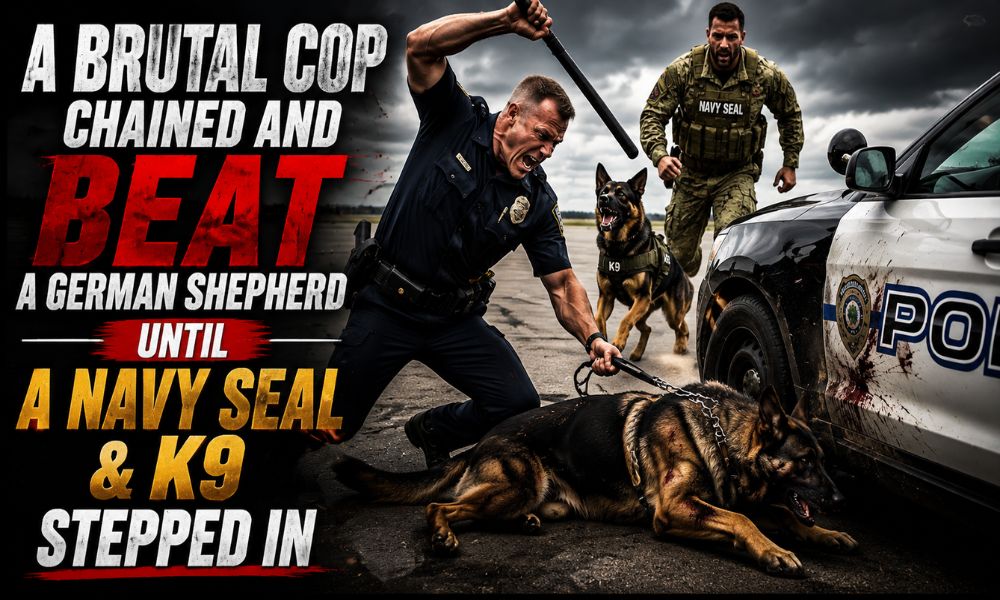
The shotgun stock crashed into the German Shepherd’s ribs, and Deputy Wade Harkins laughed when the dog collapsed against the concrete.
The sound was dull, almost ordinary.
That was the worst part.
It happened behind Miller’s Gas & Grocery at 6:17 on a Tuesday morning, while coffee brewed inside and trucks rolled past on Highway 14. The dog was chained to an old steel post beside the dumpster, close enough for customers to hear him whimper but far enough away that most could pretend they hadn’t.
Harkins looked around afterward.
He wasn’t checking whether the dog was injured.
He was checking whether anyone had seen him.
I had.
My name is Emma Ruiz. At the time, I was the morning cashier at Miller’s, and for three weeks I watched that German Shepherd disappear a little more each day.
His name was Ranger.
At least, that was the name engraved on the worn black collar around his neck.
He had arrived in the back of Harkins’s patrol vehicle one rainy Thursday. Harkins dragged him out by a chain, looped it around the post and told my manager, Earl Miller, that the dog was “county property.”
Earl didn’t ask questions.
Nobody in Oak Grove asked Deputy Wade Harkins questions.
He had been with the sheriff’s department for almost twelve years. His father had served on the county commission. His uncle owned the towing company that handled nearly every police impound in the area. His wife ran the largest real estate office in town.
Harkins didn’t need to threaten people often.
His name did most of the work.
The first day, Ranger stood tall despite the chain. He watched every passing person with alert brown eyes. When children came near, his ears lifted. When an eighteen-wheeler released its brakes, he didn’t flinch.

He looked trained.
Disciplined.
Proud.
By the end of the first week, his ribs were showing.
By the second, he stopped standing when cars pulled in.
By the third, he had learned to lower his head whenever Harkins appeared.
I left water beside the post whenever I could.
Harkins always kicked the bowl over.
“He’s being disciplined,” he told me the first time he caught me.
“For what?”
The question came out before I could stop it.
Harkins turned slowly.
He was a broad man with close-cropped hair and pale eyes that never seemed to blink enough. His uniform fit tightly across his shoulders, and he wore his badge slightly higher than regulation, as if he wanted it to be the first thing people noticed.
“For forgetting who’s in charge.”
“He’s starving.”
“He eats.”
“When?”
“When I say.”
He stepped closer.
“You got a problem with how the sheriff’s department handles its animals, Emma?”
Behind him, Ranger lay in the mud. One of his front paws was swollen. There was dried blood beneath the collar where the chain had rubbed his neck raw.
I wanted to say yes.
Instead, I looked toward the store window.
Earl stood behind the counter watching us. The moment our eyes met, he turned away.
“I’m just asking,” I said.
Harkins smiled.
“No. You’re not.”
The next morning, a county vehicle sat across from my apartment when I left for work.
It could have been a coincidence.
In Oak Grove, coincidences had badges.
After that, I kept leaving water for Ranger, but I did it when no one was looking.
Other people noticed him too.
Mrs. Evelyn Pike, who taught third grade for forty-one years, brought scraps of chicken wrapped in foil. Harkins found them and issued her a citation for “interfering with a working police animal.”
The citation was later dismissed.
But the message wasn’t.
A teenage boy named Tyler Mason recorded Ranger on his phone. Harkins stopped Tyler’s truck that evening and kept him on the roadside for nearly an hour while he searched every compartment.
A delivery driver called the sheriff’s office.
The dispatcher told him Deputy Harkins was Ranger’s assigned handler and that “corrective measures” were sometimes necessary with aggressive dogs.

Ranger had never acted aggressively toward anyone.
Not once.
He didn’t bark at strangers.
He didn’t snap when I slid food beneath the chain.
He barely even growled when Harkins hurt him.
He just endured it.
That seemed to make Harkins angrier.
Cruel men often want resistance. Resistance gives them an excuse.
Ranger gave him none.
Three weeks after the dog arrived, Harkins pulled into the gas station just after sunrise carrying a twelve-gauge shotgun.
He wasn’t responding to a call. There was no emergency. He parked beside the air pump, walked behind the store and found Ranger lying near the post.
“Up,” he ordered.
Ranger tried.
His back legs shook beneath him.
Harkins nudged him with one boot.
“I said up.”
Ranger pushed himself halfway upright, then slipped on the damp concrete.
That was when Harkins struck him with the stock.
The dog hit the ground.
Harkins laughed.
Something inside me moved before fear could stop it.
I came through the back door with my phone in my hand.
“Stop!”
Harkins turned.
For one second, surprise crossed his face. Then it vanished.
“What did you say?”
“I said stop.”
My voice shook so badly that the word barely sounded like mine.
Behind him, Ranger’s chest rose and fell in short breaths.
Harkins rested the shotgun against his shoulder.
“You filming me?”
I held the phone tighter.
“Yes.”
It was a lie.
My camera wasn’t recording.
I had pressed the wrong button.
Harkins walked toward me.
“Give it here.”
“No.”
“County investigation.”
“This is my phone.”
“And that’s obstruction.”
He reached for it.
Then we heard tires roll over gravel.
A faded dark-blue pickup turned into the station. Dust covered the hood, and one headlight was cloudy with age. It stopped beside pump four.
The driver remained inside for a moment.
Then the door opened.
A tall man stepped out wearing sand-colored Navy fatigues, worn boots and no visible weapon. His hair was cut short, but there was gray near his temples. A scar ran from beneath his right ear toward the collar of his shirt.
At his heel moved a second German Shepherd.
This dog was darker than Ranger, almost black along the back, with a silver muzzle and a steady, measured walk.
He wore no leash.
He didn’t need one.
The man closed the truck door and looked toward us.
The dog looked too.
Harkins lowered the shotgun from his shoulder.
“This doesn’t concern you,” he called.
The stranger’s eyes moved from Harkins to me, then to Ranger on the ground.
He didn’t answer immediately.
The shepherd beside him stood still, ears forward.
Finally, the man said, “Shadow. Heel.”
The dog stepped closer to his left leg.
The stranger began walking toward us.
There was nothing hurried about him.
That seemed to bother Harkins more than if he had run.
“I said this is police business.”
The man stopped about fifteen feet away.
His gaze settled on Ranger’s chain, the empty water bowl and the marks along the dog’s side.
Then he looked at the shotgun.
“What crime did the dog commit?”
Harkins gave a short laugh.
“You military?”
“Retired.”
“Then you should understand a chain of command.”
“I understand it better than most.”
Harkins tapped the badge on his chest.
“Good. Then keep walking.”
The stranger glanced at the badge but showed no reaction.
“My name is Marcus Cole,” he said. “I’m asking you to step away from the animal.”
Harkins stared at him.
People had begun gathering near the pumps. Earl stood inside the store. Mrs. Pike had pulled up for her morning newspaper and was watching through her windshield. Two utility workers paused beside their truck.
Harkins noticed them.
His posture changed.
He lifted his chin and shifted into the calm official voice he used whenever witnesses were present.
“This animal is a dangerous law-enforcement canine undergoing behavioral correction. You are interfering with an authorized training process.”
Marcus looked at Ranger again.
“No working-dog training program in this country authorizes blunt-force trauma, dehydration or prolonged restraint on a fixed chain.”
“You some kind of expert?”
“Yes.”
The answer was simple.
Harkins hadn’t expected it.
Marcus continued.
“Twenty-two years in Naval Special Warfare. Twelve working with military dogs. Six more training handlers after I left active duty.”
He nodded toward the dog beside him.
“Shadow completed three deployments.”
At the sound of his name, Shadow kept his eyes on Harkins.
The deputy’s smile thinned.
“Well, this isn’t the Navy. This is Mercer County.”
“I noticed.”
“Then you’ve got no authority here.”
Marcus looked at me.
“Is that your phone?”
“Yes.”
“Did you record what happened?”
Before I could answer, Harkins stepped between us.
“She recorded an active police operation without authorization.”
Marcus’s expression didn’t change.
“Recording police activity from a place she is legally allowed to stand does not require your authorization.”
“You a lawyer too?”
“No.”
“Then shut your mouth.”
Shadow’s ears moved.
Marcus rested two fingers against the dog’s shoulder.
The motion was barely visible, but Shadow relaxed immediately.
That small act told me more than Harkins’s badge ever had.
Marcus didn’t need fear to control his dog.
Trust was enough.
Harkins pointed toward the truck.
“Get back in your vehicle and leave.”
Marcus didn’t move.
For several seconds, neither man spoke.
Then Ranger made a low sound behind Harkins.
Not a growl.
A cry.
Shadow turned his head toward him.
Something passed between the two dogs that none of us understood. Shadow’s body tightened, and Ranger tried to lift his head.
Marcus saw it.
His face changed for the first time.
Not dramatically.
His jaw set. His eyes narrowed slightly. He took one slow breath through his nose.
Then he noticed Ranger’s collar.
“What did you say that dog’s name was?”
“I didn’t.”
Marcus stepped half a pace to the side for a better look.
Harkins blocked him again.
“Back up.”
Marcus’s attention remained on the collar.
“Ranger,” he said quietly.
The chained dog’s ears twitched.
Marcus went still.
“Ranger.”
The dog lifted his head.
It took effort. His neck trembled, and one ear remained folded back. But he looked directly at Marcus.
Shadow released a soft whine.
Marcus’s hand dropped from Shadow’s shoulder.
Harkins saw the reaction and gripped the shotgun tighter.
“You know this animal?”
Marcus didn’t answer him.
He knelt slowly, still several yards from the chain.
“Ranger. Look at me.”
The injured shepherd stared at him.
Marcus raised his right hand, palm facing inward, and gave a small signal with two fingers.
Ranger tried to rise.
His legs failed.
He hit the concrete again.
Marcus closed his eyes for half a second.
When he opened them, whatever emotion had appeared was gone.
Only focus remained.
“Where did you get this dog?” he asked.
Harkins’s voice became sharper.
“County acquisition.”
“From whom?”
“None of your business.”
“Where did you get him?”
“I’m done answering questions.”
Harkins turned toward me.
“Hand over the phone.”
I backed toward the door.
He followed.
Marcus stood.
“Deputy.”
Harkins spun around.
Marcus pointed toward the small security camera mounted above the gas station’s rear entrance.
A red light blinked beneath the lens.
“You may want to stop creating evidence.”
Every face turned toward the camera.
Earl appeared in the doorway.
“That thing hasn’t worked in months,” he said quickly.
I looked at him.
It was another lie.
I had watched Earl install a new memory card two days earlier after someone stole a box of motor oil.
Harkins studied him.
“You sure?”
Earl swallowed.
“Yes.”
Harkins’s shoulders lowered slightly.
Marcus glanced from Earl to the camera, then back to Harkins.
He said nothing.
That silence unsettled the deputy.
“Take your dog and go,” Harkins ordered.
Marcus looked toward Ranger.
“I’m not leaving him.”
“He belongs to the department.”
“Show me the transfer record.”
“What?”
“Working dogs have records. Acquisition papers. Veterinary history. Handler assignment. Certification status. Show me one document proving this animal belongs to you or Mercer County.”
Harkins laughed again, but there was less confidence in it now.
“You think you can drive into my town and demand police files?”
Marcus looked around the parking lot.
“Your town?”
The utility workers exchanged glances.
Mrs. Pike opened her car door.
Harkins heard it.
His face darkened.
“Everybody leave,” he shouted. “Now.”
No one moved.
That had never happened before.
People in Oak Grove obeyed Harkins automatically. Not because they respected him, but because they had seen what happened to people who didn’t.
But fear depends on isolation.
That morning, for the first time, we were all afraid together.
And somehow that felt different.
Harkins pointed at Mrs. Pike.
“Ma’am, return to your vehicle.”
She stepped out and closed the door behind her.
“I’ve taught half this town to read, Wade Harkins. Don’t you ‘ma’am’ me.”
One of the utility workers coughed to hide a laugh.
Harkins flushed.
“This is an active scene.”
Mrs. Pike looked at Ranger.
“It looks like animal cruelty.”
Harkins’s hand moved toward the radio on his shoulder.
Marcus watched him.
“Call your supervisor.”
“I am the ranking officer on duty.”
“Then call the sheriff.”
“The sheriff’s unavailable.”
“State police.”
“This is county jurisdiction.”
“Animal control.”
“They report to us.”
Marcus nodded once, as if Harkins had confirmed something.
“Convenient.”
Harkins raised the shotgun slightly.
Not enough to aim.
Enough to remind everyone it was there.
Shadow stepped forward.
Marcus gave no spoken command.
The dog placed himself between Marcus and the barrel.
Every person in the parking lot fell silent.
Shadow didn’t bark.
He didn’t show his teeth.
He simply stared at Harkins with a stillness that felt heavier than aggression.
Harkins looked down at him.
“What happens if I decide your dog is a threat?”
Marcus’s voice was calm.
“You’ll have to explain why you shot a retired military working dog while he stood motionless in a public parking lot.”
Harkins’s eyes moved toward the witnesses.
Then toward the camera Earl claimed didn’t work.
His grip shifted again.
“You threatening me?”
“No.”
Marcus paused.
“I’m giving you information.”
Harkins stepped back.
For the moment, it was enough.
He lowered the shotgun and pulled out his phone. He walked toward his patrol vehicle, speaking too quietly for us to hear.
Marcus turned to me.
“Do you have water?”
I nodded.
“And food?”
“Yes.”
“Bring water first. Small amount. Don’t let him drink too fast.”
I hurried inside.
Earl blocked the sink.
“Don’t.”
I stared at him.
“What?”
“You heard Harkins. That dog is county property.”
“That dog is dying.”
“And I have a business to protect.”
“So do the right thing.”
“The right thing won’t pay my mortgage when they shut this place down.”
Behind us, customers watched through the windows.
Earl lowered his voice.
“You don’t know these people.”
“I know what I saw.”
“You’ve got a daughter.”
The words stopped me.
My daughter, Sofia, was nine.
Earl knew exactly what he was saying.
He wasn’t threatening her.
He was reminding me that Harkins could.
I looked through the window at Ranger.
Marcus had knelt near him again. Shadow lay several feet away, his chin on his paws, trying to appear nonthreatening.
Ranger was watching Shadow.
For the first time in days, his tail moved.
Once.
Barely.
I pushed past Earl, filled a plastic bowl halfway and carried it outside.
Harkins was still on the phone near his vehicle.
Marcus took the bowl from me.
“Thank you.”
He approached Ranger sideways, avoiding direct eye contact. He stopped beyond the reach of the chain and set the bowl down.
Ranger tried to crawl toward it.
The chain pulled tight.
Marcus followed it to the steel post.
A heavy padlock secured the final link.
“Key?” he asked.
I looked toward Harkins.
“He keeps it.”
Marcus inspected the lock.
Then he looked at Ranger’s neck.
The collar wasn’t just tight. A thin steel cable had been threaded through it and attached to the chain, preventing anyone from removing the dog without unlocking the padlock.
“This wasn’t done for control,” Marcus said.
“What was it done for?”
“To make rescue impossible.”
Harkins ended his call and walked back.
“Backup’s coming.”
“Good,” Marcus said.
“You’ve got about two minutes to leave before you spend the day in a cell.”
Marcus stood.
“What agency?”
“What?”
“You said backup. Which agency?”
“My agency.”
“Then you didn’t call anyone who can investigate you.”
Harkins smiled.
“I don’t need investigating.”
Marcus reached into the side pocket of his fatigues.
Harkins raised the shotgun.
“Hands!”
Marcus froze.
Shadow rose immediately.
“Keep the dog back!”
Marcus held one hand open.
“My identification is in my pocket.”
“I didn’t ask for it.”
“You’ve spent ten minutes telling everyone I have no authority. I’m offering to show you who I am.”
Harkins hesitated.
Something in Marcus’s tone had changed.
Not louder.
More formal.
“Two fingers,” Harkins said. “Slowly.”
Marcus removed a black leather credential case and held it out.
Harkins didn’t take it.
“Open it.”
Marcus opened the case.
From where I stood, I could see a photograph, an official seal and several lines of print.
Harkins read them.
For the first time that morning, the color drained from his face.
It lasted less than a second.
Then he scoffed.
“This expired?”
“No.”
“What are you doing here?”
“Getting fuel.”
“That’s it?”
“That was it.”
Harkins looked toward Ranger.
Then back at the identification.
“What exactly is your position?”
Marcus closed the case.
“Special consultant to the State Working Dog Standards Board.”
Nobody in the parking lot knew what that meant.
Harkins did.
His eyes gave him away.
Marcus continued.
“We review abuse complaints, certification fraud and mishandling of public-service animals. We also assist the state inspector general when local agencies fail to maintain required records.”
Harkins handed the credential back.
“You said you were retired.”
“I am retired from the Navy.”
“You planned this.”
“No.”
“You came here looking for me.”
“I stopped for diesel.”
Marcus slipped the credential into his pocket.
“Then I watched you strike a chained dog with a firearm.”
Harkins glanced at the road.
No backup was coming.
We all realized it at the same time.
He hadn’t called dispatch.
He had called someone else.
Marcus looked at me.
“Did anyone report the dog before today?”
Several people answered.
“I did,” said the delivery driver, who had returned and was standing beside pump two.
“So did I,” Mrs. Pike said.
I raised my hand.
Marcus nodded.
“To whom?”
“The sheriff’s office.”
“Animal control.”
“The county hotline.”
“All of them,” Mrs. Pike said.
Marcus took out his phone.
Harkins stepped toward him.
“You don’t have jurisdiction over me.”
“Maybe not.”
Marcus tapped the screen.
“But the people I’m calling do.”
Harkins grabbed the phone from his hand.
It happened fast.
Too fast for any of us to react.
Harkins threw it to the pavement and crushed it beneath his boot.
The screen shattered.
Shadow surged forward with a bark that shook the glass windows.
Marcus caught him by the collar.
“Shadow. Hold.”
The dog stopped instantly, muscles rigid, eyes locked on Harkins.
Harkins backed away and swung the shotgun toward him.
“Control that animal!”
“He is controlled.”
“I’ll put him down!”
“No, you won’t.”
Marcus’s voice remained low, but something in it made Harkins pause.
Marcus looked at his broken phone.
Then at the witnesses.
“Destruction of property in front of eight people.”
“Nine,” Mrs. Pike corrected.
A man near the pumps raised his phone.
“Ten if you count the livestream.”
Harkins turned.
The man was Calvin Brooks, a mechanic from the edge of town. He held his phone at chest level.
A red symbol glowed on the screen.
LIVE.
Harkins’s mouth opened.
Calvin took one step back.
“I started streaming when you pointed the gun at the dog.”
“Turn it off.”
“No.”
“Turn it off now.”
“No.”
Harkins marched toward him.
Shadow barked again.
Marcus released one sharp command.
“Guard.”
Shadow moved.
He didn’t attack Harkins. He placed himself in the deputy’s path, angled his body and stood with his head low.
Harkins stopped so abruptly that his boots scraped the pavement.
The live phone captured everything.
The shotgun.
The chained dog.
The broken phone.
The deputy’s expression.
“You sic that animal on me,” Harkins said, “and I will kill him.”
Marcus stood behind Shadow.
“If I wanted him to attack, you would not be standing.”
The words weren’t a boast.
They were a fact.
Harkins looked at Shadow’s posture.
Then at Marcus.
Whatever he saw between them, it wasn’t fear.
That was the moment the balance began to change.
A siren sounded in the distance.
Then another.
Harkins straightened.
“My backup.”
Marcus listened.
“Different sirens.”
Harkins’s eyes flicked toward the highway.
Two dark SUVs appeared over the rise, followed by a white state vehicle and an animal-control van from the neighboring county.
They turned into the station together.
Harkins’s face tightened.
He hadn’t called them.
Marcus hadn’t either.
Not with his phone broken.
Calvin looked at his livestream.
“Somebody watching must have.”
The SUVs stopped across the parking lot. Four state investigators stepped out, two in plain clothes and two wearing tactical vests. Behind them came a veterinarian carrying a red medical case.
The first investigator approached with his badge visible.
“Deputy Wade Harkins?”
Harkins lowered the shotgun but didn’t put it down.
“Who’s asking?”
“Daniel Price, State Inspector General’s Office. Place the weapon on the ground.”
“This is my scene.”
“Not anymore.”
The sentence crossed the parking lot like a door slamming shut.
Harkins looked toward the road, perhaps expecting someone from the sheriff’s office to arrive and rescue him.
No one came.
Price repeated the order.
“Place the shotgun on the ground.”
Harkins’s hand remained around the stock.
Shadow stared at him.
The livestream continued.
Slowly, Harkins bent and laid the shotgun on the pavement.
An investigator stepped forward and moved it away.
The veterinarian went directly to Ranger.
“We need the key,” she said.
Harkins folded his arms.
“I don’t have it.”
I had seen the brass key clipped inside his left vest pocket every morning.
Marcus had too.
He pointed.
“Left pocket.”
Harkins glared at him.
An investigator removed the key.
The moment the padlock opened, the chain dropped from the post with a heavy metallic crash.
Ranger flinched.
Then he realized he was no longer attached.
He didn’t run.
He couldn’t.
The veterinarian knelt beside him and began examining his injuries. She spoke quietly to an assistant, using words like dehydration, bruising, infection and possible fracture.
Marcus crouched a few feet away.
Shadow lay beside him.
The two dogs touched noses.
Ranger’s eyes closed.
The veterinarian looked up.
“Does this dog know yours?”
Marcus didn’t answer immediately.
He was staring at a small mark inside Ranger’s right ear.
A faded identification tattoo.
Marcus leaned closer.
“Can you read that number?”
The veterinarian used a light.
“Seven-four-one-nine-Bravo.”
Marcus sat back on his heels.
All the anger left his face.
What replaced it was worse.
Recognition.
He looked at Ranger as if a ghost had opened its eyes.
“No,” he whispered.
Shadow whined and pushed his muzzle against Ranger’s neck.
Marcus placed one hand on the injured dog’s shoulder.
“Ranger.”
The dog opened his eyes.
Marcus gave the same two-finger signal he had used before.
Ranger’s tail struck the ground.
Once.
Twice.
Marcus bowed his head.
Nobody spoke.
Even Harkins seemed confused.
Investigator Price noticed.
“You know this dog?”
Marcus kept his hand on Ranger.
“Yes.”
“How?”

Marcus looked toward Harkins.
“This dog never belonged to Mercer County.”
Harkins’s expression changed.
Not much.
But enough.
Marcus saw it.
So did Price.
“What do you mean?” the investigator asked.
Marcus pointed to the tattoo.
“Seven-four-one-nine-Bravo was assigned to a military working dog named Ranger. He served with Naval Special Warfare support teams in Afghanistan.”
The veterinarian looked down at the shepherd.
“How long ago?”
“His final deployment ended seven years ago.”
Marcus’s voice tightened.
“He was retired after an explosion damaged his hearing. He was supposed to live with his last handler in Virginia.”
Price glanced at Harkins.
“Who was the handler?”
Marcus’s hand remained on the dog.
“I was.”
The entire parking lot went silent.
The twist hit us all at once.
Marcus had not merely recognized training.
He had recognized his dog.
Ranger had once run through smoke beside him.
He had once searched buildings before Marcus entered them.
He had once placed his body between soldiers and danger.
And somehow, years later, he had ended up chained behind a gas station in Oak Grove, being beaten by a deputy who called him county property.
Harkins recovered first.
“That’s impossible.”
Marcus stood slowly.
“You knew about the tattoo.”
“No.”
“You kept a steel cable through the collar so no one could remove it.”
“For safety.”
“You denied him veterinary care because a veterinarian would scan him.”
“He was scanned.”
“Then show us the record.”
Harkins looked toward Price.
“I want an attorney.”
Price’s eyes narrowed.
“A minute ago, you said the dog belonged to the department.”
“I said I want an attorney.”
Marcus stepped closer.
Shadow stayed beside Ranger.
“Where did you get him?”
Harkins said nothing.
Marcus’s voice remained controlled.
“His retirement family reported him missing eighteen months ago. They were told he had been found dead near a highway.”
Harkins’s eyes shifted.
It was tiny.
A glance toward his patrol vehicle.
Price caught it.
“Search the unit,” he ordered.
One investigator opened the rear door of Harkins’s SUV. Another checked the front console. Within minutes, they found a locked metal case beneath the driver’s seat.
Harkins refused to provide the combination.
Price obtained permission from a supervisor over the phone, and the case was forced open.
Inside were veterinary sedatives, blank county forms, three dog tags, several memory cards and a thick envelope of cash.
There was also a folded transfer document bearing the name of a private security contractor in Virginia.
Marcus read the name.
“Blue Ridge Tactical Kennels.”
Price looked at him.
“You know them?”
“They lost their federal contract two years ago after an investigation into falsified service-dog records.”
One of the investigators inserted a memory card into a laptop.
Harkins’s face changed again.
This time, everyone saw it.
His shoulders stiffened.
His lower lip moved slightly.
He wasn’t looking at Marcus anymore.
He was looking at the laptop.
Price noticed.
“What’s on the cards, Deputy?”
Harkins said nothing.
The first video opened.
It had been recorded inside a warehouse.
Ranger stood beside several stacked crates while Harkins shouted commands from behind the camera. A frightened young dog cowered in a wire enclosure nearby.
In another clip, Harkins wore civilian clothes and demonstrated attack techniques to three men. He repeatedly provoked Ranger, trying to make him lunge at a padded sleeve.
Ranger refused.
A third clip showed Harkins selling a trained shepherd to a private buyer for cash.
The county forms listed the dog as deceased.
The envelope in Harkins’s vehicle suddenly made sense.
This had never been about one cruel deputy losing his temper.
It was a business.
Harkins had been acquiring retired service dogs, failed police dogs and animals from underfunded shelters. He used county paperwork to erase their identities, then sold the most trainable dogs to private security companies and unlicensed buyers.
Dogs that resisted were punished until they obeyed.
Dogs that could not be sold were listed as euthanized.
Ranger had refused to attack on command.
Harkins couldn’t sell him.
He couldn’t return him without exposing the forged transfer.
So he chained him behind Miller’s and tried to break him.
Three weeks of starvation and beatings had not been discipline.
They had been an attempt to force a decorated military dog to become violent.
Price watched the videos in silence.
Then he turned to Harkins.
“Place your hands behind your back.”
Harkins stared at him.
“You don’t understand how this county works.”
Price removed a pair of handcuffs.
“I understand enough.”
“My sheriff will have your badge.”
“Your sheriff is currently being interviewed at his home.”
That stopped Harkins.
Price continued.
“State investigators executed warrants at the department, the animal-control facility and Blue Ridge Tactical Kennels at six this morning.”
Marcus looked at him.
“You already had an investigation open?”
“For four months.”
Price nodded toward the security camera above the gas station door.
“And unlike Mr. Miller claimed, that camera works.”
Earl went pale.
Price turned toward him.
“We obtained remote access to the store’s security system last week after receiving an anonymous report.”
Everyone looked at me.
I shook my head.
I hadn’t sent it.
Then Mrs. Pike cleared her throat.
“I may be old,” she said, “but I know how email works.”
Harkins stared at her.
Mrs. Pike met his eyes.
“You shouldn’t have cited me over chicken.”
A few people laughed.
Not because anything was funny.
Because fear was finally leaving the parking lot, and laughter was the first thing that rushed in to fill the space.
Price pulled Harkins’s arms behind him.
The handcuffs clicked shut.
For three weeks, Ranger had worn a chain because Wade Harkins believed power meant deciding who could move and who could not.
Now Harkins stood in the same patch of concrete with his own hands restrained.
But the real moment of recognition came a few seconds later.
The veterinarian and her assistant lifted Ranger onto a padded stretcher. As they carried him toward the van, Shadow walked beside him.
Ranger opened his eyes.
He saw Harkins in handcuffs.
The dog did not growl.
He did not bark.
He simply looked at him.
Harkins looked back.
His face, so confident minutes earlier, had gone gray. His mouth hung slightly open. His eyes moved from Ranger to the phones recording him, then to the neighbors he had spent years intimidating.
No one looked away.
No one lowered a camera.
No one stepped aside for him.
Harkins finally understood that the badge was no longer speaking for him.
The silence around him was not obedience.
It was judgment.
Price guided him toward the SUV.
Harkins resisted.
“This is a mistake.”
Nobody answered.
“I was authorized to handle that dog.”
Nobody answered.
“He was dangerous!”
At that, Ranger lifted his head from the stretcher.
Shadow stayed beside him.
The veterinarian placed a hand against Ranger’s chest.
“He’s not dangerous,” she said.
Her voice carried across the parking lot.
“He’s terrified.”
Harkins stopped struggling.
For the first time, he looked small.
The investigators placed him in the rear seat and closed the door.
The same kind of door he had shut on so many others.
By noon, the livestream had been shared thousands of times.
By evening, reporters had arrived from two cities.
Within forty-eight hours, Wade Harkins was charged with felony animal cruelty, evidence tampering, fraud, theft of government property, unlawful sale of working animals and obstruction of an official investigation.
The sheriff resigned three days later.
Two animal-control employees were arrested.
Records recovered from the county office led investigators to eleven dogs in three states. Seven were still alive.
Blue Ridge Tactical Kennels was shut down.
The owner eventually pleaded guilty to trafficking stolen service animals and falsifying federal records.
Earl Miller claimed he had never known what was happening behind his store.
The security footage proved otherwise.
It showed him watching Harkins kick over water bowls.
It showed him removing food people left for Ranger.
It showed him accepting an envelope from Harkins two days after the dog arrived.
Earl lost the gas station.
The new owner replaced the concrete post with a small memorial garden.
Mrs. Pike chose the plaque.
It read:
COURAGE IS NOT THE ABSENCE OF FEAR.
IT IS THE MOMENT FEAR STOPS MAKING YOUR DECISIONS.
I testified before a grand jury.
So did Calvin, the utility workers, the delivery driver and Mrs. Pike.
For weeks, I hated myself for not acting sooner.
I replayed every morning I had walked past Ranger. Every time I had heard the chain scrape behind the store and told myself I could do nothing.
Marcus never told me I should have been braver.
He didn’t need to.
One afternoon, while we waited outside the veterinary hospital, he sat beside me on a bench.
Shadow lay at his feet.
I asked the question that had been eating at me.
“Why didn’t Ranger fight back?”
Marcus looked through the glass doors toward the treatment room.
“Because he was trained not to use force without a command.”
“Even when someone hurt him?”
“Especially then.”
I stared at the floor.
“Harkins thought that meant he was weak.”
Marcus nodded.
“Men like Harkins confuse restraint with weakness because they’ve never had enough strength to practice it.”
Ranger survived.
Barely.
He had two cracked ribs, a severe infection around his neck, damage to one kidney and an old injury in his left hip that Harkins’s abuse had worsened.
For the first few days, he refused food unless Shadow was in the room.
Marcus slept on the floor beside his kennel.
He never rushed him.
Never pulled him.
Never raised his voice.
He would sit with one hand resting near Ranger’s paw and talk about ordinary things.
The weather.
The road home.
A fishing cabin near the coast.
Sometimes he told stories from their years together.
He reminded Ranger about the time Shadow stole a package of tortillas from a supply tent.
He described a helicopter ride during which Ranger had fallen asleep with his head on Marcus’s boot.
He talked to him not like a damaged animal, but like an old teammate who had finally been found.
On the sixth day, Ranger ate from Marcus’s hand.
On the ninth, he stood without help.
On the twelfth, Marcus gave the two-finger signal.
Ranger took one step.
Then another.
Shadow walked beside him.
The hospital staff gathered along the hallway, pretending they had work to do.
When Ranger reached Marcus, he leaned his entire weight against the man’s legs.
Marcus placed both hands around the dog’s neck and lowered his forehead to Ranger’s.
Nobody in that hallway said a word.
There are moments too important for applause.
Ranger went home with Marcus and Shadow three weeks later.
The video of them leaving spread almost as quickly as the video of Harkins’s arrest.
Marcus walked down the hospital ramp with Shadow on his left and Ranger moving slowly on his right.
No chains.
No raised voices.
No one forcing either dog to follow.
They followed because they trusted the man between them.
Six months later, Wade Harkins appeared in county court for sentencing.
The courtroom was full.
He entered without his uniform.
Without his shotgun.
Without the badge he had used like a shield.
His attorney asked the judge for leniency. He described Harkins as a dedicated officer under extraordinary stress. He said the videos represented isolated moments and argued that public outrage had distorted the facts.
Then the prosecutor played the gas-station footage.
The courtroom watched Harkins strike Ranger.
They watched him threaten Shadow.
They watched him destroy Marcus’s phone.
They watched his face when the handcuffs closed.
Harkins stared at the table.
After the video ended, the judge asked whether anyone wished to provide a victim-impact statement.
Marcus stood.
Ranger was not allowed inside the courtroom, but Shadow waited with him in the hallway.
Marcus walked to the front carrying one sheet of paper.
He did not describe his military record.
He did not talk about medals.
He did not ask for revenge.
He looked directly at Harkins.
“Ranger served people who never knew his name,” he said. “He entered places humans were afraid to enter. He found explosives before they could kill. He stood between danger and men who were depending on him.”
The courtroom was silent.
“He did those things because he trusted us. He trusted that when his service ended, we would protect him in return.”
Marcus placed the paper on the lectern.
“Mr. Harkins did not only injure a dog. He exploited that trust. He took Ranger’s discipline, loyalty and restraint and treated them as weaknesses to be punished.”
Harkins kept his eyes lowered.
Marcus continued.
“But Ranger survived. Not because cruelty made him stronger. He survived because cruelty failed to change who he was.”
At that, Harkins finally looked up.
Marcus held his gaze.
“You tried to turn a good dog into something violent so your own violence would look justified.”
Harkins’s face tightened.
“It didn’t work.”
Marcus returned to his seat.
The judge sentenced Harkins to eleven years in state prison, with additional restrictions prohibiting him from owning, training, transporting or working with animals after his release.
The judge also ordered the liquidation of property connected to the trafficking operation.
Part of the money funded a new regional program for retired police and military dogs.
They named it the Ranger Initiative.
A year after the morning at the gas station, Marcus returned to Oak Grove for the opening of the program’s rehabilitation center.
Ranger came with him.
He walked with a slight limp. A patch of fur around his neck never fully grew back. Loud metallic sounds still made him tense.
But he was healthy.
Shadow remained at his side.
Dozens of people gathered outside the center. Children held handmade signs. Veterans stood near the entrance. Local deputies attended under a new sheriff who had required every handler in the department to complete independent animal-welfare training.
Mrs. Pike brought chicken again.
This time, no one cited her.
She fed Ranger small pieces from her hand while Marcus pretended not to notice.
I brought Sofia.
She was ten by then.
She had heard the story, but I had never let her watch the worst parts of the video.
She approached Ranger carefully.
“Can I pet him?” she asked Marcus.
Marcus knelt beside her.
“Let him decide.”
Sofia held out her hand.
Ranger sniffed it.
Then he stepped closer and pressed his head beneath her palm.
She smiled.
Across the garden, the old steel post stood inside a glass display case. The chain had been placed beside it, along with a photograph of Ranger during his military service.
I didn’t like seeing the chain.
Marcus understood why.
“It should have been destroyed,” I said.
He looked at it for a moment.
“No.”
“Why keep it?”
“Because people forget what they’re capable of tolerating.”
I thought about Earl watching through the window.
The dispatcher dismissing complaints.
The customers who heard Ranger cry and drove away.
Me, standing at the sink while fear told me my silence was responsibility.
Marcus looked toward the crowd.
“The chain matters,” he said. “But only if people remember how it came off.”
It had not come off because one fearless hero arrived and saved everyone.
That was the version strangers preferred.
The truth was more uncomfortable.
Marcus had stepped forward first.
But then Calvin had raised his phone.
Mrs. Pike had left her car.
The workers had stayed.
The veterinarian had come.
The investigators had acted.
Witnesses had testified.
One person broke the silence, and then another, until Harkins no longer had enough silence left to hide inside.
Before Marcus left that afternoon, he handed me something.
It was Ranger’s old black collar.
The damaged steel cable had been removed, but the brass nameplate remained.
RANGER.
Beneath the name, almost worn away, were four smaller words:
HONOR. COURAGE. SERVICE. HOME.
“You should keep this,” I said.
Marcus shook his head.
“I have the dog.”
I turned the collar over in my hands.
“What am I supposed to do with it?”
“Remember that you opened the door.”
“I waited three weeks.”
“But you opened it.”
I looked toward Ranger.
He stood beneath an oak tree with Shadow. Their bodies were relaxed, their ears moving with the sounds of the crowd.
Neither wore a chain.
For a long time, Oak Grove told the story as if Wade Harkins’s downfall began when a retired Navy SEAL drove into town.
It didn’t.
His downfall began years earlier, every time he mistook fear for respect.
It began every time people obeyed him because they believed they were alone.
Marcus and Shadow didn’t bring courage to Oak Grove that morning.
They revealed that courage had been there all along, hiding behind shop windows, steering wheels and lowered eyes, waiting for someone to stand still long enough for everyone else to stand beside him.
Cruelty is powerful when it can isolate its victims.
But the moment witnesses stop looking away, even the strongest chain becomes nothing more than metal waiting to break.