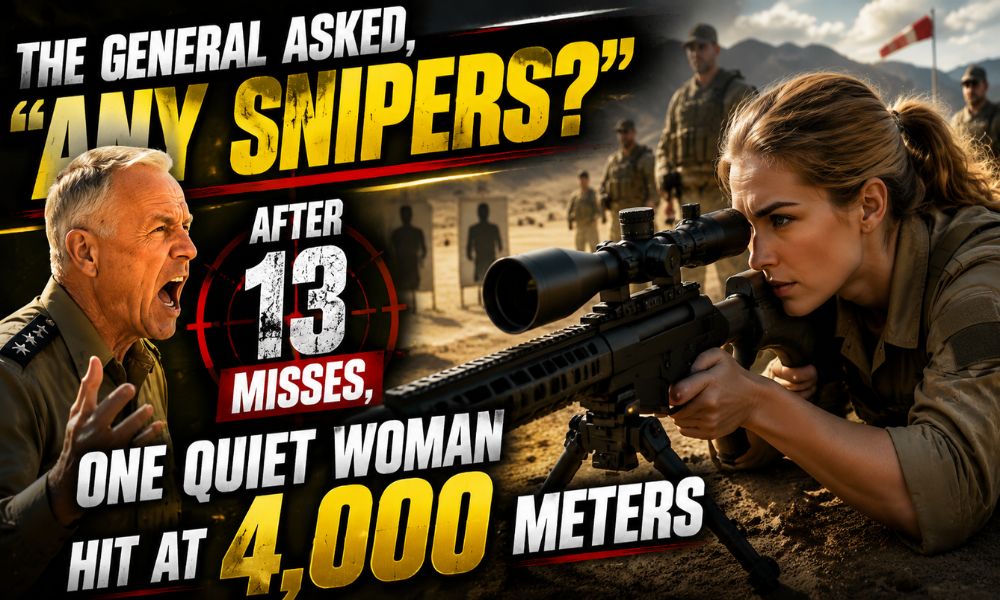
The General Asked, “Any Snipers?” — After 13 Misses, One Quiet Woman Hit at 4,000 Meters
The thirteenth bullet disappeared into the Arizona desert without touching the target.
Three seconds passed.
Then five.
No steel rang in the distance.
No red light flashed on the impact monitor.
Only the hot wind moved across the firing line, carrying dust over thirteen of the most accomplished military marksmen in the country.
General Marcus Carter lowered his binoculars.
The temperature had climbed past 110 degrees. Heat shimmered above the range, bending the horizon until the distant mountains seemed to float. Four thousand meters away, a white steel plate stood against the rocks, barely larger than a door when viewed through the most powerful optics on the line.
Captain Daniel Diaz remained behind the rifle, his jaw pressed tightly against the stock.
He had hit moving targets in Afghanistan.
He had received two commendations for combat marksmanship.
He had spent twenty minutes calculating wind, humidity, bullet drop, spin drift, air density, and the rotation of the earth.
He had still missed by more than eleven meters.
A technician checked the tracking screen again.
“Impact registered low right,” he said carefully. “Eleven-point-six meters.”
Nobody spoke.
Diaz stood, ripped off his shooting glove, and walked away from the rifle without looking at anyone.
General Carter turned toward the row of officers, instructors, technicians, and support personnel gathered behind the safety barrier.
Thirteen elite shooters had taken thirteen carefully prepared shots.
Thirteen had missed.
The general’s voice cut through the silence.
“Do we have any snipers left on this base?”
A few men shifted their weight.
Someone gave a nervous laugh.
Then, from behind the supply tent, a woman in a plain desert uniform stepped into the sunlight.
“I can take the shot, sir.”
The laughter stopped.
Her name was Emily Brooks.
Most people on the range knew her as the woman who signed equipment forms, corrected ammunition inventories, and made sure replacement parts arrived before training exercises.
A few of the younger soldiers had another name for her.
The coffee girl.
Emily had heard it more than once.
She had never corrected them.
That morning, like every morning, she had risen before the alarm.
At 4:12 a.m., she made black coffee in the small kitchen of her quarters and drank it standing beside the sink. At 4:25, she began a five-mile run along the perimeter road while the desert sky was still dark.
After the run came push-ups, pull-ups, and controlled breathing exercises.
Then she opened a long wooden case beneath her bed.
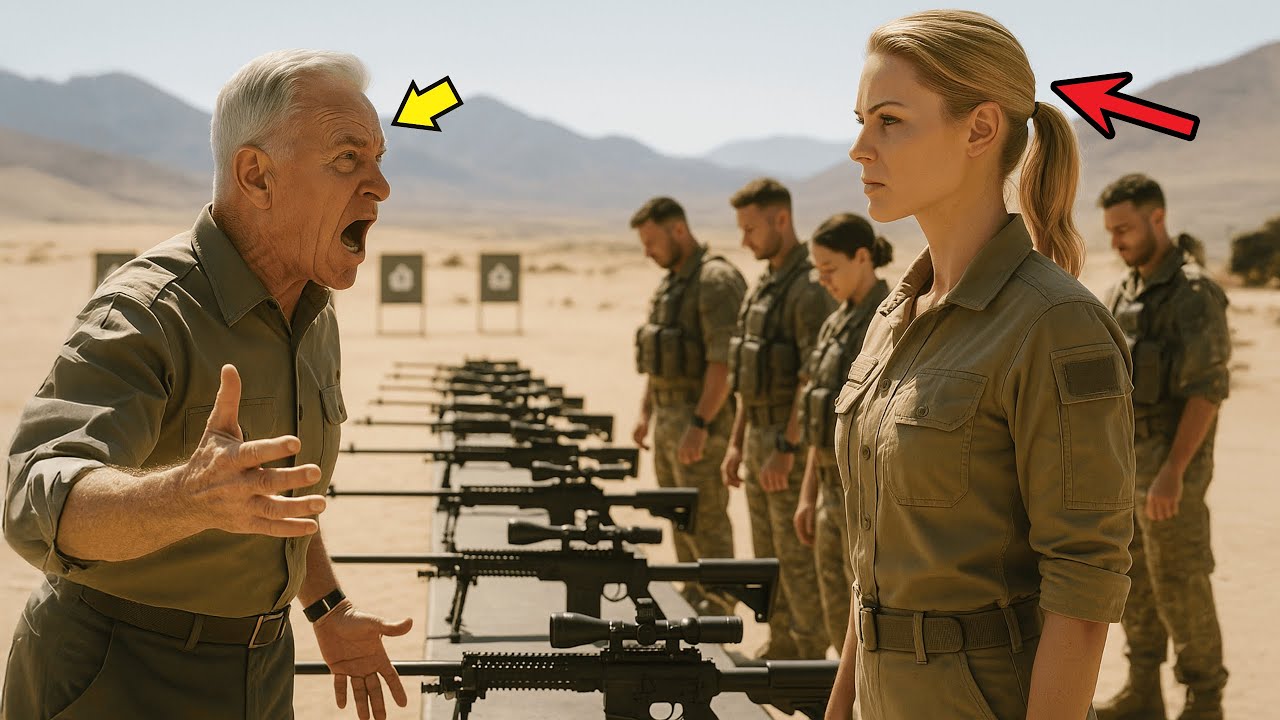
Inside was an old bolt-action rifle wrapped in oilcloth.
The weapon had not appeared on any active inventory sheet in years. Its barrel was worn smooth in places. The stock carried dents from helicopters, armored vehicles, rocks, and one hard landing Emily still remembered whenever the weather turned cold.
She disassembled it without thinking.
Bolt.
Spring.
Firing pin.
Extractor.
Each piece moved through her hands in the same sequence it had thousands of times before.
She cleaned the chamber, checked the crown, examined the scope mounts, and reassembled the rifle by touch.
Some habits remained long after a person stopped needing them.
By 6:10, the rifle was back inside its case.
By 6:30, Emily was seated behind a metal desk in the logistics building, reviewing a shipment discrepancy involving three pallets of specialized ammunition.
To anyone walking past, she looked ordinary.
Her uniform was clean but unremarkable.
There were no elite-unit patches on her shoulder.
No medals on display.
No stories told loudly enough for others to repeat.
She spoke softly, moved efficiently, and never took more space than she needed.
That made her almost invisible on a base filled with people trained to notice rank, ribbons, and reputation.
It also made her easy to underestimate.
At 7:15, two junior soldiers rolled a damaged ammunition cart into the warehouse.
Several wooden crates had broken open during transport. Boxes of different cartridges had spilled across the cart and floor.
Sergeant Tyler Parker looked at the mess and swore.
“We’re supposed to have this counted and sorted before the range opens.”
A young corporal leaned against the doorway.
“Ask the inventory princess,” he said. “This is her battlefield.”
Two soldiers laughed.
Emily set down her clipboard.
She picked up one cartridge, rolled it between her fingers, and placed it on the left side of the table.
Then another.
Then another.
Within seconds, her hands began moving faster.
She identified match-grade rounds by the shape of the projectile.
She separated lots by primer sealant, neck tension, case markings, and tiny variations in the brass.
She rejected six rounds because of hairline deformation near the shoulder.
She placed four others into a quarantine tray because their powder distribution felt wrong when she rotated them beside her ear.
Parker watched the growing rows.
“You can tell all that without checking the boxes?”
Emily did not look up.
“The boxes are wrong.”
Parker frowned.

She held up a cartridge.
“This one is labeled as Lot 7C. It isn’t. The primer seal is from 7A, and the bullet has a different bearing surface.”
The corporal in the doorway stopped smiling.
Emily examined the paperwork attached to the pallet.
“Someone switched the manifests.”
Parker stepped closer.
“Accident?”
“No.”
She turned over the top page.
A signature had been copied, but the downward stroke was too straight.
“The original inspection was completed yesterday at 18:40. This version was printed at 22:13.”
Parker stared at her.
“Why would anyone do that?”
Emily placed the last cartridge into the correct row.
“To make the shipment fail inspection this morning.”
The entire pile had taken her forty-three seconds to sort.
She wrote three serial numbers on a clean sheet of paper and handed it to Parker.
“Check the access log for these containers. Then compare warehouse camera footage between ten and eleven last night.”
Parker hesitated.
“You think someone is trying to make us look incompetent?”
Emily picked up her coffee.
“Not us.”
She walked back toward her desk.
The altered paperwork had been assigned under her name.
It was not the first time.
Requests had gone missing from shared folders. Delivery deadlines had been changed after approval. Equipment failures had been blamed on parts that Emily had never authorized.
None of the incidents had been serious enough to launch an investigation.
Together, however, they formed a pattern.
Someone wanted her to appear careless.
Someone wanted the quiet logistics officer to remain exactly where everyone believed she belonged: behind a desk, correcting mistakes other people made.
Emily had learned long ago that anger could reveal more than silence.
So she stayed silent.
At 10:00, she entered the range-planning meeting with a stack of supply reports under one arm.
The long-range test occupied the top line of the agenda.
Four thousand meters.
An experimental rifle platform.
New ammunition.
Unstable desert winds.
General Carter wanted to determine whether the system could be used for extreme-distance interdiction under battlefield conditions.
The official shooting roster included thirteen men.
Emily read every name.
She knew their qualifications.
She knew which ammunition lots they preferred, which optics they had requested, and which replacement barrels had been installed on their rifles.
Her own name was not on the list.
She had not expected it to be.
Still, she looked at the empty space beneath the thirteenth shooter.
Major Reeves noticed.
“This is restricted to personnel currently assigned to combat shooting billets,” he said.

Emily closed the folder.
“The range request mentioned qualified personnel.”
“It means active sniper-qualified personnel.”
“My certification is still valid.”
Several men looked up.
Staff Sergeant Rafael Lopez sat near the opposite end of the table. He had spent fourteen years in combat arms and enjoyed reminding support personnel that their work existed to serve his.
He leaned back in his chair.
“With respect, Lieutenant Brooks, inventory management and combat shooting are different skill sets.”
“I’m aware.”
“Then we understand each other.”
Emily met his eyes.
“Yes, Sergeant. I understand exactly what you mean.”
The room went still for half a second.
General Carter entered before Lopez could respond.
The meeting continued.
Emily said nothing else.
When it ended, Lopez waited for her in the hallway.
“You need to stay in your lane,” he said.
Emily stopped.
People passed around them carrying folders and coffee cups.
Lopez lowered his voice.
“This test is not a morale exercise. It’s not about giving everyone a chance. The people on that line have real combat time.”
“So do I.”
He gave a short laugh.
“Processing supply requests doesn’t count.”
Emily’s expression did not change.
Lopez stepped closer.
“You may know ammunition numbers, wind charts, and every specification in the manual. That doesn’t mean you have the instinct to pull a trigger when it matters.”
Emily glanced through the hallway window toward the desert.
“Pulling the trigger is the easiest part.”
Lopez’s smile faded.
She continued.
“The difficult part is knowing what will happen after you do.”
He folded his arms.
“You think you could make that shot?”
“I think shooting is mathematics.”
“That isn’t an answer.”
“If the range is open,” she said, “I’ll be there.”
She walked away before he could reply.
That evening, Emily returned to her quarters and locked the door.
She pulled the wooden case from beneath the bed, but this time she did not open the section containing the rifle.
Instead, she pressed a hidden catch beneath the handle.
A shallow compartment lifted from the base.
Inside lay a photograph of seven soldiers standing beside a helicopter.
Their faces were covered in dust.
One man had blood on his sleeve.
A younger Emily stood at the edge of the group wearing body armor, dark glasses, and a scarf around her neck.
On the back, someone had written:
Kandahar, 2016.
Silent Guardian.
Everyone came home.
Beneath the photograph rested a black fabric patch.
A green snake had been stitched around the number one.
Emily ran her thumb over the thread.
For ten years, she had kept the patch out of sight.
She had left the unit.
She had transferred into logistics.
She had declined interviews, commendation ceremonies, and every invitation to instruct advanced courses.
People assumed she had changed career paths because she lacked the ambition to remain operational.
The truth was simpler.
She had grown tired of knowing exactly how far a bullet could travel through a human body.
She returned the photograph to the compartment and closed the case.
The next morning, the four-thousand-meter test began.
By 8:00, the temperature was already climbing.
The range had been constructed across a wide stretch of desert north of the installation. The firing platform sat on a reinforced concrete pad beneath a fabric canopy. Sensors had been placed every five hundred meters to measure crosswind, temperature, and pressure.
The target stood more than two and a half miles away.
At that distance, the bullet would remain in flight for several seconds.
It would rise high above the line of sight, slow as it crossed through changing layers of air, and be pushed by winds moving in different directions along the route.
A calculation error measured in tenths could become a miss measured in meters.
Colonel Avery Chen studied the data screen beside General Carter.
“The wind is switching twice between here and the target,” she said. “Left to right at twelve hundred. Right to left at twenty-nine hundred.”
Carter nodded.
“And the heat?”
“Mirage is worsening every minute. This may not be a realistic test.”
“It is realistic somewhere.”
“It may be beyond the platform’s intended limit.”
“Then we learn that here,” Carter said, “before someone learns it while people are dying.”
The first shooter took his position.
He spent eighteen minutes preparing.
His bullet missed high.
The second corrected for the first shot and missed left.
The third waited for the wind to settle, then discovered the wind had not settled at all.
By the fifth attempt, the confident conversations behind the firing line had stopped.
By the eighth, shooters were blaming sensor inconsistency.
By the tenth, engineers were checking the rifle mounts and ammunition.
The equipment was functioning correctly.
The conditions were simply more complicated than the shooters’ models.
Each man understood one part of the problem.
None of them understood the entire environment.
Emily watched from beside the supply tent.
She had been asked to supervise ammunition distribution, a position far enough from the firing platform to remind her that she was not a participant.
She watched dust curl around a range marker.
She watched a strip of tape tied to a sensor pole three kilometers away.
She studied the distortion above a dark line of rocks.
The official instruments displayed numbers.
Emily saw movement.
She saw cold air sinking beside the ridge.
She saw heat rising from the pale sand.
She saw a narrow wind corridor forming between two terrain features that had not appeared significant on the planning map.
Captain Diaz took the thirteenth shot.
He had the strongest record on the line.
He had also spent the morning speaking loudly enough for everyone to hear him.
“This is not complicated,” he had said after the ninth miss. “People are overcorrecting because they’re afraid of the distance.”
He built his firing solution from the sensor data and ignored the shifting mirage above the ridge.
His shot missed by eleven-point-six meters.
The range fell silent.
General Carter lowered his binoculars.
“Do we have any snipers left on this base?”
Emily stepped forward.
“I can take the shot, sir.”
Every head turned.
Diaz looked at her, then at the supply tent behind her.
“You?”
“Yes.”
A few soldiers exchanged glances.
Someone whispered, “The coffee girl?”
Lopez stood near the safety barrier.
His expression tightened.
Diaz removed his shooting jacket.
“This is a controlled weapons test, Lieutenant.”
“I know.”
“You distribute the ammunition.”
“Yes.”
“You don’t shoot it.”
Emily looked at the rifle.
“Not recently.”
A few men laughed.
General Carter did not.
He studied her face as though searching for a memory he could not place.
“What are your qualifications, Lieutenant Brooks?”
“Advanced long-range certification. Mountain and urban sniper qualification. Joint terminal observation. Operational deployment experience.”
Lopez spoke before Carter could respond.
“Those records are old, sir.”
Emily looked at him.
“Math doesn’t expire.”
Diaz gave a sharp smile.
“Fine. Let her try.”
He gestured toward his rifle.
“She can use mine. Same rifle, same ammunition, same conditions. That way, when she misses, nobody can blame the equipment.”
The laughter returned, quieter this time.
Emily approached the firing platform.
She did not lie down behind the rifle.
First, she checked the bipod.
Then the stock.
Then the scope mount.
She opened the bolt, examined the chamber, and inspected the ammunition tray.
Diaz folded his arms.
“Looking for a problem?”
“No.”
“Then what are you doing?”
“Making sure there isn’t one.”
She removed a small alignment tool from her pocket and checked the optic.
Diaz raised an eyebrow.
Emily adjusted the rear support by two millimeters.
Then she looked through the scope, changed the parallax setting, and examined the reticle against a calibration board near the firing line.
“The rifle is sound,” she said.
Diaz smirked.
“Good.”
Emily looked at him.
“If I miss, it will not be the rifle’s fault.”
The smirk disappeared.
General Carter stepped closer.
“You get one round.”
“One is enough.”
That answer changed the atmosphere.
The amusement behind the line faded.
Emily placed a worn notebook beside the rifle.
Its pages were filled with columns of numbers, handwritten diagrams, environmental notes, and corrections gathered over years.
She did not begin with the computer data.
She looked toward the target.
For nearly a minute, she did not move.
Diaz shook his head.
“Is she waiting for the target to come closer?”
Nobody laughed.
Emily studied the air.
The wind at the firing line pushed gently against her right cheek.
At eight hundred meters, dust moved in the opposite direction.
At two thousand, heat distortion angled upward.
Beyond three thousand, the mirage flattened for less than a second at regular intervals.
She checked the temperature.
Then the barrel.
Then the ammunition.
She rolled one cartridge beneath her fingers and returned it to the tray.
She selected another.
General Carter noticed.
“Problem with the first round?”
“Velocity variation.”
“You can feel that?”
“I can feel the seating pressure.”
Diaz opened his mouth, then closed it.
Emily loaded the rifle.
She lay down and settled into position.
The weapon seemed to disappear beneath her.
Her shoulder found the stock without adjustment.
Her cheek met the same place on the comb as though she had used the rifle for years instead of minutes.
Her left hand rested near the rear support.
Her breathing slowed.
The people behind her became quiet enough to hear fabric moving in the wind.
Carter watched her through narrowed eyes.
Something about the position was familiar.
Not the standard doctrine taught in current courses.
Something older.
Something he had seen from a rooftop through the dust of Kandahar.
Emily turned one dial.
Then another.
She did not use the correction Diaz had entered.
She moved far past it.
Diaz stepped forward.
“That elevation is wrong.”
Emily did not look away from the optic.
“No.”
“You’re adding nearly two full minutes.”
“Yes.”
“You’ll miss high.”
“The round will lose more velocity in the third air layer.”
Diaz looked toward the environmental monitor.
“There is no third air layer.”
Emily’s finger remained outside the trigger guard.
“There is above the black ridge.”
Colonel Chen checked the long-range thermal feed.
Her face changed.
“She’s right.”
The monitor showed a thin band of rising heat invisible to the standard sensor array.
It crossed the bullet’s path for almost four hundred meters.
Emily waited.
Five seconds.
Ten.
Fifteen.
The wind flag nearest the target shifted.
She exhaled halfway.
The world narrowed to pressure, distance, angle, and time.
Her heartbeat slowed.
She knew the bullet would leave the barrel before the next full pulse.
She knew it would climb into thinner air, drift with the first crosswind, resist the second, and enter the thermal current above the ridge.
She knew the target would be hidden by mirage for most of the bullet’s flight.
She did not need to see it during the entire journey.
She only needed to know where it would be when the bullet arrived.
Her finger touched the trigger.
The rifle fired.
The recoil moved straight through her shoulder.
Dust lifted around the muzzle.
Then nothing.
One second.
Two.
Three.
The bullet traveled beyond what the human eye could follow.
Four seconds.
A sensor operator leaned toward the screen.
Five.
The white steel plate flashed.
A deep metallic sound arrived across the desert.
The impact monitor lit red.
CENTER HIT.
For several seconds, nobody reacted.
The words remained on the screen.
CENTER HIT.
Diaz stared at the target feed.
Lopez looked from the monitor to Emily and back again.
Someone behind the barrier whispered, “That’s impossible.”
Colonel Chen enlarged the image.
A dark mark had appeared less than five centimeters from the center of the plate.
Not an edge hit.
Not luck.
A near-perfect impact.
The range erupted.
Soldiers shouted.
Technicians left their stations.
Several shooters rushed toward the monitor as if distance from the screen had caused the mistake.
Emily remained behind the rifle.
She opened the bolt, removed the empty casing, and placed it on the mat.
Then she stood.
Diaz’s face had lost all color.
His mouth opened, but no words came.
He had expected embarrassment.
Instead, in front of his commander, his peers, and every person he had spent the morning trying to impress, the logistics officer had used his rifle and done what he could not.
Emily handed the weapon back to him.
“Your zero is good.”
Diaz accepted it automatically.
His eyes remained fixed on her.
The recognition was visible before he understood what he was recognizing.
Her calm.
Her position.
The worn notebook.
The way she had waited between heartbeats.
Behind him, the laughter that had followed Emily onto the range had vanished completely.
General Carter had not moved.
He stared at the hit marker.
Then at Emily.
“Where did you learn that wind call?”
“Over time, sir.”
“That isn’t an answer.”
“It’s the accurate one.”
Carter stepped closer.
“Have we met?”
Emily’s expression shifted almost imperceptibly.
“No, sir.”
“I know that shooting position.”
She said nothing.
“I know the way you build a solution. You ignored the nearest wind sensor and corrected from terrain movement. I saw someone do that in Kandahar.”
The crowd quieted again.
Carter’s voice lowered.
“Operation Silent Guardian.”
Emily looked toward the distant target.
The desert heat seemed to disappear from her face.
For the first time that morning, she looked tired.
Carter took another step.
“2016. Our convoy was pinned outside Marjah after the lead vehicle took a rocket. We had fire from three rooftops and a ridge position.”
No one behind them moved.
“We could not see our overwatch team,” Carter continued. “We never met them. We only heard the call sign.”
Emily closed the notebook.
Carter’s eyes widened.
“Viper One.”
A long silence crossed the firing line.
Emily finally looked at him.
“I was your overwatch, sir.”
The words landed harder than the rifle shot.
Carter’s face changed.
Ten years disappeared from his expression.
He was no longer standing on a controlled range in Arizona.
He was back beside a burning vehicle in Afghanistan, shouting into a radio while bullets struck the wall above his head.
His unit had been trapped for forty-seven minutes.
The enemy had occupied positions Carter’s men could not reach.
Then a calm voice had entered the radio channel.
“Viper One has visual.”
A rooftop gunner disappeared.
Then another.
Then the shooter on the ridge.
Eight hostile positions had been neutralized with eight shots.
A ninth shot disabled a truck before it could block the evacuation route.
Carter’s unit escaped with every wounded soldier alive.
He had searched for Viper One afterward.
He had been told the shooter belonged to a compartmented joint task group called Phantom Cell.
No names.
No photographs.
No ceremony.
Only a call sign spoken in units that had survived because of it.
Carter looked at Emily as though the person in front of him had stepped out of a story.
“You saved thirty-two people that day.”
Emily’s voice remained quiet.
“My team saved them.”
“You made the shots.”
“My spotter made the calls.”
Carter removed his cap.
Around him, the thirteen shooters stood motionless.
Captain Diaz looked down at the rifle in his hands.
He remembered offering it to her as a joke.
Lopez remembered telling her she lacked the instinct to pull a trigger.
The young corporal near the supply tent remembered calling her the coffee girl.
Every careless remark returned at once.
General Carter straightened.
Then he raised his hand and saluted.
The movement shocked the range more than the shot.
A general was saluting a logistics lieutenant in front of the entire test team.
Emily hesitated.
For one second, emotion pressed against the discipline in her face.
Then she returned the salute.
Colonel Chen began clapping.
One technician joined her.
Then another.
Within seconds, applause spread across the range.
It was not the loud, celebratory noise that had followed the impact.
This was different.
It carried apology.
Recognition.
And shame.
Emily lowered her hand.
She did not smile.
She gathered her notebook and walked back toward the supply tent.
The crowd parted for her.
Three days later, Lieutenant Parker found her in the warehouse.
Emily was examining a shipment of replacement bolts.
Nothing about her routine had changed.
She still arrived before everyone else.
She still drank black coffee.
She still corrected paperwork without announcing who had made the mistake.
But the base had changed around her.
People stopped talking when she entered rooms.
Young soldiers stood straighter.
Combat instructors asked her opinion before approving ammunition.
The nickname disappeared.
Parker waited until she finished the inspection.
“Lieutenant?”
Emily looked up.
He held his cap in both hands.
“I owe you an apology.”
“You sorted out the access logs?”
“Yes. We found the person who altered your manifests. The investigation is active.”
“Good.”
“That isn’t what I meant.”
Emily set down the inspection tool.
Parker took a breath.
“I heard people disrespect you. Sometimes I laughed. I thought you were just… someone who liked regulations.”
“I do like regulations.”
He almost smiled, then caught himself.
“I should have stopped them.”
“Yes.”
The direct answer surprised him.
Emily did not soften it.
Silence was useful, but it did not erase responsibility.
Parker nodded.
“I’m sorry.”
“I believe you.”
He glanced toward the warehouse door.
“How did you make that shot?”
“Which part?”
“All of it.”
Emily picked up one of the bolts and turned it beneath the light.
“There was no single part.”
“You saw something nobody else saw.”
“I looked longer.”
“You calculated something their computers missed.”
“I used information the computers were not collecting.”
“But four thousand meters…”
Emily placed the bolt into an approved tray.
“People want difficult skills to be magic. That protects their pride. If it’s magic, they don’t have to ask how many hours someone spent learning it.”
Parker listened.
“It was mathematics,” she said. “Wind reading. Ballistics. Repetition. Breath control. Understanding how the body moves when it is tired, afraid, cold, or rushed.”
“So you were born with it?”
“No.”
Her answer came immediately.
“I missed thousands of times where nobody could see me. Then I studied every miss.”
Parker looked toward the rifle range beyond the warehouse.
“Could you teach someone to do it?”
Emily paused.
Before she could answer, a messenger entered.
“General Carter wants to see you.”
Carter’s office overlooked the western training grounds.
When Emily arrived, her old file lay open across his desk.
Several pages were covered with black classification marks.
Others listed deployments, transfers, and awards that had never appeared in her public service record.
Carter stood beside the window.
“Phantom Cell,” he said. “Eight years.”
“Seven years, nine months.”
“Forty-six confirmed long-range engagements.”
Emily did not reply.
“Three hostage recoveries. Sixteen overwatch operations. Two missions that still do not officially exist.”
“Sir, why am I here?”
Carter turned from the window.
“Because your file says you requested reassignment after your spotter was killed.”
The room became still.
Emily’s eyes moved toward the desk.
“His name was Aaron Bell.”
“I know.”
“He had a wife and two daughters.”
“I know that too.”
“No, sir.” Her voice remained controlled, but the control had edges now. “You read it. That is not the same as knowing.”
Carter accepted the correction.
Emily looked out across the training grounds.
“Aaron made one bad call in eight years. One.”
“What happened?”
“He thought the wind had shifted. It had not.”
Carter waited.
“I trusted him,” Emily said. “I fired.”
Her hand closed slowly at her side.
“The target moved before impact. The round went through the wall behind him.”
She took a breath.
“There was a child in the room.”
Carter’s expression tightened.
“The report says the child survived.”
“She did.”
“Then why did you leave?”
“Because survival does not erase the sound a mother makes when a bullet enters a room.”
Neither of them spoke for several seconds.
Emily continued.
“Two weeks later, Aaron died during extraction. After that, every time I looked through a scope, I saw every person who had ever stood on the other side of it.”
Carter closed the file.
“So you transferred.”
“I was done killing people.”
“Yet you kept training.”
“I kept the discipline.”
“You kept the rifle.”
Her eyes moved to his.
Carter opened a drawer and removed a small black box.
He placed it on the desk.
Inside was a silver emblem shaped like a five-pointed star. Around its center curled a dark green snake.
Emily stared at it.
“We recovered this from a Phantom equipment case after the unit was dissolved,” Carter said. “It was never entered into the formal record.”
She did not touch it.
“I don’t want another medal.”
“It isn’t a medal.”
“Then what is it?”
“A debt.”
Carter pushed the box toward her.
“Thirty-two people came home from Kandahar because you were on a rooftop they could not see.”
Emily’s gaze remained on the emblem.
Carter continued.
“I spent ten years wishing I could thank the person behind that call sign. I will not miss the opportunity because you are uncomfortable receiving what you earned.”
Slowly, Emily picked up the emblem.
The metal was cool against her palm.
Carter returned to his chair.
“I also have a proposal.”
“I’m not returning to operations.”
“I’m not asking you to.”
He slid a folder across the desk.
PHANTOM MARKSMANSHIP PROGRAM.
TRAINING COMMAND PROPOSAL.
Emily did not open it.
“No.”
“You haven’t read it.”
“I know what it is.”
“You know what you think it is.”
“I will not train people to become better killers.”
Carter leaned forward.
“Then train them to become better decision-makers.”
She looked at him.
“The thirteen shooters on that range were not incompetent,” Carter said. “They were excellent within the limits of what they had been taught. They trusted screens more than terrain. They trusted reputation more than observation. And some of them believed confidence could replace humility.”
Emily remained silent.
“You know what the job costs,” he continued. “That is exactly why you should teach it.”
“Find someone else.”
“I did.”
He pointed toward the window.
“Thirteen of them.”
The answer stayed between them.
Carter opened the folder.
The proposal did not describe a new sniper unit.
It described a training program focused on judgment, environmental reading, restraint, and accountability.
Shooters would study not only how to make extreme-distance shots, but when not to take them.
Every trainee would review civilian-risk scenarios.
Every final qualification would include a decision in which the correct action was to keep the rifle silent.
Emily read the first page.
Then the second.
Carter waited.
Finally, she looked up.
“You wrote this after the range test?”
“I began it after Kandahar.”
That surprised her.
“I could never find Viper One,” he said. “So I built the program for the day I did.”
Emily closed the folder.
Outside, a training helicopter crossed the horizon.
“What authority would I have?”
“Full control over curriculum.”
“Selection?”
“Yours.”
“Ammunition standards?”
“Yours.”
“Final qualification?”
“Yours.”
“And if I say a shooter does not have the judgment?”
“They do not graduate.”
Carter sat back.
“Rank will not override you.”
Emily studied him.
“You will regret saying that.”
A small smile appeared on his face.
“I already regret giving you access to my supply budget.”
For the first time since entering the office, Emily smiled.
It lasted less than a second.
“I’ll consider it.”
“That is not a no.”
“No, sir.”
Two months later, the first class of the new Phantom Marksmanship Program assembled before sunrise.
Twenty-four candidates stood on the same Arizona range where thirteen elite shooters had missed.
Captain Diaz was among them.
So was Staff Sergeant Lopez.
Neither had been ordered to attend.
Diaz had submitted his application the morning after Emily’s shot.
Lopez had requested a demotion from instructor status so he could enter as a student.
Emily walked onto the range carrying a plain notebook.
The silver snake emblem was pinned beneath the collar of her uniform, almost hidden.
The candidates came to attention.
She looked across the group.
Some were decorated.
Some were young.
Some had reputations large enough to enter the room before them.
Emily did not ask about any of it.
She placed a rifle case on the table.
“Four thousand meters is not the hardest shot you will face,” she said.
The candidates waited.
“The hardest shot is the one you are capable of making but do not understand well enough to take.”
She looked toward the distant steel plate.
“You will learn mathematics here. You will learn wind, pressure, ammunition, body position, and external ballistics.”
Then she looked back at them.
“But if all you learn is how to hit a target, you will fail this course.”
Diaz stood in the front row.
There was no arrogance in his face now.
Only attention.
Emily opened her notebook.
“You will learn to observe before acting.”
She turned one page.
“To question your instruments.”
Another page.
“To challenge your assumptions.”
Then she looked directly at Lopez.
“And to never confuse someone’s assignment with the limit of their ability.”
Lopez lowered his eyes.
The recognition crossed his face again, but this time it was not humiliation.
It was acceptance.
Behind the candidates, General Carter watched from a distance.
He had expected Emily to demonstrate the impossible.
Instead, she began with the basics.
How to lie behind a rifle without fighting it.
How to feel wind against the skin.
How to watch dust, grass, heat, and shadow.
How to record every mistake.
During the first week, no candidate fired a shot beyond five hundred meters.
During the second, Emily removed the electronic wind sensors.
During the third, she gave them faulty data and waited to see who trusted observation enough to challenge it.
Diaz challenged it first.
Emily nodded once.
It was the only praise he received.
At the end of the sixth week, Parker visited the range to deliver ammunition reports.
He found twenty-four candidates lying in the dust, studying a target they had been ordered not to shoot.
“What are they waiting for?” he asked.
Emily checked her watch.
“To see who understands the exercise.”
Thirty minutes passed.
One candidate raised his hand.
“Ma’am, the shot is unsafe. There’s a reflective surface behind the target. We can’t confirm what lies beyond it.”
Emily closed her notebook.
“Correct.”
The candidate exhaled.
Several others looked frustrated.
They had spent half an hour calculating a shot they were never meant to take.
Emily faced the class.
“A rifle does not make you powerful.”
She pointed toward the untouched target.
“This does.”
Her finger moved from the target to her temple.
“The ability to understand consequences before everyone else sees them.”
By the end of the program, only nine candidates graduated.
Diaz was one of them.
Lopez was not.
He failed the final judgment exercise after taking a shot too quickly.
When Emily delivered the result, he stood silently for several seconds.
Months earlier, he might have argued.
Instead, he nodded.
“You were right,” he said.
“About what?”
“I still think pulling the trigger proves something.”
Emily closed his evaluation folder.
“Come back when it doesn’t.”
Six months later, he did.
He passed.
The four-thousand-meter target remained on the range.
Emily never shot it again.
She did not need to.
The mark from her bullet stayed near the center of the plate, dark against the white paint.
New soldiers often asked about it.
Instructors told them the story of thirteen elite marksmen who had missed under impossible conditions.
They told them about the quiet logistics officer who stepped out from behind a supply tent.
They told them how she checked the rifle, read the desert, and made a shot no one else believed could be made.
But General Carter always corrected one part of the story.
“The shot was not what made her extraordinary,” he would say.
“The extraordinary part was that she had already saved lives, carried the cost in silence, accepted disrespect without becoming cruel, and still chose to teach the people who had underestimated her.”
Years later, Emily stood at a graduation ceremony as a new class received the Phantom emblem.
Among the graduates was a young woman assigned to vehicle maintenance.
She had entered the program after an instructor noticed her correcting ballistic calculations during a convoy exercise.
Before joining the course, people had called her the grease girl.
Now she held the highest score in environmental analysis.
As the graduate stepped forward, Emily pinned the green snake emblem beneath her collar.
The young woman’s hands trembled.
“Ma’am,” she whispered, “people told me I didn’t belong here.”
Emily adjusted the pin.
“People often confuse where you are with who you are.”
The graduate looked up.
Emily stepped back and saluted her.
Across the range, General Carter watched the moment.
The applause began quietly.
Then it grew.
Not because someone had made an impossible shot.
Because an old pattern had finally been broken.
The military had once hidden Emily Brooks behind classified files, then overlooked her behind a logistics desk.
Her ability had never disappeared.
Only other people’s willingness to see it had.
And when the moment came to prove them wrong, she did not shout, boast, or demand respect.
She simply stepped forward, read the wind, and let one perfect shot expose every careless assumption on the range.
Never mistake a quiet person for an ordinary one—sometimes the person everyone ignores is the only one capable of hitting the target no one else can reach.