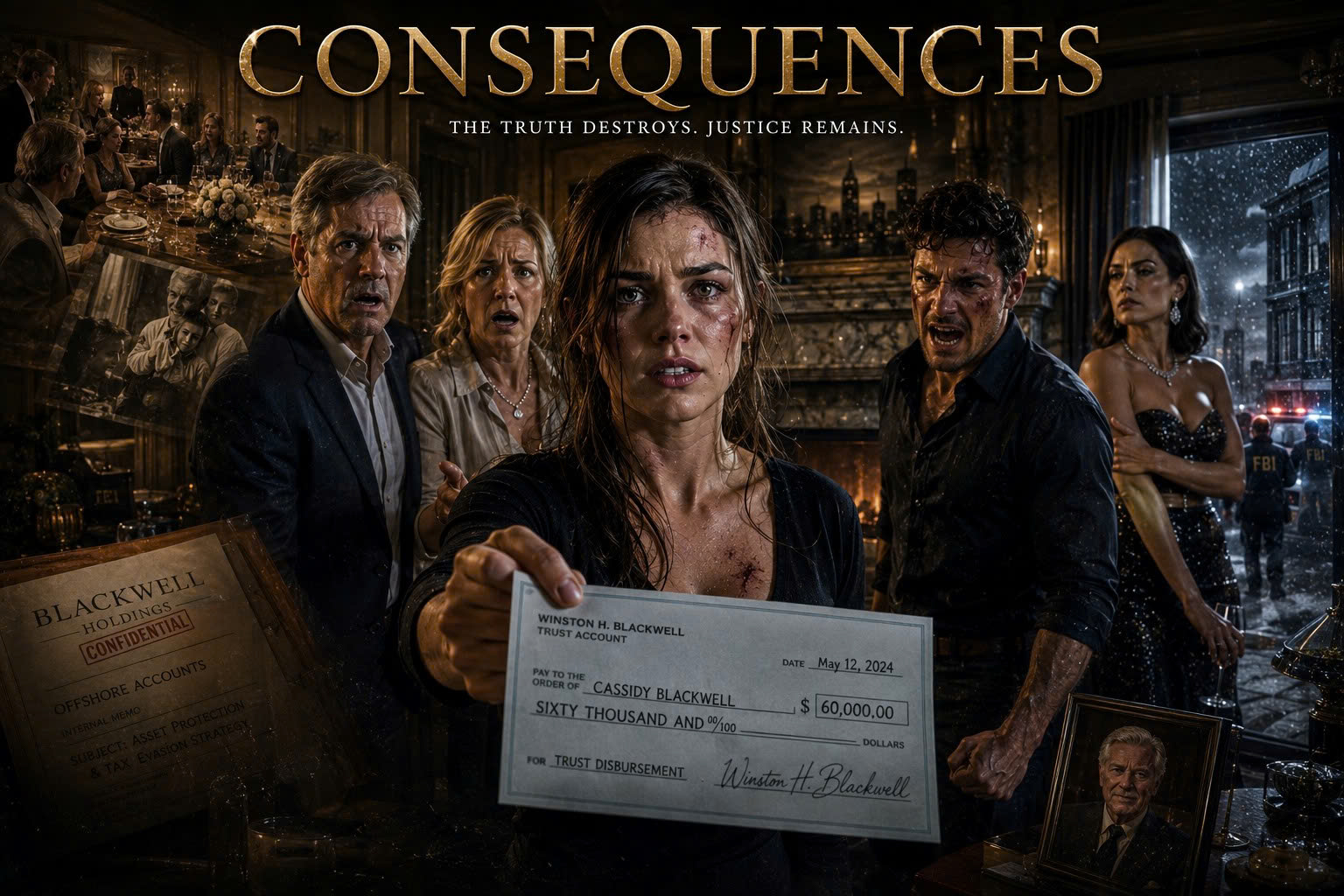
By the time Cassidy Morgan turned thirty-two, she had learned that wealthy families rarely screamed when they wanted to destroy someone.
They smiled.
They poured champagne.
They used words like responsibility, loyalty, and concern.
And then they quietly moved the money.
Her birthday dinner was held in her parents’ mansion in Lincoln Park, a limestone house with six bedrooms, two kitchens, a private garden, and enough polished marble to make every footstep sound like an announcement.
Outside, freezing rain coated the Chicago streets.
Inside, nearly sixty guests drifted beneath crystal chandeliers while a string quartet played beside the staircase. Men in tailored suits discussed markets and elections. Women wearing diamonds evaluated one another’s dresses. Caterers carried trays of champagne through rooms decorated with white roses and silver candles.
The party looked like a celebration.
To Cassidy, it felt like a performance arranged to remind her that she had failed to become the kind of daughter her family respected.
Her mother, Susan, had chosen the guest list.
Her father, David, had paid for the orchestra.
Her older brother, Trent, had invited several of his wealth-management clients.
His wife, Nia, had invited real-estate developers, socialites, and two lifestyle influencers who had spent most of the evening photographing the staircase.
Cassidy had not invited anyone.
Even the birthday cake had been chosen without asking her.
It was covered in gold frosting and topped with a miniature calculator.
“A little tribute to your accounting job,” Susan said when the cake arrived.
Nia laughed.
“Very on-brand.”
Cassidy smiled because she had spent her entire life learning how to survive insults disguised as affection.
She was not an ordinary accountant.
She was a forensic accountant who investigated hidden assets, corporate fraud, embezzlement, and financial misconduct. Her reports had helped destroy fraudulent companies, expose corrupt executives, and recover millions of dollars for clients.
Her family described her work as “checking numbers.”
Trent, on the other hand, called himself a wealth strategist.
He wore custom suits, drove a silver Porsche, and advised clients whose net worth he discussed loudly at dinner. He had no patience for details, but he had charm, confidence, and the ability to make wealthy people believe he understood things he had barely read about.
Their parents considered Trent successful.
They considered Cassidy difficult.
At nine twenty, Susan tapped a spoon against her glass.
“We should say a few words about the birthday girl.”
Cassidy stood beside the dining-room fireplace while the guests turned toward her.
Susan smiled.
“Cassidy has always been independent. Sometimes stubbornly independent.”
A few people laughed.
“She chose a very technical profession,” Susan continued. “Not glamorous, perhaps, but stable.”
More laughter.
Cassidy’s father raised his glass.
“To stability.”
Trent leaned toward one of his clients and whispered something that made the man grin.
Cassidy looked toward the far end of the room.
There was one person missing.
Her grandfather, Winston Morgan.
Winston was eighty-two and had built the family fortune through commercial property, manufacturing investments, and a rare talent for recognizing a bad deal before anyone else saw it.
For most of Cassidy’s childhood, he had been the sharpest person in every room.
Then, nine months earlier, the family announced that dementia had taken him quickly.
According to Trent, Winston no longer recognized people.
According to Susan, he became confused and aggressive.
According to David, a doctor recommended limiting visitors.
Winston had been moved into a dark study at the rear of the house, where a nurse supposedly cared for him.
Cassidy had seen him only twice since then.
Both visits had been interrupted by Trent.
That night, while the guests applauded another joke about her practical career, Cassidy quietly left the dining room.
The hallway leading to Winston’s study was empty.
She walked past the library and reached the locked door.
The key was still in the frame above it, exactly where the housekeeper had kept it for years.
Cassidy unlocked the door and stepped inside.
The study smelled of dust, old leather, and medicine.
Only one lamp was on.
Winston sat in a wheelchair beside the window wearing a dark robe. A blanket covered his knees. His head leaned slightly to one side.
“Grandpa?”
He did not respond.
Cassidy closed the door.
She crossed the room and knelt beside him.
“It’s me.”
His eyes moved toward the door.
Then his posture changed.
The weakness disappeared from his face.
His head straightened.
His gaze became focused, alert, and frighteningly intelligent.
“Lock it,” he whispered.
Cassidy stared.
“Grandpa?”
“Lock the door.”
She obeyed.
When she turned back, Winston was watching her with the same expression he had used years earlier while teaching her to read corporate balance sheets.
“You’re not confused,” she said.
“Not yet.”
“Everyone said—”
“I know what they said.”
He pulled the blanket aside and reached into the inner pocket of his robe.
“Come closer.”
Cassidy moved toward him.
Winston removed a folded check and placed it in her hand.
It was made out to Cassidy Morgan.
The amount was sixty thousand dollars.
Her mouth went dry.
“What is this?”
“A test.”
“For what?”
“For them.”
He pointed toward the ceiling, meaning the family and guests above them.
Cassidy examined the check automatically.
The payer was not Winston’s personal account.
It read:
APEX HOLDINGS LLC.
She had never heard of it.
The signature looked like Winston’s, but two short lines had been drawn beneath it.
“Tomorrow morning,” he said, “take this to the main branch downtown. Not the neighborhood branch. The main branch.”
“Why?”
“Ask for Thomas Mitchell.”
“The branch manager?”
“Yes.”
“What am I supposed to tell him?”
“Nothing at first. Give him the check.”
Cassidy looked again at the amount.
“Why sixty thousand?”
“Because it is large enough to frighten Trent but small enough to reveal exactly how afraid he is.”
Her eyes lifted.
“Trent controls this account?”
Winston’s jaw tightened.
“Trent believes he controls everything.”
A sound came from the hallway.
Winston’s entire body changed.
His eyes became vague. His mouth relaxed. His shoulders slumped.
The transformation was so complete that Cassidy stepped backward.
A shadow paused beneath the door.
Then the handle turned.
The door was locked.
Someone knocked.
“Cassidy?” Trent called. “Are you in there?”
Winston stared blankly at the wall.
Cassidy slipped the check into the inner pocket of her dress.
She unlocked the door.
Trent entered immediately and closed it behind him.
He was still wearing his dinner jacket, but the pleasant expression he used in public had disappeared.
“What are you doing in here?”
“Checking on Grandpa.”
“He needs rest.”
“He looks lonely.”
“He doesn’t know the difference.”
Cassidy glanced at Winston.
He was mumbling softly about a train station.
Trent watched her closely.
“What did he give you?”
“Nothing.”
“I saw his hand move.”
“He was reaching for the blanket.”
Trent stepped between Cassidy and the door.
“What is in your pocket?”
The speed of the question confirmed everything Winston had said.
Cassidy crossed her arms.
“Move.”
“Give it to me.”
“I don’t know what you’re talking about.”
Trent reached for her dress.
Cassidy slapped his hand away.
His expression hardened.
“You think your little fraud job makes you clever?”
“My fraud job?”
“You audit companies after real professionals build them.”
“Move away from the door.”
“Grandpa is legally incompetent. Anything he gave you belongs to his estate.”
“You said he doesn’t recognize anyone.”
“He doesn’t.”
“Then how did he know where to find something valuable?”
For half a second, Trent had no answer.
The door opened behind him.
Nia entered and closed it again.
She wore a white silk dress and carried a glass of champagne.
“What is taking so long?” she asked.
“Cassidy took something from Winston,” Trent said.
Nia looked at Cassidy’s pocket.
“Give it back.”
“You don’t even know what it is.”
“We know enough.”
Cassidy moved toward the door.
Nia blocked her.
“This is embarrassing,” she said. “Stealing from a confused old man at your own birthday party.”
“I haven’t stolen anything.”
“Then show us.”
“No.”
Trent grabbed Cassidy’s arm.
She twisted free.
“Do not touch me.”
His palm struck her face.
The sound cracked through the room.
Cassidy stumbled against the desk.
For one stunned moment, nobody moved.
Then Nia laughed quietly.
“You always bring out the worst in people.”
Cassidy pressed her fingers to her burning cheek.
Winston continued staring at the wall, but she saw his right hand tighten beneath the blanket.
Trent leaned toward her.
“Give me the check.”
Cassidy’s heartbeat slowed.
He knew exactly what Winston had given her.
“You said you didn’t know what it was.”
Trent realized his mistake.
Nia stepped closer.
“If you leave this room with property belonging to an incapacitated man, we will call the police.”
“And tell them what?”
“That you committed elder theft.”
“At my own birthday dinner?”
“We have sixty witnesses who saw you leave the party angry and come into this room alone.”
Trent smiled.
“People believe the family that looks stable.”
Cassidy looked at Winston.
His eyes remained unfocused.
But his message was clear.
Go.
She shoved Nia aside, opened the door, and stepped into the hallway.
Her mother stood near the staircase.
Susan’s smile vanished when she saw Cassidy’s face.
“What happened?”
“Ask your son.”
Trent emerged behind her.
“Cassidy is upset.”
“She assaulted me,” Nia said.
Cassidy stared at her.
Nia had not even been touched hard enough to spill her champagne.
Susan looked at Cassidy with immediate disappointment.
“Not tonight.”
“Your son hit me.”
“Lower your voice.”
“Did you hear what I said?”
“There are guests downstairs.”
That was Susan’s answer to everything.
There are guests.
People are watching.
Do not damage the family’s appearance.
Trent descended the first stair.
“She took a check from Grandpa.”
Susan’s face changed.
Only slightly.
But Cassidy noticed.
“So you knew about it,” Cassidy said.
“I know that your grandfather is vulnerable.”
“He is more aware than any of you want people to believe.”
Susan grabbed Cassidy’s wrist.
“Give the check to your brother.”
“No.”
“Cassidy, do not create a scandal.”
“You mean do not expose one.”
Her father appeared at the end of the hallway.
“What is going on?”
Trent answered quickly.
“She manipulated Winston into writing her a check.”
David’s expression hardened.
“How much?”
Cassidy said nothing.
Trent answered.
“Sixty thousand.”
David’s anger became fear.
There it was again.
Not outrage.
Fear.
Cassidy pulled free from her mother and ran.
She moved down the service stairs, crossed the kitchen, and reached the garage before anyone could stop her.
Her car was parked near the rear entrance.
She got inside and locked the doors.
Trent ran into the garage as the engine started.
He struck the driver’s window with both hands.
“Get out!”
Cassidy reversed.
He jumped aside.
“You take that check to a bank and I will destroy you!” he shouted.
She drove into the freezing rain.
For the first twenty minutes, Cassidy had no plan beyond getting away.
Then she remembered Winston’s instructions.
Main branch.
Downtown.
Thomas Mitchell.
It was after ten. The bank would not open until morning.
She could return to her apartment, but Trent knew the address. She could call the police, but the family had already prepared a story in which she was the thief.
So Cassidy drove to a twenty-four-hour parking garage two blocks from the bank.
She locked the doors, placed the check inside an envelope, and tucked it beneath her clothes.
Then she waited.
At 2:13 in the morning, Trent called.
At 2:16, Susan called.
At 2:20, David sent a message.
Come home before this becomes permanent.
At 3:02, Nia sent another.
You are making a mistake that will follow you forever.
Cassidy did not respond.
She opened her laptop and searched public business records.
Apex Holdings LLC had been created fourteen months earlier.
The registered address belonged to a virtual office.
The listed managing member was Trent Morgan.
Cassidy stared at the screen.
Winston had not written the check from an account Trent happened to manage.
He had written it from one of Trent’s companies.
At 8:55, Cassidy entered the bank.
The downtown branch occupied the first floor of a glass tower. Employees moved between polished desks. Digital boards displayed market news and investment products.
Cassidy approached reception.
“I need to speak with Thomas Mitchell.”
“Do you have an appointment?”
“No. Tell him Winston Morgan sent me.”
The receptionist’s expression changed.
She made a call.
Two minutes later, a silver-haired man in a navy suit appeared.
“Cassidy Morgan?”
“Yes.”
“I’m Thomas Mitchell.”
She removed the envelope.
“My grandfather told me to give you this.”
Mitchell opened it.
The color disappeared from his face.
He stared at Winston’s signature.
Then at the two lines beneath it.
“Where is your grandfather?”
“At my parents’ house.”
“Is he safe?”
“I don’t know.”
Mitchell looked toward the lobby.
“Come with me.”
Inside his office, he locked the door and lowered the blinds.
Cassidy remained standing.
“What does the signature mean?”
Mitchell placed the check carefully on his desk.
“Your grandfather created an emergency protocol eighteen months ago.”
“Why?”
“He became concerned about unusual activity involving accounts linked to your brother.”
“Did he report it?”
“He lacked complete evidence. Trent had obtained power of attorney documentation, and your family supported his authority.”
“The dementia diagnosis?”
Mitchell hesitated.
“I have never seen a medical report.”
Cassidy sat down.
“What is Apex Holdings?”
“A shell company.”
“Owned by Trent.”
“Yes.”
“Why would Grandpa have a check from it?”
“Because he wanted to prove that Trent had diverted funds from accounts belonging to him.”
Mitchell opened a secure banking system.
“Those two lines beneath the signature were a distress signal. Winston told me that if someone brought a check marked this way, I should assume he was being controlled or financially exploited.”
Cassidy felt cold despite the heat inside the office.
“Why me?”
“He said the messenger would be someone he trusted to understand the records.”
Mitchell entered several account numbers.
A list of transfers appeared.
Apex Holdings.
Summit Ventures.
Pinnacle Financial.
Crestview Holdings.
Zenith Strategies.
The names meant nothing and therefore looked exactly like names chosen to mean something.
Mitchell opened another screen.
Dozens of withdrawals appeared in amounts between eight thousand and nine thousand nine hundred dollars.
Cassidy leaned closer.
“Structuring.”
Mitchell nodded.
“Below common reporting thresholds.”
“How much?”
“From the accounts we can see directly, nearly two million dollars.”
Her breath caught.
“Out of what?”
“Winston’s retirement and investment portfolio originally held a little over four million in liquid and near-liquid assets.”
“Half of it is gone?”
“Potentially more.”
Mitchell displayed outgoing wires.
Several led to domestic companies.
Others led to intermediary accounts connected to the Cayman Islands.
Cassidy examined the dates.
“This has been happening for over a year.”
“Your brother used the power of attorney to authorize transfers.”
“Was it valid?”
“That is one of the questions federal investigators will need to answer.”
“You haven’t called them?”
“Winston asked me to wait for the distress signal.”
“You knew he was in danger and waited?”
Mitchell’s face tightened.
“I filed internal reports. But banks cannot seize control of someone’s life based on suspicion alone, especially when family members present legal authority and claim mental incapacity.”
Cassidy looked at the check.
“Now what?”
“Now we contact law enforcement.”
A noise rose outside the office.
Voices.
One of them belonged to Trent.
“Cassidy!”
Mitchell stood.
The door opened before he could reach it.
Trent entered with Susan and David behind him.
A security officer followed, uncertain whether he was dealing with a private family dispute or a criminal incident.
“There she is,” Trent said. “She stole a check from a vulnerable senior citizen.”
Several customers turned.
Susan placed one hand over her heart.
“Cassidy, please. We are trying to help you.”
The performance had begun.
David faced Mitchell.
“My father-in-law has advanced dementia. Our daughter manipulated him during a confused episode.”
Mitchell looked toward Cassidy.
Trent pointed at the check.
“That belongs to the estate.”
Cassidy stood.
“No. It belongs to a company you created.”
A flicker of panic crossed his face.
Then it vanished.
“You do not understand the structure.”
“I understand structuring.”
Trent laughed loudly.
“She uses financial vocabulary to intimidate people.”
Cassidy stepped closer.
“If this is an ordinary, legitimate check, why did you chase me into the garage?”
“I was afraid you would exploit Grandpa.”
“Why did you know the amount before I showed it to anyone?”
Susan interrupted.
“Cassidy has always been jealous of Trent.”
The words were meant for the room, not for Cassidy.
“He built a real career,” she continued. “She investigates other people because she has never built anything herself.”
David nodded sadly.
“She has emotional issues.”
The security officer looked at Cassidy differently.
That was how a family destroyed someone.
Not with one accusation.
With a coordinated tone of concern.
Trent turned toward Mitchell.
“As Winston’s financial representative, I am instructing you to return the check.”
Mitchell hesitated.
Cassidy saw the pressure working.
Trent had status, paperwork, confidence, and parents supporting his story.
She had a swollen cheek and a check taken from a man officially described as incompetent.
“Mr. Mitchell,” Cassidy said, “if you hand evidence of potential money laundering to the person who controls the shell company named on that evidence, you may be interfering with a federal investigation.”
The room went quiet.
Mitchell’s expression sharpened.
Trent stepped toward her.
“You have no investigation.”
“Not yet.”
Nia entered the bank at that moment carrying a leather folder.
She walked directly toward Cassidy.
“You forgot these.”
She removed two documents.
One was a nondisclosure agreement.
The other was a waiver surrendering Cassidy’s rights to any future inheritance from Winston.
“Sign them,” Nia said.
Cassidy almost smiled.
“In a bank lobby?”
“You stole money. We are offering to resolve this privately.”
Trent lowered his voice.
“If you refuse, I will file a police report for elder abuse and assault.”
“Assault?”
“You struck Nia.”
Nia looked calmly at the security officer.
“She became violent.”
Cassidy examined the documents.
The NDA prohibited her from discussing Winston’s finances, medical condition, business interests, or any alleged misconduct by family members.
The inheritance waiver included language releasing Trent, Nia, Susan, and David from all claims.
It was not a family agreement.
It was a confession written backward.
Cassidy tore both documents in half.
Then again.
Pieces fell onto the marble floor.
Susan gasped.
“You have no idea what you just threw away.”
Cassidy looked at her mother.
“I threw away your permission to silence me.”
She turned to Mitchell.
“Give me the check.”
After a long pause, he placed it in her hand.
Trent moved forward.
Security stepped between them.
Cassidy left the bank.
She expected police to stop her outside.
None did.
She drove to her apartment and locked the door.
Then she turned her living room into an investigation center.
She connected her laptop to two external monitors and entered the routing number, account number, entity name, and registered-agent information from the check.
Apex Holdings led to Summit Ventures.
Summit led to Pinnacle Financial.
Pinnacle transferred funds into Crestview Holdings.
Crestview sent money through Zenith Strategies.
Each company had been created within eighteen months.
Each used an address linked to Trent, Nia, or one of their associates.
The transfers formed a ladder.
Money left Winston’s accounts in small increments, moved through shell companies, and then reappeared in investment accounts, luxury purchases, and real-estate escrow.
Cassidy traced payments to the Porsche.
Country-club dues.
Custom suits.
Private dinners.
A yacht rental in Miami.
Then she found the larger transfers.
Vanguard Prestige Realty.
Nia’s brokerage.
Cassidy searched county property records.
A downtown penthouse had been purchased in cash.
Buyer: Nia Morgan.
A beachfront estate in Florida had been purchased through an escrow account.
Final owner: Nia Morgan.
A commercial building in the arts district had been acquired without financing.
Owner: Nia Morgan.
Not Trent.
Nia.
Cassidy leaned back.
That changed the architecture of the crime.
Trent was not simply stealing to live extravagantly.
He and Nia were converting stolen funds into property, placing the assets in her name, and preparing for the possibility that his accounts would be examined.
Nia had mocked Cassidy’s career because she understood exactly how dangerous Cassidy’s skills were.
By late afternoon, Cassidy had constructed a complete forensic timeline.
She printed the corporate filings, transfer records, property deeds, escrow links, offshore routes, and withdrawal patterns.
She placed everything inside a red binder.
At 5:42, Trent sent a message.
Family meeting. Eight o’clock. Mom and Dad’s house. Bring the check. Last chance.
Cassidy read it twice.
Then she called Richard Gallagher.
Gallagher had served as Winston’s estate attorney for more than twenty years.
He answered on the second ring.
“Cassidy?”
“My grandfather gave me the signal.”
Silence.
Then Gallagher said, “Where are you?”
“My apartment.”
“Are you safe?”
“For now.”
“Tell me everything.”
Cassidy gave him the facts in order.
Apex Holdings.
Nearly two million dollars diverted.
Withdrawals under ten thousand.
Five shell companies.
Cayman transfers.
Nia’s real-estate purchases.
The family meeting.
Gallagher did not interrupt.
When she finished, he said, “Do not sign anything.”
“I already refused.”
“Do not surrender the check.”
“I won’t.”
“Do not confront them alone.”
“I have to attend.”
“No.”
“If I don’t, they may move Winston.”
Gallagher became quiet.
“They believe I am coming because I am scared,” Cassidy continued. “They will keep everyone in one place. They will talk.”
“Can you keep them there?”
“Yes.”
“I will contact the FBI and IRS Criminal Investigation.”
“How quickly can they move?”
“With the distress protocol, bank records, the check, and your forensic report, quickly enough to freeze assets. Arrests require more.”
“They threatened me at the bank in front of witnesses.”
“That helps.”
“They also prepared an NDA releasing themselves from liability.”
“That helps even more.”
Cassidy looked at the red binder.
“I’m going into the house.”
Gallagher exhaled.
“Then keep your phone recording.”
At 7:56, Cassidy parked outside her parents’ mansion.
The birthday decorations had been removed.
The house looked darker than the night before.
She entered carrying the binder beneath one arm.
Everyone was waiting in the living room.
Susan sat upright beside David.
Nia rested one hand on the arm of a white sofa.
Trent stood near the fireplace.
Winston sat in his wheelchair in the corner, his head bowed.
“There she is,” Trent said.
Cassidy placed her coat on a chair.
“Where is the nurse?”
“Grandpa doesn’t need an audience,” Susan replied.
Cassidy looked at Winston.
He did not react.
Trent extended his hand.
“The check.”
“No.”
Nia sighed.
“Still performing.”
David pointed to a chair.
“Sit down.”
Cassidy remained standing.
Susan spoke in the patient tone she used when pretending Cassidy was unstable.
“We have decided that your behavior has made it impossible for you to remain part of the family’s financial future.”
“You mean the inheritance.”
“You are being removed from Winston’s will.”
Cassidy looked toward her grandfather.
He began humming softly.
Trent smiled.
“You see? He doesn’t even understand what we are discussing.”
Cassidy placed the red binder on the table.
The sound echoed through the room.
“What is that?” Nia asked.
Cassidy opened it.
“Apex Holdings LLC.”
Trent’s smile disappeared.
She turned the first page toward him.
“Created fourteen months ago. Sole managing member: Trent Morgan.”
“That is a legitimate investment company.”
“Then Summit Ventures received funds from it.”
She turned another page.
“Pinnacle Financial received funds from Summit.”
Another page.
“Crestview Holdings received funds from Pinnacle.”
Another.
“Zenith Strategies sent money offshore.”
David stood.
“Where did you get this?”
“Public filings, transaction references, property records, and legal financial-analysis tools.”
“You hacked your brother,” Susan said.
“No. He was careless.”
Trent approached the table.
“You do not understand the purpose of those entities.”
“I understand that you withdrew amounts between eight thousand and ninety-nine hundred dollars to avoid scrutiny.”
“That is not illegal by itself.”
“Repeated structuring to conceal theft is.”
Nia crossed her legs.
“You have no proof the money belonged to Winston.”
Cassidy opened the bank timeline.
“Nearly two point one million dollars originated from accounts tied to his retirement and investment portfolio.”
The room became still.
She turned toward Nia.
“Vanguard Prestige Realty received several transfers.”
Nia’s eyes narrowed.
“A downtown penthouse purchased in cash.”
Cassidy placed the deed on the table.
“A beachfront estate.”
Another deed.
“A commercial building in the arts district.”
Another.
“All titled in your name.”
Trent looked at his wife.
For the first time, he appeared surprised.
Cassidy noticed.
“You didn’t know every property was in her name,” she said.
“Shut up.”
Nia’s face hardened.
Cassidy continued.
“If the government proves money laundering, those properties can be seized.”
Susan grabbed one of the pages.
“This is fake.”
“The county recorder’s office will be disappointed to hear that.”
David pointed at Cassidy.
“This is cyberterrorism.”
“It is accounting.”
Trent lunged for the binder.
Cassidy pulled it away.
He grabbed her shoulder.
A knock sounded at the front door.
Nobody moved.
The knock came again.
Harder.
Gallagher entered with two federal agents and three investigators wearing jackets marked IRS CRIMINAL INVESTIGATION.
Behind them stood Thomas Mitchell.
Trent released Cassidy.
“What is this?”
Gallagher held up a document.
“An emergency asset-freeze order.”
Nia stood so quickly that her glass fell from the table.
Gallagher continued.
“Domestic accounts connected to Apex Holdings, Summit Ventures, Pinnacle Financial, Crestview Holdings, and Zenith Strategies have been frozen.”
Nia’s face lost all color.
“Escrow accounts connected to Vanguard Prestige Realty have also been restricted pending investigation.”
“You can’t do that,” she whispered.
“We already did.”
Trent looked toward the back hallway.
An agent moved between him and the exit.
Gallagher picked up the check.
“Winston created this signal because he suspected financial abuse. The marked signature instructed the bank to contact counsel and law enforcement.”
Trent pointed toward the wheelchair.
“He has dementia! He cannot authorize anything!”
Winston stopped humming.
His hands moved to the arms of the chair.
Then he stood.
Susan screamed.
David stepped backward.
Winston straightened slowly, but without confusion.
He looked at Trent.
“You have always mistaken age for weakness.”
Trent’s mouth opened.
No sound came out.
Winston walked to the table.
He was not perfectly steady, but he did not need assistance.
“You were pretending,” Susan whispered.
“So were all of you.”
Winston looked at Cassidy.
“I needed one person who would not accept the story she was given.”
Cassidy stared at him.
“You let them think you were helpless.”
“I knew Trent was taking money. I knew your parents would defend him. But suspicion was not enough. I needed him to expose the system.”
Trent pointed at Cassidy.
“She stole records!”
Winston ignored him.
“I chose Cassidy because she understands what numbers reveal when people lie.”
Susan began to cry.
“Daddy, we were trying to protect you.”
“You isolated me.”
“We believed Trent.”
“You believed the person who funded the life you wanted.”
David gripped the back of a chair.
“We did not know about the offshore accounts.”
“No,” Winston said. “You only signed loans using property connected to his companies.”
David went pale.
“What loans?”
Gallagher opened another file.
“Your home was pledged as collateral for obligations associated with Crestview Holdings.”
Susan turned to her husband.
“You said those were refinancing documents.”
David looked at Trent.
“You told me there was no risk.”
Trent backed away.
“Everyone benefited.”
The words hung in the room.
It was not a denial.
An agent stepped forward.
“Trent Morgan, you are being detained pending federal charges related to wire fraud, financial exploitation, money laundering, and conspiracy.”
Trent tried to move around him.
The agent caught his arm.
Nia ran toward the hallway.
An IRS investigator blocked her.
“This is ridiculous,” she said. “Those properties are mine.”
“That is the issue,” Cassidy replied.
Nia looked at her with pure hatred.
“You think this makes you important?”
Cassidy closed the binder.
“No. It makes you traceable.”
The agents secured Trent’s wrists.
Nia began shouting about attorneys and privileged documents.
Susan clung to Winston’s sleeve.
“You cannot let them take our house.”
Winston removed her hand.
“You were willing to let them take my entire life.”
Susan turned to Cassidy.
“You can fix this.”
Cassidy almost laughed.
For years, her mother had treated her profession as an embarrassment.
Now she wanted the glorified calculator to save the mansion.
“You said I had never built anything,” Cassidy replied.
“I was angry.”
“You said I was jealous of Trent.”
“We made mistakes.”
“You told a bank full of strangers that I was emotionally unstable.”
Susan’s voice broke.
“We are still your parents.”
Cassidy looked around the room.
At the expensive furniture.
The family portraits.
The staircase where guests had applauded jokes at her expense.
At the wheelchair Winston had used to survive inside his own family.
“Parents protect their children,” she said. “You protected your lifestyle.”
David stepped forward.
“What happens to us now?”
Gallagher answered.
“The government will determine which assets were purchased, pledged, or maintained using criminal proceeds. Creditors will determine the rest.”
“You mean foreclosure?”
“It is possible.”
Susan covered her mouth.
Trent struggled against the handcuffs.
“Cassidy! Tell them I did not hurt Winston.”
She looked at the bruise forming on her arm where he had grabbed her.
“You stole half his retirement.”
“I was investing it.”
“In your car?”
“In properties!”
“Nia’s properties.”
Trent turned toward his wife.
Nia looked away.
That small movement told him everything.
Even inside their conspiracy, they had been planning separate betrayals.
The agents led them toward the door.
As Trent passed Cassidy, he whispered, “You destroyed this family.”
Cassidy looked at him.
“No. I audited it.”
Six months later, Trent and Nia remained in federal custody after bail was denied.
Investigators uncovered additional accounts, false collateral documents, forged authorizations, and communications proving that both had planned to move more of Winston’s assets overseas.
The properties in Nia’s name were seized.
The Porsche was sold.
The country-club membership disappeared.
The offshore accounts were frozen.
The government began distributing recovered funds toward Winston’s losses and other obligations connected to the fraud.
David and Susan lost the mansion.
A bank claimed the property after the fraudulent loans and collateral agreements collapsed. The couple moved into a small two-bedroom apartment in a neighborhood Susan had once described as unsuitable.
Most of their friends vanished.
Invitations stopped.
People who had praised Trent’s financial genius suddenly claimed they had always distrusted him.
Cassidy did not attend the hearings unless her testimony was required.
She did not return her mother’s calls.
She did not read David’s long emails explaining that parents sometimes made the wrong choice for the right reasons.
She had spent too many years accepting edited versions of harm.
Winston recovered faster once he was no longer living under surveillance.
He moved into an assisted-living residence of his own choosing, where the windows faced Lake Michigan and nobody controlled his phone.
With his investment, Cassidy opened Morgan Forensic Advisory.
Her firm specialized in elder financial exploitation, hidden-asset investigations, estate fraud, and complex family-business disputes.
Within four months, she had more cases than she could personally handle.
One morning, Winston sat in her new office while snow drifted beyond the windows.
A framed copy of the sixty-thousand-dollar check hung on the wall.
Cassidy entered carrying coffee.
“You kept it,” he said.
“The bank returned it after the investigation.”
“Did you deposit it?”
“No.”
“Why not?”
“It was never really a gift.”
Winston smiled.
“It was absolutely a gift.”
“It was bait.”
“It was both.”
Cassidy handed him a cup.
“You could have warned me.”
“If I had told you everything, your reaction would have looked rehearsed.”
“So you let Trent hit me?”
Winston’s smile disappeared.
“No. I will regret that for the rest of my life.”
Cassidy sat across from him.
For a moment, neither spoke.
Then Winston looked toward the framed check.
“I knew Trent was greedy,” he said. “I did not understand how many people would help him remain greedy.”
“People rarely protect wrongdoing because they love the person doing it.”
“Why, then?”
“Because they benefit from not seeing it.”
Winston nodded slowly.
“That sounds expensive.”
“It usually is.”
Her assistant knocked and entered.
“The new client is here.”
Cassidy stood.
“Which case?”
“The widow whose son obtained power of attorney and began transferring money into consulting companies.”
Winston raised one eyebrow.
“Another Trent?”
“They are never exactly the same.”
“But the numbers are?”
“The numbers do not care who is lying.”
Cassidy walked toward the conference room.
A nervous woman in her seventies sat beside her daughter. A folder of bank statements rested between them.
The daughter stood.
“We were told you help families understand unusual transactions.”
Cassidy looked through the glass wall toward Winston.
He lifted his coffee cup.
She turned back to the clients.
“Yes,” she said. “But first, I help people understand that confusion is sometimes something others create around them.”
The older woman’s eyes filled with tears.
“My son says I cannot manage my own money.”
“Do you believe him?”
“I did.”
Cassidy sat down and opened the folder.
“Let’s see what the records believe.”
Outside, Chicago moved beneath a gray winter sky.
Six months earlier, Cassidy’s family had laughed at her career.
They had called her poor.
Jealous.
Unstable.
A glorified calculator.
They believed wealth made them untouchable and appearance made them credible.
They believed Winston’s age made him powerless.
They believed Cassidy’s silence meant submission.
But numbers had no loyalty to charming sons, elegant wives, frightened parents, or expensive houses.
Money left tracks.
Greed repeated patterns.
Lies created structures.
And eventually, every false empire produced its own audit trail.
Cassidy had not defeated her family by shouting louder than they did.
She had watched.
She had followed the transfers.
She had opened the companies they believed nobody would examine.
She had traced luxury back to theft and property back to fear.
Her family had treated her like the least important person in the room.
That was why they never noticed when she became the most dangerous.
Not because she wanted revenge.
Because she knew where to look.
And because, when Winston handed her a sixty-thousand-dollar check on her birthday, Cassidy finally understood the truth her family had spent years trying to hide:
The person they underestimated was the only one capable of counting everything they had stolen.