The first laugh came from behind the glass wall of the range office.
It was sharp, young, and loud enough to carry across the concrete apron.
The old man heard it.
He did not turn.
He stood beside a faded silver pickup with one hand resting on the open tailgate, the other wrapped around a hard rifle case the color of construction equipment. Morning wind pushed dust in thin gray ribbons across the firing line. Range flags snapped toward the eastern ridge. Somewhere beyond the berms, steel targets rang at uneven intervals.
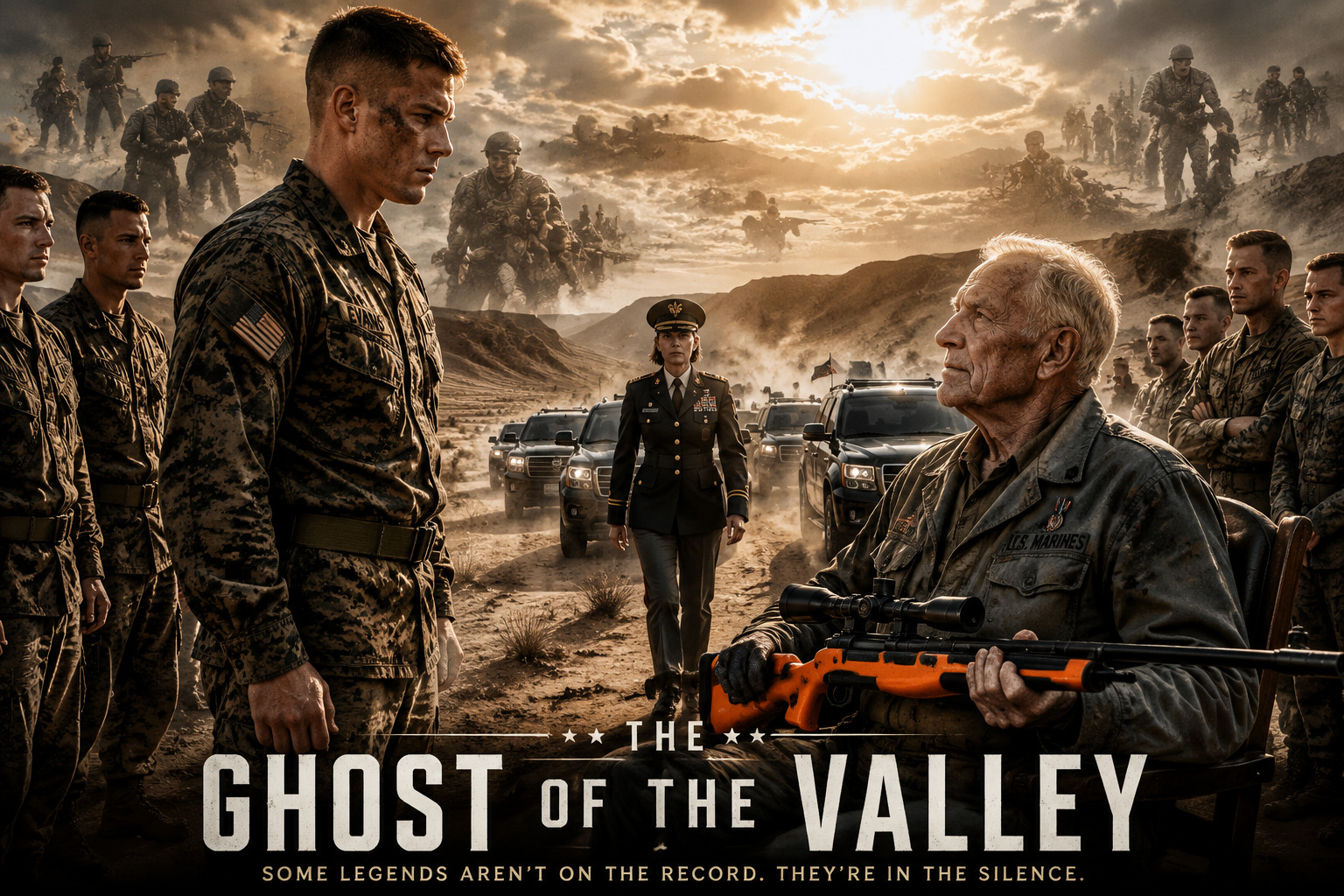
Inside the case lay a rifle painted bright orange.
Not hunter orange.
Not safety orange.
Something brighter.
Something almost ridiculous.
Staff Sergeant Connor Vale stepped through the office door with three Marines behind him, all wearing range uniforms, wraparound eye protection, and the loose confidence of men who had spent the morning outshooting everyone else.
Vale was thirty-one, broad through the shoulders, clean-shaven, and built with the efficient hardness of someone who treated physical discomfort as a personal insult. A scar crossed the bridge of his nose from a training accident he never discussed. He wore his service pistol high and tight on his belt, though regulations did not require it that morning.
His men followed his gaze toward the orange rifle.
Corporal Mason Pike grinned first.
“Sir,” Pike said, low enough to pretend it was private, “I think somebody brought a Nerf gun to the thousand-yard line.”
The others laughed.
The old man closed the case.
He was seventy-two, though the wind and sun made him look older. His name was Elias Voss. Gray hair curled from beneath a faded green cap with no unit patch, no rank, and no slogan. He wore a tan work shirt buttoned to the throat despite the heat, blue jeans worn white at the knees, and boots polished by use rather than care.
There was nothing impressive about him at first glance.
That was the mistake.
Vale walked closer.
“This is a restricted military range,” he said.
Elias checked the brass latch on the rifle case.
“I know.”
Vale waited.
The old man offered nothing else.
Behind them, the firing line stretched across a shelf of high desert under a white Nevada sky. Concrete bays stood in a long row, each marked with black numbers. Beyond the near berms, the land emptied into distances that distorted the eye. Heat already shimmered over the dry flats. Mountain shadows rested twenty miles away like smoke.
This was Calder Long Range Complex, where Marines and allied marksmen tested equipment, tactics, and pride.
Elias had arrived at 0610 in a pickup with a cracked windshield.
He had parked in a space reserved for civilian contractors.
That had been the second mistake people thought he made.
Vale looked at the case.
“You here for maintenance?”
“No.”
“Delivery?”
“No.”
“Then you’re lost.”
Elias lifted his eyes.
They were pale blue and steady.
“I have a reservation.”
Pike snorted.
“A reservation for what? Lunch?”
Vale shot him a glance, but there was no real warning in it.
Elias reached into his shirt pocket and removed a folded paper. He held it out. Vale took it with two fingers.
The document carried an official range authorization number. Lane 12. Full-distance calibration window. Eight hundred to four thousand meters. Two hours.
Vale read it twice.
His jaw tightened almost invisibly.
Lane 12 had been scheduled for his squad.
Not officially.
But everyone knew it.
His Marines had spent three weeks preparing to test a new ballistic computer and optic package before an evaluation team arrived from Quantico. The morning’s wind had settled into ideal conditions. Vale intended to use every minute.
Now an old civilian with an orange rifle had paperwork.
“Who approved this?” Vale asked.
“The range officer.”
“Captain Moreno?”
Elias nodded.
Vale looked toward the office.
Captain Lena Moreno stood behind the glass, speaking into a phone. She was forty, compact, and known for obeying written orders even when they inconvenienced men who believed themselves more important than paper.
Vale folded the authorization.
“There’s probably been a scheduling conflict.”
“There hasn’t.”
The answer came without challenge.
That made it worse.
Vale stepped closer to the pickup. “What exactly are you calibrating?”
Elias held out his hand for the document.
Vale did not return it.
Pike leaned toward the rifle case. “Can we at least see it?”
“No.”
Pike’s smile widened. “Now I have to see it.”
Elias looked at him.
Pike held the gaze for two seconds, then looked away as if distracted by the distant targets.
Vale finally gave the paper back.
“You understand Lane 12 runs past three thousand meters.”
“Yes.”
“You planning to shoot that far?”
“Yes.”
The Marines exchanged glances.
This time the laughter came softer.
More personal.
Vale’s face remained controlled, but his eyes cooled.
“Four thousand meters isn’t a recreational distance.”
“I’m not here for recreation.”
“What are you here for?”
Elias set the case on the tailgate.
“To find out whether the rifle remembers.”
Nobody laughed at that.
Not immediately.
Then Pike shook his head.
“Oh, it remembers,” he said. “It remembers being painted by a six-year-old.”
The young Marines broke again.
Elias opened the case.
The laughter stopped.
The rifle inside was massive.
Its chassis was machined from dark metal, long and severe, with an oversized action and a barrel thicker than a man’s thumb. The orange coating covered the stock, cheek rest, fore-end, and parts of the scope housing. Black adjustment markings ran along the elevation assembly. A long suppressor rested in a foam cutout beside custom brass cartridges.
It looked less like a toy at close range.
It looked like industrial equipment designed to place violence at the edge of sight.
Pike’s grin weakened.
Vale recognized the caliber before he saw the markings.
“.50?”
Elias shook his head.
“Custom fourteen-point-five.”
Vale stared at the cartridges.
“That’s not a standard round.”
“No.”
“Who loads it?”
“I do.”
“You expect us to let you fire hand-loaded fourteen-five on a Marine Corps range?”
“I expect you to follow the authorization in your hand.”
Vale’s mouth flattened.
For a moment, the only sound was the wind against the truck and the distant crack of rifle fire from Lane 4.
Then Captain Moreno came out of the office.
She wore a range cap, dark glasses, and an expression shaped by twenty years of handling armed men with fragile egos.
“Staff Sergeant.”
Vale turned.
“Ma’am.”
“Lane 12 belongs to Mr. Voss until 0930.”
“Our evaluation prep—”
“Starts at 0930.”
“We were told first light.”
“You were told first light if the lane was clear.”
Vale looked at Elias.
Elias began lifting components from the case.
“Ma’am, respectfully, four thousand meters with a civilian prototype raises safety concerns.”
Moreno removed her glasses.
Her eyes were brown and tired.
“Your concern has been noted.”
“Has his equipment been certified?”
“Yes.”
“By whom?”
Moreno paused.
“People above your pay grade.”
Pike looked down.
The other Marines suddenly found the horizon interesting.
Vale’s nostrils flared.
Moreno put her glasses back on.
“Give him the lane.”
She walked away before he could answer.
Elias carried the rifle case toward Lane 12.
Pike waited until Moreno was out of earshot.
“People above our pay grade,” he muttered. “That means nobody wants responsibility when Grandpa launches a mortar into Utah.”
Vale did not smile.
He watched the old man cross the concrete.
Something about the way Elias moved bothered him.
The gait was slow, but not uncertain. The rifle case was heavy enough to require two hands from most men. Elias carried it alone without shifting his grip.
Vale told himself it meant nothing.
He had spent his adult life learning that assumptions killed.
Yet the old man offended something in him.
Maybe it was the silence.
Maybe it was the paperwork.
Maybe it was the way Moreno had spoken as if Elias occupied a room none of them could enter.
Vale turned to his squad.
“We’ll observe.”
Pike raised an eyebrow.
“Observe?”
“We have the lane next. If his gear has a failure, I want to know before we’re standing beside it.”
That was the professional explanation.
Nobody challenged it.
They followed Elias to Lane 12.
The firing point was a roofed concrete platform facing a vast fan of desert. A steel bench sat beneath the shade. Wind meters spun on posts downrange. Cameras linked distant targets to monitors mounted near the shooter’s position.
At eight hundred meters, a black plate stood against pale dirt.
At sixteen hundred, the target became a thumbnail.
At twenty-eight hundred, it disappeared without magnification.
The four-thousand-meter target was hidden somewhere beyond a low ridge, visible only through remote optics and telemetry.
Elias set the rifle case on the bench.
He unpacked slowly.
Bipod.
Rear support.
Wind meter.
A worn leather notebook.
A silver thermos.
A small framed photograph.
Vale noticed the photograph first.
A younger Elias stood beside another man in desert camouflage. Between them sat the same orange rifle, though the barrel was shorter. The image had faded until the sky was nearly white.
Pike pointed at it.
“So this thing’s vintage.”
Elias placed the photograph face down.
Pike saw the gesture.
His smile vanished for half a heartbeat.
Then it returned.
“You know, sir, we have modern ballistic calculators. They’re more accurate than notebooks.”
Elias opened the leather book.
“Sometimes.”
Vale moved to the edge of the platform.
“Four thousand meters takes the bullet several seconds to arrive.”
“Yes.”
“The target can disappear in that time.”
“Yes.”
“The wind can change across multiple zones.”
“Yes.”
“Then what exactly are you proving?”
Elias looked through the spotting scope.
“That depends on what happens.”
Vale felt irritation rise beneath his ribs.
He had known men like this.
Old veterans who spoke in fragments because they believed mystery was the same thing as wisdom. Men who wore silence as decoration. Men who expected younger Marines to lower their voices simply because time had bent their backs.
Vale had grown up under one.
His father, Gunnery Sergeant Patrick Vale, had spent twenty-two years in the Corps and the next twelve reminding his son that none of his achievements were quite enough. Not hard enough. Not sharp enough. Not Marine enough.
Connor had learned early that respect was temporary.
It lasted only until someone stronger entered the room.
He had built himself accordingly.
Now Elias Voss stood at his firing point, and Vale felt twelve years old again.
The feeling made him dangerous.
Pike crouched beside the rifle.
“What’s with the orange?”
Elias adjusted the bipod.
“Visibility.”
“So you don’t lose it?”
“So nobody mistakes it for something else.”
Pike laughed. “What else would they mistake a rifle for?”
Elias’s hands stopped.
The silence lasted just long enough to change the air.
Then he continued.
Vale noticed.
“What happened?” he asked.
Elias opened the bolt and inspected the chamber.
“Nothing that concerns you.”
That answer struck Vale like a slap.
He stepped forward.
“On my range, a weapon’s history concerns me.”
Elias lifted his head.
“It isn’t your range.”
Pike sucked in a breath.
One of the other Marines, Lance Corporal Jordan Reese, stared at his boots.
Vale’s face lost all expression.
He spoke quietly.
“You should be careful how you talk to people who are responsible for your safety.”
Elias closed the bolt on an empty chamber.
“And you should be careful who you decide needs your protection.”
The two men looked at each other.
Wind rattled the shade roof.
Somewhere downrange, metal rang.
Vale smiled without warmth.
“Fine. Let’s see it.”
Elias returned to his notebook.
He checked temperature.
Barometric pressure.
Humidity.
Wind at the firing point.
He studied remote sensors, wrote three numbers, crossed out one, and wrote another.
Pike glanced at Vale.
“He’s doing it longhand.”
Vale folded his arms.
“Let him.”
Elias loaded one cartridge.
The brass case was nearly the length of Pike’s palm.
He settled behind the rifle.
The transformation was immediate.
The old man disappeared.
In his place lay someone flatter, smaller, and more exact. His shoulders aligned with the bore. His left hand folded under the rear support. His cheek rested against the stock without pressure. Every movement became economical.
Vale felt something tighten at the base of his neck.
Elias inhaled.
Exhaled.
The rifle fired.
The sound did not crack.
It punched.
A deep concussive blow rolled under the roof and struck the Marines in the chest. Dust jumped from seams in the concrete. The suppressor reduced the muzzle blast but could not hide the force.
Pike took an involuntary step backward.
The remote monitor showed the eight-hundred-meter plate.
A dark mark appeared six inches left of center.
Pike recovered first.
“Six inches.”
Elias opened the bolt.
“Five-point-four.”
“At eight hundred?” Pike said. “That’s your miracle rifle?”
Elias wrote in the notebook.
Vale stared at the wind flags.
“Cold-bore correction?”
Elias nodded.
“How old is the barrel?”
“Old enough.”
Pike leaned against the table.
“So are we all.”
Reese did not laugh this time.
Elias adjusted the scope by two clicks.
He loaded again.
The second shot hit the exact center of the plate.
The range camera trembled from impact.
Nobody spoke.
Elias moved the target feed to sixteen hundred meters.
Pike folded his arms.
“Okay. Center at eight. That’s respectable.”
“Respectable,” Reese repeated.
Pike shot him a look.
Vale kept his eyes on Elias.
“Wind’s rising.”
“Yes.”
“You’ll get crossing flow near the ridge.”
“Yes.”
“Sensor Four is unreliable.”
“I know.”
Vale’s eyebrows shifted.
“How?”
Elias looked at the fluttering flags downrange.
“It reads two-point-one high when the ground heats.”
Vale turned toward the sensor display.
The range technicians had discovered that flaw three days earlier. The note had not been published outside the staff.
“Who told you that?”
“No one.”
“Then how do you know?”
“The grass beneath it.”
Vale looked through binoculars.
At sixteen hundred meters, the sensor stood near a strip of brown scrub. The grass leaned less than the sensor reading suggested.
Pike lowered his voice.
“Lucky guess.”
Elias fired.
The sixteen-hundred-meter target swung backward.
Center-right impact.
He fired again.
Center.
Then twenty-two hundred.
The bullet took nearly four seconds to arrive.
It hit low.
Pike smiled.
“Found the limit.”
Elias adjusted.
The second round struck the center.
Vale no longer watched the target.
He watched the old man.
There was no celebration. No frustration. Not even satisfaction. Elias treated each impact as information, nothing more.
That was not how hobbyists shot.
That was not how competitors shot.
It was how certain professionals worked when they were alone.
Vale had seen it only twice.
Both times, the men were classified assets whose names never appeared on public schedules.
“Who were you with?” Vale asked.
Elias did not answer.
“Army?”
Silence.
“Marine?”
Elias loaded another round.
Pike crouched beside Vale.
“Maybe Boy Scouts.”
The rifle fired.
At twenty-eight hundred meters, the target camera showed empty desert.
Six seconds passed.
Nothing.
Pike grinned.
Then the plate snapped sideways so violently it nearly tore free from its mount.
The grin disappeared.
Range personnel in nearby lanes began looking over.
Elias opened the bolt.
Captain Moreno stepped outside the office again.
A technician came from the telemetry room.
“What caliber is that?” someone called.
Pike straightened.
“Prototype,” he answered, as though the rifle belonged to him.
Vale turned sharply.
“Quiet.”
The squad obeyed.
Elias changed the monitor to four thousand meters.
The screen filled with a distant black rectangle mounted against a rock face. Heat haze distorted the image. The target shimmered as if underwater.
The atmosphere changed.
Even the Marines from nearby lanes drifted closer.
Four thousand meters was not just far.
It was unreasonable.
At that distance, a bullet climbed high into the thinning air, traveled through invisible rivers of wind, slowed, dropped, and arrived so late that a man could fire, lift his head, and wonder whether he had missed before the target knew it had been chosen.
Vale looked at the old man’s rifle.
“You’ve fired at this target before.”
Elias studied the display.
“Not this one.”
“But at four thousand.”
Elias’s eyes remained on the screen.
“A long time ago.”
Pike’s voice carried to the growing crowd.
“Probably during the Civil War.”
A few men laughed.
Elias reached for the silver thermos.
His hand paused halfway.
Not trembling.
Remembering.
Vale saw it.
He saw the old photograph facedown beside the notebook.
He saw the dark line of an old scar disappearing beneath Elias’s right sleeve.
He saw the rifle’s orange paint worn thin near the grip, revealing older layers beneath it.
“Why orange?” Vale asked again.
This time, he asked without mockery.
Elias unscrewed the thermos.
“My spotter painted it.”
“The man in the photograph?”
“Yes.”
“Why?”
Elias poured coffee into the cap.
“Because he was tired of people taking things that weren’t theirs.”
Pike frowned.
“What does that mean?”
Elias drank.
For the first time, something changed in his face.
Not pain.
The memory of pain after it has become permanent.
“He said bright colors make thieves uncomfortable.”
The crowd quieted.
Pike glanced at the photograph.
“Where is he now?”
Elias set down the thermos.
“Still at work.”
No one understood the answer.
Elias turned to the four-thousand-meter target.
Vale checked the range clock.
“Wind’s shifting north.”
“Three degrees.”
“More than that past the ridge.”
“Five and falling.”
Vale looked at the flags.
He agreed.
That bothered him.
He had spent years developing the ability to read terrain. Elias did it without moving his head.
“Your round goes transonic before impact,” Vale said.
“Not this load.”
“What velocity?”
Elias named a number.
Vale stared.
“That pressure would destroy the action.”
“Not this action.”
Pike tapped the orange stock.
“Did your spotter build that too?”
Elias chambered a round.
“He designed the locking system.”
The crowd pressed closer, though no one crossed the yellow safety line.
A Marine from Lane 10 lifted his phone.
Captain Moreno pointed at him.
“Put it away.”
He did.
Elias settled behind the rifle.
Then an alarm sounded from the telemetry building.
Three quick electronic tones.
The four-thousand-meter monitor flickered.
A red banner appeared across the screen.
TARGET ARRAY OFFLINE.
Elias lifted his head.
The crowd groaned.
Pike laughed once.
“There it is. Saved by the machine.”
Moreno came onto the firing line.
“Stop all firing.”
A technician ran behind her carrying a headset.
“What happened?” Vale asked.
“Target network lost synchronization,” the technician said. “Probably the relay tower.”
“How long?”
“Could be ten minutes. Could be an hour.”
Pike leaned toward Elias.
“That’s rough.”
Elias stood slowly.
The sudden absence of gunfire made the desert seem enormous.
Moreno spoke into her radio.
“Control, confirm cease-fire across all lanes.”
Static answered.
Then a voice.
“Cease-fire confirmed.”
The technician stared at his tablet.
“Wait.”
He tapped the screen.
“What?”
“We lost the array, but the acoustic grid is still live.”
Moreno looked at Elias.
“You can shoot without visual confirmation.”
Pike shook his head. “At four thousand? That’s not a shot. That’s mailing a bullet.”
Elias examined the distant ridge with his naked eyes.
Vale walked to the spotting scope.
The target was invisible.
“You wouldn’t know if you hit.”
“The grid would,” the technician said.
“Eventually.”
Pike raised his voice so the crowd could hear.
“Sir, with respect, let’s not waste range time. He had a good run. Twenty-eight hundred is impressive for a civilian.”
The word civilian hung in the air.
Elias turned toward him.
Pike’s chin lifted.
There was no cruelty in his face now.
Only the need to regain control.
That made him more dangerous.
“You’ve got nothing to prove,” Pike continued. “Take the win.”
Elias studied him.
“You think that’s what this is?”
“What else would it be?”
Elias looked beyond Pike to Vale.
The Staff Sergeant held his gaze.
For the first time that morning, Vale felt the old man was asking him a question.
Not about the rifle.
About his Marines.
Vale should have ended it.
He should have told Pike to step back, reopened the lane after telemetry repairs, and let the old man finish in peace.
Instead, he heard his father’s voice.
Respect is temporary.
He heard Pike’s laughter.
He saw the watching crowd.
And he saw his squad’s evaluation window slipping away.
“Mr. Voss,” Vale said, “if you take the shot without visual confirmation, you own the result.”
Elias nodded.
“I always do.”
Vale stepped away from the bench.
“Then take it.”
Moreno looked at him.
“Staff Sergeant.”
“He’s authorized.”
“That’s not what I’m warning you about.”
Vale’s jaw tightened.
Elias lowered himself behind the rifle.
The technician connected the acoustic grid to a portable monitor. A topographic map appeared with small green points marking sensor stations across the range.
“Impact will register by pressure differential,” he said. “Accuracy within two meters.”
Pike whispered, “Two meters. Convenient.”
Elias ignored him.
He studied the terrain.
Not the instruments.
The terrain.
His eyes moved from flags to dust columns to heat bands shimmering above the ground. He watched a raven rise near the ridge and bank hard to the west. He waited until a gust pressed the dry grass flat, then counted under his breath as it moved downrange.
Vale heard the numbers.
Eight.
Eleven.
Fourteen.
Elias adjusted elevation.
Then windage.
Then he did something that made Vale’s skin prickle.
He closed his eyes.
For three seconds, the old man lay perfectly still behind the orange rifle.
The range disappeared around him.
No crowd.
No Marines.
No laughter.
Only breath.
Then his eyes opened.
He fired.
The rifle struck the morning like a steel door slamming shut.
Dust lifted.
The orange stock drove into Elias’s shoulder.
The bullet vanished into distance.
One second.
Two.
Three.
No one moved.
Four.
Five.
Pike looked at Vale.
Six.
Seven.
The acoustic monitor chirped.
A green point flashed on the map.
The technician leaned closer.
His mouth opened.
Moreno turned.
“Impact?”
He zoomed in.
“That can’t be right.”
Pike exhaled a laugh.
“Missed the array.”
The technician looked at Elias.
“No.”
His voice had changed.
“The round impacted at four thousand and twelve meters.”
A murmur passed through the crowd.
“Distance from target?” Moreno asked.
The technician swallowed.
“Point-eight meters.”
Pike seized on it.
“Eighty centimeters. Miss.”
Elias opened the bolt.
The technician shook his head.
“No, you don’t understand.”
He zoomed again.
“The target is at four thousand meters.”
Vale stepped toward the screen.
“Then what did he hit?”
The technician pointed to a small mark beyond the target position.
“The emergency relay housing.”
Moreno’s face went still.
The technician looked toward the distant ridge.
“He hit the relay antenna.”
Silence fell.
The target array had not failed on its own.
The shot had struck a narrow emergency antenna twelve meters behind the target, a metal rod no wider than a man’s wrist.
Pike stared at the screen.
“That’s impossible.”
The technician checked the timestamp.
Then checked it again.
“The system went offline before he fired,” Vale said.
“Yes.”
“So he didn’t cause the failure.”
“No.”
“Then why shoot the relay?”
The technician’s eyes moved to a second panel.
A warning light blinked.
His face drained of color.
“The relay was already transmitting.”
Moreno stepped closer.
“Transmitting what?”
The technician tapped through menus.
His fingers became faster.
“A distress burst.”
The crowd shifted.
Vale looked at Elias.
The old man was no longer watching the target.
He was watching the northern ridge.
The technician spoke into his headset.
“Control, check emergency frequency seven.”
Static.
Then a broken voice.
“—vehicle down—three personnel—north access—”
The transmission cut.
Moreno grabbed the radio.
“Repeat location.”
Nothing.
The technician stared at the map.
“The relay was stuck in a loop. Low power. It wasn’t reaching Control.”
Vale understood.
The shot had not been aimed at the target.
It had struck the relay antenna to alter its signal.
“You changed the transmission pattern,” he said.
Elias stood.
“The old antenna was directional.”
The technician’s head snapped toward him.
“How do you know that?”
“I helped place it.”
Moreno looked from Elias to the northern ridge.
“When?”
“Nineteen ninety-eight.”
Nobody spoke.
Elias pointed toward the mountains.
“There’s a service road behind Marker Nine. Washout near the second switchback. If a vehicle rolled, they’ll be below line of sight.”
Moreno was already on the radio.
“Dispatch rescue to north access, Marker Nine, second switchback. Possible rollover, three personnel.”
The range erupted into motion.
Radios crackled.
A rescue truck started near the medical bay.
Marines ran toward vehicles.
Pike remained beside the bench, his face unreadable.
Vale looked at Elias.
“You knew someone was out there?”
“I heard the burst.”
“No one else heard it.”
“You weren’t listening to that frequency.”
“You were?”
Elias began packing the rifle.
Vale stepped in front of him.
“How did you know the relay was active?”
“The wind sensor lights were blinking in sequence.”
Vale looked downrange as if he could see them from four kilometers away.
“You saw that?”
“Not clearly.”
“Then how—”
“I knew what to look for.”
The rescue convoy tore away in a cloud of dust.
Moreno approached Elias slowly.
“You fired at a live communications relay without informing range control.”
“Yes.”
“You could have destroyed it.”
“Yes.”
“You could have missed.”
“Yes.”
Her voice sharpened.
“Then why didn’t you tell me?”
Elias closed the rifle case.
“Because by the time you believed me, the battery would have died.”
Moreno’s lips parted.
No answer came.
Pike found his voice.
“You expect us to believe you aimed for an antenna at four thousand meters?”
Elias looked at him.
“No.”
The answer was so calm it landed harder than anger.
Pike stepped closer.
“That impact could have been luck.”
Vale turned.
“Enough.”
Pike looked at him.
“Staff Sergeant—”
“I said enough.”
Something in Vale’s tone silenced the entire firing line.
Pike’s face reddened.
He stared at Elias, then at the men watching him.
His pride had nowhere to go.
So it moved forward.
“You come out here with some antique weapon, say almost nothing, and suddenly everyone acts like you’re some kind of ghost. One shot doesn’t make you a legend.”
Elias’s hand rested on the rifle case.
“No.”
“Then who are you?”
The question carried across the concrete.
Elias looked tired now.
Not physically.
Tired in the way a man becomes tired of doors he hoped never to reopen.
“I’m the man who reserved the lane.”
Pike laughed, but no one joined him.
He stepped closer.
“You know what I think? I think people like you live for this. You show up quiet. Let everyone underestimate you. Then wait for the big reveal.”
Elias’s eyes narrowed.
Pike gestured toward the watching Marines.
“Well, here’s your audience. Go ahead. Tell us who you were.”
Elias lifted the case.
“Was?”
The single word changed the temperature.
Pike’s mouth closed.
A helicopter appeared over the southern ridge.
At first it was only a dark point.
Then the rotor beat reached the range, low and heavy.
Moreno turned toward the sound.
“That’s not rescue.”
The aircraft came in fast.
A black UH-60, unmarked except for a small white code near the tail.
It descended toward the landing pad beside the command building. Dust exploded outward. Marines shielded their eyes. Loose papers spun across the apron.
The side door opened before the wheels fully settled.
Two officers stepped down.
Then a third man emerged.
Tall.
Silver-haired.
Four stars on his collar.
The entire range snapped toward attention before anyone issued the command.
General Adrian Cole moved through the dust with one hand holding his cap. He was sixty-five, lean, and walked with a slight hitch in his left leg. His uniform was immaculate. His expression was not.
He looked frightened.
Not the fear of personal danger.
The fear of arriving too late.
Moreno met him halfway.
“General.”
“Where is he?”
She glanced toward Elias.
Cole followed her eyes.
He stopped.
The old man stood beside the orange rifle case.
For three long seconds, the General did not move.
Then he removed his cap.
Vale felt every Marine on the line notice.
Generals did not remove their caps in blowing dust for civilians.
Cole walked toward Elias.
The distance between them seemed to narrow slowly, though neither man changed pace.
When he reached the bench, the General looked at the orange case.
Then at Elias’s face.
“You still have it.”
Elias nodded.
“You’re late,” he said.
A ripple passed through the Marines.
No one spoke to a four-star general that way.
Cole’s mouth tightened.
“I came as soon as the alert reached us.”
“You always did need a louder signal.”
The General looked toward the northern ridge.
“Rescue?”
“On the way.”
“How many?”
“Three.”
Cole closed his eyes briefly.
When he opened them, he turned to Moreno.
“The men in that vehicle were part of my inspection team. Their satellite unit failed after the rollover. We lost tracking thirty-two minutes ago.”
Moreno looked at the telemetry technician.
“The relay burst didn’t reach Control.”
“It reached Nellis,” Cole said. “Barely. Changed direction after a ballistic impact.”
His gaze returned to Elias.
“You shot the antenna.”
“Yes.”
“At four thousand?”
“Four thousand and twelve.”
Cole let out a breath that might have been a laugh in another life.
Then he did something none of the Marines would forget.
He stood at attention.
Not casually.
Not as theater.
His heels came together.
His shoulders squared.
And General Adrian Cole saluted Elias Voss.
The range became absolutely silent.
Elias looked at the General’s raised hand.
His face did not change.
But his fingers tightened around the rifle case handle.
At last, he returned the salute.
Pike’s skin went pale.
Vale felt his own heartbeat in his throat.
Cole lowered his hand.
“I thought you were dead.”
“So did several people.”
“I went to your funeral.”
“I heard.”
The General’s eyes shone, but the wind gave everyone permission to pretend they did not.
Pike looked between them.
“Sir,” he said, unable to stop himself, “who is he?”
Vale turned on him.
But Cole answered.
“This is Elias Voss.”
The name meant nothing to most of the younger Marines.
It meant something to Moreno.
Her hand went to her mouth.
Cole continued.
“Chief Ballistics Architect for Project Longglass. Field operator. Instructor. The man who wrote the first extreme-distance interdiction tables your new computers are built from.”
Vale looked at the orange rifle.
Cole’s voice hardened.
“And the man who pulled me out of a burning observation post in Al Qaim while rounds were still coming through the walls.”
Pike’s eyes dropped.
Cole looked at the photograph on the bench.
His face changed.
“Daniel.”
Elias nodded.
The General touched the edge of the frame.
The younger man beside Elias in the photograph had a narrow face and a crooked smile.
“Your spotter?” Vale asked.
Elias answered without looking at him.
“My brother.”
The words settled over the firing line.
Cole picked up the photograph.
“He painted the rifle after Fallujah.”
Pike stared at the orange stock.
Cole turned the frame over in his hands.
“A contractor took the original prototype from a secured rack. Claimed he thought it was scrap. Daniel found it in a vehicle headed off base.”
Elias said nothing.
Cole looked at the Marines.
“So Daniel painted every field prototype orange. Said no one could steal what everyone remembered seeing.”
A few men lowered their heads.
Cole’s thumb moved across the photograph.
“Three months later, he died behind that rifle.”
Elias’s jaw tightened.
The movement was tiny.
Vale saw it.
For the first time, he understood the old man’s silence.
It was not performance.
It was containment.
Pike looked as though someone had struck him.
“I didn’t know,” he said.
Elias turned toward him.
“No.”
Pike swallowed.
His shoulders, so loose and confident an hour earlier, had drawn inward.
“I was out of line.”
Elias held his gaze.
“Yes.”
No comfort.
No cruelty.
Only truth.
Pike nodded once.
His eyes dropped to the concrete.
The rescue radio crackled.
“Range Control, Rescue One. We have visual on the vehicle.”
Everyone turned.
Moreno snatched the handset.
“Status?”
Static.
Then:
“Three survivors. One serious injury. All alive.”
The firing line exhaled as one body.
General Cole closed his eyes.
Vale looked at Elias.
The old man had already begun packing the remaining ammunition.
Cole watched him.
“You saved them.”
Elias placed a cartridge into the foam cutout.
“I moved a signal.”
“You saved them.”
Elias closed the case.
“I did what was in front of me.”
Cole smiled sadly.
“You always hated the word hero.”
“Usually spoken by people who arrived afterward.”
A few Marines almost smiled.
Vale did not.
Shame pressed behind his breastbone.
He stepped forward.
“Mr. Voss.”
Elias looked at him.
Vale had faced enemy fire without freezing. He had carried wounded men through darkness. He had stood before promotion boards, grieving families, and commanders who could end careers with a sentence.
None of that felt as difficult as the next few words.
“I treated you disrespectfully.”
Elias waited.
Vale forced himself not to hide behind rank or procedure.
“I saw your age. Your truck. The rifle. I decided what you were before you spoke.”
The Marines behind him stood still.
Vale glanced at Pike.
“My men followed my example.”
Pike’s eyes lifted.
The realization hurt more than correction.
Vale turned back.
“That failure is mine.”
Elias studied him for a long moment.
Then he looked at Pike.
“No,” he said. “Not all of it.”
Pike flinched.
Elias continued.
“A man can be taught arrogance. But he still chooses when to use it.”
Pike nodded.
His face had gone red around the eyes.
“Yes, sir.”
Elias looked at him.
“Don’t call me sir because a General saluted me.”
Pike’s mouth opened.
Elias tapped the orange rifle case.
“Call people sir before you know who might salute them.”
Nobody moved.
The sentence struck every man differently.
Vale felt it reach somewhere deep and old.
A place shaped by his father.
A place where respect had always been a contest.
General Cole watched him.
“You’re Patrick Vale’s son.”
Vale turned.
“You knew my father?”
Cole gave a quiet nod.
“He was a hard Marine.”
Vale waited for the rest.
There was always a rest.
Cole looked at Elias.
“So was I.”
Something unspoken passed between the two older men.
Vale understood enough.
“My father said respect had to be earned every day.”
Elias lifted the rifle case from the bench.
“He was half right.”
Vale frowned.
“What’s the other half?”
Elias looked toward the rescue convoy moving like a dust-colored thread across the distant slope.
“You earn the right to keep your own respect.”
He turned toward the pickup.
Pike stepped aside.
So did Reese.
Then the Marines from Lane 10.
A path opened across the firing line without command.
Elias walked through it carrying the orange case.
No one laughed.
At the truck, he set the case on the tailgate.
General Cole followed.
“You could come back,” the General said.
Elias secured the latches.
“To what?”
“Teaching.”
“I taught.”
“Not these men.”
Elias glanced toward the firing line.
Vale stood with his squad.
Pike had removed his sunglasses.
He looked younger without them.
More human.
“They learned something,” Elias said.
Cole looked at the orange case.
“You planned this?”
Elias gave him a tired look.
“I planned to test a rifle.”
“You always were a terrible liar.”
“I’m out of practice.”
Cole smiled.
The expression faded.
“Why now?”
Elias’s hands rested on the tailgate.
The desert wind moved through his gray hair.
“Daniel died thirty years ago next month.”
Cole waited.
“I spent most of those years blaming the rifle.”
“For what?”
“For surviving.”
Cole looked down.
Elias ran one thumb along the edge of the orange case.
“I built it to reach farther than men should need to reach. Daniel believed that meant we could protect people who thought they were alone.”
His voice grew quieter.
“After he died, all I could see was the distance between us.”
The General said nothing.
Behind them, the range resumed in fragments. Engines idled. Radios murmured. Men spoke in low voices, as if loud sounds might break something that had just been repaired.
Elias looked toward the northern ridge.
“Today the distance worked the other way.”
Cole’s eyes moved to the rescue vehicles.
“Daniel would’ve liked that.”
“He would’ve complained about the paint.”
“He chose the paint.”
“He complained about everything he chose.”
Cole laughed.
This time Elias almost did.
Almost.
Vale approached with Pike beside him.
They stopped several feet from the truck.
Vale held out the folded authorization paper.
“You left this.”
Elias took it.
Pike looked at the rifle case.
Then at Elias.
“I owe you more than an apology.”
“No.”
“I do.”
Elias slipped the paper into his pocket.
Pike forced himself to continue.
“My little brother joined last year. He thinks I know everything.”
Vale looked at him.
Pike’s voice cracked slightly.
“I’ve been letting him.”
Elias waited.
“I don’t want him becoming me.”
The old man studied him.
“Then don’t teach him your worst day as if it’s your whole life.”
Pike looked down.
A tear struck the dusty concrete near his boot.
He wiped his face quickly.
Elias pretended not to see.
That was the kindness.
Vale stepped forward.
“Will you come back?”
Elias looked at the long firing line, the distant targets, the Marines standing straighter than before.
“Maybe.”
“When?”
“When the rifle forgets again.”
He closed the tailgate.
The General shook his head.
“Still dramatic.”
Elias opened the driver’s door.
“Still late.”
Cole smiled and stepped back.
Elias climbed into the truck.
The engine coughed twice before starting.
As he pulled away, the Marines along the firing line turned toward him.
No command was given.
One by one, they stood at attention.
Pike first.
Then Reese.
Then Vale.
Captain Moreno removed her range cap.
The telemetry technician did the same.
At the center of them all stood General Adrian Cole, his right hand raised in salute as the silver pickup rolled past in a cloud of pale desert dust.
Elias did not stop.
He did not wave.
He did not look toward the crowd.
But as the truck reached the gate, his left hand rose briefly from the steering wheel.
Two fingers touched the brim of his faded green cap.
Then he was gone.
For the rest of the morning, the orange rifle became the only thing anyone talked about.
By afternoon, the story had moved through the base.
By evening, details had already begun to change.
Some said the shot split the antenna in half.
Others said Elias had fired without a scope.
One young Marine claimed the General had called him the greatest marksman alive.
None of that was true.
The truth was quieter.
Three people lived because an old man noticed a pattern no one else understood.
A General remembered a debt he could never repay.
A Staff Sergeant saw the cost of confusing authority with wisdom.
And a young corporal learned that humiliation does not always destroy a man.
Sometimes, when accepted honestly, it rebuilds him.
Two weeks later, Vale entered the range office before dawn.
A package sat on the counter.
No return address.
Inside was a worn leather notebook.
The first hundred pages contained wind tables, pressure corrections, terrain sketches, and handwritten formulas more precise than the squad’s newest ballistic software.
The final page held only one sentence.
Vale read it twice.
Then he carried the notebook to the firing line, where Pike and the others waited beneath a cold blue sky.
“What is it?” Pike asked.
Vale looked toward the far ridge.
The four-thousand-meter target had been repaired.
Behind it stood a new relay antenna, painted bright orange.
Vale handed Pike the notebook.
On the last page, in Elias Voss’s narrow handwriting, were the words:
The day you think you know who a man is by looking at him is the day you become too blind to see what he might save.