he train arrived at Rock Creek Station beneath a sky bleached white by the Wyoming sun.
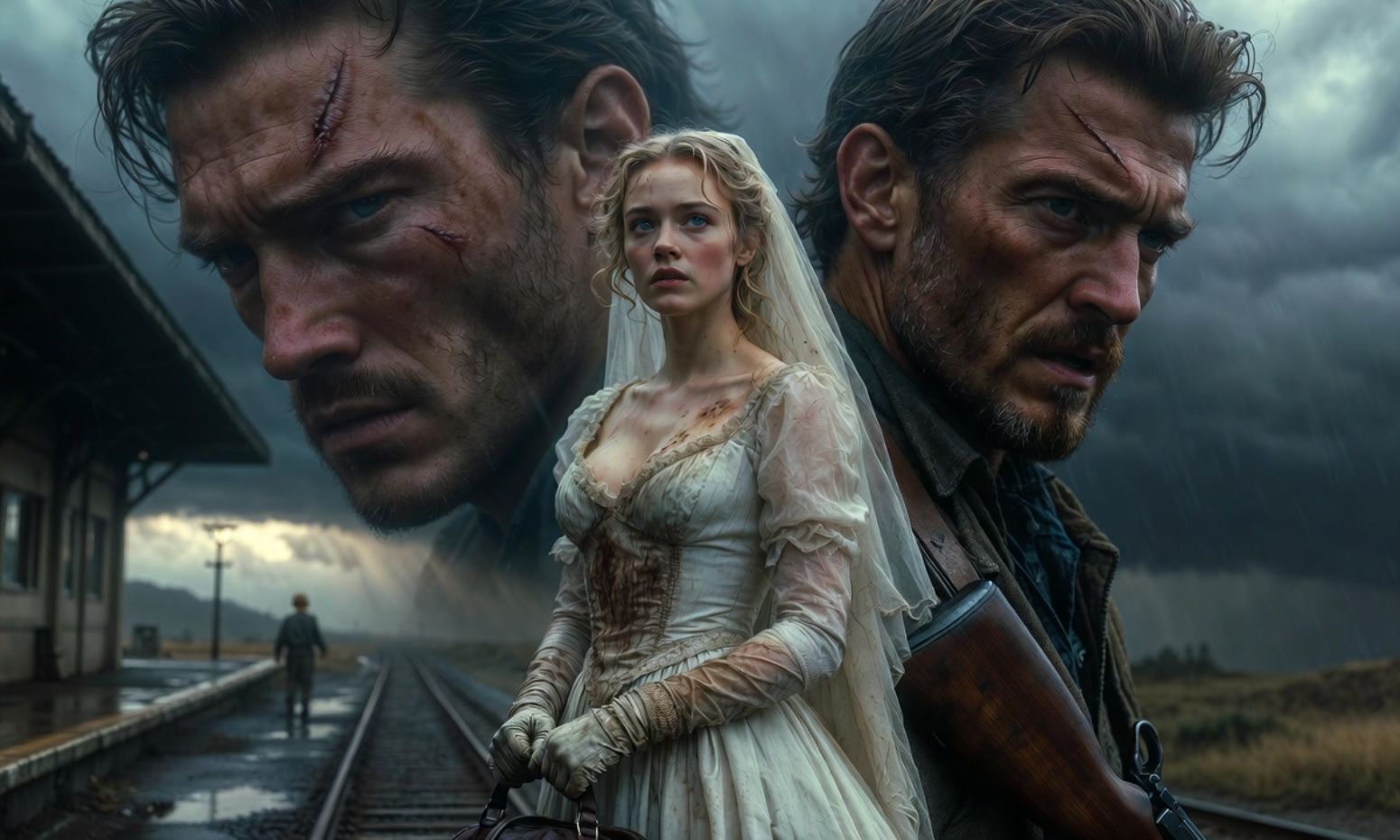
It came groaning out of the eastern distance, a black iron beast coughing smoke across the plains. By the time it stopped beside the weather-beaten platform, Clara Whitmore had been traveling for three days. Coal dust clung to her face. The hem of her ivory wedding dress had turned gray, and one sleeve was torn where it had caught on a nail in Chicago.
She knew how she looked.
Like a bride abandoned before reaching the altar.
Perhaps that was fitting.
“Your husband meeting you here?” the conductor asked as he lowered her small valise onto the platform.
Clara tightened her fingers around its worn leather handle. Inside were two plain dresses, a comb, a few coins, and the Bible that had belonged to her mother. Everything else she had once owned remained in a house she never intended to see again.
“Yes,” she lied. “He’ll be here.”
The conductor glanced at the empty platform but said nothing. He tipped his cap, climbed aboard, and signaled the engineer.
Within moments, the train was moving again.
Clara watched until the last carriage disappeared beyond the curve. Smoke lingered over the tracks, then dissolved into the enormous sky.
She was alone.
Rock Creek Station consisted of a depot, a telegraph office, a stable, and several buildings scattered along a road powdered with dust. Beyond them stretched miles of open land, interrupted only by distant hills and the dark line of the mountains.
Five years earlier, James Callahan had written that he would build a ranch somewhere in that wilderness. He had promised to send for her when he had enough money and land.
Clara had promised to wait.
Neither promise had survived her father.
She lifted her valise and took one step toward the station house.
A small boy stood beneath the water tower.
He could not have been more than four. His boots were scuffed, one suspender hung loose, and a wooden horse dangled from his hand. He stared at Clara with solemn blue-gray eyes.
James’s eyes.
The resemblance struck her so violently that the valise slipped from her fingers.
The boy’s face brightened.
“Mama!”
He ran toward her.
Clara could not move. The child wrapped both arms around her skirts and pressed his cheek against the ruined fabric.
“You came back,” he said.
Her heart seemed to stop.
Slowly, she lowered herself to her knees.
“What is your name?”
“Tommy.”
An older woman hurried from the depot, one hand holding her hat against the wind.
“Thomas Michael Callahan, you come back here this instant!”
Callahan.
Clara looked at the woman.
“Who is his father?”
The woman’s expression changed as she studied Clara’s dress, her exhausted face, and the child clinging to her.
“James Callahan,” she said carefully. “He owns the Double C Ranch.”
The answer should not have hurt. Five years was a long time. James had believed she had chosen another man. He had possessed every right to marry, to have a child, and to build the life she had promised but failed to share.
Still, the knowledge cut through her.
Tommy touched her cheek.
“You look like the picture.”
“What picture?”
“The one Papa keeps.”
Before Clara could ask more, hoofbeats thundered along the road.
A black horse came around the corner at a hard gallop. Its rider pulled back sharply, sending dust across the platform.
James swung from the saddle.
He was no longer the young man who had left Chicago with a borrowed coat and twenty dollars in his pocket. The West had hardened him. His shoulders were broader, his skin darkened by the sun, and a pale scar ran from his temple to the edge of his jaw.
But Clara would have known him anywhere.
For one suspended instant, neither of them breathed.
Then James saw Tommy in her arms.
His hand moved toward the revolver at his hip.
“Get away from my son.”
The coldness of his voice frightened even the older woman.
Clara rose slowly.
“James.”
“Don’t say my name.”
He crossed the platform and lifted Tommy away from her.
The child struggled. “Papa, it’s Mama!”
“No.” James held him firmly against his chest. “She isn’t your mother.”
Tommy’s face crumpled.
Clara forced herself to remain standing. “I didn’t know you had a son.”
“You didn’t care what happened to me.”
“That isn’t true.”
“You disappeared. Then your father told me you had married Doyle Crane.”
“He forced me.”
James gave a humorless laugh.
“Of course he did.”
“I wrote to you.”
“Not once.”
“I wrote seventeen letters.”
The muscles in his jaw tightened, but his eyes remained hard.
“My father intercepted them,” Clara continued. “He told me you had taken his money and agreed never to contact me again.”
“And he told me you chose Crane because you were tired of waiting for a penniless stable hand.”
“He lied to both of us.”
“How convenient that you discovered that after your wealthy husband died.”
Clara flinched.
News of Doyle’s death had not yet traveled this far. That was why she had left Chicago before the funeral arrangements were complete.
“I received nothing from Doyle,” she said. “I left before his family could stop me.”
James looked at her stained wedding dress. “And you traveled across the country dressed like that?”
“It was the only clothing I could reach before they locked the other rooms.”
Something flickered in his expression, but it vanished immediately.
“Go back to Chicago.”
“I have nothing there.”
“That isn’t my concern.”
“It was once.”
“That was five years ago.”
Tommy reached toward her over his father’s shoulder.
“Mama!”
James’s face tightened with pain. He carried the boy toward his horse without looking back.
Clara followed him to the edge of the platform.
“I did not leave you willingly.”
He stopped.
“I waited for you,” he said without turning. “Every stagecoach. Every train. Every stranger coming over the hill. For two years, I told myself there had to be an explanation. Then your father sent me a newspaper announcement of your marriage.”
“I had no choice.”
“There is always a choice.”
“No, James. Sometimes there is only survival.”
He finally looked at her.
For a second, she thought he might ask what she meant. Instead, he placed Tommy in the saddle.
“Mrs. Murphy owns the boardinghouse near the church. She’ll rent you a room.”
“And tomorrow?”
“Tomorrow you leave.”
Clara straightened her shoulders.
“I came here because I could not lose you without telling you the truth.”
“You already lost me.”
James mounted behind his son and rode away.
Clara watched until the horse became a dark shape against the plains.
She picked up her valise.
Tomorrow, James expected her to leave.
For five years, other people had decided where Clara would live, whom she would marry, when she could speak, and how much pain she was required to endure in silence.
She would never surrender her life that easily again.
This time, she would stay and fight.
Mrs. Abigail Murphy’s boardinghouse leaned slightly toward the road as though it had grown tired of resisting the Wyoming wind.
Its owner was a silver-haired widow with sharp eyes and little patience for secrets.
“You’re the woman from Callahan’s photograph,” she said after showing Clara to a small upstairs room.
“You’ve seen it?”
“Half the town has. Tommy carried it everywhere after Mary died.”
Clara placed her Bible beside the bed.
“Was Mary his mother?”
“She was.”
The answer reopened the ache inside Clara.
“What happened to her?”
“Childbed fever. Tommy was barely a day old.”
Clara sat on the edge of the mattress. James had married, become a father, and buried his wife while Clara was trapped in Doyle Crane’s house. Their lives had continued along separate roads, each filled with suffering the other had never known.
“Did he love her?” Clara asked.
Mrs. Murphy considered the question.
“He respected her. She was a good woman, and he treated her kindly. Sometimes that is more than love gives people.”
“But not always.”
“No,” the widow said. “Not always.”
For three days, Clara remained in Rock Creek.
People watched her when she crossed the street. Conversations stopped when she entered the mercantile. By the second morning, everyone knew she had arrived in a wedding dress and that James Callahan had ordered her to leave.
Clara bought a brown work dress with the last of her money. She helped Mrs. Murphy knead bread and scrub floors in exchange for food, but each evening she stood by the front window, watching the road from the Double C.
James never came.
On the third afternoon, storm clouds rolled over the mountains.
Mrs. Murphy found Clara repairing the torn sleeve of her wedding dress.
“You’re planning something,” the widow said.
“I am sewing.”
“You’ve stabbed the same spot six times.”
Clara put down the needle.
Mrs. Murphy poured coffee into two cups.
“Tommy has a fever.”
Clara’s head snapped up. “How do you know?”
“One of Callahan’s ranch hands came for medicine.”
“Is it serious?”
“Perhaps not. But James hasn’t slept properly since the boy started coughing.”
Clara stood.
Mrs. Murphy blocked the doorway. “The ranch is seven miles away, and that storm will break within the hour.”
“Then I must leave now.”
“You don’t know the road.”
“You can tell me.”
The widow stared at her, then sighed.
“I have a mare in the stable. She’s slow, but she won’t throw you unless lightning strikes close.”
Rain began before Clara had traveled two miles.
By the time she saw the Double C ranch house, the storm had swallowed the landscape. Wind tore at her clothes, and water streamed into her boots. She could barely feel the reins.
A lantern appeared on the porch.
The door opened, and James stepped outside with a rifle.
“Who’s there?”
“Clara!”
He lowered the weapon.
“What in God’s name are you doing?”
She tried to dismount, but her numb leg failed beneath her. James reached her before she struck the ground.
“You rode here in this?”
“Tommy is ill.”
“He had a fever. It broke an hour ago.”
Relief left her trembling against him.
James swore under his breath, lifted her into his arms, and carried her inside.
The house smelled of cedar smoke, coffee, and saddle leather. James set her near the stove and wrapped a blanket around her shoulders.
“You could have died.”
“I needed to know he was safe.”
“You hardly know him.”
“He called me Mama.”
“That doesn’t make him yours.”
“No,” she whispered. “But it made him matter.”
James turned away as though the answer had reached somewhere he did not want touched.
He opened a trunk and removed a blue dress.
“This belonged to Mary. Your clothes are soaked.”
Clara hesitated.
“She would rather you wear it than freeze.”
James pointed toward a bedroom and waited outside while she changed.
The dress fit imperfectly. It was loose at the waist and short at the wrists. Clara folded her wet clothing over a chair, then followed James upstairs.
Tommy lay beneath a patchwork quilt. His cheeks were flushed, but his breathing was steady.
When Clara approached, his eyes opened.
“Angel lady,” he murmured.
She sat beside him. “How are you feeling?”
“Hot.”
She dipped a cloth in the basin and laid it across his forehead.
Tommy smiled sleepily. “Papa looks at your picture at night.”
Behind her, James became motionless.
“He thinks I’m asleep,” the boy continued. “But I see him.”
“Tommy,” James warned.
“The picture lady looks sad. You look sad too.”
The child’s eyes drifted closed.
Clara remained beside him until his breathing deepened. When she stood, James was already walking downstairs.
She found him near the fireplace.
“Why did Tommy believe I was his mother?”
“Mary had dark hair. You look enough like the photograph he remembers.”
“That isn’t what I asked.”
James poured coffee but did not drink it.
“After Mary died, he found your picture in my desk. He decided you were the mother coming back for him.”
“And you allowed him to believe that?”
“I told him the truth. He’s four years old. He hears what he wants.”
Clara looked toward the stairs.
“What was Mary like?”
“Kind.”
“Did she know about me?”
“Yes.”
“And she married you anyway?”
“She understood that a man can care for the dead and still perform his duty to the living.”
“I wasn’t dead.”
“You were married to someone else.”
“Against my will.”
James set down the cup too hard.
“You keep saying that as if it erases five years.”
“It does not erase anything. It explains why I could not return.”
“You could have escaped.”
“I tried.”
“You could have sent word through someone your father didn’t control.”
“I tried that too.”
“You could have—”
“Stop telling me what I could have done while you know nothing about what happened!”
Thunder shook the windows.
James stared at her.
Clara’s hands were trembling, but this time not from the cold.
“My father locked me in my room when I refused Doyle. He dismissed my maid and told everyone I was ill. Doyle threatened to ruin my younger sister’s engagement and have my brother imprisoned over gambling debts. On the morning of the wedding, two men carried me to the carriage.”
James’s anger faltered.
“You expect me to believe—”
“I expect nothing from you. But I will no longer let you call my imprisonment a choice.”
The storm raged against the house.
James looked toward the stairs, then back at Clara.
“You can’t return to town tonight.”
“I know.”
“You may use Mary’s room.”
“Thank you.”
“This changes nothing.”
Clara met his eyes.
“It already has.”
Morning arrived clear and bright, the world scrubbed clean by rain.
Clara woke beneath Mary’s quilt with guilt resting heavily on her chest. A hairbrush remained on the dresser. Dried lavender hung beside the window. The room carried the quiet evidence of a woman who had once believed she would grow old there.
Downstairs, Tommy sat at the kitchen table eating oatmeal.
“Mama!”
Clara stopped in the doorway.
James stood at the stove. He did not correct the child.
She took the chair beside Tommy and helped him guide the spoon without spilling.
“I’m going to the north pasture,” James said. “The Hendersons will collect Tommy before noon.”
Clara looked up. “Why?”
“He’ll stay with them until I arrange something permanent.”
“What kind of arrangement?”
“A school in Cheyenne may accept him next year.”
Tommy continued eating, apparently unaware that his future was being discussed.
“He needs his father,” Clara said.
James’s expression hardened. “You have known my son for four days.”
“Long enough to see that he watches the door whenever you leave.”
“I work a ranch. I can’t follow him every hour.”
“Then let me help.”
“You’re leaving.”
“No.”
“You do not have the right to enter my house and judge how I raise him.”
“And you do not have the right to send him away because you are afraid he might love someone who could leave.”
James went still.
“You know nothing about my fear.”
“I know Tommy is being punished for it.”
He crossed the room and stopped before her.
“You left once.”
“I was taken.”
“That is your story.”
The words silenced her.
Clara looked down at her hands. Then she slowly rolled up her left sleeve.
James’s anger disappeared.
Pale scars circled her wrist. One was thick and uneven. Another ran along her forearm, disappearing beneath the fabric.
“What happened?”
“You wanted proof.”
She raised the sleeve higher.
“Doyle tied my wrists when I tried to escape during our first winter. This scar came from the rope. That one came from a window I broke because the door was locked.”
James’s face lost its color.
Clara touched the crooked line near her elbow.
“He broke my arm. He refused to summon a doctor until the bone had begun to heal. It never set correctly.”
Tommy stared at her, frightened.
James sent him upstairs to choose a toy for the Hendersons. When the child was gone, he lowered his voice.
“Why didn’t you tell me at the station?”
“You barely looked at me without hatred.”
“I would have listened.”
“No. You would have believed I was trying to make you pity me.”
James opened his mouth, then closed it.
“Doyle told me you had accepted my father’s money,” she continued. “He repeated it whenever I resisted him. He said no man would cross the country for a woman who had already been used by another. Eventually I stopped arguing because defiance only made him crueler.”
James turned away and pressed both hands against the table.
“How did he die?”
“His horse threw him during a hunt. His neck broke. When the men brought his body home, his sister ordered the servants to watch me until the will was read. I escaped through the kitchen and boarded the first train west.”
“You came directly here?”
“Yes.”
“Why?”
The question nearly broke her.
“Because the thought of finding you was the only thing that kept me alive.”
James lowered his head.
For years, anger had protected him from grief. Now the truth was tearing that protection apart.
“I should have known,” he said.
“How?”
“I should have questioned your father. I should have gone back to Chicago.”
“He would never have allowed you near me.”
“I should have tried.”
“We both believed lies designed by powerful men.”
James looked at her scars again.
“If Doyle were still alive…”
“He is not. And I do not want another man deciding that violence committed in my name will heal me.”
His eyes met hers.
“What do you want?”
“For you to believe that I did not abandon you.”
“I believe you.”
The words were quiet, almost reluctant, but they changed the air between them.
Clara closed her eyes.
Five years of shame did not vanish. The dead did not rise, and lost time did not return. But one burden she had carried across every locked room and lonely mile finally loosened.
James moved closer, stopping before he touched her.
“I am sorry.”
She looked at him.
“For doubting you,” he said. “For what I said at the station. For every year you suffered while I called you faithless.”
“You suffered too.”
“Not like that.”
“Pain is not a contest.”
A wagon arrived outside.
James glanced toward the window. Mrs. Henderson was coming for Tommy.
“Tell her he’s staying,” Clara said.
“You expect to change all my decisions in one morning?”
“No. Only the cruel ones.”
For the first time, something resembling his old smile touched his face.
He went outside and sent the wagon away.
Clara remained at the ranch for another night.
Then another.
No one announced that she had moved in. Mrs. Murphy simply delivered Clara’s valise and refused payment for the room.
“Rock Creek has had enough excitement,” she declared. “Try not to give us a wedding before Sunday.”
James nearly dropped the sack of flour he was carrying.
Clara laughed for the first time since arriving.
Life settled into a cautious rhythm.
Each morning, James rode out before sunrise. Clara prepared breakfast and helped Tommy dress. She repaired curtains, planted herbs beside the kitchen, and learned how to gather eggs without provoking the red hen that seemed determined to attack her.
Tommy followed her everywhere.
At first, Clara gently reminded him to call her by name. Each correction left him wounded and confused. Eventually, she stopped correcting him, though every “Mama” filled her with equal parts love and guilt.
James watched them from a distance.
Sometimes she caught tenderness in his expression. At other moments, fear returned so sharply that he withdrew into silence.
One evening, after Tommy had gone to bed, Clara sat near the fire mending a shirt. James worked across the room, repairing a bridle.
The only sounds were the snapping logs and the passage of thread through cloth.
“Do you still dream about Chicago?” Clara asked.
James’s hands stopped.
“Sometimes.”
“What happens in the dreams?”
“Nothing worth telling.”
“I told you about my nightmares.”
He placed the bridle aside.
“Sometimes we’re standing beside the river where I asked you to come west. You’re wearing that green dress.”
Clara remembered it. The sleeves had been too large, and James had teased her for looking like a frightened bird.
“And the other dreams?”
His gaze moved to the fire.
“There’s a house. Not this one. A smaller place. You’re in the kitchen, and there are children outside. I wake before I see their faces.”
Clara swallowed.
“And the nightmares?”
“In those, I find you in a locked room. I hear you calling, but no matter how hard I strike the door, it will not open.”
She put down the shirt.
“Come here.”
James did not move.
“Please.”
He crossed the room but remained beyond her reach.
Clara stood.
“You have spent five years loving a memory and hating a lie. I am neither.”
“I know.”
“No, you are still looking at me as though I might vanish.”
“You might.”
“I have nowhere else I want to go.”
“You have just escaped a prison. You do not know whether what you feel is love or desperation.”
“I knew I loved you before Doyle Crane ever touched my life.”
“We are not the people we were.”
“I am not asking to become that girl again.”
Her voice strengthened.
“That girl believed love meant waiting quietly while men decided her future. Doyle destroyed her. But he did not destroy me.”
James’s eyes shone in the firelight.
“Clara…”
“I am standing here because I chose to come. I chose to stay. If you send me away because you no longer love me, I will survive it. But do not send me away because you are afraid to believe me.”
He lifted one hand and touched her cheek.
The contact was so gentle that it hurt more than cruelty.
“I buried you,” he whispered. “Not your body, but everything I believed we could have. If I let myself hope again and lose you…”
“You will not lose me because someone else commands it.”
He bent his head until his forehead rested against hers.
When he kissed her, five years of longing broke open between them.
It was not the innocent kiss they had shared beside the Chicago River. This one carried anger, grief, hunger, and the terrible knowledge of what had been stolen. Clara gripped his shirt, and James held her as though he feared she would disappear if he loosened his arms.
Then he pulled away.
His breathing was uneven.
“We cannot repair five years in one night.”
“I know.”
“I need to be certain I am not trying to save you because I failed before.”
“And I need to know I am choosing you, not merely the safety of this house.”
James brushed his thumb across her cheek.
“Stay.”
Clara covered his hand with hers.
“I will.”
Summer slowly transformed the plains.
Wildflowers appeared beside the creek, cattle moved toward higher pastures, and the days lengthened until twilight seemed reluctant to leave.
Clara remained at the Double C.
James gave her no extravagant promises. Instead, he made small ones and kept them.
He promised to return before dark and did.
He promised never to lock a door against her.
He promised that if fear made him cruel, he would name it rather than hide behind anger.
Clara made promises of her own.
She told him when nightmares woke her instead of pretending she was unharmed. She stopped apologizing for occupying space in the house. When memories of Doyle left her shaking, she allowed James to sit beside her without demanding that he fix what could not be undone.
Tommy became the bridge between them.
He taught Clara how to identify animal tracks and insisted that every coyote print belonged to a wolf. She taught him his letters using pages from old newspapers. James carved him a new wooden horse after the first one broke.
One evening, Clara found James watching from the porch while she and Tommy chased fireflies near the garden.
“You’re staring,” she said.
“I’m thinking.”
“That is usually dangerous.”
He smiled.
“I was thinking that the house sounds different.”
“How?”
“Alive.”
The word stayed with her.
In August, a letter arrived from Chicago.
Clara recognized her father’s handwriting and nearly dropped it into the stove unopened. Instead, she carried it outside, where James was repairing a fence.
“You don’t have to read it,” he said.
“I know.”
She opened the envelope.
Her father wrote that Doyle’s family intended to challenge her right to any property. He accused her of disgracing the Whitmore name and demanded that she return before gossip destroyed her sister’s prospects.
There was no apology.
No acknowledgment of the marriage he had forced upon her.
No concern for what she had endured.
At the bottom, he had written: A daughter owes obedience to the family that gave her everything.
Clara read the line twice.
Then she tore the letter in half.
James said nothing.
She tore it again and again until the pieces scattered in the grass.
“I used to believe he controlled my life because he was strong,” she said. “Now I understand he controlled it because I had not yet learned that I could say no.”
James took her hand.
“What will you do if he comes here?”
“Say no to his face.”
“That I would like to see.”
She looked at him.
“Would you stand beside me?”
“No.”
Her heart tightened before he continued.
“I would stand behind you. You won’t need me to speak for you.”
Clara smiled.
“That might be the most romantic thing you have ever said.”
“I once compared your eyes to spring rain.”
“You were nineteen and foolish.”
“I am older now.”
“Older, certainly.”
He pulled her against him as she laughed.
From the porch, Tommy shouted, “Are you getting married?”
James glanced at Clara.
“Not today,” she called back.
“Tomorrow?”
“We’ll discuss it.”
Tommy considered this.
“Mrs. Murphy says Papa takes too long to understand things.”
James groaned.
Clara laughed harder.
The first snow arrived early.
By then, Clara’s wedding dress had been cleaned and repaired. She had considered burning it, but the dress no longer seemed to belong to Doyle. It had carried her out of his house, across the country, and onto the platform where her life began again.
One cold evening, James found her holding it near the bedroom window.
“You kept it.”
“It reminds me that escape can look like failure to people who do not know the whole story.”
He stepped into the room.
“Would you ever wear it again?”
Clara studied his face.
“Are you asking because you want an answer, or because Mrs. Murphy threatened you?”
“Both.”
She laid the dress across the bed.
James reached into his coat and removed a small wooden box.
Inside was a plain gold ring.
“I bought this five years ago,” he said. “I carried it west because I believed I would return for you. After your marriage announcement arrived, I nearly threw it into the creek.”
“But you didn’t.”
“No.”
“Why?”
“Because anger could not make me stop loving you.”
Tears filled her eyes.
James took the ring from the box but did not kneel.
“I will not ask you to promise that nothing will ever separate us. We know better than most that the world can be cruel. I will only ask whether you want to face whatever comes next beside me.”
Clara looked at the scars on her wrist.
Once, a ring had been forced onto her hand as a symbol of ownership. This ring was being offered as a choice.
“Yes,” she said. “But I have a condition.”
His eyebrows rose.
“Tommy must stand with us.”
“He would refuse to be anywhere else.”
“And I keep my own name.”
“Clara Whitmore?”
“Clara Whitmore Callahan.”
James smiled.
“I can live with that.”
He slipped the ring onto her finger.
Tommy, who had been listening outside the door, burst into the room.
“I knew it!”
James caught him before he collided with Clara.
“Were you spying?”
“Mrs. Murphy told me to listen for the right moment.”
“I am going to ban that woman from the ranch.”
“No, you aren’t,” Clara said.
“No,” James admitted. “I’m not.”
They married one week later in the small Rock Creek church.
Clara wore the restored dress, but she removed its old lace collar and replaced it with a strip of blue ribbon Tommy had chosen. Mrs. Murphy filled the church with winter roses brought from a greenhouse in Cheyenne.
James stood near the altar with Tommy beside him.
As Clara entered, James did not look at the dress. He looked only at her.
No father escorted her.
She walked down the aisle alone.
Each step belonged to her.
When the minister asked who gave the bride in marriage, Clara answered before anyone else could speak.
“I give myself freely.”
The church became silent.
Then James held out his hand.
“And I receive her freely,” he said.
Tommy tugged at the minister’s sleeve.
“Now can I call her Mama?”
Laughter moved through the church.
Clara knelt before him.
“You may call me anything you choose.”
He wrapped his arms around her neck.
“Mama.”
This time, the word did not feel borrowed from a dead woman or stolen from a life that might have been.
It felt like a promise forming in the present.
Healing did not arrive all at once.
There were nights when Clara woke believing she was back in Doyle’s locked house. There were mornings when James saw an empty room and felt the old terror that she had disappeared again.
But slowly, they learned that love was not proved by the absence of fear.
It was proved by what they chose while afraid.
James stopped hiding Clara’s photograph in his desk. He placed it on the mantel beside a portrait of Mary, whose memory remained part of Tommy’s life.
Clara never tried to replace her.
She spoke Mary’s name without jealousy and taught Tommy that a heart could hold love for the mother who gave him life and the mother who chose to help raise him.
In spring, Clara received news that her father had died.
She felt no triumph. Only a strange emptiness.
He had spent his life controlling others because he feared losing power. In the end, he had died surrounded by servants and estranged from the daughter whose future he believed he had possessed.
Clara placed his letter in the stove and watched the flames consume it.
Then she went outside, where James and Tommy were repairing the garden fence.
James saw her face and opened his arms.
She went to him, not because she was weak, but because she no longer believed strength required standing alone.
Years later, travelers passing through Rock Creek sometimes heard the story of the bride who had stepped off the train in a ruined wedding dress.
Some versions claimed she had crossed the country to steal another woman’s husband. Others said James Callahan had challenged half of Chicago to rescue her. Mrs. Murphy encouraged the most dramatic accounts whenever business at the boardinghouse was slow.
The truth was quieter.
Clara had not been rescued by a fearless man arriving at the perfect moment.
She had escaped on her own.
James had not erased her wounds.
He had simply learned to love her without demanding that she hide them.
And Tommy had not mistaken a stranger for his mother.
In the uncomplicated wisdom of a lonely child, he had recognized someone who had also spent years searching for a place to belong.
One summer evening, Clara stood on the porch watching Tommy race across the yard. He was nine now, tall for his age and determined to ride every horse James considered unsuitable.
James came up behind her and placed his hands around her waist.
“What are you thinking about?” he asked.
“The station.”
His arms tightened.
“Do you regret coming?”
Clara looked toward the western horizon. The setting sun turned the fields gold, and the mountains stood dark against the fire-colored sky.
“No.”
“Even after the way I treated you?”
“You were angry because you believed I had betrayed you.”
“I should have listened.”
“Yes,” she said. “You should have.”
He sighed against her hair.
“You could pretend I was perfect.”
“I spent too many years pretending for other people’s comfort.”
James laughed softly.
Tommy ran toward them, waving a letter.
“It came from Chicago!”
Clara accepted it without fear.
The letter was from her younger sister, Elizabeth. She had left their father’s house, ended the engagement arranged for her, and taken a teaching position in St. Louis. She wrote that Clara’s escape had shown her another life was possible.
At the bottom of the page was a single sentence:
You did not disgrace our family. You were the first of us brave enough to become free.
Clara handed the letter to James.
As he read, tears blurred the landscape before her.
For years, she had believed survival was the only victory available to her. Now she understood that one person’s refusal to remain imprisoned could become a door for someone else.
Tommy leaned against her side.
“Why are you crying, Mama?”
“Because sometimes good news hurts when you have waited a long time to hear it.”
He nodded as though this made perfect sense.
The three of them remained on the porch while twilight settled over the ranch.
There would be difficult winters ahead. Cattle would be lost, crops would fail, and the memories they carried would sometimes return without warning. Love would not protect them from every sorrow.
But Clara no longer wanted a life without pain.
She wanted a life in which pain did not have the final word.
James took her hand, his thumb passing over the scar on her wrist. Once, that scar had represented everything done to her without permission. Beneath his gentle touch, it became evidence of what she had survived.
“Come inside,” he said. “It’s getting cold.”
“In a moment.”
She looked toward the east, where the railroad tracks cut across the plains. Somewhere beyond the hills, another train sounded its whistle.
Five years earlier, Clara had believed her story had ended inside a forced marriage.
On the platform at Rock Creek, she had believed she was arriving too late.
But some endings were only doors disguised by grief.
Some promises survived silence.
And sometimes the life stolen from a person could not be recovered exactly as it had been—but it could be rebuilt into something stronger, freer, and chosen.
Clara rested her head against James’s shoulder.
“I told you I wouldn’t leave again,” she whispered.
He kissed her temple.
“And I finally learned to believe you.”
Behind them, warm lamplight spilled from the windows of the Double C Ranch. Before them stretched the open land, vast and uncertain, carrying no guarantee except the one they had given each other freely.
This time, neither of them was waiting for the past to return.
They were ready to meet the future together.


