They Threw the Female Soldier Out of the Plane — But She Returned to Save the Same Men
The first man to put his hands on Mara Vance did not look her in the eyes.
Staff Sergeant Cole Mercer grabbed the shoulder strap of her parachute harness and dragged her toward the open ramp as the transport plane bucked through black clouds.
Wind tore through the cargo bay at two hundred miles an hour.
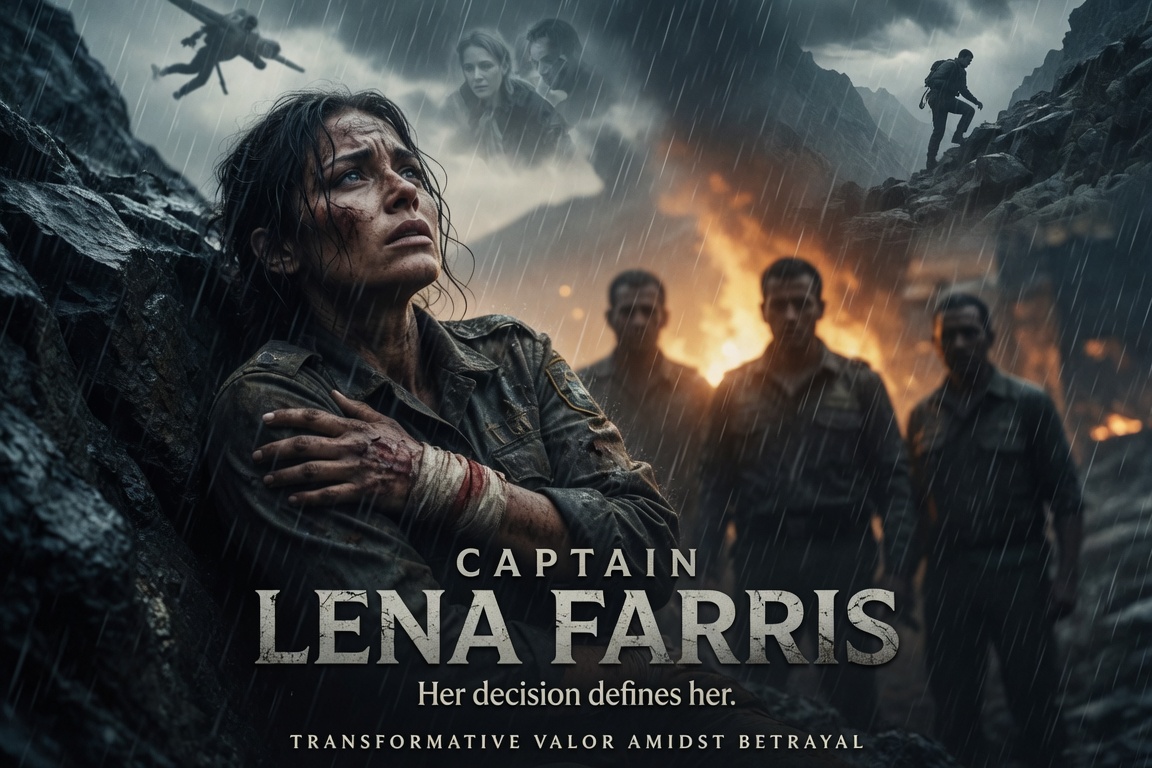
Red emergency lights flashed across six pale faces, stacked ammunition crates, and the steel ribs of the aircraft. Rain blew in sideways through the open ramp, turning the floor into a slick mirror. Somewhere below them, hidden beneath twelve thousand feet of storm and darkness, lay the mountain border between Karsan and the unrecognized territory controlled by the Rayan militia.
Mara dug one boot beneath a cargo rail.
Mercer pulled harder.
“Let go of me.”
Her voice was not loud.
It did not need to be.
Mercer hesitated for half a second, long enough for Captain Nolan Rourke to step between them.
Rourke was thirty-six, broad-shouldered, clean-jawed, and wearing the kind of expression men practiced when they wanted fear to look like command. Rain glittered on his close-cropped hair. A fresh cut above his eyebrow leaked blood down one temple.
Behind him, the left engine coughed.
The plane dropped so violently that three soldiers slammed against their restraints.
A warning horn screamed.
Rourke leaned close enough for Mara to smell coffee and copper on his breath.
“You disabled our navigation beacon.”
“No.”
“You were alone near the avionics panel.”
“I was repairing the burst receiver.”
“You changed our flight path.”
“The flight path changed because someone uploaded a corrupted terrain package.”
His nostrils flared.
“You expect me to believe you know more about this aircraft than my crew?”
“I expect you to look at the evidence.”
Another explosion punched through the fuselage.
The lights died.
For one breath, the cargo bay went completely black.
Then the emergency strips flickered back on, painting everyone in the color of blood.
Lieutenant Owen Pike shouted from the cockpit doorway.
“Captain, hydraulic pressure is falling. We’ve lost the primary controls.”
“How long?”
“Maybe four minutes.”
Rourke turned back to Mara.
There it was in his face.
Not certainty.
Need.
He needed one person to blame because fear had taken everything else from him.
Mara had seen the expression before—on young officers in burning vehicles, on fathers standing beside hospital beds, on commanders reading casualty lists with their own signatures at the bottom.
People did not always make their worst decisions because they were cruel.
Sometimes they made them because the truth was too large to carry.
Rourke pointed toward the storm beyond the ramp.
“You’re getting off my aircraft.”
The youngest soldier in the bay, Specialist Eli Torres, stared at him.
“Sir?”
Rourke did not look away from Mara.
“She’s carrying a chute. We’re too heavy, the hydraulics are failing, and I’m not keeping a suspected saboteur aboard.”
Mara’s gray eyes moved from Rourke to Mercer, then to the other men.
None of them spoke.
That silence cut deeper than the wind.
She had eaten beside them for three days at Forward Operating Base Arden. She had checked their oxygen systems. She had shown Torres how to clear a frozen feed tray without losing his fingers. She had quietly corrected Pike’s fuel calculations before takeoff.
They knew her as “Ms. Vance,” a civilian systems adviser from the Defense Recovery Office.
They knew she was forty-two.
They knew she wore no rank.
They knew the thin white scar beneath her chin and the faint limp in her left leg.
They knew almost nothing else.
Rourke mistook that absence of information for an absence of importance.
“Captain,” Mara said, “the terrain below us is controlled by Rayan militia. Their surface teams will track the aircraft. If you force me off this ramp, you are abandoning an American in hostile territory.”
“You stopped being part of this team when you touched my avionics.”
“Then restrain me.”
“We don’t have time.”
“That is not a lawful reason.”
Rourke’s jaw tightened.
“Mercer.”
The staff sergeant stepped forward.
Mara looked at him.
Cole Mercer was forty-one, with tired blue eyes and an old wedding ring hanging from a chain beneath his body armor. He had spent half the flight talking about his daughter’s college acceptance letter. He had also spent eighteen years obeying orders quickly enough to stay alive.
“Cole,” Mara said.
The use of his first name made him freeze.
“Don’t.”
His face folded inward.
“I’m sorry.”
Then he kicked her boot free of the cargo rail.
The storm took her.
One moment she was inside the aircraft.
The next, she was falling backward into darkness.
The plane’s ramp became a shrinking red rectangle above her. For an instant, she saw Mercer standing at the edge, one hand still extended.
Then the clouds swallowed everything.
Mara spun through freezing rain.
The force ripped the breath from her lungs. Her damaged left knee struck the emergency oxygen bottle clipped to her harness. Pain flashed white across her vision.
She counted.
One.
Two.
Three.
She pulled the release.
Nothing happened.
The main chute remained sealed.
Mara reached behind her, fingers fighting the wind. The pack’s deployment cable hung loose.
Cut.
Not broken.
Cut.
Lightning split the clouds, illuminating the severed cord whipping beside her shoulder.
Someone had tampered with the parachute before she ever boarded the aircraft.
And Captain Nolan Rourke had just thrown her into the night with it.
She dropped through eighteen thousand feet toward enemy territory with no functioning main chute.
Above her, the transport plane vanished over the mountains.
Below, three separate muzzle flashes blinked from the dark.
The militia had seen her fall.
And they were already coming.
Mara hit the reserve release at eight thousand feet.
The chute exploded open with enough force to wrench her spine.
She swung beneath the canopy, gasping, boots slicing through cloud. Rain struck her face like thrown gravel. Her left knee throbbed in rhythm with her heartbeat.
Below, the storm thinned.
Moonlight revealed a valley carved between black ridgelines. Pine forests covered the lower slopes. An abandoned mining settlement crouched beside a silver river, its rusted roofs shining beneath the rain.
Farther east, two trucks moved without headlights.
Mara watched their thermal signatures through the compact monocular strapped to her wrist.
Militia.
Six minutes away.
She checked the terrain, wind direction, river speed, and the jagged line of a collapsed cable tower.
Then she cut herself free at forty feet.
She dropped through wet pine branches and hit the slope hard.
Her injured knee buckled.
She rolled, smashed one shoulder against a root, and slid through mud until her hand caught a rock.
For several seconds, she lay face down in the rain.
Her lungs burned.
Blood filled her mouth where she had bitten through her lower lip.
A younger version of Mara might have forced herself upright immediately. She had once believed pain respected defiance.
Twenty-four years in uniform had taught her otherwise.
Pain respected patience.
She counted five breaths, checked her fingers, toes, ribs, spine, and pupils. Then she pushed to her knees.
The valley was silent except for rain, river water, and the distant growl of engines.
Mara removed the civilian-gray jacket she had worn aboard the plane. Beneath it was a close-fitting black combat shirt with no flag, no name tape, and no visible rank.
From the lining of the jacket, she pulled a ceramic knife, a folded signal panel, two compressed bandages, a waterproof map, and a transmitter the size of a cigarette pack.
The transmitter’s screen blinked once.
NO SATELLITE LINK.
“Of course,” she whispered.
The aircraft’s corrupted navigation package had not been the only failure.
This operation had been compromised before takeoff.
The question was whether Rourke was part of it.
Mara did not want to believe he was.
She had studied his record before joining the mission. Captain Nolan Rourke had led thirty-two flights through contested airspace. He had brought home crews other pilots would have abandoned. Four years earlier, he had landed a burning aircraft on a dry lakebed with half the tail missing.
He was talented.
He was brave.
He was also carrying a wound no medical scan could find.
His younger brother, Daniel, had died during an extraction in Yemen after a civilian contractor altered a landing plan without informing the flight commander. Rourke had spent years telling himself that hesitation had killed Daniel.
Tonight, he had confused decisiveness with judgment.
Mara rose and limped toward the trees.
Headlights appeared at the base of the mountain.
She had three minutes.
Maybe less.
She moved downhill through the pines, favoring her right leg, placing each boot between exposed roots. The air smelled of wet bark, diesel fumes, and old minerals leaching from the abandoned mine.
At the edge of the settlement, she found the remains of a mechanic’s shed.
Inside lay a rusted truck chassis, broken glass, and a coil of steel cable.
Mara crouched beside the cable.
The engines grew louder.
Men shouted in Rayan dialect.
She looped the cable around the truck’s rear axle, ran it through a pulley mount, and stretched it across the narrow road at shin height. Then she smashed the shed’s remaining light fixture and disappeared into the dark.
The first truck entered the settlement too quickly.
Its front tires struck the cable.
The axle jerked sideways. The truck flipped into a drainage trench with a scream of metal.
The second truck braked.
Mara was already moving.
She came from behind the wall, drove her shoulder into the nearest gunman, and used his body to block the rifle behind him. Two shots cracked into the rain.
She twisted the first man’s wrist until the weapon fell, caught it before it hit the ground, and struck the second gunman across the throat with the stock.
A third man emerged from the passenger side.
He saw a limping woman in black standing beneath a broken streetlamp.
His hesitation lasted less than a second.
It was enough.
Mara fired once into the road beside his foot.
“Drop it.”
He stared at her.
She repeated the order in his own dialect.
This time, he obeyed.
The militia fighters expected contractors to beg, aid workers to freeze, and isolated soldiers to run.
They did not expect a woman they had watched fall from the sky to know their language.
They expected even less when she asked which radio frequency their mountain teams were using.
Ten minutes later, Mara drove the surviving truck east with one captured radio beside her and her left knee swelling beneath torn fabric.
Behind her, three militia fighters sat bound inside the mechanic’s shed.
Ahead, through breaks in the clouds, a burning aircraft descended toward the mountains.
Captain Rourke knew the plane would not reach Arden.
The altimeter unwound in fast, merciless circles. The controls felt loose beneath his hands. Every warning light on the panel had turned amber or red.
Beside him, Pike fought the hydraulic override.
“Terrain in three miles.”
“I see it.”
“We need to ditch.”
“We’ll never survive the river.”
“We won’t survive the ridge.”
Rourke stared through the windshield.
Rain streaked across fractured glass. The mountains rose ahead like the teeth of a trap.
Behind him, Mercer entered the cockpit.
“Cargo is secured.”
“How many injuries?”
“Davis broke his wrist. Torres has a head wound. Everyone else is mobile.”
Rourke nodded.
Mercer did not leave.
Rourke felt the man’s presence behind him.
“What?”
Mercer’s voice was barely audible above the alarms.
“Her main deployment cable.”
Rourke kept his eyes forward.
“What about it?”
“I checked the chutes at Arden.”
“Then it worked.”
“I said I checked them. I didn’t say I packed them.”
Rourke turned.
Mercer’s face had gone gray.
“There was a red seal on her cable housing when we boarded. After she went out, I saw the seal on the floor.”
Pike looked back from the controls.
“What are you saying?”
“I’m saying the housing had been opened.”
Rourke felt something cold move through his chest.
“The chute was sabotaged?”
“I don’t know.”
“You dragged her to the ramp.”
Mercer flinched.
“You gave the order.”
Silence filled the cockpit.
The aircraft dropped another five hundred feet.
Rourke turned back to the windshield.
For the first time, he allowed himself to see the moment again.
Mara’s boot beneath the rail.
Her eyes on his.
Then restrain me.
She had not panicked.
She had not pleaded.
She had offered the lawful option.
He had rejected it because he had wanted the problem gone.
Not solved.
Gone.
“Ridge!” Pike shouted.
Rourke pulled hard on the controls.
The damaged aircraft cleared the rock by less than twenty feet. Pine branches exploded beneath the fuselage.
A narrow plateau opened beyond the ridge.
Rourke saw the remains of an old Soviet airstrip carved into the mountainside.
“Brace for impact.”
The plane struck tail-first.
Metal tore apart behind them.
The cockpit slammed down, bounced, and spun sideways. Rourke’s harness bit into his chest. Glass burst across the instrument panel. One propeller shattered against the ground, sending blades through the right wing.
The aircraft stopped with its nose buried in mud.
For several seconds, nobody moved.
Then someone screamed in the cargo bay.
Rourke released his harness and crawled through smoke.
The interior looked like the inside of a crushed can.
Crates had broken loose despite their straps. One wall had peeled open. Rain poured through the gap. Torres lay beneath a collapsed equipment frame with blood running from his scalp. Davis clutched his broken wrist. Sergeant Malik Brenner was unconscious near the ramp.
And Specialist Hayden Crowe was missing.
Mercer searched the wreckage.
“Crowe!”
A weak voice answered from outside.
They found him twenty yards down the runway, impaled through the thigh by a strip of aluminum.
Rourke knelt beside him.
Crowe grabbed his vest.
“Don’t let them take me.”
“Who?”
Crowe’s eyes moved toward the tree line.
Through the rain, red lights appeared in the valley below.
Vehicles.
More than a dozen.
Pike raised the captured-frequency scanner.
“Militia chatter. They tracked the crash.”
“How long?”
“Thirty minutes.”
Mercer looked at the wrecked plane, then at the steep cliffs surrounding the runway.
“We can’t move Crowe.”
Rourke pressed both hands against the wound.
He thought of Mara falling backward through the ramp.
Then he looked at the men who had followed his order without protest.
“We defend here.”
Mercer’s eyes hardened.
“That’s your plan?”
“We have injured personnel, no working beacon, and no route down the western slope.”
“We could have had someone who knew the terrain.”
Rourke’s head snapped up.
Mercer did not look away.
“You want to blame me, Captain? Fine. But don’t pretend she did this.”
A shadow crossed Rourke’s face.
“I made the call I believed protected the crew.”
“And if the call killed her?”
The words landed harder than the crash.
No one spoke.
Rourke looked down at Crowe’s blood on his hands.
“Then I will answer for it.”
A burst of gunfire echoed from the valley.
The militia had arrived early.
Mara heard the first shots while still three miles from the plateau.
She stopped the truck beneath an overhang and climbed onto the hood.
Through the rain, she saw muzzle flashes around the wrecked aircraft.
The militia had split into two groups. One climbed the eastern slope. Another advanced through drainage trenches toward the runway.
Rourke’s team had formed a defensive circle around the fuselage.
They were outnumbered at least four to one.
Mara raised the captured radio.
A militia commander spoke in clipped bursts.
“Take the pilot alive. Kill the rest. Search for the woman separately.”
Mara went still.
Search for the woman.
They knew she was aboard.
They had known before the flight.
She switched channels and transmitted on the aircraft’s emergency frequency.
“Atlas Six, this is Vesper. Respond.”
Static.
Then Mercer’s voice.
“Say again?”
“Atlas Six, this is Vesper. You have militia units approaching from the eastern drainage channel and north tree line. Do not fire on the truck coming up the service road.”
A pause.
Rourke came onto the radio.
“Vance?”
Mara looked toward the burning aircraft.
Even through static, she heard disbelief strip the authority from his voice.
“Yes.”
“You’re alive.”
“Your powers of observation remain uneven, Captain.”
Mercer made a sound that might have been a laugh or a sob.
Rourke swallowed.
“Your chute—”
“Later. How many wounded?”
“Three serious. One immobile.”
“Ammunition?”
“Eleven magazines, two belts for the light gun, no explosives.”
“Then you have eight minutes before they cut off the road.”
Rourke stared through the rain at the moving headlights below.
“How do you know?”
“Because I am driving the vehicle they expected to see.”
Mara shifted the truck into gear.
The engine growled.
“Kill your exterior lights. When I reach the first turn, fire only at the north tree line.”
“What are you going to do?”
“Change the shape of the battlefield.”
She ended the transmission.
Rourke stood beside the wreckage with the radio still pressed to his ear.
The men around him had heard every word.
Torres, blood drying across one side of his face, looked at the captain.
“You threw her out of the plane.”
Rourke lowered the radio.
Torres stared toward the approaching truck.
“And she came back.”
Mara drove uphill without headlights.
The road twisted across the mountain in narrow switchbacks. Rainwater rushed over the hood. Bullets struck the doors as militia scouts recognized the stolen vehicle.
She did not slow down.
At the first turn, she yanked the wheel left and jumped from the cab.
The truck continued forward.
It crashed through a wooden barrier and rolled down the slope toward the militia convoy below.
Inside the cab, Mara had wired the captured rifles’ ammunition to a road flare.
The truck hit the lead militia vehicle.
The night opened in orange fire.
Cartridges cooked off in rapid bursts. Men scattered. Fuel poured across the road and ignited, cutting the eastern assault group off from the plateau.
Rourke’s soldiers opened fire on the north tree line.
The militia attack faltered.
Mara climbed the final slope using roots and exposed rock. Every movement sent pain through her knee. Halfway up, she found a militia fighter behind a fallen pine, aiming toward Torres.
She hooked her arm beneath his chin and pulled him backward before he could fire.
They fell into the mud.
He was younger than she expected.
Maybe nineteen.
His rifle slipped beyond reach.
He reached for a knife.
Mara caught his wrist.
For a moment, they strained against each other in the rain.
The boy’s face twisted with fear.
Not hatred.
Fear.
Mara saw the uncertainty in his eyes and released him just enough to speak.
“Go home.”
He stared at her.
She pushed the knife away.
“Go.”
He scrambled downhill and disappeared between the trees.
Mara reached the plateau as Mercer’s light machine gun ran dry.
“Reloading!” he shouted.
A militia gunner rose behind a rock wall.
Mara fired twice.
The gunner dropped.
She crossed the runway at a crouch and slid behind the wreckage beside Mercer.
He looked at her as if a ghost had taken human form.
Mud covered her clothes. Blood ran from her lip. Her left leg trembled beneath her weight.
Mercer’s gaze fell to the cut deployment cable hanging from her harness.
His face changed.
Mara saw the exact instant he understood.
His mouth opened.
Nothing came out.
She removed the empty belt from his weapon.
“New belt.”
He handed it to her with shaking fingers.
“Mara—”
“Not now.”
“I put my hands on you.”
“Then use them to keep Torres alive.”
Mercer nodded once.
His eyes shone, but he turned back to the fight.
Rourke appeared through the smoke.
For a second, captain and abandoned soldier faced each other across the shattered cargo bay.
Rourke’s uniform was torn. Blood darkened one sleeve. The command in his posture had collapsed into something smaller and more honest.
“I thought you sabotaged us.”
“You were wrong.”
“I know.”
“Do you?”
His face tightened.
A bullet struck the fuselage between them.
Mara pulled him down.
“Recognition is not repentance, Captain. Stay alive long enough to learn the difference.”
She crawled toward Crowe.
The specialist lay beneath a tarp, shivering violently. The aluminum strip had passed through the upper thigh without severing the femoral artery, but blood continued to seep around the wound.
Mara checked his pulse.
“Crowe, look at me.”
His pupils struggled to focus.
“You came back.”
“Yes.”
“Why?”
A burst of gunfire rattled against the wreckage.
Mara tightened the tourniquet above his wound.
“Because your life does not become worthless when your judgment fails.”
Crowe cried out.
She leaned close.
“And because I do not let frightened men decide what kind of soldier I am.”
His eyes closed.
Mara stood.
Rourke watched her.
Something in his face had gone still.
Not defensive.
Not angry.
Ashamed.
The surviving soldiers gathered inside the cargo bay as the militia regrouped below.
Pike studied the terrain map.
“They’ll come from the western ridge next.”
“No,” Mara said. “They want the pilot alive. They’ll use gas or fire to force us from the fuselage.”
Rourke looked at her.
“How do you know they want me?”
“I heard their commander.”
“Why me?”
“That is the question you should have asked before accusing the nearest outsider.”
He absorbed the blow without reply.
Mara examined the broken avionics rack.
A small black device remained attached beneath the terrain processor. Its indicator light blinked once every five seconds.
She removed it with the ceramic knife.
Pike frowned.
“That isn’t ours.”
“No.”
“What is it?”
“A short-range data injector. It corrupted your navigation package and broadcast our location.”
Rourke stepped closer.
“Who installed it?”
Mara turned the device over.
A maintenance seal had been pressed into the casing.
She held it beneath the emergency light.
Pike recognized the marking first.
His face drained.
“That came from Arden.”
Mercer looked toward the cockpit.
“Only ground crew and flight staff had access.”
Rourke said nothing.
Mara watched him.
“The sabotage was not meant to destroy the aircraft immediately. It was meant to divert you into militia-controlled airspace.”
“For what?”
“To capture you.”
“Why?”
Mara met his eyes.
“Because Captain Nolan Rourke is not the most valuable man on this mountain.”
A new voice came through the radio.
Calm.
American.
“Atlas Six, this is Colonel Harlan at Arden. Authenticate and report status.”
Relief moved through the crew.
Rourke reached for the handset.
Mara caught his wrist.
“Don’t answer.”
He stared at her hand.
“That’s our base commander.”
“No. That is the man waiting to confirm whether the crash killed me.”
Every face turned toward her.
Outside, militia fighters moved through the trees.
Inside, the emergency light pulsed against Mara’s expression.
Rourke slowly lowered the radio.
“What are you talking about?”
Mara removed a waterproof card from a concealed pocket inside her shirt.
She handed it to him.
Rourke read the first line.
Then he read it again.
His shoulders dropped.
Mercer leaned close enough to see.
The identification card carried no civilian agency logo.
At the top was the seal of the United States Department of Defense.
Below it:
VANCE, MARA E.
BRIGADIER GENERAL
COMMANDING OFFICER, JOINT PERSONNEL RECOVERY COMMAND
No one moved.
Rain drummed against the torn fuselage.
Torres looked from the card to Mara.
Mercer’s mouth tightened as if he had been struck.
Rourke remained frozen, holding proof that the woman he had ordered from his aircraft outranked every officer at Forward Operating Base Arden.
Mara’s official photograph showed the same gray eyes, the same scar beneath her chin, and a uniform bearing one silver star.
Rourke lifted his head.
The color had left his face.
“You’re General Vance.”
“Yes.”
“You boarded as a civilian.”
“I boarded without visible rank.”
“Why?”
“Because three recovery teams have disappeared along this corridor in six months. Their missions were compromised by someone inside our command structure. I came to Arden to identify the leak.”
Rourke looked toward the radio.
“Colonel Harlan.”
“We do not know whether Harlan is the leak, but the data injector carries his maintenance authorization.”
Mercer stared at the severed parachute cable.
“And your chute?”
“Packed in Arden’s secure equipment room.”
Rourke’s eyes lowered.
When he spoke again, his voice had lost every trace of command.
“I delivered you to them.”
“You nearly did.”
“I abandoned a general officer in enemy territory.”
Mara stepped closer.
“No, Captain. You abandoned a soldier. Her rank only determines which regulations you violated. It does not determine the value of the life you discarded.”
No one breathed.
Rourke’s face tightened. His eyes shone beneath the red light, but he did not look away.
For years, Mara would remember that moment more clearly than the fall.
Not because a captain discovered he had humiliated a general.
Because a man finally understood that his worst act would have been just as wrong had she been nobody important.
The radio crackled again.
Colonel Harlan’s voice sharpened.
“Atlas Six, respond immediately.”
Mara took the handset.
“This is Atlas Six.”
A pause.
Then Harlan spoke carefully.
“Identify yourself.”
“Vesper Actual.”
Silence.
Long enough to confirm everything.
When Harlan returned, the warmth had vanished from his voice.
“General Vance. We believed you were missing.”
“I have been difficult to misplace.”
“Ma’am, we have a recovery aircraft inbound. Transmit your coordinates.”
Mara looked at the blinking data injector in her hand.
“You already have them.”
The channel went dead.
Pike stared at her.
“He cut transmission.”
“He is accelerating the cleanup.”
Rourke looked toward the valley.
“Meaning?”
Mara checked her watch.
“Meaning the militia has been ordered to leave no survivors.”
Below the plateau, an engine roared.
Then another.
Through the rain, headlights appeared on the western ridge.
The enemy had found the one route Mara had not yet blocked.
And this time, they brought armored vehicles.
The first mortar landed thirty yards from the fuselage.
The blast lifted the wreckage off the ground.
Mara hit the floor beside Crowe. Metal fragments screamed through the cargo bay. Davis covered Torres with his body. Mercer rolled behind the engine housing and fired toward the ridge.
A second mortar struck the runway.
The militia advanced behind two armored trucks fitted with heavy guns.
Rourke looked at Mara.
“We can’t hold this position.”
“No.”
“Then what?”
Mara unfolded the valley map.
“There is an emergency fuel pipeline beneath the airstrip. Soviet-era construction. It runs to the abandoned mine.”
Pike wiped blood from his cheek.
“Can we ignite it?”
“If the tanks still contain vapor.”
“And if they don’t?”
“Then we die with impressive professionalism.”
Torres gave a weak laugh.
Mara pointed to the runway’s southern edge.
“The access valve should be under this service cover. Mercer and Davis, open it. Pike, find me an electrical cable from the cockpit. Rourke, prepare the wounded for movement.”
Rourke nodded.
Not because her rank required it.
Because her plan did.
The men moved.
Mara crawled through gunfire toward the service cover with Mercer. Bullets chipped concrete around their hands. Together, they pried the rusted plate open.
A sweet chemical odor rose from the darkness.
Mercer coughed.
“Fuel vapor.”
“Enough to burn.”
“Maybe enough to blow the runway apart.”
“That is the intention.”
He looked at her.
Rain ran down his face.
“I should have refused.”
Mara fed cable into the pipeline.
“Yes.”
“I knew it was wrong.”
“Yes.”
“I kept telling myself it wasn’t my decision.”
Mara stopped.
Behind them, Rourke dragged Crowe toward the southern slope while mortar fire shook the mountain.
Mercer’s voice broke.
“I have a daughter.”
“I know.”
“What would I tell her?”
“The truth.”
“That I threw an innocent woman from a plane because a man with bars on his chest told me to?”
Mara looked at him.
“You tell her obedience does not transfer guilt. You tell her fear can wear the uniform of duty. And you tell her you learned to recognize the difference.”
Mercer swallowed.
“Will that be enough?”
“No.”
The answer hurt him.
It was meant to.
Mara connected the cable.
“But it may be where you begin.”
They retreated toward the southern slope.
The armored trucks reached the runway.
Militia fighters spread behind them.
Mara waited until both vehicles crossed the buried pipeline.
Then she touched the cable to a damaged battery.
For a fraction of a second, nothing happened.
Rourke looked back.
The runway erupted.
A line of fire tore through the concrete from one end of the plateau to the other. The first armored truck flipped onto its side. The second disappeared inside a wall of flame.
The blast cracked the mountainside.
Snow, mud, and rock collapsed from the western ridge, burying the militia advance beneath a roaring landslide.
The shock wave threw Mara off her feet.
She landed on her injured knee.
Something snapped.
This time, she could not rise.
Rourke ran back through falling debris.
“General!”
“Move the wounded.”
“I’m not leaving you.”
“That is not a request.”
He knelt beside her.
“No.”
Mara stared at him.
Rourke slid one arm beneath her shoulders.
“You told me recognition wasn’t repentance.”
The ground trembled.
Behind them, flames consumed the wreckage.
He lifted her.
“Let this be the first lesson.”
Together, the survivors descended the southern slope as the runway collapsed behind them.
The mine entrance lay half a mile below the plateau.
By the time they reached it, Crowe had lost consciousness. Torres could no longer walk without support. Mara’s left leg hung useless beneath her.
Inside, the tunnels smelled of wet stone, oil, and rusted machinery.
Pike found an old maintenance chamber with one defensible entrance. Mercer and Davis laid the wounded against the wall.
Rourke lowered Mara onto a wooden crate.
Her face had gone pale.
He crouched beside her leg.
“The knee is dislocated.”
“I noticed.”
“I can reset it.”
“Do it.”
He hesitated.
“This will hurt.”
She gripped the edge of the crate.
“Captain, I fell eighteen thousand feet tonight. You are unlikely to become the most painful part of my day.”
Mercer almost smiled.
Rourke braced her leg and pulled.
The joint snapped back into place.
Mara’s fingers crushed splinters from the crate. A sound escaped her throat, low and involuntary, but she did not cry out.
Rourke wrapped the knee.
Then the captured radio came alive.
Colonel Harlan’s voice filled the chamber.
“General Vance, you have created a serious problem.”
The men went still.
Mara raised the radio.
“You created it, Colonel.”
“I protected this installation.”
“You sold recovery routes to the Rayan militia.”
“I prevented a wider war.”
Mara listened to his breathing.
Steady.
Almost relieved.
He wanted someone to understand him.
Men like Harlan often did.
“Explain,” she said.
“The Rayan commander has influence over three tribal corridors. We gave him limited intelligence. In return, he kept extremist groups away from our northern supply route.”
“You traded American teams.”
“We traded compromised units operating beyond their mandate.”
“Three recovery teams disappeared.”
“Three teams whose missions would have exposed our presence and triggered congressional investigations.”
Rourke stared at the radio.
Harlan continued.
“You know how these decisions are made, Mara. Numbers on one side. Lives on the other. You have made them yourself.”
Mara’s expression did not change.
“That is why you expected me to sympathize.”
“I expected you to understand.”
“I understand perfectly. You began by sacrificing strangers for strategic convenience. Then you sacrificed your own personnel to conceal the first sacrifice. Tonight, you sabotaged an aircraft full of soldiers because accountability frightened you more than the enemy.”
Harlan’s voice hardened.
“You were never supposed to board that flight.”
“But I did.”
“And now every man with you will die because you refused to see the larger picture.”
Mara looked around the chamber.
At Crowe’s blood-soaked bandage.
At Torres leaning against Davis.
At Mercer’s exhausted face.
At Rourke, still kneeling beside the woman he had thrown from his plane.
“No,” Mara said. “They are alive because I saw the individuals inside your larger picture.”
She switched off the radio.
Pike exhaled.
“Did we record that?”
Mara reached beneath her shirt and removed the transmitter that had shown no satellite link after her fall.
A green light now blinked on its side.
“Every word.”
Mercer stared.
“I thought it was dead.”
“It could not reach a satellite from the valley. The pipeline explosion cleared enough atmospheric interference for a burst transmission.”
“To whom?”
“Joint Recovery Operations Center in Virginia. The Secretary of Defense’s duty officer. Army Criminal Investigation Division.”
Rourke looked at her.
“Harlan just confessed.”
“Yes.”
“Then help is coming.”
Mara listened toward the tunnel entrance.
Far away, boots scraped over stone.
“Eventually.”
She lifted her rifle.
“But Harlan’s men are already here.”
The firefight inside the mine lasted nine minutes.
It felt longer than the fall.
The militia entered in pairs, using flashlights and smoke. Mercer held the left tunnel. Rourke held the right. Pike dragged Crowe deeper into the chamber while Davis shielded Torres.
Mara remained seated because she could not stand.
She fired from the crate.
Each shot was measured.
Each command was calm.
“Mercer, two high.”
“Rourke, reload.”
“Lights out.”
Darkness swallowed the tunnel.
The militia fired toward the last visible position.
Mara counted the muzzle flashes.
Three shooters.
One kneeling.
Two advancing.
She shifted six inches and fired into the dark.
A body struck the floor.
Rourke moved beside her.
“They’re breaking through the secondary shaft.”
“How many?”
“Too many.”
Mara checked her magazine.
Two rounds.
Mercer had three.
Rourke had one.
Then a grenade rolled into the chamber.
Torres saw it first.
He kicked it toward the tunnel, but his wounded leg failed beneath him. The grenade stopped against a rail track six feet away.
Mara reached for it.
Rourke was faster.
He grabbed the grenade and threw it through the shaft opening.
The blast collapsed half the entrance.
Stone fragments tore across his back.
He fell at Mara’s feet.
For one terrifying second, he did not move.
Then he coughed.
Mara pulled him behind the crate.
Blood spread beneath his shoulder blade.
“You should have left me on the runway,” she said.
His mouth twitched.
“I’m trying a different command style.”
Footsteps approached through the remaining tunnel.
Mercer raised his empty rifle like a club.
Mara lifted her weapon and aimed at the darkness.
One round remained.
A silhouette appeared.
She tightened her finger on the trigger.
Then the tunnel filled with white light.
A voice thundered through the mine.
“United States Army! Drop your weapons!”
Gunfire erupted from the far side.
The militia fighters turned.
Within seconds, they were pinned between Mara’s survivors and a Special Operations recovery team advancing from the eastern shaft.
The last gunman dropped his rifle.
Silence returned piece by piece.
Boots splashed through water.
A colonel in night-vision equipment entered the chamber, pulled off his helmet, and looked at Mara.
“General Vance.”
Mara lowered her rifle.
“You took your time, Colonel Shaw.”
“We had to arrest Harlan before he launched his aircraft.”
Rourke’s eyes closed with relief.
Shaw looked around at the wounded soldiers, the empty magazines, and the blood on the walls.
Then he saw the severed deployment cable hanging from Mara’s harness.
His expression sharpened.
“What happened?”
No one answered.
Rourke pushed himself upright despite the blood running down his back.
“I ordered General Vance removed from the aircraft.”
Shaw stared at him.
“You did what?”
“I accused her of sabotage. I denied her request for restraint. I ordered Sergeant Mercer to force her from the ramp over hostile territory.”
Mercer stepped forward.
“I carried out the order.”
Shaw’s face hardened.
Rourke removed his captain’s insignia.
His hands shook, but his voice did not.
“I accept full responsibility.”
Mara watched him place the bars on the crate beside her.
Not hidden in a pocket.
Not dropped into the mud.
Placed where every survivor could see them.
That mattered.
Not enough to erase what he had done.
Enough to show he was no longer running from it.
Four months later, Captain Nolan Rourke stood inside a military courtroom at Fort Belvoir.
The room was full.
Pilots filled the rear benches. Recovery personnel lined the walls. Members of Rourke’s former crew sat together behind the defense table.
Mara entered through a side door wearing her dress uniform.
The room rose.
One silver star gleamed on each shoulder.
Rourke looked at her across the courtroom.
This time, he did not look away.
The investigation had uncovered seven compromised missions, four unlawful intelligence transfers, and a network of payments routed through Colonel Harlan’s private foundation. Harlan had believed he was preserving regional stability. He had repeated that belief through every hour of interrogation.
It did not save him.
Intent explained his choices.
It did not absolve them.
Rourke faced charges for reckless endangerment, unlawful abandonment, and conduct unbecoming an officer. Mercer faced a separate disciplinary hearing for executing an unlawful order.
The prosecutor asked Mara to describe the moment she was forced from the aircraft.
She did.
Without dramatization.
Without mercy.
When she finished, the defense attorney rose.
“General Vance, Captain Rourke later risked his life to save yours. Is that correct?”
“Yes.”
“He carried you from the runway.”
“Yes.”
“He protected you from a grenade.”
“Yes.”
“Would you describe those actions as courageous?”
Mara looked at Rourke.
His face was thinner than it had been aboard the aircraft. The old confidence was gone. In its place was something quieter.
Harder earned.
“Yes,” she said. “They were courageous.”
The attorney nodded.
“Does that change your view of his earlier decision?”
“No.”
The room became very still.
Mara continued.
“Courage after wrongdoing is not a receipt that cancels the debt. It is evidence that the person may still be capable of paying it.”
Rourke lowered his eyes.
The military judge found him guilty of reckless endangerment and unlawful abandonment, but cleared him of conspiring in the sabotage. He was dismissed from flight command, reduced in rank, and sentenced to confinement followed by mandatory service in a recovery training unit if he remained eligible.
Mercer received a formal reprimand, loss of rank, and reassignment.
Neither man appealed.
Colonel Harlan received twenty-eight years in federal prison.
But the moment people remembered did not happen in court.
It happened six months later at a recovery training center in Arizona.
Mara arrived without warning during a field exercise.
The desert heat shimmered above the runway. Helicopter rotors chopped the air. Young soldiers carried weighted stretchers through sand while instructors shouted corrections.
Near the medical tent, a sergeant with a scar across his back was teaching recruits how to challenge an unlawful command.
Nolan Rourke saw Mara and stopped speaking.
The recruits turned.
He walked toward her, no longer wearing pilot’s wings.
For a moment, they stood beneath the desert sun without rank, courtroom, storm, or gunfire between them.
“I heard you refused the early discharge,” Mara said.
“I did.”
“You could have left.”
“Yes.”
“Why didn’t you?”
Rourke looked toward the recruits.
One of them was practicing how to say, “Sir, I cannot lawfully carry out that order.”
Rourke’s throat moved.
“Because I spent half my career teaching people how to act without hesitation.”
He watched the young soldier repeat the sentence more firmly.
“No one taught them when hesitation is the moral thing.”
Mara studied him.
“And now?”
“Now I teach them that obedience is a tool. Not a shelter.”
Across the training field, Mercer helped a recruit adjust a parachute harness. He checked the deployment cable twice, then made the recruit check it again.
Mara noticed.
Rourke followed her gaze.
“He checks every chute personally.”
“He should.”
“He still writes to you.”
“I know.”
“Do you read the letters?”
“Yes.”
“Will you ever answer?”
Mara looked toward the wide Arizona sky.
There were wounds that closed because time passed.
Others closed because someone returned to them, day after day, without demanding forgiveness.
“Perhaps when he stops asking me to forgive him,” she said, “and begins telling me who he has helped.”
Rourke nodded.
He understood.
A helicopter descended near the runway, throwing dust across the field.
The recruits shielded their faces.
Mara did not.
Rourke watched her standing inside the storm of sand, uniform snapping in the rotor wash, silver stars bright against her shoulders.
On the mountain, he had first understood that she outranked him.
Here, he finally understood why she deserved to.
It was not because she had survived the fall.
It was not because she had defeated the men hunting them.
It was not even because she had returned to save the crew that abandoned her.
It was because she had possessed the power to leave them to their consequences—and had chosen responsibility over revenge.
Rourke raised his hand in salute.
Mara returned it.
Then she walked toward the waiting helicopter.
Behind her, a recruit asked Rourke the question he would hear for the rest of his career.
“Sergeant, was that really the general they threw out of the plane?”
Rourke watched Mara climb aboard.
The helicopter lifted, rising into the hard blue sky.
“Yes,” he said.
The recruit stared after her.
“Why did she come back?”
Rourke’s eyes remained on the aircraft until it became a dark shape against the sun.
“Because character is what remains when everyone gives you permission to become cruel.”
And that was the lesson none of them ever forgot:
Never measure a person’s worth by the rank you can see—because the one you cast aside may be the only one strong enough to come back for you.