The last peaceful morning of my life began with an apple and a kitchen knife.
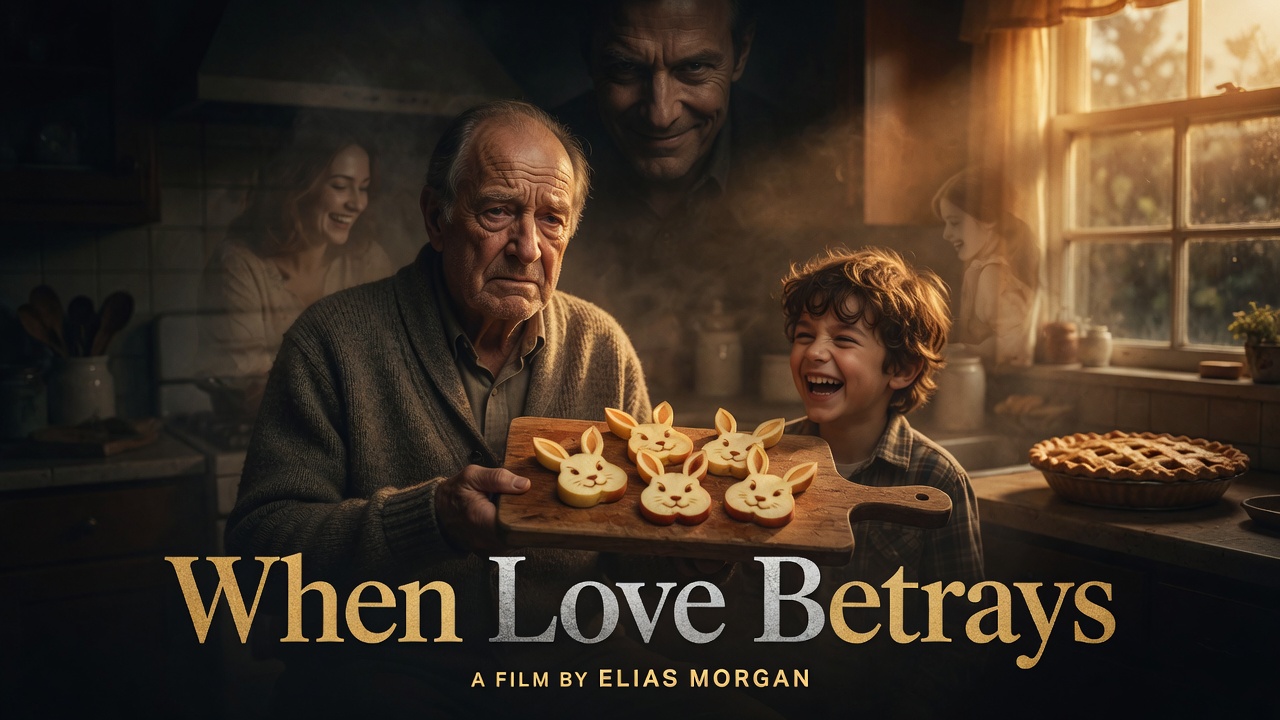
At seventy-one, my fingers were no longer steady enough for delicate work. Still, I stood beneath the yellow light over the kitchen sink and carefully carved two slices of apple into rabbits.
One ear came out longer than the other. The second rabbit looked more like a frightened cat. But when my six-year-old grandson shuffled into the kitchen in dinosaur pajamas, he smiled as if I had placed a feast before him.
“You made the bunnies again,” Stellin said.
“I promised I would.”
He climbed onto his chair and reached for the crooked one.
Across from him, Eleanor’s place remained untouched.
Her white china cup sat on its saucer. A thin ribbon of steam rose from the Earl Grey tea I had poured out of habit. Eleanor had been gone for eight months, yet every morning I still boiled enough water for two.
Grief does not always look like crying.
Sometimes it looks like making tea for a dead woman.
“Can Grandma see the rabbits?” Stellin asked.
I glanced toward the empty chair.
“I think she can.”
“From heaven?”
“From wherever people go when they love us too much to leave completely.”
He considered that answer while chewing.
“Does she know Daddy’s coming today?”
The knife stopped in my hand.
“I expect so.”
Stellin lowered his eyes.
It was such a small movement that another adult might have missed it. But for seven months, I had watched this child breathe, sleep, eat, dream, and wake from nightmares he refused to explain.
I knew every silence.
His father—my only son, Prescott—had been involved in what his attorney called “a temporary legal complication.” There were allegations of financial misconduct at his investment firm, though no charges had yet been filed. Because Stellin’s mother had vanished two years earlier, the family court granted me temporary guardianship.
Prescott insisted it would last only a few weeks.
Seven months later, Stellin still slept in the bedroom overlooking the maple tree.
And every time his father visited, the boy became quieter.
At ten that morning, a black sedan stopped outside.
Prescott emerged wearing a gray suit and the expression he had perfected as a teenager—the confident smile of someone who had already decided how a conversation would end.
He carried a brightly wrapped package for Stellin and a white pharmacy bag for me.
“Dad.”
He embraced me with one arm while looking over my shoulder into the house.
“Prescott.”
Stellin remained near the stairs.
“There’s my champion,” Prescott said.
The boy allowed himself to be hugged, but his arms stayed at his sides.
Prescott pretended not to notice.
The gift was an electronic building set. Too expensive, too complicated, and exactly the kind of present designed to impress a court evaluator rather than a six-year-old.
The pharmacy bag contained a brown bottle labeled DAILY COGNITIVE SUPPORT.
“You look tired,” Prescott said. “These are natural. My doctor recommends them to everyone over sixty.”
“My memory is fine.”
“I didn’t say it wasn’t.”
“You implied it.”
He smiled. “That’s the attorney in you talking.”
“I was a history teacher.”
“Same thing. You both argue about the past.”
He placed the bottle beside the kettle, then began asking questions.
Had the court scheduled another guardianship review?
Had a social worker visited?
Was I keeping Stellin’s medical records updated?
Had I made provisions in my will?
Each question sounded responsible on its own. Together, they felt like an inventory.
As he prepared to leave, Prescott knelt beside his son and whispered something into his ear.
Stellin’s face lost all color.
“What did you say?” I asked.
“Father-son business.”
“Stellin is six.”
“All the more reason a grandfather wouldn’t understand.”
Prescott kissed the top of the boy’s head and left.
For the rest of the afternoon, Stellin barely spoke.
That evening, I swallowed the first supplement with water.
Outside the kitchen window, a figure stood beneath the dead streetlamp at the end of Hawthorne Lane.
The person was too far away to identify. I could only make out the shape of a man in a dark coat.
He appeared to be looking directly at my house.
When I stepped closer to the window, he turned and walked away.
I told myself it was a coincidence.
That was my first mistake.
My second was continuing to take the pills.
Within two weeks, I began misplacing things.
Keys appeared in the refrigerator. The kettle burned dry twice. One afternoon, I drove to collect Stellin from school and could not remember the teacher’s name, though I had spoken to her almost every weekday since February.
Prescott called more often.
“How are you feeling, Dad?”
“Fine.”
“Any dizziness?”
“No.”
“Confusion?”
“Why would you ask that?”
“No reason. I worry about you.”
The man in the dark coat returned three nights later.
Then again the following week.
Sometimes he stood at the end of the street. Sometimes beside the hedge separating my yard from the empty house next door. Once, I found a muddy footprint beneath the back window.
When I called the police, an officer inspected the property and found no sign of forced entry.
“Could be a teenager,” he said. “Could be someone walking a dog.”
“At two in the morning?”
He shrugged.
The house next door had been empty since the previous owner moved into assisted living. Then, on the first Friday in October, a light appeared behind its upstairs window.
A moving van arrived the next morning.
The new resident was a small elderly woman named Cordelia Marsh.
She had silver hair, an ivory-handled cane, and the unsettling habit of looking at people as if they were witnesses who had forgotten they were under oath.
I took her an apple pie.
Cordelia invited me inside but did not touch the pie.
Her house contained only a few boxes, a desk, and three locked metal filing cabinets.
“No family photographs?” I asked.
“I prefer people to tell me who they are before photographs tell me who they used to be.”
That should have warned me she was not an ordinary neighbor.
Instead, I found myself telling her about Eleanor, Prescott, and Stellin.
When I mentioned the man outside, Cordelia’s expression changed.
“What time does he usually appear?”
“Between ten and midnight.”
“Does he approach the doors?”
“Not that I’ve seen.”
“Has your son visited after dark?”
“Not while I was awake.”
Cordelia placed both hands on her cane.
“That was not my question.”
I studied her.
“What do you know?”
“Not enough yet.”
Before I could demand an explanation, Stellin knocked over a glass in the kitchen next door. Cordelia rose faster than her frail appearance suggested.
She found him staring at the broken pieces.
“I’m sorry,” he whispered. “Please don’t tell Daddy.”
“It was an accident,” I said.
But Stellin began crying.
Not the loud cry of a frightened child. It was silent, suffocating panic.
Cordelia crouched before him.
“Stellin, does your father punish you for accidents?”
He shook his head too quickly.
“Did he tell you not to talk about something?”
The boy looked at me.
“Daddy says secrets keep families together.”
My stomach tightened.
“What secret?”
“If I tell, the judge will send me to strangers. And Grandpa will get sick.”
Cordelia’s eyes met mine.
“Has your father come to this house at night?”
Stellin pressed both hands over his mouth.
That was answer enough.
Later, after I put him to bed, I examined the back door.
Fresh scratches surrounded the lock.
I remembered that Prescott still had Eleanor’s old key. He had promised to return it after the funeral.
He never had.
The next morning, an email arrived from the county court.
Prescott had petitioned for full custody of Stellin.
The supporting documents described me as physically fragile, emotionally unstable, and “showing progressive symptoms consistent with cognitive decline.”
Attached were statements claiming I forgot school pickups, left appliances burning, confused medication dosages, and spoke regularly to my dead wife.
Every allegation contained a piece of truth twisted into a weapon.
I did pour Eleanor tea.
I had burned the kettle.
I had forgotten names.
But those problems had begun only after the supplements arrived.
When I showed Cordelia the petition, she read all thirty-eight pages without interruption.
Then she removed her glasses.
“This isn’t a worried son asking for custody,” she said. “This is a file being constructed.”
“How can you tell?”
“Because I spent twenty-two years as a family-court judge.”
I stared at her.
“Why didn’t you tell me?”
“You didn’t ask.”
“Did you know who I was before you moved here?”
She paused.
“That answer requires evidence I’m not yet prepared to show you.”
By sunset, Cordelia had contacted a security installer she trusted. Four discreet cameras were placed around my house—front porch, rear entrance, living room, and kitchen.
She personally adjusted the kitchen camera until it captured the kettle, medicine cabinet, and supplement bottle.
“Why the vitamins?” I asked.
“Because your son mentioned your cognition in a petition before any doctor diagnosed a problem.”
“You think Prescott is doing something to me?”
“I think assumptions make terrible evidence.”
That evening, Stellin woke screaming.
I found him curled beneath his desk.
“He comes when you’re sleeping,” he whispered.
“Who?”
“Daddy. He says it’s special time.”
“What does he do?”
“He asks where Grandma kept papers. He makes me open the back door. He says you’ll forget by morning.”
A cold pressure spread through my chest.
“Has he hurt you?”
Stellin shook his head.
“He squeezes my arm when I cry. He says if I’m bad, you’ll go to a hospital and I’ll never see you again.”
I held him until dawn.
The police listened more seriously this time, but without video of Prescott entering or physical evidence of a crime, they said their options were limited.
Cordelia was furious.
“The system waits for harm to become measurable,” she said. “By then, the damage has often learned to speak in complete sentences.”
Three nights later, she knocked on my door and handed me a sealed envelope.
Her fingers trembled, though her voice did not.
“Open this at ten forty-five.”
“What is it?”
“At eleven, turn off every light and sit behind the front-room curtain.”
“Why?”
“Because someone is coming.”
“Who?”
“You’ll recognize the danger before you recognize the man.”
I tried to open the envelope.
Cordelia stopped me.
“Not yet.”
“This is my house.”
“And that is your grandson upstairs. Whatever you see outside, do not leave. Do not call out. Do not confront anyone.”
“Why should I trust you?”
She looked toward Eleanor’s empty chair.
“Because your wife did.”
At ten forty-five, I opened the envelope.
Inside was a single handwritten note.
Trust the process, not the impulse. At 11:00, watch the man’s hands.
I put Stellin to bed, locked every door, turned off the lights, and sat behind the curtain.
At exactly eleven, a black SUV rolled to the curb without headlights.
A man stepped out.
He was the figure I had seen for weeks.
But this time, he crossed the lawn.
He walked around the house, tested the back gate, examined the kitchen window, and crouched beside the cellar vent. He wore gloves but carried no burglary tools.
Then he approached the porch.
Instead of trying the lock, he raised both hands toward the camera Cordelia had installed.
In his right hand, he held a photograph of Eleanor.
In his left, a small silver key.
He turned the key twice beneath the porch light, placed it inside an envelope, and slid it under my door.
Then he walked away.
I was still staring when a voice spoke behind me.
“His name is Cormarmac Ellery.”
I nearly fell from the chair.
Cordelia stood in the doorway connecting the dining room to the hall.
“How did you get inside?”
“Eleanor gave me a key.”
My anger exploded.
“You have been entering my home?”
“Tonight was the first time.”
“You knew that man?”
“Yes.”
“You let me believe he was threatening us!”
“I allowed Prescott to believe we did not know he was being watched.”
The room seemed to shift beneath me.
“Explain.”
Cordelia sat opposite Eleanor’s empty chair.
“Years ago, I presided over a financial-fraud case involving Prescott. Witnesses withdrew. Records disappeared. The case collapsed. But your wife attended every hearing.”
“Eleanor never told me.”
“She was ashamed of what she suspected about her son.”
“What did she suspect?”
“That Prescott was stealing from elderly clients. That he had forged signatures. That he used intimidation to silence a woman named Levvenia Shaw.”
My hands curled into fists.
“And Cormarmac?”
“He met Eleanor while volunteering at a community food program. He is a retired fraud investigator. She hired him in April.”
“April? She died in January.”
Cordelia looked at me sadly.
“She hired him before she died. His instructions began afterward.”
The envelope beneath the door contained the silver key and the address of a café.
I met Cormarmac there the next morning.
He was sixty-five, broad and weathered, with the posture of someone accustomed to waiting inside parked vehicles.
“You frightened my grandson,” I said.
“That was never my intention.”
“You stalked my home.”
“I watched it.”
“On whose authority?”
“Eleanor’s.”
He placed a photograph on the table.
Eleanor stood beside him outside a church warehouse. She looked thin from chemotherapy but was smiling.
“She believed Prescott was preparing to take control of Stellin and your estate,” Cormarmac said. “She asked me to observe, document, and wait until you were ready.”
“Ready for what?”
“The truth about your son.”
He slid the silver key across the table.
It opened a safe-deposit box registered under Eleanor’s maiden name.
Inside was a USB drive, a handwritten letter, bank records, copies of two wills, and a card bearing Levvenia Shaw’s telephone number.
On the USB was a video recorded three weeks before Eleanor died.
She sat in our bedroom wearing the blue cardigan I had bought for her last Christmas.
“Harlon,” she began, “if you’re watching this, Prescott has moved sooner than I hoped.”
I had imagined hearing her voice again thousands of times.
I had not imagined it warning me about our child.
“I know you will want to confront him,” Eleanor continued. “Please don’t. He plans around anger. Let Cordelia and Cormarmac help you. Protect Stellin first. Grieve the rest later.”
I paused the video because I could no longer see through my tears.
Levvenia agreed to meet us that afternoon.
She was thirty-four, with tired eyes and a scar across one knuckle. She had once worked as Prescott’s office manager—and had been engaged to him before Stellin was born.
“Prescott used client accounts to conceal loans,” she explained. “When I discovered it, he threatened my mother’s house. He said he would accuse me of theft and make sure she lost everything.”
“Why didn’t you go to police?”
“I did. Then documents disappeared, and a witness changed her statement. Your son knows how to make truth look unstable.”
For two years, Levvenia had secretly preserved emails, audio recordings, account ledgers, and photographs.
Among them were messages about my property.
Once the old man is medically compromised, guardianship follows. Control the child, control the estate.
The sender was Prescott.
The recipient was a lawyer named Adrian Vale.
Then Levvenia showed me the wills.
The first document, supposedly signed by Eleanor six months before her death, appointed Prescott executor and gave him authority over my estate if I became incapacitated.
The second was Eleanor’s actual will.
It expressly prohibited Prescott from becoming Stellin’s guardian or controlling any funds intended for the child.
Cordelia examined both.
“The signature on the first is traced,” she said. “The notary stamp was issued after the stated signing date.”
“Can we prove it?”
“The real will was filed under seal with an attorney in Des Moines. Eleanor anticipated this.”
I looked at her.
“You helped her.”
“Yes.”
“You moved next door because she asked you to.”
Cordelia’s eyes softened.
“Not exactly. Eleanor purchased the house.”
The revelation left me speechless.
“She bought it through a trust four months before she died,” Cordelia continued. “She asked me to live there temporarily if Prescott’s plan began. I owed her more than I could ever repay.”
“What did Eleanor do for you?”
Cordelia looked toward the window.
“My daughter died leaving a child behind. Years ago, that child was nearly placed with an abusive relative. Eleanor found evidence everyone else overlooked and brought it to my court. She saved my grandson.”
The frail neighbor had not arrived by coincidence.
She was Eleanor’s final line of defense.
We gave the documents to Detective Mara Whitmore. She listened, studied the recordings, and said what I feared.
“It shows motive and potential fraud. But to prove poisoning or unlawful entry, we need physical evidence.”
I had not used the word poisoning.
Cordelia had.
The next morning, I stopped taking Prescott’s supplements.
I stored the bottle in a plastic bag and replaced it with identical harmless capsules.
Within ten days, the fog in my mind began to lift.
Prescott noticed.
“You sound better,” he said during a phone call.
“I’ve been sleeping more.”
“Still taking the supplements?”
“Every morning.”
A pause.
“Good. Don’t miss any.”
Two nights later, the kitchen camera sent an alert.
At 2:13 a.m., Prescott entered through the back door with Eleanor’s stolen key.
He moved directly to the supplement bottle, removed it, and replaced it with another from his coat.
Then he walked upstairs.
I watched the recording the next morning with my heart hammering.
The hallway camera showed him stopping outside Stellin’s room.
He entered for less than two minutes.
The bedroom itself had no camera. But the microphone in the hallway captured his whisper.
“You keep doing what I told you. Grandpa is getting confused. Soon you’ll come home with me.”
Stellin’s voice trembled.
“I want to stay here.”
“That is not your choice.”
“If I tell Grandpa—”
“He’ll disappear before the judge believes him.”
Prescott left through the kitchen.
The entire visit lasted eleven minutes.
His hand touched the vitamin bottle for eleven seconds.
Those eleven seconds nearly destroyed him.
But we still needed to know what was inside the capsules.
Dr. Howell called me before the laboratory results returned.
“Harlon, I need you at the hospital immediately.”
His office door was closed when I arrived. Two toxicologists waited beside him.
A synthetic compound had been detected in my blood. It was normally prescribed in tightly controlled doses for severe neurological conditions. Taken by a healthy person over time, it could cause memory loss, tremors, disorientation, fatigue, and emotional instability.
“Could it resemble dementia?” I asked.
Dr. Howell nodded.
“That appears to be the purpose.”
“How long have I been exposed?”
“Based on the concentration, six to eight months.”
Stellin had moved into my house seven months earlier.
Prescott had brought the first bottle shortly afterward.
My own son had been slowly poisoning me—not to end my life, but to erase my credibility.
Detective Whitmore obtained an emergency warrant.
The replacement bottle tested positive for the same compound. Prescott’s fingerprints were on the inner seal. Pharmacy records showed prescriptions issued under the name of a deceased client from his investment firm.
Yet Whitmore asked us to wait forty-eight hours.
“We believe Prescott has an accomplice watching the house,” she said. “If we arrest him too early, the forged documents and financial records may disappear.”
The black SUV returned the following night.
This time, Cormarmac photographed the driver.
It was Adrian Vale, Prescott’s attorney.
The next morning, Prescott called.
“I’m coming by this evening.”
“For what?”
“To discuss the hearing.”
“I’m tired.”
“That’s exactly why we need to talk.”
Whitmore listened through a speaker.
“Let him come,” she mouthed.
At seven, Prescott entered carrying a leather folder.
He found Stellin coloring at the kitchen table and me sitting beneath Eleanor’s photograph.
“You look pale,” he said.
“I haven’t been feeling like myself.”
“I warned you this might happen.”
He opened the folder.
Inside was a voluntary guardianship agreement. If I signed it, Prescott would receive immediate custody of Stellin and temporary control of my medical decisions, bank accounts, and property.
“You prepared all this quickly,” I said.
“I’m trying to protect you.”
“From what?”
“From becoming a danger to yourself.”
He placed a pen in my hand.
My fingers did not tremble.
For the first time, Prescott noticed.
His smile faded.
“You stopped taking them.”
“Taking what?”
We stared at each other.
Then Stellin spoke.
“The bad vitamins.”
Prescott turned toward him.
“What did you say?”
The boy shrank in his chair.
I stood between them.
“You will never threaten him again.”
Prescott’s expression changed—not into rage, but calculation.
He looked at the smoke detector where Whitmore had hidden a microphone. Then toward the dark window.
“How much do you know?”
“Enough.”
“Cordelia?”
“Your mother.”
For the first time, real fear crossed his face.
“Mom is dead.”
“And she still outplanned you.”
He grabbed the leather folder and moved toward the door.
Police lights ignited outside.
Prescott froze.
Detective Whitmore entered with three officers.
“Prescott Decker, you are under arrest for intentional poisoning, document forgery, financial fraud, unlawful entry, witness intimidation, and child endangerment.”
He did not resist.
Instead, he smiled toward the kitchen camera.
“You think this ends with me?” he said.
Then he looked at Stellin.
“Ask your grandfather who your mother really was.”
The officers led him away.
Stellin began to cry.
I held him, but Prescott’s final sentence remained in the room.
Ask your grandfather who your mother really was.
I knew almost nothing about Stellin’s mother.
Prescott had introduced her as Marissa Cole. They had never married. After Stellin was born, she struggled with addiction and disappeared. That was the story I had accepted because Eleanor refused to discuss it and Prescott became furious whenever I asked.
Levvenia recognized the name immediately.
“Marissa Cole wasn’t her real name,” she said.
She opened one of Eleanor’s encrypted files.
The woman who gave birth to Stellin was named Julia Marsh.
Cordelia’s face went white.
“No,” she whispered.
Julia Marsh had been Cordelia’s granddaughter—the child Eleanor once helped save from an abusive relative.
Years later, Julia met Prescott while working at his firm. When she discovered his fraud, she planned to testify. Prescott discredited her, forged medical records suggesting addiction, and used his influence to isolate her.
Then she vanished.
Cordelia had spent five years believing Julia had run away.
Eleanor had discovered the truth shortly before her cancer diagnosis.
Prescott had hidden Stellin’s maternal identity so Cordelia could never claim kinship or investigate his custody.
The neighbor who moved in to protect my grandson was not a stranger.
She was his great-grandmother.
When we told Stellin, he looked from Cordelia to me.
“Does that mean I have two grandpas and another grandma?”
Cordelia knelt, tears streaming down her face.
“It means more people love you than you knew.”
But the discovery raised a darker question.
What had happened to Julia?
Prescott refused to answer.
Adrian Vale attempted to destroy records but was arrested at a private storage facility. Inside, police found forged wills, stolen client documents, medication records, and a sealed box labeled J.M.
The box contained Julia’s passport, a necklace, hospital documents, and letters written to Stellin.
She had not abandoned him.
Prescott had intercepted every letter.
Julia was alive.
With help from Eleanor, she had entered a confidential witness-protection program after agreeing to testify in a federal financial investigation. But the case was compromised when Adrian Vale leaked her location. Fearing Prescott would find her, Julia remained hidden and communicated only through Eleanor.
When Eleanor became ill, the communication stopped.
Prescott used the silence to convince everyone Julia had relapsed and disappeared.
Federal agents located her in Oregon three weeks after the arrest.
She returned to Iowa under protection.
At our first meeting, Stellin hid behind my leg.
Julia did not rush toward him. She sat on the floor several feet away and placed a small wooden train between them.
“I’m your mother,” she said. “But you don’t have to call me that until you want to.”
Stellin studied her.
“Did you leave me?”
“No.”
“Daddy said you didn’t want me.”
Julia closed her eyes.
“I wanted you every day.”
Stellin crossed the room slowly.
When he touched her face, Julia broke.
So did Cordelia.
So did I.
Prescott’s trial began eleven months later.
Cordelia presented the authentic will and explained the forged documents. Cormarmac described Eleanor’s investigation and the surveillance Prescott had ordered. Levvenia played recordings of Prescott threatening her family.
Dr. Howell explained how the drug had been used to imitate cognitive decline.
The jury watched the eleven-second kitchen video three times.
Then Julia testified.
Prescott looked at her for the first time in five years.
“You were supposed to stay gone,” he muttered.
The courtroom microphone captured every word.
Julia did not look away.
“You confused silence with surrender.”
The prosecution revealed that Prescott’s motive extended beyond custody.
Eleanor had created a $3.8 million educational trust for Stellin. If I became incapacitated and Prescott obtained custody, he could petition to control those funds. He also planned to refinance my house, liquidate Eleanor’s investments, and blame every transaction on my supposed dementia.
Adrian Vale had prepared a medical affidavit before I experienced a single symptom.
The poisoning had not been an act of desperation.
It had been scheduled.
Prescott was convicted of intentional poisoning, financial exploitation, forgery, witness intimidation, child endangerment, and conspiracy. The judge imposed consecutive sentences totaling forty-two years.
Before the officers took him away, Prescott finally looked at me.
“You chose strangers over your son.”
“No,” I said. “I chose the people who protected your child.”
He turned toward Stellin.
The boy moved closer to Julia and took her hand.
Prescott’s face hardened.
Then he was gone.
That night, after the trial, I finally watched the remainder of Eleanor’s video.
She looked exhausted. Her voice was barely above a whisper.
“Harlon, if we were lucky, Prescott was stopped before Stellin learned to fear everyone who loved him. If we were not, be patient with the boy. Fear leaves slowly.”
She paused to catch her breath.
“I am sorry I kept so much from you. I knew you would confront Prescott, and he would use your anger to portray you as unstable. You have always believed love means standing in front of danger. Sometimes love means standing still until danger reveals its face.”
I pressed my hand to the screen.
“Do not let rage consume what remains of our family,” she continued. “Prescott made his choices. Stellin did not. Julia did not. Neither did you.”
Then Eleanor smiled.
“And please stop pouring tea for me every morning. Earl Grey was always your favorite. I only drank it because you made too much.”
I laughed and cried at the same time.
One final file remained on the USB.
It was addressed to Cordelia.
We watched it together.
“Dear Cordelia,” Eleanor said, “if you are hearing this, then Harlon finally followed instructions without arguing. That alone proves miracles are possible.”
Cordelia laughed through her tears.
“Stellin will need both of you,” Eleanor continued. “One of you knows how to challenge a system. The other knows how to cut apples into rabbits. Between those skills, I believe the boy has a chance.”
Spring came late that year.
My blood tests gradually returned to normal. The tremor disappeared. My memory sharpened. There were still mornings when I entered a room and forgot why, but Dr. Howell assured me that was age—not poison.
Julia rented the house Cordelia had occupied next door.
We did not force Stellin into a new life. He continued sleeping in his room beneath the maple tree. Julia joined us for breakfast, school pickups, and counseling sessions. Trust returned in small pieces.
One morning, Stellin asked her to cut the apple rabbits.
She made four.
They looked worse than mine.
Stellin laughed so hard that milk came through his nose.
Cordelia became “Grandma Cora.” Cormarmac taught Stellin to fish. Levvenia helped authorities recover money for dozens of Prescott’s elderly victims.
Our family no longer resembled the one Eleanor and I had imagined.
It was stranger, more wounded, and held together by choices rather than appearances.
Then, on the anniversary of Eleanor’s death, Detective Whitmore brought me one final item recovered from Prescott’s office.
It was a sealed envelope in his handwriting.
On the front were the words:
OPEN AFTER MY FATHER IS DECLARED INCOMPETENT.
Inside was a prepared statement claiming I had confessed to poisoning myself.
Prescott planned to tell the court that grief had made me unstable, that I had taken the medication deliberately, and that I had coached Stellin to fear him.
Attached was a photograph of me pouring pills into my palm.
The photograph had been taken through the kitchen window by Adrian Vale.
For months, the man at the end of the street had not merely been watching whether the poison worked.
He had been constructing an alternate truth.
Had Cordelia not installed the camera, had Cormarmac not documented the surveillance, had Eleanor not preserved the real will, Prescott might have succeeded.
I could have spent my remaining years in a locked memory-care facility, insisting I had been framed while everyone interpreted the truth as another symptom of dementia.
Stellin would have been returned to the man who terrified him.
Julia would have remained hidden.
Cordelia would never have known her great-grandson lived next door.
That was Prescott’s final plan.
But it was not the final twist.
Tucked behind his false statement was a handwritten note from Eleanor.
Prescott had apparently stolen it from her desk but never understood its meaning.
It read:
If Harlon sees the man at eleven, Cordelia will know the cameras are working. If he obeys and stays inside, he is ready to learn the truth. If he runs outside, wait. He is still grieving like a husband instead of thinking like a guardian.
The mysterious night had never been designed merely to expose the watcher.
It had been a test for me.
Eleanor knew my instincts better than anyone. She knew I would chase danger without considering that Stellin might be left alone inside. She needed to know whether grief still controlled me—or whether I had become the guardian our grandson required.
For once, I had stayed.
That choice opened the door to everything that followed.
Now, each morning, I still place Eleanor’s cup on the table.
But I no longer pour tea into it.
The empty cup does not represent a woman waiting to return.
It reminds me that someone can be absent and still leave behind a plan strong enough to protect the living.
Stellin sits beside Julia. Cordelia complains that my toast is too dark. Cormarmac sometimes appears without knocking. Our kitchen is noisier than it was before, crowded with people who share different names, different histories, and the same determination that one frightened child will never again be used as leverage.
Prescott believed blood entitled him to loyalty.
Eleanor understood something deeper.
Family is not the person who whispers, “Keep my secret or something bad will happen.”
Family is the person who leaves the light on next door.
Family is the woman who waits years to hold a great-grandchild she never knew existed.
Family is the investigator who watches from the end of the street, the witness who preserves documents despite threats, the mother who crosses half a country to tell her child she never stopped wanting him.
And sometimes, family is a dying woman who arranges every piece on the board, knowing she will not live to see whether the people she loves survive the game.
Stellin occasionally asks whether his father loved him.
I do not lie.
“I think he loved possessing people,” I say. “That is not the same as caring for them.”
“Can bad people love?”
It is a difficult question for a six-year-old.
It is an even harder one for a father.
“Maybe,” I tell him. “But love that hurts you, frightens you, or steals your choices is not love you must accept.”
He thinks about that.
Then he reaches for another apple rabbit.
The house is peaceful again, but it is not the peace of ignorance.
It is the peace that comes after locks have been changed, lies have been named, and frightened people have discovered they are no longer alone.
I am seventy-two now.
I move more slowly. I sometimes forget where I put my glasses. My knees ache before it rains.
But every night, before I turn off the kitchen light, I look through the window toward the house next door.
A year ago, that window was dark.
Then a frail old woman moved in, handed me a sealed envelope, and told me to look outside at eleven.
I thought she was warning me about the stranger in the street.
I was wrong.
She was warning me about the stranger my own son had become.
And she was showing me the family waiting in the darkness to help us survive him.