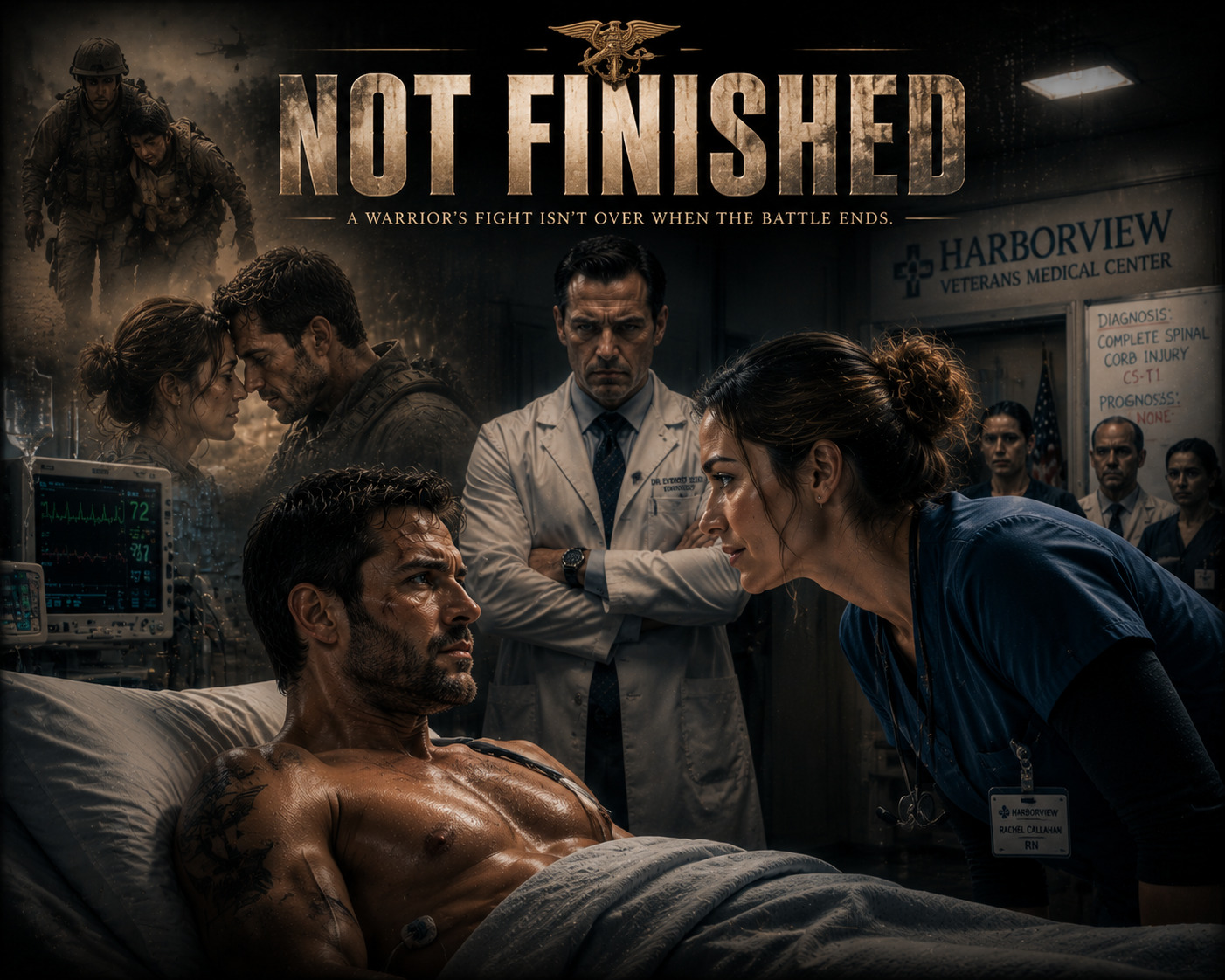
Chapter One: Room 412
The first person to call Gabriel Mercer a waste of a bed was standing close enough for him to hear it.
“He’s been here eleven months,” Dr. Adrian Kessler said, flipping through the chart as though the man beneath the blankets were an unpaid invoice. “No measurable progress. No functional speech. No voluntary movement below the neck. He refuses therapy, frightens the staff, and costs this hospital more every week than three ambulatory patients combined.”
Rain hammered the windows of Harborview Veterans Medical Center. Beyond the glass, Puget Sound had disappeared beneath a sheet of iron-colored weather. The room smelled of antiseptic, old coffee, and the faint medicinal sweetness of the feeding formula dripping into Gabriel’s abdomen.
Eight people stood around his bed.
Not one looked directly at him.
Gabriel lay perfectly still beneath a white thermal blanket. At forty-one, he should have looked young. Instead, immobility had sharpened him. His cheeks were hollow. Silver threaded the dark hair at his temples. A pale scar disappeared beneath the collar of his hospital gown.
Only his eyes moved.
Gray-green, clear, and merciless.
They followed each speaker in turn.
Administrator Elaine Ward crossed her arms over a tailored cream jacket. “Evergreen Long-Term Care has agreed to take him.”
The social worker shifted uneasily. “They specialize in chronic neurological patients, not combat trauma.”
“They specialize in accepting federal reimbursement rates.”
Gabriel’s eyes moved to Elaine.
She noticed.
Her voice lowered. “That look is exactly why half the nurses refuse to enter the room alone.”
“He can’t move,” a young resident said.
“His eyes can.”
A few people laughed.
The sound was brief, embarrassed, and cruel enough to fill the whole room.
At the back of the group stood Mara Voss in bright blue scrubs, holding a basin of warm water.
She had been a nurse on the fourth floor for six weeks.
Most employees knew three things about her.
She was thirty-eight.
She spoke so quietly that people often leaned closer without realizing it.
And she never joined a conversation in the break room unless someone asked her a direct question.
She was not the kind of woman administrators remembered after meetings. Her brown hair stayed twisted into the same low knot. She wore no wedding ring, no perfume, no makeup except a thin layer concealing the pale burn marks along her left jaw.
The charge nurse called her “steady.”
The younger nurses called her “creepy calm.”
Dr. Kessler barely called her anything.
Mara looked at Gabriel.
His eyes were fixed on the transfer form in Elaine Ward’s hand.
A muscle fluttered once beneath his right eyelid.
Not random.
Not fear.
A signal.
Kessler closed the chart. “Transfer him Friday morning.”
Gabriel’s breathing changed.
The ventilator was no longer breathing for him, but the soft nasal oxygen amplified every ragged inhale. His heart monitor climbed from eighty-four to one hundred and six.
The resident reached for a syringe.
“He’s escalating.”
Mara stepped forward. “What are you giving him?”
“Lorazepam.”
“He’s already received two milligrams.”
The resident glanced at the medication record. “Four hours ago.”
“One hour and seventeen minutes ago.”
Kessler looked at her for the first time. “Nurse Voss, this is a medical planning conference.”
“I know.”
“Then allow the physicians to plan.”
Mara placed the basin on the counter.
Gabriel’s heart rate climbed again.
His left eye closed once.
His right remained open.
Then the pattern repeated.
Left. Right. Left.
Mara stopped breathing for half a second.
She had last seen that signal beneath green tactical lights in the belly of a C-130 transport aircraft.
Three taps meant hostile observation.
Left-right-left meant do not trust the room.
The resident uncapped the syringe.
Gabriel forced air through his throat.
A broken sound emerged.
Everyone turned.
His lips trembled.
“Cin…”
The word collapsed in his chest.
The resident leaned closer. “What did he say?”
Gabriel swallowed. Pain tightened every line of his face.
“Cin…der.”
Elaine frowned. “Is that a person?”
No one answered.
No one except Mara understood that Cinder was not a person.
Cinder was a burned extraction point on a rocky peninsula five thousand miles away.
Cinder was the code word transmitted fourteen minutes before six American operators vanished from every official record.
Mara crossed the room and bent beside Gabriel.
His eyes widened when he saw her face clearly.
She spoke so softly that the others had to stop moving to hear.
“Rook.”
The heart monitor skipped.
Gabriel stared at her.
Mara leaned closer.
“Rook, this is Nightingale. I see you.”
For eleven months, the paralyzed Navy SEAL in room 412 had refused to cry.
One tear slid from the corner of his eye and disappeared into his hair.
Behind Mara, Dr. Kessler dropped the chart.
Chapter Two: The Name That Should Not Exist
The folder struck the tile with a flat slap.
Kessler recovered first.
“What did you call him?”
Mara did not look away from Gabriel. “His call sign.”
“His records contain no call sign.”
“His records contain almost nothing.”
Elaine Ward bent to retrieve the folder. “Chief Mercer served with Naval Special Warfare. Call signs are hardly unusual.”
“Rook isn’t in his file,” Kessler said.
Mara finally turned.
The doctor stood near the foot of the bed, one hand pressed against his silver tie. He was fifty-eight, tall and spare, with the composed face of a man accustomed to delivering devastating news in complete sentences.
He had spent twenty-two years in military medicine before becoming Harborview’s director of neurological rehabilitation. Photographs of him shaking hands with presidents, senators, and wounded veterans lined the main corridor.
His reputation had been built on one promise.
No warrior left behind.
His eyes now held something that had nothing to do with surprise.
Recognition.
Mara saw it and knew he saw her seeing it.
The resident looked between them. “Do you two know each other?”
“No,” Kessler said.
Mara answered at the same time.
“Yes.”
The room fell silent.
Gabriel’s pulse accelerated.
Kessler stepped toward her. “Nurse Voss, outside.”
“I’m caring for my patient.”
“He is not assigned to you.”
“He is now.”
Elaine gave a humorless laugh. “That isn’t how assignments work.”
Mara pulled the blanket away from Gabriel’s right shoulder.
The skin beneath his gown was red and broken.
A pressure injury the size of a quarter darkened the ridge of his shoulder blade.
The social worker covered her mouth.
Mara lifted the oxygen tubing. Another wound had formed beneath the plastic at his ear.
“These aren’t in the chart,” she said.
Kessler’s face hardened. “That is a nursing failure.”
“These wounds are at least ten days old. The skin assessments were copied forward without examination.”
The charge nurse, Lydia Shaw, glanced down at the floor.
Mara turned Gabriel’s wrist carefully.
Four fresh puncture marks dotted the inside of his arm.
“His medication record shows two injections this week. There are four marks.”
The resident’s face lost color.
Elaine closed the transfer folder. “This meeting is over.”
“No,” Mara said.
The single word stopped her.
Mara rarely raised her voice. She did not raise it now.
That made the refusal feel heavier.
Gabriel’s eyes moved toward the small whiteboard beside the bed.
Mara followed his gaze.
The board had been positioned beyond his line of sight. On it, someone had written:
GOALS: REDUCE AGGRESSION. ACCEPT PLACEMENT. COOPERATE.
Nothing about pain.
Nothing about communication.
Nothing about returning to the world.
Mara moved the board until Gabriel could see it.
His eyes fixed on the word cooperate.
His jaw trembled.
“You’ve been calling him noncompliant,” Mara said. “How does he communicate consent?”
Kessler clasped his hands behind his back. “We have attempted eye-tracking devices.”
“Attempted?”
“He rejected them.”
Gabriel blinked twice.
No.
Mara looked at him. “They didn’t work?”
One blink.
Yes.
“Because you couldn’t control them?”
One blink.
“Because they were taken away?”
One blink.
Lydia Shaw whispered, “He understands everything.”
Gabriel’s eyes shifted to her with such force that she stepped back.
Mara looked toward the ceiling camera.
“Who reviews the footage from this room?”
Elaine answered too quickly. “Security.”
“Is there audio?”
“No.”
Gabriel blinked twice.
Mara’s skin went cold.
She bent beside him again. “There is audio?”
One blink.
Kessler moved between them.
“That is enough.”
Mara straightened.
He lowered his voice. “You are interpreting involuntary eye movement as communication because you have developed an emotional fixation.”
“I’ve been in this room for eleven minutes.”
“Long enough to call him by a classified name.”
The word classified slipped out before he could stop it.
Elaine Ward turned toward him.
“You said it was not in his records.”
Kessler’s mouth tightened.
Gabriel forced another sound through his throat.
“Ech…”
Mara bent close.
His breath touched her ear.
“Echo.”
His eyes moved toward the wall behind his bed.
Then he whispered two more words.
“Still… alive.”
Mara looked at the featureless wall.
Echo had been the youngest operator on the Cinder mission.
Petty Officer Jonah Bell.
Twenty-four years old.
Officially killed in a helicopter crash seven years earlier.
Mara had held his dog tags while his mother stood over an empty casket.
Kessler reached for the call button.
Mara caught his wrist.
Not hard.
Just enough to stop him.
Everyone stared.
Kessler looked down at her hand.
Mara released him.
“The patient just identified a missing service member.”
“The patient produced two sounds.”
“He said Echo is alive.”
“You heard what you wanted to hear.”
Gabriel’s gaze locked on Kessler.
The monitor climbed.
Kessler pressed the call button.
“Security to room 412.”
Mara looked at him. “Why are you afraid of a man who cannot move?”
Kessler’s expression did not change.
But a drop of sweat slid from his temple.
“Because,” he said, “men like Gabriel Mercer rarely need to move in order to destroy things.”
Chapter Three: Nightingale
Security escorted Mara from the room in full view of the nursing station.
No one touched her.
They did not need to.
Twenty employees watched as she walked between two uniformed officers, her badge turned backward against her chest. Someone near the medication cart whispered, “What did she do?”
Another voice answered, “Threatened Dr. Kessler.”
By the time the elevator doors closed, the story had already become more dramatic than the truth.
Mara had attacked a physician.
Mara had triggered a psychotic veteran.
Mara had lied about serving with special forces.
She heard the rumors travel through the corridor behind her.
Humiliation had a sound.
It was not laughter.
It was the lowering of voices when the person being discussed passed close enough to hear.
The officers took her to a conference room on the administrative floor. The windows overlooked wet rooftops and the dark water beyond the city. A framed flag hung on one wall. On another, donors’ names had been etched into brass plates.
Elaine Ward sat at the head of the table.
Kessler stood at the window.
Human Resources joined by video screen.
Mara remained standing.
Elaine placed Mara’s personnel file on the table. It was noticeably thin.
“Mara Voss,” she read. “Registered nurse. Trauma certification. Previous employment at private surgical centers in Arizona, Nevada, and Maryland. No military service listed.”
“That is correct.”
“You addressed Chief Mercer as though you had served with him.”
“I knew him.”
“In what capacity?”
“I’m not authorized to discuss it.”
Elaine stared at her.
“You are a probationary nurse in a veterans hospital, not an intelligence officer.”
Mara said nothing.
Kessler turned from the window.
The rain behind him streaked the glass like scratches.
“What do you believe happened to Mercer?”
“I believe he has been systematically sedated, isolated, and denied reliable communication.”
“Why?”
“To make him appear incompetent.”
“And what do you imagine he knows?”
Mara looked at him.
“You tell me.”
The human resources director cleared her throat through the screen. “This is not productive.”
Elaine folded her hands. “Nurse Voss, I’m offering you a clean exit. Resign today. We will not report the physical contact with Dr. Kessler to the licensing board.”
“I stopped him from sedating a patient without consent.”
“You grabbed a physician.”
“I prevented another undocumented injection.”
Kessler’s expression sharpened.
Elaine leaned back. “You have no proof.”
“Then preserve the camera audio.”
No one answered.
Mara saw the answer in the silence.
The audio would disappear.
Perhaps it already had.
Elaine slid a resignation form across the table.
Mara did not touch it.
Kessler moved closer.
“Take the offer.”
His voice was almost kind.
That made her angrier than a threat would have.
“You abandoned him once,” Mara said. “Wasn’t that enough?”
Kessler’s eyes flicked toward the security camera in the corner.
He understood the warning.
Do not answer here.
He placed both palms on the table.
“You were not at Cinder.”
Elaine looked up.
Mara felt the old heat rise beneath the scar along her jaw.
The smell of jet fuel.
Burning rubber.
Salt water turning black beneath a moonless sky.
She heard Gabriel’s voice in her memory.
Nightingale, stay with the bird.
The bird had been a twelve-year-old girl wrapped in a silver emergency blanket, shaking so hard her teeth cut her lower lip.
Mara had stayed.
Gabriel had gone back for Echo.
Then the shoreline had turned white with fire.
Mara’s hands remained still at her sides.
“You saw my face,” she said.
“I saw a medic pulled from the water.”
“You signed my death certificate.”
Elaine’s head turned toward Kessler.
The doctor did not deny it.
For the first time, the woman from Human Resources looked frightened.
Mara continued.
“You listed me as unidentified allied personnel. You removed my testimony from the mission review. Then you told me every member of the team had died.”
Kessler’s jaw tightened.
“That operation prevented a regional war.”
“That sentence has buried a great many bodies.”
Elaine pushed back from the table. “What operation?”
Kessler looked at her.
“Leave the room.”
“I run this hospital.”
“No. You run its finances.”
The contempt in his voice stunned her.
Kessler waited until Elaine and the security officers stepped into the hallway. The video screen went dark.
He closed the blinds.
Then he sat across from Mara.
The great Dr. Adrian Kessler suddenly looked less like a famous physician and more like a tired military officer who had spent too many years sleeping beside locked doors.
“Gabriel was never supposed to come here,” he said.
Mara remained standing.
“Where was he supposed to go?”
“A secure rehabilitation facility.”
“Where?”
“It no longer exists.”
“Echo.”
Kessler looked toward the dark screen.
“Jonah Bell survived Cinder.”
Mara’s heartbeat became a hammer.
“Where is he?”
“I don’t know.”
“You expect me to believe that?”
“I expect nothing from you.”
Kessler’s gaze dropped to her scar.
“He disappeared eighteen months ago. Three months later, Gabriel’s transport convoy was attacked. He arrived at Harborview paralyzed and unable to speak.”
“Who attacked him?”
“I don’t know.”
“You keep saying that.”
“Because ignorance is the only reason I am still alive.”
The blinds trembled as wind struck the windows.
Mara sat slowly.
Kessler leaned toward her.
“Cinder was not a rescue mission.”
She said nothing.
“It was a field trial.”
The room seemed to contract around them.
“For what?”
His eyes held hers.
“A system designed to control whether wounded soldiers could move.”
Before Mara could speak, the conference room door opened.
Lydia Shaw stood in the hallway, pale and breathless.
“Chief Mercer is crashing.”
Kessler rose.
Lydia did not move aside.
“He asked for Nightingale.”
Chapter Four: The Body Remembers
Gabriel’s room had filled with people again.
This time, none were laughing.
His oxygen saturation had fallen to eighty-two percent. His face had turned gray. The muscles in his neck strained with each breath.
A respiratory therapist prepared for emergency intubation.
Mara reached the bed and looked at the monitor.
Blood pressure dropping.
Heart rate slowing.
His pupils were small.
Too small.
“What was he given?”
The resident from the morning stood near the medication cart. “Nothing.”
Mara grabbed the chart.
There was no new entry.
She opened Gabriel’s gown.
A small adhesive patch had been placed beneath his left collarbone.
No label.
No hospital barcode.
Kessler saw it and stopped.
Mara tore the patch away.
Gabriel’s heart rate jumped.
“What is it?” Lydia asked.
Kessler took the patch from Mara’s fingers.
His face became rigid.
“A transdermal neuromuscular suppressant.”
The respiratory therapist stared at him. “We don’t stock that.”
“No,” Kessler said. “We don’t.”
Gabriel dragged in a deeper breath.
His oxygen level began to rise.
Mara examined the patch.
A tiny black symbol had been printed on the underside.
A circle divided by a vertical line.
She had seen it before on sealed equipment crates loaded aboard the Cinder transport.
“Project Helix,” she said.
Kessler crushed the patch in his fist.
The resident stepped backward.
Elaine Ward appeared at the door with two security officers.
“Why is she back on this floor?”
Mara ignored her.
Gabriel’s gaze found Mara’s face.
His lips moved.
She leaned close.
“Four… twelve.”
“You’re in room 412.”
His eyes closed once.
No.
He repeated the number.
“Four… twelve.”
Kessler went still.
Mara looked at the room number above the door.
Then at him.
“What does it mean?”
Kessler did not answer.
Gabriel’s eyes moved toward the clock.
4:12 p.m.
The second hand ticked across the white face.
Lydia whispered, “It’s 3:58.”
Mara understood.
Something would happen in fourteen minutes.
She bent beside Gabriel. “Is someone coming?”
One blink.
“Hospital staff?”
Two.
“Military?”
Two.
“Contractor?”
One.
Kessler backed toward the door. “We need to move him.”
Elaine blocked him. “He is scheduled for transfer Friday.”
“He will be dead by Friday.”
The administrator’s expression changed.
Not compassion.
Calculation.
A dead Navy SEAL inside Harborview would be harder to explain than an expensive one.
“What do you need?”
“Secure elevator. Surgical wing. No electronic charting.”
Mara looked at Gabriel. “He doesn’t want to move.”
Kessler snapped, “His preference is irrelevant if someone intends to kill him.”
Gabriel’s eyes burned.
Mara leaned closer.
“You trust me?”
One blink.
“Do you trust Kessler?”
A long silence.
Then one blink.
Mara looked up.
Kessler’s face revealed no relief.
Only shame.
They moved Gabriel through a service corridor toward the old surgical wing. Rainwater rattled through pipes overhead. The hospital lights flickered as the storm pressed against the city.
At 4:06, every elevator stopped.
At 4:08, the electronic medical record went offline.
At 4:10, fire doors closed across the fourth floor.
At 4:11, the security cameras turned toward the walls.
Mara pushed Gabriel’s bed while Lydia managed the oxygen tank. Kessler walked ahead with a portable monitor.
Elaine had remained behind to call federal authorities.
No one knew whether she had succeeded.
They reached the old surgical wing at 4:12.
The doors opened from the inside.
Three men in dark maintenance uniforms stood waiting.
The first carried a tool case.
The second held a compact pistol with a suppressor.
The third wore an employee badge belonging to a janitor who had died two years earlier.
Kessler stopped.
The armed man lifted the pistol.
Gabriel’s eyes snapped toward Mara.
Left. Right. Left.
Mara shoved the bed sideways.
The first shot shattered the oxygen regulator.
Gas screamed into the corridor.
Lydia dropped behind the bed.
Kessler threw the portable monitor at the gunman. The machine struck his wrist. The pistol fired again, punching into the wall.
Mara seized the oxygen cylinder before it fell, released the valve fully, and rolled it down the corridor.
The steel tank spun beneath the men’s feet, blasting freezing vapor.
The gunman lost his balance.
Kessler lunged.
He was nearly sixty, unarmed, and still fast enough to drive his shoulder into the man’s chest.
They crashed against the wall.
Mara pulled Gabriel’s bed through the surgical doors. Lydia followed, blood running from a cut above her eyebrow.
A third shot struck the door frame.
The old surgical wing had no patients. Half the ceiling lights were dead. Plastic sheeting covered abandoned equipment. Dust swirled beneath red emergency lamps.
“Lock it,” Mara said.
Lydia hit the manual lever.
Steel doors began to close.
Kessler rolled through the narrowing gap.
The gunman reached after him.
The door caught the man’s arm.
He screamed.
Lydia slammed the emergency stop, trapping him at the elbow.
Mara removed the pistol from his hand.
She had not held a weapon in seven years.
Her fingers remembered before the rest of her did.
Magazine.
Chamber.
Safety.
The gunman looked at her stance and stopped struggling.
Recognition crossed his face.
“Nightingale.”
Kessler stared at him.
Mara pointed the weapon toward the floor.
“Who sent you?”
The man smiled through clenched teeth.
“Echo.”
Gabriel’s monitor began to alarm.
His eyes rolled back.
Beneath his gown, something started vibrating inside his spine.
Chapter Five: Helix
Gabriel arched against the mattress.
For eleven months, his body had shown almost no voluntary movement.
Now every muscle contracted at once.
His shoulders lifted from the bed. His fingers curled. His legs strained beneath the blanket so violently that one heel struck the rail.
Lydia stared.
“He’s moving.”
“He’s seizing,” Kessler said.
“No.”
Mara pressed her palm against Gabriel’s chest. Beneath his skin, just below the scar at the base of his neck, a hard object pulsed.
An implant.
The vibration traveled through bone.
“Helix,” she said.
Kessler tore open an emergency cabinet. “Find me a surgical magnet.”
“This wing has been closed for six years.”
“Then find anything magnetic.”
Lydia ran.
The trapped gunman laughed behind the door.
“You can’t stop it.”
Mara pressed the pistol against the steel beside his face.
“Watch me.”
She searched his tool case.
Wire cutters.
Encrypted radio.
A black handheld controller displaying a pulsing circle divided by a line.
Kessler took it.
The screen showed a countdown.
00:43.
“What happens at zero?” Mara asked.
The gunman smiled.
“He becomes proof the program never worked.”
Gabriel’s body convulsed again.
Blood appeared at his nostril.
Kessler tried to interrupt the signal, but the controller demanded a biometric key.
“Whose?” Mara asked.
“Mine.”
The gunman lifted his chin.
Mara placed his thumb against the scanner.
ACCESS DENIED.
He laughed harder.
Kessler looked at the symbol.
“It isn’t keyed to field personnel.”
The countdown reached thirty-two seconds.
Mara looked at Gabriel.
His eyes had opened.
He was watching the controller.
His gaze moved toward Kessler.
Then toward the gunman.
Then toward Mara.
Blink.
Blink.
Blink.
Three equal signals.
Team code.
Third option.
There was always a third option.
Mara opened the back of the controller. Fine wires connected the battery to the transmitter board.
“Cut the power?” Lydia asked, returning with a heavy surgical magnet.
“No,” Kessler said. “The implant will interpret signal loss as a hostile shutdown and discharge at maximum output.”
The countdown reached twenty seconds.
Mara looked at the gunman’s radio.
Same symbol.
Same signal band.
She turned both devices over.
The radio battery had a manual pulse setting.
“What frequency does Helix use?”
Kessler shook his head. “It changes every five seconds.”
“It follows the controller?”
“Yes.”
“Then it expects one command.”
Mara connected the radio leads directly across the controller’s transmitter.
Kessler understood.
“You’ll create a loop.”
“An echo.”
The trapped gunman stopped smiling.
At nine seconds, Mara activated the radio.
The controller flashed.
UNKNOWN COMMAND.
At six seconds, the implant beneath Gabriel’s skin pulsed so hard the monitor leads jumped.
At three, the controller produced a second signal identical to its own.
The countdown froze.
The screen went black.
Gabriel collapsed onto the mattress.
For one second, no one moved.
Then his right hand opened.
Slowly.
Deliberately.
His fingers spread against the sheet.
Lydia covered her mouth.
Gabriel stared at his own hand.
He moved his index finger.
Once.
Then again.
Mara touched his fingertips.
The motion was weak enough to be mistaken for a tremor.
It was also the first voluntary movement documented since his injury.
Gabriel looked at Kessler.
The doctor sat beside the bed, breathing hard.
“You knew,” Mara said.
Kessler did not deny it.
“You knew the implant was still active.”
“I believed it had been disabled.”
“You built it.”
“I helped design the neural interface.”
The trapped gunman spoke through the door.
“He designed the cage.”
Kessler closed his eyes.
Helix had begun as a battlefield medical system. A network of microscopic leads implanted around damaged spinal pathways could translate neural intention into electrical movement.
A paralyzed soldier might lift a hand.
Stand with assistance.
Breathe without a machine.
Then someone inside military intelligence recognized the other half of the equation.
Anything that could create movement could suppress it.
The same system that returned control could take it away.
Project Helix shifted from medicine to command.
Soldiers carrying the implant could be immobilized remotely if captured, compromised, or considered dangerous.
“Cinder was the first live operational trial,” Kessler said.
Mara’s voice became cold. “You implanted the team without telling us.”
“I was told every operator had consented.”
“Did you verify it?”
His silence answered.
Gabriel’s finger moved beneath hers.
One letter at a time, he traced against her palm.
E.
C.
H.
O.
Mara looked toward the trapped man.
“You said Jonah sent you.”
The gunman met her eyes.
“He wants Mercer alive.”
“You put a kill patch on him.”
“To force you to activate the implant.”
Kessler stood. “Why?”
The man’s smile returned.
“Because now it has transmitted its location.”
A low mechanical thump rolled through the ceiling.
Mara recognized it instantly.
Rotor wash.
A helicopter had landed on Harborview’s roof.
Chapter Six: The Dead Man on the Roof
The helicopter carried no military markings.
It crouched above the hospital like a black insect, rotors chopping rain into silver sheets. Wind tore across the rooftop, flattening coats and driving water beneath doors.
Mara stepped onto the landing pad with the pistol concealed beneath a surgical blanket.
Behind her, Lydia pushed Gabriel’s bed. Kessler walked beside the IV pole.
They had left the trapped gunman inside the surgical corridor with his injured arm secured to the door. Hospital security remained unreachable.
The rooftop access door slammed shut behind them.
A man emerged from the helicopter.
He wore a dark wool coat over a black sweater. His hair had gone almost completely white, though he was only thirty-one.
His left leg ended below the knee.
He crossed the wet concrete on a carbon-fiber prosthesis.
Mara knew him before he came close enough for the floodlights to show his face.
Jonah Bell.
Echo.
The dead operator whose mother had buried an empty casket.
He stopped ten feet from Gabriel.
For a moment, the storm disappeared from his expression.
He looked at his former team leader with the grief of a younger brother who had taken too long to come home.
“Rook.”
Gabriel’s right index finger lifted from the blanket.
Jonah looked at Mara.
“Nightingale.”
She pulled the pistol.
He raised both hands.
“If I wanted you dead, I would have left the implant running.”
“You sent armed men into a veterans hospital.”
“I sent a recovery team.”
“They shot at us.”
“They were told Kessler would resist.”
Jonah’s gaze moved to the doctor.
“He always does when his work is threatened.”
Kessler stepped forward. “You murdered six researchers.”
“I killed two men who tried to activate suppression implants inside wounded veterans. The others were moved.”
“Where?”
“Somewhere your sponsors can’t reach them.”
Mara kept the pistol aimed at Jonah’s chest.
“Why bring Gabriel here?”
“I didn’t.”
He looked at Gabriel.
“Rook found Harborview on his own.”
Gabriel blinked once.
True.
Jonah continued.
“He discovered Kessler had hidden the original Helix server beneath the hospital. Every patient record. Every unauthorized implant. Every remote command.”
Lydia looked at the rooftop beneath her feet as though the building had become hollow.
Kessler shook his head. “The server was destroyed.”
“No. You moved it.”
“I did not.”
Jonah studied him.
For the first time, uncertainty crossed his face.
Mara looked from one man to the other.
Neither was lying.
“Who had access besides you?” she asked.
Kessler’s gaze drifted toward the helicopter.
“Rear Admiral Owen Vale.”
A new voice came from behind Jonah.
“Former rear admiral.”
An older man stepped from the aircraft.
Owen Vale was sixty-six, broad across the chest, his white hair cut close to the scalp. He wore no uniform, but his posture carried decades of command.
Mara had seen him once before, seven years earlier, standing beneath red lights aboard a destroyer while Cinder burned over the horizon.
He had ordered the extraction aircraft to turn back.
Vale descended the last step from the helicopter.
“It is unfortunate,” he said, “that all of you survived long enough to misunderstand what happened.”
Jonah turned.
The helicopter crew raised weapons.
The recovery team had never belonged to Jonah.
They belonged to Vale.
Mara’s grip tightened.
Vale smiled faintly.
“You always did notice the room a second too late, Nightingale.”
Jonah reached for his coat.
A laser sight appeared on his chest.
“Don’t,” Vale said.
Gabriel’s right hand curled against the blanket.
Vale approached the bed.
The rain ran down his face without changing his expression.
“Chief Mercer, you have caused extraordinary inconvenience.”
Gabriel stared at him.
“You should be proud,” Vale continued. “Helix saved your life.”
Gabriel’s finger moved.
Mara watched him trace one word against the sheet.
Liar.
Vale looked at Kessler.
“The doctor believed he was creating a medical miracle. That made him useful.”
Kessler’s face tightened. “You told me remote suppression would only be used to prevent captured operators from revealing classified intelligence.”
“And you believed me because the alternative would have required abandoning your life’s work.”
Vale’s words landed cleanly.
Kessler had not been fooled because he lacked intelligence.
He had been fooled because he wanted Helix to succeed.
The admiral turned to Mara.
“You believe silence makes you innocent?”
“I’ve never believed that.”
“Yet you stayed silent for seven years.”
The accusation struck deeper because it was true.
Mara had accepted a new identity.
A civilian license.
A sealed settlement.
She had told herself that surviving was not betrayal.
But every morning she had chosen not to speak.
Vale saw the wound open behind her eyes.
“You were never dangerous,” he said. “You were ashamed.”
Gabriel’s monitor began to climb.
Vale touched the scar at the base of his neck.
Mara raised the pistol.
“Step away.”
One of the crewmen aimed at her.
Vale did not move.
“Lower your weapon, Commander Voss.”
Lydia looked at Mara.
Kessler stared.
Jonah’s expression changed.
Mara’s hidden rank struck the rooftop harder than the storm.
Vale smiled.
“Did they not know?”
Mara kept the weapon steady.
The nurse in bright blue scrubs was not merely a former medic.
Commander Mara Voss remained an active officer in the Navy Reserve.
And for the past six weeks, she had been serving under direct appointment from the Defense Health Agency’s Office of Inspector General.
Harborview had not hired a quiet probationary nurse.
It had admitted an undercover investigator.
Kessler whispered, “You came for me.”
“No.”
Mara looked at Vale.
“I came for whoever was still using Helix.”
Below them, lights blazed to life across the hospital.
Every window on the administrative floor illuminated at once.
Vale glanced down.
Mara smiled for the first time.
“You noticed the room a second too late.”
Chapter Seven: The Hearing
The helicopter crew lowered their weapons when federal tactical officers flooded the roof.
They came through both access doors and rappelled from a second aircraft hovering beyond the building. Vale’s men were disarmed in less than forty seconds.
Vale himself did not resist.
He simply looked at Mara with mild disappointment.
“You still don’t understand what you’re protecting.”
Mara handed her pistol to the lead agent.
“I’m protecting the right to decide what happens to your own body.”
Vale glanced at Gabriel.
“You think he would have volunteered for Cinder if he knew the risks?”
Gabriel’s hand moved.
Mara read the letters traced against the blanket.
YES.
Vale saw it too.
Something bitter crossed his face.
“Men always answer yes after surviving.”
He was taken downstairs in restraints.
Jonah disappeared before federal officers could question him. Security footage later showed him entering the stairwell, but no camera captured him leaving the building.
By sunrise, Harborview Veterans Medical Center was surrounded by news trucks.
By noon, federal investigators had sealed the neurological wing.
By evening, Administrator Elaine Ward announced that Mara Voss had been suspended for “multiple breaches of patient safety and institutional protocol.”
The announcement was delivered during a televised press conference.
Elaine stood behind a podium beneath Harborview’s blue-and-gold emblem.
Dr. Kessler stood several feet behind her.
Mara watched from an employee holding room with Lydia beside her.
“They’re making you the story,” Lydia said.
“That was always the plan.”
Elaine told the cameras that Harborview had discovered “isolated irregularities” involving a former military research program. She praised the hospital’s rapid response. She described Gabriel Mercer as a “complex patient whose challenging behavior had placed extraordinary pressure on staff.”
Then she addressed Mara.
“Nurse Voss acted outside the scope of her civilian position, endangered colleagues, and introduced a firearm into a patient care environment.”
Every statement was technically true.
That was what made the press conference effective.
Lydia looked toward Mara. “Why doesn’t your office stop this?”
“Because we still need the server.”
Federal teams had searched every official basement room.
They found nothing.
Vale refused to speak.
Kessler insisted he had never moved the Helix archive beneath Harborview.
Gabriel had been transferred to a secure intensive care unit. His implant remained active but disconnected from remote command. The brief return of movement in his hand had faded after several hours.
He was paralyzed again.
Except for his eyes.
And one finger that sometimes moved when no one expected it.
At six that evening, the Harborview board convened an emergency public hearing.
Elaine insisted on transparency.
In reality, she intended to sacrifice Kessler, discredit Mara, and preserve the hospital.
The auditorium held three hundred people. Veterans filled the first rows. Employees stood along the walls. Cameras crowded the aisles.
Gabriel’s bed was placed near the stage.
Someone had dressed him in a navy-blue hospital gown.
Mara sat alone at a witness table wearing her bright blue scrubs.
She had been given no uniform.
No medals.
No visible rank.
Elaine wanted the cameras to see a nurse who had forgotten her place.
Kessler sat at another table with legal counsel.
His face looked carved from gray stone.
The board chair opened the hearing.
For the next hour, Harborview employees described Gabriel as combative, uncooperative, and threatening.
A physical therapist testified that Gabriel had intentionally refused eye-tracking equipment.
A nurse claimed he had tried to bite her.
A resident said Mara had encouraged his paranoia.
Each witness avoided looking toward room 412’s silent patient.
Then Elaine called Mara.
Mara took the oath.
Elaine approached with a stack of personnel records.
“You concealed your military affiliation when applying to Harborview.”
“My employment was coordinated through federal investigators.”
“Yet hospital leadership was not informed.”
“That was the purpose of the investigation.”
Murmurs moved through the audience.
Elaine held up a document.
“Your military record includes psychological treatment after an undisclosed operation.”
“Yes.”
“You experienced memory loss?”
“Yes.”
“Hallucinations?”
“Night terrors and auditory flashbacks.”
“Were you diagnosed with post-traumatic stress?”
“Yes.”
Elaine turned toward the cameras.
“Is it possible that your belief in a conspiracy involving Chief Mercer and Dr. Kessler is influenced by unresolved trauma?”
“Yes.”
The answer surprised everyone.
Elaine paused.
Mara continued.
“It is possible for a traumatized person to be wrong. It is also possible for a traumatized person to recognize the people who caused the trauma.”
Several veterans in the audience nodded.
Elaine changed direction.
“You physically grabbed Dr. Kessler.”
“Yes.”
“You handled an unregistered firearm.”
“Yes.”
“You manipulated an experimental implant without authorization.”
“Yes.”
“You disobeyed hospital command.”
Mara looked toward Gabriel.
“Yes.”
Elaine faced the board.
“No further questions.”
The humiliation was deliberate.
Mara had admitted every violation.
The cameras would not need editing.
Kessler’s attorney rose to question her.
Before he could speak, Gabriel made a sound.
The auditorium quieted.
His lips moved.
No word came.
Elaine looked toward the staff. “Please remove him if he becomes distressed.”
Gabriel’s right index finger lifted.
It pointed toward the stage.
Then toward the floor.
Again.
Stage.
Floor.
Mara stood.
Elaine snapped, “Sit down.”
Mara looked at the wooden platform beneath the board members.
In the original architectural plans, the auditorium had not been an auditorium.
It had been Harborview’s first rehabilitation pool.
The floor had been raised during renovations.
A sealed mechanical chamber remained beneath it.
Gabriel was not pointing at the board.
He was pointing below them.
“The server,” Mara said.
Kessler rose so quickly his chair fell backward.
The entire audience heard him whisper:
“Oh, God.”
Chapter Eight: What Harborview Buried
Federal agents opened the chamber beneath the stage while the hearing remained in session.
Elaine tried to clear the auditorium.
The veterans refused to leave.
A retired Marine in the first row locked the main doors from the inside.
“No more private rooms,” he said.
The floor panel lifted.
Cold air escaped from the darkness beneath the stage.
Inside stood six server cabinets, each connected to an independent power supply.
The Helix archive had been humming beneath ceremonies, donor banquets, and memorial speeches for nine years.
Kessler stared at the machines.
“I didn’t put them here.”
Elaine backed away from the opening.
Mara saw it.
The tiny movement.
The failure to look surprised.
“You knew,” Mara said.
Elaine’s face emptied.
All cameras turned toward her.
The administrator’s voice remained controlled.
“I knew the hospital housed classified federal equipment.”
“You approved patient access.”
“I approved a research partnership.”
“Without consent?”
“The consent process was handled by military liaisons.”
Mara stepped closer.
“How much did Harborview receive?”
Elaine’s eyes hardened.
“Enough to keep this hospital open.”
The room became silent.
There it was.
Her reason.
Not greed alone.
Not cruelty.
Harborview had been three months from bankruptcy when Elaine became administrator. Two rural veteran clinics had already closed. The Helix contract provided more than $80 million over six years.
It paid nurses.
Replaced surgical equipment.
Kept rehabilitation beds open.
“I saved this hospital,” Elaine said. “Do you understand what would have happened without that funding? Thousands of veterans would have lost care.”
Gabriel watched her.
Elaine turned toward him.
“I am sorry for what happened to you.”
His eyes did not soften.
She continued, voice breaking for the first time.
“But administrators make choices with numbers because numbers are how institutions survive.”
Mara looked around the auditorium.
At nurses who had skipped meals during short-staffed shifts.
At veterans who had driven four hours for appointments.
At employees whose pensions depended on Harborview remaining open.
Elaine believed she had traded a few invisible lives for thousands of visible ones.
Like Vale.
Like Kessler.
Different uniforms.
The same arithmetic.
Kessler stepped toward the open server chamber.
“I want full access.”
His attorney grabbed his arm.
“Do not touch anything.”
Kessler pulled free.
“These files include every command sent to an implant. Every dosage, movement pattern, suppression event.”
“And every death,” Mara said.
He nodded.
He was no longer protecting his reputation.
He was looking at the full shape of his work.
Agents connected a secure monitor.
Folders filled the screen.
Thousands of patient names.
Not all were soldiers.
Prisoners.
Intelligence assets.
Civilian witnesses placed in federal protection.
Helix had expanded far beyond wounded veterans.
One folder was labeled CINDER.
Another carried Gabriel’s call sign.
ROOK_CONTINUITY.
Mara opened it.
Video filled the auditorium screens.
Gabriel appeared before his injury, standing inside a training facility. He wore black tactical gear. Electrodes ran from his spine to a portable control unit.
Kessler’s younger voice came through the recording.
“Raise your right hand.”
Gabriel raised it.
“Now resist the command.”
His arm dropped instantly.
On screen, Gabriel looked toward the camera.
“You said the system couldn’t override voluntary control.”
Vale answered from behind the lens.
“We said it would not.”
The next video showed the Cinder team aboard the aircraft.
Mara saw herself at thirty-one, fastening a medical bag beneath her seat.
Jonah Bell laughed at something outside the frame.
Gabriel checked each operator’s harness.
None knew Helix nodes had been injected near their spinal pathways during routine pre-deployment vaccinations.
Kessler gripped the witness table.
“I didn’t know they used the injectable version.”
Vale had lied to him too.
The final video had been recorded after Cinder.
Gabriel lay restrained in a recovery facility.
Vale stood beside his bed.
“You will state that enemy fire caused the mission failure.”
Gabriel spat blood onto the floor.
Vale activated a controller.
Gabriel’s body went still.
His eyes remained conscious.
The same eyes Harborview later called violent.
The video ended.
No one in the auditorium moved.
Then Gabriel whispered.
The sound barely crossed the space.
“Coward.”
Elaine looked at him.
He was not speaking to Vale.
His eyes were fixed on Kessler.
The doctor stepped away from the table.
“I know.”
Gabriel’s finger moved against the blanket.
Mara read the letters aloud.
YOU KNEW ENOUGH.
Kessler closed his eyes.
“Yes.”
That was the truth no conspiracy could erase.
He had not known everything.
He had known enough to stop.
And he had chosen not to.
Kessler removed his hospital identification badge.
He placed it on the witness table.
Then he faced the audience.
“My name is Dr. Adrian Kessler. I designed the core Helix interface. I authorized trials on service members whose consent I did not independently verify. When injuries occurred, I accepted classified explanations because challenging them would have ended the program.”
His attorney whispered urgently.
Kessler continued.
“I told myself I was saving future patients. In reality, I was protecting the version of myself who believed he could change medicine.”
Elaine shook her head. “Adrian, stop.”
“No.”
He looked at Gabriel.
“I called you impossible because admitting you understood me would have required me to hear you.”
The public humiliation Elaine had designed for Mara turned toward those who had built it.
Cameras captured every word.
But Gabriel’s eyes suddenly left Kessler.
They moved to the server monitor.
A red warning had appeared.
REMOTE PURGE INITIATED.
Time remaining: 02:00.
Vale had activated the deletion protocol from federal custody.
Mara looked beneath the stage.
“If the archive is purged, we lose the evidence.”
Kessler was already moving.
“No,” he said. “We lose more than evidence.”
The Helix implants were linked to the server.
If the archive died, every active device would receive one final command.
Full suppression.
More than four hundred people across the country would stop breathing.
Chapter Nine: Two Minutes
The auditorium erupted.
Federal agents shouted into radios. Technicians rushed toward the server chamber. The monitor counted down.
01:47.
Kessler climbed beneath the stage.
Mara followed.
The chamber was narrow and bitterly cold. Blue lights flickered across steel cabinets. Fans roared loudly enough to drown the chaos above.
Kessler pulled open a control panel.
“We need the root authorization.”
“Vale?”
“No. Helix was designed with two-person control.”
“Who is the second?”
Kessler looked up toward Gabriel.
“Rook.”
Mara climbed back onto the stage.
Gabriel watched the countdown.
01:22.
She knelt beside him.
“The system needs your authorization.”
His eyes shifted toward his useless body.
Mara understood.
The original biometric key required his hand.
His finger had stopped moving.
“We can route through the implant,” Kessler shouted from beneath the floor. “But he must produce a voluntary neural command.”
“He can’t.”
“Then everyone connected to Helix dies.”
01:03.
Mara placed both hands around Gabriel’s right hand.
His skin was cold.
“Rook, listen to me.”
His eyes fixed on her.
“You moved this finger before.”
His jaw tightened.
“Do it again.”
Nothing.
The monitor reached fifty seconds.
People in the audience began praying.
Lydia stood beside the bed, tears running freely down her face.
Gabriel’s heart rate climbed.
Mara leaned closer.
“You led men through gunfire. You survived Cinder. You stayed conscious while Vale locked you inside your own body.”
His eye closed once.
A tear escaped.
“But this is not an order,” Mara said. “You don’t owe the Navy another piece of yourself.”
Thirty-eight seconds.
“What do you want?”
His eyes moved toward the veterans in the audience.
Then toward the nurses.
Toward the open server chamber.
His lips moved.
“Home.”
The word broke Mara’s heart.
Not revenge.
Not rank.
Not justice.
He wanted to go home.
“Then take one step toward it,” she whispered. “Not with your legs. With this.”
She squeezed his hand.
Twenty-seven seconds.
Gabriel’s face tightened.
A vein rose in his temple.
The muscles along his forearm trembled.
The finger did not move.
Twenty.
Kessler shouted from below, “Now, Gabriel!”
Mara looked down at him.
“Don’t command him.”
Kessler fell silent.
Fifteen.
The auditorium held its breath.
Mara brought Gabriel’s fingers against her palm.
She traced the first signal he had taught his team years before.
Not an order.
A promise.
Nobody moves alone.
Ten.
Gabriel’s index finger twitched.
The system did not respond.
Six.
His finger lifted the width of a coin.
The monitor beneath the stage flashed.
BIOMETRIC COMMAND DETECTED.
Kessler struck the override.
The countdown stopped at two seconds.
Across the country, four hundred and twelve Helix implants disconnected from central control.
In the auditorium, no one cheered at first.
The room was too stunned.
Then a wounded Army veteran in the front row stood from his wheelchair with the help of two canes.
He raised one hand in salute.
Another veteran stood.
Then another.
Nurses rose.
Doctors.
Orderlies.
Families.
Within seconds, the entire auditorium was on its feet.
Everyone except Gabriel Mercer.
The paralyzed Navy SEAL lay beneath the lights, his finger resting against Mara’s palm.
He looked around the room.
No pity met him.
Only respect.
Mara leaned close.
“You did it, Rook.”
His lips curved into the smallest smile.
Then his heart monitor flattened.
Chapter Ten: Nobody Moves Alone
“Code blue!”
The applause became screaming.
Mara climbed onto the bed and began compressions.
Gabriel’s chest gave beneath her hands.
Lydia ventilated him.
Kessler came up from the server chamber and tore open the emergency cart.
“Epinephrine.”
“Given.”
“Charge to two hundred.”
The defibrillator whined.
Mara pressed the pads against Gabriel’s chest.
“Clear.”
His body lifted from the mattress.
The monitor remained flat.
Kessler checked the implant readings.
“The neural surge disrupted his cardiac rhythm.”
“Then fix it.”
“I don’t know if I can.”
Mara looked at him.
Kessler had built machines that commanded muscles. He had testified before Congress. He had allowed himself to believe intelligence and intention were the same thing.
Now none of it mattered.
A man lay dying in front of him.
“Try,” Mara said.
They shocked Gabriel again.
Nothing.
Around the bed, hundreds watched.
Elaine Ward stood near the witness table, one hand over her mouth.
Jonah Bell appeared at the rear of the auditorium.
No one saw where he had entered.
He moved through the crowd and stopped beside Mara.
“His implant has a manual rhythm channel,” he said.
Kessler looked up. “That was removed from the later design.”
“Not from Rook’s.”
“How do you know?”
Jonah opened his coat.
A matching scar ran along his spine.
“You weren’t the only one who learned how the cage worked.”
He connected a cable from his own portable controller to Gabriel’s implant port.
Kessler entered a sequence.
“Frequency?”
“Seventy-eight.”
“That could rupture the lead.”
“Seventy-eight.”
Mara continued compressions.
Jonah activated the pulse.
Gabriel’s body jerked.
A single heartbeat appeared.
Then nothing.
“Again,” Mara said.
A second pulse.
One heartbeat.
Then another.
The line stumbled into rhythm.
Gabriel inhaled.
The breath sounded small in the huge auditorium.
It was enough.
Mara bowed her head over his hand.
For several seconds, she could not speak.
Jonah touched Gabriel’s shoulder.
“Still stealing the dramatic exit.”
Gabriel’s eyes opened.
They moved toward Jonah.
His finger traced weakly against Mara’s palm.
E.
C.
H.
O.
Jonah smiled.
“Good to see you too.”
Federal officers began moving toward him.
Mara looked at the lead agent.
“He is a protected material witness under my authority.”
“You cannot grant that unilaterally.”
Mara removed a folded credential from inside her scrub pocket.
For six weeks, she had carried it without showing anyone.
Commander Mara Voss.
Special Investigative Authority.
Defense Health Agency.
The agent read the orders printed beneath her photograph.
Then he stepped back.
Across the auditorium, employees who had mocked the quiet nurse stared at the rank they had never imagined.
Lydia looked at Mara’s bright blue scrubs.
“You could have walked in here wearing a uniform.”
“No.”
“Why not?”
“People behave differently when they know authority is watching.”
Mara looked around the room.
At the doctors who had called Gabriel impossible.
The administrators who had called him expensive.
The staff who had called him violent because his eyes still accused them.
“I needed to see who they were when they thought nobody important was in the room.”
Elaine heard her.
The administrator lowered her eyes.
Three months later, Harborview Veterans Medical Center remained open.
The federal government froze the Helix contracts, seized contractor funds, and redirected the money into patient care under independent oversight.
Elaine Ward resigned after admitting she had concealed research agreements from the hospital board. She was not charged with assault or murder. Her punishment was slower and more public.
She had to testify before families who had trusted her hospital.
Dr. Adrian Kessler surrendered his medical license while cooperating with the investigation. His testimony dismantled three classified research programs and identified dozens of veterans whose diagnoses had been manipulated.
He never asked Mara to forgive him.
That was one of the few honorable choices he made without being forced.
Lydia Shaw became Harborview’s interim director of nursing. Her first policy required communication assessments for every nonverbal patient within twenty-four hours of admission.
No chart could use the word noncompliant without documenting what the patient had been asked, what they understood, and how they were allowed to answer.
Jonah Bell entered witness protection after visiting his mother.
He did not warn her.
He simply knocked on the door.
The reunion was never filmed.
Mara refused every interview request.
Reporters wanted the decorated commander.
The secret investigator.
The combat nurse who had defeated a military system while wearing blue scrubs.
Mara returned to room 412.
Gabriel was still paralyzed.
There was no miraculous recovery.
His right hand moved on good days. On difficult days, only his index finger responded. A new eye-tracking system allowed him to speak through a computer voice he disliked because it sounded, in his words, “like an accountant trapped in a refrigerator.”
He spent six hours a day in rehabilitation.
He swore at therapists.
He apologized afterward.
He learned to operate a powered wheelchair through eye movement and a small sensor near his jaw.
One winter morning, snow covered the roofs around Puget Sound.
Mara entered room 412 carrying two cups of coffee.
Gabriel’s chair faced the window.
His computer spoke without him turning.
“You are late, Nightingale.”
“By ninety seconds.”
“Standards are standards.”
She placed a cup beneath the holder attached to his chair.
“You can’t drink that yet.”
“I enjoy the smell.”
“It smells burned.”
“Military coffee.”
Mara pulled a chair beside him.
For a while, they watched a ferry move through the white distance.
Gabriel’s computer spoke again.
“Why did you answer?”
She looked at him.
“At the hearing?”
“The first day.”
He meant the moment he whispered Cinder.
The moment she called him Rook.
Mara wrapped both hands around her coffee.
“Everyone else was listening for words.”
“And you?”
“I was listening for what it cost you to say one.”
His eyes moved toward the snow.
The computer remained silent.
Mara knew enough not to fill the quiet.
After several minutes, Gabriel’s finger shifted against the armrest.
Slowly, carefully, he traced the old team signal.
Nobody moves alone.
Mara answered against the back of his hand.
Nobody gets left behind.
His computer spoke.
“That slogan has a poor historical record.”
She smiled.
“Then we improve it.”
Outside, morning light broke through the clouds and spread across the harbor.
Inside room 412, the man everyone had abandoned turned his chair toward the door.
Mara stood beside him.
Not ahead.
Not behind.
Together, they rolled into the corridor.