They Mocked the Girl for Saying Her Grandad Was a SEAL Legend — Then Froze When the Unit Walked In
Chapter One: The Red Jacket
The first laugh came from the back row.
It was small, no more than a breath pushed through a boy’s nose, but in a silent classroom it landed like a coin dropped onto church marble.
Ten-year-old Ellie Mercer stopped beside the projector screen.
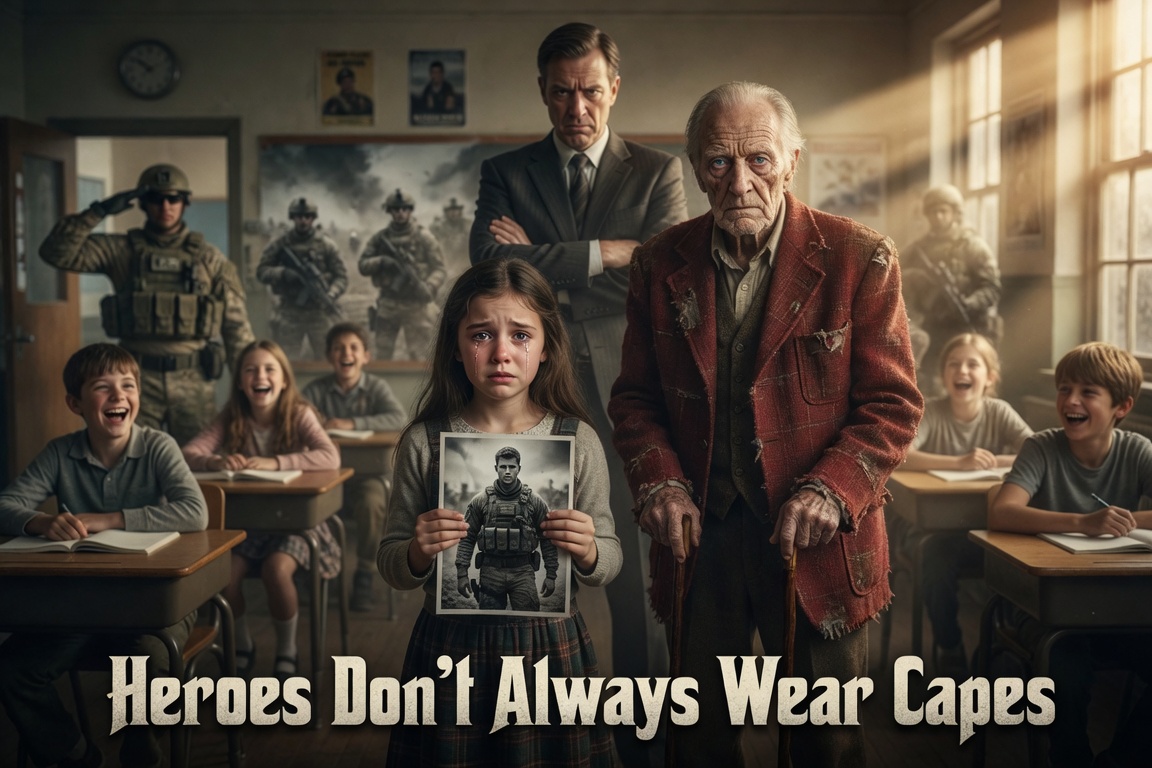
Behind her, an enlarged photograph showed her grandfather standing on the porch of their weather-beaten Virginia house. He wore gray trousers, scuffed brown shoes, and a frayed red tweed jacket that hung too loosely from his shoulders. One hand rested on a cane. The other trembled against the porch railing.
Across the top of the slide, Ellie had written:
ARTHUR MERCER: THE MAN THEY CALLED REAPER
Mr. Nolan Pike lowered the remote in his hand.
“Reaper?”
He said the word slowly, as though examining something rotten beneath a microscope.
A few students turned toward the last row, where Arthur Mercer sat alone beneath the classroom clock.
Arthur was eighty-two. Silver hair lay in thin waves against his scalp. A pale scar divided his left eyebrow, and a tremor ran through both hands, causing the brass tip of his cane to tap lightly against the floor.
Tap.
Tap.
Tap.
He did not look embarrassed.
That somehow made Mr. Pike more irritated.
Ellie swallowed. “It was his call sign.”
“In the Navy?” Pike asked.
“Yes.”
“And your grandfather told you this?”
“He doesn’t talk about it much.”
“Convenient.”
The word drew another ripple of laughter.
Outside, March rain rattled against the windows of Gideon Welles Middle School. The heating vents breathed out air that smelled of dust and scorched metal. On the walls, portraits of presidents and generals watched over twenty-eight seventh graders who had spent the week presenting family histories.
One girl’s great-grandmother had marched for civil rights.
A boy’s uncle had repaired helicopters in Afghanistan.
Another student had brought a Purple Heart in a velvet box.
Ellie had brought Arthur.
She looked back at him now.
He lifted two fingers from the cane and tapped them against his wrist.
Twice.
Their signal.
Breathe in.
Hold.
Let it go.
Ellie turned toward the class again.
“My grandad joined the Navy when he was seventeen. He served for twenty-eight years. Most of his missions are still classified, but he was part of a special unit before people were allowed to know the unit existed.”
Mr. Pike walked in front of the projector, cutting the photograph in half with his shadow.
“Ellie, history is not mythology.”
His voice remained calm. That was what made him dangerous. He never shouted. He corrected people with the patient disappointment of a surgeon explaining why a limb had to be removed.
She tightened her grip on her note cards.
“I have photographs.”
“You have a photograph of an elderly man in a red jacket.”
The boy in the back row laughed again.
Mr. Pike looked toward Arthur.
“Sir, were you a Navy SEAL?”
Arthur’s gaze remained on Ellie.
“I served in the Navy.”
“That was not my question.”
“No,” Arthur said. “It wasn’t.”
The room went still.
Pike smiled without warmth.
“I have taught military history for seventeen years. I have interviewed veterans, worked with historical societies, and exposed three cases of fraudulent service claims. People invent stories because they enjoy the respect that belongs to better men.”
Ellie felt heat climb her neck.
“My grandfather isn’t lying.”
Pike raised one hand.
“I know you believe him.”
The pity in his voice was worse than anger.
He stepped closer to Arthur. His eyes moved over the old man’s shaking hands, worn cane and red tweed jacket. One elbow had been patched with darker cloth. A loose thread hung near the collar.
“You chose an interesting outfit for a military presentation.”
Arthur looked down at the jacket.
“My wife liked this one.”
“Did she also provide the nickname?”
Arthur’s jaw shifted once.
Ellie had seen that movement only twice before. Once when a hospital administrator had called her mother’s death an unfortunate outcome. Once when two men at a gas station had shoved a frightened cashier against the register.
Both times, Arthur had become very quiet.
Pike turned toward the class.
“This is why primary evidence matters. Uniforms. Discharge papers. Unit records. Citations. Not family legends.”
“I didn’t wear a uniform,” Arthur said.
Pike faced him again. “Why not?”
“Because this is her day.”
Arthur nodded toward Ellie.
“Not mine.”
For half a second, something moved through the classroom. A hesitation. A flicker of shame.
Then Pike saw the tiny brass shape inside Arthur’s jacket.
A Naval Special Warfare Trident had been pinned to the inner lining, hidden against his chest.
Pike reached out and pulled the lapel aside.
Ellie heard Arthur’s cane stop tapping.
The teacher stared at the insignia.
Then he laughed.
It was not loud, but it was deliberate.
“A costume medal hidden inside a costume jacket.”
Arthur looked down at Pike’s fingers gripping the red tweed.
“Let go.”
Pike did not.
“I can purchase one of these online for twenty dollars.”
“Let go of the jacket.”
“Or what?”
Arthur’s eyes finally met his.
The old man’s voice softened.
“You will learn something in front of your students that you should have learned in private.”
Pike released the lapel.
For a moment, neither man moved.
Then the teacher stepped back, raised the remote and shut off Ellie’s presentation.
The screen went black.
“Sit down, Ellie.”
She stared at him.
“My presentation isn’t finished.”
“Yes, it is.”
Arthur reached inside his jacket.
Several children flinched.
He pulled out an old black telephone, the kind with physical buttons and a screen no larger than a postage stamp.
His thumb trembled over the keypad.
Pike glanced at the phone and smirked.
Arthur typed six words.
MERCURY GLASS. THIRD BELL. BRING THE LEDGER.
Then he pressed send.
Chapter Two: The Man Who Hated Heroes
Nolan Pike had not always hated stories about heroes.
When he was eight, he believed every one of them.
His older brother Aaron had taught him to salute the flag on their father’s porch. Aaron could turn a broomstick into a rifle, a drainage ditch into a trench and three pine trees into enemy territory. He enlisted after high school, but a damaged knee kept him from completing Marine Corps training.
Aaron came home carrying a failure no one else could see.
For years, he searched for a way to stand near the honor he believed he had lost.
Then he met Everett Dane.
Dane traveled Virginia wearing a SEAL Trident above his heart. He spoke at schools, churches and veterans’ fundraisers. He claimed to have rescued hostages, survived torture and served beside a legendary operator known only as Reaper.
Aaron believed him.
He invested his savings in Dane’s charity. He persuaded friends to donate. He convinced their mother to refinance her house.
When investigators revealed Dane had never served a day in uniform, the charity collapsed.
So did Aaron.
He survived another fourteen months, but the brother Nolan remembered never came back.
Nolan had been twenty-six when he found Aaron sitting inside a cold truck behind an abandoned warehouse, an unopened letter resting on the passenger seat.
The letter contained six words.
I wanted to believe in somebody.
Nolan built the rest of his life around never making that mistake again.
He became a historian. He learned to search service archives, identify counterfeit medals and recognize rehearsed lies. He gave lectures about stolen valor and the exploitation of military grief.
Three frauds had been removed from public ceremonies because of him.
Parents thanked him.
Veterans shook his hand.
Local newspapers called him a guardian of truth.
But standing in Classroom 214, with Arthur Mercer’s warning still suspended between them, Nolan felt something he had not felt in years.
Uncertainty.
It angered him.
He walked to his desk and opened his laptop.
“Arthur Mercer,” he said while typing. “United States Navy.”
Ellie remained standing beside the dead projector screen.
“Mr. Pike, please stop.”
He clicked through several results.
An insurance broker in Ohio.
A dentist in Arizona.
A deceased accountant from Maryland.
Nothing about Navy Special Warfare. Nothing about classified operations. Nothing about a man called Reaper.
Nolan rotated the screen toward the students.
“No military biography. No newspaper profile. No public citation.”
Arthur slipped the telephone into his jacket.
“Not every record lives on the internet.”
“Records live somewhere.”
“Yes.”
“Then show us.”
Arthur studied him for a long moment.
“You are confusing evidence with entitlement.”
Nolan’s fingers tightened against the laptop.
“I am protecting these students from misinformation.”
“By humiliating one of them?”
“I am correcting a false historical claim.”
“You interrupted a child before she presented her evidence.”
A murmur moved through the room.
Nolan glanced toward the students.
Several had their phones below their desks. One girl was recording openly now, her camera pointed toward Arthur.
He should have ended it.
He should have told Ellie to continue and reviewed the evidence later.
But Arthur’s calmness felt like arrogance. It reminded Nolan of Everett Dane smiling beneath stage lights while Aaron sat in the front row, believing every word.
“You know what frauds depend on?” Nolan asked. “Silence. They say the records are classified. They say witnesses are dead. They say no one can verify what happened.”
Arthur rubbed one thumb across the head of his cane.
“Sometimes the witnesses are dead.”
“And sometimes they never existed.”
Ellie stepped between them.
“My grandmother existed.”
Her voice cracked, but she did not move.
Nolan looked down at her.
“This is not about your grandmother.”
“You made it about her when you laughed at his jacket.”
Arthur closed his eyes briefly.
Ellie continued.
“She bought that fabric in Scotland before I was born. She made the jacket herself because Grandad hated formal clothes. After she died, he wore it every Sunday for a year.”
A boy near the window lowered his gaze.
Nolan felt the room shifting away from him.
He hated that too.
He softened his voice.
“Ellie, personal grief does not make a military claim true.”
“No,” she said. “But being a teacher doesn’t make you right.”
The class inhaled as one.
Arthur stood.
It took him several seconds.
His knee resisted. The cane slipped half an inch across the tile before he caught himself. Ellie reached for his arm, but he shook his head.
He would not let Nolan see her holding him up.
“My granddaughter prepared twelve slides,” Arthur said. “You have seen one.”
“I have seen enough to recognize a pattern.”
“No. You recognized a memory.”
Nolan’s face changed.
Arthur noticed.
The old man’s eyes narrowed, not with anger but recognition.
“You knew one,” he said.
Nolan said nothing.
“A man who lied about service.”
“This is not relevant.”
“He hurt someone you loved.”
Nolan shut the laptop.
“You do not get to analyze me.”
“No. But you have analyzed my granddaughter, my wife and me since we walked through the door.”
Arthur lifted his cane and pointed toward Ellie’s presentation.
“Let her finish.”
Nolan stared at the blank screen.
A part of him knew the old man was right.
Another part imagined Aaron’s truck behind the warehouse.
He reached for the remote.
Before he could press it, the classroom door opened.
Principal Marisol Hayes stood in the hallway.
She looked first at Nolan, then at Arthur, then at the children holding phones.
“What,” she asked quietly, “is happening in here?”
Chapter Three: The Third Bell
Principal Hayes had a way of entering a room that made everyone aware of what they were doing with their hands.
Phones vanished.
Backs straightened.
Even the heating vent seemed to lower its voice.
She was fifty-one, with close-cropped black hair, narrow silver glasses and the exhausted posture of someone who had spent the morning resolving problems created by people who considered themselves reasonable.
“Nolan?”
He stepped toward her.
“A student made an unverified claim regarding a family member’s military service. I asked for evidence.”
“You called my grandfather a fraud,” Ellie said.
Hayes looked at Nolan.
“Did you?”
“I explained the characteristics of stolen valor.”
“In the middle of her presentation?”
“The claim involved an alleged Tier One operator whose existence does not appear in any accessible record.”
Hayes turned toward Arthur.
“Mr. Mercer, I’m Marisol Hayes.”
“I know.”
“We met at Veterans Day last year.”
“You gave a speech about invisible wounds.”
Her eyes dropped to the Trident still visible inside his jacket.
Arthur closed the lapel.
Hayes lowered her voice.
“Would you come with me to my office?”
“No.”
Nolan exhaled through his nose.
Arthur continued.
“My granddaughter was invited to present her family history. She has not finished.”
Hayes looked at Ellie’s note cards scattered across the front table.
“How much remains?”
“Eleven slides.”
One student snorted, then disguised it as a cough.
Hayes walked to the projector and switched it back on.
The second slide appeared.
It showed a faded black-and-white photograph of Arthur at approximately seventeen years old. He stood shirtless beside three other sailors, lean as wire, his face sunburned and unsmiling. A handwritten date in the corner read 1962.
The room leaned forward.
Nolan did not.
“Photographs prove Navy service,” he said. “Not SEAL service.”
Ellie clicked to the next slide.
A training photograph appeared. Men carried an inflatable boat over their heads while waves broke around them.
Several faces had been circled in blue ink.
Arthur’s face had been scratched out.
Not blurred digitally.
Scratched out by a blade.
Hayes glanced toward him.
“Who damaged this?”
“I did,” Arthur said.
“Why?”
“Because I was told to.”
Nolan folded his arms.
“By whom?”
Arthur looked toward the clock.
1:27 p.m.
The third bell would ring at 1:35.
“People you will not find online.”
Nolan gave a humorless laugh.
Hayes raised one finger.
“Enough.”
She turned to Ellie.
“Continue.”
Ellie pressed the remote.
The next slide contained a map of Southeast Asia with no route marked, no operation name and no dates. Only a red dot near a river and the photograph of a brass key.
“My grandad gave this key to my grandmother before every deployment,” Ellie said. “She kept it in a blue bowl beside their front door.”
“What did it open?” a student asked.
“Nothing.”
The answer came from Arthur.
The children turned.
“It was a signal,” he said. “If it came back in an envelope, she knew I was alive. If someone brought it to the house, she knew I was missing. If it never came back, she knew not to wait.”
Ellie stared at him.
He had never told her that part.
Nolan watched the girl’s expression.
“This was not in your presentation?” he asked.
She shook her head.
Arthur’s tremor worsened.
The cane began tapping again.
Tap.
Tap.
Tap.
Ellie clicked to the next slide.
It showed the red tweed jacket hanging from a bedroom door.
At the bottom of the photograph, almost hidden in shadow, six small white knots had been sewn into the inner cuff.
“What are those?” Principal Hayes asked.
Arthur’s gaze moved toward the door.
“Stitches.”
“They form a pattern,” Nolan said.
For the first time, his skepticism gave way to professional interest.
Two close knots. A gap. One knot. A longer gap. Three knots together.
Binary spacing.
A field cipher.
Nolan stepped closer to the screen.
“Did your wife sew those?”
“Yes.”
“What do they mean?”
Arthur did not answer.
The clock changed to 1:32.
Ellie clicked again.
The next slide showed her grandmother, Miriam Mercer, standing outside a government building in Washington in 1968. She was twenty-four, with dark hair, a wool coat and the same red tweed fabric folded over one arm.
“My grandmother worked as a typist for the Navy,” Ellie said. “She met Grandad at a bus station.”
Arthur’s mouth moved slightly.
It was almost a smile.
“She stole my seat,” he said.
“You offered it to me,” Miriam’s voice seemed to answer in his memory.
“You took it before I finished.”
“You were too slow.”
For sixty years, Arthur had remembered the yellow scarf around her neck, the rain on the bus windows and the way she corrected the newspaper crossword using a red pencil.
Ellie clicked to another photograph.
Miriam stood beside Arthur on their wedding day. No military guests. No uniforms. No medals.
Just the red jacket draped around both their shoulders against the cold.
The classroom door opened again.
A school security officer appeared, breathing hard.
He whispered something to Principal Hayes.
Her expression changed.
“How many?”
“Six,” he said.
“Armed?”
“No visible weapons. They surrendered everything at the entrance. Federal credentials checked out.”
Nolan heard the words.
“So why are they here?”
The security officer looked toward Arthur.
“They asked for him.”
Arthur checked the clock.
1:34.
One minute before the third bell.
In the hallway, footsteps approached.
Not hurried.
Not heavy.
Synchronized.
Every child turned toward the door.
Arthur remained facing the screen, where Miriam Mercer smiled from a sixty-year-old photograph with the red tweed jacket across her shoulders.
The bell rang.
Chapter Four: Six Shadows
The classroom door opened on the final note of the bell.
Six people entered.
They wore dark blue service uniforms without ceremonial ribbons. Five men and one woman, ranging in age from their late twenties to perhaps fifty. They carried no weapons, yet the room seemed to become smaller around them.
Their eyes moved first to the windows.
Then the corners.
Then the exits.
Only after reading the room did they look at Arthur.
The oldest among them stepped forward.
He was tall, broad through the shoulders and gray at the temples. A thin white scar disappeared beneath his right ear. His uniform displayed the silver eagle of a Navy captain.
He stopped three paces from Arthur.
The other five formed a line behind him.
No one spoke.
The captain’s gaze dropped to Arthur’s red jacket.
Then to the six white knots inside the cuff.
His face lost its military hardness.
“Mercury Glass,” he said.
Arthur nodded once.
The captain placed a weathered black case on the nearest desk.
“Third bell. Ledger delivered. No colors.”
Nolan looked from the case to Arthur.
“What does that mean?”
The captain did not acknowledge him.
“Permission to enter the room, Chief?”
Arthur glanced around at the maps, the half-erased homework and twenty-eight frightened children.
“You’re already inside, Daniel.”
The captain’s mouth tightened.
“Yes, Chief.”
Every member of the unit raised a hand and saluted.
Arthur did not move.
His hand trembled beside his cane.
For a moment, Ellie thought he would leave them standing there.
Then he lifted his hand.
The tremor did not stop, but the salute was exact.
Six arms lowered at once.
No one in the classroom laughed.
Captain Daniel Keene turned toward Principal Hayes.
“Ma’am, I command a Naval Special Warfare task group operating out of Little Creek. We were in Norfolk for a closed memorial briefing when Chief Mercer contacted us.”
Nolan found his voice.
“You expect us to accept that because six people walked into a classroom?”
Keene looked at him for the first time.
His expression contained no anger.
That was worse.
“No, Mr. Pike.”
Nolan stiffened. “How do you know my name?”
“The principal identified the teacher when school security contacted our liaison.”
Keene placed both hands on the black case.
“You should accept nothing without evidence. That appears to be the purpose of today’s discussion.”
A few students glanced at Nolan.
He felt their attention like heat against his skin.
Keene opened the case.
Inside lay a ledger wrapped in transparent archival cloth, a folded American flag, a small brass key and a strip of red tweed protected beneath glass.
Nolan stared at the fabric.
It matched Arthur’s jacket.
Keene removed the ledger.
Its black leather cover had been scorched at one corner. A metal clasp held the pages shut.
“This document was declassified three months ago,” he said. “Most names and operational details remain redacted. It records a joint maritime intelligence operation conducted in 1974.”
Arthur’s eyes sharpened.
“You said it would remain sealed.”
“The review board changed its recommendation.”
“Why?”
Keene looked at Ellie.
“Because the last civilian analyst connected to the operation died four years ago.”
Miriam.
Arthur’s hand tightened around the cane.
“You used her death to open the file?”
“We used her written authorization.”
Arthur went still.
Keene reached into the case and removed a white envelope.
The handwriting on the front belonged to Miriam Mercer.
Arthur recognized the slight rightward tilt, the broad capital M and the smudge where her little finger always dragged through wet ink.
For Arthur, when he finally stops hiding.
Ellie moved closer.
“Grandad?”
Arthur did not seem to hear her.
Keene held out the envelope.
Arthur did not take it.
“She left that with the command historian in 1998,” Keene said. “Instructions were to deliver it only if you invoked Mercury Glass in the presence of a child from your family.”
Nolan’s eyes moved toward the six knots displayed on the projector.
A field cipher.
A trigger phrase.
A sealed archive.
His certainty began breaking apart, not dramatically, but piece by piece, like ice under steady weight.
He reached for the nearest chair.
Keene opened the ledger.
“The individual known within the unit as Reaper served under four operational names. Arthur James Mercer was one of them.”
Silence swallowed the room.
Ellie looked at her grandfather.
He seemed smaller than he had minutes earlier.
Not weaker.
Exposed.
Keene continued.
“The nickname did not originate from a kill count. It came from an extraction near the Cambodian border in which Chief Mercer entered a compromised facility six times after being ordered to withdraw.”
A photograph was placed on the desk.
It showed a burning structure beside a flooded field.
Twenty-three figures stood near a helicopter.
Arthur was kneeling in mud, holding a child.
“He removed eleven prisoners, four allied personnel and eight local civilians,” Keene said. “The final person he carried out was a seven-year-old girl whose family had been targeted for assisting American intelligence.”
A girl in the second row whispered, “Why did they call him Reaper?”
Keene looked at Arthur.
“Because one of the rescued prisoners said he walked into death and harvested the living.”
Arthur closed his eyes.
“I told them to bury that name.”
“They tried.”
Keene turned another page.
“It survived.”
Nolan’s lips had gone pale.
“The Trident,” he said. “The one inside his jacket.”
“Earned in 1965. Reissued after the original was damaged during an underwater demolition.”
Keene’s gaze hardened.
“And it should never have been touched without permission.”
Every student remembered Nolan pulling open Arthur’s lapel.
The teacher looked at his own hand as though it belonged to someone else.
Arthur spoke quietly.
“That’s enough.”
Keene stopped.
“No, sir,” Ellie said.
Arthur turned toward her.
Her eyes were wet, but her chin remained lifted.
“He didn’t stop when you asked him.”
The words struck deeper than accusation.
Arthur looked toward Nolan.
The teacher lowered his head.
“You’re right,” Arthur said. “He didn’t.”
Keene opened the ledger to a marked page.
“There is more.”
Arthur saw Miriam’s name before Keene spoke it.
Not under administrative support.
Not under clerical personnel.
Under operational architects.
MERCER, MIRIAM E. — CIVILIAN CRYPTANALYST, DESIGNATION LARK
Arthur’s cane slipped from his hand.
Chapter Five: Lark
The brass handle struck the tile with a sound like a gunshot.
Ellie caught Arthur’s arm before he fell.
For once, he allowed her to support him.
Captain Keene stepped forward, but Arthur raised one shaking hand.
“Read it,” he said.
Keene looked uncertain.
Arthur pointed toward the ledger.
“Read her part.”
The captain turned the book so the classroom could see.
“The operation was compromised before the extraction team reached shore. Enemy forces had obtained portions of the unit’s communications schedule. Standard authentication phrases could no longer be trusted.”
Nolan stared at Miriam’s photograph on the screen.
The typist.
The woman with the yellow scarf.
Keene continued.
“A civilian cryptanalyst designed an emergency verification system using everyday objects, stitching patterns and phrases drawn from personal correspondence. The system allowed operators to confirm identity without transmitting conventional military language.”
His finger moved to the next line.
“The system was called Mercury Glass.”
Ellie looked at Arthur’s cuff.
“The stitches.”
“Yes,” Keene said. “Two, one, three represented a phrase known only to the analyst and the field commander.”
“What phrase?” a student asked.
Arthur answered.
“Come home angry.”
The children looked confused.
Arthur touched the white knots.
“Miriam never told me to be careful. She said careful men still died. Before I left, she told me to come home angry because anger meant I was alive enough to complain.”
For the first time, several students smiled.
Ellie did not.
Her eyes remained on the ledger.
“You told me Grandma typed reports.”
“She did.”
“What else did she do?”
Arthur looked toward Miriam’s photograph.
“She listened to broken messages. Found patterns in static. Recognized lies in numbers. She could look at a page of nonsense and tell you who had written it, where they were frightened and which word they had been forced to include.”
“Was she in the Navy?”
“They wouldn’t let her be what she was.”
The room went quiet again.
Keene turned another page.
“Miriam Mercer identified the compromised communication chain, constructed the replacement cipher and remained at her station for nineteen hours while the extraction unfolded. When a senior officer ordered the mission abandoned, she altered the distribution list so the order would be delayed by six minutes.”
Principal Hayes looked up sharply.
“She disobeyed an order?”
“She manipulated one,” Arthur said.
A trace of pride entered his voice.
“Six minutes,” Keene continued, “allowed Chief Mercer’s team to complete the final extraction.”
Arthur’s gaze returned to the burning building in the photograph.
He smelled wet soil, diesel fuel and human hair singed by flame. He heard rotor blades chopping the night apart. He felt the weight of the child against his chest and remembered believing, for three terrible seconds, that she had stopped breathing.
He had carried that night inside him for fifty-two years.
Miriam had carried the six minutes.
“She saved them,” Ellie whispered.
Arthur looked at her.
“She saved all of us.”
“Then why didn’t anyone know?”
“Because the report classified her as clerical support. Because she had no rank. Because the men who signed the papers could praise a field operator more easily than admit a woman with a pencil had outmaneuvered an entire intelligence network.”
Keene removed the strip of red tweed from the case.
“The fabric was used as a visual confirmation marker. Operatives entering the alternate extraction zone were instructed to look for red cloth tied beneath the east bridge.”
Arthur touched his jacket.
“Miriam cut the strip from the fabric she had bought for herself.”
“She later made the jacket from what remained,” Keene said.
Ellie stared at the worn sleeves.
The frayed red tweed was not merely something her grandmother had liked.
It was part of the operation.
Part of the rescue.
A fragment of history worn openly by a man who refused to explain it.
Nolan stepped away from the chair.
“I owe both of you an apology.”
Arthur looked at him.
“No.”
The teacher’s face tightened.
“No?”
“You owe her one first.”
Arthur nodded toward Ellie.
Twenty-eight students watched Nolan Pike walk to the front of the classroom.
He had spent years believing public correction was a moral instrument. A lie spoken in front of witnesses, he often told his classes, had to be corrected before those same witnesses.
Now he stood before the child he had humiliated and discovered how heavy that principle became when pointed at him.
“Ellie,” he said, “I interrupted you before seeing your evidence. I mocked your grandfather’s clothing, dismissed your research and used my authority to make the class laugh at you.”
His voice faltered.
He started again.
“I thought my reasons made my behavior responsible. They did not. I was cruel.”
Ellie studied him.
“Did you think he was lying?”
“Yes.”
“Do you still?”
“No.”
“Are you sorry because the unit came?”
The question cut cleanly through him.
Nolan looked at Arthur, Keene, Principal Hayes and the students who had once admired him.
“Yes,” he said. “Partly.”
Ellie’s brow furrowed.
It was not the answer she expected.
Nolan continued.
“Their arrival frightened me. It proved I was wrong in a way I could not argue with. But I am not only sorry because your grandfather is important.”
He swallowed.
“I am sorry because he would still have deserved dignity if he had been an ordinary sailor, or a mechanic, or a man who had never served at all.”
Arthur’s expression shifted.
The answer did not erase what had happened.
But it was true.
Ellie gathered her note cards from the table.
“Then sit down.”
Nolan obeyed.
He took an empty student desk near the wall.
Ellie faced the class.
“My presentation has changed.”
Arthur retrieved his cane.
“How?”
She clicked to the photograph of Miriam.
“I thought it was about Grandad.”
Her finger pressed the remote.
The next slide appeared.
A simple sentence filled the screen.
HISTORY DOES NOT FORGET PEOPLE. PEOPLE DECIDE WHO HISTORY IS ALLOWED TO REMEMBER.
Ellie looked toward Arthur.
“Now it’s about both of them.”
At the rear of the room, Captain Keene quietly closed the ledger.
But before he secured the clasp, Nolan saw a familiar name on the following page.
DANE, EVERETT — INVESTIGATION REFERENCE
His breath stopped.
Chapter Six: The Fraud
“Wait.”
The word escaped Nolan before he could stop it.
Keene looked toward him.
Nolan stood slowly.
“The name on that page.”
Arthur’s eyes closed.
He had hoped the ledger would remain open no longer than necessary.
Nolan stepped closer.
“Everett Dane.”
Keene glanced at Arthur.
Arthur gave the smallest shake of his head.
The captain closed the ledger.
“That section does not concern today’s presentation.”
“It concerns me.”
Nolan’s voice had changed. The polished authority was gone. In its place stood the younger brother who had opened a truck door behind an abandoned warehouse.
“My brother lost everything because of Everett Dane.”
Arthur lowered himself into the chair beneath the clock.
“I know.”
Nolan stared at him.
“How?”
Arthur rubbed both hands over the head of his cane. The tremor had become violent enough that the wood rattled against his wedding ring.
“Dane used my call sign.”
“You knew him?”
“No.”
“He claimed he served with Reaper.”
“He claimed many things.”
Nolan moved toward the desk.
“Were you involved in the investigation?”
Arthur looked at Ellie.
This was the part of history he had never wanted her to inherit.
Not the operations.
Not the bodies.
The aftermath.
The way false heroes fed upon the hunger of wounded men.
“Yes,” Arthur said.
The classroom seemed to move farther away from Nolan.
“He ruined my brother.”
“Dane found men who believed service was the only honorable thing they had failed to do. He sold them proximity to a war they had never fought.”
“My brother wasn’t weak.”
“I didn’t say he was.”
“You said he was hungry.”
“He was.”
Arthur’s voice remained gentle.
“Hunger is not weakness. But it can make poison look like food.”
Nolan’s face twisted.
“You don’t know anything about Aaron.”
“I met him twice.”
The teacher gripped the edge of a desk.
“No.”
“He came to Richmond during the preliminary inquiry. He refused to testify against Dane.”
“That’s not true.”
“He believed exposing the fraud would humiliate every person he had recruited into the charity.”
Nolan shook his head.
“My brother never told me.”
“He was ashamed.”
“You’re lying.”
Arthur lifted his eyes.
Nolan recoiled from what he saw there.
Not anger.
Recognition.
The unbearable recognition of one man who had watched another drown while standing on dry land.
Arthur reached inside the red jacket and withdrew his wallet.
Behind an old photograph of Miriam, he found a folded photocopy.
He placed it on the desk.
Nolan recognized Aaron’s handwriting before reading the words.
Mr. Mercer,
You said courage is not the absence of humiliation. You said sometimes courage is walking into the room where everyone knows you were fooled. I’m not ready. I don’t know if I ever will be.
I wanted to believe in somebody.
Nolan’s knees weakened.
The final sentence was the same one Aaron had left in the truck.
Arthur had seen it before.
“What did you say to him?”
“I told him he had believed in the wrong man for the right reason.”
“And that was supposed to save him?”
“No.”
Arthur’s mouth tightened.
“I thought he needed space. Men of my generation were trained to confuse silence with respect. Sometimes silence is just another locked door.”
He looked at Ellie.
“It is one of my greatest failures.”
Nolan lowered himself into a chair.
For seventeen years he had sharpened grief into certainty. He had imagined himself defending Aaron each time he exposed a liar.
Now the man he had publicly humiliated had tried to help Aaron before Nolan even knew his brother was in danger.
“There was money,” Nolan said. “After the charity collapsed. Someone covered my niece’s tuition for two semesters.”
Arthur said nothing.
Nolan looked at the photocopy again.
At the bottom, beside Aaron’s signature, an investigator had written a notation.
AM approved emergency family support. No attribution.
“AM,” Nolan whispered.
Arthur’s gaze returned to the rain-streaked window.
“You paid it.”
“It was Dane’s money.”
“The accounts were frozen.”
“Not all of them.”
Captain Keene glanced toward Arthur.
This detail was not in the official case file.
Nolan stood.
“You took it?”
“I recovered it.”
“How?”
“You don’t have clearance for that story.”
One of the students gave a nervous laugh.
No one joined him.
Nolan looked at Arthur’s red jacket, the hidden Trident and the trembling hands he had mistaken for fear.
All morning he had believed he was exposing a predator.
Instead, he had placed a survivor on trial.
“I don’t know what to say.”
Arthur turned toward him.
“Say your brother’s name.”
Nolan blinked.
“What?”
“You have spoken about frauds for seventeen years. How often have you spoken about Aaron?”
The teacher opened his mouth.
No sound emerged.
Arthur leaned forward.
“Frauds survive by stealing the center of every story. Even after they are exposed, people remember the liar’s name and forget the people he used.”
Nolan’s eyes filled.
“My brother’s name was Aaron Michael Pike.”
Arthur nodded.
“What was he good at?”
The question nearly broke him.
“Woodworking.”
“What did he make?”
“Tables. Cabinets. Toys for his daughter.”
“What made him laugh?”
Nolan wiped his face with one hand.
“Terrible impressions. He could imitate our mother ordering at a drive-through.”
A few students smiled.
“What was he afraid of?”
“Being useless.”
Arthur looked down at his own shaking hands.
“Yes.”
Nolan breathed through the pain.
“He wasn’t useless.”
“No,” Arthur said. “He wasn’t.”
The classroom remained silent, but it was no longer the silence of spectacle.
It was the silence people create when they are helping someone carry weight.
Arthur pointed toward Ellie’s presentation.
“That is history too.”
Chapter Seven: What Power Looks Like
Principal Hayes ended the recording.
She did not confiscate the students’ phones. It was too late for that. Portions of the confrontation had already reached parents, group chats and social media.
By nightfall, thousands would watch Nolan Pike laugh at the old man in red tweed.
They would watch the unit enter.
They would watch the salute.
The easiest story would have a villain and a hero.
Arthur knew how quickly easy stories became dishonest.
Captain Keene offered to have the Navy’s legal office contact the school district.
Arthur refused.
Principal Hayes asked whether he wanted Nolan suspended.
Arthur refused that too.
“You are protecting him?” Ellie asked.
They stood together near the classroom windows while Keene spoke quietly with the principal.
“No.”
“It looks like it.”
Arthur watched Nolan sitting alone beneath the portrait of Dwight Eisenhower.
“I’m protecting the next child he teaches.”
“How does keeping him here do that?”
“Removing a man can stop his behavior. Changing him may stop the behavior from spreading.”
Ellie folded her arms.
“What if he doesn’t change?”
“Then Ms. Hayes removes him.”
“You always talk like there’s time.”
Arthur looked at her.
The accusation was not about Nolan.
It was about Miriam.
It was about Ellie’s mother, Rachel, who had died after an eighteen-month illness while Arthur kept telling everyone to remain calm.
It was about every hard conversation he postponed because he believed stability was kindness.
Ellie’s voice dropped.
“You never told me about Grandma.”
“I was trying to protect her promise.”
“She’s dead.”
The words struck him with the blunt force only a child could deliver.
“She doesn’t need protection. I needed the truth.”
Arthur lowered his gaze.
“You’re right.”
“Why did she hide it?”
“She didn’t hide all of it. I did.”
“Why?”
“Because people wanted Reaper. They wanted the name, the missions and the violence. If I spoke, they turned me into something I did not recognize.”
“And Grandma?”
“They called her a secretary.”
Ellie’s eyes shone.
“So you said nothing.”
“I thought silence denied them the story they wanted.”
“But it denied her story too.”
Arthur looked toward the image of Miriam on the screen.
Yellow scarf.
Red fabric.
Red pencil in her hand.
For decades he had believed secrecy was the last duty they shared.
Now he understood that secrecy, like a weapon, could remain dangerous long after the war ended.
Captain Keene approached with the envelope Miriam had left.
Arthur finally accepted it.
The paper shook between his fingers.
“Read it,” Ellie said.
“Here?”
“This is where she sent it.”
Arthur slid one finger beneath the flap.
Inside was a single sheet.
He recognized Miriam’s dry humor in the first sentence.
Arthur, if you are reading this in front of one of our grandchildren, then either you have become brave in your old age or someone has finally made you angry enough to stop being stubborn.
A laugh moved through the room.
Arthur’s lips parted.
He continued aloud.
You always believed silence was the purest form of loyalty. Sometimes it was. Sometimes it was merely convenient.
His voice weakened.
Ellie placed her hand on his sleeve.
Arthur read on.
They will call you a legend because legends are easier to admire than people. People shake. People fail. People carry the wrong person out first. People obey bad orders and disobey good ones. People come home and sit in the dark because they cannot explain why they lived.
Arthur stopped.
Keene looked away.
The younger operators remained rigid, but one of them pressed his tongue against the inside of his cheek.
Tell the child the truth. Not all of it. Children deserve innocence, but they also deserve honest foundations. Tell them courage is not what you did in that building. Courage was coming home afterward and learning how to become gentle again.
Arthur’s vision blurred.
He reached the final paragraph.
And tell them I was not your assistant.
A laugh escaped him, broken and full of grief.
You were mine.
Below the words, Miriam had drawn six small knots.
Two.
One.
Three.
Come home angry.
Arthur folded the letter carefully.
Ellie leaned against him.
This time, when she supported his weight, he did not pretend otherwise.
Across the room, Nolan stood.
“Mr. Mercer.”
Arthur looked at him.
“I intend to resign.”
“No.”
Nolan’s face tightened. “You don’t get to decide that.”
“You’re right.”
Arthur nodded toward Principal Hayes.
“She does.”
Hayes crossed her arms.
“And I have not decided.”
Nolan looked at the students.
“I abused my authority.”
“Yes,” Hayes said.
“I made a child defend her family against me.”
“Yes.”
“I turned my brother’s pain into permission to hurt someone.”
Hayes waited.
Nolan drew a breath.
“If I stay, it cannot be because everyone forgets what happened.”
“No one will forget,” Ellie said.
The teacher met her eyes.
“I know.”
He walked to his desk, removed a framed newspaper clipping from the wall and set it facedown. The headline praised him for exposing a fraudulent veteran.
“For years,” he said, “I have taught a unit called How to Identify False Heroes.”
Arthur studied him.
“What will you call it now?”
Nolan looked toward Aaron’s letter.
“How We Decide Who Deserves Respect.”
Arthur shook his head.
“Too many words.”
A smile flickered through the class.
Nolan tried again.
“Evidence and Dignity.”
Arthur nodded.
“Better.”
Chapter Eight: The Last Slide
Ellie returned to the front of the classroom.
Captain Keene and the five operators remained along the back wall. Principal Hayes stood beside the door. Nolan sat among his students, no longer behind his desk.
Arthur settled into the chair beneath the clock.
The red jacket hung open.
The Trident remained visible.
Ellie clicked to the final slide.
A photograph appeared that Arthur had never seen.
Miriam sat at the kitchen table, perhaps seventy years old, teaching a five-year-old Ellie how to solve a crossword. Morning light crossed her face. A red pencil rested between her fingers.
Behind her, Arthur stood at the stove burning pancakes.
The class laughed softly.
“Grandma told me Grandad was a terrible cook,” Ellie said. “She said he could cross a jungle without leaving footprints but couldn’t cross a kitchen without setting off the smoke alarm.”
Arthur raised one finger.
“That happened once.”
“Grandma wrote the date on the ceiling.”
The students laughed again.
Even Nolan smiled.
Ellie placed her note cards on the table.
“My grandad was a Navy SEAL. His call sign was Reaper. He rescued people during missions that stayed secret for more than fifty years.”
She looked toward Keene.
“But that isn’t what makes him important.”
Arthur’s brows lifted.
“My grandmother was a cryptanalyst. She built a code that helped save twenty-three people. The report called her a typist because the truth didn’t fit the space people had prepared for her.”
She looked toward Nolan.
“Mr. Pike thought he was protecting history from a lie. But he decided what the truth was before he listened.”
Nolan did not look away.
Ellie’s voice steadied.
“My grandfather thought silence protected Grandma. But sometimes silence protects the people who erased you.”
Arthur felt the words enter him.
No gunshot.
No explosion.
Something quieter and more permanent.
A lock opening.
“The lesson isn’t that my grandad was secretly powerful,” Ellie continued. “It’s that Mr. Pike thought power had to look a certain way.”
She pointed toward the photograph of Arthur in the red jacket.
“He saw shaking hands and thought weakness. He saw old clothes and thought pretending. He saw an old man who didn’t defend himself and thought there was nothing to defend.”
The classroom was silent.
“The unit saw the same jacket,” Ellie said. “They saw a code.”
Captain Keene lowered his eyes.
“Grandma saw fabric,” Ellie continued. “Then she turned it into a signal. Later she turned it into something Grandad could wear after she was gone.”
Ellie looked at Arthur.
“So maybe power isn’t what something looks like.”
She pressed the remote one final time.
A sentence appeared beneath the family photograph.
POWER IS WHAT REMAINS WHEN NO ONE IS CLAPPING.
Arthur stared at the screen.
Miriam would have corrected the wording.
Then she would have admitted she liked it.
Ellie faced the room.
“That’s my presentation.”
For several seconds, nobody moved.
Then the girl in the front row began clapping.
Another student joined.
Then another.
The applause spread through the classroom, but Arthur did not stand.
He looked at Ellie and shook his head gently.
She understood.
This was not the point.
Ellie raised one hand.
The applause faded.
“Grandad doesn’t want you to clap for him.”
A boy near the window asked, “What does he want?”
Arthur leaned forward on his cane.
“I want you to remember what happened before the door opened.”
No one spoke.
“That was the important part,” he said. “Not the uniforms. Not the salute. You watched someone with authority decide another person had no value. Some of you laughed because laughter felt safer than objecting.”
Several students looked down.
Arthur continued.
“The next time that happens, no unit may walk through the door.”
His gaze moved from face to face.
“You may be the only reinforcement coming.”
Outside, the rain had stopped.
Sunlight pressed through the clouds and touched the wet windows, scattering pale gold across the desks.
Captain Keene closed the black case.
Before leaving, he approached Arthur.
“The memorial board still wants an answer.”
Arthur frowned. “I gave them one.”
“You declined a room named after Reaper.”
“I still decline.”
Keene glanced toward Ellie’s final slide.
“What about a room named after Lark?”
Arthur looked at Miriam’s photograph.
For fifty-two years, men had spoken his call sign in places where her name could not be mentioned.
He had believed rejecting honors kept them equal.
Now he saw the flaw.
“No,” he said.
Keene’s face fell.
Arthur nodded toward Ellie.
“Name the cryptanalysis library after Miriam Mercer. Put her work inside it. Let students use the room.”
Keene smiled.
“Yes, Chief.”
“And Daniel?”
“Sir?”
“No statue.”
“No statue.”
“No photograph of me.”
Keene hesitated.
“Her photograph?”
“The one with the red pencil.”
Ellie grinned.
Keene saluted again.
This time Arthur did not return it.
He held out his hand.
Keene took it carefully, feeling the tremor and the strength beneath it.
The unit filed from the classroom.
At the door, the youngest operator paused beside Ellie.
She was perhaps twenty-nine, with dark hair twisted into a severe knot. Until then, she had not spoken.
“My grandfather was one of the children taken out of that building,” she said.
Arthur looked up sharply.
The woman removed a small brass key from beneath her uniform collar.
“He kept this in a blue bowl beside his front door.”
Arthur stared at the key.
Not the same one.
One of many.
Proof that the night had continued into lives he never saw.
The operator placed the key in Ellie’s palm.
“He asked me to return it if I ever found the man in the red cloth.”
Arthur’s breath caught.
“Your grandfather is alive?”
“He died last winter.”
The woman’s composure fractured for half a second.
“He had four children, eleven grandchildren and two great-grandchildren. He taught chemistry for thirty-seven years. He wanted you to know what you carried out of that building.”
Arthur closed his eyes.
For decades he had remembered only the weight of the child who nearly stopped breathing.
He had never known the boy beside her became a teacher.
The operator stepped through the door.
Ellie carried the key to Arthur.
He turned it over in his shaking hand.
A tiny number had been scratched into the brass.
Twenty-three.
The number of people listed in the ledger.
Arthur pressed the key against the Trident hidden inside his jacket.
Nolan watched from the student desk.
“Mr. Mercer,” he said.
Arthur looked at him.
“What happened to Everett Dane?”
The old man considered the question.
Years earlier, Nolan would have wanted a punishment. A courtroom. A public collapse. Evidence that the universe eventually forced liars to kneel.
Now he asked differently.
Not with hunger.
With caution.
Arthur slipped the key into his pocket.
“He served eleven years.”
“And after that?”
“He changed his name.”
“Do you know where he is?”
“Yes.”
Nolan waited.
Arthur rose with Ellie beside him.
“He repairs wheelchairs at a church workshop in West Virginia.”
Nolan stared.
“That’s all?”
“No.”
Arthur buttoned the red jacket.
“He has to live every day knowing the only honest thing anyone will remember about him began after everyone learned he was a fraud.”
Nolan looked toward Aaron’s letter.
“Did you forgive him?”
Arthur paused at the classroom door.
“Forgiveness is not the same as pretending the wound closed.”
“Then what is it?”
Arthur looked down at Ellie’s hand holding his.
“It is deciding the wound does not get to choose who you become.”
He and Ellie stepped into the hallway.
Students’ voices rose behind them. Chairs moved. Principal Hayes began giving instructions. Nolan Pike remained seated among the desks, facing the blank projector screen and the reflection of the man he had been that morning.
Outside the school, the sky had opened into clear blue.
Water dripped from the branches of bare oak trees. The pavement shone beneath the afternoon sun. Somewhere beyond the buildings, a helicopter crossed toward the naval station, its low rhythm traveling through the air.
Ellie and Arthur walked toward the parking lot.
His cane struck the pavement.
Tap.
Tap.
Tap.
“Grandad?”
“Yes?”
“Why didn’t you tell Mr. Pike who you were at the beginning?”
Arthur considered the question.
“Because a title can end an argument without teaching anyone anything.”
She looked up at him.
“Were you afraid?”
“Yes.”
“Of him?”
“No.”
He touched the envelope inside his jacket.
“Of becoming Reaper again.”
Ellie squeezed his hand.
“You didn’t.”
Arthur looked at the red sleeve, at Miriam’s stitches and at the place where the old fabric had begun to fray.
“No,” he said.
For the first time in fifty-two years, the name held no power over him.
“I came home.”