By the time the black Mercedes jumped the curb, fourteen-year-old Eli Reed owned exactly eighty-seven cents, one bruised apple, and a peppermint he had not unwrapped in six years.
The apple was in his backpack.
The coins were inside his left shoe.
And the peppermint was tucked deep inside the torn pocket of his gray jacket, wrapped in faded blue paper that had been folded into the shape of a tiny bird.
It was the only thing in the world Eli refused to trade.
Not for food.
Not for a warm bed.
Not even on the night the temperature dropped below freezing and another boy at the shelter offered him twenty dollars for it.
His mother had placed it in his palm three days before she died.
“Keep this until someone recognizes it,” she had whispered.
Eli had asked who would recognize an old piece of candy.
But his mother had already closed her eyes.
Now, seven months later, Eli was standing outside Vale Meridian Tower in downtown Havenport, wondering whether he had been foolish to come.
The building rose above the street in sheets of blue glass. Men and women in polished shoes moved through the revolving doors without looking at him. A security guard had already told him twice to leave.
Eli had spent the entire morning trying to gather the courage to ask for Eleanor Vale.
He had never seen Eleanor before.
He only knew that she was rich, powerful, and somehow connected to the final words his mother had written inside a red notebook.
If Eleanor Vale ever agrees to see you, show her the blue bird.
That was all the notebook said.
Eli had reached the entrance shortly after eight. The guard had stared at his stained shoes and torn sleeves, then laughed when Eli said he needed to speak with the owner of the company.
“Mrs. Vale doesn’t speak to street kids,” the guard had said.
“I’m not asking for money.”
“They all say that.”
“I only need five minutes.”
“You’ve had thirty seconds. Move.”
Eli moved.
He crossed the plaza and sat beside a newspaper stand, where he could see the tower’s entrance without being seen by the guard.
Two hours passed.
Then three.
At eleven fifteen, the revolving doors turned, and an elderly woman stepped into the sunlight.
She was smaller than Eli expected a billionaire to be.
She wore a dark green coat, plain black shoes, and a silver pin shaped like a bird. Her white hair had been pinned neatly behind her head, but several strands had escaped in the wind.
No assistants followed her.
No bodyguards surrounded her.
She stood at the edge of the sidewalk, searching through her handbag, while a line of cars waited at the traffic light.
Eli noticed the Mercedes before anyone else did.
It came from the far end of the street, moving too fast.
The driver swerved around a delivery truck, ran the red light, and climbed onto the curb.
People screamed.
The elderly woman looked up.
For one terrible second, she did not move.
The Mercedes was less than twenty feet away.
Eli dropped his apple.
He ran.
He reached the woman just as the car’s front wheel struck the edge of the sidewalk.
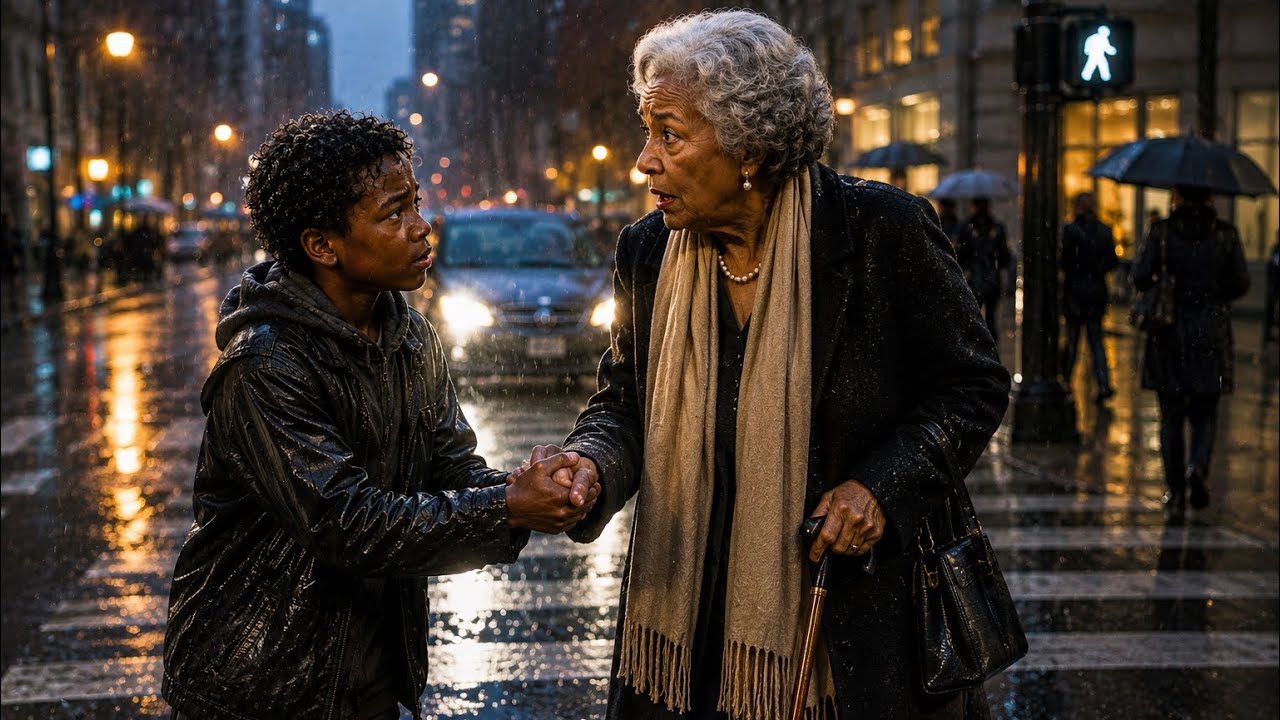
“Hold my hand, ma’am!”
She turned toward his voice.
Eli grabbed her wrist, wrapped his other arm around her waist, and pulled with everything he had.
They fell behind the newspaper stand.
The Mercedes tore through the spot where she had been standing, smashed into a metal bench, and stopped against a stone planter with smoke rising from its hood.
Glass scattered across the pavement.
The newspaper vendor shouted.
Someone called the police.
Someone else began filming.
For a moment, Eli could hear nothing except his own breathing.
The elderly woman lay beside him, one hand pressed against the ground. Her face had gone white.
“Are you hurt?” Eli asked.
She looked at him as though she had forgotten how to speak.
“Ma’am?”
“I’m all right,” she finally said. “I think.”
Eli helped her sit up.
Blood ran from a cut near his elbow, but he hid it beneath his sleeve.
The woman looked toward the ruined bench, then back at him.
“You pulled me away.”
“The car was coming.”
“You could have been killed.”
“So could you.”
She stared at him for another second.
Then several men rushed from Vale Meridian Tower.
The first was tall and broad-shouldered, with silver at his temples and a dark suit that looked as though it had never been wrinkled.
“Eleanor!”
He pushed through the crowd and knelt beside her.
Behind him came two security officers and a woman holding a phone.
The tall man looked from Eleanor to Eli.
His expression changed immediately.
“What did he do?”
Eli stood.
“He saved me,” Eleanor said.
The man barely glanced at the wrecked car.
He examined Eli instead.
“Did he touch your bag?”
Eleanor’s eyes narrowed. “Victor.”
“These situations are designed to create confusion.”
“He pulled me out of the path of a car.”
“Or pushed you and then pretended to help.”
Several people in the crowd protested.
“I saw the whole thing!”
“The kid saved her!”
“He ran before anyone else moved!”
Victor ignored them.
One of the security officers stepped toward Eli.
“Come with us.”
“I didn’t steal anything,” Eli said.
“Then you have nothing to worry about.”
Eli had heard those words before.
They had been spoken by police officers outside shelters, by store managers who searched his backpack, and by adults who believed an accusation was the same thing as proof.
He took one step backward.
Victor noticed.
“There,” he said quietly. “He’s trying to run.”
Eleanor rose to her feet.
“No one is taking him anywhere.”
The security officer stopped.
Victor’s jaw tightened.
“Eleanor, you’re shaken.”
“I may be shaken, but I am not confused.”
She turned toward Eli.
“What is your name?”
“Eli.”
“Eli what?”
“Reed.”
“Do you have someone we can call?”
“No.”
“A parent?”
Eli looked away.
Before Eleanor could ask another question, something slipped from his torn pocket.
It landed between them.
A peppermint.
The faded blue wrapper was creased with age and held together by a small piece of yellowing tape. Its corners had been folded into wings, making it look like a tiny bird resting on the pavement.
Eleanor stopped breathing.
The crowd continued moving around her.
Police sirens approached.
The driver of the Mercedes shouted through the cracked windshield.
But Eleanor heard none of it.
She stared at the candy.
Her handbag fell from her hand.
Victor looked down.
For the first time since arriving, all the confidence left his face.
It lasted less than a second.
Then he stepped forward, reaching for the peppermint.
Eleanor moved faster.
She picked it up before he could touch it.
Her fingers trembled as she turned it over.
On the underside of one folded wing was a small crescent-shaped burn.
Beside it, written in faded purple ink, were two uneven letters.
C. M.
Eleanor’s knees nearly gave way.
“Where did you get this?”
Eli hesitated.
“It belonged to my mother.”
“Where did she get it?”
“From her mother.”
“What was her mother’s name?”
“I never met her.”
“What was her name?”
“Rose.”
Eleanor closed her eyes.
A tear slipped down her cheek.
Victor looked at the people filming them.
“This is not the place for this conversation.”
Eleanor opened her eyes again.
They were fixed on Eli.
“Rose what?”
“Rose Reed.”
The peppermint shook between her fingers.
“No,” Eleanor whispered.
Eli stepped closer, uncertain whether she was about to faint.
“Ma’am?”
Eleanor looked at the boy’s face.
At his narrow chin.
At the small scar above his right eyebrow.
At his gray eyes, which carried the same ring of blue around the pupils that she had seen every morning for six years in the face of a little girl who had disappeared forty-five years earlier.
A little girl named Clara.
“Who was your mother?” Eleanor asked.
“Maya Reed.”
“And your father?”
“Gone.”
“Is Maya alive?”
Eli’s expression answered before he spoke.
“She died in January.”
The peppermint slipped in Eleanor’s fingers.
Victor caught her arm.
“That’s enough,” he said. “An ambulance is coming. You need to be examined.”
Eleanor pulled away from him.
She reached for Eli’s hand instead.
This time, she was the one holding on.
“Come with me,” she said.
Eli looked at Victor, then at the security officers.
“I don’t want trouble.”
“You saved my life.”
“That doesn’t mean I belong in your house.”
“No,” Eleanor said. “It means you belong somewhere safe while we find out why you were carrying something I last saw forty-five years ago.”
Victor leaned closer to her.
“You’re making a mistake.”
Eleanor did not look at him.
“Then it will be my mistake.”
The ambulance took both of them to St. Matthew’s Hospital.
Eleanor had bruised her shoulder. Eli needed six stitches in his arm.
While a nurse cleaned the cut, Eli watched the door.
“You think someone’s coming after you?” she asked.
“No.”
“You keep checking.”
“I’m not used to doors that lock from the outside.”
The nurse paused.
“This one doesn’t.”
She finished the stitches and brought him a sandwich.
Eli ate half and wrapped the other half in a paper napkin.
“For later?” she asked.
He nodded.
“You can have another one.”
“I know.”
But he still placed the first half inside his backpack.
Across the hall, Eleanor sat in a private room while Victor paced beside the window.
“You cannot bring that boy into Vale House,” he said.
“Why?”
“You know why.”
“I would like to hear you say it.”
“He is a homeless teenager carrying an object connected to your greatest vulnerability. That is not coincidence. It is manipulation.”
“He ran in front of a car.”
“People have done worse for less.”
“You saw the candy.”
“I saw an old wrapper.”
“You recognized it.”
Victor stopped pacing.
“I recognized your reaction.”
“That is not what I said.”
A woman in her early sixties entered the room carrying a leather folder.
Her name was Sofia Grant. She had served as Eleanor’s personal attorney for twenty-three years and was one of the few people who spoke to Victor without lowering her voice.
“I came as soon as I heard,” Sofia said.
Victor pointed toward the hallway.
“There is a boy here claiming to be connected to Clara.”
“I never claimed that,” Eli said from the doorway.
They all turned.
His arm was bandaged. His backpack hung from one shoulder.
“I only said who gave me the candy.”
Eleanor gestured toward the chair beside her.
“Sit.”
“I’d rather stand.”
Victor studied him.
“Your mother sent you here?”
Eli said nothing.
“Did she tell you Mrs. Vale was wealthy?”
“Everyone knows she’s wealthy.”
“Did she tell you to create a dramatic entrance?”
Eli’s eyes moved to Victor.
“My mother died in a room where the heater didn’t work. She wasn’t planning dramatic entrances.”
Sofia lowered her folder.
Eleanor’s face hardened.
Victor remained silent for a moment.
Then he adjusted his cuff.
“I am trying to protect my aunt.”
Eli looked at Eleanor.
“You’re his aunt?”
“Not by blood,” Eleanor said. “Victor’s father was my husband’s oldest friend. After Victor’s parents died, I helped raise him.”
Victor gave her a warning look.
Eleanor continued.
“He has managed Vale Meridian’s daily operations for the past six years.”
“And he thinks I’m a thief.”
“I think circumstances deserve investigation,” Victor replied.
Eli reached into his backpack.
Victor tensed.
Eli removed a worn red notebook and placed it on the chair.
“My mother wrote one name in here,” he said. “Eleanor Vale. She told me to show you the blue bird.”
Eleanor picked up the notebook.
Most of its pages were filled with medical appointments, unpaid bills, grocery lists, and addresses of temporary rooms. Near the back, three pages had been carefully folded together.
On the first was a message written in Maya’s uneven handwriting.
Eli—
Some families are separated by anger. Some are separated by fear. Ours was separated by a lie.
The blue bird belonged to your grandmother Rose. She received it from her real mother on the last day they saw each other.
Rose spent most of her life believing she had been abandoned. Before she died, she learned that might not have been true.
Find Eleanor Vale.
Do not ask her for money.
Ask her whether she remembers Clara.
Eleanor covered her mouth.
Sofia sat beside her.
Victor reached for the notebook.
Eli took it first.
“You don’t touch this.”
Victor’s hand remained in the air.
Eli closed the notebook and returned it to his backpack.
Eleanor whispered the name.
“Clara.”
She had not spoken it aloud in years.
Forty-five years earlier, before Vale Meridian had offices in twenty-two countries, before magazines called Eleanor one of the most powerful women in America, she had been a thirty-one-year-old mother trapped inside a marriage she was afraid to leave.
Clara was six.
She had Eleanor’s eyes and a habit of folding candy wrappers into birds.
Peppermints were her favorite.
Whenever Clara became frightened, Eleanor placed one in her hand and told her to close her fingers around it.
“Fear gets smaller when it has to share the space,” Eleanor would say.
Clara always laughed at that.
On October 12, forty-five years earlier, Eleanor had planned to take Clara and leave her husband.
Julian Vale had inherited a regional shipping company and a family name that opened doors. He also had a talent for making cruelty sound reasonable.
Clara was not Julian’s child.
Eleanor had been widowed before meeting him, and Julian never allowed her to forget that Clara came from a life he considered beneath him.
At first, he ignored the girl.
Then he began criticizing her manners, her clothes, the way she spoke at dinner.
By the time Clara turned six, Julian had decided she needed to attend a distant boarding school.
Eleanor refused.
Julian made arrangements anyway.
On the morning Eleanor planned to leave, she took Clara to Havenport Central Station. They were supposed to board the eleven-thirty train to Brighton, where Eleanor’s older sister lived.
Clara wore a blue coat.
She held Eleanor’s hand so tightly their palms became damp.
They had almost reached the platform when Samuel Shaw, Julian’s driver and closest friend, appeared beside them.
He told Eleanor that Julian had collapsed.
He said there had been a heart attack.
Eleanor did not believe him.
Then Samuel handed her a note in Julian’s handwriting.
Your mother is at the house. If you leave, she leaves with nothing.
Eleanor’s mother was ill and completely dependent on Julian’s money for treatment.
Eleanor turned away for less than a minute.
When she looked back, Clara was gone.
Samuel was gone too.
By evening, Julian claimed Clara had run away from the station.
Two days later, he produced a police report stating that a child matching Clara’s description had been struck by a truck outside the city. The body, he said, had been too badly injured for Eleanor to see.
A family dentist supposedly confirmed the identification.
There was a closed coffin.
There was a funeral.
There was no birth certificate in the coffin.
No photograph.
No lock of hair.
Nothing Eleanor could touch.
She spent four years searching secretly.
Private investigators accepted her money and disappeared.
Police officers told her to stop reopening old wounds.
Julian hired a psychiatrist who described her suspicion as “grief-induced delusion.”
When she confronted Samuel Shaw, he looked her in the eyes and swore that he had watched Clara leave the station alone.
Eleanor never believed him.
But disbelief was not proof.
Julian controlled the company, the house, the accounts, and nearly everyone around her.
By the time he died thirteen years later, every file connected to Clara had vanished.
Eleanor inherited a failing business and turned it into Vale Meridian.
She made billions.
She funded missing-child organizations, women’s shelters, and legal clinics.
But she never found Clara.
Eventually, she stopped saying the name aloud because every time she did, people looked at her with pity.
Now a homeless boy stood in a hospital room carrying Clara’s candy.
Eleanor looked at Eli.
“How old was Rose when she died?”
“Fifty-one.”
“Did she ever talk about her childhood?”
“Not to me. My mother said Grandma Rose hated train stations.”
Eleanor’s hand closed around the silver bird pinned to her coat.
“What did Rose look like?”
Eli opened the front pocket of his backpack.
Inside was a photograph protected by two pieces of plastic.
It showed three people standing outside a small yellow house.
Eli was eight.
Beside him stood Maya, thin and smiling, with one hand on his shoulder.
Behind them was an older woman with gray-streaked hair.
Rose Reed.
Eleanor stared at the photograph.
The room tilted.
Rose had Clara’s chin.
Clara’s eyes.
Clara’s slight crooked smile.
But photographs could be misleading. Grief could turn strangers into relatives. Eleanor knew that.
Victor knew it too.
“This proves nothing,” he said.
Eleanor handed the photograph to Sofia.
“It proves we need answers.”
Victor stepped between them.
“We need caution.”
“Then be cautious,” Eleanor said. “I am taking Eli home.”
Vale House stood on a wooded hill outside the city.
It had twenty-three rooms, two kitchens, a library, a greenhouse, and a staff larger than the population of the apartment building where Eli had lived with his mother.
When the car passed through the iron gates, Eli leaned toward the window.
“You live here alone?”
“Most of the time.”
“Why?”
Eleanor looked around the enormous entrance hall when they arrived.
“I have asked myself that more than once.”
A housekeeper named Margaret showed Eli to a guest room.
There were white sheets, a private bathroom, and a window overlooking the river.
Eli placed his backpack on the floor but did not remove his jacket.
“You can put your things in the closet,” Margaret said.
“These are my things.”
She glanced at the backpack.
“All of them?”
“Yes.”
Margaret opened a drawer and placed a new toothbrush inside.
“Dinner is at seven. The door doesn’t lock from the outside.”
Eli looked at her.
“The nurse said that too.”
“Then perhaps people have noticed how often you check.”
At dinner, Victor sat across from Eli.
Eleanor had invited Sofia and ordered the staff to serve the same food to everyone. Eli studied the silverware, then chose the smallest fork.
Victor watched him pocket a dinner roll.
“There will be breakfast in the morning,” he said.
Eli continued folding the roll into his napkin.
“I heard.”
“You don’t need to hide food here.”
“I’m not hiding it. You’re watching me.”
Sofia almost smiled.
Victor put down his glass.
“Let us be direct. What do you want?”
Eli looked at Eleanor.
“She asked me to come.”
“That was not my question.”
“I want to know what happened to my family.”
“And after that?”
“After that, I want to go back to school.”
Eleanor leaned forward.
“When did you leave?”
“January.”
“After your mother died?”
Eli nodded.
“Why didn’t you enter foster care?”
“I did.”
The room became still.
“For eleven days,” he continued. “The man in the house took my backpack at night. He said I didn’t need to keep old junk. When I asked for it back, he told the caseworker I had threatened him.”
“The notebook was inside?” Sofia asked.
“And the candy.”
“What happened?”
“I climbed out a bathroom window.”
Eleanor looked at Victor.
“Tomorrow, Sofia will contact child services.”
Eli’s chair scraped against the floor.
“No.”
“To protect you.”
“That’s what everyone says before they take everything.”
“We will not take your belongings.”
“You can’t promise what other people will do.”
Eleanor studied him.
He was not shouting.
He was not begging.
His voice had become quieter, which made every word heavier.
“I will not send you anywhere tonight,” she said. “Tomorrow, we will discuss it together.”
Eli slowly sat again.
Victor shook his head.
“This is exactly how manipulation begins.”
Eleanor turned to him.
“You have used that word repeatedly. Yet Eli has asked me for nothing.”
“He does not need to ask. You are already offering.”
“I offered him a bed.”
“You are considering giving him a family.”
The words struck the table like a dropped plate.
Eli stood.
“I don’t need anyone to give me a family.”
He took the dinner roll, picked up his backpack, and left.
Eleanor found him twenty minutes later sitting on the floor of the guest room.
The bed had not been touched.
He was reading the red notebook.
“I am sorry,” she said.
“You didn’t say it.”
“I allowed it to be said at my table.”
Eli closed the notebook.
“Rich people apologize differently.”
“How?”
“They apologize like they’re signing a document.”
Eleanor sat against the wall beside him.
At first, Eli looked surprised.
Then he moved his backpack so she had room.
“What should I say?” she asked.
“The truth.”
“The truth is that I want you to be connected to Clara.”
“That doesn’t mean I am.”
“I know.”
“And if I’m not?”
Eleanor looked toward the untouched bed.
“You still pulled me away from a speeding car.”
“That wasn’t the question.”
“No,” she said. “It wasn’t.”
She took a breath.
“If you are not connected to Clara, I will still help you return to school. I will still make sure your mother is buried somewhere you can visit. I will still make certain no adult takes your belongings again.”
“Why?”
“Because I should have done those things before I saw the candy.”
Eli looked at her for a long moment.
Then he opened the notebook again.
“My mother didn’t trust rich people.”
“She had good reason.”
“She said money makes people believe they can rename what they do.”
Eleanor’s mouth tightened.
“Did she write to me?”
Eli turned several pages.
“She said she did.”
“Do you have the letters?”
“No. She mailed them.”
“I never received them.”
“That’s what she expected you to say.”
Eleanor flinched.
Eli regretted the words immediately, but did not take them back.
“Tomorrow,” Eleanor said, “we will begin with records. Not feelings. Not guesses. Records.”
Eli nodded.
The following morning, Sofia contacted an independent genealogist, a family court advocate, and a laboratory that specialized in historical kinship testing.
Victor contacted someone else.
At ten seventeen, while Eli was in the kitchen helping Margaret repair a broken cabinet hinge, Victor stood inside Eleanor’s study with the door closed.
“You are placing the company at risk,” he said.
Eleanor was seated behind her desk.
“The company survived a car accident.”
“It may not survive a succession scandal.”
“There is no succession scandal.”
“Yet.”
Eleanor removed the silver bird pin from her coat and placed it on the desk.
“You recognized the peppermint.”
Victor did not answer.
“When it fell, you looked afraid.”
“I was concerned about you.”
“You reached for it.”
“It was evidence.”
“Evidence of what?”
“A scheme.”
“Then why did your hand shake?”
Victor’s expression did not change, but the pulse near his temple became visible.
“You are seeing what you want to see.”
“That sentence sounds familiar.”
“I am not Julian.”
“No,” Eleanor said. “Julian was less careful.”
Victor stepped closer to the desk.
“Do the test. Investigate the records. But do not let a street boy sleep under your roof while strangers photograph your gates.”
“He has a name.”
“So did every person who ever tried to take advantage of you.”
Eleanor stood.
“Leave my study.”
Victor stared at her.
Then he picked up the silver bird pin.
Eleanor’s hand closed over his wrist.
“I said leave.”
He released the pin.
By noon, photographs of Eli entering Vale House appeared online.
By afternoon, the story had changed.
The boy who had saved a billionaire became a “mysterious homeless teen with an alleged family claim.”
A commentator on local television called him “a possible opportunist.”
An anonymous Vale Meridian executive told a business reporter that Eleanor had recently shown signs of confusion.
At five, a headline appeared:
TEEN GRIFTER TARGETS AGING VALE MATRIARCH AFTER STAGED TRAFFIC RESCUE?
The article provided no evidence that the rescue had been staged.
It did not mention the witnesses.
It did not mention Eli’s stitches.
It did not mention that the driver had been arrested for driving under the influence.
Eli read the headline on Margaret’s tablet.
Then he put on his jacket.
Eleanor found him near the back staircase.
“Where are you going?”
“Somewhere your employees can’t blame me for your problems.”
“They are not my employees. The article came from someone close to Victor.”
“That’s better?”
“No.”
Eli adjusted his backpack.
“If I stay, they’ll say I’m using you.”
“If you leave, they will say you ran because you were guilty.”
“They already decided.”
“I have not.”
Eli looked toward the front windows.
Three news vans waited outside the gates.
“People like Victor always win this part,” he said.
“What part?”
“The part where they get to describe you first.”
Eleanor stepped between him and the stairs.
“Then we will describe you with evidence.”
“You don’t have any.”
“Not yet.”
The genealogist found Rose Reed’s death certificate within two days.
Rose had died three years earlier from a cerebral aneurysm in a small town called Millhaven.
Her birth certificate listed Miriam Reed as her mother.
The document had been filed seven months after Rose’s birth.
There was no father named.
School records showed that Rose entered first grade at the age of six.
No preschool records existed.
No infant medical history existed.
Before the age of six, Rose Reed did not exist on paper.
Sofia also discovered that Miriam Reed had worked as a bookkeeper for Samuel Shaw’s older sister.
That was the first real link.
The second came from Rose’s marriage license.
In the section asking for previous names, Rose had written one word, then crossed it out so violently the paper had almost torn.
The word was Clara.
Eleanor sat at the library table with the copy in front of her.
Eli stood behind her.
“That’s her handwriting,” Eleanor said.
“You remember after forty-five years?”
“A mother remembers the way her child writes her own name.”
Victor, who had entered without knocking, looked at the document.
“A crossed-out word is not proof.”
“No,” Sofia said. “But this may be.”
She placed another file on the table.
It contained an employment record from October forty-five years earlier.
Samuel Shaw had taken an unexplained six-week leave beginning the day Clara disappeared.
When he returned, Julian Vale had transferred twelve thousand shares into a trust for Samuel’s family.
Those shares were now worth nearly forty million dollars.
Victor looked at Sofia.
“Why are you investigating my father?”
“Because his name appears in the records.”
“My father served this family for thirty years.”
“Your father helped Julian lie to me,” Eleanor said.
“That is an accusation.”
“It is a memory.”
“Memories are not evidence.”
Eli saw Eleanor’s face change.
Victor had used the exact phrase Julian’s doctors once used against her.
Before she could respond, Sofia closed the folder.
“The laboratory will collect samples tomorrow.”
Victor turned to her.
“Which laboratory?”
“An independent one.”
“Vale Meridian has a medical services subsidiary.”
“That is why we are using an independent one.”
Victor smiled without warmth.
“Of course.”
The laboratory collected DNA from Eleanor and Eli in separate rooms.
A court-appointed advocate watched each sample being sealed.
The technician explained that because of the number of generations involved, the test would search for a pattern consistent with a great-grandparent relationship.
Results would take several days.
During that time, Eli remained at Vale House.
He fixed a broken greenhouse latch, repaired an old radio in the kitchen, and spent hours in the library reading engineering books far above his grade level.
Margaret discovered that he could solve mechanical problems by staring at them.
“You should be in school,” she said one afternoon.
“I know.”
“You say that as though it is someone else’s fault.”
“It is.”
“Whose?”
Eli tightened a screw on the radio.
“Depends on the day.”
At night, he slept on the floor beside the bed.
Eleanor never told him to stop.
On the fourth evening, she found him in the kitchen making peppermint tea.
He placed the old blue bird on the counter but did not unwrap it.
“What exactly did your mother tell you about that candy?” she asked.
“She said it wasn’t for eating.”
“I assumed.”
“She said Grandma Rose carried it from house to house when she was a kid. She replaced the tape, but she never opened the wrapper.”
“Did Rose remember me?”
“Not at first.”
Eleanor’s fingers tightened around her teacup.
“What does that mean?”
“My mother said Grandma had dreams about a train station. A woman in a green coat. A silver bird.”
Eleanor looked down at the pin on her blouse.
“I wore one that day.”
“Grandma thought the dreams were made up. Then, when she was forty-eight, Miriam Reed died. She left Grandma a box.”
“What was in it?”
“I don’t know. Grandma wouldn’t talk about it.”
“Nothing?”
“She told my mother that someone had stolen her real name.”
Eleanor’s eyes filled.
Eli looked away, giving her the privacy of pretending not to notice.
“Did Rose hate me?” she asked.
“My mother said she spent a long time trying to.”
The answer hurt more than a lie would have.
Eleanor nodded.
“Thank you for telling me.”
“She also said Grandma couldn’t do it.”
“Couldn’t do what?”
“Hate you.”
The results arrived the next morning.
Victor insisted on being present.
Eleanor, Eli, Sofia, and the court advocate gathered in the library. The laboratory director appeared by video.
She verified the sample numbers.
She reviewed the testing method.
Then she delivered the conclusion.
“The results do not support a biological relationship between Mrs. Vale and Elijah Reed.”
No one moved.
Eleanor looked at the printed report.
Eli stared at the floor.
Victor released a quiet breath.
Sofia asked several technical questions, but the answer remained the same.
There was no genetic match.
When the call ended, Eleanor reached toward Eli.
He stepped back.
“I am sorry,” she said.
“For what?”
“For allowing you to hope.”
“I didn’t.”
His voice cracked on the final word.
He picked up his backpack.
Eleanor stood.
“The records still need to be investigated.”
“You heard the test.”
“Tests can be wrong.”
“Only when rich people don’t like the answer?”
The words struck both of them.
Eli pulled the old peppermint from his pocket and placed it on the table.
“You should keep it.”
Eleanor did not touch it.
“It is yours.”
“No. It was hers.”
“It belonged to your mother.”
“My mother wanted someone to recognize it.”
“I did.”
“Then it did what she wanted.”
He turned toward the door.
Victor stepped aside with the careful courtesy of a man who believed he had won.
Eleanor followed Eli into the entrance hall.
“You do not have to leave.”
“Yes, I do.”
“Where will you go?”
“Somewhere people know I’m not their family.”
Eleanor’s face crumpled.
Eli stopped.
For one second, he seemed ready to turn back.
Then he shook his head.
“I didn’t pull you away from that car because I thought we were related,” he said. “So you don’t owe me anything.”
He opened the door.
Eleanor watched him walk beyond the gates with his backpack over one shoulder.
The next morning, the newspapers announced that DNA had disproved Eli’s claim.
Victor’s office issued a statement without Eleanor’s authorization.
Vale Meridian is relieved that an attempted exploitation of Mrs. Eleanor Vale has been identified before further harm occurred.
The statement called Eli’s family documents “fabricated.”
By noon, strangers were posting his photograph beside the word SCAMMER.
By evening, two boys found him outside the Eastgate bus terminal.
They followed him beneath the railway bridge.
They knocked the food from his hands and asked how much the billionaire had paid him.
Eli did not fight back until one of them grabbed his backpack.
Then he fought like someone defending a life.
Denise Alvarez, owner of a twenty-four-hour diner near the terminal, heard the shouting and ran outside carrying a metal soup ladle.
The boys fled.
Eli sat against the wall with blood running from his lip.
Denise picked up the backpack.
“You could have been killed over this thing.”
“It has my mother’s notebook.”
“Paper can be replaced.”
“No,” Eli said. “It can’t.”
Denise had known Eli for four months.
She let him wash dishes for meals even though city rules prohibited it. When the weather turned dangerous, she allowed him to sleep inside the diner’s locked storage room.
That night, she brought him upstairs to her small apartment.
“You’re not going back under that bridge,” she said.
“I don’t want trouble at your business.”
“Trouble already eats breakfast there every morning. I charge it three dollars.”
Eli almost smiled.
At Vale House, Eleanor remained in the library long after midnight.
The peppermint sat on the table.
Beside it lay the DNA report.
She read the report again.
Then a third time.
Near the bottom of the second page, she saw something that had escaped everyone’s attention.
The sample identified as Elijah Reed listed his blood group as A positive.
Eleanor remembered the nurse at St. Matthew’s placing a red sticker on Eli’s chart.
O negative.
She remembered because the nurse had called it the universal donor type.
Eleanor picked up the phone and called Sofia.
“Something is wrong with the test.”
At eight the next morning, Sofia arrived with the court advocate and a laboratory compliance officer.
They reviewed the chain-of-custody records.
Eli’s sample had been sealed correctly.
It had arrived at the laboratory correctly.
But three hours after arrival, the sample was transferred to a secondary storage unit following what the laboratory described as a “refrigeration alert.”
The alert had been reported by a maintenance contractor.
The contractor was owned by a Vale Meridian subsidiary.
The technician who authorized the transfer had received a call from Victor’s executive assistant eleven minutes earlier.
By noon, the laboratory suspended two employees.
By two, Sofia obtained security footage showing a man entering the restricted storage corridor carrying an insulated medical case.
The man worked for Victor.
Eleanor watched the footage once.
Then she called security.
“Bring Victor to the library.”
Victor entered fifteen minutes later.
He looked at the compliance officers, the frozen security image, and the blood-type discrepancy.
His face remained calm.
“Tell me this is a misunderstanding,” Eleanor said.
“It is.”
“Explain it.”
“I cannot explain the conduct of every contractor in every subsidiary.”
“Your assistant called the laboratory.”
“She schedules medical matters for executives.”
“The sample belonged to Eli.”
Victor placed both hands on the table.
“You are allowing Sofia to build a conspiracy around clerical errors.”
Eleanor picked up the blue bird peppermint.
“Who was Clara?”
Victor’s eyes moved to the wrapper.
“My answer has not changed.”
“That was not my question.”
“She was your daughter.”
“What happened to her?”
“I do not know.”
“Your father did.”
“You have no proof.”
“Not yet.”
Victor smiled faintly.
“You keep saying that.”
“And you keep sounding afraid.”
Victor’s gaze hardened.
“You want this boy to be your great-grandson because the alternative is admitting Clara died while you were trying to abandon my uncle.”
The room went silent.
Eleanor’s face lost all color.
Sofia stood.
“Leave.”
Victor realized too late what he had said.
Eleanor’s voice became very quiet.
“Julian was not your uncle.”
Victor said nothing.
“He was your father’s employer. You called him Mr. Vale until you were twenty.”
Victor looked toward the door.
Eleanor stepped in front of him.
“How did you know I was planning to leave Julian that day?”
Victor’s mouth opened.
No answer came.
Eleanor could see the recognition in his face.
His shoulders stiffened.
His eyes moved from her to Sofia, then to the compliance officers.
For the first time, he understood that he had revealed something no public record contained.
Something Eleanor had told only three people.
Julian.
Samuel Shaw.
And Clara.
Victor reached for the door.
Sofia blocked him.
“My father told me,” he said.
“When?” Eleanor asked.
“Years ago.”
“What did he tell you?”
“That Julian believed Clara would ruin you.”
“Where did Samuel take her?”
“I don’t know.”
“You are lying.”
“I know nothing about the boy.”
“You knew enough to change his blood sample.”
Victor looked toward the camera mounted in the corner of the library.
His silence lasted three seconds.
It was three seconds too long.
Eleanor saw it.
Sofia saw it.
The compliance officers saw it.
And the camera recorded it.
Victor left Vale House without another word.
That evening, someone broke into Denise’s apartment.
The lock had been forced, but nothing valuable was taken.
The television remained on the wall.
Cash remained inside a kitchen jar.
The only missing item was Eli’s red notebook.
Eli stared at the empty place where he had hidden it beneath the mattress.
“They knew exactly what they wanted,” Denise said.
Eli reached into his jacket pocket.
The peppermint was not there.
Then he remembered.
He had left it with Eleanor.
He ran downstairs.
A black car was parked across the street.
Its headlights came on.
Eli stopped.
The car pulled away.
Denise called the police.
Eli called Eleanor.
She answered on the first ring.
“They took the notebook.”
“Are you hurt?”
“No.”
“Stay where you are.”
“Victor has it.”
“We do not know that.”
“He knew about the notebook. He watched me put it in my bag at the hospital.”
Eleanor was silent.
“Eli, was anything hidden inside it?”
“Only what my mother wrote.”
“Think carefully.”
Eli closed his eyes.
He pictured his mother at the kitchen table during the final months of her illness.
He remembered her cutting the lining near the notebook’s spine and sewing it closed again.
At the time, he had assumed she was repairing it.
“She put something inside the cover.”
“What?”
“I don’t know.”
“Did you ever open it?”
“No.”
Eleanor looked at Sofia, who was listening on speakerphone.
“Could it have been a key?” Sofia asked.
Eli remembered a faint metallic shape beneath the red fabric.
“Yes.”
“A small key?”
“Yes.”
Denise touched his arm.
“Your mother rented a storage unit,” she said.
Eli turned to her.
“How do you know?”
“She came into the diner once carrying a bill from Millhaven Storage. She asked me how long they kept units after someone stopped paying.”
“Why didn’t you tell me?”
“I didn’t know it mattered.”
Sofia was already searching.
Millhaven Storage had one facility.
A unit had been rented six years earlier under the name Maya Reed.
The payments were current.
Someone had paid the next ten years in advance.
Victor had the key.
But Eli had something Victor did not know about.
His mother’s old email account.
She had written the password on the back of a photograph inside his backpack.
Sofia accessed the account with Eli’s permission.
There, buried among medical bills and school notices, they found a photograph of the storage key.
Stamped into the metal was the unit number.
The facility manager refused to open the unit without the original key until Sofia arrived with a court order and two police officers.
Eli, Eleanor, and Denise stood in the narrow hallway as the lock was drilled open.
Inside Unit 317 were seven cardboard boxes, a wooden chair, a portable cassette recorder, and a blue child’s coat.
Eleanor stopped at the entrance.
The coat hung from a nail on the wall.
One sleeve had been torn.
A dark stain marked the collar.
Near the pocket was a small embroidered bird.
Eleanor stepped inside.
She touched the fabric with both hands.
“This was Clara’s.”
Eli stood behind her.
“You’re sure?”
“I sewed the bird.”
The first box contained photographs of Rose at different ages.
Six.
Ten.
Sixteen.
Twenty-five.
Fifty.
In the earliest photograph, she wore the same blue coat.
The second box contained letters.
Hundreds of them.
Letters from Rose to Eleanor.
Letters from Maya to Eleanor.
Most had never been mailed.
Some had been returned.
One envelope had a Vale Meridian stamp across the back.
RETURN TO SENDER — RECIPIENT DECEASED.
The letter was dated two years earlier.
Eleanor had been alive.
The company mailroom had marked her dead.
Sofia examined the routing code.
“This was processed through the executive office.”
Victor’s office.
The third box contained a leather-bound journal belonging to Miriam Reed.
Her entries described a six-year-old girl delivered to her home by Samuel Shaw forty-five years earlier.
Samuel told Miriam that the child’s mother had surrendered custody.
He provided forged papers and enough money to relocate.
Miriam had doubted the story.
But she had recently lost a daughter of her own, and she convinced herself the frightened child needed her more than she needed the truth.
She changed Clara’s name to Rose.
She moved twice.
She never contacted Eleanor.
Near the end of her life, guilt broke through the excuses she had built.
She placed every document inside a box and left it to Rose.
The fourth box contained medical records.
The fifth contained newspaper clippings about Eleanor.
Rose had followed her life for decades.
She had cut out photographs from business magazines, charity events, and public speeches.
On one photograph, Rose had written:
She still wears the bird.
Eleanor sat on the storage room floor.
Eli sat beside her.
Neither spoke.
Denise opened the sixth box.
Inside was a cassette labeled SAMUEL SHAW — APRIL 14.
Sofia placed it in the recorder.
The tape crackled.
Then an old man’s voice filled the room.
“My name is Samuel Henry Shaw. I am recording this because I do not deserve to die with the truth.”
Eleanor gripped Eli’s hand.
On the tape, Samuel confessed.
Julian Vale had ordered him to take Clara from the train station.
Julian feared Eleanor would expose his financial crimes during a divorce. He also feared that Clara, who was not his child, would inherit part of the Vale estate through Eleanor.
Samuel took the girl to Miriam Reed.
Julian paid him in company shares.
He arranged the false police report.
He bribed the family dentist.
He placed stones inside a closed coffin.
Samuel said he visited Rose twice over the years but never told her who she was.
Then his voice changed.
“My son Victor found the papers after Julian died. He knew what we had done. He said the truth would destroy the family and cost us everything. He took the original file. He promised me no one would ever see it.”
Eleanor closed her eyes.
The recording continued.
“Rose found me three years ago. She had Miriam’s journal. She asked whether her mother had abandoned her.”
Samuel began to cry.
“I told her no.”
The tape went silent for several seconds.
“I told her Eleanor fought for her. I told her Julian threatened everyone around her. I told her I watched a mother scream until she lost her voice, and I still drove away with her child.”
Eli wiped his face with his sleeve.
Samuel’s final words came slowly.
“Victor knows Rose has a daughter named Maya. He knows Maya has a son. He told me he would handle them. God forgive me for understanding what that meant and doing nothing.”
The tape clicked off.
Eleanor remained on the floor.
She had spent forty-five years imagining Clara dead.
The truth was worse.
Clara had been alive.
She had grown up.
She had married.
She had raised a daughter.
She had searched for her mother.
And while Eleanor sat in a mansion surrounded by empty rooms, letters from Clara’s family had been stopped less than thirty feet from her office.
“Did my grandmother know you didn’t abandon her?” Eli asked.
Eleanor looked toward the final box.
Inside was another cassette.
The label read:
FOR ELEANOR — IF SHE EVER LISTENS.
Eli placed it in the recorder.
A woman’s voice filled the unit.
It was gentle, tired, and older than the six-year-old voice Eleanor remembered.
“My name is Rose Reed. But before that, my name was Clara.”
Eleanor pressed one hand against her mouth.
“I don’t know whether this will reach you. I don’t know whether you will believe me. For most of my life, I believed you gave me away because that was what I had been told.”
The recording paused.
“I was angry at you before I knew your face. I hated photographs of you. I hated your houses, your company, your speeches about protecting children. I thought you had built a life large enough to forget me.”
Eleanor bowed her head.
“Then Miriam died, and I found her journal. I found Samuel. He told me the truth. I learned that you went back to the station every October for eleven years. I learned that you paid investigators. I learned that you kept my room untouched until Julian sold the house.”
Rose’s voice trembled.
“I learned that you did not stop loving me. You were simply surrounded by people who benefited from making your love powerless.”
Eli tightened his hand around Eleanor’s.
“I do not want your money,” Rose said. “I do not want your guilt. I only want you to know I remembered more than they thought.”
There was a small sound on the tape.
Paper unfolding.
“You gave me a peppermint wrapped like a bird. You burned one wing when the wax paper touched the stove. You wrote C and M underneath.”
Clara and Mama.
“I carried it through every house. I never opened it because I was afraid that once the candy was gone, the last proof of you would be gone too.”
Eleanor’s shoulders shook.
“Samuel told me you still wear the silver bird. That is how I know you remembered.”
Rose took a breath.
“I have a daughter named Maya. She has your stubbornness. She has a little boy named Eli. He fixes everything he can reach. He watches doors. He pretends he is not afraid when he is.”
Eli stared at the recorder.
“If they ever stand in front of you, please do not try to repair forty-five years in one day. Just tell them the truth. Then hold their hands long enough for them to believe you.”
The tape ended.
Eleanor did not move for several minutes.
Then she leaned forward until her forehead touched Eli’s shoulder.
Eli sat perfectly still.
He had spent seven months imagining adults taking from him.
His room.
His backpack.
His name.
His mother’s words.
Now an elderly woman worth billions was crying against his torn jacket, and for the first time in years, he did not feel the need to protect his pockets.
He placed one hand over hers.
“I’m sorry you didn’t find her in time,” he said.
Eleanor lifted her head.
“I found you.”
The independent DNA test was repeated under federal supervision.
This time, Eleanor and Eli’s samples never left the sight of two observers.
The result arrived forty-eight hours later.
The probability that Eleanor Vale was Eli Reed’s biological great-grandmother exceeded 99.9 percent.
But by then, the DNA was only one piece of the truth.
Sofia’s forensic team recovered deleted emails from Victor’s office.
One contained a scanned letter Maya had sent eighteen months earlier.
At the top, Victor had written:
Do not route to EV. Treat as extortion.
Another email identified the apartment building where Maya and Eli lived.
Victor had ordered a Vale Meridian shell company to purchase the property.
Three weeks later, tenants received eviction notices.
Maya, already ill, wrote Victor directly.
She asked for ten minutes with Eleanor.
Victor replied through an attorney.
Any attempt to contact Mrs. Vale will be considered harassment.
The building was emptied.
Maya and Eli moved between temporary rooms until her illness became too severe.
She died in January.
Eli began sleeping near the Eastgate terminal twelve days later.
Victor had not caused Maya’s disease.
He had done something colder.
He had learned that she was dying and used her weakness to keep her away.
The day before Victor planned to ask Vale Meridian’s board to remove Eleanor for “cognitive instability,” he arrived at company headquarters expecting a private meeting.
Instead, he found the main auditorium filled.
Board members sat in the first rows.
Employees stood along the walls.
Reporters waited at the back.
A large screen displayed the words:
SPECIAL GOVERNANCE SESSION — INDEPENDENT COUNSEL REPORT.
Victor stopped in the doorway.
Eleanor stood on the stage.
Eli sat beside Denise in the front row.
Sofia approached the microphone.
Victor’s face changed when he saw the blue child’s coat hanging behind them.
He looked at Eli.
Then at Eleanor.
Then at the screen.
“What is this?” he demanded.
Eleanor answered.
“The part where I describe him first.”
Sofia presented the documents.
The forged birth certificate.
Miriam Reed’s journal.
Samuel Shaw’s recorded confession.
The returned letters.
The falsified DNA chain.
The shell-company purchase.
The eviction orders.
Victor remained standing throughout.
At first, he crossed his arms.
Then he placed both hands on the chair in front of him.
When his own email appeared on the screen, his fingers tightened.
Do not route to EV.
When the laboratory footage played, his face went pale.
When Samuel’s voice said, “My son Victor found the papers,” Victor looked toward the exits.
Every camera in the room followed his eyes.
Eleanor stepped down from the stage.
She stopped several feet away from him.
“For forty-five years, your family told me my daughter was dead.”
Victor swallowed.
“My father made that decision.”
“You continued it.”
“I protected the company.”
“You protected your inheritance.”
“This boy appeared with a story designed to destroy everything we built.”
Eli stood.
“I didn’t know who she was when I pulled her out of the road.”
Victor looked at him.
The room became quiet.
Eli continued.
“I came to the tower that morning because my mother told me to find Eleanor Vale. The guard wouldn’t let me inside. I was leaving when I saw the car.”
Eleanor looked at him.
This was the first time he had told her.
“You came to find me?”
Eli nodded.
“I almost went back to the bridge. Then you walked outside.”
Victor pointed toward him.
“You expect us to believe this is coincidence?”
Eli’s voice remained calm.
“No. I think it’s the first honest thing that happened in this family for forty-five years.”
Several people in the audience lowered their eyes.
Victor turned toward the board.
“This is emotional theater.”
Sofia lifted another document.
“This is a unanimous recommendation from independent counsel that Victor Shaw be removed immediately as chief executive and referred to state and federal authorities for evidence tampering, obstruction, fraud, unlawful retaliation, and conspiracy.”
Victor’s confident expression finally disappeared.
His mouth opened.
No words came.
He looked at Eleanor as though expecting the woman who had raised him to save him.
She did not.
Security approached.
Victor stared at the officers, then at the employees he had commanded for years.
People moved aside to let him pass.
No one spoke.
No one reached for him.
As he crossed the auditorium, his eyes fell on the old peppermint in Eleanor’s hand.
The blue wings were still held together by yellowing tape.
Victor stopped.
For one second, he looked exactly like a boy who had just realized the adults who protected him were no longer in the room.
Then security led him away.
The board removed Victor that afternoon.
Criminal investigations followed.
Two laboratory employees admitted accepting payments to replace Eli’s sample.
Victor’s assistant cooperated with prosecutors.
Vale Meridian returned the apartment building to a community housing organization and paid restitution to every displaced tenant.
Victor’s family trust, built from the shares Julian had given Samuel after Clara’s abduction, was frozen during the investigation.
Eleanor refused to call the outcome victory.
“Victory would have been finding Clara alive,” she told Sofia.
“This is only accountability.”
Three weeks later, Eleanor and Eli visited Rose’s grave in Millhaven.
The headstone was small.
ROSE REED
BELOVED MOTHER AND GRANDMOTHER
SHE KEPT THE LIGHT ON
Eli placed flowers beside it.
Eleanor knelt.
She brought the blue coat, the silver bird pin, and the peppermint.
For a long time, she said nothing.
Then she placed the silver bird against the stone.
“I came back to the station,” she whispered. “Every year. I need you to know that.”
Wind moved through the trees.
Eli stood several feet away, giving her space.
Eleanor touched Rose’s name.
“I should have been stronger.”
Eli stepped closer.
“You were alone.”
“So was she.”
“That wasn’t your choice.”
“It was still her life.”
Eli sat beside her.
They remained there until the afternoon light began to fade.
When Eleanor tried to stand, her knees shook.
Eli offered his hand.
“Hold my hand, ma’am.”
She looked up at him.
The same words he had spoken beside the speeding car.
But this time, there was no panic.
No crowd.
No cameras.
Only a boy, an old woman, and a grave holding the years stolen from both of them.
Eleanor took his hand.
“My name is Eleanor,” she said.
“I know.”
“You keep calling me ma’am.”
“I’m working up to the other options.”
A small laugh escaped her.
It was the first sound of joy she had made at Rose’s grave.
The legal process took months.
Eleanor did not simply announce that Eli would live with her forever.
She remembered Rose’s warning.
Do not try to repair forty-five years in one day.
A family court advocate gave Eli choices.
Denise became his temporary guardian while Eleanor completed the required evaluations. Eli returned to school under the name Elijah Reed. He refused to change it to Vale.
“No one asked you to,” Eleanor told him.
“Victor would have.”
“I am not Victor.”
“I know.”
Six months later, Eli moved into Vale House.
He chose the smallest bedroom on the second floor because it had a workbench near the window.
The first week, he continued sleeping on the floor.
Eleanor never mentioned it.
The second week, he slept on top of the covers.
The third week, Margaret found the bed unmade.
She closed the door and cried in the hallway where no one could see her.
Eli kept food in his backpack for nearly a year.
Then one morning, he took out the final emergency granola bar and placed it in the kitchen pantry.
Eleanor noticed.
She did not say anything.
Some victories were too private for applause.
The Clara Reed Foundation was announced on the anniversary of the rescue.
Eleanor contributed two hundred million dollars.
But Eli rejected the original plan.
The first proposal focused on temporary shelters.
Eli read it and shook his head.
“What is wrong with it?” Eleanor asked.
“It gives people a bed, then makes them prove every morning that they deserve to keep it.”
“What would you build?”
“A place where the key still works tomorrow.”
The foundation changed direction.
It purchased permanent housing, funded tenant attorneys, supported teenagers leaving foster care, and employed people who had experienced homelessness to design every program.
Denise joined the advisory board.
Margaret insisted the foundation include emergency food lockers that could be opened without identification.
Eli designed the locking system.
Two years later, the old apartment building where he and Maya had lived reopened under resident ownership.
A plaque near the entrance read:
MAYA REED HOUSE
NO ONE SHOULD LOSE A HOME FOR TELLING THE TRUTH
Eleanor attended the opening.
Eli stood beside her wearing a jacket that fit.
Reporters asked him whether being related to a billionaire had changed his life.
He looked toward the families receiving their keys.
“Yes,” he said. “But not in the way people think.”
“What changed most?”
“Someone finally believed my mother.”
The reporter asked whether he considered Eleanor his great-grandmother.
Eli glanced at her.
“She’s still under review.”
Eleanor raised an eyebrow.
The crowd laughed.
Then Eli reached for her hand.
He did it without thinking.
Eleanor looked down at their joined fingers.
For decades, she had believed wealth could protect people.
Julian had used wealth to silence.
Samuel had accepted wealth to betray.
Victor had defended wealth as though it were more valuable than truth.
Eli had owned almost nothing when he saved her.
Yet he had been the only person in the street who moved toward danger.
On Eli’s seventeenth birthday, Eleanor gave him a small wooden box.
Inside was the blue bird peppermint.
The wrapper had been professionally preserved without being opened. The faded initials remained visible beneath the wings.
C. M.
Eli held it carefully.
“I thought you kept this.”
“It belongs to you.”
“It belonged to Clara.”
“And then to Rose. Then Maya. Then you.”
“What happens when the wrapper falls apart?”
“It won’t.”
“You can’t promise that.”
“No,” Eleanor said. “I cannot.”
Eli turned the candy over.
“Grandma Rose carried this because she thought it was proof you remembered her.”
Eleanor’s eyes shone.
“I did.”
“My mother carried it because she thought it could lead us to you.”
“It did.”
“I carried it because I was scared to lose the last thing she gave me.”
Eleanor reached across the table.
“You do not have to carry fear alone anymore.”
Eli looked at her hand.
Then he placed the peppermint back into the box.
He did not lock it away.
He kept it on the workbench beside his engineering books, where sunlight reached it every morning.
Years later, people would still tell the story of the homeless boy who saved a billionaire from a speeding car.
They would focus on the rescue.
The dramatic photographs.
The DNA test.
The disgraced executive.
The fortune Eli might someday inherit.
But those closest to the family understood that the most important moment happened after the cameras disappeared.
It happened beside a grave in Millhaven.
An elderly woman had spent forty-five years believing her daughter was dead.
A boy had spent seven months believing he had no family left.
Neither had the power to return what had been stolen.
Neither could change the years of silence.
But when Eleanor struggled to stand, Eli reached down and offered his hand.
And this time, when he said, “Hold my hand,” she understood what Clara had been trying to tell her all those years ago.
A hand cannot erase the road behind you.
It cannot undo betrayal, restore lost years, or bring the dead home.
But it can stop someone from facing the next step alone.
Sometimes the person who pulls you out of danger is the same person history tried to erase—and justice begins the moment you refuse to let go.