Chapter One
The Man in the Worn Jacket
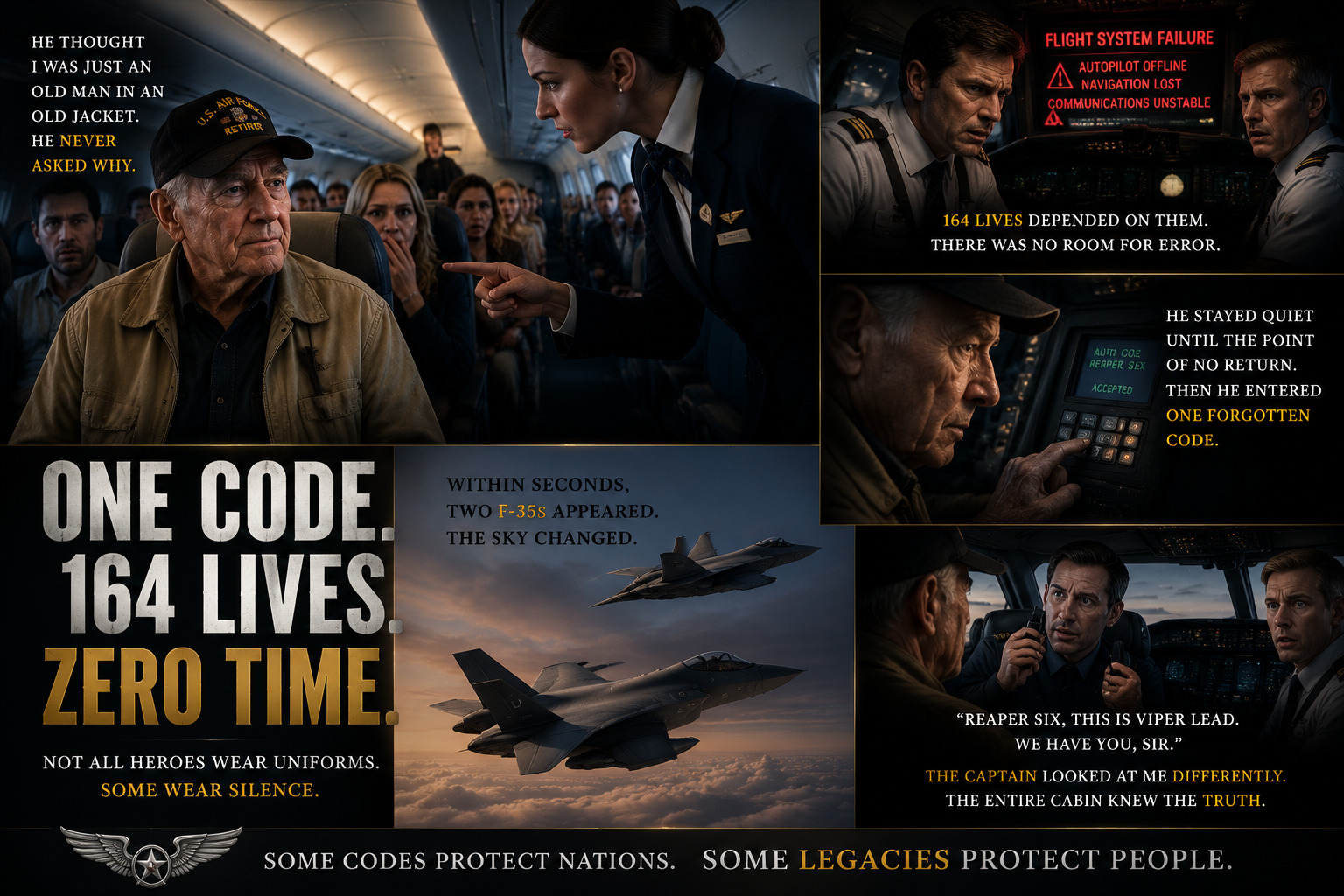
“Take your hand off that door, sir.”
The command cut through the first-class cabin before the turbulence did.
Every face turned toward the old man standing beneath the glowing seat-belt sign.
Nolan Mercer, AeroWest’s senior flight attendant, had wrapped one hand around the man’s thin forearm. His fingers pressed deeply into the cracked leather sleeve of a flight jacket that looked older than half the aircraft’s passengers.
The old man did not resist.
At eighty-three, Elias Rourke had learned that resistance usually made frightened people squeeze harder.
His silver hair had been trimmed close around the ears. A pale scar disappeared beneath the left side of his jaw, and one of his knees remained slightly bent, as though he were forever balancing on a deck no one else could feel.
He looked past Nolan toward the reinforced cockpit door.
“Your flight deck is filling with smoke.”
Nolan’s grip tightened.
“You have been told twice to return to your seat.”
“I heard you.”
“Then why are you still standing?”
Elias lifted his chin toward the ceiling.
The air-conditioning system exhaled another thin breath.
Beneath the scent of coffee, perfume, reheated chicken and anxious sweat, something metallic lingered in the cabin. It smelled like hot copper and burned dust.
The odor was faint.
To Elias, it was unmistakable.
“Because that isn’t galley smoke.”
A businessman in 2A lowered his newspaper. Across the aisle, a woman pulled one earbud free.
Nolan glanced around and noticed the attention gathering.
Public attention had always sharpened him. His shoulders squared. His navy uniform was immaculate, his tie perfectly centered, his silver wings polished so brightly they reflected the overhead lights.
“Sir, I will not warn you again.”
Elias’s eyes moved to Nolan’s nameplate.
“Nolan, your captain has reduced power twice in four minutes. The left pack stopped cycling. We’ve been drifting three degrees south since the last turn.”
Nolan stared at him.
The old man continued in the same maddeningly quiet voice.
“And somebody switched the cockpit speakers off.”
For half a second, uncertainty crossed Nolan’s face.
Then it hardened into anger.
“You’ve been watching too many movies.”
A few passengers laughed.
Not cruelly. Nervously.
Elias looked at the businessman, then at the college student holding up her phone, then at the little boy in 3F who had been staring at his jacket since Denver.
The boy’s mother pulled him closer.
Nolan leaned toward Elias.
“A leather jacket does not make you a pilot.”
“No.”
“Being old enough to remember propellers does not make you a pilot.”
“No.”
“And wandering toward a secure cockpit at thirty thousand feet makes you a threat.”
That sentence changed the cabin.
The nervous laughter died.
The college student kept recording.
Elias lowered his eyes to Nolan’s hand, still locked around his arm.
“Then treat me like one.”
Nolan blinked.
“But open that door first.”
The aircraft dropped.
Not the soft sinking sensation of ordinary turbulence.
It fell.
Coffee lifted out of cups. An overhead compartment burst open. A laptop struck the ceiling before slamming into the aisle.
Passengers screamed as AeroWest Flight 271 rolled hard to the left.
Nolan lost his footing.
Elias caught him.
The old man’s hand closed around Nolan’s elbow with startling strength. He planted one shoe against the base of a seat and held both of them upright while the cabin tilted around them.
For three seconds, the aircraft seemed to hang on one wing.
Then it lurched level.
Oxygen masks did not fall.
The engines continued running.
But the lights above the cockpit door flickered once, twice, and died.
A chime sounded from the galley.
One tone.
Then another.
Then a continuous electronic alarm that no passenger was supposed to hear.
Nolan tore his arm free.
His face had lost its color.
From behind the cockpit door came three dull impacts.
Someone was hitting it from the other side.
Nolan pushed past Elias and reached the access panel.
“Captain Hale?”
No response.
He entered the emergency code.
The red light flashed.
Denied.
“Captain Hale, this is Nolan. Respond.”
The smell of burned wiring thickened.
Something hissed beyond the door.
The little boy in 3F began to cry.
Nolan entered the code again.
This time, the green light appeared.
The cockpit door opened six inches.
Gray smoke rolled into the cabin.
Nolan froze.
Elias did not.
He pulled the door wide.
Inside, Captain Marcus Hale hung motionless against his shoulder harness.
The first officer was still conscious.
She had blood running from one nostril, an oxygen mask hanging crookedly across her face and both hands locked around the control column.
Her eyes found Elias through the smoke.
“Help me,” she gasped.
Nolan stepped into the doorway and spread his arms.
“No passengers in the cockpit.”
The aircraft rolled left again.
The first officer’s voice rose behind him.
“I said help me!”
Elias looked directly into Nolan’s eyes.
“You have six seconds to decide whether your rules exist to protect that cockpit or bury everyone behind it.”
Nolan did not move.
Five seconds.
Four.
Three.
Then the left wing dropped toward the mountains.
And Elias Rourke stopped asking permission.
Chapter Two
Procedure
Elias drove one shoulder into Nolan’s chest.
It was not a violent blow. It did not need to be.
Nolan staggered sideways, more shocked by the old man’s decision than by his strength.
Elias entered the cockpit and closed one hand around the back of the captain’s seat.
The instrument panel pulsed through smoke. Half the displays were black. Others flashed warnings in amber and red. The autopilot had disconnected, and the aircraft was banking through twenty degrees.
“Level the wings,” Elias said.
First Officer Lily Grant stared at him through watering eyes.
“I’m trying.”
“Don’t chase the display. Look at the standby horizon.”
“My left arm is numb.”
“Then use your right.”
Lily pulled.
The control column barely moved.
Elias looked at the trim indicator, engine instruments and hydraulic pressure gauges.
“Rudder.”
“What?”
“Right rudder. Two inches. Easy.”
She pressed the pedal.
The bank slowed.
“Hold it.”
He reached across Captain Hale and placed two fingers against the captain’s neck.
Pulse.
Weak, but steady.
Elias unlatched the captain’s harness.
“Nolan, I need him out.”
Nolan remained in the doorway.
Smoke crawled across the ceiling above him.
“You assaulted a crew member.”
Elias looked back.
“You can write the report after we land.”
“You are not touching those controls.”
Lily coughed into her mask.
“He already is.”
Nolan’s jaw tightened.
“This aircraft has one hundred fifty-eight passengers.”
“Plus six crew,” Elias said. “One hundred sixty-four people.”
“You don’t know this airplane.”
“I know what it’s doing.”
“That is not the same thing.”
“No. It’s more useful.”
Another warning tone sounded.
The left engine temperature climbed.
Lily’s gaze flicked toward it.
“Bleed-air leak.”
“Maybe,” Elias said. “Could be a damaged duct cooking the wiring loom. Could be an electrical fire feeding on oxygen. Either way, we isolate before we diagnose.”
He pointed toward the overhead panel.
“Left pack off.”
Lily reached for the switch but missed it.
Her fingers shook.
Elias guided her wrist.
“Here.”
She moved the switch.
The hiss above them changed pitch.
One of the dead displays flashed back to life.
Nolan stared at Elias’s hand.
It had trembled in the cabin.
It did not tremble now.
“Who are you?” Lily asked.
“Someone who needs the captain’s seat.”
Nolan stepped forward.
“No.”
Elias met his stare.
Behind Nolan, passengers were shouting. A baby wailed. A woman repeatedly asked whether they were crashing.
Nolan planted himself in the doorway.
His entire career had been built around preventing this exact image: an unauthorized person inside a locked cockpit, touching systems he had no legal right to touch.
Eight years earlier, during recurrent training, he had watched footage of a man forcing his way into a flight deck while passengers screamed behind him. Nolan had memorized every second. He had promised himself that confusion would never outrun him.
Long before that, his younger brother had died in a private aircraft outside Boise. The investigation blamed a pilot who had skipped a checklist because he had flown the same route hundreds of times.
Experience, Nolan had learned, was often the name reckless men gave their arrogance.
Now an old stranger in a costume was asking Nolan to trust him with 164 lives.
“No,” Nolan repeated.
Elias looked at the smoke building around Captain Hale’s shoulders.
“Then you sit here.”
Nolan’s lips parted.
“Take the captain’s seat,” Elias said. “Fly the airplane.”
“I’m cabin crew.”
“So act like it. Remove the injured captain, secure the cabin, find medical help and prepare for an emergency landing.”
Elias’s voice never rose.
That made it worse.
“Or keep standing in the doorway because you’re afraid someone might notice you don’t know what to do.”
The humiliation landed harder than a shout.
The college student’s phone was still pointed toward them from the first row.
Nolan saw it.
He saw the passengers watching.
He saw the old man waiting.
Then Captain Hale convulsed.
Lily cried out.
Nolan moved.
He released the captain’s harness while Elias gripped the man beneath the arms. Together they pulled him from the seat.
“Doctor!” Nolan shouted into the cabin. “I need a doctor now!”
A woman in 4C unfastened her belt before he finished speaking.
“My name is Maya Patel. Emergency medicine.”
She crawled forward as the aircraft shook.
Nolan and Maya dragged Captain Hale into the galley. A second flight attendant brought oxygen and the medical kit.
Elias lowered himself into the left seat.
The leather creaked beneath him.
His right knee protested as he adjusted the rudder pedals. The cockpit looked both familiar and foreign, decades of aeronautical evolution arranged in glowing rectangles and guarded switches.
He did not pretend the aircraft was one he had flown yesterday.
He did what pilots had done since canvas wings and open cockpits.
He identified what still worked.
Air speed.
Altitude.
Attitude.
Thrust.
Direction.
The aircraft was descending through 29,400 feet.
“Lily, can you hear me?”
“Yes.”
“Can you stay awake?”
“For a while.”
“That’s not an answer.”
She took a breath.
“Yes.”
“Good. Tell me what failed first.”
“Left pack warning. Then master caution. Smoke. Electrical bus transfer failed. Captain reached for his mask and the panel arced.”
“Autopilot?”
“Disconnected before the arc.”
“Radios?”
“Primary is dead. Number two was intermittent.”
“Transponder?”
She tapped the panel.
No response.
Elias looked through the windshield.
Clouds swallowed the world.
The aircraft was blind, silent and drifting south with no working transponder.
Somewhere below the cloud layer lay mountains, highways, towns and military airspace.
Somewhere beyond the static, air traffic controllers were watching AeroWest Flight 271 vanish from their screens.
Elias eased the wings level.
“Get the emergency checklist.”
Lily pulled the book free.
Behind them, Nolan reappeared in the doorway.
“The captain is breathing. Doctor says smoke inhalation and electrical burns.”
“Good.”
Nolan gripped the frame.
“Can you fly this aircraft?”
Elias studied the remaining displays.
“No.”
Nolan’s face went still.
Then Elias looked at him.
“But I can keep it alive long enough to learn.”
The cabin lights went dark.
Chapter Three
The Black Cockpit
Emergency lighting washed the cabin in dim red.
In row 18, a man began praying in Spanish. Two seats behind him, someone laughed uncontrollably until his wife slapped him.
Nolan moved through the aisle with a flashlight held between his teeth, checking seat belts and forcing overhead bins closed.
“Stay seated. Heads away from the aisle. Shoes on.”
“What’s happening?”
“Are the pilots dead?”
“Why is that old man in the cockpit?”
Nolan answered none of them.
He kept moving.
At row 23, a large man in a baseball cap grabbed his sleeve.
“My daughter is in the bathroom.”
Nolan pulled free.
“I’ll get her.”
“She’s nine.”
“I heard you.”
The aircraft shuddered.
Nolan reached the rear lavatory and pounded on the door.
“Open it!”
A small voice answered through sobs.
“It won’t!”
He forced the latch with a galley tool and caught the girl as she fell into him.
Her bare feet were wet from water sloshed across the floor.
Nolan lifted her, carried her to her father and fastened her belt himself.
For a moment, the man’s hand closed around Nolan’s wrist.
“Thank you.”
Nolan nodded once and moved on.
Procedure gave him somewhere to put his fear.
In the cockpit, Elias had found the backup radio alive beneath a blanket of static.
“AeroWest two-seven-one, Mayday, Mayday, Mayday.”
Only static replied.
He tried again.
“Any station, this is AeroWest two-seven-one. We have cockpit smoke, partial electrical failure, flight crew incapacitation. Position uncertain. Descending through two-eight thousand.”
The speaker crackled.
A voice appeared for half a second, then vanished.
Lily pressed one hand against her forehead.
“Denver Center should have us.”
“Not if the transponder died before the turn.”
“We were cleared north.”
“But the airplane went south.”
“How far?”
Elias checked the magnetic compass.
“Far enough.”
The heading indicator had frozen at 284 degrees, but the standby compass showed them drifting southwest.
Lily stared at it.
“That puts us near restricted airspace.”
“Yes.”
“Dugway?”
“Maybe.”
“There are military ranges out there.”
“I remember.”
She looked at him.
“You remember?”
“I once got yelled at by a colonel for putting a fighter twelve miles inside one.”
“How long ago?”
“Before you were born.”
“That doesn’t narrow it down.”
Despite the smoke, despite the blood beneath her nose, Lily gave a small laugh.
It lasted only a second.
Then the left engine surged.
The aircraft yawed sharply.
Elias caught it with rudder and reduced thrust.
“Engine rollback,” Lily said.
“Not yet. It’s hunting.”
“Could be bleed damage.”
“Could be five things. We’ll deal with the one trying to kill us first.”
He balanced the thrust levers until the vibration softened.
His breathing remained slow, but pain had begun moving through his right knee and into his hip. He had not spent more than two hours in a cockpit since his seventieth birthday. His last medical certificate had expired years ago.
He could feel his age everywhere except his hands.
Lily looked at the leather sleeve beside her.
A rectangular patch had once been sewn near the shoulder. Only darker stitching remained.
“You were military.”
Elias did not answer.
“What did you fly?”
“Things with fewer seats.”
“Air Force?”
“Once.”
“You have a name?”
“Elias Rourke.”
Her eyes narrowed.
The name touched something in her memory, then slipped away.
“Rank?”
“Not relevant.”
“It becomes relevant when an eighty-three-year-old breaks into my cockpit.”
“I didn’t break in.”
“Nolan may disagree.”
“Nolan disagrees professionally.”
Lily coughed again.
Her eyelids fluttered.
Elias reached over and tightened her oxygen mask.
“Stay with me.”
“I’m trying.”
“Don’t try. Pick something.”
“What?”
“Something you refuse to die before doing.”
She looked at him as if the question offended her.
Then her expression changed.
“My sister gets married Saturday.”
“Are you in the wedding?”
“Maid of honor.”
“Dress ugly?”
“Violently.”
“Then you can’t die. She’ll make someone else wear it.”
Lily laughed, then winced.
Her eyes cleared.
Elias pointed at the checklist.
“Read.”
Behind them, Nolan entered.
“Cabin secured. One passenger has a possible broken wrist. Two panic attacks. No major injuries.”
“Good work.”
Nolan did not acknowledge the praise.
“Doctor Patel wants to know how long until we land.”
“Tell her gravity is making excellent progress.”
“I need a real answer.”
“So do I.”
Nolan looked at the dead screens.
“You said you could keep it alive.”
“I am.”
“You also said you can’t fly this airplane.”
“I said I could learn.”
Nolan’s voice dropped.
“This is not a classroom.”
“No. Classrooms are less forgiving.”
The radio cracked again.
This time, the voice was stronger.
“Unknown aircraft, heading southwest at flight level two-seven-zero, this is United States Air Force aircraft on guard. If you hear this transmission, acknowledge immediately.”
Nolan’s eyes widened.
Lily turned toward Elias.
A second voice followed, colder than the first.
“Unknown aircraft, you are approaching restricted military airspace. Alter course north immediately or you may be intercepted.”
Elias keyed the microphone.
“Air Force aircraft, AeroWest two-seven-one. Mayday. We are unable to maintain assigned course. Partial flight-control and electrical failure.”
Silence.
Then:
“AeroWest two-seven-one, your transponder is not responding. State number of souls aboard.”
Elias looked at Nolan.
“One hundred sixty-four.”
“State status of flight crew.”
Elias pressed the transmit switch.
“Captain incapacitated. First officer injured.”
A pause.
“Who is flying the aircraft?”
Nolan stared at the old man.
Elias released the switch without answering.
Far beyond the clouds, two armed F-35s turned toward them.
Chapter Four
An Unauthorized Pilot
The F-35s appeared first as shadows.
Two dark shapes materialized inside the cloud layer, moving faster than anything that large seemed capable of moving.
Then one slid alongside the airliner’s left wing.
Its gray fuselage was sharp and clean, built from angles that seemed to cut the sky instead of passing through it. Condensation curled over its wings before vanishing.
The fighter pilot looked across the gap between the aircraft.
Elias saw the silver helmet turn toward him.
Nolan saw it too.
“Why are they armed?”
“They’re always armed when it matters.”
“Are they here to help us?”
“They’re here to determine what we are.”
The radio came alive.
“AeroWest two-seven-one, this is Talon One. We have you visual. Your left engine nacelle shows heat discoloration. No visible flame. You are trailing intermittent smoke from the forward fuselage.”
Elias keyed the microphone.
“Talon One, understood.”
“Confirm identity of person at the controls.”
Elias looked straight ahead.
“Retired pilot assisting the crew.”
“State name and qualifications.”
Nolan folded his arms.
“Yes,” he said. “State them.”
Elias ignored him.
“Talon One, we have limited electrical power and degraded hydraulic pressure. Request vectors to the nearest runway capable of handling a damaged seven-three-seven.”
“Negative. State identity first.”
Lily whispered, “They think we’ve been hijacked.”
“They should.”
Nolan stepped closer.
“Tell them who you are.”
Elias looked at him.
“That mattered to you ten minutes ago.”
“It matters differently now.”
“No. You just have a larger audience.”
Nolan’s face tightened.
“What do you want from me?”
“Your job.”
“I am doing my job.”
“Then stop needing me to be important before you listen.”
The words struck cleanly.
Nolan looked away.
Elias returned to the radio.
“Talon One, my name is Elias Rourke. United States Air Force, retired. Former command and test evaluation pilot. Civilian type ratings are expired.”
The fighter pilot did not respond immediately.
When the voice returned, its professional distance had sharpened.
“Colonel Rourke, can you provide service number or authentication?”
“Not over an open frequency.”
“We need proof.”
“You have a crippled airliner crossing military airspace. Proof can wait until the wheels stop.”
“Sir, we require confirmation that the flight deck is secure.”
Elias glanced at Lily.
“First Officer Grant, is the flight deck secure?”
Lily pressed the transmit button.
“This is First Officer Lily Grant. The cockpit is secure. Captain is incapacitated. Colonel Rourke is assisting under my authority.”
Nolan opened his mouth.
Lily’s eyes moved toward him.
“Sit down or get out.”
Nolan said nothing.
The second F-35 moved to the airliner’s right side.
Talon One spoke again.
“Understood. Hill Air Force Base is approximately ninety miles west-southwest. Runway available. Emergency equipment is being deployed.”
Lily unfolded the approach chart.
“Ninety miles.”
“We need lower altitude,” Elias said.
“The left engine may not survive the descent.”
“It doesn’t have to survive. It has to remain polite.”
Nolan stared through the windshield at the fighter jet.
“What can I do?”
Elias pointed behind him.
“Find the strongest passenger who can follow instructions.”
“For what?”
“We may need manual gear extension.”
“I can do that.”
“You have a cabin to prepare.”
“I know the cabin.”
“Then prepare it.”
Nolan did not move.
Elias looked at him.
“You want control because control feels like safety. Right now, safety is accepting that you don’t have it.”
Nolan’s throat tightened.
“My brother died because a pilot ignored procedure.”
Lily looked over.
Nolan continued, his voice low enough that only those in the cockpit could hear.
“Small plane. Mechanical warning before takeoff. The pilot said he knew the aircraft better than the checklist. They found my brother’s watch in a field three days later.”
The anger in his face no longer looked arrogant.
It looked seventeen years old.
Elias watched him for a moment.
“Then you learned the wrong lesson.”
Nolan flinched.
“The checklist wasn’t wrong,” Elias said. “The man was. Procedure is a tool. Fear turns it into a weapon.”
Nolan’s fingers closed around the cockpit frame.
“And what happens when you’re wrong?”
Elias looked at the mountains beginning to emerge beneath the clouds.
“Then I die knowing I was wrong.”
“That’s not good enough.”
“No.”
Elias’s eyes moved toward the dark cabin behind him.
“But it’s more honest than pretending there is a choice without risk.”
A warning illuminated on the panel.
HYDRAULIC SYSTEM A LOW PRESSURE.
Lily read it aloud.
Nolan turned toward the aisle.
“I’ll prepare the cabin.”
Before leaving, he looked at Elias’s jacket.
“What was your call sign?”
Elias’s expression closed.
“Not relevant.”
Nolan walked away.
Outside, Talon One banked closer.
The fighter pilot’s voice returned.
“Colonel Rourke, Hill command requests your former unit and call sign for authentication.”
Elias did not answer.
Lily studied him.
“Why don’t you want to tell them?”
His thumb rested on the transmit switch.
For the first time since entering the cockpit, his hand began to tremble.
Chapter Five
The Name Buried in the Jacket
Thirty-four years earlier, Elias Rourke had promised himself he would never use the name again.
It had belonged to a younger man.
A man with dark hair, perfect vision and the arrogance to believe that surviving danger meant he understood it.
On a winter night over northern Iraq, that younger man had led eleven damaged aircraft through an electronic blackout after a strike package lost navigation, radar support and contact with command.
The sky had been filled with anti-aircraft fire.
Fuel was disappearing.
One pilot had been blind from shrapnel.
Another had lost every instrument except a magnetic compass that swung wildly whenever he turned.
Elias had stayed above the formation with one engine failing and a hole through his left stabilizer. He had spoken to them one at a time.
Turn three degrees.
Hold your altitude.
Breathe.
Look at my exhaust.
Do not chase the fire beneath you.
Stay with my voice.
The last aircraft landed with seventy seconds of fuel remaining.
The classified report called it an extraordinary recovery of combat assets.
The pilots called it something else.
They said Rourke had hung himself in the black sky like a lantern and refused to go out until everyone was home.
The call sign followed him through two commands, three test programs and the remainder of his career.
After retirement, it appeared in textbooks, officer training lectures and stories that grew less accurate every year.
Elias hated those stories.
They removed the fear.
They removed the mechanic who had kept his damaged engine alive.
They removed the young weapons officer who bled to death twenty minutes after landing.
They removed Samuel Becker, the pilot Elias had ordered to remain in formation even after Becker’s aircraft began burning.
Samuel had obeyed.
Samuel had not made it home.
Heroes, Elias learned, were often created by editing out the dead.
His wife Ruth understood why he removed the patch from his jacket.
“Names don’t carry ghosts,” she once told him. “People do.”
She had been gone six years.
The jacket still smelled faintly of the cedar closet where she kept it.
“AeroWest two-seven-one,” Talon One said. “We require your call sign.”
Elias looked at the altimeter.
Twenty-two thousand feet.
Mountain peaks pierced the clouds ahead.
Lily’s breathing had grown shallow. Nolan was preparing 158 passengers for a landing none of them knew how to imagine.
The left engine surged again.
Elias pulled the thrust lever back.
The right F-35 drifted closer, its pilot watching.
“Talon One,” Elias said, “former Seventeenth Tactical Fighter Squadron.”
The radio remained silent.
Elias closed his eyes for half a heartbeat.
“Call sign Lantern.”
Static filled the cockpit.
Lily turned slowly toward him.
Nolan had returned to the doorway in time to hear it.
Outside the windshield, the F-35 on the left moved away.
For one terrible second, Elias thought the transmission had been lost.
Then the fighter rolled.
Not a combat maneuver.
Not an inspection turn.
A slow, deliberate wing rock.
The F-35 on the right answered with the same motion.
When Talon One spoke again, the voice was different.
The pilot sounded younger.
And shaken.
“Lantern, Talon One.”
The transmission stopped.
A breath came over the radio.
Then:
“Sir, the Seventeenth still carries your coin in the lead aircraft.”
Lily stared at Elias.
Talon One continued.
“Our emergency recovery doctrine begins with the Rourke sequence. Aviate. Build the picture. Bring everyone home.”
Elias’s mouth tightened.
“They should have changed the name.”
“No, sir.”
The fighter pilot’s voice cracked, then recovered.
“My squadron commander requests that I tell you the Seventeenth knows exactly who is flying that aircraft.”
Nolan stepped into the cockpit.
His face was pale.
“What did he mean?”
Elias said nothing.
Lily did.
“He means you tried to drag an Air Force legend away from the controls.”
The words passed into the cabin before Nolan could stop them.
A passenger near the front repeated them.
Then another.
Phones rose above the seats.
Nolan stood in full view of the people who had watched him call Elias confused, dangerous and old.
The college student in 1C lowered her phone just enough to look at him without the screen between them.
Nolan’s uniform suddenly seemed too tight.
His polished wings seemed small.
Talon One’s next transmission came through the cockpit speakers and the open door.
“Lantern, all Talon aircraft salute.”
Both F-35s rolled outward, wings flashing in the afternoon sun.
A sound moved through the cabin.
Not cheering.
Not yet.
Something softer.
A collective breath released after being held too long.
The little boy in 3F pressed his face against the window.
Elias did not look at the fighters.
He watched the hydraulic pressure continue to fall.
“Everyone finished?” he asked.
Lily blinked.
“Sir?”
“The airplane doesn’t care who I was.”
He pointed toward the panel.
“And unless we get the gear down, the runway won’t either.”
The right engine warning light illuminated.
Then its thrust dropped to idle.
Chapter Six
One Engine, No Applause
The aircraft yawed violently.
Passengers screamed as the right wing dipped.
Elias drove the left rudder pedal down and pulled the right thrust lever fully back.
“Right engine rollback,” Lily said.
“I see it.”
“Restart?”
“Not yet.”
“We need both engines.”
“We need one engine that works more than two that argue.”
The airliner continued descending.
Elias trimmed against the yaw, but the electric trim responded in uneven bursts.
Talon One moved beneath the right wing.
“Lantern, we see dark vapor from engine two.”
“Any flame?”
“Negative.”
“Keep watching.”
Nolan remained in the doorway.
The public humiliation was still burning through him, but the fear had changed shape. It was no longer fear of losing authority.
It was fear that his pride had already cost them time they did not have.
“What do you need?” he asked.
Elias pointed toward the cabin.
“Two able-bodied passengers. Not the loudest. The calmest.”
Nolan chose a construction foreman named Darius Webb and a ranch veterinarian named Claire Dawson. He brought them forward, secured the cockpit door behind them and led them to the manual gear mechanism beneath the cabin floor.
Lily read instructions over the interphone.
“Remove the access panel. You’ll see three red handles.”
Darius pulled the panel free.
“I see them.”
“Do not touch anything until instructed.”
Nolan crouched beside him.
The red emergency lighting cut deep shadows across his face.
“Ready.”
In the cockpit, Elias began the descent checklist.
The airspeed fluctuated.
The left engine temperature remained high.
Hill Air Force Base appeared on the remaining navigation display, then vanished as electrical power flickered.
Talon One took over.
“Lantern, turn right heading two-six-zero. Hill is forty-one miles, eleven o’clock.”
Elias turned carefully.
The aircraft responded with a slow, reluctant roll.
“Talon One, inspect landing gear when deployed.”
“Copy.”
Elias called Nolan.
“Release the main gear.”
Nolan nodded to Darius.
“First handle.”
Darius pulled.
A heavy mechanical thump traveled through the floor.
In the cockpit, the left main gear indicator turned green.
The right remained dark.
“Second handle,” Elias said.
Another thump.
The right indicator flickered, then glowed green.
“Nose gear.”
Darius pulled the third handle.
Nothing happened.
He tried again.
The handle stopped halfway.
“It’s jammed,” he said.
Nolan took hold of it.
“Together.”
They pulled.
The cable groaned beneath the floor.
Nolan’s injured hand reopened where a galley latch had cut it. Blood ran across his wrist and soaked into his white cuff.
He did not release the handle.
“Again,” he said.
Darius planted both feet.
Claire braced his shoulders.
The three of them pulled.
The handle dropped.
A violent bang shook the forward fuselage.
In the cockpit, the nose-gear light remained dark.
Lily closed her eyes.
“No indication.”
“Talon One,” Elias said, “visual check on nose gear.”
The F-35 descended beneath them.
For several seconds, the radio stayed silent.
Elias watched the altimeter unwind.
Ten thousand feet.
Nine thousand.
Talon One returned.
“Nose gear appears extended, but the assembly is not centered. Repeat, nose gear appears rotated approximately fifteen degrees.”
Lily looked at Elias.
“It could collapse.”
“Yes.”
“What do we do?”
“Land on the mains. Hold the nose up as long as possible.”
“With one engine and degraded hydraulics?”
“Yes.”
“You say that like it’s normal.”
“Normal is no longer participating.”
The mountains opened into a broad valley.
Sunlight struck the Great Salt Lake in the distance, turning it into a sheet of white fire.
Hill’s runway appeared ahead, long and narrow, surrounded by flashing emergency vehicles.
Lily stared at it.
“It looks small.”
“Runways always do when you need them.”
Nolan returned to the cockpit.
“Cabin is ready.”
Elias glanced at his bleeding hand.
“You?”
“I’m ready.”
“No, you’re not.”
Nolan swallowed.
“No.”
“Good. Fear belongs in the room. Just don’t give it a vote.”
Nolan looked at the runway.
“What should I tell them?”
“The truth.”
“Which part?”
“That the landing will be hard. That there may be fire. That they must leave everything behind.”
Nolan’s mouth tightened.
“And if the nose gear collapses?”
“Tell them to listen for your voice.”
Nolan nodded.
He started to turn away.
“Nolan.”
He looked back.
Elias held his gaze.
“When it happens, they will not remember your mistake in this cockpit.”
Nolan’s eyes reddened.
“They will remember whether you were useful afterward.”
Nolan returned to the cabin.
He picked up the interphone.
The passengers looked toward him.
Some with fear.
Some with anger.
Some with the open contempt of people who had just learned how badly he had misjudged the one man keeping them alive.
Nolan did not defend himself.
“My name is Nolan Mercer,” he said. “In several minutes, we will make an emergency landing at Hill Air Force Base.”
The cabin became silent.
“The nose landing gear may fail. When we stop, there may be smoke or fire. You will leave your bags. You will leave your phones. You will help the person beside you if they cannot move.”
He looked toward the little girl he had carried from the bathroom.
“You will listen to my voice.”
The aircraft shook.
Nolan tightened his grip on the interphone.
“And I owe every person aboard this aircraft an apology. I allowed certainty to become more important than judgment.”
The college student’s phone remained lowered.
“I was wrong about the man flying this plane.”
Nolan looked toward the cockpit.
“He was not confused. I was.”
No one spoke.
Nolan inhaled.
“Brace positions.”
One hundred fifty-eight passengers folded forward.
In the cockpit, Elias saw the runway lights align beneath the nose.
Talon One moved beside the left wing.
“Lantern, winds two-one-zero at eighteen, gusting twenty-six.”
“Of course they are.”
“Emergency crews are standing by.”
“Tell them to expect the nose.”
“Copy.”
The fighter pilot paused.
“Sir, it is an honor.”
Elias’s hand tightened around the control column.
“Save it until we stop.”
At five hundred feet, the left engine fire warning illuminated.
Chapter Seven
The Last Five Hundred Feet
Lily reached for the extinguisher handle.
Elias stopped her.
“No confirmed fire.”
“The warning says fire.”
“The wiring has been lying to us for forty minutes.”
Talon One’s voice cut through.
“Lantern, visible flame from engine one. Small but increasing.”
Lily’s hand closed around the fire handle.
“Now?”
“Not yet.”
“Why?”
“Because it’s also our only thrust.”
Four hundred feet.
The runway rose toward them.
Crosswind pushed the nose right. Elias corrected with rudder, but the response came late.
The control column vibrated beneath his hands.
Three hundred feet.
“Talon One, break away.”
The F-35s climbed.
For the first time since they appeared, AeroWest Flight 271 was alone.
Two hundred feet.
The fire warning bell rang continuously.
Lily looked at the flames reflected against the left side of the fuselage.
“We’re on fire.”
“I know.”
One hundred feet.
Elias reduced thrust.
The aircraft dropped faster than he wanted.
He added power.
The damaged engine hesitated, coughed and answered.
Fifty feet.
“Hold,” he whispered.
The runway filled the windshield.
“Hold.”
The left main gear struck first.
The impact slammed Elias against his harness.
The right gear hit an instant later.
The tires screamed.
Smoke erupted beneath the wings.
Elias held the nose high while the aircraft tore down the runway at more than one hundred forty miles per hour.
“Speed brakes!” Lily shouted.
“No hydraulic pressure.”
“Reverse thrust?”
“Right engine is dead.”
He pulled the left reverser.
The aircraft swerved.
He released it immediately and corrected with rudder.
The nose began to fall.
“Not yet.”
His arms shook.
The control column pushed forward with the weight of the damaged aircraft.
“Not yet.”
The airspeed passed ninety knots.
The nose gear touched.
For half a second, it held.
Then the wheel twisted sideways.
Metal exploded beneath the cockpit.
The nose collapsed.
The windshield filled with sparks.
Lily screamed as the aircraft dropped onto its forward fuselage and slid.
Elias’s head struck the seat.
The runway became a roaring tunnel of smoke and orange light.
He kept one hand on the control column and the other over the fuel switches.
The left engine fire spread along the nacelle.
“Cutoff!”
Lily pulled the fuel lever.
Elias discharged the extinguisher.
The aircraft spun five degrees, then ten.
Emergency vehicles raced alongside them.
The right wingtip scraped the pavement.
Inside the cabin, luggage burst from overhead compartments. Panels fell. A row of oxygen masks deployed and whipped through the smoke.
Nolan stayed strapped into his jump seat until the aircraft stopped moving.
The silence afterward lasted less than a second.
Then every alarm sounded at once.
“Release seat belts!” Nolan shouted. “Leave everything! Move!”
He opened the forward door.
Smoke rushed inward.
“Blocked!”
Fire was spreading along the left side.
He crossed to the opposite exit and armed the slide.
The door opened.
Daylight flooded the cabin.
“Come to me! Jump and slide!”
Passengers moved.
At first, too slowly.
Nolan climbed onto a seat and roared with a voice no training room had ever heard.
“MOVE!”
The spell broke.
People surged forward.
At row 12, an elderly woman froze.
Nolan fought upstream, reached her and unfastened her belt.
“I can’t,” she whispered.
“Yes, you can.”
“My legs.”
“Then use mine.”
He lifted her and carried her toward the exit.
Behind him, flames appeared outside the left windows.
The college student who had recorded the confrontation stopped to retrieve her phone.
Nolan kicked it down the aisle.
“Leave it!”
She jumped onto the slide.
Darius and Claire opened the overwing exits. Passengers climbed onto the wings and dropped into the arms of firefighters.
Doctor Patel remained with Captain Hale until two men helped carry him forward.
In the cockpit, Lily struggled with her harness.
The buckle had jammed.
“Elias.”
He turned.
Blood ran from his temple.
He pulled at the buckle.
It would not release.
Smoke entered through a crack in the side window.
The instrument panel sparked.
“Go,” Lily said.
“No.”
“You brought us down.”
“I haven’t brought everyone home.”
He found the emergency knife beside the seat and cut through the harness webbing.
The strap snapped.
Lily collapsed against him.
At eighty-three, Elias could no longer carry a grown woman.
He hooked her arm over his shoulder anyway.
They moved through the cockpit door together.
Nolan was waiting.
The cabin behind him was nearly empty.
He took Lily’s weight.
“Captain’s out,” Nolan said. “All passengers accounted for.”
“Crew?”
“Two still at the rear.”
“Get them.”
Nolan hesitated.
“Come with us.”
Elias looked toward the first row.
The little boy’s blue backpack remained beneath the seat. A plastic astronaut key chain hung from the zipper.
Something moved behind it.
A hand.
Elias dropped to one knee.
The boy from 3F had crawled beneath the seats during the evacuation.
His eyes were wide.
“I lost my mom.”
Elias reached for him.
The boy backed away.
“Listen to me,” Elias said.
The aircraft groaned.
Heat rolled through the cabin.
“What’s your name?”
“Caleb.”
“Caleb, your mother is outside waiting to be angry with you.”
The boy began crying.
“She said not to leave my seat.”
“Your mother was right earlier.”
Elias extended his hand.
“She is wrong now.”
The left windows shattered.
Fire entered the cabin.
Caleb grabbed his hand.
Elias pulled him free and lifted him against his chest.
His knee buckled.
Nolan caught both of them.
Together they staggered toward the exit.
Firefighters sprayed foam across the fuselage.
Nolan pushed Caleb onto the slide.
Elias followed.
The moment his shoes touched the runway, the left engine erupted.
A fireball rolled over the wing.
Firefighters dragged Elias and Nolan across the wet pavement.
For several seconds, Elias lay on his back beneath the Utah sky.
Sirens screamed around him.
Smoke climbed hundreds of feet above the burning aircraft.
Passengers stood behind emergency vehicles, wrapped in silver blankets.
One hundred sixty-four people.
Alive.
A shadow moved across Elias’s face.
Talon One and Talon Two passed overhead in perfect formation.
This time, Elias looked up.
Chapter Eight
When the Sky Remembered
The first military officer reached Elias before the ambulance did.
Brigadier General Andrew Keene crossed the runway without his cap, followed by security personnel, firefighters and a young major still wearing an F-35 flight suit.
Elias sat on the pavement with an oxygen mask hanging beneath his chin.
A medic pressed gauze against the cut on his forehead.
General Keene stopped three steps away.
For a moment, he simply stared.
Then he came to attention.
The salute was sharp enough to silence the people standing nearby.
“Colonel Rourke.”
Elias looked at the general’s stars.
“General.”
“Welcome back to Hill, sir.”
Elias returned the salute slowly.
“I would have preferred the terminal.”
The young F-35 pilot laughed before catching herself.
She removed her helmet. Sweat had flattened her dark hair against her forehead.
“Major Tessa Vance, Talon One.”
“You gave good vectors.”
“Your manual recommends them.”
“My manual?”
“The Rourke Recovery Sequence.”
Elias closed his eyes.
“They actually called it that?”
“Yes, sir.”
“That explains why nobody reads it.”
Tessa smiled.
Behind them, firefighters continued pouring foam over the aircraft.
Passengers were being counted for the third time.
Reporters had begun gathering beyond the base perimeter, though no civilian camera had yet reached the runway.
Nolan stood near an ambulance while a medic wrapped his bleeding hand.
His uniform was blackened with smoke. One sleeve had torn at the shoulder. The silver wings that he had polished that morning were gone.
A security officer approached him.
“Mr. Mercer, we need a statement regarding the cockpit access incident.”
Nolan nodded.
“I understand.”
The college student from first class stood nearby. Her phone had survived despite Nolan kicking it down the aisle.
She had already uploaded the opening confrontation.
The video showed Nolan gripping Elias’s arm.
It showed him mocking the old man’s age.
It showed him calling Elias a threat.
The final frame captured Elias pushing past him as the aircraft rolled.
The clip had been online for seven minutes.
It had already been viewed more than two million times.
The comments were merciless.
Nolan watched them appear on the student’s screen.
Fraud.
Coward.
Fire him.
Put him in prison.
He said nothing.
General Keene noticed him.
“Is that the flight attendant who attempted to remove you from the cockpit?”
The question carried across the tarmac.
Passengers turned.
Military personnel turned.
Nolan stood beneath every eye he had once tried to control.
“Yes, sir,” he said.
The general’s face hardened.
“Do you understand who this man is?”
Nolan looked at Elias.
“Yes.”
“No,” General Keene said. “I don’t believe you do.”
Elias removed the oxygen mask.
“General.”
Keene paused.
“He did his job badly for several minutes,” Elias said. “Then he did it well when the minutes mattered more.”
Nolan looked up.
Elias continued.
“He secured the cabin, extended the landing gear and evacuated every passenger. He went back into a burning aircraft.”
“He also delayed cockpit assistance.”
“Yes.”
“He publicly accused you of being a threat.”
“Yes.”
“He humiliated you.”
Elias glanced toward the scorched wreckage.
“Humiliation is not an aviation emergency.”
The general studied him.
Elias shifted his gaze to Nolan.
“You were wrong.”
Nolan’s eyes shone.
“I know.”
“You were not wrong because you followed procedure.”
Nolan waited.
“You were wrong because you stopped observing reality the moment it disagreed with your fear.”
The words hurt.
They were meant to.
Nolan accepted them without looking away.
“I’m sorry.”
Elias gave a small nod.
“Good.”
“Is that all?”
“No.”
Elias pushed himself to his feet despite the medic’s protest.
“Being sorry is private. Changing is evidence.”
Nolan looked down at his bandaged hand.
“I don’t know whether the airline will let me fly again.”
“You don’t fly.”
A faint smile moved through the nearby passengers.
For the first time, Nolan smiled too.
“No,” he said. “I suppose I don’t.”
Caleb broke through the line of medics and ran toward them.
His mother followed, calling his name.
The boy stopped in front of Elias.
“Were you really a fighter pilot?”
Elias looked at the child’s soot-streaked face.
“A long time ago.”
“Did you shoot down bad guys?”
“Sometimes.”
“How many?”
“Enough to understand that the number isn’t the important part.”
Caleb examined the worn leather jacket.
“Why did they call you Lantern?”
Elias looked toward the two F-35s taxiing in the distance.
“Because pilots are not very creative.”
Major Vance crouched beside Caleb.
“That isn’t why.”
Elias gave her a warning look.
She ignored it.
“His formation lost navigation during a combat mission. Colonel Rourke led them home.”
“How many?”
“Eleven aircraft.”
Caleb’s eyes widened.
“Did everyone live?”
The question emptied the air from Elias’s lungs.
He saw a burning aircraft over a black desert.
He heard Samuel Becker breathing over the radio.
Stay with my voice.
Stay with me.
Almost home.
Elias looked down at Caleb.
“No.”
The boy became quiet.
“Then why do they call you a hero?”
Elias glanced at the wreckage of AeroWest Flight 271.
“Because people need a word for someone who was scared and kept working.”
Caleb considered this.
Then he raised one hand in a crooked salute.
Elias corrected the angle of the boy’s wrist.
“Thumb along the seam.”
Caleb tried again.
Elias returned the salute.
Across the runway, phones captured the moment.
Within an hour, recordings of the radio transmission reached Air Force bases from Alaska to Florida.
Pilots gathered around screens in ready rooms.
Retired crew chiefs called old squadron friends.
Young officers who knew the Rourke Recovery Sequence only as lines in a textbook heard the actual voice behind it.
Lantern.
At the Pentagon, a colonel replayed the transmission three times before forwarding it to the Chief of Staff.
At Hill, someone placed Elias’s old squadron coin inside the cockpit of Talon One before its next mission.
AeroWest released a statement praising the emergency actions of its surviving crew and the retired military pilot who had assisted them.
Nolan Mercer requested that the statement include Elias’s warning about the smoke.
It did.
Three days later, investigators confirmed that a fractured bleed-air duct had overheated electrical wiring near the cockpit. The failure had disabled multiple systems and filled the flight deck with toxic fumes.
Elias had smelled it nearly nine minutes before the first official warning appeared.
Those nine minutes might have prevented the fire from becoming fatal.
Nolan read the report alone in a hospital corridor while waiting to visit Captain Hale.
He folded the pages carefully.
Then he enrolled in a new aviation safety program focused on decision-making under stress.
He kept the video of his humiliation.
Not as punishment.
As evidence.
Elias refused every television interview.
He refused the parade proposed by the governor.
He refused an Air Force ceremony until General Keene promised there would be no giant portrait, no dramatic music and no description of him as fearless.
“They’ll describe you as brave,” Keene said.
“That’s usually what people say when they don’t know the details.”
“What should we say?”
Elias thought about the smoke.
Lily’s injured hand.
Nolan pulling the gear cable until blood ran down his wrist.
The passengers helping strangers from the wings.
The firefighters running toward an aircraft everyone else was fleeing.
“Say there were 164 people aboard.”
“And?”
“They brought one another home.”
Six weeks after the accident, Elias returned to Hill.
He wore the same leather jacket.
The torn stitching remained where the call-sign patch had once been.
Inside the Seventeenth Squadron’s ready room, young pilots stood as he entered.
No one spoke.
On one wall hung a black-and-white photograph of Elias at thirty-five, helmet beneath his arm, eyes narrowed against desert sunlight.
Beneath it, someone had placed a new patch.
LANTERN.
Elias stared at it.
Major Vance stood beside him.
“We can remove it.”
He touched the edge of the patch.
For decades, the name had carried ghosts.
Now it carried other voices too.
Lily refusing to miss her sister’s wedding.
Nolan admitting he was wrong.
Caleb asking why heroes failed to save everyone.
Elias picked up the patch.
His hand trembled.
This time, he did not hide it.
“Do you have a needle?” he asked.
Major Vance smiled.
“Yes, sir.”
Outside, two F-35s launched into the evening sky.
Their engines shook the windows as they climbed through gold light and turned west.
Elias stood beneath the photograph of the man he had once been while a young crew chief sewed the call sign back onto his jacket.
A radio crackled somewhere in the operations room.
“Talon flight, cleared for departure.”
The fighters accelerated.
A second voice answered.
“Two’s with you.”
Elias closed his eyes.
For most of his life, people had believed a lantern was remembered because it shone brighter than the darkness around it.
They were wrong.
A lantern mattered because someone, somewhere, was still searching for the way home.